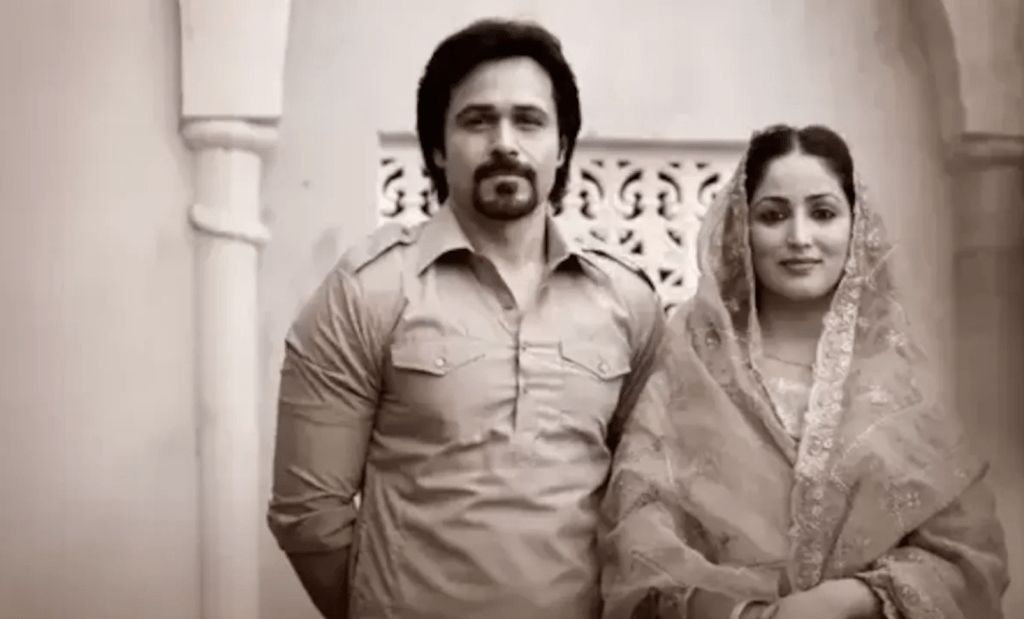
For the most part, Haq is not a story only about Muslim women. It is a story about women in general. Almost all of us know someone, married or unmarried, who has been cheated in love. We have seen that heartbreak up close, and we understand the emotional toll it takes.
When Shazia feels betrayed, we feel it too. When she wants the best for her children, that emotion feels familiar. When she fights for her rights, it resonates deeply. And when her father stands by her without hesitation, it reminds us of our own fathers and the quiet strength that support brings. These are emotions that are universal to women, cutting across religion, culture, and background.
The narrative becomes specifically about Muslim women only when the legal issues come into focus. That is where the real differences emerge, and the film clearly highlights how laws and systems can shape a woman’s fight for justice. It is to be noted that soon after the Triple Talaq ban was implemented in India, many Muslim women began approaching the courts to seek justice. While there was no open praise for the current government for such a ban, there was a quiet acceptance of the relief and protection the law offered them in real life. Many Muslim men, however, continue to view the ban as an insult to their faith rather than as a legal safeguard for women.
Getting back to the movie, Yami’s final monologue is powerful and leaves a strong impact. Emraan feels completely natural throughout and never once seems like he is performing. Sheeba Chaddha is equally convincing and brings depth to her role.
I especially want to credit Emraan for choosing to act in a film that openly talks about Muslim women’s rights. It takes conviction to support a story like this, especially as a Muslim, without dismissing it as Islamophobic. The film is clearly not that. Instead, it focuses on real issues and lived experiences, and his decision to back the narrative adds credibility and strength to the message being told.
Overall, I liked the film. The background music could have been better, and Yami is not fully convincing in a few scenes. Still, she more than makes up for it in the final act, which stays with you long after the film ends.
I watched Dhurandhar a few days back, and it has stayed with me ever since. It keeps running in my head – the songs, the action sequences, the passion for the country. The nationalist in me is satisfied.
For the first time in a long while, an Indian spy movie moved away from humanizing terrorism. That shift feels bold and necessary. The film forces you to sit with harsh truths instead of offering easy heroes and neat endings. It does not try to make violence look noble or harmless. That honesty is what makes Dhurandhar powerful, and also hard to shake off.
Personally, I felt a quiet mix of angst and sorrow when I saw some people brush the film off as propaganda or political. This view is subjective, but it still made me uneasy. The events shown are not opinions or theories. They happened. Calling a film like Dhurandhar propaganda does a disservice to the people who lost their lives in terrorist attacks. It dismisses real events that happened and real pain that was lived. These truths were not addressed openly for years, often out of fear or sheer convenience. When cinema finally creates space to tell these stories, the instinct should be to listen, not reject. The strong box office response shows that many people are ready to face uncomfortable realities. That response matters. Aditya Dhar deserves credit for choosing honesty over comfort. I have admired his films for consistently daring to tell stories most would rather avoid.
When the screen turned red, I could not hold back my tears. It made me emotional. But I also wondered if anyone watched that moment and felt nothing at all. That thought itself felt disturbing. Not feeling the pain of fellow Indians, or even a flicker of anger, says something deeper. In a country where apathy is already common, it is easy to believe some viewers saw it with blank eyes. For them, everything uncomfortable becomes propaganda, dismissed as an attempt to show Pakistan in a bad light.
Sometimes it feels like a lost cause to expect people to stand firmly with the country, without hesitation or filters. Many of us avoid the truth because it feels uncomfortable. We prefer to hide behind safe words like peace and love. But years of doing that came at a cost. We were taken for granted. Our suffering was questioned. Our stories were dismissed as lies or branded as conspiracy theories.
I think it is time for India to stand up for itself. We need to acknowledge our truth and stop looking away. Facing reality head-on is not hatred or extremism. It is honesty. Only when we accept what went wrong can we learn from it. Growth does not come from denial. It comes from clarity, courage, and accountability.
Now there are people who argue that this much truth does not belong on screen. If that were true, then why do we make social films like Homebound at all? Those films are also hard-hitting and deeply uncomfortable. Cinema has always helped bring difficult issues to the public in a more digestible way. Stopping that only pushes reality back into silence.
The violence in the movie is also being criticised, but real-world events prove how close such scenes are to the truth. The recent lynching of a Hindu man in Bangladesh is a grim reminder that brutality is not exaggerated fiction. Dhurandhar does not sugarcoat this reality, and that honesty is exactly why it matters.
Coming to the performances, while many are praising Akshaye Khanna, for me it was Ranveer Singh who truly stood out. His eyes did most of the talking, and it was brilliant to watch. There was a quiet intensity in his acting that stayed with me. Sara Arjun also impressed me with her performance and screen presence. She brought both grace and emotional weight to her role. The music deserves special mention too. It lingers in your mind and pulls you back into the world of Dhurandhar long after the film ends.
Overall, I would say Dhurandhar is a must-watch. It is not an easy film, but it is an important one. It stays with you long after the credits roll. I most probably would end up watching it again.
I started watching the Telugu film The Girlfriend with low expectations. I assumed it would be yet another romantic drama that glorifies toxic relationships and emotional manipulation in the name of love. To my surprise, the movie took a more thoughtful and layered route.
Minor spoilers ahead for context
The Girlfriend doesn’t just explore unhealthy love. It also dives into toxic parenting and how childhood conditioning shapes adult behaviour. The female lead is quiet, agreeable, and used to shrinking herself. The film makes it clear that her personality isn’t random. Her upbringing trained her to feel guilty for wanting space, choices, or independence. So when she picks a controlling partner, it feels strangely familiar to her. She’s not frightened of it at first, but she faces a tinge of uncertainty throughout. She tries to treat her partner’s behaviour towards her as normal because she has spent years adjusting to her father’s controlling behaviour. But deep down, there’s a quiet discomfort she can’t ignore. Something feels off, and her instincts begin to push back. This duality is what makes the character so different. This push and pull that many of us have experienced in our own relations with others who are not right for us.
The male lead, on the other hand, is aggressive, impulsive, and driven by ego. He worships Virat Kohli, maybe because he admires the cricketer’s aggressiveness and his devotion towards his wife, Anushka Sharma. He has a charming personality and enjoys a lot of attention. People around him like him, and he knows it. He’s used to getting what he wants, even in friendships. His behaviour reflects a narcissistic mindset where his needs come first, and empathy barely exists. Yet he remains popular, which feels very realistic. In real life, people like him often get the benefit of the doubt because their confidence and charm make them likable, even when behind closed doors, they’re not. This is why it’s often hard for someone with a narcissistic partner to justify leaving. People around them struggle to believe anything is wrong. The scene where he delivers that long, dramatic monologue in front of everyone when she ends the relationship is unforgettable and true to life. It’s an attempt to stage himself as the victim, even when he himself was the one in the relationship with the problematic dynamic.
When the movie shows the male lead’s mother, the pattern becomes clear. She mirrors the heroine’s personality. Anxious. Passive. Always accommodating. His father dominated the household, and his mother absorbed the behaviour without protest. In his partner, he doesn’t just see love. He sees a repetition of his family dynamic. In his own dysfunctional world, this is the definition of love.
This is what makes the film interesting. Many romantic movies in Indian cinema focus only on the lovers. But The Girlfriend highlights how family culture, parenting style, and generational trauma influence relationships. It reminds you that behaviour has context.
It made me think of my own past. My ex-husband had a similar attitude at home. I remember watching him take all his mother’s freshly washed clothes and throw them outside the house, onto the dirt-filled ground, just because she left them drying near the house’s entrance. She didn’t scold him. She didn’t even react. She simply smiled and picked them up to wash again. She later told me she was once abandoned on the roadside at night by her husband after an argument. She narrated it casually, as if it were normal. That’s when I understood why her son expected unquestioning loyalty and forgiveness from his own partner, me.
Watching the movie felt personal because it portrayed something many Indian families silently live with. Not abuse in the usual cinematic sense, but the subtle cycle of fear, guilt, silence, and acceptance.
I liked The Girlfriend mainly because of how honestly it handled the parenting angle. The performances were solid, especially from Rashmika Mandanna and Dheekshith Shetty. Their chemistry felt natural, and the relationship dynamics never felt exaggerated or forced. The emotional tension, confusion, fear, and hope all felt real. It’s rare to see an Indian movie explore love, trauma, and family influence with this level of subtlety. If you enjoy character-driven cinema with emotionally complex and layered characters, this one is worth watching.
The Girlfriend is streaming on Netflix and runs for 2 hours and 18 minutes.
I waited a while before watching Neeraj Ghaywan’s Homebound on Netflix. Even with glowing reviews and friends urging me to watch it, I knew it wouldn’t be an easy experience. It’s heavy in more ways than one, because the film doesn’t just explore caste discrimination, it also shines a light on the prejudice faced by Muslims in India. So from the beginning, you know you’re stepping into something intense and uncomfortable.
Neeraj Ghaywan holds an important place in Indian cinema as he’s one of the very few Dalit directors who publicly acknowledge his Dalit identity. As viewers, most of us don’t sit and think about a filmmaker’s caste or religion when watching a movie. But the uncomfortable truth is that opportunities in the film industry still seem to be uneven. If he is the first Dalit filmmaker in decades because of gatekeeping rather than lack of talent, then that says a lot about how deep systemic bias still runs in India, even in an artistic platform like the film industry. This is something the film industries across India need to acknowledge and work on.
As expected, the story in Homebound was heartwrenching. It’s based on a real incident, which sadly doesn’t come as a surprise. The film also draws inspiration from the Bhim-Meem idea, a political expression that promotes Dalit-Muslim unity, adding another layer of depth and context to its narrative.
For me, the most heartbreaking scene was when Ishaan’s character, a young Muslim boy, is accused of being Pakistani after an India vs Pakistan cricket match. That moment was infuriating and hard to sit through.
At the same time, I feel Indian films need to move beyond the usual “General Category vs Dalit” and “Hindu vs Muslim” framework when addressing oppression. Recent incidents, including the honour killing of a Dalit man by an OBC family because he dared to love their girl, show that reality is much more complex in India, and discrimination doesn’t come from one direction. It exists across castes and religions. Dalit Christians, Pasmanda Muslims, and many others face layered forms of exclusion, yet these conversations rarely enter mainstream media or pop culture.
I recently spoke to someone from the Yadav community who felt that Yadavs should be getting more opportunities than others in Bihar. It surprised me, because it shows how deeply caste identity shapes expectations, even among groups that aren’t “upper caste.” It’s even sadder to see communities that once faced discrimination now repeating the same mindset toward those they see as lower in the hierarchy. Many people assume caste hierarchy is a simple top-to-bottom structure, but in reality, it behaves more like overlapping layers of status, power, and regional identity.
I also think about the discrimination that exists within minority communities. My neighbour, a very liberal Muslim woman in Kerala, once told me that some of her extended family members won’t eat food cooked by non-Muslims. So who addresses that side of prejudice?
If we want a more equal and united India, we need to acknowledge and call out all forms of discrimination. But if someone tries to make a film exploring other angles, it often gets labelled propaganda or agenda-driven. That makes honest conversation difficult.
We’ve seen similar themes in films like Dhadak 2 this year, and even the first Dhadak explored the same kind of social divide. Something that stood out to me across movies in this space was the prominent placement of Ambedkar’s photograph. It’s a small detail, but it says a lot. Ambedkar himself is a layered and complex figure. His critique was not limited to Hinduism, and he questioned multiple belief systems with the same sharpness. But that side of him rarely enters public discussion, because even many of his admirers seem hesitant or defensive about acknowledging it.
Many of us are ready to recognise discrimination against Muslims and Dalits, and those conversations are important. But there should also be space to talk about other traumatic histories like the Kashmiri Pandit exodus without being dismissed or judged. Empathy and understanding shouldn’t stop at one group. If injustice matters, it should matter universally.
This isn’t a rant. Just a hope that our films, stories, and discussions grow braver and more layered. Because India isn’t simple. It’s diverse, complicated, emotional, and full of uncomfortable truths. And storytelling feels meaningful when it reflects that reality rather than just one slice of it.
I recently watched Nobody Wants This Season 2. If you haven’t seen Season 1 of this Netflix series, I really think you should. It deals with a topic that most interfaith love stories never touch — conversion. It’s a sensitive issue, especially among Abrahamic religions. So it felt quite bold that the makers decided to go into it at all.
Season 1 had already touched on the idea of conversion. But Season 2 takes it a little further. This time, you see the boyfriend, who is a Jewish rabbi, and his family, constantly pushing his Christian girlfriend, who seems more atheist or maybe agnostic, to convert. It adds a new layer to their story and makes the whole situation feel even more complicated.
However, this post is not a detailed review of the series, but the many thoughts that came to my mind while watching it, mainly concerning conversion and how it is seen in India.
There are many abroad who have a distorted idea of religious freedom in India, no thanks to misleading, half-baked news articles, often written by left-leaning Hindus or non-Hindus, and I wish to debunk those notions as well and present them from the perspective of a centre-right Hindu who was, till two years ago, a leftist.
Be prepared for a long post, because this is a topic I feel strongly about. If you’re short on time, you may want to save or bookmark it and read it when you’re free.
A Hindu’s View on Conversion
Before I begin, I want to make my religious beliefs clear. I’m not a religious Hindu in the traditional sense, but I’m still a staunch Hindu. If that sounds confusing, it’s only because Hinduism allows this kind of pluralism. You can be spiritual, non-religious, or even an atheist, and still remain Hindu.
The faith makes space for many ways of thinking, which is why someone like me fits comfortably within it. I’m not ostracized for eating beef, nor am I ostracized for not following religious beliefs properly. I can question and I can push back against religious rules I don’t believe in without repercussions.
This freedom that my belief generously allows me is exactly why I strongly stand by the community and call myself a “staunch Hindu.” I advocate for the rights of my community, which a religious Hindu in India may not always do, as they wish to appear secular and tolerant of even the injustices against us.
Now that my beliefs are out of the way, I want to say that even as a non-traditional, progressive Hindu feminist, I don’t support conversion. I don’t understand why anyone has to give up their identity for love, marriage, or even politics, no matter how much anyone would try to justify it.
Most Hindus in India feel the same way, which is why you rarely see the community protesting against anti-conversion laws in some states. Among ourselves, we often say the same thing quietly: “What’s the need to convert?” Of course, many reasons are given. I address them later in this post.
Then we see Indian-origin Hindu politicians in America converting to Christianity to stay relevant and gain acceptance, and it makes us pause. It makes us wonder, “Is America really the land of the free?” And on what basis do they judge India on religious matters when they themselves have not reached full religious secularism yet?
However, in Abrahamic religions, conversion is considered a matter of freedom of faith. This is acknowledged. But this is also a major reason for communal tensions in a Hindu-majority country like India. Most Hindus do not believe in conversion or proselytization, while Abrahamic faiths consider it a part of their practice.
Hindus are of the belief that everyone should be free to practice their faith without disturbing others or disrespecting anyone else’s faith. Proselytization goes against that idea. It feels disrespectful because it implies someone’s existing faith is not good enough. It involves putting down those beliefs, so they are convinced enough to join the new one. So, this “freedom of faith” often comes at the expense of disrespecting others, which was tolerated for the longest period of time, till the Hindu community got the strength to say “enough is enough.”
This pushback is the part that’s often presented to the world as a “lack of religious freedom” in India. Or, to put it more frankly, the lack of freedom to convert Hindus. This clash of beliefs has no solution, and I see it continuing even after a change of government. It’s a label the country has to live with, because there can be no middle ground when people feel their identity is being erased.
A thought I often hear is, “There are so many Christian-majority and Muslim-majority countries in the world. Why can’t they just leave us alone?” It reflects the frustration many Hindus feel when they see constant pressure to convert despite already being a global minority.
Pressure to Convert in Interfaith Marriages
The topic of conversion in marriages is prevalent in Indian Reddit circles. Almost every other day, you see someone saying, “My partner’s parents want me to convert. What should I do?”
From what I’ve seen, it’s usually the Hindu who is expected to convert. And often, the Hindu partner is unaware of what that really means. They hear lines like, “You just need to get baptized. After that, you can follow your own culture,” and they assume there’s no conversion involved. Many agree because they don’t realize the deeper implications. We walk into these situations thinking others are as pluralistic and flexible as we are, and that’s where the misunderstanding begins.
Conversion is also very normalized. When I ask my Christian friends if someone needs to convert to marry into their community, they casually say “yes,” as if it’s the most ordinary thing in the world.
We recently saw this when JD Vance openly and coolly said he hopes his wife, Usha Vance, a Hindu, converts someday. Ironically, the same line appears in Nobody Wants This Season 2 as well, where the Jewish rabbi says he hopes his Christian girlfriend converts one day.
For us Hindus, it’s a culture shock, almost regressive, because we never expect something like this from others. At the same time, Abrahamics and international news channels are confused when they report that there’s outrage in India over Vance’s statement. They have no idea why Hindus are angry. So they brand it as “far-right Hindutva.”
Why Do Hindus Dislike Conversion?
Most Hindus find the idea of conversion strange, because the religion itself accepts that God can appear in many forms. It is naturally pluralistic. So someone like me, who is not religious, or even someone who is an atheist, is still seen as a Hindu, because schools like Carvaka already accept that. We also tend to readily accept other gods because of this pluralism. We don’t consider them as fake. We don’t believe that ours is the “only true god” either.
This pluralistic mindset of Hindus is both a boon and a bane. A boon because we naturally accept all faiths, and a bane because we expect the same openness from others, and we don’t always receive it.
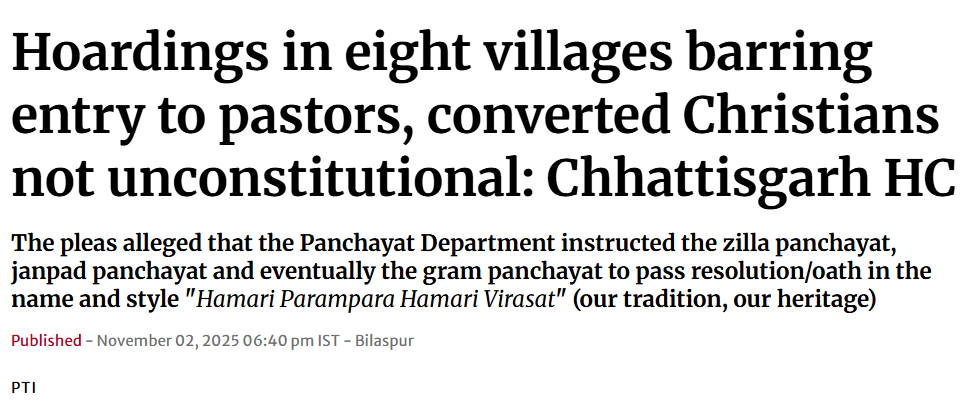
On top of that, many Hindus today focus more on careers and less on having children. So there is a natural tendency to protect the current Hindu population from inducements. The Chattisgarh High Court reiterated the same thing recently:
Chhattisgarh High Court Condemning Induced Conversions
With all this in mind, it’s natural that the majority of Hindus don’t look at conversion in a positive way. Our faith is already mocked by many Abrahamics around the world, who use words like “demon-worshipping pagans.” This makes it even more important to push back against that narrative and simply exist as we are.
Hindus, in short, want the freedom to be seen and respected in their own identity. But this way of thinking is often dismissed by, ironically, the very same people who speak loudly about secularism and freedom of religion. If others believe Hindus can be freely converted, then Hindus also have the right to openly object to it.
Ghar Wapsi
Now, some may argue that even Hindus encourage conversion in the form of Ghar Wapsi (reverting to Hinduism). However, Ghar wapsi is not a core part of Hinduism. It is more of a reaction to the aggressive conversions that have been happening in the country.
Most people I know converted to Abrahamic religions because of perks, not out of faith. They were poor and needed money. They were promised financial benefits if they converted. The fact that they are openly admitting this is nothing any faith should feel proud of. The only reason to convert to another faith should be faith itself. You should feel that the new faith and its principles are right for you, not be influenced by inducements or pressure.
If you ask why the Hindu side can’t match these perks, the answer is simple: we don’t have multiple Hindu-majority nations funding such activities. India is the only major Hindu-majority country, so the playing field is not equal.
Ghar Wapsi is simply an attempt, based on faith alone, to help those who genuinely want to return to Hinduism.
Arguments Used to Justify Conversions in India
1. Charity
There’s this belief that the money given during conversions is out of pure kindness. But I know many Christians who are struggling, working extra hours just to manage their basic needs. If the intention is genuine help, why not support them first?
And, most importantly, why should any help come with the condition of conversion?
Real help doesn’t demand a change of faith. If it does, you have to wonder whether it’s truly help or part of an agenda.
2. Caste Discrimination in Hinduism
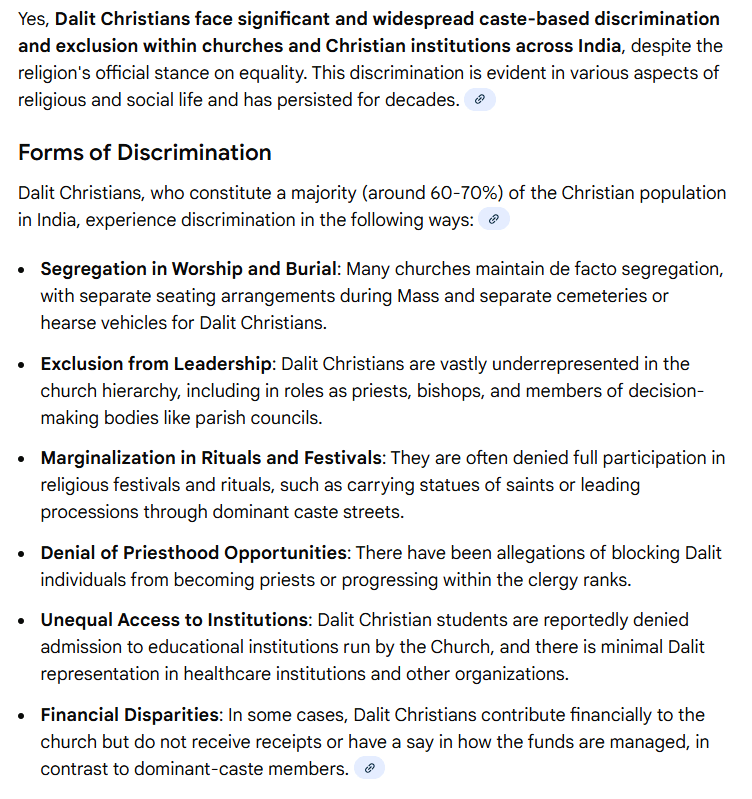
It’s also misleading to say that converted Christians escape discrimination to enter a better way of life after they leave Hinduism. Many are treated as “lower-level” Christians, and some have even gone back to Hinduism because of this.
Source: New Indian Express (July 2025)
Additionally, consider the points made below (took help from Google Search AI):
One person told me about a convert in her family who wants to return but cannot, because they signed a financial help agreement that now holds them back.
The good thing is that the caste system within Hindu society is slowly being dealt with. Families are becoming more open to inter-caste marriages, including in my own family. This change is happening faster in the South than in the North. It’s not perfect yet, but progress is real. In this situation, constantly blaming a community that is actively trying to fix the problem does not help.
Yes, many Hindus still support caste, and as long as they exist, the issue will continue. But this divide is also kept alive by leaders, both political and religious, because it benefits them. If caste truly disappears, many of these leaders lose their power to divide or convert Hindus, and that is why the system hasn’t faded away completely.
Instead of building bridges, the “narrative builders” choose to burn them by feeding divisive stories, which only pushes people of different castes further apart. Missionaries often highlight caste discrimination so aggressively because it helps them drive conversions. So you have to ask — are they really helping, or are they using the problem to serve their own goals?
4. Freedom of Faith
The tricky side of conversion in India is that Hindus openly say they are against it. But in Kerala, I often see Christian groups shift their stand based on who is converting and to which religion. They welcome anyone who joins their faith, but they loudly object when someone chooses to leave it.
Churches often use the term “love jihad” when a Christian woman converts to Islam for love. Yet the same groups talk about “freedom of faith” when a Hindu woman converts to Christianity for love.
Since both Abrahamic religions support proselytization as part of their belief system, you would expect them to be supportive of conversions into each other’s religion. But that rarely happens.
Complications of Conversion in Interfaith Relationships
Spoiler Ahead for Nobody Wants This Season 2
Click to reveal spoiler
Considering the many unwanted complications related to conversion, I was really hoping the female character in Nobody Wants This would take a stand. I wanted both partners to accept that two religions can live side by side without one needing to disappear. The ending didn’t go the way I hoped, but since there’s a Season 3 coming, I’m hoping they fix things and take the story in a better direction.
*Spoiler Ends*
In many interfaith relationships, I notice that the Hindu partner often gives in to the Abrahamic faith — if not through marriage, then through the children.
Take Usha Vance, for example. All three of her children were baptized because her husband couldn’t accept the kids growing up Hindu. That feels like a loss of her own identity. It shows that even an educated woman like her is not fully protected from this pressure.
If it were up to me, ideally, I would want the kids to grow up with both religions. But if we had to choose one religion for my “imaginary” children, I would fight hard to raise them in my own. Purely because Hinduism is naturally pluralistic, and it doesn’t invalidate any other faith. It would also matter to me because Hindus are a global minority, while the other religions face no existential crisis. It’s like the global majority religion being generous enough to make space for the growth of the minority.
Also, if I had to pick, I would choose a court marriage. But if the partner insists on a religious ceremony, then it would have to be a temple wedding. You don’t need to convert for that. You only need to respect the rituals. It’s simple, fair, and inclusive.
This is probably why I feel an interfaith marriage may not work for me. I believe in equality between religions, while an Abrahamic partner may not always see it the same way. There would be constant tension, and I am not the kind of Hindu who would compromise on my identity.
When I was younger, I probably would not have thought this way. Back then, love felt like everything. But growing older makes you see the bigger picture.
Pushback Against Conversions in India
More Hindus today realize that they don’t need to give up their beliefs for anything, which is why you see fewer people willing to convert.
Hindu Villagers in India Fighting Back Against Conversion
This awareness is slowly growing. I recently saw a post on Reddit where an Indian Christian said they felt sad that many Hindus in India are no longer open to conversion or to “the way of the Lord.” To me, this is actually a positive sign for the Hindu community. It shows that more people are choosing to stay firm in their identity.
And honestly, this should be true for every religion, because love and true secularism do not require anyone to change who they really are.
What surprises me more than the terror attacks in India is the speed with which some Indians dismiss them as “false flag operations.” For instance, a look at the comments under Faye D’Souza’s Instagram post about the Delhi terror blasts shows several users mocking the incident and blaming the Indian government instead of the perpetrators. Many genuinely seem to believe it’s a political ploy to influence votes rather than an act of terror.
The “false flag” narrative isn’t new. It has surfaced after nearly every major terror attack in India. Even the 26/11 Mumbai attacks were, at first, misrepresented by some as an internal operation. The claim gained attention mainly because Ajmal Kasab, one of the attackers, wore a saffron thread on his wrist. Those spreading the theory strangely assumed such a thread could only belong to members of BJP or RSS. They overlooked the possibility that it might have been deliberately used to mislead investigators.
Ajmal Kasab with Saffron Thread on His Wrist
Kasab’s real plan, as later revealed, was to die appearing as a “Hindu” and thus shift suspicion away from Pakistan-based handlers, reinforcing the myth of “saffron terror.” Thankfully, due to the extraordinary courage and sacrifice of Assistant Sub-Inspector Tukaram Omble, Kasab was captured alive and later confessed to being a Pakistani national trained by terrorists.
Tukaram Omble
By then, however, the false-flag theory had already gained widespread circulation. Well-known public figures even released a book titled 26/11: RSS ki Saazish? that promoted the “false flag” theory surrounding the attacks.
Influential Indian Figures Promoting “26/11: RSS ki Saazish?” Book
The “false flag” narrative resurfaced after the Pulwama terror attack, when a suicide bomber from Jaish-e-Mohammed (JeM) drove an explosive-laden vehicle into a CRPF convoy in Pulwama, Jammu & Kashmir, killing 40 soldiers. Following the attack, some voices in Pakistan, including senior officials, suggested that India might have staged the incident to influence the upcoming 2019 elections. Commentators in India echoed similar theories online, framing the tragedy as politically motivated rather than acknowledging it as an act of cross-border terrorism.
Then came the recent Pahalgam attacks, where Pakistani media outlets and online commentators claimed that India had staged the incident to divert attention from domestic issues and influence elections. They described it as part of an alleged “Indian playbook” of false-flag operations. Soon after, similar talking points appeared in sections of Indian social media and commentary spaces.
In each case, claims of “false flag operations” lacked credible evidence and were primarily rooted in conspiracy theories first circulated in Pakistan and later amplified by certain opinion groups in India.
The Global “False Flag” Obsession
It’s worrying that many people in India tend to believe external narratives about terror attacks rather than trusting verified investigations at home.
This pattern might have been up for serious debate if it only happened locally, but the deflection from religious extremism appears to be a global trend. To cite a few examples:
The 9/11 attacks are still viewed by some as a “false flag” orchestrated by the U.S. or Israel to malign Muslims. This is a theory long disproved but still used by extremist groups to recruit followers. They thrive on anger, convincing vulnerable minds that violence is the only response to perceived oppression. In India, extremist recruiters have similarly exploited stories like the Babri Masjid while dismissing events like the Godhra train burning as conspiracies, weaving grievance into a tool for radicalization.
The October 7 attacks in Israel were also met with widespread conspiracy claims, framed as a false flag operation meant to discredit certain groups.
Likewise, criticism of regimes such as Iran’s leadership, the Taliban, or Hamas is often dismissed as Western propaganda. This is another form of deflection that prevents honest introspection.
Conspiracies Shield Extremists
It’s time to move past the overused “false flag” narrative.
Each time a terror attack is dismissed as a conspiracy, it insults the victims, weakens trust, and blurs the line between truth and propaganda. These baseless claims don’t protect anyone. They only embolden extremists and deepen divisions.
Real courage and national unity will come from confronting facts, condemning violence without bias, and demanding accountability from those who spread hate, no matter where it comes from.
Ending the false flag obsession is the first step toward restoring integrity in how we respond to terrorism.







You must be logged in to post a comment.