
Left-leaning media in America often attack Donald Trump. They will scrutinise his policies, question his ideology, and discuss the dangers of his politics.
But when it comes to hate against Indians, specifically Indian Americans, the same urgency and enthusiasm seem to disappear.
This kind of hatred may not always be visible in everyday life in the Western world. Many Indians live perfectly ordinary lives abroad. But when racism does surface, there isn’t always a strong or sustained public pushback against it. There’s an eerie quietness, even among the liberals. A kind of “silent racism” going on.
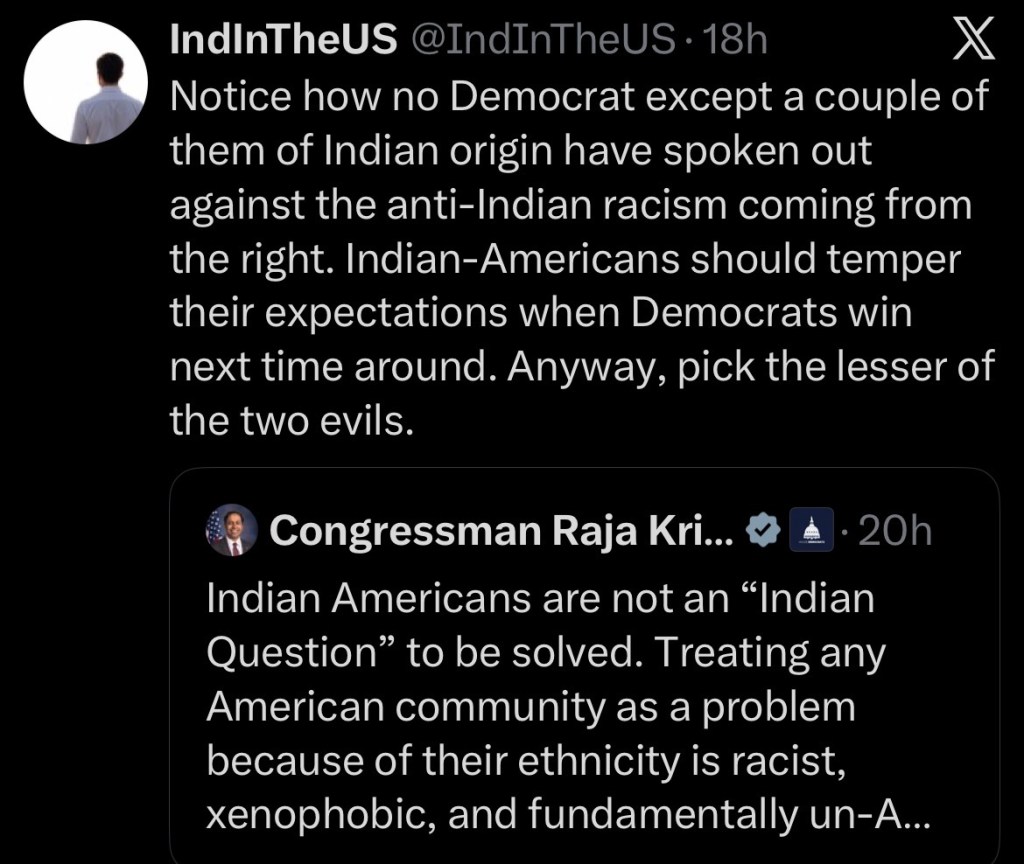
Which makes me wonder: do many people prefer to keep their racism and bigotry private?
Why Are We Suddenly Talking About “The Indian Question”?
The immediate reason for this post is Christopher Rufo’s podcast episode on YouTube titled The Indian Question. Rufo is a prominent conservative activist and political commentator in the US.
I watched the episode last night to understand why it attracted so much attention.
The title itself deserves scrutiny.
Historically, the phrase “The Jewish Question” was used in European debates to justify racism against Jews.
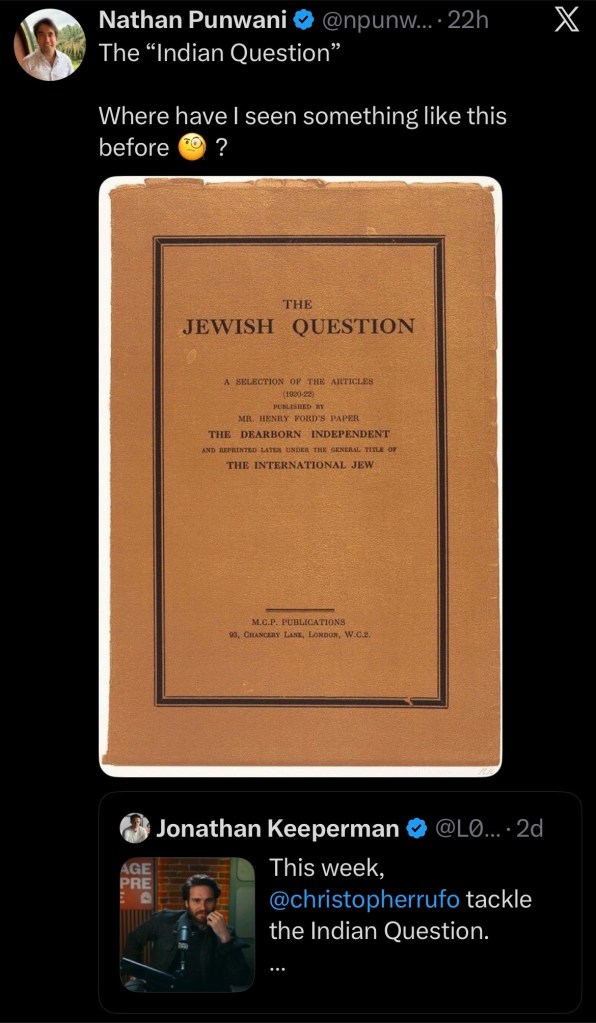
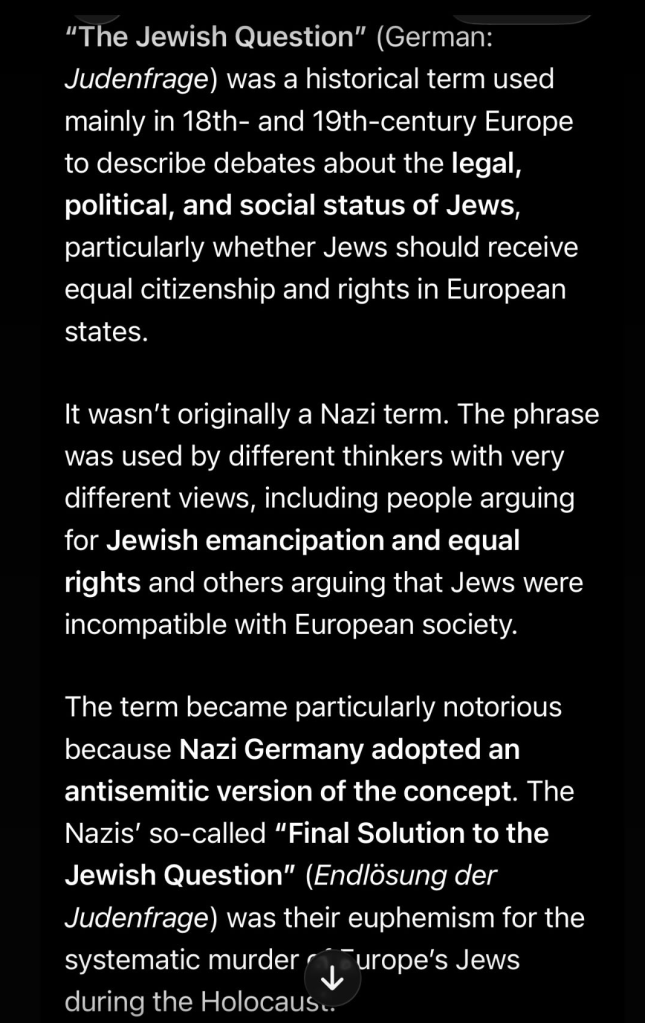
The concern with using “The Indian Question” is the framing. When an ethnic community is discussed as a question to be solved, rather than as people with individual rights, it becomes a problem.
Indian Americans are not a problem to be solved. They are people living, working, studying, raising families, and contributing to the country they call home. They are more loyal to America than India, from what I have observed.
The Indian population in the US is nowhere near a majority. Indian Americans make up roughly 1.5% of the US population. Why does the presence of Indians, particularly successful Indians, provoke such hate in American society, even if they are the minority?
Apparently, Indians Haven’t Assimilated Enough
One of the arguments discussed in the episode concerns a video of Indian students celebrating a football team’s success. This video attracted attention after being shared by Texas political figure Bo French.
The argument goes something like this:
The first person implies, “Indians are assimilating. Look at the students celebrating an American football victory.”
The other person counters, “Even these students might not be truly assimilated. Otherwise, why would anyone be discussing their participation in American culture?”
Think about that for a moment.
If Indians don’t participate in American traditions, they haven’t assimilated. If they do participate, the fact that their participation is being discussed apparently proves that they haven’t assimilated either.
What exactly is the winning answer here? The goalposts seem to shift depending on the argument.
And then comes another example: Indian children winning spelling bee competitions.
According to the argument, these children study day and night to win. Spelling bees, apparently, are supposed to be fun rather than competitive. The justification is that this emphasis on academic achievement somehow makes Indian children less American.
The other person laughs and nods along.
The broader argument seems to be that being American means being aggressive and expressive, like people at football matches, rather than studious and academically competitive.
So Indians are now supposed to prove their assimilation by being less successful? From now on, all Indian Americans should make a few adjustments.
- When you submit reports to your manager, make several mistakes.
- When your manager offers you a promotion, reject it.
- When your child is asked to spell “lovely”, teach them to say “l-u-v-l-y”.
That’s how you assimilate, apparently: by playing dumb.
The issue is that Indians are being judged by standards not applicable to anyone else. If participating in American culture doesn’t count as assimilation, and excelling academically counts against assimilation, what exactly are Indians expected to do?
The Problem With Trying Too Hard to Please Racists
As usual, the comment sections in the YouTube video provide another layer to this discussion.
I see a few Indian Americans saying things like, “As an Indian American, I agree.”
There is a difference between honest criticism and agreeing with racial generalisations simply to gain acceptance.
Many encourage or justify racism in the hope that racists will make an exception for them. If someone is being racist towards Indians, it needs to be called out. Don’t respond with self-hatred or an endless list of reasons why you are one of the “good Indians”. Because they will use that list of reasons against you as well. A few people behaving badly does not give anyone the authority to generalise an entire community.
Say it plainly: “You can criticise an individual without generalising the whole community.”
Racism doesn’t necessarily disappear because you have the right job, speak perfect English, support the right political party and religion, or distance yourself from your cultural background.
Racists simply don’t want you there. No amount of people-pleasing can guarantee they will change their minds.
When Hindu Culture Becomes the Convenient Explanation
Another thing that stood out to me was the way Indian culture was represented in the YouTube video.
When these commentators talk about Indian culture, the visuals often feature Hindu temples, Hindu festivals, and religious celebrations. They also bring up videos from India, including footage of a cow dung festival that many Indians themselves may never have heard of. An unfamiliar or unusual practice is presented as though it represents ordinary Indian life.
Why?
Because it helps create a particular impression of India and Indians. Once that impression is established, it becomes easier to argue that Indians are culturally incompatible with America.
Let’s be honest. India is enormous and extraordinarily diverse. There are hundreds of languages, different religious traditions, countless regional customs, and vast differences in everyday life.
One unusual festival, one viral video, or one person’s behaviour cannot explain an entire country.
But this is where the argument becomes convenient. If you want to dislike Indians, you can always find something to point at.
If a Hindu festival is loud, that’s evidence of cultural incompatibility.
If Indian students excel academically, that’s evidence that they haven’t assimilated.
If Indians participate in American traditions, that somehow isn’t enough either.
The examples change, but the conclusion remains the same.
Indians are the problem.
That is what makes this more than a debate about cultural differences. It starts looking like racism and bigotry dressed up as a discussion about assimilation.
Why Are So Many NRIs Afraid to Speak Up?
The saddest part of this conversation is the silence of some Indians living abroad.
I’ve heard people say things along the lines of, “Life is already hard. We just want to keep our heads down so we don’t get attacked by racists.”
I understand the fear.
If you live in another country, your job, visa status, family, financial security, and future may depend on your ability to maintain a stable life there. You may not want to become the target of online abuse or workplace hostility.
Not everyone has the luxury of speaking out. And nobody should be forced to put their safety or livelihood at risk to prove their courage.
But it is worth noticing the contrast.
Some Indians who hesitate to speak publicly about racism or other issues in the countries where they live will readily post about everything that is wrong with India. Of course, Indians in India do the same. Criticising one’s own country is perfectly legitimate.
If people can freely criticise India but feel that criticising racism in their adopted country is too risky, what does that tell us: that India has more freedom of speech?
When people stay silent because they fear the consequences, those spreading hatred may begin to assume that their views are acceptable.
The Selective Outrage of Indian Commentators
Then there is the response from certain commentators in India, particularly those who are strongly anti-Modi.
The moment an Indian pushes back against racist Americans, the moral policing begins.
“Don’t you see what’s happening in India? Concentrate on that.”
India has serious problems, and those problems deserve scrutiny. But why should one concern cancel out another?
Why can’t we discuss anti-Indian racism in America and discrimination in India in the same conversation?
Why does calling out racism against Indians suddenly become suspicious when the person speaking happens to be a Hindu, supports Modi, or disagrees with a particular political ideology?
Selective outrage is a real problem. Human rights should not become a team sport. Racism does not become acceptable because its victims belong to a political group you dislike.
I suspect another reason for this selective response is that some NRIs interpret anti-Indian racism in the US and other Western countries primarily as hostility towards right-wing Hindus, rather than as prejudice against Indians as a whole. That makes it easier to dismiss the problem.
But racist people don’t necessarily make those distinctions. They may target Indians because of their skin colour, name, accent, ethnicity, or perceived religion. And when Indian commentators themselves minimise the problem, racists can use those statements as convenient ammunition.
Are Indians Responsible for the Hate They Receive?
We are responsible for how we treat others, how we behave in public, and whether we challenge prejudice within our own communities. Indians are not above criticism, and being a minority abroad does not make every Indian automatically right.
But we are not responsible for someone else’s racism.
There is a difference between acknowledging that individuals can behave badly and accepting collective blame for an entire community.
And this brings me to Dinesh D’Souza.
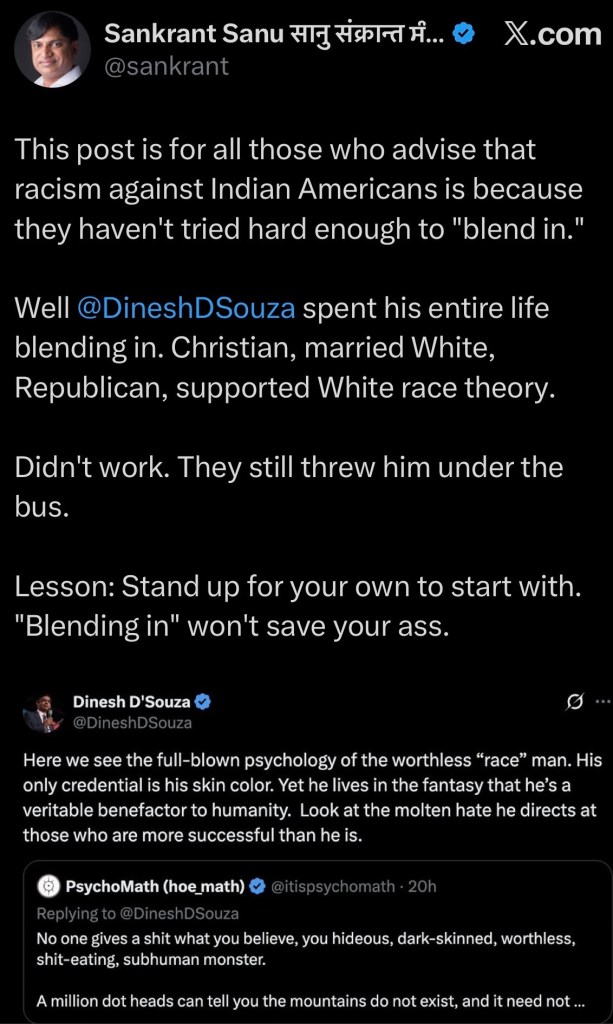
D’Souza is a Christian conservative commentator of Indian origin who has spent years aligning himself with American right-wing politics. Yet he has faced racial abuse, including the use of the term “Dot Head”, a derogatory reference to the bindi traditionally worn by Indians (mostly Hindu women).
Think about the contradiction.
If the objection were genuinely about Hinduism, his Christian identity should make a difference, and racists wouldn’t have attacked him the way they are doing now on social media. To someone determined to see an outsider, an Indian face is enough.
This is why I find the entire argument about assimilation flawed.
D’Souza has criticised many aspects of liberal politics and has aligned himself with conservative causes. Yet his ethnicity is still a target.
In a way, I feel sorry for him. Dinesh spent considerable energy on social media trying to establish himself as a true-blue American by hating aspects of Indian and Hindu culture. He, like many others, believed that assimilation was the reason for anti-Indian racism.
The Double Standard Around Indian Religious Festivals
I also refuse to accept the argument that loud Indian religious festivals abroad somehow justify racism against Indians.
That is simply another way of shifting the blame onto the people facing hate.
Let’s look at Keralam. The place I’m from.
In Keralam, Hindu and Christian festivals can involve loud music, drums, processions, and celebrations that continue for days. Yes, they can be overwhelming. Elderly people need sleep, children need rest, and people have work the next morning.
But most of us understand that a festival is a special occasion. People are celebrating something meaningful to them, and we generally make room for that.
Similarly, Ashoora processions in parts of India can involve crowds, chest-beating, chanting, and considerable noise. These are not quiet affairs either.
And we coexist with these celebrations, even when we don’t personally participate in them.
That is part of living in a diverse society. That’s religious freedom.
If Indian communities in the West obtain the necessary permissions for a religious festival and are still told to tone it down simply because other people find their culture uncomfortable, we should ask what kind of religious freedom means in practice in these developed countries.
Am I to assume India has more religious freedom?
Good Noise and Bad Noise
Honestly, a lot of this comes down to what I call “good noise” and “bad noise”.
I find the noise from the nearby football stadium absolutely intolerable during matches. Anyone living near a stadium will know what I mean.
Songs. Dancing. Drums. Trumpets. Screaming. The whole thing.
It can sound remarkably similar to a religious festival. But I’ve never posted a story complaining about it. Why?
Because I understand that, for someone who loves football or cricket, that noise is part of the excitement. The crowd is celebrating. People are having a good time. It is “good noise”.
But when the celebration belongs to a religion or culture that someone dislikes, suddenly it becomes “bad noise”.
The sound itself may not be all that different from a football or cricket match. What changes is the meaning people attach to it.
You don’t have to love the noise. You don’t have to attend the festival. You don’t even have to understand why people enjoy it.
But you should be able to tolerate other people having the freedom to celebrate their religion, within the same reasonable rules that apply to everyone else.
Otherwise, perhaps the problem isn’t really the noise.
The Latest US Immigration Restrictions Make This Even More Concerning
The debate about Indian Americans is not happening in isolation. It is unfolding alongside a broader political debate about immigration.
And the latest developments involving the US Permanent Labor Certification programme, commonly known as PERM, are concerning for Indian professionals.
On October 8, 2026, reports emerged that the Trump administration had suspended several major technology companies from participating in the PERM process. The affected firms include Indian IT companies such as Infosys, Tata Consultancy Services, Wipro, HCLTech, and Cognizant, alongside other companies. The action affects employers who use it to sponsor eligible foreign workers for employment-based green cards.
This is especially relevant when anti-Indian rhetoric is gaining visibility. When people are already portraying Indian workers as a threat, immigration restrictions can reinforce the feeling that their presence is unwelcome.
Note the use of “indentured servants” and the last couple of words by the Vice President of the US:
Vice President JD Vance breaks down the data:
“If you are working as an H-1B visa in the United States of America, you’re earning $20,000 less than an American citizen hired in the same position. If you were brought in by one of these foreign outsourcing firms, you’re making $48,000 less than an American citizen in a similar position. So I’m sure that everybody here understands the game that is being played. You bring in indentured servants from outside the country, you lay off American workers and, if you’re a corporation, you make a ton of money by under cutting the wages of American workers, replacing them with people who frankly shouldn’t be in the United States of America to begin with.”— Vice President JD Vance (@VP) October 8, 2026
Final Thoughts
I don’t believe every criticism is racist. But I do believe that this incessant anti-Indian racism should be called out.
I believe Indian Americans should be able to celebrate their festivals, raise academically ambitious children, build successful careers, practise their faith, and participate in American society without having their entire identity put on trial. This is not too much to ask – considering they make up only 1.5% of American society.
***
Featured Photo by RDNE Stock project





You must be logged in to post a comment.