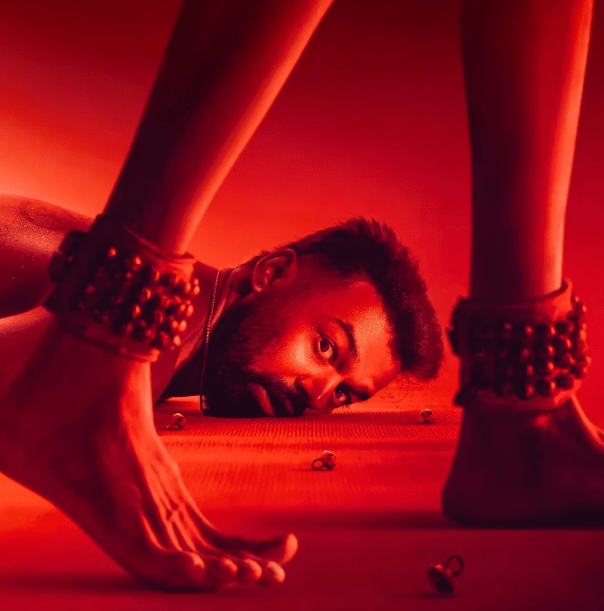
Like many, I found the movie’s name, Diés Iraé, tricky to pronounce. I’m quite sure I’m still saying it wrong. But the offbeat name adds to its charm. For those who don’t know, Diés Iraé is Latin for “Day of Wrath.” It’s a term from Christian theology referring to the day when souls are judged.
The first time I heard about Diés Iraé was when I went to watch Lokah. The trailer of the movie immediately captured my attention. The execution looked stylish, and Pranav Mohanlal looked good. I knew then that I had to watch this movie in a theatre.
What’s It About?
A young, wealthy man who lives life to the fullest begins experiencing strange supernatural events in his home after visiting the house of an ex-fling who was found dead in a well. The restless spirit haunting him seems furious for unknown reasons and determined to destroy his life.
Thoughts
Since Diés Iraé is a horror film, only adults were allowed inside the theatre. An ID card was required. The theatre I went to was almost empty, which I actually didn’t mind. It meant no one was around to make unwanted comments or jokes. This has become a real problem in many Kerala theatres. I faced this issue when I went to watch Bramayugam. I hope the film industry or theatre authorities take strict action against such behavior. If they want to attract more viewers, they must ensure a respectful environment. Otherwise, serious movie lovers will simply wait for the OTT release and enjoy the film peacefully at home.
Getting back to Diés Iraé, I wouldn’t call it mind-blowing. The special effects were impressive, though. Nothing looked fake or unintentionally funny. Pranav Mohanlal delivered a decent performance, and he looked great on screen, which helped balance out a few of his less convincing moments.
There are a few jump scares, so be prepared for that.
Overall, the story felt average. If you’ve seen a lot of horror films, this one might not surprise or scare you much. Still, the execution was solid, and the fact that a film of this scale and quality came from Kerala is definitely something to be proud of.
The creepiest part was seeing the line “inspired by true events.” I didn’t dare look up what those events were. Some things are better left unresearched if you want to sleep peacefully at night.
I would say Diés Iraé is a good one-time watch. At under two hours, it’s a quick and engaging film that keeps you entertained throughout.
I’m a divorcee. I have been for many years now. I’ve never hidden this fact. But I also never imagined my marriage would end the way it did. Then again, who does?
We all grow up believing our marriages will last forever. I also used to think of myself as a tolerant person, so the idea of my marriage failing felt impossible. In my mind, this is something that others might have to go through, the ones with anger issues, those who couldn’t compromise. Not me.
I followed every piece of advice perfectly. The kind you might have seen relationship gurus meting out on social media nowadays, i.e., communicate respectfully, try to understand the other person’s perspective, etc. But over time, I realized communication isn’t a one-way effort; it takes two people to make it work. If only one partner keeps trying while the other sits back, believing they have nothing to change, it slowly chips away at your happiness.
With time, after observing other marriages around me, I understood that maybe I wasn’t as tolerant as I thought — at least not by Indian standards.
Different Levels of Tolerance in Relationships
My regrets in relationships are less about the ex and more about how I handled things. “Why did I let others influence my decisions? Why did I tolerate and compromise more than required?“
Of course, every relationship requires compromises. But each partner also has their own tolerance limits. For me, physical or emotional abuse is unacceptable. Yet, even I, someone who might appear intolerant of everything, tolerated it for a while before deciding I’d had enough. Many women, however, make peace with such situations in their marriages (and relationships in general) for their own reasons (dependency, fear, children, financial pressures, and more).
To cite an example of varying levels of tolerance: When I kept hearing cries of domestic violence in my building, I complained to the building association, even though people advised me not to. “It’s their family, their rules.” But I couldn’t just sit there doing nothing while hearing those cries. It was traumatizing. I took this step because there were times, even in my own relationship, that I wished my neighbors had intervened. Probably, ring the doorbell or knock on the door. It would have provided that much-needed relief.
After my complaint, it hasn’t happened since. But who’s to say the guy didn’t just find quieter ways to hurt his wife? I would’ve run away if such things had happened to me repeatedly, even if it meant begging on the streets for the rest of my life. But his wife might be thinking, “It’s okay. He’s doing it all out of love.” Who’s to know? You can’t save someone who doesn’t want to be saved.
Different levels of tolerance.
People also need to understand that no one files for divorce after just one instance of mistreatment. It happens when the same behavior repeats, even after requests, pleas, and calm conversations. Some choose to walk away, while others make peace with the idea that this is how their life will be. So the common advice of “give it one more chance” is mostly useless, and a bit insensitive, because the ones involved might have already given it multiple chances before deciding to let go.
Power of Faith During Tough Times
Even though I’m not a religious Hindu, having faith in some form has always helped me through tough times. It’s the one thing to hold onto when it feels like your world is falling apart. Even now, I rarely visit temples or follow rituals properly, but in moments of extreme heaviness, I still pray. Not to any specific god. I believe we’re all praying to the same divine force, just using different names and stories. What else could explain miracles happening in every community?
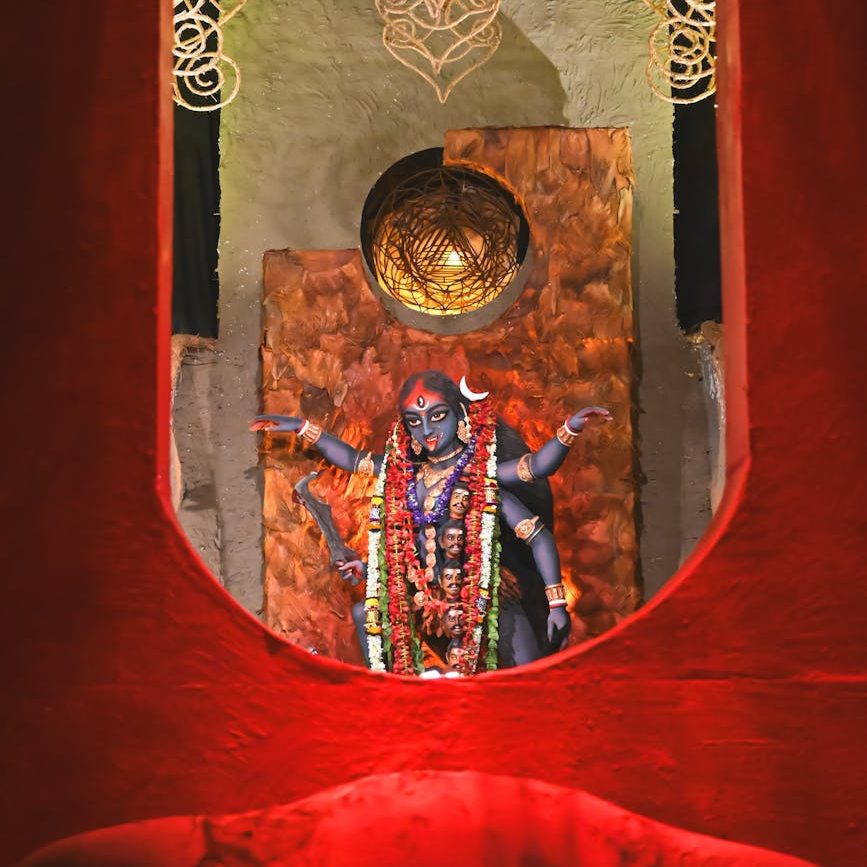
I remember, when I was married, our home had a lone idol of Goddess Kali, a deity I had rarely prayed to before. My parents usually had Lord Krishna at home. I still remember looking at the deity and crying. I asked if this was how it would be for the rest of my life – painful and broken on the inside, faking happiness on the outside (especially for social media).
I sometimes think I might have continued living that way if I hadn’t been pushed by some greater power to take a stand for myself. Probably it was Her. Must have been fed up with me always looking at Her, crying and whining. Even goddesses have their tolerance limits. Also, gods only help those who help themselves, right? Or as we Malayalees say, “Thaan paathi, dhaivam paathi” (you must put in your half of the effort, and God will take care of the rest). Maa Kali might have gone, “Bitch, why don’t you just leave the marriage, instead of troubling me all the bloody time?“
The day I walked out of my marriage was also the day I told my parents, “If you don’t help me, I’ll do it on my own.” Thankfully, they stood by me when I made that decision. I also had the confidence to stand on my own feet. I wasn’t employed then, but my freelance work brought in some income. I knew that if I left the marriage, I wouldn’t be a burden on anyone. That same freelance experience later helped me secure a job. It formed the bulk of my resume, and it convinced my employers that I could handle responsibilities independently, even while working from home, at a time when WFH wasn’t even common.
When I look back, I feel the universe was guiding me in small but meaningful ways toward a life that may be inadequate for someone else, but is absolutely correct for a homebody, introverted feminist like me.
Taking Marriage Advice from Society
But the point is, society will tell you not to take advice from a woman like me. Because I’m a divorcee. What would I know about marriage and relationships, right?
Yet it will encourage you to listen to the woman who keeps enduring it all, at the cost of her well-being, because that’s what a “good wife” does.
Society doesn’t really care about what a woman thinks or feels. It just wants you to stick to the rules.
As someone who’s chronically online and keeps up with news from all kinds of sources, mainstream, regional, left, and right, I’ve noticed something important: Christians in Kerala don’t really have a go-to political party anymore.
For a long time, people assumed the Indian National Congress (INC) was the party in Kerala that understood what every community wanted. But that idea seems to be changing fast on the ground.
Communal Conflicts in Kerala: Who Supports Whom?
If you’re new to Kerala politics, here’s a simple way to understand how parties respond to communal issues here:
Hindu vs Minority: CPM and Congress usually back the minority community.
Upper Caste Hindu vs Lower Caste Hindu: CPM and Congress generally side with the lower caste.
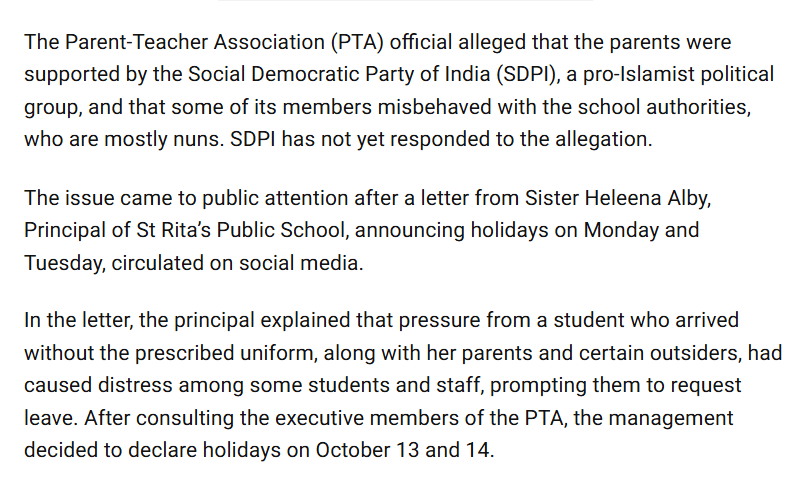
Christian vs Muslim: CPM and Congress often stay neutral at first, saying things like “we’ll look into it,” but in the end, they tend to side with Muslims. Examples include the Munambam Waqf issue, Professor Joseph’s case, Sona Eldhose’s conversion, and incidents involving SDPI bullying, such as the hijab case at the Christian-run St Rita’s school in Kochi (details in the image below).
News Source: “Hijab controversy forces school in Kochi to close temporarily after parents’ protest” (Mathrubhumi.com)
If you look at any case in Kerala, the pattern more or less stays the same. I’m not sure about regional politics in other states, but I suspect it’s similar elsewhere.
While BJP clearly positions itself as a Hindu party, there’s a growing sense in Kerala that Congress and CPM lean pro-Muslim. Why? It’s not really about religion. It’s about vote-bank politics. Christians are a minority among minorities in Kerala, so pandering to them doesn’t win many votes and can even cost support from other minority groups.
Growth of Chrisanghis in Kerala
Now, in Kerala, there’s a growing group called “Chrisanghis,” a term left-leaning voices like Arundhati Roy have used. These are Christians who support the BJP. Arundhati recently warned Christians in Kerala not to become Chrisanghis, citing conversion attacks in the North as a concern.
So why do some Christians support the BJP? It’s because they view Islamist groups like SDPI and Jamaat-e-Islami as a bigger threat than BJP. Many point to the persecution of Christians in countries like Nigeria by Islamist groups and feel that, compared to such threats, the BJP’s Hindutva agenda poses a lesser danger. At the same time, parties like Congress and CPM often downplay or ignore the activities of these Islamist groups in India, mostly for political gain, leading some Christians to see BJP as a safer option.
News Source: “Congress in a fix as Jamaat arm readies to back theocratic state” (NewIndianExpress.com)
Notably, Jamaat-e-Islami has frequently been in the news, even recently, for persecuting minorities in Pakistan and Bangladesh. In India, its branch presents a secular image, likely to gain acceptance and influence within mainstream politics, using it as a pathway to gain power.
It’s also true that Kerala’s two mainstream parties have largely ignored such concerns from the Christian community. Their typical response is often, “Don’t fall for RSS/BJP propaganda,” even when the issues have nothing to do with RSS or BJP.
Thoughts
So what can the Christian population in India do in this situation? On one side, there’s a pro-Hindu or “Hindutva” party that will never fully accept conversions under “freedom of religion,” and on the other, there are parties that haven’t supported Christians when they faced threats from Islamist groups.
From my perspective, Christians should keep all parties guessing about where their votes will go. They shouldn’t strongly back any party, since none fully meets their needs. Take the Munambam Waqf issue, for example: the removal of Section 40 in the Waqf Bill allowed the Kerala High Court to rule the Waqf claim over Munambam land as illegal, protecting Christian landowners. Congress leaders like Hibi Eden tried to persuade residents to drop their case, saying nothing would come of it, while the only BJP MP from Kerala, Suresh Gopi, stood by the people, largely comprising Christian fisherfolk, and supported the amendment that ensured their land rights.
When missionaries face attacks by far-right Hindus in the North, that’s when Opposition parties step in. But in cases like the Chhattisgarh nuns’ arrests over alleged conversions, the local Congress in Chhattisgarh hardly protested, as taking a stand would have cost them votes. On the other hand, in Kerala, protesting the arrest of the nuns would have earned them support, which is why several Opposition leaders from Kerala traveled to Chhattisgarh to show solidarity.
This shows that Christians can’t rely fully on any party and should strategically make their political influence felt.
This is how politics works: there are no fixed principles for political parties. They act based on the local political context. Christians in India should remember this and avoid fully backing or rejecting any party. Instead, they can use this knowledge strategically and wisely, since different parties support them in different situations.
Personal observation: In almost every war, there’s always someone who doesn’t want it to end.
In the India–Pakistan war, many in India didn’t want the fighting to stop because they felt Pakistan hadn’t learned its lesson yet. Some even wanted the government to reclaim PoK (Pakistan-occupied Kashmir) during this time (which I strongly oppose).
When Israel attacked Iran’s nuclear sites, many anti-regime Iranians wanted the war to continue because they hoped the regime would fall.
The Israel–Gaza conflict is even more unusual. Many who kept calling for a ceasefire suddenly went quiet or were openly against it when finally announced. Maybe they had expected Israel to be driven out and a new Palestinian state to rise “from the river to the sea.” But that idea is unrealistic and only calls for more violence. Just like India will never give up Kashmir, Israel will never give up its land. Both countries get a lot of criticism for putting their own interests first. But, over the years, Jews and Indians have learned an important lesson: if they want their interests protected, they can’t rely on anyone else. When Indians get murdered in America, there’s next to no backlash. It’s the same case with Jews. History is also proof that when Hindus face persecution or genocide (Kashmiri Pandits, Sandeshkhali, Bangladeshi, and Pakistani Hindus), the world stays silent. In a world shaped by selective activism, these two communities have gradually learned to shed their passivity and docile nature, standing up for themselves without guilt. Indians, in my view, are still learning. Our tendency to stay silent runs deep. But since 2014, that’s starting to change, much to the annoyance of some. Apparently, a “good” Indian is still largely expected to be a silent one in the face of persecution and bigotry.
Anyway, the point is that in any war, there’s always duality. Those who push for the conflict to continue aren’t always on the “far-right.” Sometimes, they are far-left or far-right figures from other communities, disguised as leftist liberals. Take, for example, the India-Pakistan war. Many leftists in India wanted it to end and for peace to prevail. Yet recently, some of those same voices wanted Hamas to reject the peace deal, even at the cost of many lives.
I’ve often felt that the far-left and far-right are just two sides of the same coin. The recent wars and reactions to them over the years only validate this claim.
The debate around Umar Khalid, Sharjeel Imam, and other Delhi riots accused who have not yet been granted bail has once again come into focus. From the right-wing perspective, the issue is not as simple as “judicial delay” or “denial of justice.” I thought of writing this post because many in India only trust left-wing channels, which causes them to miss important fact-based points shared by the right-wing.
Adjournments and CJI’s Remarks
First of all, let us understand what an adjournment is. Simply put, it is when a court hearing or trial is postponed to a later date instead of being completed on the scheduled day.
Out of the 14 adjournments in Umar Khalid’s case, 7 were initiated by his own legal team. This was mentioned by CJI D.Y. Chandrachud himself in his interview with Barkha Dutt.
Source: Lawbeat
“I do not want to comment on the merits of the case but I must tell you one thing which is lost sight by a lot of people when it comes to Umar Khalid‘s case, can you imagine that the case was adjourned, they were at least seven if not more adjournments which were sought by the council appearing for Umar Khalid and eventually the application for bail was withdrawn.” – CJI Chandrachud
Justice Chandrachud noted that, on social media, a one-sided narrative often takes hold, leaving judges with no space to defend themselves. He added that if one looks closely at the actual proceedings in court, the reality is far more nuanced than what is portrayed online.
While some “fact checkers” online have attempted to dismiss this claim by relying on surface-level sources, it is reasonable to trust the CJI more on this matter. As head of the judiciary, he had direct access to both official and indirect records of adjournments.
The Delay Tactic
According to many on the right, Khalid and Imam’s legal strategy is clear. If the trial begins, conviction is almost certain. Thus, their team is accused of deliberately delaying proceedings by filing fresh petitions, often citing a “change in circumstances.” The idea is to drag the trial as long as possible and eventually claim bail on the grounds of delay.
Notably, some petitions that caused delays were also filed by other accused who are already out on bail.
The Judicial Tactic Explained
The strategy seen here is not unique. It is a common tactic in the Indian judiciary:
Lawyers repeatedly file petitions (often citing new circumstances).
Each petition leads to adjournments, dragging the trial.
Eventually, the accused can argue that their right to a speedy trial (protected under Article 21 of the Constitution) has been violated.
On that ground, they can seek bail due to judicial delay.
This slow erosion of the process not only stalls justice but also erodes public trust in the judiciary. Something that many argue is part of the plan.
CJI on Unseen Angles
In an interview with Barkha Dutt, CJI Chandrachud hinted that there are angles in the case that cannot be revealed to the public. Right-wing commentators believe this may refer to multiple coordinated fronts behind the Delhi riots.
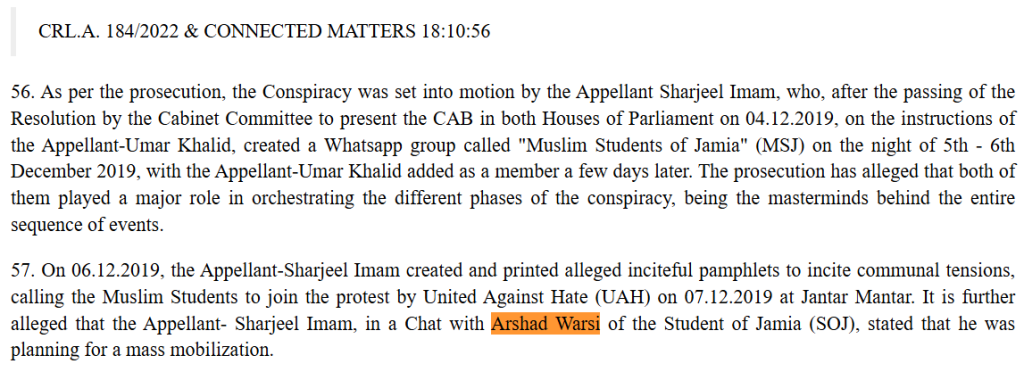
One example often cited is ISIS member Arshad Warsi (not the actor), who was in contact with Sharjeel Imam. Warsi allegedly helped decide the content of pamphlets that were distributed to mosques and Muslim neighbourhoods prior to the riots to incite violence. He was later arrested in the Pune ISIS module case.
Sharjeel Imam’s connection with Arshad Warsi. Source: indiankanoon.org/doc/156202283/Arshad Warsi arrested
There are also allegations of foreign funding and terror groups like PFI supporting the protests and unrest.
Umar Khalid met with other accused people in the PFI office to discuss funds for riots. Source: indiankanoon.org/doc/156202283/
The Seriousness of the Delhi Riots
The 2020 Delhi riots were not minor incidents of unrest. They claimed the lives of 53 people, including Intelligence Bureau officer Ankit Sharma. For many, this underscores the gravity of the case and why justice cannot be indefinitely postponed.
Right-Wing Response
Right-wing commentators like Abhijit Iyer-Mitra and Kushal Mehra have now openly criticized the delay of trials. They argue that instead of dragging the matter endlessly, the trial should begin as soon as possible, and justice should be delivered. In their view, it is time to see through legal manoeuvres and bring the culprits to justice. The longer the delay, the more the perception of judicial inefficiency grows, and that benefits only those seeking to evade accountability.
It is also important to understand that, though we can call for quick trials, courts in India are bound to follow established legal procedures. Every step, adjournments, evidence submission, witness examination, bail hearings, has to comply with the Code of Criminal Procedure (CrPC), the Evidence Act, and constitutional safeguards like Article 21 (right to life and liberty, including speedy trial).
Judges cannot simply “override” these protocols, even if they suspect delaying tactics. If the defense files a petition citing “change in circumstances” or another procedural ground, the court is obliged to hear it and decide. Ignoring or fast-tracking outside the rules would open the door to appeals, accusations of bias, or even the case collapsing later.
Delays often frustrate people. However, they’re also part of the judiciary, ensuring the trial stands on solid legal ground.
Left-Wing Response
The left-wing argues that delays aren’t only due to Khalid’s side and that long undertrial detention is unfair. While these points deserve acknowledgment, they don’t erase the fact that half the adjournments were filed by Khalid’s own team and that Sibal’s strategy clearly aims at running down the clock.
They also say Hindu mobs who killed during the riots haven’t faced equal scrutiny. But the distinction is clear: Hindu rioters were violent on the ground, yes, but they did not make the kind of provocative, mass-scale mobilizing speeches Khalid and Sharjeel Imam did that led to loss of lives. Khalid mobilized crowds by invoking the Kashmir issue, while Sharjeel Imam spoke about separating Assam from India and attempted to provoke people through pamphlets referencing the Babri Masjid dispute. Videos of their speeches can be accessed easily on social media platforms. That’s why the charges against them are different and why delaying the trial feels like a deliberate tactic.
My Take
It is important to examine cases from every angle instead of blindly accepting one-sided propaganda. Dhruv Rathee does not question the opposition, while journalists like Shiv Aroor do not question the ruling party. So it’s up to us, the citizens, to collect points from both sides and analyze it.
I have tried to provide proof for all the points in this post, but they can also be independently validated online. I would highly recommend going through the Indian Kanoon link (indiankanoon.org/doc/156202283/) to read more about the case.
Rather than dismissing everything right-wing as lies, citizens should review the available evidence and ask: Is a separatist attitude acceptable for the country? Does this kind of behaviour warrant bail? This cannot simply be brushed off as freedom of speech, because in this case, speech directly incited violence and led to the loss of 53 lives and the injury of thousands.
In India, there are rarely open-and-shut cases. Even Ajmal Kasab, a convicted terrorist, was given a fair trial. By that standard, it is certain that Sharjeel Imam and Umar Khalid will also receive a fair hearing once their trial begins, especially since their offences, while serious, are not on the same level as Kasab’s. That is why the trial should begin without further delay. So their actions can be properly examined, and justice delivered swiftly.
After celebrating Onam and engaging in numerous social activities, my introvert battery hit rock bottom. I needed a desperate recharge. So what do I do? Naturally, I retreated to every introvert’s most favourite new-gen comfort zone: scrolling endless Instagram reels. Nothing says “I’ve had enough of people” quite like being a couch potato, locked up in your house, while going through everyone else’s social lives.
As I scrolled through the multiple Onam-related posts, I couldn’t help but appreciate the inclusivity in Kerala. Malayalees across religions, whether they are Hindus, Christians, or Muslims, celebrated Onam with equal enthusiasm. Everyone welcomed Mahabali with open arms. A few voices did try to stop their communities, saying Onam is a “Hindu festival,” but not many paid attention. That’s a good sign. People are choosing to step out of religious bubbles to celebrate together.
Still, Kerala, often praised as a secular state, has been showing sporadic worrying signs of exclusion. Just before Onam, a teacher told students not to participate in the festival because “our religion doesn’t allow it.” The outrage led to her suspension, but this mindset isn’t limited to one person. How widespread is the thought? No one can quantify. It’s impossible to analyze each and every Indian’s thought. However, there is an increasing number of cases that advocate for exclusionary behaviour. You are penalized for celebrating other festivals, or for respecting someone else’s god, or for chanting something as simple as “Bharat Mata ki Jai.”
India guarantees freedom of religion for all communities. But if we use that freedom only to exclude ourselves from others, we risk creating deeper divides. True communal harmony comes from participation: joining in festivals, enjoying each other’s food, and refusing to see other faiths as “untouchable.”
For India to stay secular, this effort has to come from all of us. We’ve come far since independence, but there’s still a long way to go. It’s up to us to ensure religion doesn’t become a wall, but a bridge.









You must be logged in to post a comment.