Personal observation: In almost every war, there’s always someone who doesn’t want it to end.
In the India–Pakistan war, many in India didn’t want the fighting to stop because they felt Pakistan hadn’t learned its lesson yet. Some even wanted the government to reclaim PoK (Pakistan-occupied Kashmir) during this time (which I strongly oppose).
When Israel attacked Iran’s nuclear sites, many anti-regime Iranians wanted the war to continue because they hoped the regime would fall.
The Israel–Gaza conflict is even more unusual. Many who kept calling for a ceasefire suddenly went quiet or were openly against it when finally announced. Maybe they had expected Israel to be driven out and a new Palestinian state to rise “from the river to the sea.” But that idea is unrealistic and only calls for more violence. Just like India will never give up Kashmir, Israel will never give up its land. Both countries get a lot of criticism for putting their own interests first. But, over the years, Jews and Indians have learned an important lesson: if they want their interests protected, they can’t rely on anyone else. When Indians get murdered in America, there’s next to no backlash. It’s the same case with Jews. History is also proof that when Hindus face persecution or genocide (Kashmiri Pandits, Sandeshkhali, Bangladeshi, and Pakistani Hindus), the world stays silent. In a world shaped by selective activism, these two communities have gradually learned to shed their passivity and docile nature, standing up for themselves without guilt. Indians, in my view, are still learning. Our tendency to stay silent runs deep. But since 2014, that’s starting to change, much to the annoyance of some. Apparently, a “good” Indian is still largely expected to be a silent one in the face of persecution and bigotry.
Anyway, the point is that in any war, there’s always duality. Those who push for the conflict to continue aren’t always on the “far-right.” Sometimes, they are far-left or far-right figures from other communities, disguised as leftist liberals. Take, for example, the India-Pakistan war. Many leftists in India wanted it to end and for peace to prevail. Yet recently, some of those same voices wanted Hamas to reject the peace deal, even at the cost of many lives.
I’ve often felt that the far-left and far-right are just two sides of the same coin. The recent wars and reactions to them over the years only validate this claim.
The debate around Umar Khalid, Sharjeel Imam, and other Delhi riots accused who have not yet been granted bail has once again come into focus. From the right-wing perspective, the issue is not as simple as “judicial delay” or “denial of justice.” I thought of writing this post because many in India only trust left-wing channels, which causes them to miss important fact-based points shared by the right-wing.
Adjournments and CJI’s Remarks
First of all, let us understand what an adjournment is. Simply put, it is when a court hearing or trial is postponed to a later date instead of being completed on the scheduled day.
Out of the 14 adjournments in Umar Khalid’s case, 7 were initiated by his own legal team. This was mentioned by CJI D.Y. Chandrachud himself in his interview with Barkha Dutt.
Source: Lawbeat
“I do not want to comment on the merits of the case but I must tell you one thing which is lost sight by a lot of people when it comes to Umar Khalid‘s case, can you imagine that the case was adjourned, they were at least seven if not more adjournments which were sought by the council appearing for Umar Khalid and eventually the application for bail was withdrawn.” – CJI Chandrachud
Justice Chandrachud noted that, on social media, a one-sided narrative often takes hold, leaving judges with no space to defend themselves. He added that if one looks closely at the actual proceedings in court, the reality is far more nuanced than what is portrayed online.
While some “fact checkers” online have attempted to dismiss this claim by relying on surface-level sources, it is reasonable to trust the CJI more on this matter. As head of the judiciary, he had direct access to both official and indirect records of adjournments.
The Delay Tactic
According to many on the right, Khalid and Imam’s legal strategy is clear. If the trial begins, conviction is almost certain. Thus, their team is accused of deliberately delaying proceedings by filing fresh petitions, often citing a “change in circumstances.” The idea is to drag the trial as long as possible and eventually claim bail on the grounds of delay.
Notably, some petitions that caused delays were also filed by other accused who are already out on bail.
The Judicial Tactic Explained
The strategy seen here is not unique. It is a common tactic in the Indian judiciary:
Lawyers repeatedly file petitions (often citing new circumstances).
Each petition leads to adjournments, dragging the trial.
Eventually, the accused can argue that their right to a speedy trial (protected under Article 21 of the Constitution) has been violated.
On that ground, they can seek bail due to judicial delay.
This slow erosion of the process not only stalls justice but also erodes public trust in the judiciary. Something that many argue is part of the plan.
CJI on Unseen Angles
In an interview with Barkha Dutt, CJI Chandrachud hinted that there are angles in the case that cannot be revealed to the public. Right-wing commentators believe this may refer to multiple coordinated fronts behind the Delhi riots.
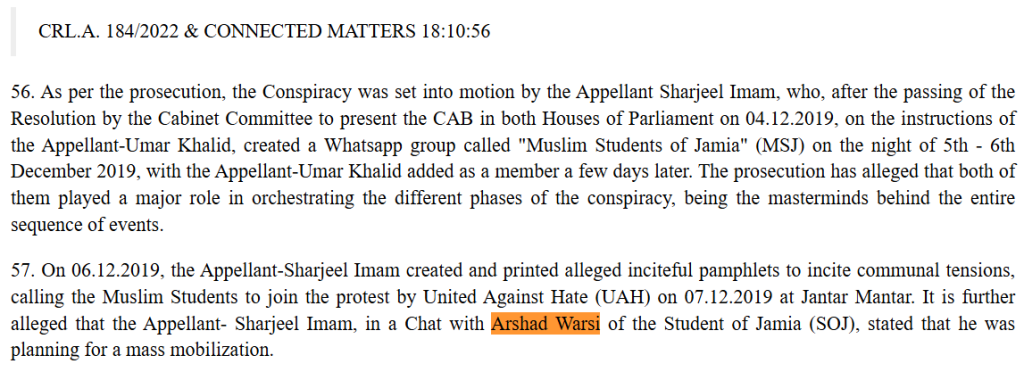
One example often cited is ISIS member Arshad Warsi (not the actor), who was in contact with Sharjeel Imam. Warsi allegedly helped decide the content of pamphlets that were distributed to mosques and Muslim neighbourhoods prior to the riots to incite violence. He was later arrested in the Pune ISIS module case.
Sharjeel Imam’s connection with Arshad Warsi. Source: indiankanoon.org/doc/156202283/Arshad Warsi arrested
There are also allegations of foreign funding and terror groups like PFI supporting the protests and unrest.
Umar Khalid met with other accused people in the PFI office to discuss funds for riots. Source: indiankanoon.org/doc/156202283/
The Seriousness of the Delhi Riots
The 2020 Delhi riots were not minor incidents of unrest. They claimed the lives of 53 people, including Intelligence Bureau officer Ankit Sharma. For many, this underscores the gravity of the case and why justice cannot be indefinitely postponed.
Right-Wing Response
Right-wing commentators like Abhijit Iyer-Mitra and Kushal Mehra have now openly criticized the delay of trials. They argue that instead of dragging the matter endlessly, the trial should begin as soon as possible, and justice should be delivered. In their view, it is time to see through legal manoeuvres and bring the culprits to justice. The longer the delay, the more the perception of judicial inefficiency grows, and that benefits only those seeking to evade accountability.
It is also important to understand that, though we can call for quick trials, courts in India are bound to follow established legal procedures. Every step, adjournments, evidence submission, witness examination, bail hearings, has to comply with the Code of Criminal Procedure (CrPC), the Evidence Act, and constitutional safeguards like Article 21 (right to life and liberty, including speedy trial).
Judges cannot simply “override” these protocols, even if they suspect delaying tactics. If the defense files a petition citing “change in circumstances” or another procedural ground, the court is obliged to hear it and decide. Ignoring or fast-tracking outside the rules would open the door to appeals, accusations of bias, or even the case collapsing later.
Delays often frustrate people. However, they’re also part of the judiciary, ensuring the trial stands on solid legal ground.
Left-Wing Response
The left-wing argues that delays aren’t only due to Khalid’s side and that long undertrial detention is unfair. While these points deserve acknowledgment, they don’t erase the fact that half the adjournments were filed by Khalid’s own team and that Sibal’s strategy clearly aims at running down the clock.
They also say Hindu mobs who killed during the riots haven’t faced equal scrutiny. But the distinction is clear: Hindu rioters were violent on the ground, yes, but they did not make the kind of provocative, mass-scale mobilizing speeches Khalid and Sharjeel Imam did that led to loss of lives. Khalid mobilized crowds by invoking the Kashmir issue, while Sharjeel Imam spoke about separating Assam from India and attempted to provoke people through pamphlets referencing the Babri Masjid dispute. Videos of their speeches can be accessed easily on social media platforms. That’s why the charges against them are different and why delaying the trial feels like a deliberate tactic.
My Take
It is important to examine cases from every angle instead of blindly accepting one-sided propaganda. Dhruv Rathee does not question the opposition, while journalists like Shiv Aroor do not question the ruling party. So it’s up to us, the citizens, to collect points from both sides and analyze it.
I have tried to provide proof for all the points in this post, but they can also be independently validated online. I would highly recommend going through the Indian Kanoon link (indiankanoon.org/doc/156202283/) to read more about the case.
Rather than dismissing everything right-wing as lies, citizens should review the available evidence and ask: Is a separatist attitude acceptable for the country? Does this kind of behaviour warrant bail? This cannot simply be brushed off as freedom of speech, because in this case, speech directly incited violence and led to the loss of 53 lives and the injury of thousands.
In India, there are rarely open-and-shut cases. Even Ajmal Kasab, a convicted terrorist, was given a fair trial. By that standard, it is certain that Sharjeel Imam and Umar Khalid will also receive a fair hearing once their trial begins, especially since their offences, while serious, are not on the same level as Kasab’s. That is why the trial should begin without further delay. So their actions can be properly examined, and justice delivered swiftly.
After celebrating Onam and engaging in numerous social activities, my introvert battery hit rock bottom. I needed a desperate recharge. So what do I do? Naturally, I retreated to every introvert’s most favourite new-gen comfort zone: scrolling endless Instagram reels. Nothing says “I’ve had enough of people” quite like being a couch potato, locked up in your house, while going through everyone else’s social lives.
As I scrolled through the multiple Onam-related posts, I couldn’t help but appreciate the inclusivity in Kerala. Malayalees across religions, whether they are Hindus, Christians, or Muslims, celebrated Onam with equal enthusiasm. Everyone welcomed Mahabali with open arms. A few voices did try to stop their communities, saying Onam is a “Hindu festival,” but not many paid attention. That’s a good sign. People are choosing to step out of religious bubbles to celebrate together.
Still, Kerala, often praised as a secular state, has been showing sporadic worrying signs of exclusion. Just before Onam, a teacher told students not to participate in the festival because “our religion doesn’t allow it.” The outrage led to her suspension, but this mindset isn’t limited to one person. How widespread is the thought? No one can quantify. It’s impossible to analyze each and every Indian’s thought. However, there is an increasing number of cases that advocate for exclusionary behaviour. You are penalized for celebrating other festivals, or for respecting someone else’s god, or for chanting something as simple as “Bharat Mata ki Jai.”
India guarantees freedom of religion for all communities. But if we use that freedom only to exclude ourselves from others, we risk creating deeper divides. True communal harmony comes from participation: joining in festivals, enjoying each other’s food, and refusing to see other faiths as “untouchable.”
For India to stay secular, this effort has to come from all of us. We’ve come far since independence, but there’s still a long way to go. It’s up to us to ensure religion doesn’t become a wall, but a bridge.
I just finished A House Without Windows by Afghan-American writer Nadia Hashimi. These days, I gravitate more toward non-fiction and find it more engaging. Still, I’m not ready to give up fiction entirely. A House Without Windows was my fiction pick of the month.
What’s It About?
The story begins with a murder in an Afghan home. A woman, Zeba, is accused of killing her husband and is detained, with almost no chance of survival under Afghanistan’s strict laws for women in such cases. An Afghan-American lawyer, Yusuf, arrives in the country to connect with his roots, stumbles upon her case, and decides to defend her.
Thoughts
I really enjoyed the storyline, though I found the narration slow and somewhat predictable. What stood out most was how Nadia Hashimi portrayed the Afghan-American lawyer’s struggle to balance two cultures in America. This is a story familiar to many migrants. They want to embrace the new, yet can’t fully let go of their roots.
When Yusuf starts dating, everything boils down to one question: Will she bond well with my mother? That’s such a desi trait: wanting your partner to get along with your parents, and if there’s friction, it’s often the partner who pays the price. I also liked the part where he decides to travel to Afghanistan to reconnect with his roots, eventually making peace with the country’s imperfections, because where there’s love, hate doesn’t stand a chance.
The storyline is unique, with a blend of mystique, magic, and sacrifice. I wouldn’t say I strongly recommend the book, as I personally found it slow. However, what’s slow for me might be perfectly paced for someone else.
Ending this post with some quotable quotes from the book:
Alone and free of angst and sorrow I’ve bled enough for today and tomorrow Now it is time for my bud to bloom I’m a sparrow in love with solitude All my secrets contained within me I sing aloud—I’m alone, finally!
SHE DID NOT REGRET THE CHILDREN, BUT AT TIMES SHE DID resent them. All mothers did, didn’t they? How could they not bear a little resentment toward people who took took took all the time? How could she be expected to feed them all? Where was Kamal when they were sick or tired or unreasonable?
Medicine is what this man calls his liquor Strange is the remedy that only makes him sicker.
“And women?” she asked thoughtfully. “What is the world to us?” Gulnaz offered a meek smile. “Do you not know, my daughter? Our world is the spaces between the rocks and meat. We see the face that should but doesn’t smile, the sliver of sun between dead tree branches. Time passes differently through a woman’s body. We are haunted by all the hours of yesterday and teased by a few moments of tomorrow. That is how we live—torn between what has already happened and what is yet to come.”
People only say nice things about the dead, so you never know what the truth is. You can be a brute in life, but the moment you die, all is forgiven. It used to make me mad, but now that I’m old and know what people say about me, I’m glad for it.
Men were always so frightened by their mortality that they obsessed over ways to live forever: sons to carry on their work, grandsons to carry on their name, their legacies in books, on streets, or in newspapers. Some became more desperate as their black hairs turned silver.
I had put off watching Black Mirror Season 7 for a long time, as Season 6 had failed to impress me. But on a friend’s recommendation, I decided to give it a shot. I’m happy to report that most of the episodes, except the last one, lived up to my expectations.
What’s It About?
Story 1 – Common People: A devoted husband, unwilling to lose his terminally ill wife, uses a high-end new technology to keep her alive. At first, it seems like a miracle. But as with most modern tech, things soon spiral out of control. The couple is forced to confront the harsh reality of love, loss, and the consequences of clinging to the impossible.
Story 2 – Bête Noire: An ambitious professional’s life is thrown into disarray when a former schoolmate unexpectedly joins her workplace. What begins as unease quickly escalates as unusual events unfold around her, sending her mental state into a downward spiral.
Story 3 – Hotel Reverie: A popular actress, bored of dull roles, signs on to a high-tech film project that aims to recreate a classic movie using immersive technology. She steps into a world where she must play out scenes with virtual versions of the original cast. But the line between fiction and reality begins to fade, and the production eventually takes a dark and unexpected turn.
Story 4 – Plaything: A socially isolated man is arrested for murder. During interrogation, he reveals his obsession with a computer game involving digital creatures. The more he cares for these forms, the more they grow. And the more they demand from him.
Story 5 – Eulogy: A man is tasked with writing a eulogy for an old lover with the help of a photo-based immersive memory technology that lets him relive past shared moments with her. Some are joyful, others painful, and some reveal truths he wasn’t prepared to face.
Story 6 – USS Callister: Into Infinity: A stranded crew battles for survival in an endless virtual universe. They are trapped in a multiplayer simulation, and they must outsmart other players to escape the loop and find freedom.
Thoughts
Though I enjoyed every episode in Black Mirror Season 7, my favourite was Plaything. The technology shown in the story is both fascinating and disturbing. The sing-song tune of the little digital forms adds just the right touch of eeriness. The lead actor delivers a convincing performance as the eccentric character ready to go above and beyond for his virtual friends.
The season as a whole highlights how technology can go wrong in unexpected ways. It drives home the point that in the pursuit of something “better,” we often overlook the risks that come with it.
I didn’t find the final episode particularly interesting. Probably because outer space-themed plots don’t usually appeal to me.
Overall, I would say Black Mirror Season 7 is worth a watch. All six episodes, each about an hour long, are streaming on Netflix.
I recently watched a thoughtful discussion by Zarna Garg on interracial romance, featuring her own family. Based in the US, their candid conversation offers a refreshing glimpse into how Indian-American families are navigating such topics. It was heartening to see everyone, parents and kids, engage so openly. In many Indian households, these conversations either happen too late or not at all, often wrapped in hesitation or silence. But here was a family talking honestly about dating, identity, and interracial relationships. A big shoutout to them for their openness and clarity. It’s these dialogues that make a real difference.
Watch the video below:
Thoughts
I’ve spent most of my life abroad before choosing to return to India. Yet even while living overseas, I always knew my relationships would be with Indian men. Perhaps it’s because I studied in an Indian school and mostly socialized within the Indian community, even outside the country. I look Indian, dress Indian, and speak with an Indian accent. So it was natural to feel more comfortable with Indian men.
However, in today’s globalized world, with increasing interracial mingling, millennials like me must come to terms with the fact that more non-Indians are likely to become part of our families. Someone recently remarked how the world is blending in such a way that you can no longer easily tell someone’s ethnicity. Even appearances are getting “globalized.” It was an eye-opener. I’ve come to realize this holds especially true in the Indian context. Today’s new-generation kids often no longer look or sound traditionally Indian, especially the kids in Indian metros. Their accents, fashion, and even body language reflect a more global identity.
A few months ago, a relative married a Spanish man, the first white partner in our family. Surprisingly, everyone, including the older generation, was welcoming. No drama. No resistance. That in itself feels like progress. Our extended family no longer fusses over caste or religion in love marriages. Marrying someone from a “lower caste” has become normal (though I personally reject terms like “lower” and “upper” caste, which are inherently divisive). Only a few super-senior relatives seem to hold on to rigid views, but even that seems to be fading.
I wonder if this shift is due to the older generation’s growing access to YouTube and social media. Many now watch global discussions on love, identity, and acceptance. One moment really stood out: a senior aunt watched Kaathal, a Malayalam film about same-sex love, and casually remarked, “Being gay or lesbian is fine. It’s not a disease.” That kind of acceptance would’ve been unthinkable even a decade ago. But it’s happening now, and that matters.
More recently, one of my nieces fell in love with a white guy. It’s a bit more delicate because it hits closer to home. While I’m happy she found someone, I can’t help but feel a bit anxious. Our cultures are worlds apart, and it’s not just the couple that has to adjust, but the families too. At this age, do I or her parents have the patience? I’m unsure. On second thought, it doesn’t concern me or her family, as the relationship is hers to navigate. Still, as Zarna Garg wisely said in her family discussion, any relationship can thrive if the core values align: education, family, career, loyalty, and health. Everything else is secondary and can be worked around.
One comment from Zarna’s husband lingered with me. He mentioned that their eldest daughter has only dated white men, and he took it personally. He had read somewhere that girls whose fathers aren’t ideal husbands are more likely to do this. That struck a chord. My niece also has a pattern of dating white men, and to be honest, her father isn’t exactly the perfect partner either. Could there be a subconscious link? I wouldn’t dare bring it up now, especially since she lives abroad, but maybe someday in person.
There’s so much our generation is still figuring out. As millennials in our 40s, we stand between tradition and transition. We want to be open-minded and inclusive, but also grounded. At times, it worries us to see the younger generation drifting away from tradition. There’s a quiet fear: will our culture someday fade into oblivion? But these are changing times, and change demands a degree of acceptance. We may not always agree, but we must learn to adapt. I also see a growing trend among young parents today: trying too hard to be politically correct, often avoiding difficult conversations just to stay in their children’s good books. This might be a measure to ensure they don’t repeat their parents’ mistakes of being too restrictive. But experience teaches us that hard truths, spoken with love, are just as necessary today as it was yesterday.
Some of the advice I dismissed in my 20s now makes perfect sense. You only begin to understand your parents once you reach their age. That’s how life unfolds. You gain clarity with time. Until then, all we can do is trust, adapt, and hope it all works out in the end.








 The Monkey Dilemma
You must be logged in to post a comment.