
Breaking Taboos, One Bindi at a Time

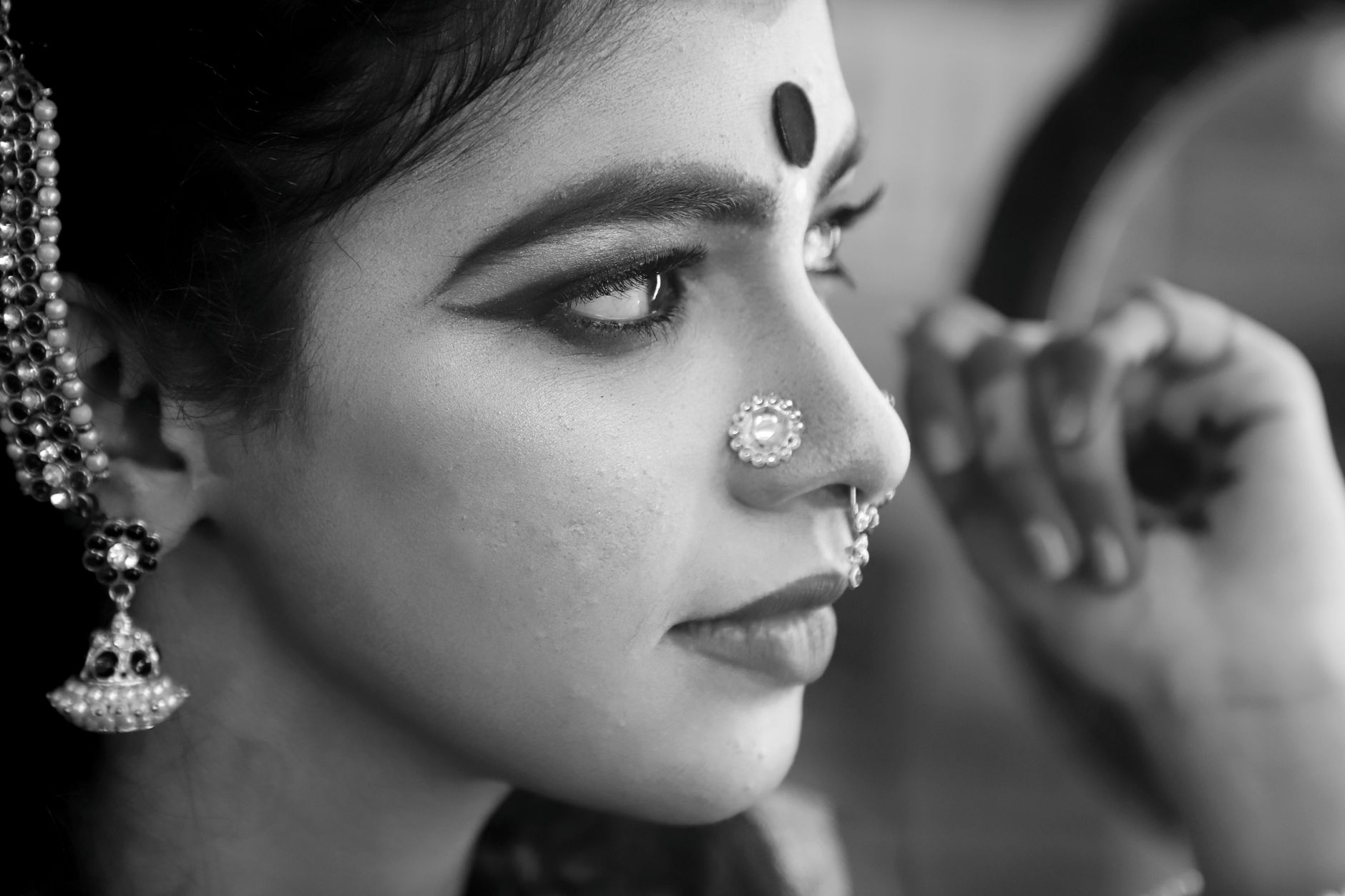
Woman Wearing a Bindi

The other day, a neighbour came over for a chat.

She’s a Muslim and a communist. I mention both because it helps explain the situation. Despite coming from a deeply religious and conservative family, she’s personally quite liberal.

She told me how her daughter landed in trouble for posting a photo on social media wearing a bindi, the small forehead dot traditionally worn by many Indian women, especially Hindus.

Her sister’s daughters, who apparently keep tabs on everyone’s social media, spotted the photo, shared it with the rest of the family, and turned it into a full-blown controversy.

The best part?

The girl refused to delete the photo.

I told my neighbour something I genuinely believe. If someone has an irrational “allergy” to something completely harmless, the solution isn’t to hide it. The solution is to let them see it so often that it eventually becomes normal.

If a harmless bindi causes outrage, keep wearing it until people get used to seeing it.

If colours like saffron, orange, or green trigger unnecessary controversy, keep wearing them until they stop attracting attention. This is related to the incessant mockery that the actress Priya Prakash Varrier faced in Kerala from a journalist for appearing in a Cuticura campaign wearing a Orange coloured outfit (or in his words “Saffron-coloured”). She had chosen the outfit simply to match the brand’s colours. Even something as ordinary as a dress colour became a point of criticism.

Similarly, if being divorced is treated as a stigma, then more divorced people should stop hiding, own the label without shame, and help normalize it.

That’s how irrational taboos lose their power. Not through arguments, but through familiarity. When ordinary people refuse to feel ashamed of harmless personal choices, those choices gradually stop being controversial.

I’m obviously not saying, “Keep using drugs until people get used to it.” I’m talking about harmless personal choices, whether it’s wearing a bindi, choosing a colour, or being divorced, that other people feel entitled to police.

The more these everyday choices are seen in public, the less power stigma and social policing have over people’s lives.

***

Photo by Sharath G.

When Did Millennials Get So Serious?

So I’m in my 40s now, and one thing I’ve noticed lately is just how serious many of my peers have become.

Of course, the reason is obvious – life happened. Careers happened. Marriage, kids, ageing parents, bills, responsibilities… they all have a way of changing you. It’s not like our 20s when many of us had fewer worries and life felt a lot more carefree. Growing up changes everyone.

But even then, the transformation is fascinating.

I’ve seen people who once had the most ridiculous sense of humour become almost unrecognisable. The ones who could turn any conversation into a comedy show are now quiet, serious, and sometimes even a little weighed down by life. It’s sad to see, but I understand it. That’s what life does.

That seriousness has shifted online too. Most of the funny content is by Gen Z.

I’m guilty of it myself. Somewhere along the way, I also started posting only about serious issues rather than silly ones. I look at my old posts on Facebook and don’t recognise myself either.

Surely life isn’t meant to be taken this seriously all the time?

Take the Reposts tab on Instagram, for example.

When I open someone’s reposts, I’m hoping to learn something about them. What kind of humour they enjoy. The movies they love. The random memes that made them laugh. Maybe a dog video that melted their heart. Something that tells me who they are.

Instead, I often find an endless stream of political posts.

By the time I leave their profile, I know exactly which political party they dislike, but nothing else about them.

It’s strange. Politics has become such a huge part of social media that it’s slowly replaced personality. Our online identities now revolve around what we’re against instead of what we enjoy.

I’m trying to disconnect from all of it, but it feels like a lost cause. In India, there’s almost no escaping politics. Even when you’re sitting in a hospital waiting room in Kerala, there’s usually a news channel playing on the TV. It’s as if we’re not allowed to switch off from the constant political noise, even when we’re unwell.

And when did millennials become this serious?

We were genuinely funny. I would even argue we were funnier than Gen Z.

Every now and then, I go back and read old Facebook posts and comments, and it’s like opening a time capsule. People teased each other endlessly. There was harmless banter, ridiculous inside jokes, and conversations that wandered off in every direction.

Nobody was trying to go viral. Nobody cared about engagement or reach. We were just… hanging out online.

Of course, social media algorithms haven’t helped.

Today, a post from your friend with 4 likes gets buried, while a random stranger whom you’re not following ends up at the top of your feed.

Half the time, when I open Facebook, I’m looking at people I’ve never met. If I actually want to see what my friends are posting, I have to switch to the Friends feed. Extra steps, too cumbersome, leading to less engagement.

I really hope someone builds a social media platform that brings back what made the early internet so much fun. A place where the goal isn’t chasing likes, growing followers, or gaming the algorithm.

Just a place where friends share everyday moments. Random thoughts. Terrible jokes. Blurry photos. Half-baked opinions. Embarrassing stories.

You know… life.

I would join that platform in a heartbeat.

***

Photo by MART PRODUCTION

The Introvert-Extrovert Chat Paradox

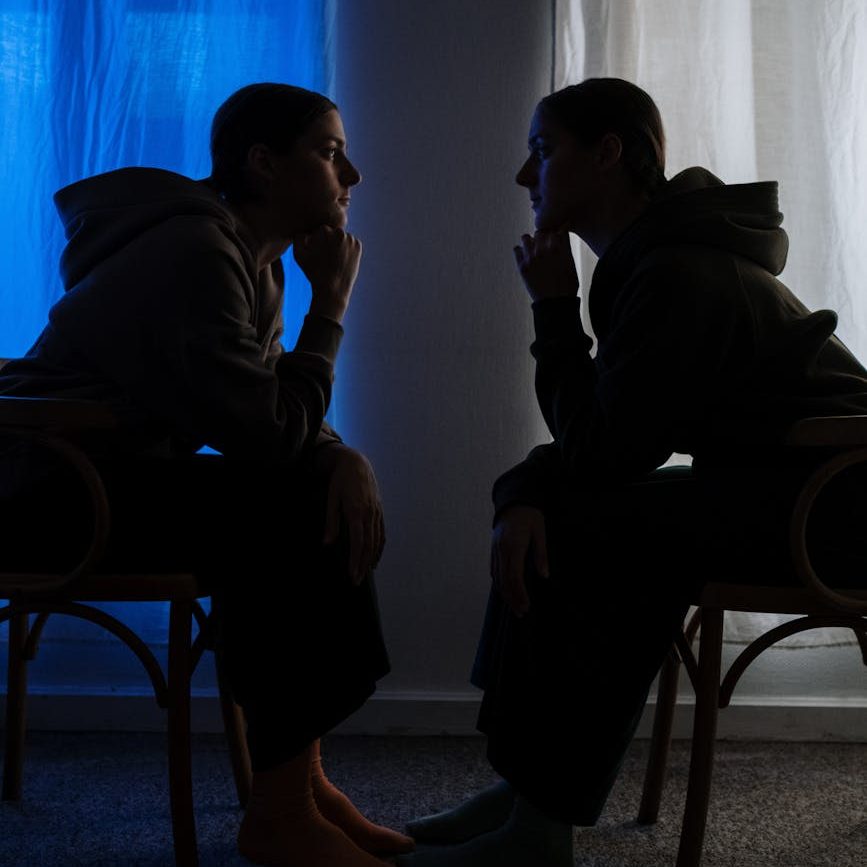
Picture of two people looking at each other, depicting introversion and extroversion

Something that has caught my eye often over the years is the difference between how introverts and extroverts communicate in real life and online. I wonder if you’ve noticed it too.

I’m an introvert who loves writing and blogging. But I’m someone with a fairly extroverted chatting personality.

On the other hand, many extroverts I know are surprisingly quiet on chat. Some even come across as shy. Meanwhile, introverts like me can appear far more outgoing and expressive online.

This is where things get interesting.

Imagine a friendship that begins through real-life interactions. Someone gets to know your actual personality, and then later comes across your online personality or chat personality. What if they don’t like that version of you as much? The opposite can happen too. Someone may enjoy your confident, talkative online presence but struggle to connect with the quieter, more reserved version of you in real life.

I think this is where many misunderstandings and personality clashes happen today.

This post is simply an observation. It’s just something I’ve noticed while navigating friendship and online conversations.

As someone in my 40s, I didn’t grow up with this confusion because there was no online personality to manage. The people around you knew only one version of you.

I did start blogging during my college days. Over time, I developed an online personality that was more outgoing and expressive. The internet felt like a safe space where I could communicate freely. As someone who was studious and never benefited from what people call “pretty privilege,” writing online allowed me to share my thoughts without feeling judged.

My appearance may have changed over the years, but my introverted nature never really did. The internet continues to be a comfortable space where I could express my feelings and connect with others in a way that felt natural to me.

Today, we live in a digital age where friendships and even relationships are shaped by multiple versions of ourselves. Real-life conversations, text messages, social media interactions, blogs, and online communities collectively play a role in how others judge us.

Maybe that’s why getting to know someone has become both easier and more complicated than ever before.

***

Photo by cottonbro studio

The Truth Behind Why Bail Was Denied to Umar Khalid and Sharjeel Imam

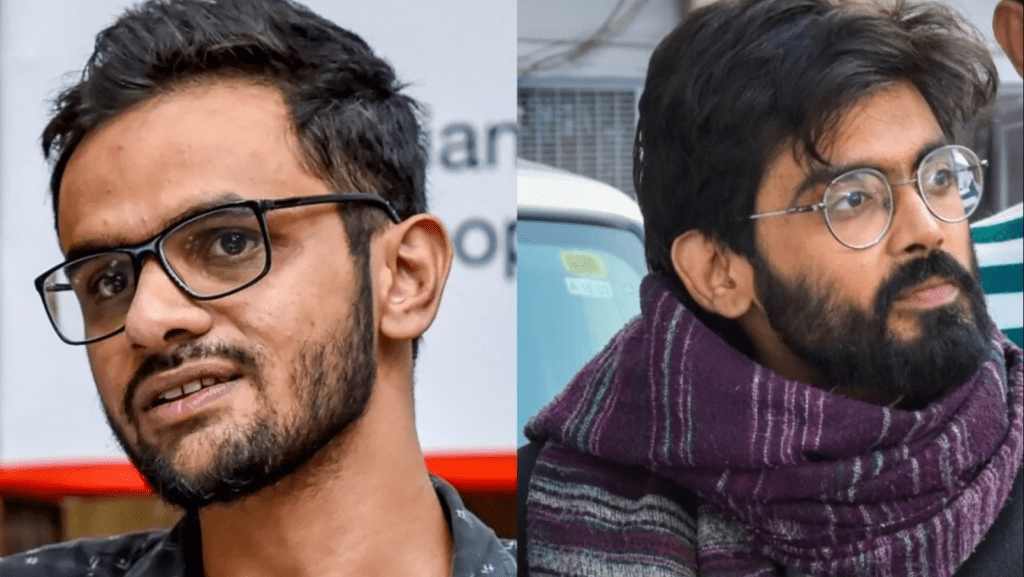
Umar Khalid and Sharjeel Imam Photo

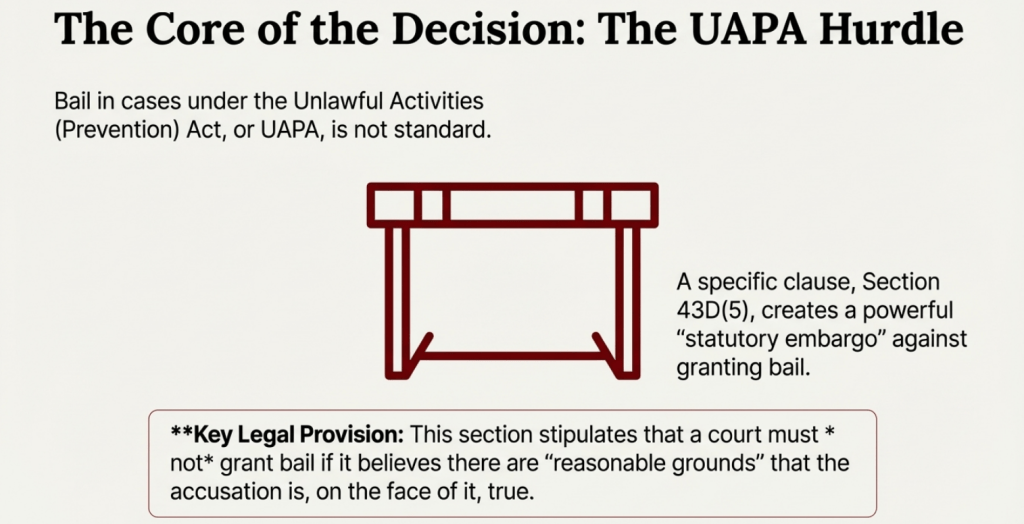
With the Umar Khalid and Sharjeel Imam cases once again drawing global attention, especially after Umar Khalid’s father met US politician Zohran Mamdani, it’s the right time to scrutinize why the Supreme Court rejected bail pleas for both activists. The issue has sparked renewed discussion around India’s anti-terror law, the UAPA, and how it is applied in high-profile cases.

In the age of social media, misinformation often travels across the world long before the truth gets its moment. That makes it all the more important to examine each argument carefully and understand the reasoning behind the court’s responses. We are living in a time where selective fact-checking is common, misinformation is circulated to serve political agendas, and inconvenient truths are pushed out of sight. From what I have seen, some of the material relevant to this case has still not reached the wider public because it is rarely covered by mainstream media. As a result, distrust continues to linger.

Of course, for some people, no amount of truth really matters. What they seek is validation for their existing biases or political leanings. This post is not meant for that audience. No amount of proof can change such a mindset. It is written for readers willing to acknowledge facts when presented.

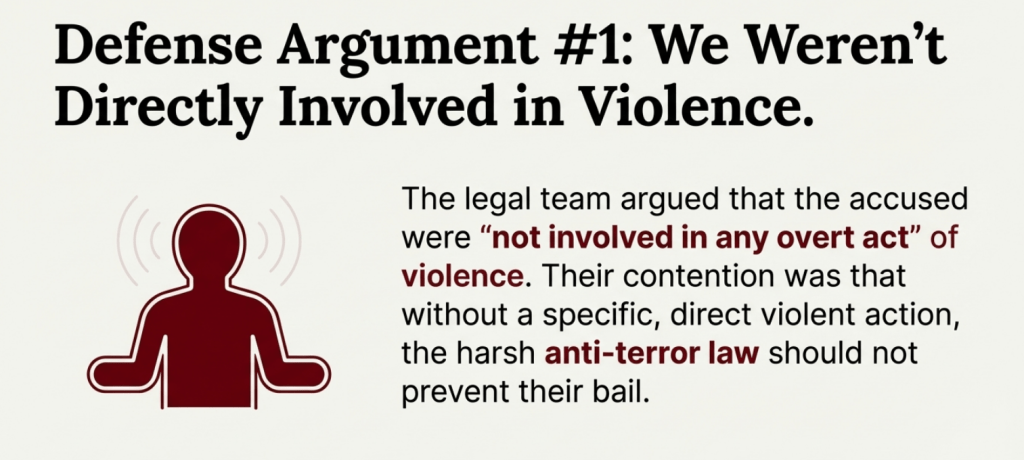
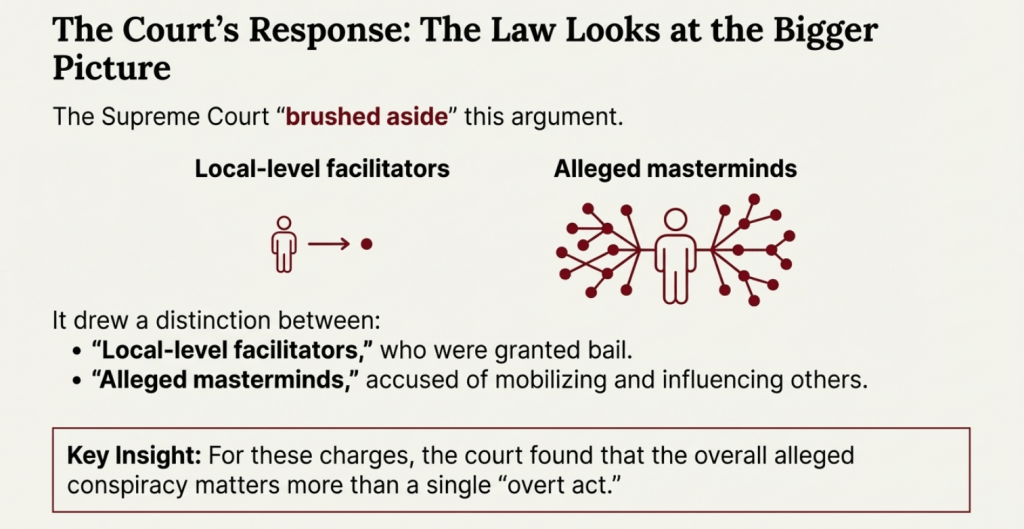
Getting back to the case, according to the prosecution, Umar Khalid and Sharjeel Imam were not just participants but masterminds who mobilised or influenced others during the events in question. The defence, however, put forward two key arguments while seeking their release on bail. Let’s take a closer look at what those arguments were and why the court chose not to accept them.

Defense Argument #1:
Not Directly Involved in Violence

Sharjeel Imam Umar Khalid Bail Defense Argument #1 Photo

One of the most repeated arguments, especially in Umar Khalid’s case, is that he was not present at the riot spots when the violence took place.

Court Response

The court indicated that the act of masterminding the riots, even without direct presence, was in itself sufficient. The court’s position was clear and firm: nothing comes above the interests of national security. On a prima facie assessment of the material placed before it, which includes videos, audios, posts, and messages, the court held that both Umar Khalid and Sharjeel Imam faced similar allegations of being the masterminds, which weighed heavily against granting bail. Due to their involvement in the larger plan, several people were killed and injured, including an intelligence officer.

Sharjeel Imam Umar Khalid Bail Defense Argument #1 Court Response Photo

It should be noted that provocative words alone can be enough to incite violence. This is not something new. Something similar was seen even before the Gujarat riots, where RSS members were found to have mobilised people through provocative speeches. Many who provoked never participated in the violence, but their words were enough. They were taken into custody and remained there for years.

This raises an important question: what makes those cases different from the cases of Sharjeel Imam and Umar Khalid, so that the latter deserves bail? Both instances were the same: provocative speeches leading to mass mobilization. The 2020 Delhi riots too had a communal angle, with tensions between different communities being stirred during the violence. Videos of the provocative communal speeches are available widely on X. WhatsApp groups were formed along religious lines, which added to the sense of division at the time.

Rather than relying on political influencers or commentators, I recommend reading the official case files to understand the facts as presented in court. You can find these by searching Google with terms like “Delhi NCT Sharjeel Imam pdf” and then looking within the document for specific details.

Often, religion is used as a tool to strengthen or manipulate one’s case, and that appears to have happened here as well. As someone who has gone through the provocative videos and social media posts of the two, it is difficult to see them as innocent. I cannot quote or reproduce those statements here because of their sensitive nature, but they are publicly available and can be found on social media platforms like X by searching their names.

Sharjeel Imam’s Facebook account is still active, while Umar Khalid has deleted his. I would recommend going through Sharjeel’s Facebook posts to see for yourself how passionately he tried to convince people to hit the streets. Some posts had a communal dimension as well. The content includes rhetoric that can be interpreted as calls for violence and even secession, which adds serious weight to the charges against them.

Defense Argument #2:
The Trial Delay

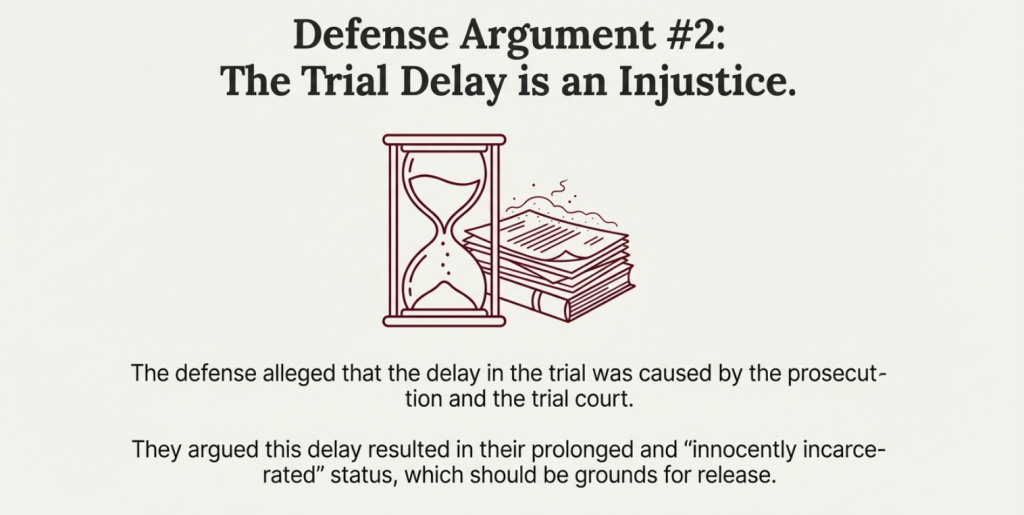
One more argument that often comes up is the long delay in the trials of Sharjeel Imam and Umar Khalid.

Sharjeel Imam Umar Khalid Bail Defense Argument #2 Photo

Court Response

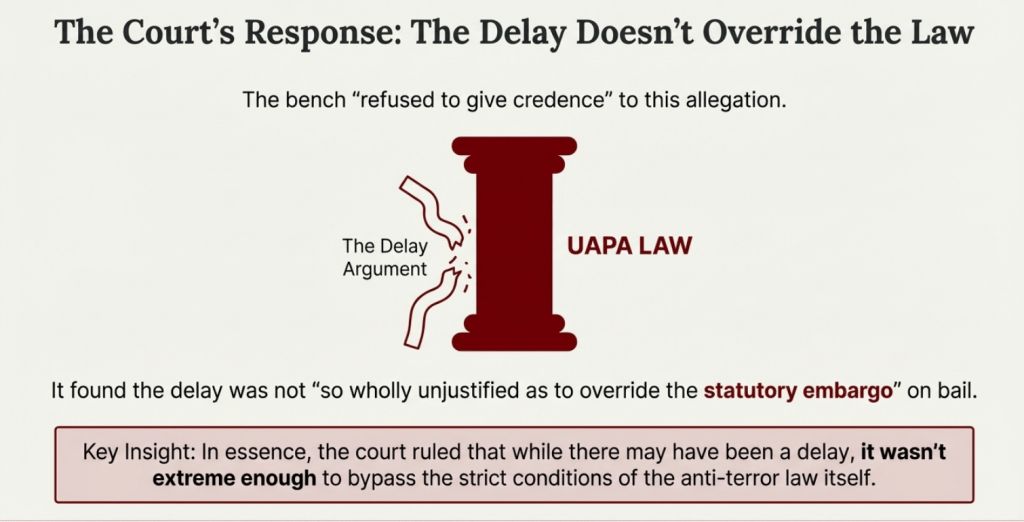
The court maintained that a delay in the trial does not dilute the gravity of the case.

Also Read: CJI’s Remarks on Umar Khalid’s Trial Delays

Sharjeel Imam Umar Khalid Bail Defense Argument #1 Court Response Photo

The Final Verdict

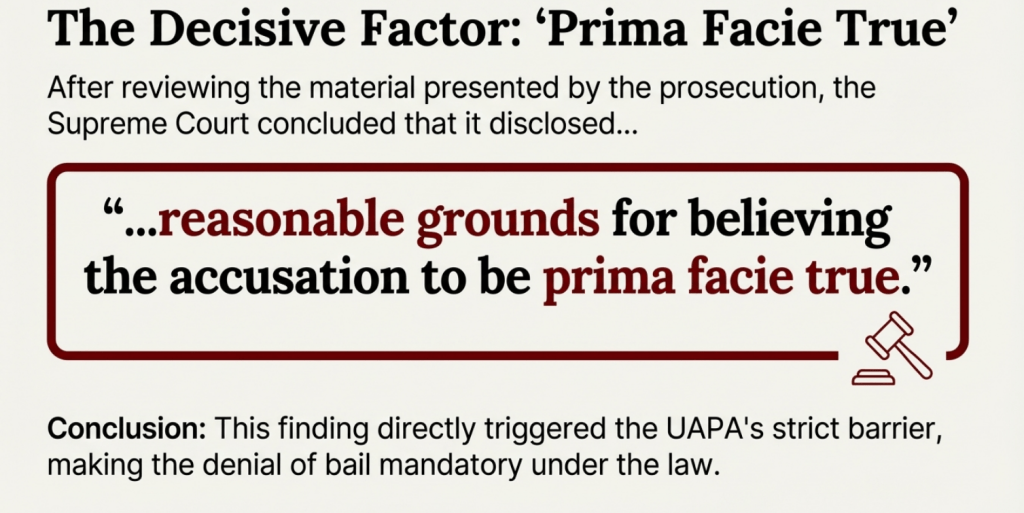
The court observed that the polarising material appeared prima facie true, and this played a key role in denying bail to them as alleged masterminds.

Sharjeel Imam Umar Khalid Bail Rejection Decision Image
Sharjeel Imam Umar Khalid Proof Prima Facie True Image

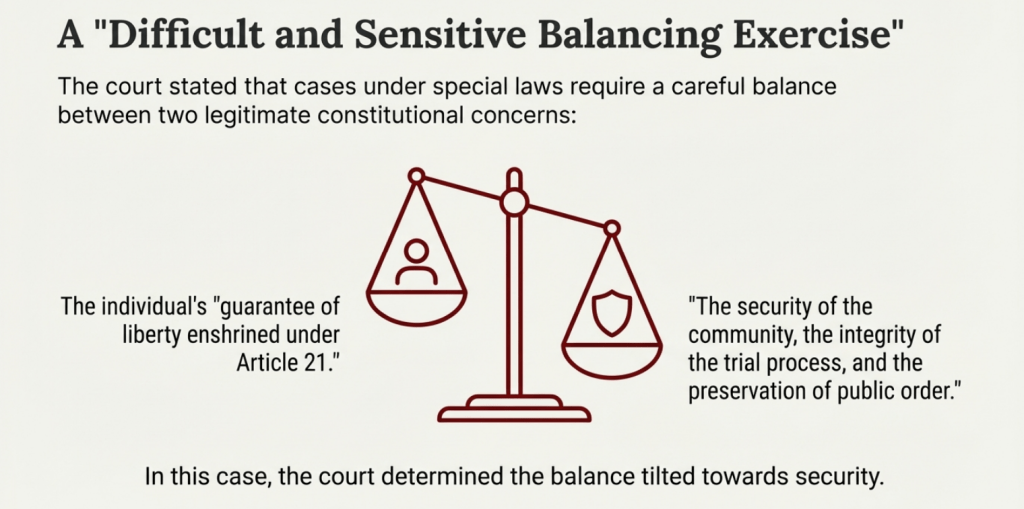
The court admitted that balancing individual rights with the nation’s security is never an easy task.

Sharjeel Imam Umar Khalid Bail Is a Difficult and Sensitive Balancing Exercise Image
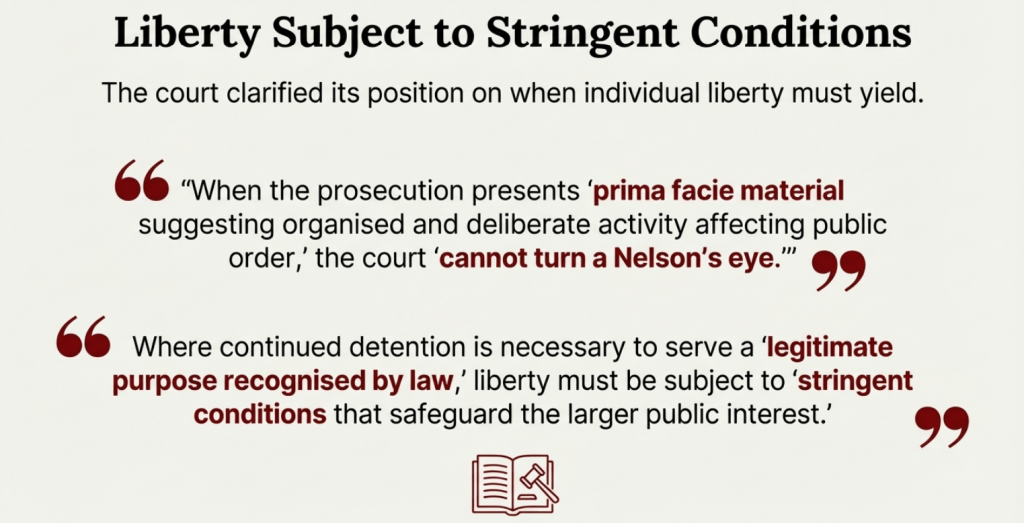
Sharjeel Imam Umar Khalid Liberty Subject to Stringent Conditions Image
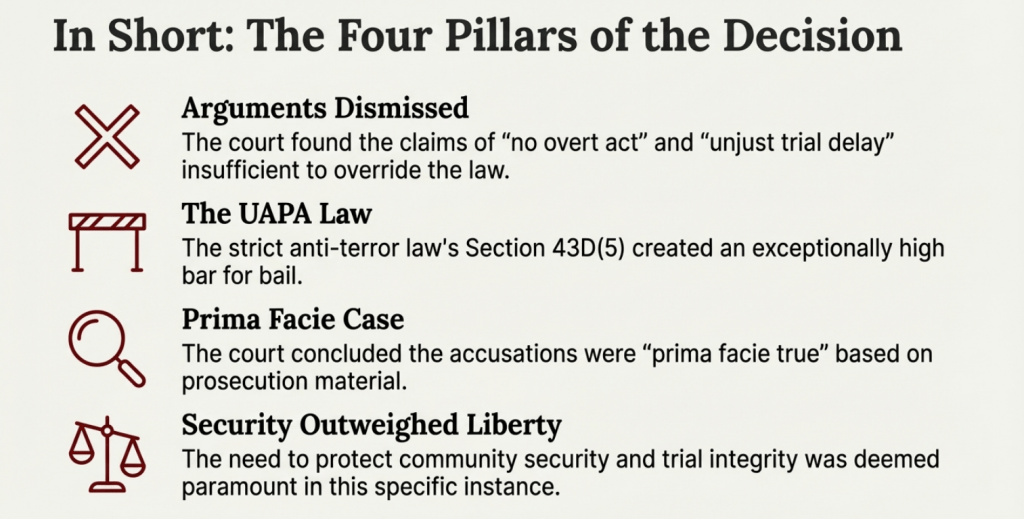
Sharjeel Imam Umar Khalid Bail Rejection Summary Image

Umar Khalid and Sharjeel Imam were not denied bail because of unfairness or a failure of the legal system. Their bail was rejected because the court found the material presented before it to be valid and credible.

However, unless this material, such as videos or posts, is made available for public viewing in a structured and responsible manner, many people will continue to believe that the legal system itself is fractured. Since I have seen the provocative videos and social media posts and gone through the case details, I do not doubt the court’s reasoning.

But the lack of transparency leaves room for misunderstanding. It also creates space for political parties and interest groups to selectively present facts and shape narratives for their own benefit. Should there not be a mechanism to clearly explain why and how such decisions are taken, along with supporting material, so that the ordinary citizen does not have to rely on fragments found on their own?

An Ode to Dopamine Detoxes

I’m at that stage now where I can discern the reason behind my restlessness. The symptoms that previously used to confound me can finally be attributed to a source and countered with practical solutions. I say this with pride because discovering the cause of any turmoil is always the first step to recovery.

The reason for my dopamine going out of whack and my feeling a flurry of erratic emotion? Social media.

I have a love-hate relationship with social media. Because of social media, I found my voice. Because of social media, my introverted self learned to be a tad more expressive. I could post online, and there would always be someone to listen to my endless thoughts, view my never-ending selfies, and validate my existence. As much as I enjoy the platforms, I often find myself getting lost in engaging with the myriad of interesting content while also feeling bad about someone close not liking my photos or reels or videos, wondering if everyone had a life far superior to mine, wanting to go on the same expensive trips that others do even if it’s not what I want. Social media can be draining. It takes away your mental resources and leaves you with very little to deal with the everyday complexities of life.

When you feel like a puppet in a system with no say over your actions, you know it’s time to take back control. It’s time for a dopamine detox. I turn off my notifications, log out from social media, and take a break from doomscrolling. What I get in return is an incredible sense of relief and calm.

My dopamine detoxes help me connect with myself, reflect and refocus my energy. I enjoy the stillness and the ability to engage with my work, family, and thoughts without being bombarded with external distractions.

I find such dopamine detoxes more valuable at work. When you’re neck-deep immersed in tasks, the last thing you need is a distracting WhatsApp chat demanding your attention. Turning the wi-fi off helps me in cutting down on unwanted noise. To combat my Fear of Missing Out (FOMO), I remind myself that I’m just a phone call away from those who need me. Sometimes, when I need 100% me-time, I enable the flight mode on my phone. It has been a life-changer.

Enough people don’t realize what staying connected 24×7 does to your brain. If they did, everyone, including myself, would have attempted to disconnect more regularly. I know what social media does to me, and I try to step away, but it’s not long before I turn delusional again and turn a blind eye to the side effects. I relapse and restart doomscrolling.

The irony is that I have to experience the dreaded symptoms again for my brain to knock some sense into my dopamine-hungry system. The symptoms being — feeling angry about nothing, annoyed over everything, and mentally and physically empty. These symptoms are my wake-up calls to step back. The moment I do, I feel refreshed. It always astonishes me how forgiving our bodies tend to be. They are quick to spring back to life if you give them a chance. A few hours of downtime is often all it takes.

I wonder how many people must have mistaken mental overstimulation for depression and continued using social media without understanding its negative impact on them. Overstimulation is not depression, but it may lead to depression. Prolonged use of social media can result in your body crying SOS in the form of a nervous breakdown, loneliness, and anxiety. If you feel irritated when your internet is down, even though you have nothing important to finish online, you are addicted – no second thoughts about it.

Correlation between social media and depression (courtesy: system.com)

If you are interested in the studies shown in the above image, here are the links:

We can see the symptoms but somehow fail to attribute them to social media. Even if we understand the negatives, it doesn’t stop most of us from endlessly scrolling through our feeds. It might be similar to how drug addicts feel. They know the side effects of the drugs they consume and how it physically and mentally affects them, but it doesn’t stop consumption.

I was at that stage again recently, ignoring the fact that it’s time for a digital detox, when I stumbled upon the book Dopamine Detox by Thibaut Meurisse on Prime Reading. The book is available for free if you are an Amazon Prime user in India. After exhausting my monthly budget for books, I decided to give it a go. It’s a quick read. It takes about 30 minutes or less to finish but is jam-packed with information.

The book helped as a reality check. Somehow I had conveniently forgotten what social media could do to my mental health and had started overusing it. I even attributed my increased irritability and lack of energy to sleep deprivation, vitamin deficiency, or lack of exercise. I fixed all these issues but turned a blind eye to my social media usage. Eventually, from a state of surrender, I accepted that disconnecting from social media was the best way to resolve my problem. So, dear readers, if everything fails to lift up your mood, try logging out from your social media accounts.

I have cut down my usage, but I have no idea when things will go down south again. For now, I enjoy being wide awake, in the present, and the temporary freedom from negativity. I have set up social media time restrictions on my phone to prevent doomscrolling, but how long before I disable them and return to my old ways? Only time can tell.

An Ode to Taking Fewer Photos and Living in the Moment

Photo by Vlad Cheu021ban

I take a sip of refreshing chai and relish the warmth it brings.

I visit a striking green paradise and breathe in the intoxicating air.

I spend time laughing with my loved ones, engaging in deep conversations.

Time stands still.

I welcome the moment with a big smile, comfortable baggy clothes, and frizzy hair.

All of it, without taking a single photograph to lock the moment.

There’s no pressure to look perfect.

There’s no pressure to get the perfect photographs, angles, filters, and light.

It’s perfect as it is.

In this age of social media, consciously taking a step back to enjoy life has proven therapeutic. It’s a transition that happened naturally for me during the pandemic. A metamorphosis that seeped unconsciously and significantly helped to reduce my anxiety. Along with it came the realization that we don’t have to lock everything in static images or never-ending videos. Sometimes, it’s okay to not record and to take that risk of losing a moment forever. Rest assured, the important things will stick and refuse to detach from you. You don’t really need a camera for that.

The constant pressure of social media, with its likes, shares, and validation, can weaken even the bravest. If our first reaction to a beautiful scenery is to take our phone out and view it through the camera’s lens, rest assured, we are not genuinely engaging. Our mind gets distracted by the constant back-and-forth shuffle between real life and reel life (Instagram or otherwise). The pressure doesn’t end there. Once you post the image, you are then distracted by who liked your pictures and what they commented. Each of these tasks might only take a few seconds. Still, collectively that’s a lot of time wasted navigating away from the present.

Contrary to popular notions, human beings are terrible at multitasking. Our brains are not wired to handle these many distractions. You can get things done, of course, but the overall value would reduce if you indulge in multiple interests simultaneously. Don’t believe me? Try to cut out other sensory reactions when you are listening to music – switch off the lights and engage in your favorite melodies. You will experience it like never before. The vocals and instruments sound sharper, richly intense, and more beautiful, purely because you are only focusing on the music alone and nothing else.

As a New Year resolution, maybe more people should learn to ignore the 24/7 pressure box they hold so tenderly in their hands. You can do more good for your body with this simple act – probably more than a gym membership would be able to.