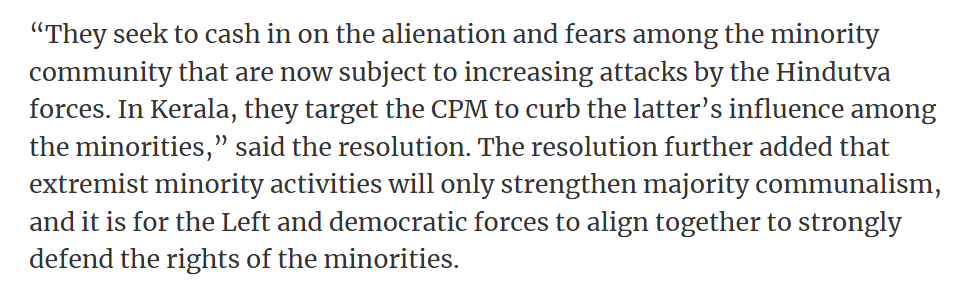
CPM mentions this about Islamist groups in the draft resolution:
Hindu extremists are using radical Muslim groups as fodder to fuel hatred between communities. But the reverse is also true—radical Muslim groups exploit the political climate to spread their own agenda. They feed off each other.
One side claims, “If Islamists stop, Hindu extremism will die down.” The other side counters, “If Hindu extremists stop, Islamists will weaken.”
There’s no middle ground. How do we break this cycle? Who should compromise? The answer is—both.
The only way forward is to call out radical elements within your own community—those who discourage interfaith interactions, prevent you from celebrating others’ festivals, and push you away from the secular fabric of the country. Peaceful coexistence is the only solution.
However, I mostly see this self-criticism coming from the Hindu community. Not everyone supports right-wing politics, a Hindu Rashtra, or extremist activities, and many Hindus actively speak out against radicalism within their own circles. But the same level of criticism isn’t visible in other communities. At least 95% of the Muslims I know have never condemned extremism within their own community, but they are very vocal about Hindu extremism. If only one side is willing to challenge its radicals, how can we truly achieve peaceful coexistence in a secular, democratic nation like India?
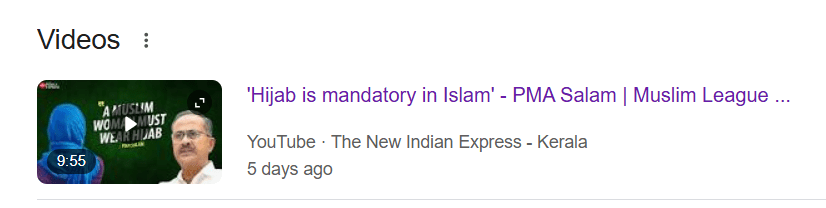
I feel this silence comes from fear—fear of being ostracized by their own community. In Kerala, the Muslim League openly stated that the hijab is not a choice for Muslim women; it is mandatory. When a journalist asked, “What if someone doesn’t want to wear it?” the leader reaffirmed, “If she’s a Muslim, we advise her to wear it.” There was no room for choice. Yet, despite often advocating for personal freedom, there was no backlash from within the Muslim community against this statement. This silence is unsettling. It makes people wonder—“If they won’t even speak up for their own freedom of choice, how can we expect them to stand up for ours?”
India is a secular nation, and preserving this secularism requires protecting religious freedom. When prominent leaders impose strict regulations on women, silence is not an option—it is a time to question them and hold them accountable. If not now, then when? Waiting until things spiral out of control will only make it harder to reclaim lost freedoms.
Western countries often criticize India, accusing it of restricting the religious freedom of minorities. For a long time, I was puzzled by this, as I saw minorities freely attending their religious places without any problems. On the other hand, Hindus in Jammu require police protection to visit their religious sites due to the ongoing threat of terrorism. So, where is this accusation truly coming from?
One of the main reasons many Christians oppose the BJP is that the party has significantly restricted international funds meant for proselytization. These funds were often misused in India to attract economically disadvantaged citizens into converting, with promises of financial assistance tied to conversion. As a result, conversions were driven more by economic pressures and manipulation than genuine faith.
Countries like the USA actively fund missionary programs, with groups such as the evangelical World Vision and the U.S. Commission on International Religious Freedom (USCIRF) advocating for unrestricted proselytization as a form of religious freedom. They often cite Article 18 of the United Nations’ Universal Declaration of Human Rights (UNDHR), which asserts that every individual “has the right to freedom of thought, conscience and religion; this right includes freedom to change his religion or belief…” This interpretation forms the basis for their criticism of India, accusing the country of limiting religious freedom and ranking it low in the religious freedom index. A 2012 article written by Dr Aseem Shukla explains this point brilliantly (hinduamerican.org/blog/proselytism-conversion-to-intolerance/).
This raises an important question: why offer monetary assistance only after conversion? Why not provide help based on humanitarian principles, without attaching religious conditions? When people are lured into faith through financial incentives, it undermines the integrity of the belief system itself. Shouldn’t conversions be driven by genuine faith and conviction, rather than economic manipulation or coercion?
Unfortunately, that’s not the reality for many. People are being lured into changing their religion through manipulation, whether through money or other means. I personally know several individuals who converted simply because they were promised financial support. What’s even more surprising is that younger generations are now making conversion a prerequisite for marriage. It’s hard to comprehend how, in today’s world, people still can’t accept different faiths and feel the need to demand conversion from their partner for the sake of marriage. Is this really secularism? Or love? I discussed this topic on this blog after watching a show, Nobody Wants This, on Netflix some time ago.
I’m currently reading a book about Kamala Das, The Love Queen of Malabar, written by a Canadian author, where it’s mentioned that Kamala was pressured to claim her conversion was out of faith, not love. The reasoning behind this was that saying she converted for love would diminish the strength of her faith. However, after her partner left her, she felt deeply depressed. The book suggests that the man she loved had been financially incentivized by foreign entities to convert Kamala. Later, Kamala wished to return to Hinduism but feared for her life and her family’s safety, including her grandchildren. Her sons even used to correct her whenever she, by habit, uttered the name of her former god, as they were afraid it might anger radicals and put their family at risk.
Why manipulate people into conversion? Let them choose to convert out of genuine faith – that is true religious freedom, not a process driven by external incentives.
The new government has largely restricted predatory conversion tactics by limiting international funds and addressing radical elements within society. This is one of the primary reasons the Indian government is widely criticized globally.
The propaganda against India has a broader base compared to the narratives propagated by BJP supporters. It’s easier for these narratives to spread, as the Christian and Muslim communities form larger global groups compared to the Hindu community. With such a widespread network, sensational news spreads quickly and easily. Adding to this challenge is the Hindu community’s general reluctance to actively counter exaggerated news, making it even harder to protect India’s image.
Many who believe in proselytization through unfair means seek the removal of the current government to restore previous practices. This is probably why they complain about every small issue and often manipulate facts to present one-sided stories. By focusing on selective narratives, they aim to undermine the current administration and bring back the old ways.
The narratives about India are often more complex than they appear in the media or through agenda-driven sources. They tend to present only one side of the story, exaggerating it to evoke emotional reactions. This is why it’s crucial to consult both left and right-wing media to gain a more balanced perspective. Otherwise, you risk forming judgments based on incomplete or biased information.
Some Indian Muslims like Arfa, Rana, Zubair, and Naseeruddin Shah feel India is intolerant and unsafe for Muslims.
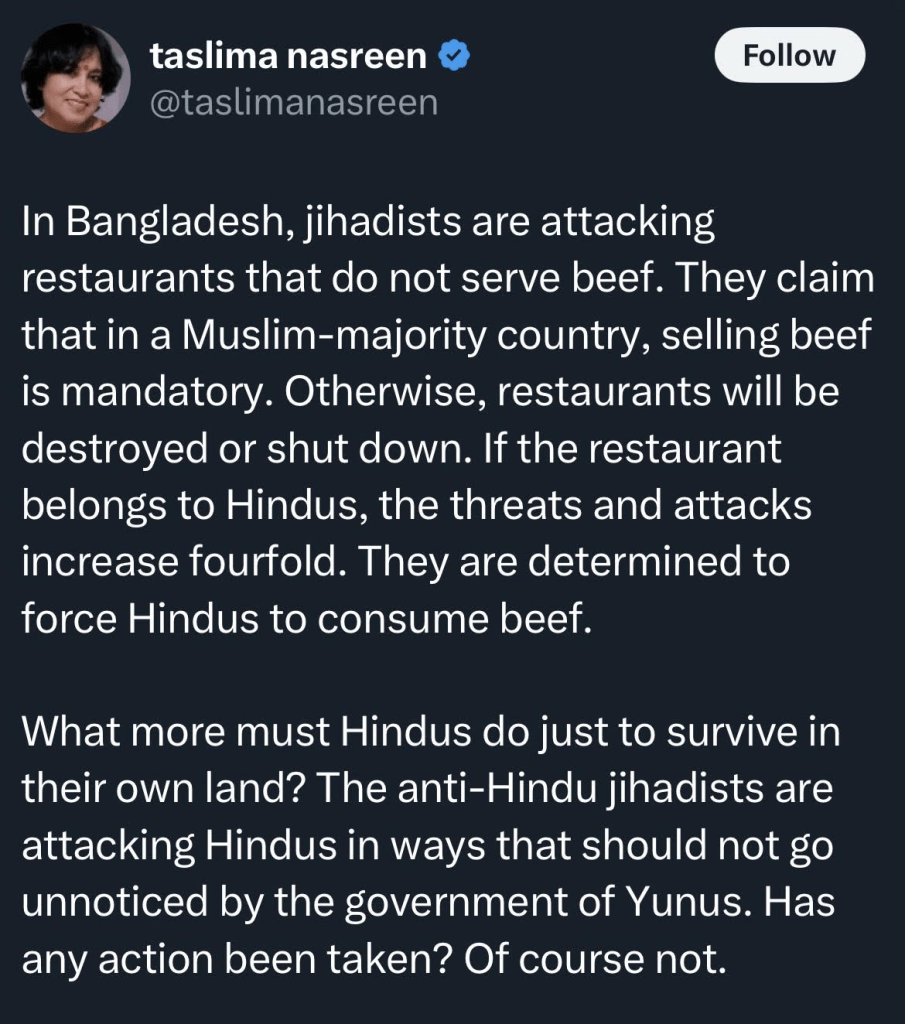
Yet, Muslims like Taslima Nasreen and Sheikh Hasina feel safer in India than in their own Muslim-majority countries. They have escaped their countries to avoid getting persecuted and can openly criticize extremists in India.
Souce: x.com/taslimanasreen
In India, you can criticize any religion freely, like PC George in Kerala targeting Islam, or Stalin in Tamil Nadu attacking Sanatana Dharma.
Source: livelaw.in
But at the same time, mocking/disrespecting Hinduism or Islam can also lead to lynching or beheading.
This shows the complicated nature of India’s religious tolerance. It’s not fully black or white; there are many layers of grey.
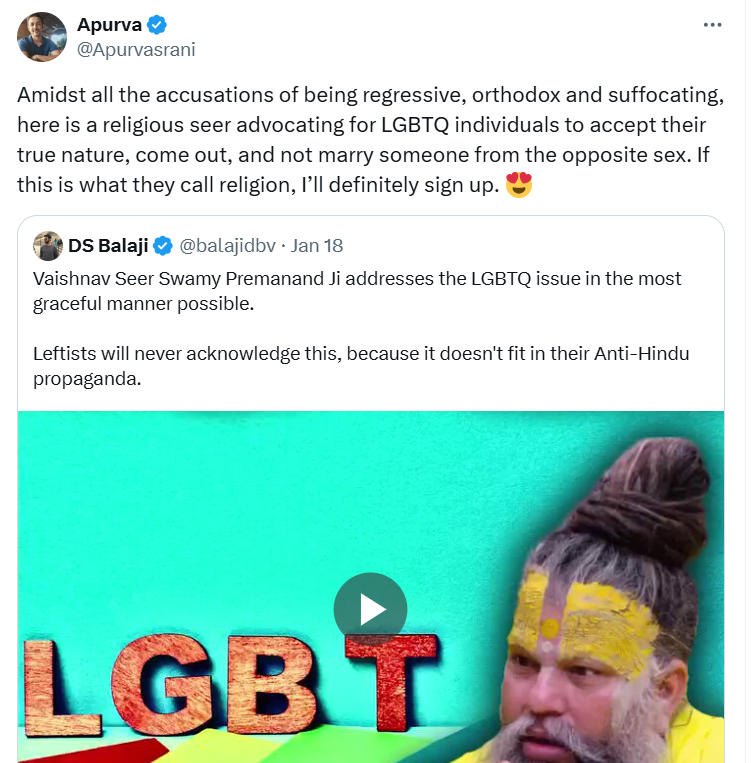
A country, accused of religious intolerance, is also a country where seers like Swamy Premanand Ji openly advocate for LGBTQ issues. He advises young members of the LGBTQ community not to succumb to parental pressure to marry according to societal norms, as it could harm both their own life and that of their partner.
From these examples, it is quite clear that India is a nation with diverse perspectives. Yet international media often portrays it as a regressive and intolerant society, probably because they rely heavily on left-leaning biased sources for their information. This depiction is unfair to the country’s social fabric, which embraces various ideologies.
It is important to note that much of the left-leaning media in India tends to present only one side of the story, resulting in incomplete or biased information. In an era where media bias is prevalent, it is strongly recommended to read news from both left- and right-leaning sources to gain a comprehensive understanding of the issue. Without this balanced approach, people may remain unaware of where genuine reforms are needed and could be misled by those with specific agendas.
The downside of one-sided stories is that they can foster an extreme victim mentality, making people believe that any violence or attack is justified due to past suffering. For instance, some celebrated the LA fires, posting that the USA deserved it for funding weapons for Israel, without considering that pro-Palestinians could have lost their homes too. If a tragedy strikes India, similar comments might surface. This is partly due to media narratives that fuel such sentiments and intensify hatred.
In an increasingly polarized world, it is crucial to report news with accountability. Both extremes are harmful—religious extremism that forces others to conform through coercion and an extreme victim mentality that blinds individuals to any positive aspects, making them focus solely on negative narratives. Currently, in India, I am seeing more of the latter than the former. Media is partly responsible for this.
I was once a leftist. However, at that time, I didn’t consider all sides of a story. Even though I am a Hindu, I was often dismissive of conflicts in which Hindus were victims in India, such as the Kashmiri Pandit genocide, the 1992 Ajmer rapes, the Moplah riots, and others. I coldly labeled the narratives as right-wing propaganda. I was radicalized to the extent I wasn’t open to other perspectives.
On October 7th, 2023, I experienced a significant shift in my perspective. I witnessed people justifying acts of violence, including rape and saw secular politicians in my country referring to it as resistance. This left me shocked. It wasn’t the BJP that influenced my change, but rather the people around me. The only individuals expressing outrage about these events were from the right wing, which took me by surprise.
Over the next couple of months, I underwent a monumental shift in my ideology that startled me. It felt like old layers of my beliefs were peeling away, making way for new understandings—a painful process. I came to realize that the principles of fairness and equality I had believed in until then were merely a façade. I also understood that I would likely be alone in this revelation.
The world operates in a contradictory and troubling way. People often expect unwavering support from others, yet when it’s their turn to show empathy, they respond with scoffing, mockery, and belittlement towards heinous crimes. They easily justify acts of violence, murder, and rape with statements like, “So what? They deserved it.”
It took me months to calm my anger and process the betrayal I felt when I discovered that some of my friends had become radicalized to the point of believing that rapes were justified. Until that moment, I had viewed the world through rose-colored glasses, believing it to be a kind place.
I then looked at my country with a fresh perspective and realized that similar patterns were at play here. Hindus seemed to have to compromise more than other communities in the name of secularism. I observed that many conflicts where the victims were predominantly Hindus were dismissed as propaganda, belittled, mocked, or invalidated, much like the rapes of Israelis on October 7.
I now identify as a right-winger. I consider myself center-right and hold no animosity toward anyone. In the past, I hesitated to label myself as a right-winger because almost everyone I know leans left. However, over time, I’ve moved past the fear of labels. People can judge or categorize me as they wish; as we age, labels become less significant. My shift in ideology is not due to any political party or its propaganda, but rather my observations of people’s behavior and their viciousness.
I have become more patriotic and now want everyone in India to adopt a “nation first” mentality. This is something I missed when I was a leftist; I felt that people weren’t sufficiently pro-India. I realize now that the center-right community is where I truly belong.
We, the center-right, believe in the following principles:
We are patriotic and uphold a “nation first” mentality.
We reject extremism from both the far-right and the far-left.
We take pride in the achievements of India.
We advocate for equal rights for everyone, regardless of their community.
We oppose appeasement politics.
We strongly support enhanced security measures.
We have zero tolerance for radical groups.
There are several negative aspects of the far-right that frustrate people like me. They should be held accountable by the government. However, I still feel positive about my country under strong leadership that has the courage to confront extremism.
Unfortunately, in India, when you openly call out extremism, you are declared Islamophobic. When radicals get arrested due to active participation in extremist groups, the country is declared Islamophobic. The global media often gets their news about India from the local left-leaning media which is notorious for giving one-sided stories. In this day and age of media bias, it is imperative to refer to both the left and right-wing channels to get a full balanced view.
It’s true that Islamophobia exists in India and the country should do more to protect its minorities. However, even if the BJP takes positive steps, it is unlikely to reduce the extreme victim mentality prevalent in the community that refuses to acknowledge any good done by the party. For example, the BJP introduced the Shadi Shagun Yojana scheme in which a Muslim girl is given Rs 51000/ when she marries after her graduation (BA, BSc, BCom, BE etc.). BJP banned the Triple Talaq. This is for Muslims alone. Most of the recipients of other welfare schemes have been members of the Muslim community. No ruler would have tried to uplift the Muslim community if they were Islamophobic. Riots and young children getting murdered due to terrorist activities in Kashmir have also drastically reduced. But these plus points are often blatantly ignored and many choose to judge Modi by the actions of the far-right.
A question to consider is: If Modi is still judged for the 2002 Gujarat riots, why isn’t Congress held accountable for the 1984 Sikh riots that they enabled, which were equally horrific? Politicians have contributed to deepening societal divisions by fueling narratives. Riots and violence instigated by one party are often deemed forgivable, while those provoked by another are considered unforgivable.
My political ideology is not fixed. I may shift from center-right to center-left in the future if I find that the center-left in India has become bold enough to openly oppose Islamist extremism as well, not just Hindutva. As of now, they do not meet that standard.
To end with a quote on pseudo-secularism in India:
To those who claim we are now living in a totalitarian, fascist, Hindu Rashtra, one must ask:
What kind of Hindu Rashtra is this where Ram Navami, Hanuman Jayanti, Durga pooja processions, and even Garba celebrations, are attacked and stoned with impunity?
What kind of Hindu Rashtra is this where Hindus are forced to be refugees in their own land, where one can settle 40,000 Rohingya Muslims but not 700,000 Kashmiri Hindus, the land’s original inhabitants; where the judiciary says it is too late to prosecute those who raped, murdered, and ethnically cleansed lacs of Hindus?
What kind of Hindu Rashtra is this where Hindu temples are exclusively controlled by the State, and where the government usurps hundreds of thousands of acres of temple land and is responsible for more than 100,000 temples losing lakhs of crores in rental income?
What kind of Hindu Rashtra is this where the Right to Education Act discriminates only against Hindus and their schools, forcing tens of thousands of them to shut down?
What kind of Hindu Rashtra is this where a communal violence law was about to be enacted through with only the Hindus would have been held guilty in a communal riot even if they were in a minority for example in Kashmir?
What kind of Hindu Rashtra is this where court judgments like the Sabarimala and legislative enactments like the Hindu Code Bill purport to reform only Hindu religious practices but dare not touch practices of other religions, and if they do, the decisions are promptly reversed like in the Shah Bano case?
What kind of Hindu Rashtra is this where the Waqf Act gives overarching powers to Muslims to declare a 1500-year-old Hindu temple to be on Islamic land when Islam is only 1300 years old?
If this is how a Hindu is rewarded in a Hindu Rashtra, he’d much rather be in a Muslim Rashtra because then at least there’d be no pretence of equality.
I’ve always viewed Hinduism as a mainstream religion. However, I recently learned that there are people, especially outside India, who consider Hinduism as “pagan.” Surprisingly, even within India, some Hindus refer to themselves as “the last polytheistic pagans remaining on earth.”
However, an article on Scroll by Arvind Sharma presented an interesting explanation of why Hinduism cannot be considered Pagan.
This pluralistic nature of Hinduism could explain why India, a Hindu-majority country, is able to embrace the beliefs of diverse communities. Communal clashes happen, but everyone is free to complain. There is no existential threat. The freedom to complain is in itself an underrated freedom. People in several countries cannot question their government or the majority religion. Sadly, we often take this freedom for granted.
Currently, there is no self-declared Hindu nation; all nations with a Hindu majority identify as secular. Even if a country were to declare itself a “Hindu nation” in the future, the principle of secularism would likely endure, as the idea of secularism is deeply embedded within Hinduism itself. So, a Hindu nation will not be one that would force people into converting to Hinduism, but one that is already in effect and on full display in Hindu-majority nations. Take the case of India. LGBT couples can have a joint bank account in India, abortion is legal, and atheism is tolerated. You are free to worship your god, not worship a god, or go to any religious place of your choice. No one is going to force you to wear a religious symbol or yank it off you.
Is India perfect? Definitely not. It’s like any other pluralistic nation. There is discrimination, but not to the extent the media, especially Western media, reports. Some even peddle fake news as the reality, without hearing both sides of the story.
The problem with religious propaganda is that it attracts the wrong kind of people. Recently, Rahul Gandhi said that Sikhs are unable to practice their religion freely in India. This came as a shock to many, including Sikhs in the country, as there have been no such allegations in the last decade from the community. However, the leader of a separatist group was happy and quoted Rahul’s words to reinforce the group’s agenda to form an independent nation for Sikhs that spans parts of India. Similarly, allegations against India of being Islamophobic have triggered radical Islamist groups like ISIS. The group frequently references India (particularly Hindus) in their newsletters, using the country’s internal clashes to advance its agenda and emphasize to its followers the need for “disciplining” us.
Seeking justice is acceptable. However, I hope people, especially Indians, are mindful of exaggerating communal events in the country, as they often end up catching the attention of extremists, who then use the news to create propaganda videos and material for fueling hatred and recruiting new members to their groups. When the time comes, extremists do not look at political party affiliations, religion, race, color, caste, region, or language before they cause havoc. Everyone is the same for them. Being wary of social media activism is essential for our country’s well-being. We should double-check details from both left-wing and right-wing sources to get a full idea of the story. Most journalists in India today are biased, which is why due diligence is required before endorsing/believing stories.
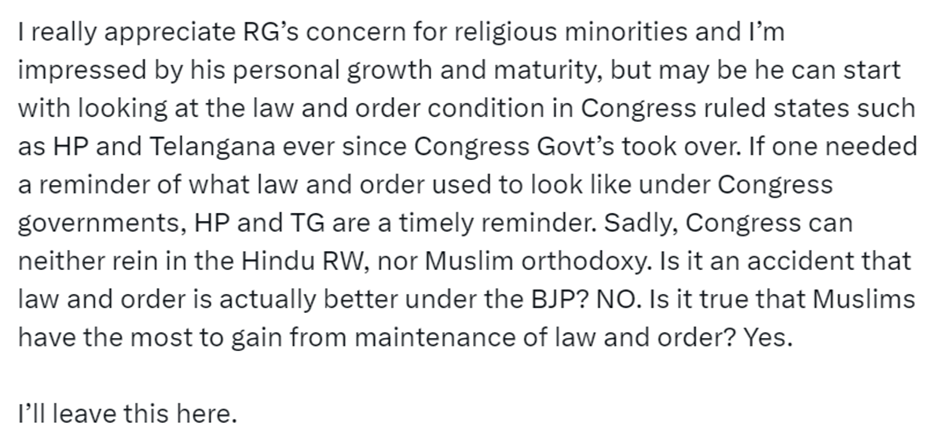
Before signing off, I wish to share this tweet by Shehla Rashid, which beautifully debunks the communal allegations against India.
Yesterday, a Muslim friend visited, and we ended up discussing religion. She’s a practicing Muslim but not overly devout; for instance, she only wears a hijab when her mother-in-law visits.
During our conversation, she shared something beautiful:
People do things in the hope of reaching paradise. There’s so much fear surrounding it. But no one has ever returned from death to confirm if paradise truly exists. What we have now is paradise, isn’t it? You and I, of different faiths, sitting here together, conversing, laughing, and enjoying each other’s company—what better paradise could there be?
I asked her how she developed this perspective when everyone around her follows religious rules so strictly. She said it might be because she attended a non-religious school instead of an Islamic one. She emphasized how important it is to interact with other communities rather than only associating with people from our own. Her husband shares the same outlook. While he offers Namaz five times a day, he hasn’t imposed any religious restrictions on his wife or children. They are the only ones in their family who approach religion this way.
This principle is applicable to all communities. The more we engage with people from different backgrounds, the more open-minded and accepting we become of diverse ideas and perspectives. Conversely, isolating ourselves can lead to more rigid and extreme viewpoints.
I believe this may be why Indians tend to integrate more easily in foreign countries. Growing up in a society where different faiths coexist has shaped our ability to adapt. This is why I feel we should be sharing our culture with the world rather than adopting foreign ones. India’s inclusive culture, which embraces all faiths, is truly beautiful. I hope we continue to honor and preserve it.










You must be logged in to post a comment.