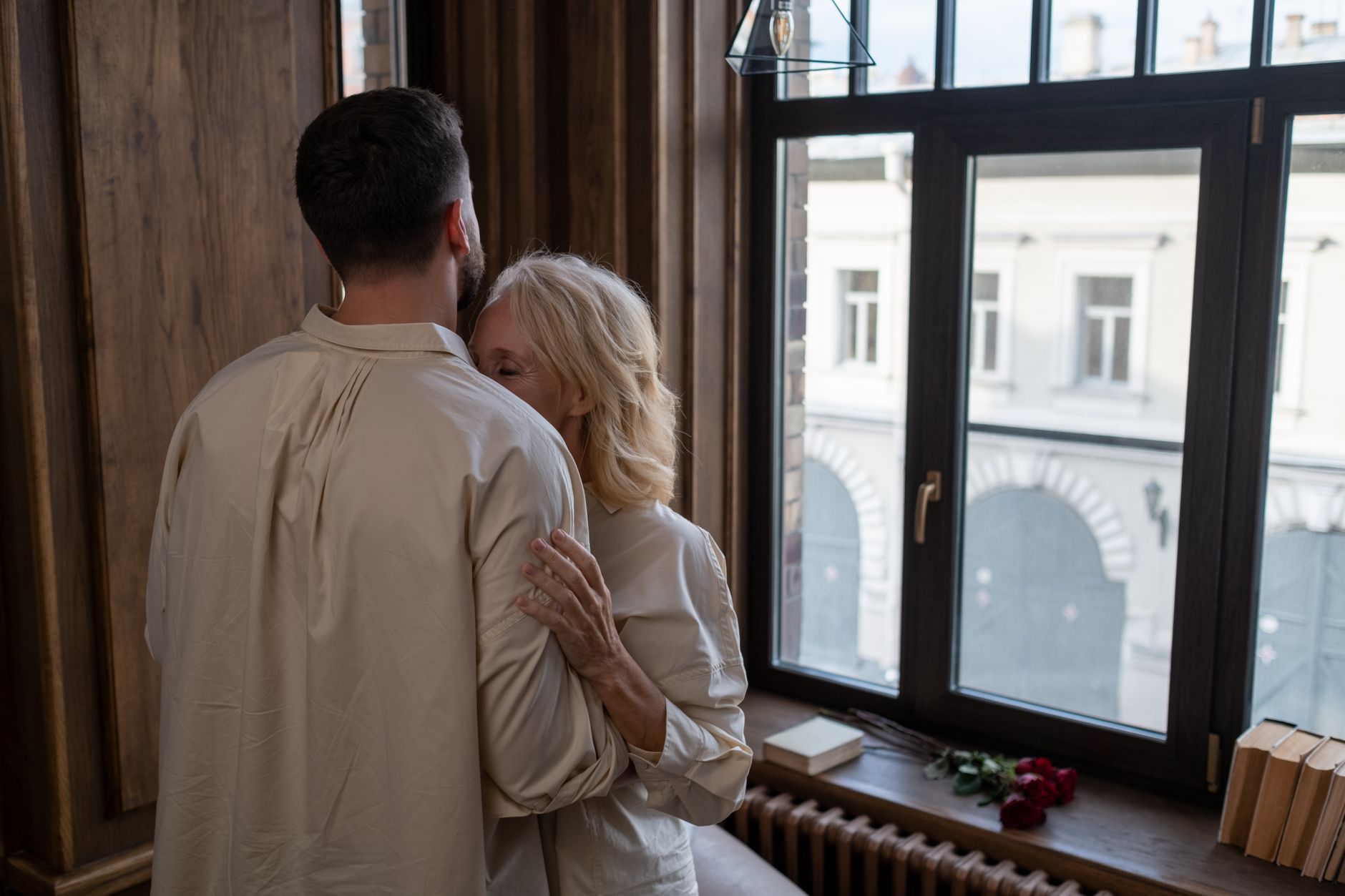
Gen-Z Men Pursuing Older Women: What Is Going On?

Image of Older Woman and Younger Man

One thing I have noticed about Gen-Z in India is that they are unhinged. I am not sure if it is the same case with Gen-Z around the world, but the ones in India truly seem to be. And no, I am not talking about student protests or anything political. I am talking about something much more personal.

As a 40+ unmarried woman, I have found myself being stared at by boys in their 20s while I am simply out and about. And interestingly, it is not the older men who are doing it. It is the younger ones, making their best attempts to lock eyes with me.

Apparently, according to what I keep seeing on social media, this is becoming a thing. There seems to be growing interest among younger men in dating significantly older women. Maybe it is a genuine preference. Maybe it is a fantasy. Maybe it is simply curiosity. From what I have read, many of these relationships don’t necessarily translate into long-term commitments, but the fact that younger men seem increasingly comfortable making their interest obvious is interesting in itself.

This changing scenario has resulted in books and movies exploring age-gap romances where the woman is older, like The Idea of You, as well as One & Only. One thing I’ve realised is that my mind is still not fully adapted to the idea of an age-gap romance. So when the lead characters make out, my first reaction is always, “OMG! But he’s just a kid!” Even when he’s actually a full-blown adult.

Now, getting to personal experiences. Recently, I mentioned my age to a boy in his 20s who simply wouldn’t look away.

His response?

“Age is just a number.”

So, apparently, that’s where we are now. Of course, this does not apply to all, because society at large age-shames women and finds older women unsuitable for relationships. But there is another part of this that I find much more interesting.

There is a very common, and frankly somewhat misogynistic, term for women who date significantly younger men: cougar.

Almost everyone knows the word. It has become so mainstream that you will find it casually used in movies, television, social media and everyday conversations.

But did you know there is a term for older men who pursue much younger women too?

Manther.

It is nowhere near as well known. In fact, I would bet that many people reading this have never heard the word before.

And that, in itself, says something about how we view relationships between older and younger people.

We are generally much more comfortable with men dating women who are 20 or 30 years younger, or even more. We rarely question it. “Love has no age,” we say.

Popular culture has reflected this dynamic for decades, with stories where an older man falls in love with a much younger woman being treated as perfectly normal, romantic or even aspirational.

But reverse the genders and suddenly the conversation changes.

An older woman with a younger man becomes a “cougar.” Her age becomes the focus. Her motives are questioned. She can be ridiculed, sexualized or shamed in a way that the older man in the equivalent relationship often isn’t.

And that brings me to something I genuinely wonder about.

How many people would actually be comfortable watching a mainstream movie where an older woman falls in love with a man 20 or 30 years younger than her, and the story treats their relationship with the same seriousness and romantic legitimacy usually given to an older man and a younger woman?

Would we call it a love story?

Or would we call her a cougar?

Maybe the younger generation really is changing some of these attitudes. Maybe the increased visibility of age-gap dating is slowly making older women dating younger men less unusual.

Or maybe we are simply becoming more comfortable talking about something that has always existed.

Either way, I find it fascinating that a 20-something can look at a woman in her 40s, hear her age, shrug and say, “Age is just a number.”

Perhaps Gen-Z really is unhinged.

Or perhaps they are just less bothered by rules that previous generations took for granted.

***

Photo by Ron Lach

I Almost Missed This Indonesian Horror Gem

Image of a scene from Wanita Ahli Neraka

I had this Indonesian horror movie on my watchlist for the longest time after seeing people on Reddit recommend it. Like many movie lovers, I often browse popular social media platforms for movie recommendations because that’s how I end up discovering hidden gems that I would probably never come across otherwise.

Wanita Ahli Neraka is an Indonesian horror movie that blends supernatural horror with themes of religion and women’s empowerment. One thing I appreciated was that the film does not disrespect religion in any way. Instead, it highlights how faith can be a source of strength in the fight against evil, while also showing how some people misuse religion as a tool for manipulation and control, which goes against the very values that religion stands for. At its core, the movie encourages women to stand up against injustice rather than silently accept it in the name of religion.

Interestingly, Wanita Ahli Neraka doesn’t have a high IMDb rating. I didn’t read the reviews because I generally avoid doing that before watching a movie. Over the years, I’ve realized that my taste often differs from both critics and general audiences. I’ve enjoyed plenty of movies with low ratings and disliked highly rated ones. Because of that, I prefer to watch a film first and form my own opinion instead of relying solely on reviews or ratings.

The lead performances by Febby Rastanty as Farah and Oka Antara as Wahab are excellent and add emotional depth to the story. The movie also has several effective jump scares along with a few disturbing scenes, so that’s something to keep in mind if you’re sensitive to horror.

If you’re looking for a horror movie with strong performances, nuanced themes, and genuine scares, Wanita Ahli Neraka is worth checking out.

Wanita Ahli Neraka is currently streaming on Netflix.

If You Were Locked in a Room with 10 Men for 10 Days

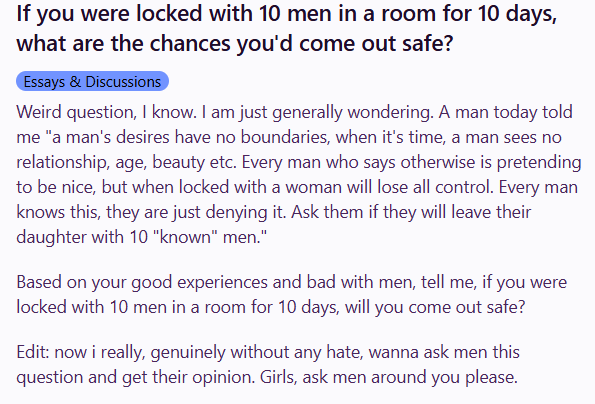
I came across this post on Reddit recently. It immediately made me think about my own experiences.

At the end of the day, it really comes down to energy, doesn’t it?

When I was in the North East, and it started snowing heavily, I stepped into a small shed with a heater. The shed was full of North Eastern men, including my guide. I was the only woman there at that moment.

And yet, I did not feel unsafe even for a second.

That moment stayed with me because it showed me something important about how we perceive safety while traveling or being around strangers.

Now imagine a similar situation somewhere else in India. There are some men I know personally, even a few colleagues, with whom I would feel uncomfortable being stuck in a small space. Not because they have ever done anything that could be complained about. Nothing like that. But the energy they give off simply does not make me feel comfortable.

Safety often has less to do with whether we know someone and more to do with the vibes they give off and whether we are comfortable with those vibes.

Many women will relate to this. We tend to have strong instincts when it comes to unsafe environments. Research often suggests that these instincts developed over time as part of human evolution. Women had to learn to read subtle cues in order to stay safe.

That is why sometimes we feel calm around complete strangers, while at other times we feel uneasy around people we already know.

If women were allowed to choose the people they would spend those 10 days locked up with, most of us would probably make the right call about who we feel safe around.

The real problem arises when that choice is taken away from us, and the men we are to be locked up with, whether known or unknown, are chosen by someone else. When that happens, the chances of discomfort or even unsafe situations naturally increase.

For me, that snowy day in the North East was a reminder that safety is not always about familiarity. Sometimes it is simply about the energy people carry, and the signals our instincts quietly pick up.

Haq: When a Film About Muslim Women Speaks to All Women

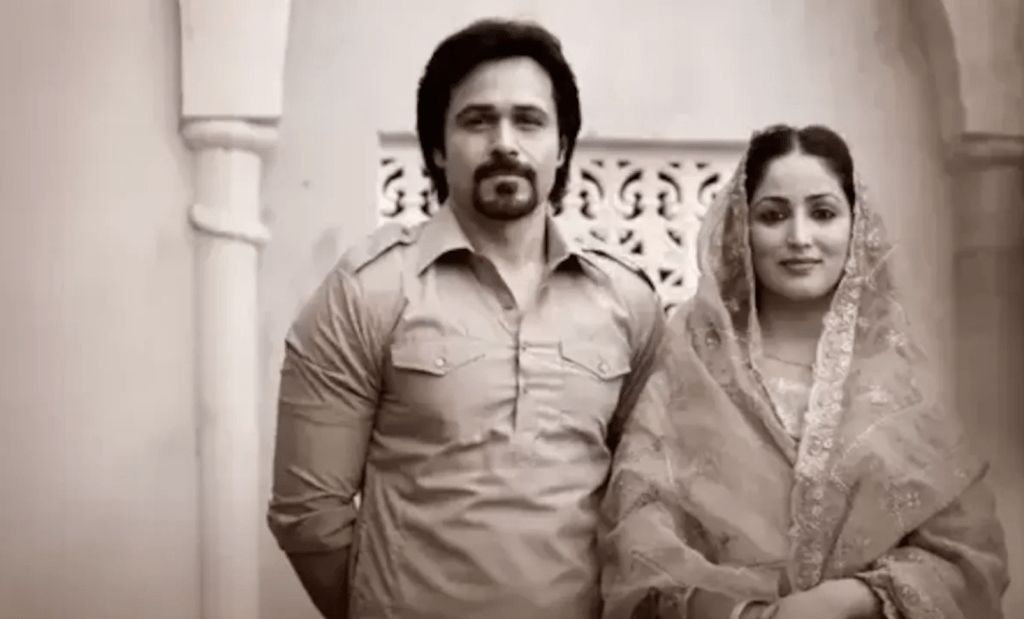
Haq Movie Poster

For the most part, Haq is not a story only about Muslim women. It is a story about women in general. Almost all of us know someone, married or unmarried, who has been cheated in love. We have seen that heartbreak up close, and we understand the emotional toll it takes.

When Shazia feels betrayed, we feel it too. When she wants the best for her children, that emotion feels familiar. When she fights for her rights, it resonates deeply. And when her father stands by her without hesitation, it reminds us of our own fathers and the quiet strength that support brings. These are emotions that are universal to women, cutting across religion, culture, and background.

The narrative becomes specifically about Muslim women only when the legal issues come into focus. That is where the real differences emerge, and the film clearly highlights how laws and systems can shape a woman’s fight for justice. It is to be noted that soon after the Triple Talaq ban was implemented in India, many Muslim women began approaching the courts to seek justice. While there was no open praise for the current government for such a ban, there was a quiet acceptance of the relief and protection the law offered them in real life. Many Muslim men, however, continue to view the ban as an insult to their faith rather than as a legal safeguard for women.

Getting back to the movie, Yami’s final monologue is powerful and leaves a strong impact. Emraan feels completely natural throughout and never once seems like he is performing. Sheeba Chaddha is equally convincing and brings depth to her role.

I especially want to credit Emraan for choosing to act in a film that openly talks about Muslim women’s rights. It takes conviction to support a story like this, especially as a Muslim, without dismissing it as Islamophobic. The film is clearly not that. Instead, it focuses on real issues and lived experiences, and his decision to back the narrative adds credibility and strength to the message being told.

Overall, I liked the film. The background music could have been better, and Yami is not fully convincing in a few scenes. Still, she more than makes up for it in the final act, which stays with you long after the film ends.

Haq is now streaming on Netflix.

An Ode to Feminichi Fathima

Feminichi Fathima Movie Poster

Feminichi Fathima is a Malayalam movie I had been waiting to watch for a long time. The film received strong appreciation at several film festivals. Many critics also spoke highly of it in their reviews. Now that it has finally released on OTT, the wait feels worth it. After watching the film, I can say it truly lives up to the praise it received.

The movie is a bold and thoughtful effort by director Fasil Muhammed to explore feminism from the perspective of a Muslim woman. This is a refreshing shift in Indian cinema, where feminist narratives are often shown through a cultural Hindu lens. Films like The Great Indian Kitchen (Mrs. in Hindi) and Thappad shaped much of that earlier conversation. Against that backdrop, this film feels timely and necessary. It adds a new voice to discussions on gender, faith, and everyday patriarchy.

What’s It About?

Fathima is married into a conservative and deeply religious family in the Malappuram district in Kerala. Her husband is a usthad (a religious leader) who expects his household to follow every rule without question. Life in the home is seen only through a strict, conservative lens.

Trouble begins when their young son wets the mattress. Fathima cleans it and leaves it outside to dry, but a dog later urinates on it. Since dogs are viewed as ritually impure, her husband reacts with anger and disgust. What follows is Fathima’s quiet struggle to fix the situation, facing resistance at every step.

The film makes a strong point that a woman in religious clothing can also be a feminichi (a slur often used by Malayalee misogynists to dismiss feminists).

Thoughts

Shamla Hamza and Kumar Sunil deliver standout performances. Shamla Hamza, in particular, is remarkable throughout the movie. It is hard to believe this is only her second project, after 1001 Nunakal, released in 2022. She performs with the ease and control of a seasoned actor. Her expressions carry much of the film’s emotional weight. Shamla winning the Kerala State Film Award for Best Actress feels well deserved. The storyline is fresh and quietly rebellious, which makes her performance even more powerful.

In many ways, the film feels braver than other feminist movies. Dissent is rarely encouraged in conservative Muslim families, which makes this narrative more powerful. The story shows how questioning norms itself becomes an act of courage. That is what sets this Malayalam feminist film apart. It opens space for conversations that are often silenced. Ideally, it will inspire more Feminichi Fathimas to speak up and stand for their rights.

Even though the subject is heavy, the movie never becomes overwhelming. It avoids melodrama and keeps emotions grounded. Light comedy is woven into the narrative. This balance makes the film feel surprisingly breezy. The pacing is tight and engaging throughout. You can easily watch the full 1.5 hours in one sitting without needing a break.

I would call this movie a must-watch for anyone interested in meaningful Malayalam cinema. Feminichi Fathima is now streaming on Manorama Max. You can also watch it via Amazon Prime with a Manorama Max subscription. English subtitles are available.

Movie Spotlight: Paradha

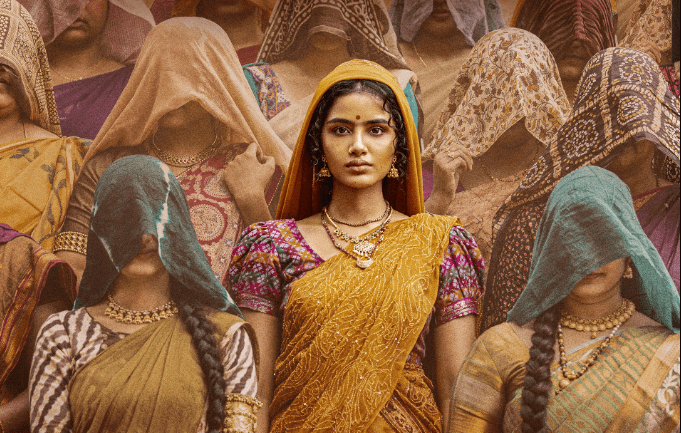
Paradha Movie Poster

I actually wanted to watch Paradha in the theatre, because I thought the cast was interesting. It had my lovely curly-haired favourites: Anupama Parameshwaran and Darshana Rajendran, who are known faces in the South. But then I got caught up with other priorities and missed booking a ticket that weekend. Later, I came across some reviews that made me second-guess whether it was worth watching on the big screen and decided to skip going to the theatre. Recently, when it was released on Amazon Prime, I finally decided to watch it.

The movie made me realize that not every review online is meant for you. Reviews often reflect the reviewer’s personal taste, but we tend to assume we’ll feel the same way. I’ve had similar experiences with other films, too, where the reviews were harsh, yet I ended up enjoying them. I still don’t get the importance of movie reviews, because whether we like a movie or not is subjective. But here I am, giving my own movie reviews from a highly subjective viewpoint. I think we should treat reviews as such: personal opinions of someone who loves watching movies, and not the absolute truth.

What’s It About?

Paradha, true to its name, centers on Subbu (Anupama Parameshwaran), a young Hindu woman from a remote Indian village where the tradition of paradha (dupatta veiling) is strictly practiced. While this custom is largely cultural in many parts of India, the film presents it as a religious mandate. The villagers worship Goddess Jwalamma, who they believe commanded that women remain hidden behind a veil. From puberty onward, every girl is forced to follow this rule, with severe consequences for defiance. Subbu, however, finds herself caught in a controversy that threatens her marriage to the man she loves.

Thoughts

Though the story begins with a devout woman who strictly follows religious practices, Paradha is not just about her. It portrays women from different walks of life, each facing gender discrimination in unique ways.

The first woman is deeply religious, bound by the strict purdah or dupatta system. The second, married outside the village, has left purdah behind but remains traditional in other aspects. The third rejects religious traditions altogether, embraces modern values, and focuses on her career. The fourth is a policewoman who’s happily married, enjoying full freedom, and choosing to follow certain traditions out of personal preference rather than compulsion. The movie keeps the narrative balanced this way.

Paradha is a feminist film centered on women’s empowerment, and it may not appeal to everyone. It highlights how women, even the most progressive, continue to face discrimination, no matter how far they try to escape from it.

I really enjoyed the movie. The climax was chilling, and the performances, especially by Anupama Parameshwaran, Darshana Rajendran, and Sangeetha, were superb. It’s a brave film, because criticizing patriarchy is never easy. Often, women themselves defend restrictive practices by saying, “It’s our choice.” But true choice exists only when opting out doesn’t bring harsh criticism or punishment. Many women follow norms not out of freedom, but because they have no other option. The movie captures this truth powerfully.

Paradha is now streaming on Amazon Prime. I watched it in the original Telugu with English subtitles.