I recently came to know that there is an Apple TV series based on Bonnie Garmus’s Lessons in Chemistry. Still, like many book lovers who believe the original story is always better than any adaptation, I chose to read the book first. And I am glad I did.
Lessons in Chemistry is warm, quirky, and emotional. It begins at a quick pace and later slows down to let the reader focus on how the characters are feeling. The fictional novel explores women empowerment, career, ambition, love, grief, and self discovery.
The story is about two unconventional scientists who view the world through logic. Their relationship feels unusual to others because their conversations revolve around research, experiments, and what most people would call nerdy banter. But the connection they feel with each other is real. They believe they are soulmates.
The female scientist eventually steps into an unexpected phase of her life and has to leave her career only to soon become the host of a cooking show. The show goes on to gain popularity dude to her unique, scientific approach towards food. She treats every recipe like a science experiment. She explains why each ingredient matters and the chemical composition that affects taste and cooking. This fresh perspective inspires her audience and transforms the way they think about cooking.
If you enjoy fiction that blends romance, feminism, science, and character driven storytelling, Lessons in Chemistry is worth adding to your reading list.
I also want to list some of my favourite thought-provoking quotes from the book. Hope you enjoy them as much as I did.
One thing I’ve learned, Calvin: people will always yearn for a simple solution to their complicated problems.
It’s a lot easier to have faith in something you can’t see, can’t touch, can’t explain, and can’t change, rather than to have faith in something you actually can.
From his own lessons, he knew repetition was important. The key was not to overdo the repetition—not to make it so tiresome that it actually had an inverse result and caused the student to forget. That was called boredom. According to Elizabeth, boredom was what was wrong with education today.
No wonder people didn’t understand animals. They could barely understand each other.
Having a baby, Elizabeth realized, was a little like living with a visitor from a distant planet. There was a certain amount of give and take as the visitor learned your ways and you learned theirs, but gradually their ways faded and your ways stuck. Which she found regrettable. Because unlike adults, her visitor never tired of even the smallest discovery; always saw the magic in the ordinary.
“What I find interesting about rowing,” Dr. Mason was saying, “is that it’s always done backwards. It’s almost as if the sport itself is trying to teach us not to get ahead of ourselves.” He opened his car door. “Actually, when you think about it, rowing is almost exactly like raising kids. Both require patience, endurance, strength, and commitment. And neither allow us to see where we’re going—only where we’ve been. I find that very reassuring, don’t you? Except for the flip-outs—of course. I could really do with fewer flip-outs.”
But as she read, she’d found herself wondering—did the artist ever get distracted? Ink an asp instead of a goat? And if so, did he have to let it stand? Probably. On the other hand, wasn’t that the very definition of life? Constant adaptations brought about by a series of never-ending mistakes?
“I don’t have hopes,” Mad explained, studying the address. “I have faith.” He looked at her in surprise. “Well, that’s a funny word to hear coming from you.” “How come?” “Because,” he said, “well, you know. Religion is based on faith.” “But you realize,” she said carefully, as if not to embarrass him further, “that faith isn’t based on religion. Right?”
“Whenever you start doubting yourself,” she said, turning back to the audience, “whenever you feel afraid, just remember. Courage is the root of change—and change is what we’re chemically designed to do. So when you wake up tomorrow, make this pledge. No more holding yourself back. No more subscribing to others’ opinions of what you can and cannot achieve. And no more allowing anyone to pigeonhole you into useless categories of sex, race, economic status, and religion. Do not allow your talents to lie dormant, ladies. Design your own future.
When you go home today, ask yourself what you will change. And then get started.”
I recently watched Nobody Wants This Season 2. If you haven’t seen Season 1 of this Netflix series, I really think you should. It deals with a topic that most interfaith love stories never touch — conversion. It’s a sensitive issue, especially among Abrahamic religions. So it felt quite bold that the makers decided to go into it at all.
Season 1 had already touched on the idea of conversion. But Season 2 takes it a little further. This time, you see the boyfriend, who is a Jewish rabbi, and his family, constantly pushing his Christian girlfriend, who seems more atheist or maybe agnostic, to convert. It adds a new layer to their story and makes the whole situation feel even more complicated.
However, this post is not a detailed review of the series, but the many thoughts that came to my mind while watching it, mainly concerning conversion and how it is seen in India.
There are many abroad who have a distorted idea of religious freedom in India, no thanks to misleading, half-baked news articles, often written by left-leaning Hindus or non-Hindus, and I wish to debunk those notions as well and present them from the perspective of a centre-right Hindu who was, till two years ago, a leftist.
Be prepared for a long post, because this is a topic I feel strongly about. If you’re short on time, you may want to save or bookmark it and read it when you’re free.
A Hindu’s View on Conversion
Before I begin, I want to make my religious beliefs clear. I’m not a religious Hindu in the traditional sense, but I’m still a staunch Hindu. If that sounds confusing, it’s only because Hinduism allows this kind of pluralism. You can be spiritual, non-religious, or even an atheist, and still remain Hindu.
The faith makes space for many ways of thinking, which is why someone like me fits comfortably within it. I’m not ostracized for eating beef, nor am I ostracized for not following religious beliefs properly. I can question and I can push back against religious rules I don’t believe in without repercussions.
This freedom that my belief generously allows me is exactly why I strongly stand by the community and call myself a “staunch Hindu.” I advocate for the rights of my community, which a religious Hindu in India may not always do, as they wish to appear secular and tolerant of even the injustices against us.
Now that my beliefs are out of the way, I want to say that even as a non-traditional, progressive Hindu feminist, I don’t support conversion. I don’t understand why anyone has to give up their identity for love, marriage, or even politics, no matter how much anyone would try to justify it.
Most Hindus in India feel the same way, which is why you rarely see the community protesting against anti-conversion laws in some states. Among ourselves, we often say the same thing quietly: “What’s the need to convert?” Of course, many reasons are given. I address them later in this post.
Then we see Indian-origin Hindu politicians in America converting to Christianity to stay relevant and gain acceptance, and it makes us pause. It makes us wonder, “Is America really the land of the free?” And on what basis do they judge India on religious matters when they themselves have not reached full religious secularism yet?
However, in Abrahamic religions, conversion is considered a matter of freedom of faith. This is acknowledged. But this is also a major reason for communal tensions in a Hindu-majority country like India. Most Hindus do not believe in conversion or proselytization, while Abrahamic faiths consider it a part of their practice.
Hindus are of the belief that everyone should be free to practice their faith without disturbing others or disrespecting anyone else’s faith. Proselytization goes against that idea. It feels disrespectful because it implies someone’s existing faith is not good enough. It involves putting down those beliefs, so they are convinced enough to join the new one. So, this “freedom of faith” often comes at the expense of disrespecting others, which was tolerated for the longest period of time, till the Hindu community got the strength to say “enough is enough.”
This pushback is the part that’s often presented to the world as a “lack of religious freedom” in India. Or, to put it more frankly, the lack of freedom to convert Hindus. This clash of beliefs has no solution, and I see it continuing even after a change of government. It’s a label the country has to live with, because there can be no middle ground when people feel their identity is being erased.
A thought I often hear is, “There are so many Christian-majority and Muslim-majority countries in the world. Why can’t they just leave us alone?” It reflects the frustration many Hindus feel when they see constant pressure to convert despite already being a global minority.
Pressure to Convert in Interfaith Marriages
The topic of conversion in marriages is prevalent in Indian Reddit circles. Almost every other day, you see someone saying, “My partner’s parents want me to convert. What should I do?”
From what I’ve seen, it’s usually the Hindu who is expected to convert. And often, the Hindu partner is unaware of what that really means. They hear lines like, “You just need to get baptized. After that, you can follow your own culture,” and they assume there’s no conversion involved. Many agree because they don’t realize the deeper implications. We walk into these situations thinking others are as pluralistic and flexible as we are, and that’s where the misunderstanding begins.
Conversion is also very normalized. When I ask my Christian friends if someone needs to convert to marry into their community, they casually say “yes,” as if it’s the most ordinary thing in the world.
We recently saw this when JD Vance openly and coolly said he hopes his wife, Usha Vance, a Hindu, converts someday. Ironically, the same line appears in Nobody Wants This Season 2 as well, where the Jewish rabbi says he hopes his Christian girlfriend converts one day.
For us Hindus, it’s a culture shock, almost regressive, because we never expect something like this from others. At the same time, Abrahamics and international news channels are confused when they report that there’s outrage in India over Vance’s statement. They have no idea why Hindus are angry. So they brand it as “far-right Hindutva.”
Why Do Hindus Dislike Conversion?
Most Hindus find the idea of conversion strange, because the religion itself accepts that God can appear in many forms. It is naturally pluralistic. So someone like me, who is not religious, or even someone who is an atheist, is still seen as a Hindu, because schools like Carvaka already accept that. We also tend to readily accept other gods because of this pluralism. We don’t consider them as fake. We don’t believe that ours is the “only true god” either.
This pluralistic mindset of Hindus is both a boon and a bane. A boon because we naturally accept all faiths, and a bane because we expect the same openness from others, and we don’t always receive it.
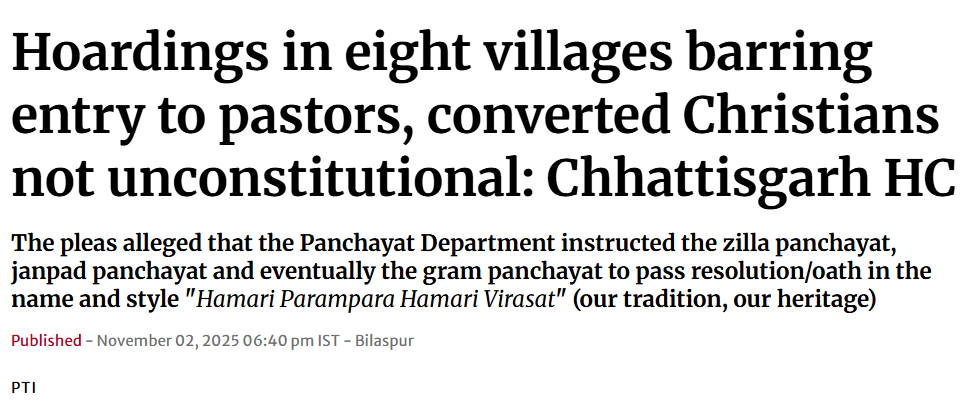
On top of that, many Hindus today focus more on careers and less on having children. So there is a natural tendency to protect the current Hindu population from inducements. The Chattisgarh High Court reiterated the same thing recently:
Chhattisgarh High Court Condemning Induced Conversions
With all this in mind, it’s natural that the majority of Hindus don’t look at conversion in a positive way. Our faith is already mocked by many Abrahamics around the world, who use words like “demon-worshipping pagans.” This makes it even more important to push back against that narrative and simply exist as we are.
Hindus, in short, want the freedom to be seen and respected in their own identity. But this way of thinking is often dismissed by, ironically, the very same people who speak loudly about secularism and freedom of religion. If others believe Hindus can be freely converted, then Hindus also have the right to openly object to it.
Ghar Wapsi
Now, some may argue that even Hindus encourage conversion in the form of Ghar Wapsi (reverting to Hinduism). However, Ghar wapsi is not a core part of Hinduism. It is more of a reaction to the aggressive conversions that have been happening in the country.
Most people I know converted to Abrahamic religions because of perks, not out of faith. They were poor and needed money. They were promised financial benefits if they converted. The fact that they are openly admitting this is nothing any faith should feel proud of. The only reason to convert to another faith should be faith itself. You should feel that the new faith and its principles are right for you, not be influenced by inducements or pressure.
If you ask why the Hindu side can’t match these perks, the answer is simple: we don’t have multiple Hindu-majority nations funding such activities. India is the only major Hindu-majority country, so the playing field is not equal.
Ghar Wapsi is simply an attempt, based on faith alone, to help those who genuinely want to return to Hinduism.
Arguments Used to Justify Conversions in India
1. Charity
There’s this belief that the money given during conversions is out of pure kindness. But I know many Christians who are struggling, working extra hours just to manage their basic needs. If the intention is genuine help, why not support them first?
And, most importantly, why should any help come with the condition of conversion?
Real help doesn’t demand a change of faith. If it does, you have to wonder whether it’s truly help or part of an agenda.
2. Caste Discrimination in Hinduism
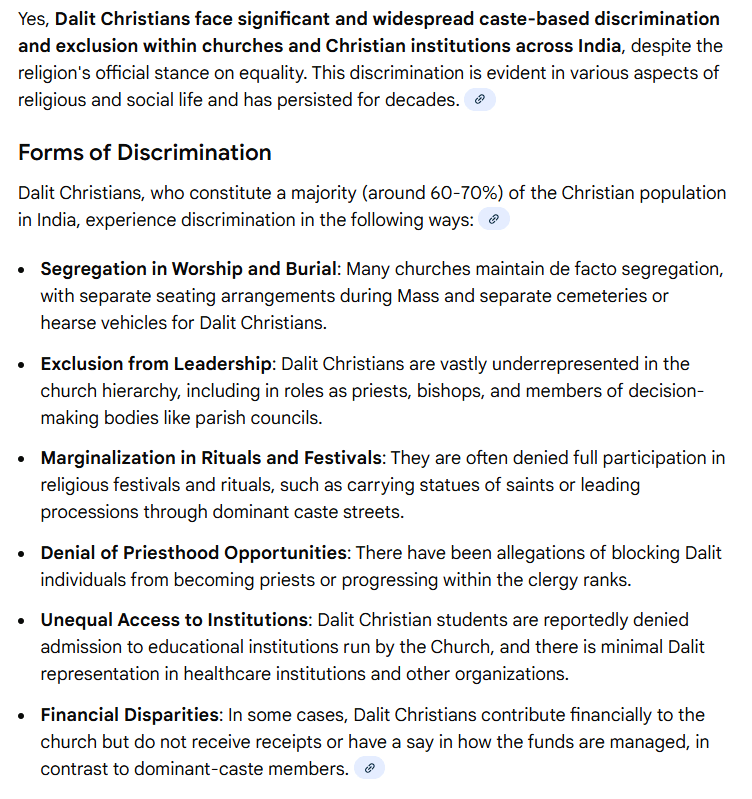
It’s also misleading to say that converted Christians escape discrimination to enter a better way of life after they leave Hinduism. Many are treated as “lower-level” Christians, and some have even gone back to Hinduism because of this.
Source: New Indian Express (July 2025)
Additionally, consider the points made below (took help from Google Search AI):
One person told me about a convert in her family who wants to return but cannot, because they signed a financial help agreement that now holds them back.
The good thing is that the caste system within Hindu society is slowly being dealt with. Families are becoming more open to inter-caste marriages, including in my own family. This change is happening faster in the South than in the North. It’s not perfect yet, but progress is real. In this situation, constantly blaming a community that is actively trying to fix the problem does not help.
Yes, many Hindus still support caste, and as long as they exist, the issue will continue. But this divide is also kept alive by leaders, both political and religious, because it benefits them. If caste truly disappears, many of these leaders lose their power to divide or convert Hindus, and that is why the system hasn’t faded away completely.
Instead of building bridges, the “narrative builders” choose to burn them by feeding divisive stories, which only pushes people of different castes further apart. Missionaries often highlight caste discrimination so aggressively because it helps them drive conversions. So you have to ask — are they really helping, or are they using the problem to serve their own goals?
4. Freedom of Faith
The tricky side of conversion in India is that Hindus openly say they are against it. But in Kerala, I often see Christian groups shift their stand based on who is converting and to which religion. They welcome anyone who joins their faith, but they loudly object when someone chooses to leave it.
Churches often use the term “love jihad” when a Christian woman converts to Islam for love. Yet the same groups talk about “freedom of faith” when a Hindu woman converts to Christianity for love.
Since both Abrahamic religions support proselytization as part of their belief system, you would expect them to be supportive of conversions into each other’s religion. But that rarely happens.
Complications of Conversion in Interfaith Relationships
Spoiler Ahead for Nobody Wants This Season 2
Click to reveal spoiler
Considering the many unwanted complications related to conversion, I was really hoping the female character in Nobody Wants This would take a stand. I wanted both partners to accept that two religions can live side by side without one needing to disappear. The ending didn’t go the way I hoped, but since there’s a Season 3 coming, I’m hoping they fix things and take the story in a better direction.
*Spoiler Ends*
In many interfaith relationships, I notice that the Hindu partner often gives in to the Abrahamic faith — if not through marriage, then through the children.
Take Usha Vance, for example. All three of her children were baptized because her husband couldn’t accept the kids growing up Hindu. That feels like a loss of her own identity. It shows that even an educated woman like her is not fully protected from this pressure.
If it were up to me, ideally, I would want the kids to grow up with both religions. But if we had to choose one religion for my “imaginary” children, I would fight hard to raise them in my own. Purely because Hinduism is naturally pluralistic, and it doesn’t invalidate any other faith. It would also matter to me because Hindus are a global minority, while the other religions face no existential crisis. It’s like the global majority religion being generous enough to make space for the growth of the minority.
Also, if I had to pick, I would choose a court marriage. But if the partner insists on a religious ceremony, then it would have to be a temple wedding. You don’t need to convert for that. You only need to respect the rituals. It’s simple, fair, and inclusive.
This is probably why I feel an interfaith marriage may not work for me. I believe in equality between religions, while an Abrahamic partner may not always see it the same way. There would be constant tension, and I am not the kind of Hindu who would compromise on my identity.
When I was younger, I probably would not have thought this way. Back then, love felt like everything. But growing older makes you see the bigger picture.
Pushback Against Conversions in India
More Hindus today realize that they don’t need to give up their beliefs for anything, which is why you see fewer people willing to convert.
Hindu Villagers in India Fighting Back Against Conversion
This awareness is slowly growing. I recently saw a post on Reddit where an Indian Christian said they felt sad that many Hindus in India are no longer open to conversion or to “the way of the Lord.” To me, this is actually a positive sign for the Hindu community. It shows that more people are choosing to stay firm in their identity.
And honestly, this should be true for every religion, because love and true secularism do not require anyone to change who they really are.
I actually wanted to watch Paradha in the theatre, because I thought the cast was interesting. It had my lovely curly-haired favourites: Anupama Parameshwaran and Darshana Rajendran, who are known faces in the South. But then I got caught up with other priorities and missed booking a ticket that weekend. Later, I came across some reviews that made me second-guess whether it was worth watching on the big screen and decided to skip going to the theatre. Recently, when it was released on Amazon Prime, I finally decided to watch it.
The movie made me realize that not every review online is meant for you. Reviews often reflect the reviewer’s personal taste, but we tend to assume we’ll feel the same way. I’ve had similar experiences with other films, too, where the reviews were harsh, yet I ended up enjoying them. I still don’t get the importance of movie reviews, because whether we like a movie or not is subjective. But here I am, giving my own movie reviews from a highly subjective viewpoint. I think we should treat reviews as such: personal opinions of someone who loves watching movies, and not the absolute truth.
What’s It About?
Paradha, true to its name, centers on Subbu (Anupama Parameshwaran), a young Hindu woman from a remote Indian village where the tradition of paradha (dupatta veiling) is strictly practiced. While this custom is largely cultural in many parts of India, the film presents it as a religious mandate. The villagers worship Goddess Jwalamma, who they believe commanded that women remain hidden behind a veil. From puberty onward, every girl is forced to follow this rule, with severe consequences for defiance. Subbu, however, finds herself caught in a controversy that threatens her marriage to the man she loves.
Thoughts
Though the story begins with a devout woman who strictly follows religious practices, Paradha is not just about her. It portrays women from different walks of life, each facing gender discrimination in unique ways.
The first woman is deeply religious, bound by the strict purdah or dupatta system. The second, married outside the village, has left purdah behind but remains traditional in other aspects. The third rejects religious traditions altogether, embraces modern values, and focuses on her career. The fourth is a policewoman who’s happily married, enjoying full freedom, and choosing to follow certain traditions out of personal preference rather than compulsion. The movie keeps the narrative balanced this way.
Paradha is a feminist film centered on women’s empowerment, and it may not appeal to everyone. It highlights how women, even the most progressive, continue to face discrimination, no matter how far they try to escape from it.
I really enjoyed the movie. The climax was chilling, and the performances, especially by Anupama Parameshwaran, Darshana Rajendran, and Sangeetha, were superb. It’s a brave film, because criticizing patriarchy is never easy. Often, women themselves defend restrictive practices by saying, “It’s our choice.” But true choice exists only when opting out doesn’t bring harsh criticism or punishment. Many women follow norms not out of freedom, but because they have no other option. The movie captures this truth powerfully.
Paradha is now streaming on Amazon Prime. I watched it in the original Telugu with English subtitles.
I think a lot about how we as a culture have turned “forever” into the only acceptable definition of success. Like… if you open a coffee shop and run it for a while and it makes you happy but then stuff gets too expensive and stressful and you want to do something else so you close it, it’s a “failed” business. If you write a book or two, then decide that you don’t actually want to keep doing that, you’re a “failed” writer. If you marry someone, and that marriage is good for a while, and then stops working and you get divorced, it’s a “failed” marriage.
The only acceptable “win condition” is “you keep doing that thing forever”. A friendship that lasts for a few years but then its time is done and you move on is considered less valuable or not a “real” friendship. A hobby that you do for a while and then are done with is a “phase” – or, alternatively, a “pity” that you don’t do that thing any more. A fandom is “dying” because people have had a lot of fun with it but are now moving on to other things.
I just think that something can be good, and also end, and that thing was still good. And it’s okay to be sad that it ended, too. But the idea that anything that ends is automatically less than this hypothetical eternal state of success… I don’t think that’s doing us any good at all.
It’s never “the person successfully got out of a bad marriage or bad friendship,” which, in my opinion, is one of the toughest things to do, at least in India. There are always a hundred people telling you to save the marriage or friendship, even if it sucks your soul. They go all out to make you feel guilty. When you do manage to get out of it eventually, it’s labelled a “failed” relationship.
Have we got our definition of success all wrong? The way it stands today, it often makes us cling to things that are no longer healthy, just for the sake of appearances. We try to make them work, even when we know they’re a lost cause, because society’s approval depends on it. We want people to look at us from afar and say, “Yes, they’re doing well in life.” This happened to me when I was trying to get out of my bad marriage. Society did not see my anguish; they simply wanted me to save the marriage.
Over time, I’ve grown less dependent on that kind of validation. Experience teaches you that to find true happiness, you need to first understand what happiness is to you, not others. I no longer feel the need to prove anything to anyone. There’s a calmness that comes with stepping out of the race. But it does not come without effort. In a world that constantly pushes you to do more, choosing to stay still and steady is often misunderstood. Living a life that balances financial independence (not luxury) with peace of mind rarely gets branded as “success.” However, luxury and fame without peace of mind are often labelled as the ultimate life.
Success takes on different meanings, even outside personal or professional life. Take politics, for instance. Many Indians see Modi’s stance against Trump’s tariffs and his refusal to bow down to demands (such as where India should purchase their oil from) as a mark of success. Others, however, view it as a diplomatic setback for India. And then there are those who believe it was actually a diplomatic failure for the U.S., considering India is among the fastest-growing economies in the world.
Of course, success looks different for everyone. We judge others by our own yardsticks. But clarity comes when you start asking yourself:
What do I actually want? Do I want wealth in heaps, or do I want balance?
What are the trade-offs, and am I okay with them?
How long am I willing to sacrifice? Am I truly passionate enough to give up other things I hold dear for this one pursuit?
When you have that honest conversation with yourself, defining success on your own terms rather than society’s, life feels lighter. And you stop depending on others for validation and how you should live your life. This does not apply to kids and young adults, though, who still need guidance on how to navigate life. A child cannot simply say, “Screw studies, it makes me upset,” and get away with it in the name of freedom of choice.
Effort is important, but so is knowing when to hold on and when to let go. True freedom comes only after achieving some level of financial independence. So that should be the first pursuit, regardless of gender.
We are a generation obsessed with climbing the corporate ladder. We want to make a lot of money and afford the best things money can buy. This is not necessarily a bad thing. Ambition is an admirable quality that many people aspire to possess. It takes you places. We all wish to do well in our respective careers and live the high life. But, it often comes at the expense of our health.
Enduring long periods of work-related stress may keep our bank balance happy, but when it’s time to relax, our entire being goes into a state of confusion. We have never been taught how to unwind. Since childhood, we’ve been taught to persevere and avoid rest. However, when we do take some time to catch a breather, restlessness uncannily creeps in. Before we know it, we find ourselves caught up in another stressful endeavor. Eventually, there comes a burnout point when our body and mind scream for a break, and our entire system goes into hibernation mode.
Doctor Slump is a k-drama that focuses on this particular phase in our life trajectory.
What’s It About?
Two doctors who were school rivals meet each other again at a turning point in their careers. They find comfort in each other, helping one another manage their mental exhaustion and insecurities in life.
Thoughts
The highlight, or rather highlights, of Doctor Slump are the characters. Park Hyung Sik is back to his quirky avatar, which he portrayed convincingly before with much fanfare in k-dramas like Strong Girl Bong Soon and The Heirs. It is difficult not to like him. His comedy timing is impeccable, and you end up feeling a sense of comfort watching him on-screen. Park Shin Hye aces her role as well. The moment she and Park Hyung Sik break down in tears while sitting on a bench is one for the books. I have not seen a scene like that in a web series or movie. The beautiful words in the background add to the overall vibe of the scene. Their chemistry will make you smile.
The downside of the series is, unfortunately, the story. Although Doctor Slump starts strong, it loses momentum after the 6th or 7th episode. You find yourself losing interest. However, you stick on because you love the characters.
If you are looking for some comic relief and an empathetic take on mental health, I would recommend Doctor Slump. It’s great to see a series promoting work-life balance amidst hustle culture.
All episodes of Doctor Slump are now streaming on Netflix. It has 16 episodes, with each episode lasting an hour.
Recently, I posted being concerned about my performance appraisal this year as the previous ones did not go well. I have some news to share – I finally got good feedback! This is a reason to celebrate, as my head was clouded with self-doubt over the past year, and I questioned my work quality. “This is the only type of work I believed I was good at. Am I not as good as I think?”
When managers take time to appreciate your work, your confidence hits a different level. It’s the type of reassurance every hard-working employee deserves.
Needless to say, I am over the moon. If you had gone through my past appraisal posts, you would know how distraught I was. I gave it my best this year and wondered if it would be enough as my confidence was quite shaken. But it ended well (this year, at least). Now, the challenge is to maintain this level of performance.
I am not exactly sure what I did right this year, but I am sharing one key takeaway.
I know the internet is filled with advice on avoiding interacting with difficult managers as much as possible. I did this initially. I was intimidated by my managers and found it challenging to reach out to them. They weren’t particularly friendly either. So my solution was to avoid them. My advice is: don’t.
Try increasing your interactions with them to a point you no longer feel intimidated by their presence. I started asking questions regularly, reaching out for discussions, and becoming more proactive. Initially, it felt tough, as anyone would feel uncomfortable interacting with someone who intimidates them. But then, things started getting better. My fear was gone as I trained myself to approach them more. This helped me ask better questions and seek their help if needed. This, in turn, improved my work.
I realized they weren’t criticizing me on purpose. I did lag in some areas. When you are only given negative feedback, your first impulse is to escape. I almost thought about quitting, thinking maybe they disliked me for other reasons.
At this point, I can’t help but think how many employees must have quit their jobs because they couldn’t take criticism. We see posts about “work where you will be appreciated.” Sometimes, we need to take time to reflect on whether it is really them who should work on appreciating us or if it is actually us who need to make improvements.
Yes, some managers will not like you or your work, no matter how hard you try. You need to change your job for peace of mind in such cases. But often, that’s not the issue. Sometimes we overthink and overanalyze things and make decisions on the spur of the moment. Like quitting. When we quit, we stop ourselves from learning from our mistakes.
Learning only happens when someone points out the areas you need to improve. Some managers communicate this empathetically and effectively, but some might take a different route.
Not every manager excels at communication. As long as a supervisor doesn’t abuse or resort to toxic, manipulative techniques, employees should reflect on what is needed, reach out, ask questions, and work accordingly.








You must be logged in to post a comment.