In a world where extroverts are admired and introverts are judged, a book like Quiet by Susan Cain can prove transformative. It might be because Susan Cain herself is an introvert. No one can truly understand an introvert better than another introvert. Extroverts who have taken the time to introspect and reflect on an introverted loved one’s personality trait might also understand and respect introversion. However, they are few and far between.
For most of my life, I was told to talk more, be more extroverted, or “smart”. My introversion was considered a defect, more like a disease I needed to be cured of. I believed it to be true as no one told me otherwise. It wasn’t until I discovered the internet that I realized there are others like me. I was relieved to find people who shared the characteristics that I thought were unique to me. It provided much-needed validation. I started understanding introversion. I started understanding myself from the lens of a new unacknowledged world.
Introverted kids often feel like a misfit because of the constant judgment. Is it any surprise that they often grow up to become shy and underconfident? Nothing undermines someone’s self-confidence more than being repeatedly told they are not okay the way they are.
People find it hard to accept that I’m an introvert now that I’m an adult. I play my part well. Or rather, I have trained myself to play the extroverted part well. I have learned over the years to create this impressionable extroverted façade to gain acceptance into this world of Extrovert Ideals, all for the sake of attaining “normality”. However, I can keep up the act only for a few hours before I feel this mad urge to rush back home to re-energize – in short, to slip into my pajamas and dive into the comfort of books.
Susan Cain covers this façade (of extroversion) and more in her book. The case studies covering different aspects of introversion are a revelation. In the real world, extroversion still gets the upper hand at school, work, and every phase of life. Your competency is determined based on how extroverted you are. The book explores why a teacher, parent, or employer needs to understand the quantifiable benefits introversion brings to the table. The author explains how to reach out to the hidden treasures buried among the buzz and commotion. The solution is pretty simple: the world only needs to stop talking for a little while, introspect a bit, and try listening instead.
The Sandwich Feedback Method is a kind of feedback model that allows leaders to formulate any kind of feedback to their subordinates positively. This kind of method ensures the employees do not feel demotivated or left with negative feelings after a performance review. You might have seen this technique being used in Shark Tank.
It is arguably the best way to provide feedback to someone, but not many use it. I have never seen it happen. But it is one of those dreamy feedback mechanisms that I hope would be the norm someday.
There are three layers to the sandwich method:
Start with a positive message: Tell your employee what you admire the most in their work. If they are disciplined, hard-working, innovative, and eager to learn new things – you can start by saying that. If they had done something noteworthy in the last couple of months, point that out. Often, employers skip mentioning the positives at the time of feedback. When you say positive things first, you make the employee more comfortable and open to what’s coming up next – constructive criticism. This does not mean you have to lie. Look deeper into how the person works or interacts; you will always find something worth complimenting. If you can’t find anything, chances are you’re facing a mental block that is stopping you from seeing the positives. Try harder!
Constructive Feedback: The second layer is the meat. This is where you provide the feedback that could have been construed negatively by the subordinate if it were to be given first. Keeping it second in line gives the employee enough time to develop a positive mindset about what’s to come. Constructive feedback, even if it’s the second layer of the sandwich method, should be handled with care. Do not appear brash and rude in the name of honesty. Repeat the sentences back to yourself and ask, “Would these words hurt me if I’d heard them from my boss?” If yes, reframe the feedback. Avoid an accusatory tone, and provide solutions on how they can implement the feedback you have given.
The Final Slice of Happiness: Now that you have given your feedback, finish the session with a positive message again. Something to the tune of, “We know you can do what is expected. You are capable.” A final motivational note can inspire any employee to kickstart what is required of them.
When an employee leaves a performance review or feedback session feeling more motivated than dejected, you know you are a good leader. Feeling discouraged can rob a person from doing their best possible work out of anxiety. Fear-mongering is not the characteristic of an efficient leader and should be avoided at all costs.
The Sandwich Feedback Method can also be used in your personal life to provide feedback to your friends and family members.
Give the Sandwich Method a trial run and see what happens. You have nothing to lose anyway. It’s a win-win situation for all.
Ian Tuhovsky’s Communication Skills book is more than the quotes on this page. He mentions tips and tricks for effective networking, creating a unique personality in business, remembering names, giving a great presentation, and so on. But more than all the how-tos, it’s his need for us to understand our fellow humans better, which truly resonated with me. He wants us to acknowledge the fact that everyone has a different mental model uniquely formed by their own experiences and that it’s not fair to judge them through our personal filters. Only a deeply empathetic person can write this way.
The most intriguing part of the book to me was his take on reading people’s eye movements to analyze their thoughts better. I have never tried it out, so I can’t really say for sure if it holds true. As we all know, non-verbal communication speaks as much (if not more) as verbal. By keenly observing others, we can improve our communication skills.
Here are some of my favorite quotes, stories, and thoughts from the book. They provide a lot of insight into how and why we need to communicate in a certain way at work or in our personal lives to achieve desired results.
We all are programmed to give and receive love, fulfilling our needs at the same time. When someone is not doing that and behaving in a way we don’t like, it’s not natural. They’re probably suffering and that’s what makes them hurt other people. The reason for that is they just don’t get it. They don’t have the skillset to cope with the situation, they don’t have the right tools or they don’t know how to use them. Very often, when you change your perspective, the things you look at literally change.
When you accept and understand it, you notice that every human being has a different map of the world. Eventually you’ll come to the realization that every person on this planet has different life experiences, different beliefs, different values and expectations. Interpretation of the same information may be completely different when made by different people. There is no one objective truth. Everyone is right according to their own map of the world.
What people say to you—it’s about them. When you say anything, it’s about you. It reflects who you are. It’s all about the way we are perceiving the events, the reality.
Anything people say to you doesn’t have any meaning except for the meaning you give it.
Our brain does not really recognize negations—a proposition not to think about pink elephants will end up with failure, because what you hear (despite the negation), the brain will process anyway. Next time, when someone tells you, “I do not want to get at you, but…” you will know that they most probably want to get at you. Instead of saying to your employee: “Don’t respond to a customer that way,” explain how exactly you want that person to respond. Rule number three: what you say must be positively formulated.
When someone isn’t seemingly very intelligent and has never acted too smart in many areas of life according to your opinion, then you can’t really transplant their brain, can you? However, what you CAN do is refer to their behaviors, because these—as opposed to inborn capabilities or personality traits—are quite easy to change. Additionally, it’s much harder to offend someone when relating only to their behavior. Instead of, “You are stupid,” say: “When you go to meet your client next time, please read much more about their company so you really know what you are talking about, okay?” Instead of, “You are so intelligent!” it’s sometimes better to say: “When you expressed your opinion about that book yesterday, it was so immersive and well-detailed, you really inspired me to read it!”
The problem is that when someone thinks they have done something wrong, they will not have the opportunity to empathize with your pain. They will allocate all of their energy into defending themselves. Therefore, there is no point in blaming others when we feel bad. It makes no sense at all on a practical level of reason. If we want to solve the matter constructively, we have to allow that person to understand what is going on inside of us, how we really feel. To express your anger wisely, it is worth it to restrain yourself from throwing swear words, plates, cutlery and photo frames.
The mere act of smiling, even artificially, causes the release of endorphins in the brain. Activity of the muscles responsible for smiling is so strongly associated with our well-being that it works both ways. So if you want to feel better in a second, just smile a couple of times, even if you do not have the desire to. Try it yourself, even now.
You should never look people in the eyes for more than seven seconds, non-stop. It’s a typical communication-newbie mistake, kind of a creepy thing to do, even though we’ve been conditioned to look people in the eyes in our Western culture. Also, remember not to open your eyes too wide (the same thing, sign of aggression…or psychosis).
Don’t treat people the way you like to be treated, treat them the way THEY want to be treated. That’s a big rapport take-away to remember!
In his book Introducing NLP, Joseph O’Connor writes: “A good speaker forms his message the way it fits the other person’s world. He uses language compatible with their metaprograms, changing the shape of information in advance and making sure that they will be able to understand it easily.”
Another day, another Indian CEO. This time the star is from Twitter.
Though I take pride in the fact that an Indian is receiving global fame and accolades, I have not yet tweeted or reposted the news anywhere. It is not because I am salty. It is not because I am a spoilsport. It is not due to envy.
It might be because it all feels a bit… unfair?
Parag Agrawal is from IIT Bombay. He must have reached where he is with much hard work. But hard work alone isn’t the key to success. Is hard work of much use without intellect, without a “beautiful” mind that can come up with path-breaking solutions? You can do all the hard work you like, but if you aren’t smart enough, you are not going to reach the top.
And the truth is – not all of us are blessed with the same level of intellect. It might not even be naturally possible.
“It is thought that around 50 to 80 percent of the variation in general intelligence between people is down to genetics.”
The people who are naturally smart will obviously thrive.
No matter how hard others with lesser intellectual capabilities work, they might never be able to achieve the level of success earned by someone with a higher IQ.
In every phase of our life, appreciation and accolades are for those who are intellectually skilled.
Teachers applaud children who learn the fastest.
Colleges hold tests to admit the smartest.
Companies recruit people who can answer the quickest.
Professional networking sites celebrate those who rise the swiftest.
How often have we seen star students struggle with a math problem, receive terrible grades, not able to understand concepts? They have it easy intellectually compared to others who are not as gifted. Combine brains with hard work – you have got a lethal combo. The CEO material.
Where does that leave the weak? All through life, they might get reprimanded, insulted, mocked for being “below average.” By teachers, colleagues, friends, family. They might never get appreciation. They might never feel valued.
The ones who try so hard to learn tough theories but even after several tries might not master them.
The ones who hope their hard work would compensate for their lack of groundbreaking ideas, innovations, and solutions, in every phase of life. Only to realize, it is not enough.
Here’s to you for trying. And for surviving in this world that only acknowledges and appreciates the rank holders, the quick thinkers, and the naturally gifted.
I say demotivating because my last two performance reviews were negative. I might keep repeating “demotivating” throughout the article because that is how I feel right now.
So demotivated, dazed, confused, furious.
All because of one manager.
Somehow he has made up his mind to never encourage anyone. The only positive word I have ever seen come out of his mouth is “Good.” But he is ever ready to nullify that with 100 negatives.
The worrying part is many in my company feel that way.
2020 was the year I was most proud of myself. I learned things on my own. I built things from scratch. Got everything up and going with minimal errors after several hours of overtime. The least I expected was an “I appreciate your hard work.” An acknowledgement of what I have done.
But nothing came.
Don’t be that manager.
I am at my productive best when I am reporting to a good manager. I am at my worst when the manager is negative. This is true for many. We want to do our best, help the company reach the top when our work is valued.
Don’t get me wrong. I love constructive feedback. But not feedback that is laced only with negatives.
If you are a performance reviewer, here are some “How not to be a demotivating boss” tips:
Start the conversation in a light tone. A “Hi, how are you?” at the start never killed anyone. It gives the employee some time to breathe and relax. Remember, most employees get into a performance review with extreme anxiety. Help them out by being courteous and kind.
Start with the positives. And by positives, I do not mean just saying a single “Good.” Be descriptive. Tell them what you liked about their work. Use the same number of sentences that you would use while giving constructive criticism. 3 full sentences describing the negatives? Follow it up with 3 honest sentences about their positives. Balance it out.
Do not make the employee feel like they have done nothing for the company.
Ease into the negatives. Give some time for the employee to respond or tell you what’s on their mind. Don’t ramble non-stop. The moment you start the negatives is when you need to be the kindest. Frame negatives in a nice way, then stop and take a step back, wait for them to respond, ask if they have to anything to say. Be open-minded to listening to them.
You look around and you see many employees dissatisfied with their managers. Why is that? Because there is a huge communication gap. Any thoughts and reviews are left for the last moment i.e. during the performance review. Some companies like Microsoft, Accenture, Adobe and Deloitte have done away with annual performance reviews because of this reason alone.
The best way to give feedback is right after a task is completed. This helps them change their course if need be. Don’t wait till annual performance reviews – to throw unpleasant surprises.
I got a raise and a bonus. So it was not all bad. But all it takes is one person’s words to ruin the high you feel, right? Is that the price you pay for a salary?
By the end of it all, I told him “That was very demotivating.” Probably it was the first time he heard it from someone. Most employees prefer to ignore such bosses. My retort was followed by a one-minute silence. Of all the things I said this year, I am most proud of this one dialogue.
My manager then went on to give several excuses on how the intention was not to demotivate but to give feedback.
But feedback should be a mix of good and bad. Backed up with encouraging words on how you believe the employee can do what’s been suggested. If it is not, it is not feedback, it is being demotivational. As simple as that.
So I would like to say kudos to me for surviving yet another performance review with a demotivating manager. I expect more to come. And I plan to survive them all. By ranting here, and to my friends, and family, and anyone who would listen.
The day my boss says something nice, I will let you know. Stay tuned?
Leaving the company doesn’t make sense because as far as I know most of the people around have terrible bosses. I rather stick to one familiar demotivating one that becomes overbearing during performance review time rather than explore new ones.
If you are feeling demotivated too, rant! To someone.
That is what my colleagues and I do anyway.
One day, hopefully, all managers will learn how to give feedback constructively. Till then, the corporate servants will have to time and again, feel the extreme disappointment of not feeling valued by that one manager, who simply doesn’t know how to give a good performance review.
And I also hope one day we start earning enough passive income from our websites, investments and, other sources. So that we can run far away from everything that is, you guessed it, demotivational! Every corporate slave’s secret dream.
How is Googling a skill? Anyone can search on Google, right?
Yes, but not everyone does. Why? Because most people do not like to research or read.
In the tech industry, many of the answers are easily available online. Just a search away. It is very rare that you are the first one to face an issue. For a lot of coders, Stack Overflow is like a second home.
Whichever industry you are in currently, Googling is a good skill to have. It is right there, all the details, 24×7, for free. If you are able to research and find out an answer on Google for most of your problems, then in my opinion, that IS a skill. To learn more, to be self-reliant, without being overly dependent on others, is a skill.
Even if you get help from someone, you should STILL Google about it to learn more. Most people are too busy to get into in-depth teaching. They will just touch the topic at a high-level. I always make it a point to do some Googling when someone offers me a solution. It has helped me a lot in building on my base knowledge.
Why Do So Many People Dislike Googling?
People are hesitant to Google for an answer even if it is much easier than waiting for an answer from someone.
We are all naturally lazy (including yours truly). We just want all the answers to come to us without effort. We like to be spoon-fed without lifting a finger (even if it is for a search engine that automatically does the rest of the work for you). But growth happens (as cliché as the next line might sound) – “outside our comfort zone.”
I realized many people are bad at Googling when I posted snippets of some random articles on my Instagram story (with the title, website name et all), and my friends still asked me for the link instead of searching on Google using the article name. Mind you, to provide them the article link, I had to go through the exact same steps – search using the article name on Google, copy the URL and paste it on our chat. I did not have the link stored anywhere for easy access.
It continues even today.
Even after explaining to them how to search on Google.
I am not a passive aggressive type, so I find it difficult to use the infamous “sure, let me Google that for you” when someone asks me something that can be easily Googled.
Some Neat Googling Tips & Tricks
Most of the time, we can get what we want by just entering the search query on Google.
But what if we want something extra?
Well, for the curious cats, here are some cool Google search tips and tricks you can use to get a desired result.
Double Quotes
My most favourite.
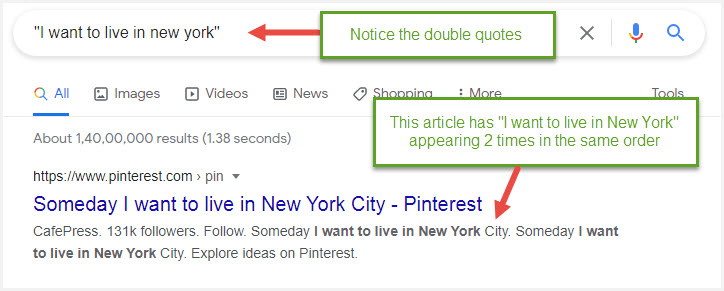
Use double quotes if you want the exact phrase in the same order to appear in your search results.
For example, “I want to live in New York” will give results where the phrase appears in the exact same order.
Remove the quotes, and you will have the keywords scattered all over the article, and not exactly in the same order.
Using double quotes is also a great way to search for articles using just their titles.
In the example below, I want to search for posts that have mentioned “I want to live in new york” in the exact same order.
Using Double Quotes to Search for the Exact Phrase on Google
Define
Defines a word and also includes an audio clipping on how to pronounce it correctly.
Use Define: followed by the word.
Use Define: to Find Out How a Word is Defined and Pronounced
Search
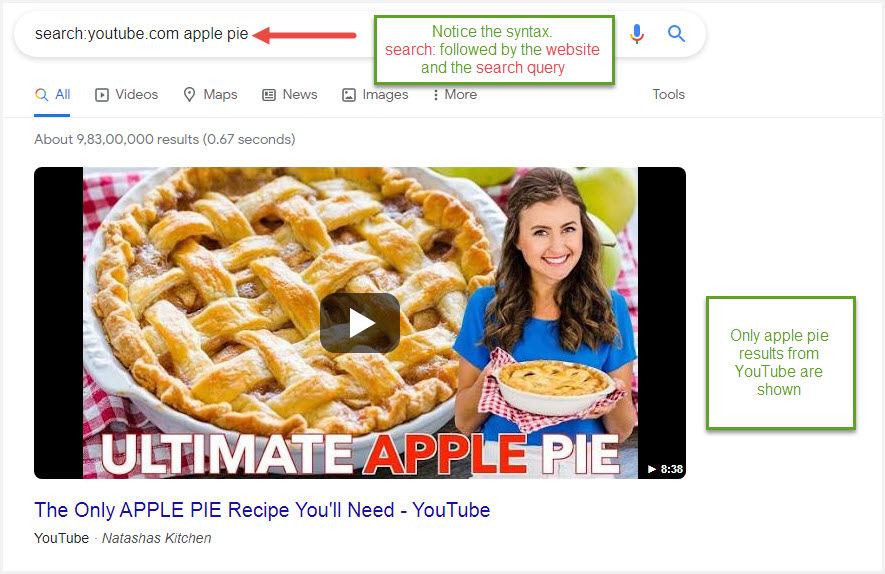
Searches for results on a specific site.
Use Search: followed by the website URL and search query.
In the example below, I want to search all recipes for apple pie on YouTube.
Use Search: to View Search Results from a Specific Site
Asterisk*
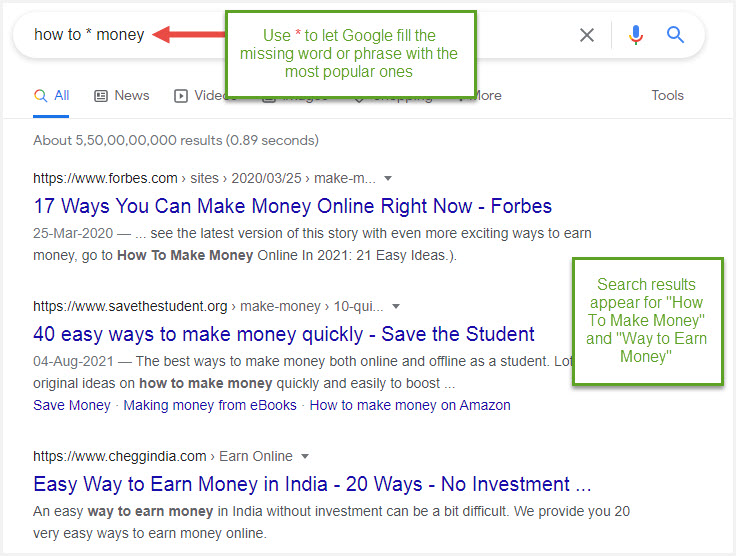
Use the * asterisk symbol to let Google do the guessing work. This allows you to see the most popular search phrases that match a part of your query.
Insert * wherever you want Google to add in the most popular search words/phrases. In the example below, I have used how to * money, so it will consider popular search phrases like how to make money, how to earn money etc.
Use Asterisk (*) to Search for Missing Words
Related
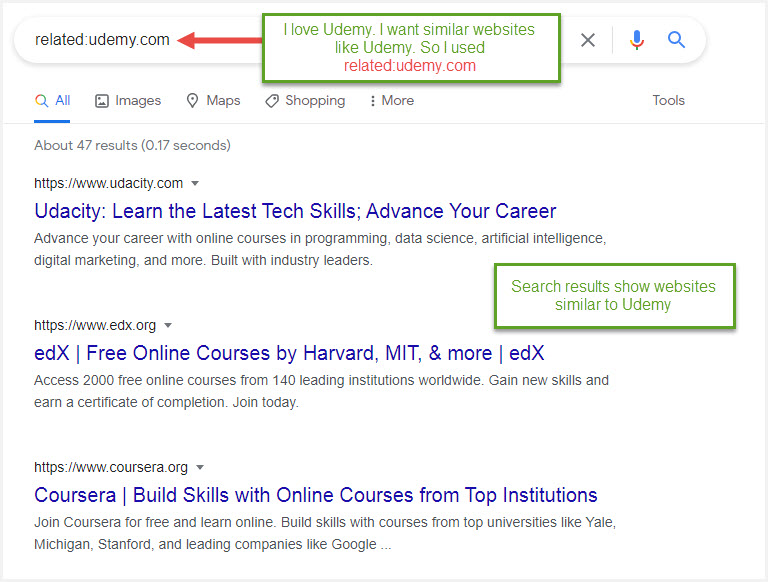
If you find a website you really like, and wish to see similar ones, use Related: followed by the URL of the website you liked.
In the example below, I want websites similar to Udemy that offers courses online.
Use Related: to Find Related Websites
Tilde~
This is a great way to include synonyms.
Use ~ before the word that requires synonyms.
Use Tilde (~) to Find Synonyms
Location-specific
If you wish to see search results only related to a specific location use location: after the search phrase.
Use Location: to Find Specific Location Results
File Type
In case you are looking for content in a particular format, use filetype: followed by the type of file (example: pdf).
Use Filetype: to Search for Specific Formats
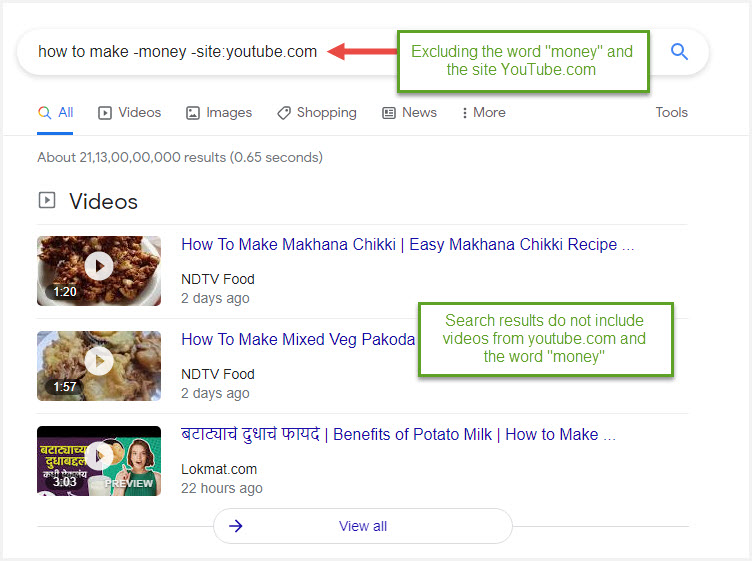
Exclude
Exclude something from search results by using dash –.
For example, let us consider the example below, when you type -money, this means you want Google to exclude the word “money” from the search results. I have additionally added another exclusion, that is the website YouTube.com.
Exclude Certain Words & Sites from Results (Potato Milk?! You learn something new everyday :))






 The Monkey Dilemma
You must be logged in to post a comment.