Personal observation: In almost every war, there’s always someone who doesn’t want it to end.
In the India–Pakistan war, many in India didn’t want the fighting to stop because they felt Pakistan hadn’t learned its lesson yet. Some even wanted the government to reclaim PoK (Pakistan-occupied Kashmir) during this time (which I strongly oppose).
When Israel attacked Iran’s nuclear sites, many anti-regime Iranians wanted the war to continue because they hoped the regime would fall.
The Israel–Gaza conflict is even more unusual. Many who kept calling for a ceasefire suddenly went quiet or were openly against it when finally announced. Maybe they had expected Israel to be driven out and a new Palestinian state to rise “from the river to the sea.” But that idea is unrealistic and only calls for more violence. Just like India will never give up Kashmir, Israel will never give up its land. Both countries get a lot of criticism for putting their own interests first. But, over the years, Jews and Indians have learned an important lesson: if they want their interests protected, they can’t rely on anyone else. When Indians get murdered in America, there’s next to no backlash. It’s the same case with Jews. History is also proof that when Hindus face persecution or genocide (Kashmiri Pandits, Sandeshkhali, Bangladeshi, and Pakistani Hindus), the world stays silent. In a world shaped by selective activism, these two communities have gradually learned to shed their passivity and docile nature, standing up for themselves without guilt. Indians, in my view, are still learning. Our tendency to stay silent runs deep. But since 2014, that’s starting to change, much to the annoyance of some. Apparently, a “good” Indian is still largely expected to be a silent one in the face of persecution and bigotry.
Anyway, the point is that in any war, there’s always duality. Those who push for the conflict to continue aren’t always on the “far-right.” Sometimes, they are far-left or far-right figures from other communities, disguised as leftist liberals. Take, for example, the India-Pakistan war. Many leftists in India wanted it to end and for peace to prevail. Yet recently, some of those same voices wanted Hamas to reject the peace deal, even at the cost of many lives.
I’ve often felt that the far-left and far-right are just two sides of the same coin. The recent wars and reactions to them over the years only validate this claim.
I recently watched a thoughtful discussion by Zarna Garg on interracial romance, featuring her own family. Based in the US, their candid conversation offers a refreshing glimpse into how Indian-American families are navigating such topics. It was heartening to see everyone, parents and kids, engage so openly. In many Indian households, these conversations either happen too late or not at all, often wrapped in hesitation or silence. But here was a family talking honestly about dating, identity, and interracial relationships. A big shoutout to them for their openness and clarity. It’s these dialogues that make a real difference.
Watch the video below:
Thoughts
I’ve spent most of my life abroad before choosing to return to India. Yet even while living overseas, I always knew my relationships would be with Indian men. Perhaps it’s because I studied in an Indian school and mostly socialized within the Indian community, even outside the country. I look Indian, dress Indian, and speak with an Indian accent. So it was natural to feel more comfortable with Indian men.
However, in today’s globalized world, with increasing interracial mingling, millennials like me must come to terms with the fact that more non-Indians are likely to become part of our families. Someone recently remarked how the world is blending in such a way that you can no longer easily tell someone’s ethnicity. Even appearances are getting “globalized.” It was an eye-opener. I’ve come to realize this holds especially true in the Indian context. Today’s new-generation kids often no longer look or sound traditionally Indian, especially the kids in Indian metros. Their accents, fashion, and even body language reflect a more global identity.
A few months ago, a relative married a Spanish man, the first white partner in our family. Surprisingly, everyone, including the older generation, was welcoming. No drama. No resistance. That in itself feels like progress. Our extended family no longer fusses over caste or religion in love marriages. Marrying someone from a “lower caste” has become normal (though I personally reject terms like “lower” and “upper” caste, which are inherently divisive). Only a few super-senior relatives seem to hold on to rigid views, but even that seems to be fading.
I wonder if this shift is due to the older generation’s growing access to YouTube and social media. Many now watch global discussions on love, identity, and acceptance. One moment really stood out: a senior aunt watched Kaathal, a Malayalam film about same-sex love, and casually remarked, “Being gay or lesbian is fine. It’s not a disease.” That kind of acceptance would’ve been unthinkable even a decade ago. But it’s happening now, and that matters.
More recently, one of my nieces fell in love with a white guy. It’s a bit more delicate because it hits closer to home. While I’m happy she found someone, I can’t help but feel a bit anxious. Our cultures are worlds apart, and it’s not just the couple that has to adjust, but the families too. At this age, do I or her parents have the patience? I’m unsure. On second thought, it doesn’t concern me or her family, as the relationship is hers to navigate. Still, as Zarna Garg wisely said in her family discussion, any relationship can thrive if the core values align: education, family, career, loyalty, and health. Everything else is secondary and can be worked around.
One comment from Zarna’s husband lingered with me. He mentioned that their eldest daughter has only dated white men, and he took it personally. He had read somewhere that girls whose fathers aren’t ideal husbands are more likely to do this. That struck a chord. My niece also has a pattern of dating white men, and to be honest, her father isn’t exactly the perfect partner either. Could there be a subconscious link? I wouldn’t dare bring it up now, especially since she lives abroad, but maybe someday in person.
There’s so much our generation is still figuring out. As millennials in our 40s, we stand between tradition and transition. We want to be open-minded and inclusive, but also grounded. At times, it worries us to see the younger generation drifting away from tradition. There’s a quiet fear: will our culture someday fade into oblivion? But these are changing times, and change demands a degree of acceptance. We may not always agree, but we must learn to adapt. I also see a growing trend among young parents today: trying too hard to be politically correct, often avoiding difficult conversations just to stay in their children’s good books. This might be a measure to ensure they don’t repeat their parents’ mistakes of being too restrictive. But experience teaches us that hard truths, spoken with love, are just as necessary today as it was yesterday.
Some of the advice I dismissed in my 20s now makes perfect sense. You only begin to understand your parents once you reach their age. That’s how life unfolds. You gain clarity with time. Until then, all we can do is trust, adapt, and hope it all works out in the end.
The protagonist of Convenience Store Woman by Sayaka Murata is unlike anyone I’ve encountered in any book. Keiko is quietly charming, yet deeply unconventional. She’s content with her simple routine at a convenience store, a place she has worked for over 18 years. This does not gel well with people around her who expect her to climb the career ladder, or “at least get married”, instead of sticking to this “lowly” job. They are unable to comprehend her happiness or her emotional detachment in situations where strong feelings are typically expected. In her own words, she’s a “foreign object.”
There are parts of Keiko’s personality I could relate to, especially her tendency to operate more from the brain than the heart. I’ve often questioned this trait in myself, particularly in political matters, where I naturally lean toward a calculated, strategic view rather than reacting emotionally. This sometimes makes people see me as cold. But that’s where my similarities with Keiko end.
I tend to get deeply emotional about things that may not always move others in the same way. My responses aren’t absent, like Keiko’s. I cry easily when I see children being affectionate with their parents or when animals are hurt. I feel emotional and distraught when I see small children picking up guns or stones in conflict zones. I want them to study and grow up contributing to society in peaceful ways. I well up seeing warmth in society. For example, when the visually impaired children sang “Happy Birthday” to our Indian President Murmu, she cried, I cried, we all cried. I’m also deeply moved by the struggles of elderly people, perhaps because I’ve spent time with them and seen what many others, especially those living far from their parents, often overlook. I do feel deeply, just not always in ways others expect, a bit like Keiko.
If you are wondering what makes Keiko strange, this snippet from the book gives an idea:
I wouldn’t say I loved Convenience Store Woman, but it was certainly thought-provoking, especially how society treats you as a “foreign object” that needs to be discarded if you don’t follow the rules. Society insists Keiko must adapt to its norms to be seen as “normal.” It does not matter to them how fulfilled or happy she is. Keiko’s struggle to meet societal expectations forms the core of the novel. Many of us might relate to this struggle with conformity. Not everyone is wired to follow every rule or expectation to the letter.
Ending this post with some thought-provoking quotes from the book:
The normal world has no room for exceptions and always quietly eliminates foreign objects. Anyone who is lacking is disposed of.
He seemed to have this odd circuitry in his mind that allowed him to see himself only as the victim and never the perpetrator l thought as I watched him.
It occurred to me that it wasn’t such a stretch to say that contemporary society was still stuck in the Stone Age after all. So the manual for life already existed. It was just that it was already ingrained in everyone’s heads, and there wasn’t any need to put it in writing. The specific form of what is considered an “ordinary person” had been there all along, unchanged since prehistoric times I finally realized.
“Look, anyone who doesn’t fit in with the village loses any right to privacy. They’ll trample all over you as they please. You either get married and have kids or go hunting and earn money, and anyone who doesn’t contribute to the village in one of these forms is a heretic.”
I recently retook the MBTI test after a few years to see if my personality had changed. I noticed that some of my friends went from being introverted to extroverted, or the other way around, due to their life experiences. This made me curious about my own metamorphosis.
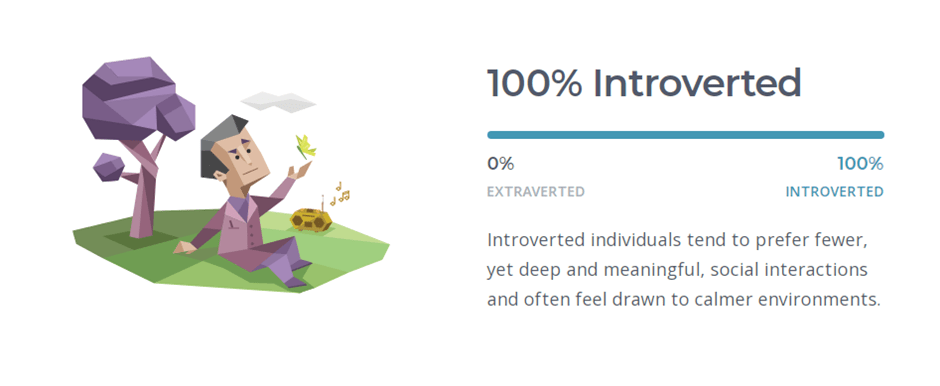
The test didn’t have anything new to offer for me. I am still as introverted as ever. Even though these results are not to be taken to heart, I agree with my assessment of being a 100% introvert. I am yet to see someone who is as introverted (not shy) as I am. Or maybe I have not met one because they are as reclusive as me.
So, what does it mean to be a 100% introvert? I can only talk from personal experience. Here’s what makes me one:
Social interactions tend to drain me, even with my close ones. If I put on a fake extroverted persona for an extended period, I feel exhausted by the end of the day, and I have to overcome that fatigue by sleeping a lot. This phony outgoing persona is a survival mechanism that introverts often adopt to function in this society that only rewards extroversion.
I can survive without talking to anyone for hours. But that doesn’t stop my monkey mind from blabbering non-stop. Hence, this blog.
I absolutely detest phone calls. But I am slowly making peace with it because many things are better discussed through calls. It’s faster, but that doesn’t stop me from trying to get an answer through text first.
I explain things better through text. I get more clarity while I write.
I used to be a chat person, but not any longer. In short, I am not much of a phone person!
I prefer one-on-one interactions because I find them more insightful. A group setting is the best for fun conversations, though.
I get absolute joy from canceled plans. I have big-time JOMO.
I can stay indoors for days without feeling bored, sad, or lonely.
I’m a single woman in my 40s. I prefer not to get married because I crave too much personal space.
New situations disorient me. I take time to adjust to them.
I tend to have an emotional meltdown if I have several new things bombarding me simultaneously. To avoid any sensory overload, I consciously focus on one new thing at a time. Of course, this is not always possible. However, if given a choice, I go step-by-step and sort of soothe myself into the new scenario.
I am hypersensitive to sound, so I like to avoid “happening” places. Yes, I am boring.
If you want to try the test, you can do it for free at 16Personalities. However, this is not a professionally accredited test.
***Note: As I write this, my thoughts are scattered. I’m thinking of those facing unsettling times, displaced and disoriented in volatile regions, many of whom have lost loved ones. If you’ve read this far, I’d like to request a moment of contemplation. Let’s hope for peace to prevail. Let’s control our anger and emotions during these testing times and treat each other with empathy and respect. There’s enough hate in this world. Let us be mindful not to add to it.
Habits are easier to perform, and more satisfying to stick with, when they align with your natural inclinations and abilities. You want to play a game where the odds are in your favor. Embracing this strategy requires the acceptance of the simple truth that people are born with different abilities. Some people don’t like to discuss this fact. On the surface, your genes seem to be fixed, and it’s no fun to talk about things you cannot control. The areas where you are genetically predisposed to success are the areas where habits are more likely to be satisfying. The key is to direct your effort toward areas that both excite you and match your natural skills, to align your ambition with your ability.
This paragraph got me nodding away.
We all believe hard work can get us anywhere. It does, to a limit. If we are not naturally talented in what we are doing, more effort is required. But how much effort is too much? When do we stop? This requires some self-awareness. As the famous adage goes, “You cannot judge a fish by its ability to climb a tree.” No matter how much you believe “I will learn to fly one day,” it is physically impossible, even if you practice for hours on end flapping your arms, thinking your hard work will pay off one day.
Consider my case. I am not particularly good at math. I can solve problems, but it takes more time than average. My strengths are my patience and determination, which almost always help me figure out a solution. If I were to start a career in finance (which I did once upon a time), I would have been a disaster due to my dislike for numbers. Currently, I have made my financial life more manageable by outsourcing money-related decisions to experts. Instead, I took up a job that rewarded my problem-solving skills, irrespective of how long it took me to discover a solution. My work is challenging, but since it naturally aligns with what I am good at, there is considerably less friction. As a result, I am happier doing what I do.
Acknowledging your limitations shouldn’t be treated as a failure. On the contrary, it’s more energy-efficient to align with your natural skills and play to your strengths instead of moving far away from them. You need not over-stress yourself with things that do not seem to improve, no matter how hard you try. Maybe there is something else you are naturally good at.
I read that as kids, BTS members V and Jung Kook experimented in different fields to understand their aptitude. Their parents encouraged it. Both eventually chose music. Afterward, when V had a stress-related emotional meltdown, his father told him it was okay to come back home. “We can find something else you’re good at,” he said. However, V persisted because he didn’t want to disappoint his family. Those words of encouragement meant a lot to him. It made him realize that even if he quit, he could sail through. But not everyone is like V (or his parents).
I honestly feel we should be told it is okay to give up and try out other things when the time comes so we don’t get stuck in a depressing rut. Not everything in life can be achieved with hard work. And that’s okay.
I am a new k-entertainment fan. I have started bingeing kdramas, kpop, kceleb interviews, and variety shows. I adore BTS and absolutely love all the members. As someone in her 40s, I am not ashamed to be a fan, though many people think k-entertainment is primarily for young adults. I feel art and music transcend all generations, and everyone, irrespective of age, should be able to enjoy creativity in all forms.
One thing that strikes me, especially in BTS, is how playful even the eldest member (Jin) is. That got me thinking – why don’t we see more adults being playful? Almost every adult you see has a serious, practically poker-faced sense of humor. They express their happiness less and worry more. I find it true in India, where I live, but I am sure it’s a practice across the globe. Probably because we relate seriousness with maturity. The more serious you look, the more mature you are considered to be.
Why can’t we be playful as we age instead of becoming no-nonsense adults?
Why do we have to lose our childlike qualities when we grow up?
Why can’t we look at the world with the same curiosity and wide-eyed wonder?
Most of these questions have one answer: life experiences. What we go through in life tends to sober us down and take some of that effervescent energy away. I look at my posts and realize how I have become more serious over the years. I kind of miss the younger, quirkier me. Friends who had the most incredible sense of humor have mellowed due to the pressure that age brings with it. When older people say that school and college offer the best days of your life, they mean it – you get to enjoy things with abandon when you are young. “Maturity” is a sham that can drain that enthusiasm away – we smile less, joke even less, and constantly worry about what the future will behold.
Another reason is society. People expect you to be serious and leave your childlike qualities behind when you turn older; otherwise, you’re deemed immature. It does not matter if you do your duties meticulously and perform all your responsibilities. If you project any playful traits, you are looked at with judgment.
Blessed are those, in my opinion, who get to retain their childlike playfulness in this world that tends to be a spoilsport. The ability to joke around, laugh wholeheartedly many times a day, and find happiness in the smallest things is a skill that many of us would do better to possess. Such qualities make the world a happier place to live in, for our own selves and the people around us.
So, to people who bring joy to those around them with their playful antics, instead of preaching, “Be more mature. This is not the age for such things,” I would like to say, “Please stay the same! You bring joy just the way you are.”





 The Monkey Dilemma
You must be logged in to post a comment.