
The Butcher of Bosnia and the Illusion of Threat

Butcher of Bosnia Image

I came across a news report about thousands of people attending the funeral of the man referred to as the “Butcher of Bosnia.” His name is Ratko Mladić. The report said that he was convicted of genocide for his role in the killing of more than 8000 mostly Muslim Bosniak men and boys in Srebrenica, Bosnia and Herzegovina. He died in prison at the age of 84 in August this year.

I was totally taken aback by this information and I had to look into why such a controversial figure is being considered a hero by many. I found that his supporters remember him as a military commander who defended their community against what they saw as “perceived threats” from Bosniak Muslims during the Bosnian War, which began in 1992.

I can’t help but notice a pattern here: violence is often justified nowadays by this very “perceived threat” – the belief that another community poses a threat to our existence, religion, culture, or way of life. Maybe this pattern has always been there, or maybe social media has simply made these attitudes much more visible.

Let’s take a look at some examples.

Israel’s ongoing conflict with Palestinians is framed by supporters of Israel around threats to its existence, while Palestinians and their supporters describe the consequences in terms of occupation, displacement, and violence against civilians.

Hitler is also being glorified on TikTok today, with his actions being presented through the deeply disturbing logic that he “helped eradicate” a community, Jews, whom they view as a threat to the world.

Afzal Guru and Ajmal Kasab are considered heroes by many because their actions are framed as acts of resistance against perceived threats or justified through a particular political narrative.

Savarkar is hated by many, even more strongly than some historical figures associated with mass violence, but he is also considered a hero by many who believe Hinduism and Hindu identity have been under threat.

I remember feeling absolute dread (a feeling of threat) when thousands attended Yakub Memon’s funeral in Mumbai.

And that is what makes this whole subject so uncomfortable.

Mourning, glorifying, or defending people who have done questionable things simply because they supposedly acted against “perceived threats to our existence” is becoming mainstream.

Closer to home, Hindus have attacked minorities in India because they believe their religion or cultural identity is under threat.

Christians in places like Tamil Nadu have also staged protests when public spaces in their area are used for festivals associated with other religions, with some viewing this as a threat to their own religious identity or traditions.

Then there are Kashmiri Pandits, who are being portrayed as a threat to the “culture” or “religion” of the land even when they are simply celebrating their festivals in a place with which they have a deep historical connection.

The circumstances are obviously different. But the underlying psychology is worth examining.

Once we convince ourselves that another community is an existential threat, almost anything can start being rationalised in the name of protecting our own.

And that leaves me wondering: who is going to do what next in the name of a “perceived threat”?

No community is completely free from this tendency, and no community can automatically claim moral superiority. Across religions, nationalities, ethnic groups, and political movements, people have at different points convinced themselves that their identity, culture, religion, or very existence is under threat.

Once “they are a threat” starts gaining ground, the question is no longer simply who is right or wrong. The question becomes how far people are willing to go to bring down or harm the people they have decided are the threat.
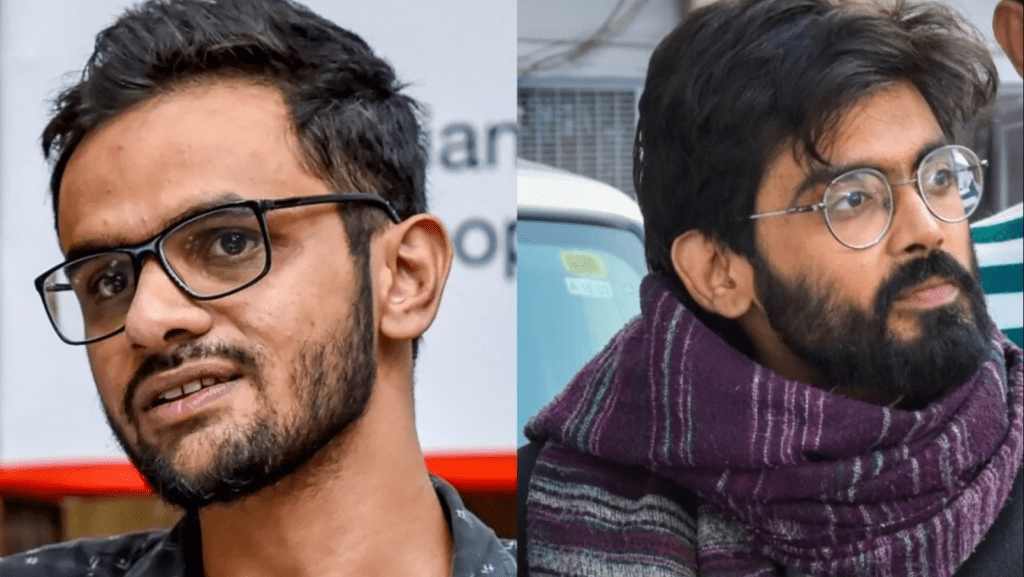
The Truth Behind Why Bail Was Denied to Umar Khalid and Sharjeel Imam

Umar Khalid and Sharjeel Imam Photo

With the Umar Khalid and Sharjeel Imam cases once again drawing global attention, especially after Umar Khalid’s father met US politician Zohran Mamdani, it’s the right time to scrutinize why the Supreme Court rejected bail pleas for both activists. The issue has sparked renewed discussion around India’s anti-terror law, the UAPA, and how it is applied in high-profile cases.

In the age of social media, misinformation often travels across the world long before the truth gets its moment. That makes it all the more important to examine each argument carefully and understand the reasoning behind the court’s responses. We are living in a time where selective fact-checking is common, misinformation is circulated to serve political agendas, and inconvenient truths are pushed out of sight. From what I have seen, some of the material relevant to this case has still not reached the wider public because it is rarely covered by mainstream media. As a result, distrust continues to linger.

Of course, for some people, no amount of truth really matters. What they seek is validation for their existing biases or political leanings. This post is not meant for that audience. No amount of proof can change such a mindset. It is written for readers willing to acknowledge facts when presented.

Getting back to the case, according to the prosecution, Umar Khalid and Sharjeel Imam were not just participants but masterminds who mobilised or influenced others during the events in question. The defence, however, put forward two key arguments while seeking their release on bail. Let’s take a closer look at what those arguments were and why the court chose not to accept them.

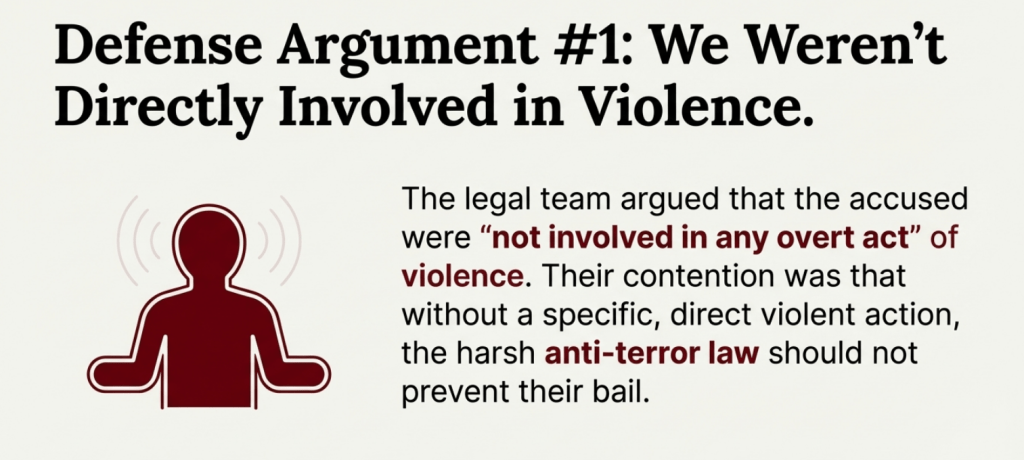
Defense Argument #1:
Not Directly Involved in Violence

Sharjeel Imam Umar Khalid Bail Defense Argument #1 Photo

One of the most repeated arguments, especially in Umar Khalid’s case, is that he was not present at the riot spots when the violence took place.

Court Response

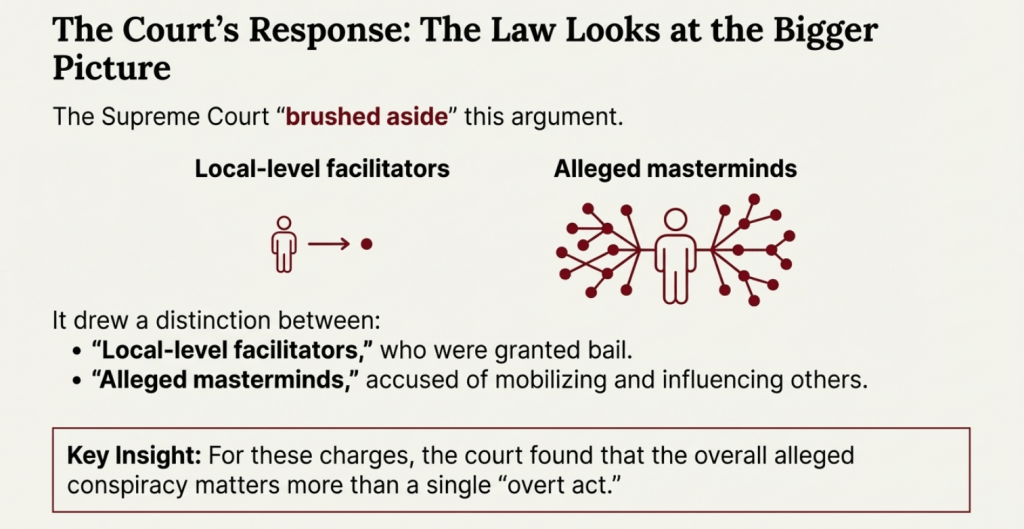
The court indicated that the act of masterminding the riots, even without direct presence, was in itself sufficient. The court’s position was clear and firm: nothing comes above the interests of national security. On a prima facie assessment of the material placed before it, which includes videos, audios, posts, and messages, the court held that both Umar Khalid and Sharjeel Imam faced similar allegations of being the masterminds, which weighed heavily against granting bail. Due to their involvement in the larger plan, several people were killed and injured, including an intelligence officer.

Sharjeel Imam Umar Khalid Bail Defense Argument #1 Court Response Photo

It should be noted that provocative words alone can be enough to incite violence. This is not something new. Something similar was seen even before the Gujarat riots, where RSS members were found to have mobilised people through provocative speeches. Many who provoked never participated in the violence, but their words were enough. They were taken into custody and remained there for years.

This raises an important question: what makes those cases different from the cases of Sharjeel Imam and Umar Khalid, so that the latter deserves bail? Both instances were the same: provocative speeches leading to mass mobilization. The 2020 Delhi riots too had a communal angle, with tensions between different communities being stirred during the violence. Videos of the provocative communal speeches are available widely on X. WhatsApp groups were formed along religious lines, which added to the sense of division at the time.

Rather than relying on political influencers or commentators, I recommend reading the official case files to understand the facts as presented in court. You can find these by searching Google with terms like “Delhi NCT Sharjeel Imam pdf” and then looking within the document for specific details.

Often, religion is used as a tool to strengthen or manipulate one’s case, and that appears to have happened here as well. As someone who has gone through the provocative videos and social media posts of the two, it is difficult to see them as innocent. I cannot quote or reproduce those statements here because of their sensitive nature, but they are publicly available and can be found on social media platforms like X by searching their names.

Sharjeel Imam’s Facebook account is still active, while Umar Khalid has deleted his. I would recommend going through Sharjeel’s Facebook posts to see for yourself how passionately he tried to convince people to hit the streets. Some posts had a communal dimension as well. The content includes rhetoric that can be interpreted as calls for violence and even secession, which adds serious weight to the charges against them.

Defense Argument #2:
The Trial Delay

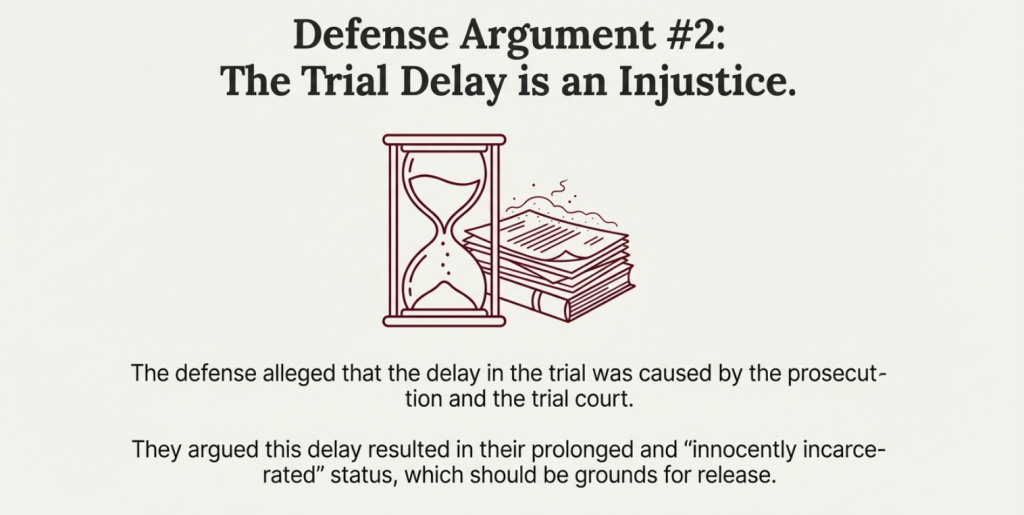
One more argument that often comes up is the long delay in the trials of Sharjeel Imam and Umar Khalid.

Sharjeel Imam Umar Khalid Bail Defense Argument #2 Photo

Court Response

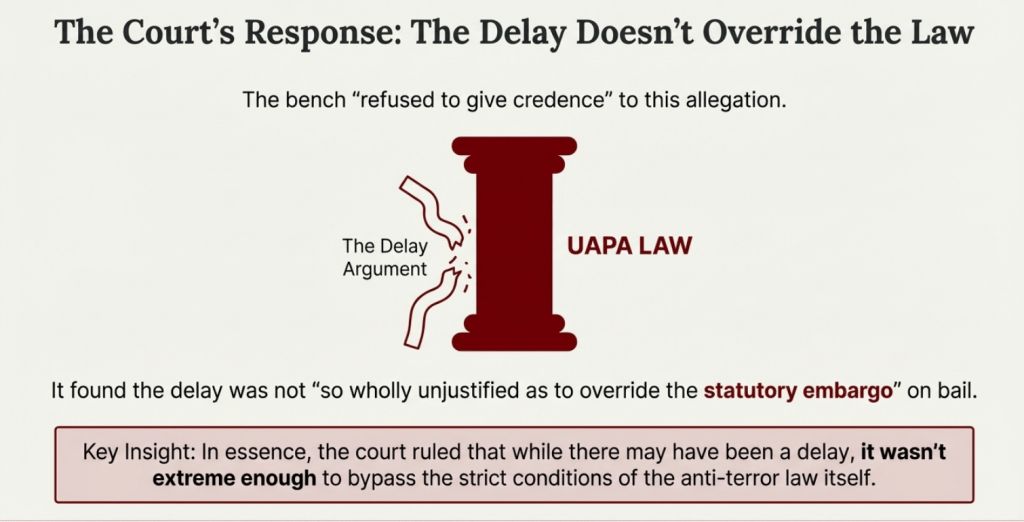
The court maintained that a delay in the trial does not dilute the gravity of the case.

Also Read: CJI’s Remarks on Umar Khalid’s Trial Delays

Sharjeel Imam Umar Khalid Bail Defense Argument #1 Court Response Photo

The Final Verdict

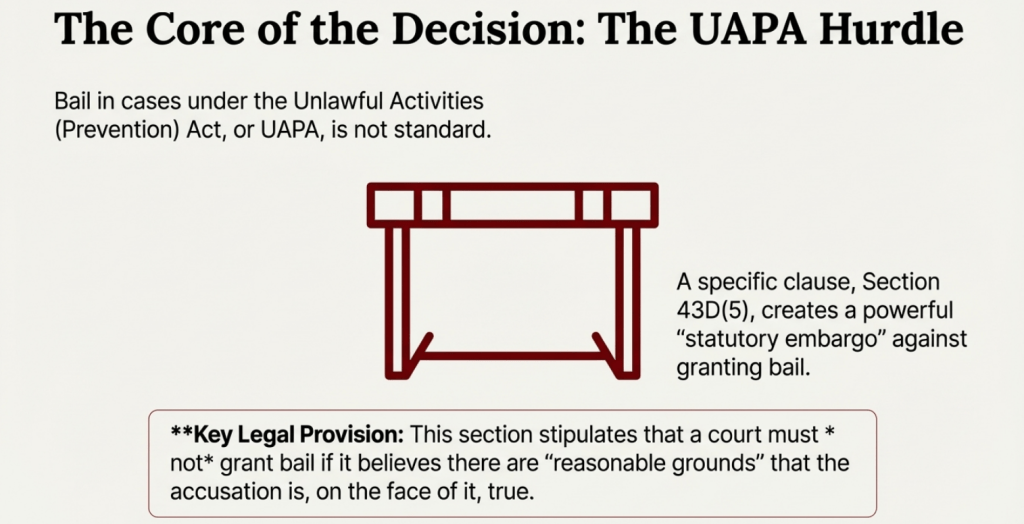
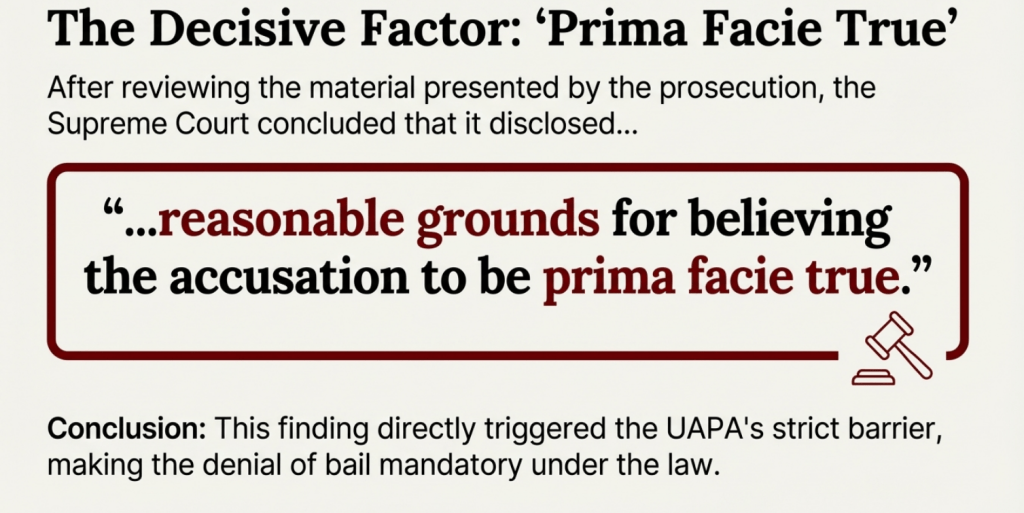
The court observed that the polarising material appeared prima facie true, and this played a key role in denying bail to them as alleged masterminds.

Sharjeel Imam Umar Khalid Bail Rejection Decision Image
Sharjeel Imam Umar Khalid Proof Prima Facie True Image

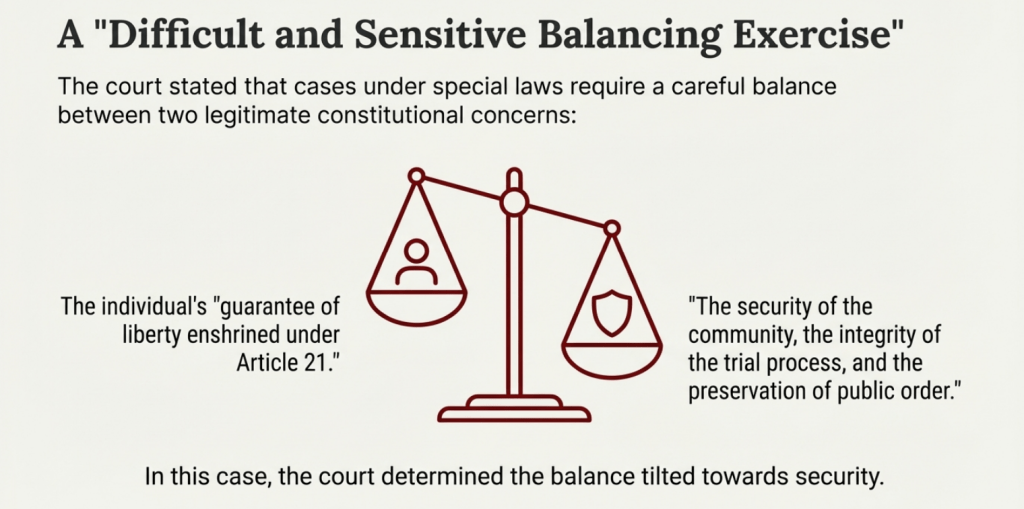
The court admitted that balancing individual rights with the nation’s security is never an easy task.

Sharjeel Imam Umar Khalid Bail Is a Difficult and Sensitive Balancing Exercise Image
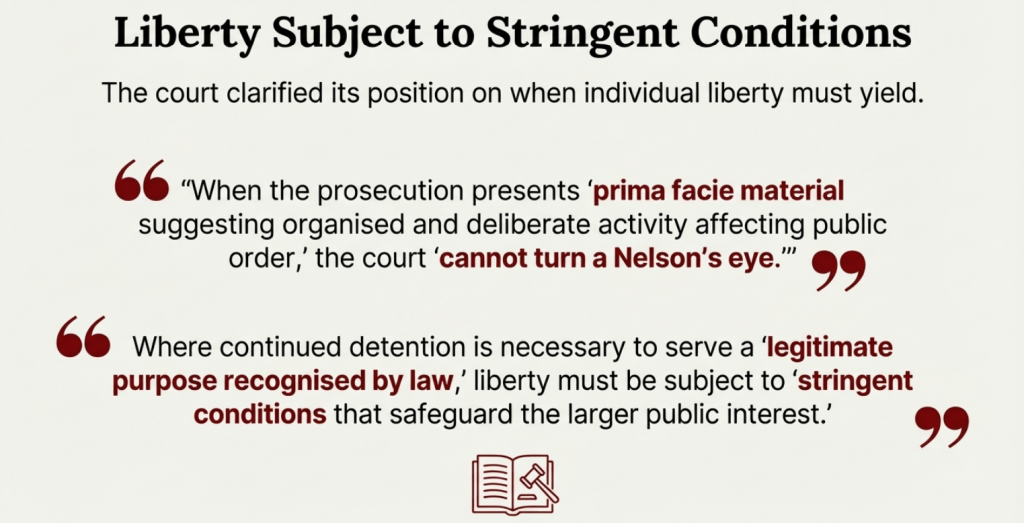
Sharjeel Imam Umar Khalid Liberty Subject to Stringent Conditions Image
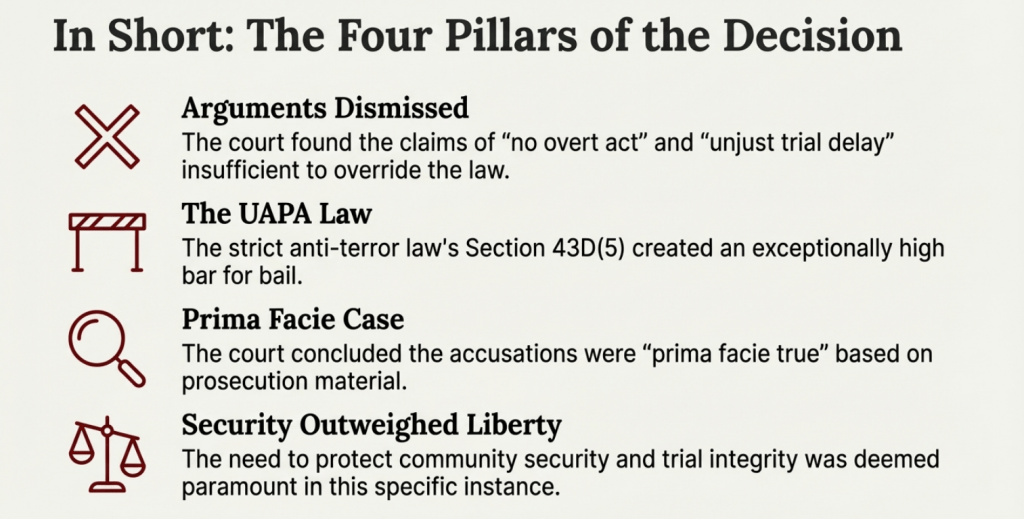
Sharjeel Imam Umar Khalid Bail Rejection Summary Image

Umar Khalid and Sharjeel Imam were not denied bail because of unfairness or a failure of the legal system. Their bail was rejected because the court found the material presented before it to be valid and credible.

However, unless this material, such as videos or posts, is made available for public viewing in a structured and responsible manner, many people will continue to believe that the legal system itself is fractured. Since I have seen the provocative videos and social media posts and gone through the case details, I do not doubt the court’s reasoning.

But the lack of transparency leaves room for misunderstanding. It also creates space for political parties and interest groups to selectively present facts and shape narratives for their own benefit. Should there not be a mechanism to clearly explain why and how such decisions are taken, along with supporting material, so that the ordinary citizen does not have to rely on fragments found on their own?

Dhurandhar Lingers Long After the Credits Roll

Dhurandhar Movie Poster

I watched Dhurandhar a few days back, and it has stayed with me ever since. It keeps running in my head – the songs, the action sequences, the passion for the country. The nationalist in me is satisfied.

For the first time in a long while, an Indian spy movie moved away from humanizing terrorism. That shift feels bold and necessary. The film forces you to sit with harsh truths instead of offering easy heroes and neat endings. It does not try to make violence look noble or harmless. That honesty is what makes Dhurandhar powerful, and also hard to shake off.

Personally, I felt a quiet mix of angst and sorrow when I saw some people brush the film off as propaganda or political. This view is subjective, but it still made me uneasy. The events shown are not opinions or theories. They happened. Calling a film like Dhurandhar propaganda does a disservice to the people who lost their lives in terrorist attacks. It dismisses real events that happened and real pain that was lived. These truths were not addressed openly for years, often out of fear or sheer convenience. When cinema finally creates space to tell these stories, the instinct should be to listen, not reject. The strong box office response shows that many people are ready to face uncomfortable realities. That response matters. Aditya Dhar deserves credit for choosing honesty over comfort. I have admired his films for consistently daring to tell stories most would rather avoid.

When the screen turned red, I could not hold back my tears. It made me emotional. But I also wondered if anyone watched that moment and felt nothing at all. That thought itself felt disturbing. Not feeling the pain of fellow Indians, or even a flicker of anger, says something deeper. In a country where apathy is already common, it is easy to believe some viewers saw it with blank eyes. For them, everything uncomfortable becomes propaganda, dismissed as an attempt to show Pakistan in a bad light.

Sometimes it feels like a lost cause to expect people to stand firmly with the country, without hesitation or filters. Many of us avoid the truth because it feels uncomfortable. We prefer to hide behind safe words like peace and love. But years of doing that came at a cost. We were taken for granted. Our suffering was questioned. Our stories were dismissed as lies or branded as conspiracy theories.

I think it is time for India to stand up for itself. We need to acknowledge our truth and stop looking away. Facing reality head-on is not hatred or extremism. It is honesty. Only when we accept what went wrong can we learn from it. Growth does not come from denial. It comes from clarity, courage, and accountability.

Now there are people who argue that this much truth does not belong on screen. If that were true, then why do we make social films like Homebound at all? Those films are also hard-hitting and deeply uncomfortable. Cinema has always helped bring difficult issues to the public in a more digestible way. Stopping that only pushes reality back into silence.

The violence in the movie is also being criticised, but real-world events prove how close such scenes are to the truth. The recent lynching of a Hindu man in Bangladesh is a grim reminder that brutality is not exaggerated fiction. Dhurandhar does not sugarcoat this reality, and that honesty is exactly why it matters.

Coming to the performances, while many are praising Akshaye Khanna, for me it was Ranveer Singh who truly stood out. His eyes did most of the talking, and it was brilliant to watch. There was a quiet intensity in his acting that stayed with me. Sara Arjun also impressed me with her performance and screen presence. She brought both grace and emotional weight to her role. The music deserves special mention too. It lingers in your mind and pulls you back into the world of Dhurandhar long after the film ends.

Overall, I would say Dhurandhar is a must-watch. It is not an easy film, but it is an important one. It stays with you long after the credits roll. I most probably would end up watching it again.