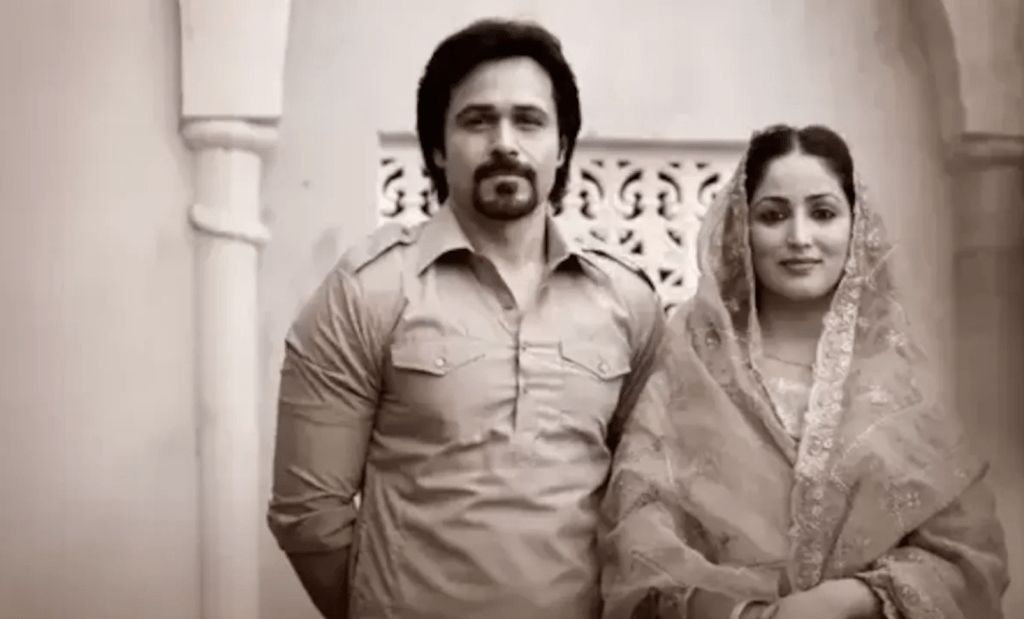
For the most part, Haq is not a story only about Muslim women. It is a story about women in general. Almost all of us know someone, married or unmarried, who has been cheated in love. We have seen that heartbreak up close, and we understand the emotional toll it takes.
When Shazia feels betrayed, we feel it too. When she wants the best for her children, that emotion feels familiar. When she fights for her rights, it resonates deeply. And when her father stands by her without hesitation, it reminds us of our own fathers and the quiet strength that support brings. These are emotions that are universal to women, cutting across religion, culture, and background.
The narrative becomes specifically about Muslim women only when the legal issues come into focus. That is where the real differences emerge, and the film clearly highlights how laws and systems can shape a woman’s fight for justice. It is to be noted that soon after the Triple Talaq ban was implemented in India, many Muslim women began approaching the courts to seek justice. While there was no open praise for the current government for such a ban, there was a quiet acceptance of the relief and protection the law offered them in real life. Many Muslim men, however, continue to view the ban as an insult to their faith rather than as a legal safeguard for women.
Getting back to the movie, Yami’s final monologue is powerful and leaves a strong impact. Emraan feels completely natural throughout and never once seems like he is performing. Sheeba Chaddha is equally convincing and brings depth to her role.
I especially want to credit Emraan for choosing to act in a film that openly talks about Muslim women’s rights. It takes conviction to support a story like this, especially as a Muslim, without dismissing it as Islamophobic. The film is clearly not that. Instead, it focuses on real issues and lived experiences, and his decision to back the narrative adds credibility and strength to the message being told.
Overall, I liked the film. The background music could have been better, and Yami is not fully convincing in a few scenes. Still, she more than makes up for it in the final act, which stays with you long after the film ends.
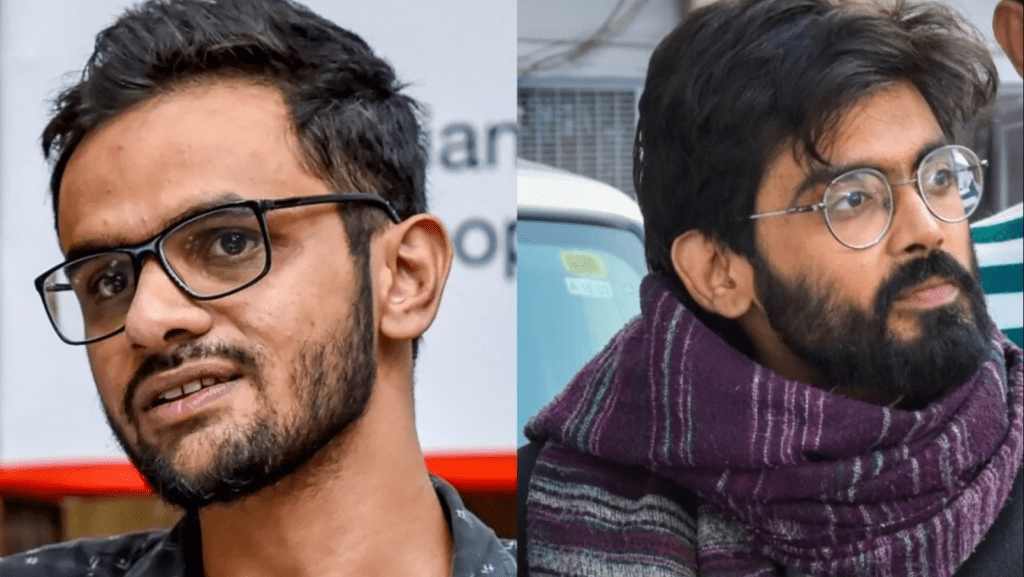
With the Umar Khalid and Sharjeel Imam cases once again drawing global attention, especially after Umar Khalid’s father met US politician Zohran Mamdani, it’s the right time to scrutinize why the Supreme Court rejected bail pleas for both activists. The issue has sparked renewed discussion around India’s anti-terror law, the UAPA, and how it is applied in high-profile cases.
In the age of social media, misinformation often travels across the world long before the truth gets its moment. That makes it all the more important to examine each argument carefully and understand the reasoning behind the court’s responses. We are living in a time where selective fact-checking is common, misinformation is circulated to serve political agendas, and inconvenient truths are pushed out of sight. From what I have seen, some of the material relevant to this case has still not reached the wider public because it is rarely covered by mainstream media. As a result, distrust continues to linger.
Of course, for some people, no amount of truth really matters. What they seek is validation for their existing biases or political leanings. This post is not meant for that audience. No amount of proof can change such a mindset. It is written for readers willing to acknowledge facts when presented.
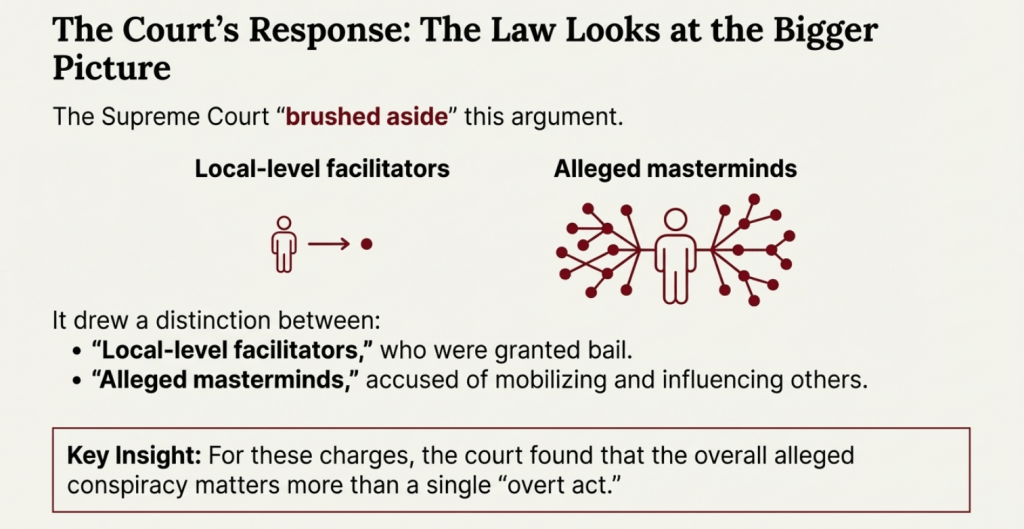
Getting back to the case, according to the prosecution, Umar Khalid and Sharjeel Imam were not just participants but masterminds who mobilised or influenced others during the events in question. The defence, however, put forward two key arguments while seeking their release on bail. Let’s take a closer look at what those arguments were and why the court chose not to accept them.
Defense Argument #1: Not Directly Involved in Violence
One of the most repeated arguments, especially in Umar Khalid’s case, is that he was not present at the riot spots when the violence took place.
Court Response
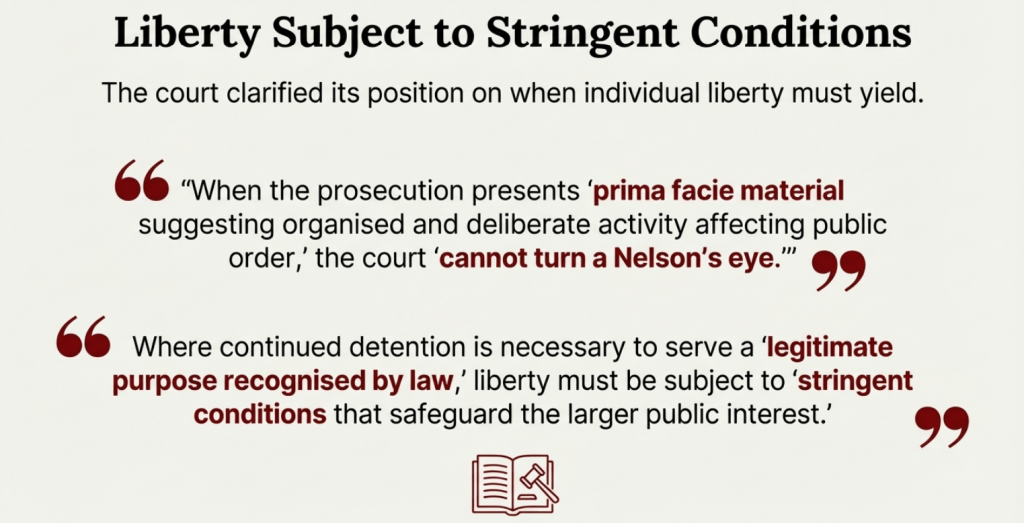
The court indicated that the act of masterminding the riots, even without direct presence, was in itself sufficient. The court’s position was clear and firm: nothing comes above the interests of national security. On a prima facie assessment of the material placed before it, which includes videos, audios, posts, and messages, the court held that both Umar Khalid and Sharjeel Imam faced similar allegations of being the masterminds, which weighed heavily against granting bail. Due to their involvement in the larger plan, several people were killed and injured, including an intelligence officer.
It should be noted that provocative words alone can be enough to incite violence. This is not something new. Something similar was seen even before the Gujarat riots, where RSS members were found to have mobilised people through provocative speeches. Many who provoked never participated in the violence, but their words were enough. They were taken into custody and remained there for years.
This raises an important question: what makes those cases different from the cases of Sharjeel Imam and Umar Khalid, so that the latter deserves bail? Both instances were the same: provocative speeches leading to mass mobilization. The 2020 Delhi riots too had a communal angle, with tensions between different communities being stirred during the violence. Videos of the provocative communal speeches are available widely on X. WhatsApp groups were formed along religious lines, which added to the sense of division at the time.
Rather than relying on political influencers or commentators, I recommend reading the official case files to understand the facts as presented in court. You can find these by searching Google with terms like “Delhi NCT Sharjeel Imam pdf” and then looking within the document for specific details.
Often, religion is used as a tool to strengthen or manipulate one’s case, and that appears to have happened here as well. As someone who has gone through the provocative videos and social media posts of the two, it is difficult to see them as innocent. I cannot quote or reproduce those statements here because of their sensitive nature, but they are publicly available and can be found on social media platforms like X by searching their names.
Sharjeel Imam’s Facebook account is still active, while Umar Khalid has deleted his. I would recommend going through Sharjeel’s Facebook posts to see for yourself how passionately he tried to convince people to hit the streets. Some posts had a communal dimension as well. The content includes rhetoric that can be interpreted as calls for violence and even secession, which adds serious weight to the charges against them.
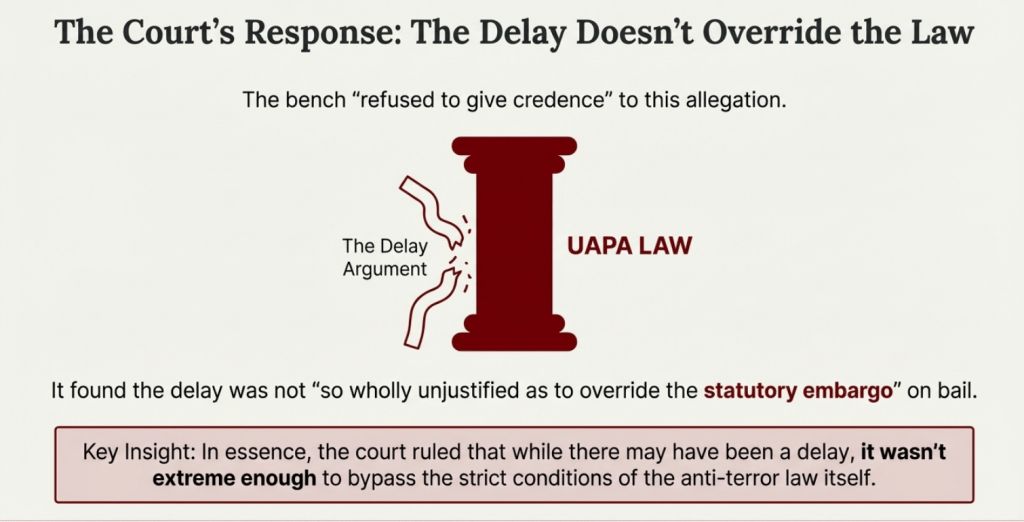
Defense Argument #2: The Trial Delay
One more argument that often comes up is the long delay in the trials of Sharjeel Imam and Umar Khalid.
Court Response
The court maintained that a delay in the trial does not dilute the gravity of the case.
The court observed that the polarising material appeared prima facie true, and this played a key role in denying bail to them as alleged masterminds.
The court admitted that balancing individual rights with the nation’s security is never an easy task.
Umar Khalid and Sharjeel Imam were not denied bail because of unfairness or a failure of the legal system. Their bail was rejected because the court found the material presented before it to be valid and credible.
However, unless this material, such as videos or posts, is made available for public viewing in a structured and responsible manner, many people will continue to believe that the legal system itself is fractured. Since I have seen the provocative videos and social media posts and gone through the case details, I do not doubt the court’s reasoning.
But the lack of transparency leaves room for misunderstanding. It also creates space for political parties and interest groups to selectively present facts and shape narratives for their own benefit. Should there not be a mechanism to clearly explain why and how such decisions are taken, along with supporting material, so that the ordinary citizen does not have to rely on fragments found on their own?
I wanted to watch the Real Kashmir Football Club series on Sony Liv the moment the teaser dropped. It felt positive and full of hope. The story promised a future built on progress, peace, and development through football. That feeling stayed with me through the series. I was not disappointed.
Real-Life Inspiration
While most stories about Kashmir focus on pain and instability, this one chooses a different path. It highlights the positive side of the region in a quiet, honest way. The story is not entirely fictional. It is inspired by a real football club in Kashmir, started by a Kashmiri Hindu and a Muslim.
To quote Wikipedia:
Real Kashmir Football Club is an Indian professional football club based in Srinagar, Jammu and Kashmir. Incorporated in 2016, the club currently competes in I-League, the second tier of the Indian football league system. Real Kashmir with its reserve side also participates in the Jammu & Kashmir Premier Football League regionally.
Nicknamed “Sheeni Seh” (transl. Snow Leopards), Real Kashmir is the first club from Jammu and Kashmir to earn promotion in any top flight football league of the country. They also won the IFA Shield title in 2022. Club’s futsal section has been competing in the state league, as well as AIFF Futsal Club Championship, the highest division in the country.
The origin of Real Kashmir FC date to 2014 after devastating floods swept through the region causing massive loss of life and property. To keep the youth, who had lost much during the floods—engaged, Shamim Meraj, editor of a local newspaper named “Kashmir Monitor”, and Sandeep Chattoo, a local businessman, came together to arrange footballers.
What began as a community outreach programme garnered support from the local populace and it soon started evolving into something more. Real Kashmir FC as a club, formalised in 2016, and affiliated with Jammu & Kashmir Football Association (JKFA) under the tireless efforts by Chattoo. Founded in 2016, Real Kashmir FC emerged as the first ever top flight professional football club in Jammu and Kashmir.
Back to the Series…
The goal of the series is simple and meaningful. It is all about guiding the youth toward something productive through football.
The star of the show is Mohd Zeeshan Ayub, who plays the Muslim founder. He delivers a strong performance, his expressions changing effortlessly as the situation shifts. He’s a natural and perfectly suited for the role of the calm, steady, and rarely perturbed founder. Manav Kaul, meanwhile, plays the Kashmiri Hindu founder who’s quiet yet exhibits all the traits of an effective entrepreneur. He has a vision, and he wants it achieved. Together, they form the heart of the series.
Beyond the two main characters, Abhishant Rana stands out as the Kashmiri youngster searching for direction. His character is mischievous and witty, but he’s also a youngster without goals. Watching him find hope just when his life could have taken a darker turn was heartwarming.
I would easily call it a must-watch series. It is uplifting, relevant, and rooted in reality. The story leaves you with a sense of calm and optimism. It is a good watch for anyone looking for a positive story set in Kashmir.
If you enjoy meaningful sports dramas, this one fits well. The series is currently streaming on Sony Liv.
I watched Dhurandhar a few days back, and it has stayed with me ever since. It keeps running in my head – the songs, the action sequences, the passion for the country. The nationalist in me is satisfied.
For the first time in a long while, an Indian spy movie moved away from humanizing terrorism. That shift feels bold and necessary. The film forces you to sit with harsh truths instead of offering easy heroes and neat endings. It does not try to make violence look noble or harmless. That honesty is what makes Dhurandhar powerful, and also hard to shake off.
Personally, I felt a quiet mix of angst and sorrow when I saw some people brush the film off as propaganda or political. This view is subjective, but it still made me uneasy. The events shown are not opinions or theories. They happened. Calling a film like Dhurandhar propaganda does a disservice to the people who lost their lives in terrorist attacks. It dismisses real events that happened and real pain that was lived. These truths were not addressed openly for years, often out of fear or sheer convenience. When cinema finally creates space to tell these stories, the instinct should be to listen, not reject. The strong box office response shows that many people are ready to face uncomfortable realities. That response matters. Aditya Dhar deserves credit for choosing honesty over comfort. I have admired his films for consistently daring to tell stories most would rather avoid.
When the screen turned red, I could not hold back my tears. It made me emotional. But I also wondered if anyone watched that moment and felt nothing at all. That thought itself felt disturbing. Not feeling the pain of fellow Indians, or even a flicker of anger, says something deeper. In a country where apathy is already common, it is easy to believe some viewers saw it with blank eyes. For them, everything uncomfortable becomes propaganda, dismissed as an attempt to show Pakistan in a bad light.
Sometimes it feels like a lost cause to expect people to stand firmly with the country, without hesitation or filters. Many of us avoid the truth because it feels uncomfortable. We prefer to hide behind safe words like peace and love. But years of doing that came at a cost. We were taken for granted. Our suffering was questioned. Our stories were dismissed as lies or branded as conspiracy theories.
I think it is time for India to stand up for itself. We need to acknowledge our truth and stop looking away. Facing reality head-on is not hatred or extremism. It is honesty. Only when we accept what went wrong can we learn from it. Growth does not come from denial. It comes from clarity, courage, and accountability.
Now there are people who argue that this much truth does not belong on screen. If that were true, then why do we make social films like Homebound at all? Those films are also hard-hitting and deeply uncomfortable. Cinema has always helped bring difficult issues to the public in a more digestible way. Stopping that only pushes reality back into silence.
The violence in the movie is also being criticised, but real-world events prove how close such scenes are to the truth. The recent lynching of a Hindu man in Bangladesh is a grim reminder that brutality is not exaggerated fiction. Dhurandhar does not sugarcoat this reality, and that honesty is exactly why it matters.
Coming to the performances, while many are praising Akshaye Khanna, for me it was Ranveer Singh who truly stood out. His eyes did most of the talking, and it was brilliant to watch. There was a quiet intensity in his acting that stayed with me. Sara Arjun also impressed me with her performance and screen presence. She brought both grace and emotional weight to her role. The music deserves special mention too. It lingers in your mind and pulls you back into the world of Dhurandhar long after the film ends.
Overall, I would say Dhurandhar is a must-watch. It is not an easy film, but it is an important one. It stays with you long after the credits roll. I most probably would end up watching it again.
Feminichi Fathima is a Malayalam movie I had been waiting to watch for a long time. The film received strong appreciation at several film festivals. Many critics also spoke highly of it in their reviews. Now that it has finally released on OTT, the wait feels worth it. After watching the film, I can say it truly lives up to the praise it received.
The movieis a bold and thoughtful effort by director Fasil Muhammed to explore feminism from the perspective of a Muslim woman. This is a refreshing shift in Indian cinema, where feminist narratives are often shown through a cultural Hindu lens. Films like The Great Indian Kitchen (Mrs. in Hindi) and Thappad shaped much of that earlier conversation. Against that backdrop, this film feels timely and necessary. It adds a new voice to discussions on gender, faith, and everyday patriarchy.
What’s It About?
Fathima is married into a conservative and deeply religious family in the Malappuram district in Kerala. Her husband is a usthad (a religious leader) who expects his household to follow every rule without question. Life in the home is seen only through a strict, conservative lens.
Trouble begins when their young son wets the mattress. Fathima cleans it and leaves it outside to dry, but a dog later urinates on it. Since dogs are viewed as ritually impure, her husband reacts with anger and disgust. What follows is Fathima’s quiet struggle to fix the situation, facing resistance at every step.
The film makes a strong point that a woman in religious clothing can also be a feminichi (a slur often used by Malayalee misogynists to dismiss feminists).
Thoughts
Shamla Hamza and Kumar Sunil deliver standout performances. Shamla Hamza, in particular, is remarkable throughout the movie. It is hard to believe this is only her second project, after 1001 Nunakal, released in 2022. She performs with the ease and control of a seasoned actor. Her expressions carry much of the film’s emotional weight. Shamla winning the Kerala State Film Award for Best Actress feels well deserved. The storyline is fresh and quietly rebellious, which makes her performance even more powerful.
In many ways, the film feels braver than other feminist movies. Dissent is rarely encouraged in conservative Muslim families, which makes this narrative more powerful. The story shows how questioning norms itself becomes an act of courage. That is what sets this Malayalam feminist film apart. It opens space for conversations that are often silenced. Ideally, it will inspire more Feminichi Fathimas to speak up and stand for their rights.
Even though the subject is heavy, the movie never becomes overwhelming. It avoids melodrama and keeps emotions grounded. Light comedy is woven into the narrative. This balance makes the film feel surprisingly breezy. The pacing is tight and engaging throughout. You can easily watch the full 1.5 hours in one sitting without needing a break.
I would call this movie a must-watch for anyone interested in meaningful Malayalam cinema. Feminichi Fathima is now streaming on Manorama Max. You can also watch it via Amazon Prime with a Manorama Max subscription. English subtitles are available.
I started watching the Telugu film The Girlfriend with low expectations. I assumed it would be yet another romantic drama that glorifies toxic relationships and emotional manipulation in the name of love. To my surprise, the movie took a more thoughtful and layered route.
Minor spoilers ahead for context
The Girlfriend doesn’t just explore unhealthy love. It also dives into toxic parenting and how childhood conditioning shapes adult behaviour. The female lead is quiet, agreeable, and used to shrinking herself. The film makes it clear that her personality isn’t random. Her upbringing trained her to feel guilty for wanting space, choices, or independence. So when she picks a controlling partner, it feels strangely familiar to her. She’s not frightened of it at first, but she faces a tinge of uncertainty throughout. She tries to treat her partner’s behaviour towards her as normal because she has spent years adjusting to her father’s controlling behaviour. But deep down, there’s a quiet discomfort she can’t ignore. Something feels off, and her instincts begin to push back. This duality is what makes the character so different. This push and pull that many of us have experienced in our own relations with others who are not right for us.
The male lead, on the other hand, is aggressive, impulsive, and driven by ego. He worships Virat Kohli, maybe because he admires the cricketer’s aggressiveness and his devotion towards his wife, Anushka Sharma. He has a charming personality and enjoys a lot of attention. People around him like him, and he knows it. He’s used to getting what he wants, even in friendships. His behaviour reflects a narcissistic mindset where his needs come first, and empathy barely exists. Yet he remains popular, which feels very realistic. In real life, people like him often get the benefit of the doubt because their confidence and charm make them likable, even when behind closed doors, they’re not. This is why it’s often hard for someone with a narcissistic partner to justify leaving. People around them struggle to believe anything is wrong. The scene where he delivers that long, dramatic monologue in front of everyone when she ends the relationship is unforgettable and true to life. It’s an attempt to stage himself as the victim, even when he himself was the one in the relationship with the problematic dynamic.
When the movie shows the male lead’s mother, the pattern becomes clear. She mirrors the heroine’s personality. Anxious. Passive. Always accommodating. His father dominated the household, and his mother absorbed the behaviour without protest. In his partner, he doesn’t just see love. He sees a repetition of his family dynamic. In his own dysfunctional world, this is the definition of love.
This is what makes the film interesting. Many romantic movies in Indian cinema focus only on the lovers. But The Girlfriend highlights how family culture, parenting style, and generational trauma influence relationships. It reminds you that behaviour has context.
It made me think of my own past. My ex-husband had a similar attitude at home. I remember watching him take all his mother’s freshly washed clothes and throw them outside the house, onto the dirt-filled ground, just because she left them drying near the house’s entrance. She didn’t scold him. She didn’t even react. She simply smiled and picked them up to wash again. She later told me she was once abandoned on the roadside at night by her husband after an argument. She narrated it casually, as if it were normal. That’s when I understood why her son expected unquestioning loyalty and forgiveness from his own partner, me.
Watching the movie felt personal because it portrayed something many Indian families silently live with. Not abuse in the usual cinematic sense, but the subtle cycle of fear, guilt, silence, and acceptance.
I liked The Girlfriend mainly because of how honestly it handled the parenting angle. The performances were solid, especially from Rashmika Mandanna and Dheekshith Shetty. Their chemistry felt natural, and the relationship dynamics never felt exaggerated or forced. The emotional tension, confusion, fear, and hope all felt real. It’s rare to see an Indian movie explore love, trauma, and family influence with this level of subtlety. If you enjoy character-driven cinema with emotionally complex and layered characters, this one is worth watching.
The Girlfriend is streaming on Netflix and runs for 2 hours and 18 minutes.










 The Monkey Dilemma
You must be logged in to post a comment.