It’s the fifth anniversary of the Abrogation of Section 370. I couldn’t help but reflect on differing opinions about this watershed moment in the nation’s history. There are politicians like Omar Abdullah and Mehbooba Mufti who consider it a disaster. Then, there are BJP supporters who think it’s the best thing that happened to Kashmir.
How do you know who is right?
It’s a given that our biases influence the sides we choose. When we believe something is unjust, we tend to seek out information that aligns with that perspective. Conversely, when we aim to be more optimistic, we focus on positive news.
In the context of Kashmir, you see different types of YouTube videos. If a vlogger or YouTuber seeks to demonstrate that the Abrogation of Article 370 was misguided, they will seek out discontented Kashmiri locals who share that viewpoint. On the other hand, those looking to justify the decision would seek out locals who support it. No matter one’s perspective, there will always be individuals who support each side of the story. Both sides are also convinced that only their version is the correct one.
However, it’s important to consider the facts.
As per Firstpost’s new article, “The incidents of organized stone pelting, connected with terrorist-separatist agendas, went from a staggering 1,767 in 2018 to zero in 2023“. More facts are provided in the article, which is worth a read.
The writer poses a valid question to Omar Abdullah, who keeps talking about how nothing has changed in Kashmir:
The question arises now that, for the first time in two decades, since four years, which is 1460 days and counting, not one youth has died, but you are saying that the situation overall is terrible. Are we then to assume that normalcy is stone-pelting and youngsters dying every week? The end of stone-pelting and no civilians dying is actually a terrible development for your politics.
Ultimately, your perception of a situation is influenced by your bias. But I can’t help but wonder with all the discontent over the Abrogation of 370: Is the prevention of youth fatalities from stone-pelting incidents of less importance than advocating a political agenda?
As a woman in my 40s, I am living an unconventional life in India, a conservative country that believes a woman’s life is incomplete if unmarried. I have experienced the ups and downs of living this kind of life while exploring new territories and learning from my experiences along the way. None of my family members or friends have chosen to live this way, so I don’t have anyone to look to for guidance. Is it daunting? Of course. But would I have it any different? Definitely not.
It’s amusing that many people who warn about the drawbacks of being single are usually married. They haven’t experienced living alone for a significant amount of time, so they may not be the best advisors on “the other side” of the single life. These wellwishers often point to that one person they know who is feeling lonely in their 40s to push you to get married. Is it a genuine concern for your well-being, or is it a way for them to reaffirm their own choices? It’s hard to say for sure. In my view, only someone who has lived alone for 10+ years is truly qualified to answer whether the single life is as daunting as it’s made out to be.
Some advocates of marriage believe it to be the solution to all problems, especially for women in India. Feeling bored? Get married. Want to travel to foreign countries? Get married. Want to party at a club? Get married. Getting married is an all-in-one solution.
I got married in my 20s due to pressure. It was an arranged marriage. Unfortunately, it did not end well, as we were incompatible. Our culture and beliefs clashed from day one. We knew we were poles apart before we got married, but we fell for the usual narrative that marriage is the solution to all problems, even compatibility issues. No one was sensible enough to advise us that basic compatibility is required for a marriage to work. In fact, both sides of the family were desperate for us to get married as we were quickly crossing the ideal age for marriage.
My marriage eventually ended. It’s been 15+ years since my divorce, and I haven’t still tied the knot. I have no plan to. A year after my divorce, relatives started telling me how marriage is important and that I should consider getting married again. They told me to think of how my life would be in my 40s without a husband. In their eyes, it would be torture. But now that I am in my 40s and still unmarried, I will tell you a little secret. I have never felt freer and happier.
Someone now might say, “Wait till you are in your 50s“. I am ready to accept that challenge too. No one knows me better than I do. And I am sure it’s the case with you too. However, if you are in your early 20s and wondering if marriage is for you, here are some points to consider.
Get married if you are a social butterfly
If you are naturally extroverted and love being around people, chances are you would crave companionship at some point in your life. I am an introvert, bordering on being a loner. For me, solitude is a way of life.
As you age, you will find yourself spending a lot of time by yourself because everyone in your age group will be busy with life. You might get together once in a while, but meeting up every day would be unfeasible. Picture yourself in such a scenario. Would you crave constant companionship? Or would you be fine without it? As per my experience, most extroverts are not comfortable with stillness, silence, and calm. They need some human presence around them to feel energetic.
Find out the actual reason for your disinterest in marriage
I have seen that those who wish to get married but cannot find a partner end up choosing to live alone out of frustration or tiredness that emanates from constant disappointment. There is a chance such people might end up feeling lonely in their 40s. They have that “if only” in the back of their minds. Genuinely ask yourself if you are choosing to stay unmarried because it’s the best lifestyle for you or because you are unable to find a partner. If it’s the latter, you should not give up on the idea of marriage.
Living alone can be expensive
If you plan to stay single, you will need to save more. A pro of being married is that both of you can contribute to your daily expenses, whereas if you stay single, the onus falls on you alone – to earn well, invest wisely, and save efficiently. Of course, you shouldn’t get married thinking it will be costly to stay alone. Marriage is for companionship. However, this is a point that I found worth mentioning.
Living alone can be frustrating at times
I have been living alone for ages now, but there are times when I feel, “If only I could share this chore with someone.” But wanting a person to delegate my chores to isn’t a good enough reason for me to get married. I know for a fact that this need would be fulfilled if I hired some help. Alas, I am someone who wants to do it all by myself. This often leads to me being overwhelmed. But I take each experience as a lesson. If I were married, I wouldn’t have learned many things I know today. I would have been overly dependent on my husband to handle everything – from finances to decision-making. But yes, be prepared to be overwhelmed while you navigate through stressful times on your own.
Staying unmarried doesn’t mean saying no to love
You can be in love and still choose to remain unmarried. This is not widely understood. Many people assume that being unmarried means rejecting love. I have been in a committed relationship for many years, and I have no plans to marry because the traditional Indian married life is not what either of us wants.
What about the future?
Many people in favor of marriage often pose the question, “What about the future? What will happen when you’re 70 or 80?” It’s a valid question but not a compelling reason to get married. Your spouse may pass away, and if you don’t have children, you may find yourself alone. In Indian culture, parents often view their children as a safety net for their old age. However, many elderly parents in India find themselves alone as their children are settled abroad and only visit occasionally.
I have a few options to consider for my future living arrangements. I could stay in a good retirement home or move in with a friend or relative who is living alone and could use some companionship. It’s important to me that I don’t become a burden to the people I care about because of my health issues. There are many potential paths to choose from, and the decisions I make will depend on the trajectory of my life. I simply want to be financially independent and not rely on anyone else.
Having the confidence that I can thrive regardless of what life brings my way means I don’t have to fear being unmarried.
I don’t consider myself a shopaholic. I haven’t upgraded my phone in over 7 years or my car in over 10 years. It’s not because I can’t afford it, but because the ones I own still work perfectly. I replace items only when the current ones completely wear down, and I’m not tempted by new features in upgraded products (yet). I guess you could say I’m a capitalist’s worst nightmare.
I don’t think I am the best person to write a monthly favorites post, where I introduce a new favorite product each month. However, I do like to invest in products based on whether they fulfill a current need.
Here are some of my current favorites.
Scalp Massager
I like my monthly hair spas at the salon. I do it not to improve my hair quality or to boost hair growth but because the salon lady gives the best scalp massages. After a stressful work week, getting a good Indian scalp massage feels like paradise. This is one thing I love about India – hair spas are affordable – and you can pamper yourself with rejuvenating treatments as frequently as you like.
Of course, you don’t need to go to a salon for a scalp massage if a family member does it for you. Recently, during a visit to my mother, she treated me to a soothing scalp massage. It made me realize how wonderful it would be to have regular at-home massages. That is when I headed to Amazon to purchase a manual head massager.
While searching, I came across a new rechargeable scalp massager with silicon heads that mimic finger movements. I decided to buy one and, to my surprise, quite liked it. The silicon heads do not damage your hair and are gentle on the scalp. I was concerned whether the silicon heads would pull my hair, but thankfully no such thing happened.
There are different scalp massagers available on the market, but the one I got was the Caresmith one. My only issue with it is that only the silicone heads are washable. This means that it’s not really suitable for an oil hair massage or hair mask massage as it claims, because it’s impossible to do such massages without greasing the body of the massager.
Hot Chocolate
Now, I have had my share of hot chocolates, but Swiss Miss is by far my favorite. It caters to my taste (not extremely sweet and has a rich texture), comes in individual envelopes, and is easy to make. I first came across this brand on a k-drama. I was surprised to find it available on Amazon India. There are different varieties to choose from, but I’ve only tried the milk chocolate one.
Electric Toothbrush
I stayed away from electric toothbrushes for the longest time as I did not get the hype around them. I finally decided to invest in one and have loved the experience so far. I feel my teeth look brighter and cleaner, probably because of the consistent, circular brush movements that are difficult to emulate manually.
The one I got was Oral B because a friend’s doctor recommended it to her. But there are other affordable brands available on Amazon.
Back Rest
I enjoy reading in bed, but it’s not always comfortable. I often wished my bed had good back support. One that is flexible, so I could adjust it to sit straight or lie back as needed. That’s when I searched on Amazon for a suitable product and came across this backrest. The good thing about it is that you can use it on the floor or the bed (after removing the attached padded mat).
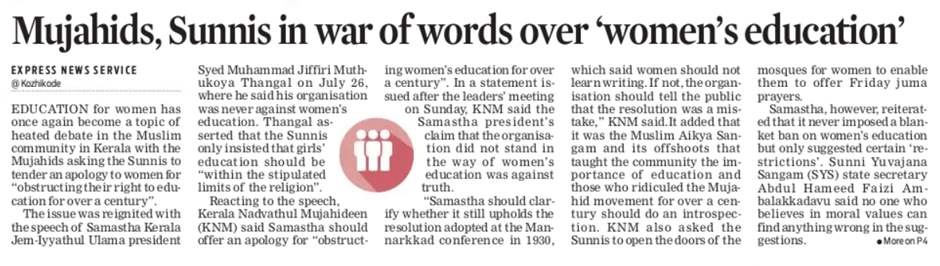
I came across this news today. It is comforting to know that there are members of the Muslim community in India who are fighting for unrestricted women’s education.
Samastha earlier had conveyed that a Muslim woman’s education should be encouraged but within religious restrictions. This became a point of debate across the state of Kerala, with many progressives calling it problematic. However, the most striking response came from a group within the community – the KNM. The organization is demanding that Samastha apologize for its take. KNM is not without its faults, but the stand they took on this particular issue is noteworthy.
Samastha and KNM
To the uninitiated, the “Samastha” group in Kerala refers to “Samastha Kerala Jamiyyathul Ulama,” an influential Sunni Muslim scholarly body in the state. Samastha plays a significant role in managing religious and educational institutions, including madrasas and mosques, and often issues guidelines on religious matters.
The term “Mujahids” in the context of Kerala typically refers to the Kerala Nadvathul Mujahideen (KNM), a prominent Islamic reformist organization in the state. The KNM often contrasts with traditionalist groups like Samastha, promoting a more modern interpretation of Islam, such as advocating the opening of the doors of mosques for Muslim women to enable them to offer Friday juma prayers.
Restricting Women’s Education on Religious Lines
If we connect religion with education, the progress of women in our country will be hindered. Afghanistan is a live example of this. Currently, girls in Afghanistan are generally allowed to attend school only up to the sixth grade. The Taliban, who regained control of the country in August 2021, have imposed severe restrictions on girls’ education beyond this level. Secondary education for girls (grades 7-12) has been largely suspended, and there have also been significant restrictions on female university students, including the closure of universities to women in late 2022. These measures have been widely condemned by international organizations and human rights groups. The global campaign #LetHerLearn, which advocates for Afghan women’s right to education, is gaining traction.
India is no Afghanistan. Here, women are allowed to study without restrictions regardless of religion. Women who are limited to religious studies may face challenges in the corporate world. It would severely restrict their job opportunities in a secular country like India, where well-paid corporate jobs often require you to engage with a global audience and follow strict academic and professional protocols that might not always adhere to religious lines.
Jobs cannot be built around religion in a democracy. Corporate jobs often require specific skills such as critical thinking, teamwork, leadership, and digital literacy. Religious studies may not always focus on developing these skills, which can impact the ability to perform effectively in a corporate setting.
Unfortunate Consequences
What happens when there are limited job opportunities for women due to religious restrictions? They will end up staying at home. Marriage becomes the only option. Financial independence becomes a distant dream.
It is ultimately up to the Indian Muslim woman to decide. If she wishes to pursue further studies, she should not be shamed.
Indian Muslim women deserve quality education, just like anyone else in India. We should have more Indian Muslim women in top positions in the corporate world. Currently, they are practically non-existent outside of Muslim countries. However, to make this happen, there need to be some reforms within the community that will help the women integrate more seamlessly into the existing corporate structure.
***
Picture Courtesy: The New Indian Express (July 2nd 2024, Kerala Edition)
The recent election in India was proof that the BJP is not invincible. Despite the party’s considerable efforts in improving the economy, it failed to connect with the people at the grassroots level. Voters ultimately prioritized free benefits and voted based on caste and religion in rural areas, where the BJP performed poorly. These are the exact issues the government had been working to avoid because they do not contribute to India’s growth in any way.
The election outcome cannot be blamed on the voters, as it is understandable why promises of freebies and jobs with guaranteed 1 lakh salaries were more alluring than infrastructure or development, no matter how burdensome such things might prove for the exchequer. Saying no to such promises is a luxury reserved for the privileged.
It needs to be acknowledged that all political parties, not just the BJP, have played a role in fueling discontent, animosity, and disharmony among communities. It is a collective failure that we, as a society, allowed ourselves to be divided along religious lines. The INDI alliance, too, resorted to fear tactics and misinformation in the name of secularism to further their agendas. As the opposition parties relentlessly worked on propagating their “savior” image, people were quick to believe that the answer to all their solutions, like poverty and joblessness, was the INDI alliance.
I have always been of the belief that one should judge a party/politician by the work they do, not the words they utter. But unfortunately, we are quick to believe hate narratives and forget that in this big bad world of politics, there is no savior, only megalomaniacs greedy for power.
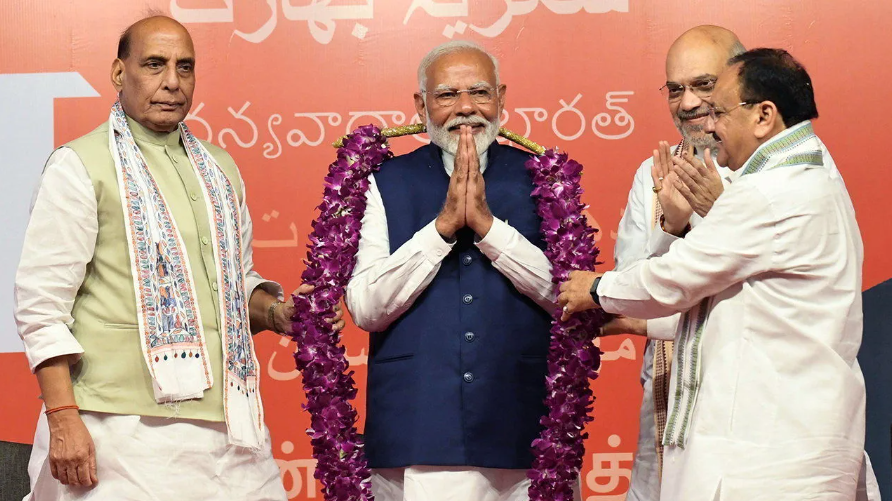
To gain back confidence, the coalition NDA government needs to pull up its socks. Things are far from gloomy for the BJP, as they still are the party with the most seats (240) in India. Congress comes a distant second with their 99 seats. However, BJP’s performance was still a big disappointment to its supporters who expected their party to get more support, especially in Uttar Pradesh, where the sacred Ayodhya temple was built after a long period of wait.
Some changes are in need of the hour. What can the Indian coalition government do to improve its performance? Here are my takes.
Don’t take success for granted
Undoubtedly, this has been the biggest lesson for the ruling party that you should never take your success for granted. The BJP became overconfident with their “400 paar” declarations, which resulted in them not doing enough groundwork.
Many reasons are mentioned for voter dissatisfaction in places like Uttar Pradesh, but the parties would have more accurate insights than us, the speculators. RSS workers allegedly did not campaign extensively or help voters reach the booth, there is also an allegation of missing votes, not enough compensation for people who lost their homes to make way for the temple, etc. Regardless of the issue, the fact remains that the BJP and RSS did not make an effort to connect with voters in rural areas and understand their issues. Instead of providing justifications, the BJP should regroup and focus on the areas where it faltered.
Outreach programs for minorities
Most Christians and Muslims I know are frightened of the BJP. This is where the opposition party made a resounding impact, albeit in a negative/divisive manner. The local politicians went around, scaring people into thinking they would be evicted if the BJP came into power. Elderly, economically disadvantaged Muslims who were approached by news channels were seen pleading to the general public with teary eyes, “Please don’t vote for the BJP. If they come into power, they will kill us.”
Who is responsible for this fearmongering? The “Hindu vs other religions” narrative has gained such solid ground that it seems next to impossible to convince minorities that Hindus mean no harm to anyone. Media, too, has a huge role to play in spreading this fear. Due to their irresponsible journalism, done solely to put Modi in a poor light, they ended up creating irreparable damage.
It became easier for the opposition to spread hatred after the emergence of the Ayodhya Temple. No one from the ruling party made an effort to explain to the minorities that these sites are as important to religious Hindus as Mecca or Medina for Muslims or the Vatican for Christians. Justice was denied to the Hindu community since the Mughal era when temples were brutally demolished to make way for mosques. A few Muslims realized this, such as the archaeologist KK Muhammed (the one who studied the site and came to the conclusion that the mosque was brazenly built over a temple) and the BJP Malappuram candidate Dr. Abdul Salam. Both of them have openly said on news channels how other communities should show empathy to “our Hindu brothers and sisters” as the community was subjected to extreme unfairness in the past, so much so that even their most sacred sites were denied to them. It takes a great deal of empathy to acknowledge someone else’s turbulent past, and you can’t help but feel gratitude for such people.
As no effort was made by the ruling party to bridge misunderstandings, political parties milked the opportunity for what its worth. Rest assured, they will continue to use the sacred temple as a tool for playing politics, further increasing the divide between Hindus and other communities. BJP should realize communication is key and work towards improving the skill to effectively clear misunderstandings.
The BJP team in Thrissur (Kerala) appeared to have been effective in their communication, which may explain why the party received Christian votes despite the opposition’s efforts to portray the Manipur issue as a communal clash. Interestingly, it was only after the elections did priests and bishops in Kerala clarified that the Manipur issue is not communal but rather ethnic. However, by that time some individuals on the ground had already done enough research to discover this on their own.
BJP often lags in countering allegations or taking strict action against the hatemongers. They never communicate their side of the story or a simple “you are safe with us,” the absence of which leads to speculations and uncertainty. They need to interact more with minorities at the ground level and induce confidence in them by clearing their misconceptions. This can come only with proper effort.
Offer financial relief to citizens
In rural areas or for those with low income, freebies are highly valued. However, it’s important to note that these freebies are often funded by taxing the middle class. The government should find a way to carefully balance the two – providing assistance to the poor without burdening the middle class. While investing in infrastructure and development projects is beneficial for the economy, it’s crucial to also provide some relief to ordinary citizens.
Avoid polarizing language
In order to gain the trust of more people, the BJP needs to use more restrained language. While Modi’s “ghuspetiyas” comment was aimed at illegal immigrants, it was twisted by the opposition for their own benefit, leading to fear-mongering.
Many people now understand that words uttered by politicians often mean nothing and are solely used as a tool to sway voters. They understand it’s a game. However, others may take it more seriously. To prevent this, simple language should be used, and the intention should be clearly specified.
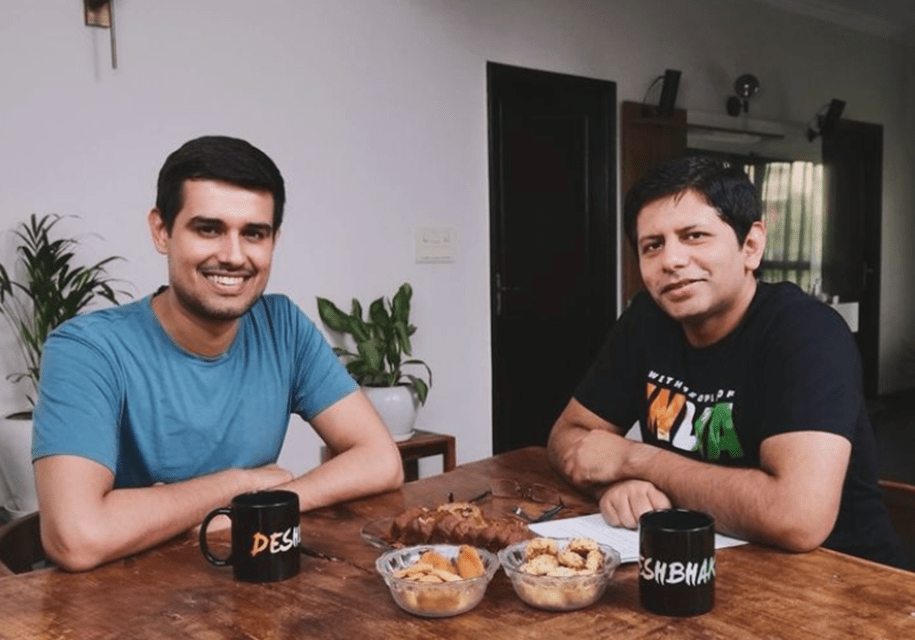
We have observed the significant rise of left-leaning political commentators on social media, particularly YouTubers, during this election. Dhruv Rathee and Ravish have amassed massive views, surpassing even mainstream news channels. It was believed that they would have a significant impact on the Lok Sabha Elections.
Dhruv, who typically maintains a neutral tone, noticeably shifted his approach in the months leading up to the election, embracing a more polarized political viewpoint. I use the term “polarized” because he blatantly overlooked several important issues during this time, such as the Sandeshkhali rapes in West Bengal and the Sidharthan case in Kerala, primarily because these cases put the opposition in a poor light. Personally, I felt his demeanor change from that of a regular YouTuber to that of a politician.
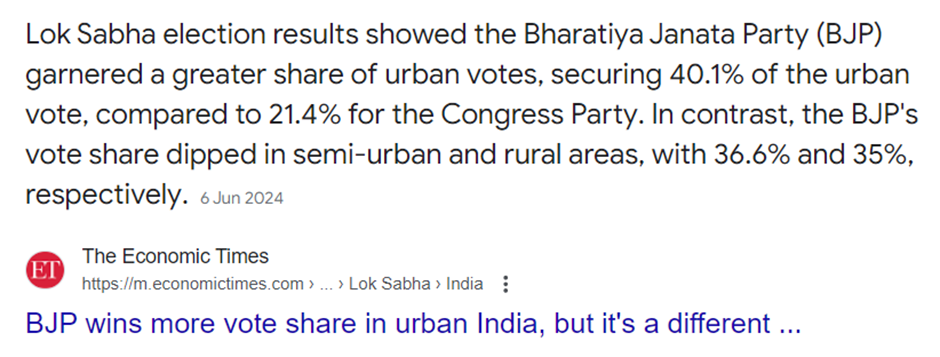
After months of running intense social media campaigns, were these left-leaning YouTubers successful? In a previous post, I mentioned how Dhruv Rathee is unlikely to have a significant impact on the Lok Sabha elections. The echo chamber angle aside, the answer lies in the data collected from the CSDS-Lokniti Post Poll Survey. It shows how the BJP performed well in urban areas while lagging in rural areas.
How much influence do YouTubers have in rural areas? Unless a proper survey is conducted that asks people living in villages, “Did Dhruv Rathee or any other YouTuber influence you to change your voting pattern this time?” we will never know for sure. Another way to analyze the impact is by examining video statistics. Content creators can share their video statistics, including the regions where their videos were most viewed. Did they receive significant viewership from rural areas?
Huge rallies were conducted in villages where Dhruv’s videos were played. However, it’s safe to say that people in rural areas do not vote based on social media activism. Instead, they vote based on their personal experiences, caste-based politics, and the help they receive. They are unlikely to resort to the Internet to research the pros and cons of political parties.
To summarize, any success resulting from YouTube videos should have primarily been reflected in urban areas, but that was not the case. BJP performed considerably well in cities.




 The Monkey Dilemma
You must be logged in to post a comment.