The UN analytical support and sanctions monitoring team has released its 35th report that analyzes ISIL’s threat to the world. Here are some interesting points related to India:
The report states that handlers attempted to incite lone-wolf attacks through their India-based supporters. Analysts have often argued that India faces greater threats from internal radicalization than external forces, particularly from terror sympathizers.
Anti-India propaganda from terror-linked publications, such as the pro-ISIL magazine Serat ul-Haq, is now spreading on social media. These platforms frequently highlight Babri Masjid and selectively amplify one-sided, inflammatory narratives about attacks on Muslims. The goal is to fuel a victim mentality, making many believe these narratives are the absolute truth.
Those unaware of online radicalization tactics easily fall for such content, and an extreme victim mindset often leads to anger, pushing individuals toward extremist groups. Recently, the Israel-Hamas war has been exploited for recruitment by terror organizations like ISIL.
I feel it’s important for India to be wary of such anti-India propaganda online. Not every piece of news is covered to bring awareness. Selective activism and outrage are often used to misguide youth into taking up arms. There should be awareness regarding this, so people know what to expect.
Since India has established some level of cordial relations with the Taliban-led government in Afghanistan, it must remain cautious of this engagement. The Taliban has expressed interest in having its representatives work in India’s embassy, but given the group’s radical nature, India should approach this with hesitation.
At the end of the day, for groups like the Taliban, religious extremism often takes precedence over diplomacy.
To read the full report, go here: docs.un.org/en/S/2025/71
The Love Queen of Malabar is a captivating exploration of the life of Kamala Das, also known as Kamala Surayya, one of India’s most celebrated poets. Written by Merrily Weisbord, the book is thought-provoking, highly controversial, poetic, melancholic, and at times, shocking.
Kamala Das shares her deepest emotions with Merrily, treating her as a confidante in revealing thoughts that range from lyrical to unexpected. While the book may not appeal to everyone, it left a lasting impression on me—an eye-opener that offered a rare glimpse into the intimate world of a literary icon.
I have carefully selected some non-controversial quotes from the book. Not everything Kamala says can be shared publicly due to its sensitive nature. However, the quotes listed here provide insight into Kamala’s thoughtful persona and capture the essence of Merrily’s book.
“A writer moves away from family, old relationships, very far with the speed of a falling star,” she says. “Otherwise the writer is destroyed, and only the member of the family remains: the mother, sister, daughter, wife. The writer at some point must ask, Do I want to be a well-loved member of the family? Or do I want to be a good writer? You can’t be both at the same time. The days when you are with the children and are being a very good mother, you cease to be the writer. You feel repelled by the pen and the paper, which are definitely going to come between you and your loved ones.”
“Because the writer can give all of herself only to that task of writing. She will have to write against her loved one, put him under the microscope, dissect him, analyze his thoughts, his words. After a while he is no longer the man you held in your arms at night. You have cut him into little slivers, everything is burst open, he is seeds and pulp and juice all spread out in little bits on your writer’s table. After that, you can’t go to his arms the same way.”
If I had not learned to write how would I have written away my loneliness or grief? Garnering them within my heart would have grown heavy as a vault, one that only death might open, a release then I would not be able to feel or sense.
“Ask the books that I read why I changed,” she says. “Ask the authors dead and alive who communicated with me and gave me the courage to be myself.”
“Make a woman laugh, then make her cry, that is the secret of a good film. Not make her cry, cry, cry. What message is that for women today?”
Her dislike of organized religion is so much more pronounced than on my last visit that I wonder if any beliefs remain to comfort her. “Yes,” she answers. “A concept of God. A presence in my room. I’m not alone. I visualize a shower of moonlight falling on someone in prayer. It is a soothing exercise. I feel bathed in light, and I know there is a God.”
She tells me that even in Kerala, which prides itself on religious coexistence, she is still being attacked from both sides. The Hindu Sangh Parivar, an association of Hindu nationalist organizations, protests her ownership of the snake shrine on her own ancestral property at Nalapat because she is a Muslim. The Muslims are “disgusted” with her because she speaks against their practices and clergy, refusing to support sectarian politics she finds unpalatable. “They feel they are losing their grip on me.”
In 1921, Kerala witnessed the Moplah Riots, where numerous Hindus were killed in communal violence. However, to this day, Congress and CPI(M) refuse to acknowledge it as a communal riot and instead label it a “class struggle between Hindu landlords and Muslim peasants.”
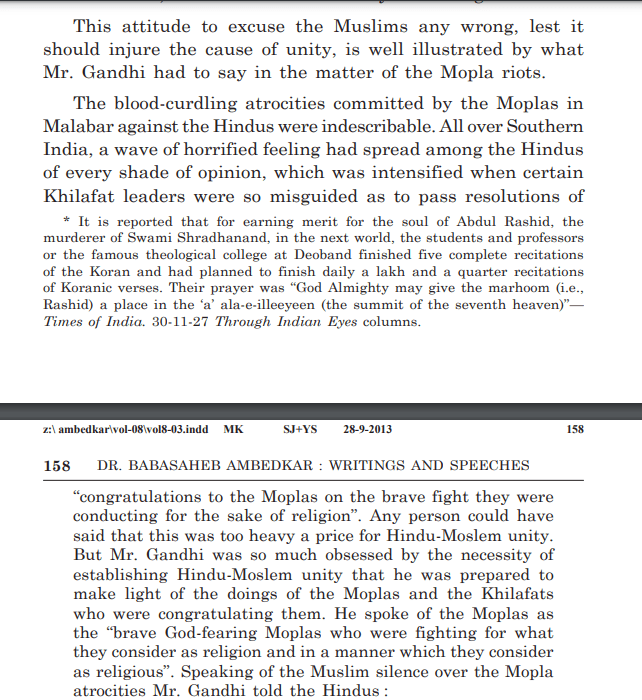
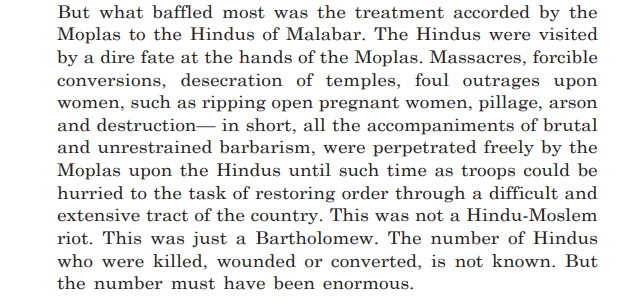
I also believed the class struggle narrative until I read B.R. Ambedkar’s book, The Partition of India. He clearly highlights the communal nature of the Moplah Riots, mentioning temple destruction, mass killings, and forced conversions of Hindus.
Some clippings from the book:
Source: Dr. Babasaheb Ambedkar : Writings and Speeches (Vol. 8)
If Hindus were specifically targeted, their temples destroyed, and they were forcibly converted, how can this not be considered a communal riot? Ambedkar’s account challenges the attempt to whitewash history by reducing it to just a landlord-peasant conflict.
Here is the question I asked AI and the response it generated:
Question: Were temples destroyed during the Moplah riots?
Answer: Yes, several temples were destroyed, looted, or desecrated during the Moplah Riots of 1921 in the Malabar region of Kerala.
Historical Accounts of Temple Destruction:
Looting and Desecration:
Many Hindu temples were attacked, idols were broken, and valuables were looted.
Records mention temples like the Thirumandhamkunnu Bhagavathy Temple being desecrated.
Forced Conversions and Killings:
The riots targeted Hindus, with reports of forced conversions, massacres, and mass displacement.
Many Hindus fled their villages, leaving temples unprotected.
British Reports and Historical Records:
British colonial reports and contemporary eyewitness accounts mention temple destruction.
Annie Besant and Veer Savarkar documented attacks on Hindu religious sites.
Conclusion:
Yes, temples were destroyed and desecrated during the Moplah Riots, which started as an anti-British uprising but later turned into violent communal attacks against Hindus in Malabar.
So how can it be concluded as merely a class struggle? Next time, someone dismisses the communal angle of the Moplah Riots as propaganda, one should ask, “Why were temples destroyed if the riots weren’t communal? Why did conversions happen? Was Ambedkar lying in his book?“
This is just one of the many lies spread by Congress and CPI(M). Why do they do it? Only they know. Perhaps to ensure Hindus keep supporting them, or maybe to prevent the majority community from developing resentment.
The second reason might have been understandable if only they didn’t paint Hindus as villains in other communal conflicts. The lack of consistency exposes their bias.
Surprisingly, many Indians are unaware that Hamas is anti-India. I’ve seen people glorify the group as “freedom fighters who are only interested in the Palestinian cause,” but a little research makes it clear that Hamas is also pro-Pakistan and anti-India.
I found Hamas problematic from the moment the October 7 attacks happened. Left-leaning friends tried to convince me they were simply fighting oppression, but I couldn’t support a group that used rape as a weapon of resistance. As a feminist, I believe in defending women’s rights universally, not selectively. I refuse to justify rape and violence when it suits one cause while condemning it elsewhere.
October 7 changed my perspective. It exposed the hypocrisy of some so-called “feminists” who speak up only when it aligns with their politics. They remain silent on Iran oppressing women, Yazidis being taken as sex slaves by ISIS, Afghanistan restricting women’s rights, or Hamas using sexual violence as a weapon. Their activism is not about justice—it’s just political.
Why Indians Should Stop Glorifying Hamas
Hamas has expressed support for Pakistan’s claim over Kashmir, viewing it as a cause similar to the Palestinian struggle. They have engaged in discussions with Pakistani leaders about Kashmir. For instance, in 2023, reports indicated that Hamas leaders met with Pakistani officials to discuss mutual concerns, including the situation in Kashmir. This alignment underscores Hamas’s willingness to support actions that could harm innocents in India.
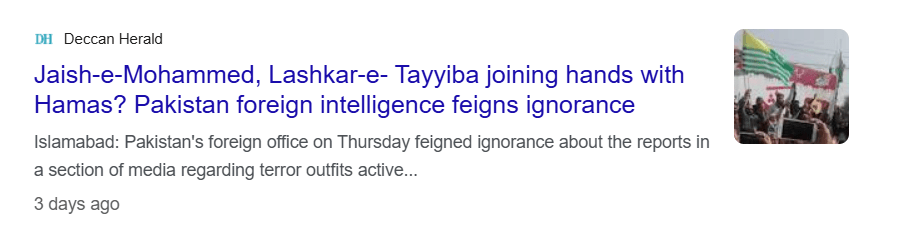
In February 2025, Hamas leaders landed in Pakistan for the first time to talk about Kashmir with Jaish-e-Mohammed and Lashkar-e-Tayyiba, groups notorious for carrying out several terrorist attacks in India. Pakistan’s foreign intelligence feigned ignorance, making it clear they support harboring anti-India terrorists on their soil.
Radical groups often shift focus when their primary battleground becomes difficult to operate in. Radicals thrive on violence—it’s a cycle they cannot break. As Son of Hamas mentions in his book, the moment peace prevails in Palestine, terror groups seek new ways to stir conflict. This keeps their funding networks active, especially from supporters abroad.
With Hamas now struggling to regroup in Gaza, could India become the next target in this Israel-Hamas lull period?
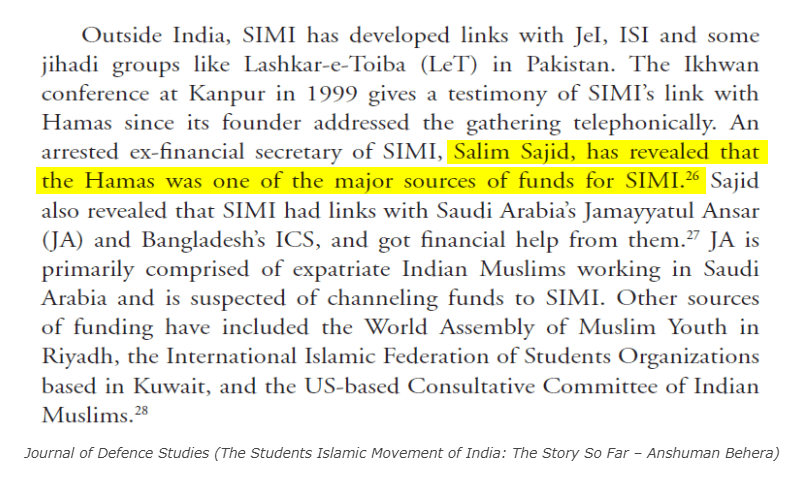
Hamas Funded Radical Group SIMI in India
An old research paper published by SSPC in 2006 mentioned the following about Hamas’ link with SIMI, the Jamaat-e-Islami’s banned student radical group whose aim was to establish Islamic rule in India:
Page 2 of The Society for the Study of Peace and Conflict (SSPC)’s Terrorism Monitor published in 2006. SSPC is considered credible within academic and research circles. It publishes well-researched papers and articles on global security, conflict resolution, and peace studies to inform scholars, policymakers, and the public.
SIMI morphed into the current PFI after it was banned.
So when I say Hamas is anti-India and pro-Pakistan, this is what I mean. Mainstream media rarely highlights this, and older reports on the subject have either been removed or are difficult to find. Articles from 2006 that covered Hamas’s stance on Kashmir have disappeared, and reference links in publications are now inactive.
This suggests a deliberate effort to portray Hamas as an organization with only good intentions. Right now, Hamas is heavily focused on the Palestinian cause, but if circumstances allowed, it would likely attempt to destabilize India as well.
Palestinians Openly Endorsing Hate and Attacks Against Hindus
In a video shared extensively online, a group of Palestinians are seen openly endorsing hate and attacks against Hindus. The speaker calls on Pakistan to attack the “filthy Hindus” to teach them a lesson for “oppressing Muslims”.
He says: “The only way to deal with the cow-worshipping Hindus is by eradicating them.”
However, it’s a credit to Indians that despite this extreme hate, most are moderate in their stance, and do not endorse violence.
How India Should Deal with Hamas
Now that Hamas has openly aligned with Pakistani terrorists, the Indian government must take steps to curb its influence in India.
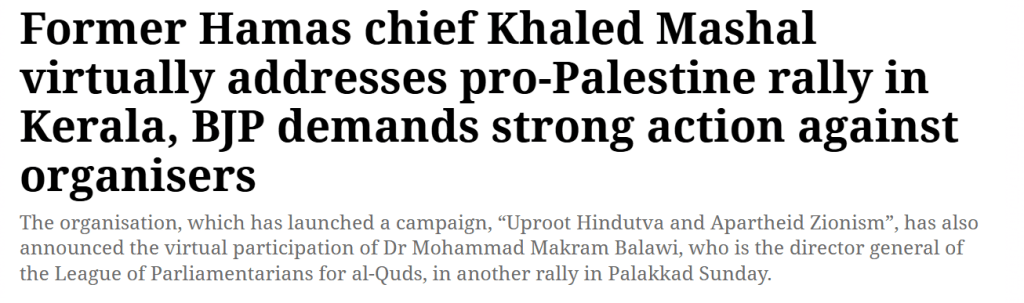
In December 2023, a Hamas leader virtually addressed a pro-Palestinian event in a Muslim-majority area of Kerala, raising serious concerns. Such events should never be allowed on Indian soil, as they carry the risk of radicalizing impressionable youth and promoting violence. The government must act decisively to prevent extremist narratives from gaining ground in India.
Hamas should be immediately designated as a terrorist organization as a precautionary measure, rather than waiting for a threat to materialize. Banning it would also prevent Indians from glorifying a group that has openly aligned with Pakistani terrorists and poses a potential threat to India.
While people are free to sympathize with any cause, it should never come at the cost of national security.
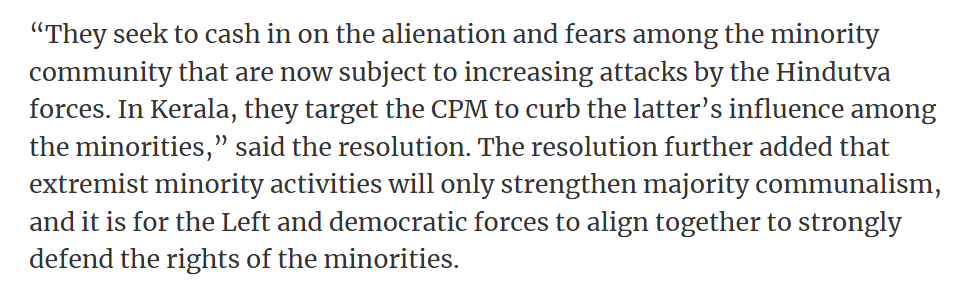
CPM mentions this about Islamist groups in the draft resolution:
Hindu extremists are using radical Muslim groups as fodder to fuel hatred between communities. But the reverse is also true—radical Muslim groups exploit the political climate to spread their own agenda. They feed off each other.
One side claims, “If Islamists stop, Hindu extremism will die down.” The other side counters, “If Hindu extremists stop, Islamists will weaken.”
There’s no middle ground. How do we break this cycle? Who should compromise? The answer is—both.
The only way forward is to call out radical elements within your own community—those who discourage interfaith interactions, prevent you from celebrating others’ festivals, and push you away from the secular fabric of the country. Peaceful coexistence is the only solution.
However, I mostly see this self-criticism coming from the Hindu community. Not everyone supports right-wing politics, a Hindu Rashtra, or extremist activities, and many Hindus actively speak out against radicalism within their own circles. But the same level of criticism isn’t visible in other communities. At least 95% of the Muslims I know have never condemned extremism within their own community, but they are very vocal about Hindu extremism. If only one side is willing to challenge its radicals, how can we truly achieve peaceful coexistence in a secular, democratic nation like India?
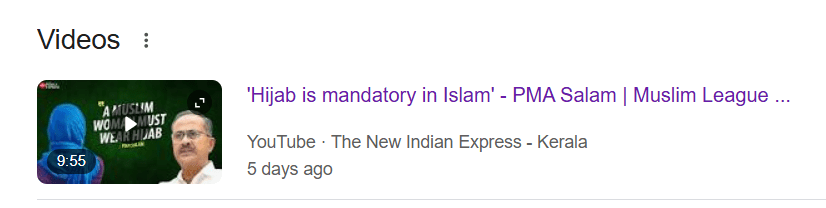
I feel this silence comes from fear—fear of being ostracized by their own community. In Kerala, the Muslim League openly stated that the hijab is not a choice for Muslim women; it is mandatory. When a journalist asked, “What if someone doesn’t want to wear it?” the leader reaffirmed, “If she’s a Muslim, we advise her to wear it.” There was no room for choice. Yet, despite often advocating for personal freedom, there was no backlash from within the Muslim community against this statement. This silence is unsettling. It makes people wonder—“If they won’t even speak up for their own freedom of choice, how can we expect them to stand up for ours?”
India is a secular nation, and preserving this secularism requires protecting religious freedom. When prominent leaders impose strict regulations on women, silence is not an option—it is a time to question them and hold them accountable. If not now, then when? Waiting until things spiral out of control will only make it harder to reclaim lost freedoms.
Western countries often criticize India, accusing it of restricting the religious freedom of minorities. For a long time, I was puzzled by this, as I saw minorities freely attending their religious places without any problems. On the other hand, Hindus in Jammu require police protection to visit their religious sites due to the ongoing threat of terrorism. So, where is this accusation truly coming from?
One of the main reasons many Christians oppose the BJP is that the party has significantly restricted international funds meant for proselytization. These funds were often misused in India to attract economically disadvantaged citizens into converting, with promises of financial assistance tied to conversion. As a result, conversions were driven more by economic pressures and manipulation than genuine faith.
Countries like the USA actively fund missionary programs, with groups such as the evangelical World Vision and the U.S. Commission on International Religious Freedom (USCIRF) advocating for unrestricted proselytization as a form of religious freedom. They often cite Article 18 of the United Nations’ Universal Declaration of Human Rights (UNDHR), which asserts that every individual “has the right to freedom of thought, conscience and religion; this right includes freedom to change his religion or belief…” This interpretation forms the basis for their criticism of India, accusing the country of limiting religious freedom and ranking it low in the religious freedom index. A 2012 article written by Dr Aseem Shukla explains this point brilliantly (hinduamerican.org/blog/proselytism-conversion-to-intolerance/).
This raises an important question: why offer monetary assistance only after conversion? Why not provide help based on humanitarian principles, without attaching religious conditions? When people are lured into faith through financial incentives, it undermines the integrity of the belief system itself. Shouldn’t conversions be driven by genuine faith and conviction, rather than economic manipulation or coercion?
Unfortunately, that’s not the reality for many. People are being lured into changing their religion through manipulation, whether through money or other means. I personally know several individuals who converted simply because they were promised financial support. What’s even more surprising is that younger generations are now making conversion a prerequisite for marriage. It’s hard to comprehend how, in today’s world, people still can’t accept different faiths and feel the need to demand conversion from their partner for the sake of marriage. Is this really secularism? Or love? I discussed this topic on this blog after watching a show, Nobody Wants This, on Netflix some time ago.
I’m currently reading a book about Kamala Das, The Love Queen of Malabar, written by a Canadian author, where it’s mentioned that Kamala was pressured to claim her conversion was out of faith, not love. The reasoning behind this was that saying she converted for love would diminish the strength of her faith. However, after her partner left her, she felt deeply depressed. The book suggests that the man she loved had been financially incentivized by foreign entities to convert Kamala. Later, Kamala wished to return to Hinduism but feared for her life and her family’s safety, including her grandchildren. Her sons even used to correct her whenever she, by habit, uttered the name of her former god, as they were afraid it might anger radicals and put their family at risk.
Why manipulate people into conversion? Let them choose to convert out of genuine faith – that is true religious freedom, not a process driven by external incentives.
The new government has largely restricted predatory conversion tactics by limiting international funds and addressing radical elements within society. This is one of the primary reasons the Indian government is widely criticized globally.
The propaganda against India has a broader base compared to the narratives propagated by BJP supporters. It’s easier for these narratives to spread, as the Christian and Muslim communities form larger global groups compared to the Hindu community. With such a widespread network, sensational news spreads quickly and easily. Adding to this challenge is the Hindu community’s general reluctance to actively counter exaggerated news, making it even harder to protect India’s image.
Many who believe in proselytization through unfair means seek the removal of the current government to restore previous practices. This is probably why they complain about every small issue and often manipulate facts to present one-sided stories. By focusing on selective narratives, they aim to undermine the current administration and bring back the old ways.
The narratives about India are often more complex than they appear in the media or through agenda-driven sources. They tend to present only one side of the story, exaggerating it to evoke emotional reactions. This is why it’s crucial to consult both left and right-wing media to gain a more balanced perspective. Otherwise, you risk forming judgments based on incomplete or biased information.









 The Monkey Dilemma
You must be logged in to post a comment.