
It’s Okay to Not Be Okay: Moon Gang-tae Has Officially Ruined Men for Women Everywhere

It's Okay to Not Be Okay Poster

I kept delaying watching It’s Okay to Not Be Okay because I have a bit of an aversion to hospital dramas. Several friends had recommended this popular Korean drama to me, but I kept putting it off. I was judging the series by its title, and honestly, I wasn’t in the mood for what I assumed would be an intense emotional rollercoaster.

I finally took the plunge a couple of weeks ago.

It took me some time to finish the series because each episode runs for over an hour, and there are 16 episodes in total. I am also not much of a binge-watcher, especially when a series deals with serious or emotionally heavy topics. So yes, completing It’s Okay to Not Be Okay took me a while.

But the time I took to finish it doesn’t take away from the fact that It’s Okay to Not Be Okay is an entertaining, thoughtful and beautifully layered K-drama.

Let’s talk about the male lead first.

Moon Gang-tae, played by the enigmatic Kim Soo-hyun, is such a major green flag that he might just make pursuing relationships in the real world a tad more difficult for women. Because honestly, who can even compete with this kind of surreal charm, patience and thoughtfulness?

He is calm, sorted, emotionally aware and dependable. He is the person you would want beside you when things get difficult. He handles uncomfortable situations with a level of maturity and emotional intelligence that makes you think, “Yes, this is exactly how my partner should behave.”

Basically, Moon Gang-tae is the ultimate go-to guy.

Go Moon-young, played by Seo Yea-ji, is completely different.

She is volatile, unpredictable and unapologetically herself. But beneath all that intensity, she also shows moments of compassion when the situation calls for it. She has a magnetic personality. What makes her even more interesting is that she knows exactly how powerful her presence can be and the effect she has on people.

She is not the easiest character to understand, but she is definitely difficult to ignore.

For me, though, the real star of It’s Okay to Not Be Okay was Oh Jung-se. He plays Moon Sang-tae, the autistic older brother of the male lead, and his performance was so convincing that there were moments when I genuinely wondered whether he was autistic in real life. Yes, I actually Googled him. That, in itself, says a lot about how convincing his portrayal was.

His performance was heartfelt, nuanced and incredibly believable. In my opinion, he absolutely deserved every award and recognition that came his way for this role.

At its core, It’s Okay to Not Be Okay is a serious drama that explores mental well-being, emotional healing, trauma, relationships and the process of learning to accept oneself.

But despite its heavier subjects, the series doesn’t feel emotionally exhausting all the time. I enjoyed the little moments of humour scattered throughout the episodes. They provide some much-needed lightness and make the story feel more balanced.

And the BTS scenes towards the end were absolutely adorable. Seeing the camaraderie between the cast members behind the scenes was a lovely bonus after spending so much time with these characters.

Overall, I found It’s Okay to Not Be Okay to be an entertaining and thoughtful Korean drama. It took me a while to finish, but by the end of it, I was glad I finally gave this much-recommended series a chance.

It’s Okay to Not Be Okay is currently streaming on Netflix.

The Best Part of Project Hail Mary Wasn’t The Space Adventure

Project Hail Mary Movie Grab

The most impressive part of Project Hail Mary isn’t the science, the space adventure, or the mission. It’s the friendship between two complete opposites. Two beings who don’t share the same language, appearance, history, or culture, yet somehow come together to create something beautiful.

When you think about it, we’re all aliens to someone from another culture. The way we speak, the food we eat, the way we dress, our traditions, our manners, everything can feel unfamiliar.

But those differences disappear when there’s mutual respect and a genuine willingness to understand and acknowledge each other. That’s what makes the friendship in Project Hail Mary special. It reminds you that connection doesn’t always need similarity. Sometimes, it just needs empathy.

It’s also the kind of friendship you wish existed in real life. The kind where someone chooses to stay, no matter how uncomfortable or polarizing things get.

Recently, I came across a beautiful Instagram post about what it means to be consciously “kept” in someone’s life, to be chosen day after day, without giving up. It stayed with me because I’ve had friendships and relationships that didn’t last. Sometimes I was the one who didn’t want to continue. Other times, they didn’t. But in almost every case, at least one of us wanted it to survive. We wanted the other person not to walk away. We hoped they would understand, stay, or try a little harder. It’s neither’s fault, because everyone has their own breaking point, but you can’t help hold that idealistic thought that we would all fight to keep each other.

When you eventually realize that you’re the only one doing that fighting, it hurts. It affects your self-esteem. “Wasn’t I worth it?” It’s one of those heartbreaks that doesn’t always have a dramatic ending. You move on, quietly. Accepting it as your fate. Other times, you dwell in self-pity.

But some things can never be forced. Not love. Not affection. And certainly not friendship.

Watching Project Hail Mary reminded me of all of that. I don’t know if a friendship as pure and selfless as the one in the movie really exists, but it was comforting to watch. It made me believe, at least for a couple of hours, that such connections are possible.

I wish I had watched it on the big screen instead of on Amazon Prime. The visuals are absolutely stunning, and this is one of those sci-fi movies that deserves to be experienced in a theater. Still, I’m glad I finally watched it.

And Ryan Gosling was simply fantastic. At no point does it feel like he’s acting. He disappears into the character so completely that you forget you’re watching one of Hollywood’s biggest stars. That’s always the sign of a great performance.

I would absolutely recommend watching the movie on the biggest screen at home if possible. Streaming on Amazon Prime.

When People Forget You

A Scenic Nature Photo

Memory is such a weird thing. Some people remember the tiniest details about me from years ago, while others can’t recall spending time with me ever. They have forgotten entire moments. A day out, the day we talked, the laughs we shared.

I mean, how is that even possible? How can people erase entire days?

It also leaves you with a strange sense of self-doubt. Did you not make enough of an impression to be remembered?

A school friend, whom I reconnected with years later, couldn’t remember that we had spoken over the phone before. He was under the impression we had never talked. Another friend couldn’t recollect attending a wedding with me, which was actually the place where we first met. Even today, he acts as though we’ve never met. A few days ago, another friend, this time a woman, said she doesn’t remember going to a movie with me. It wasn’t just a quick outing. The entire day revolved around that one activity, so it was mind-boggling to realize that the memory had completely disappeared from her mind.

And then there are people like my niece, who can remember things from years ago with surprising clarity. Every time she brings up something I had completely forgotten, I’m both amazed and happy.

I guess this just proves that human memory is a fickle thing. It isn’t the perfect record of our lives that we often assume it is. So how can we depend on memory alone to define our current relationships or friendships and the moments that mattered?

Maybe someone, somewhere, did something incredibly kind for you, but you’ve completely forgotten it. Over time, you start believing they were never there for you because the memory no longer exists. You convince yourself there were no meaningful moments together, when in reality, they simply faded away.

Sometimes, forgotten memories say more about how the mind works than they do about the people involved.

It’s kind of scary, isn’t it? How hard do we have to try to hold on to the good memories? To make sure time doesn’t play the villain and quietly erases them for good.

***

Photo by Baro

Off Campus: The Friendship Was the Real Love Story

Off Campus Representative Image

I started watching Off Campus because of all the social media hype surrounding the series. It took me almost two weeks to finish it, but honestly, that is how I watch almost every show these days.

In fact, it is not limited to web series alone. I often break movies into 30-minute sessions and watch them over several days like a series. I used to think it was because my attention span had become shorter. But then I watched both parts of Dhurandhar, which were over three hours each, in the theatre without feeling bored for a second. That made me realize the issue probably is not my attention span. The story simply has to hook me enough.

Anyway, back to Off Campus.

One thing I appreciated about this Amazon Prime series is that it fully embraces the campus drama setting and focuses on the lives of young adults. That said, I found it a little difficult to relate to the “college student” aspect because most of the cast looked quite grown-up and remarkably sorted out for their age.

As someone who belongs firmly to the K-drama enthusiast camp, I also struggled a bit with how physical the relationships felt compared to the emotional depth I am used to seeing in Korean dramas. The show does explore trauma, vulnerability, and personal growth, but it never quite reaches the level of empathy and layered storytelling that many K-dramas excel at. Because of that, the series did not emotionally move me as much as I expected.

At the same time, I completely understand why Off Campus has resonated with younger audiences. Beneath the romance, it talks about important themes like dealing with complicated feelings, open communication, consent, emotional support, and empathy. These may sound basic, but they are often easier said than done.

Personally, I enjoyed the friendship between Hannah and Allie even more than some of the main romantic storylines. The scene where Hannah finally chooses to share her story with Allie was an absolute tearjerker for me. Truly, blessed are those who have a friend like that in their lives.

I also found Allie’s romantic arc far more nuanced and interesting. She desperately wants to prove she can be alone without using relationships as a crutch and, in the process, makes some questionable decisions. Honestly, that felt very relatable because most of us have done our fair share of nonsense while trying to convince ourselves we have everything figured out.

Her confusion is what makes the storyline compelling. She has a partner who is not a bad person by any measure, but he is not quite the right person for her either. That grey area, where nobody is necessarily wrong yet things still do not feel right, makes for a much more engaging relationship story. Mika Abdalla aces the role. Her resemblance to the Indian actress, Mahima Chaudhry, is also uncanny.

For me, the overall vibe of Off Campus felt like a blend of 13 Reasons Why and Beartown. Because of that, it did not feel particularly fresh or groundbreaking. A quick Google search tells me that the Off Campus books were published around the same period as Beartown, and some even earlier. Still, my point is simply that the storyline felt familiar to me.

Overall, I think Off Campus is a decent one-time watch if you enjoy young adult romance. It may not have offered anything entirely new, but it was engaging enough to keep me watching.

Off Campus is currently streaming on Amazon Prime Video.

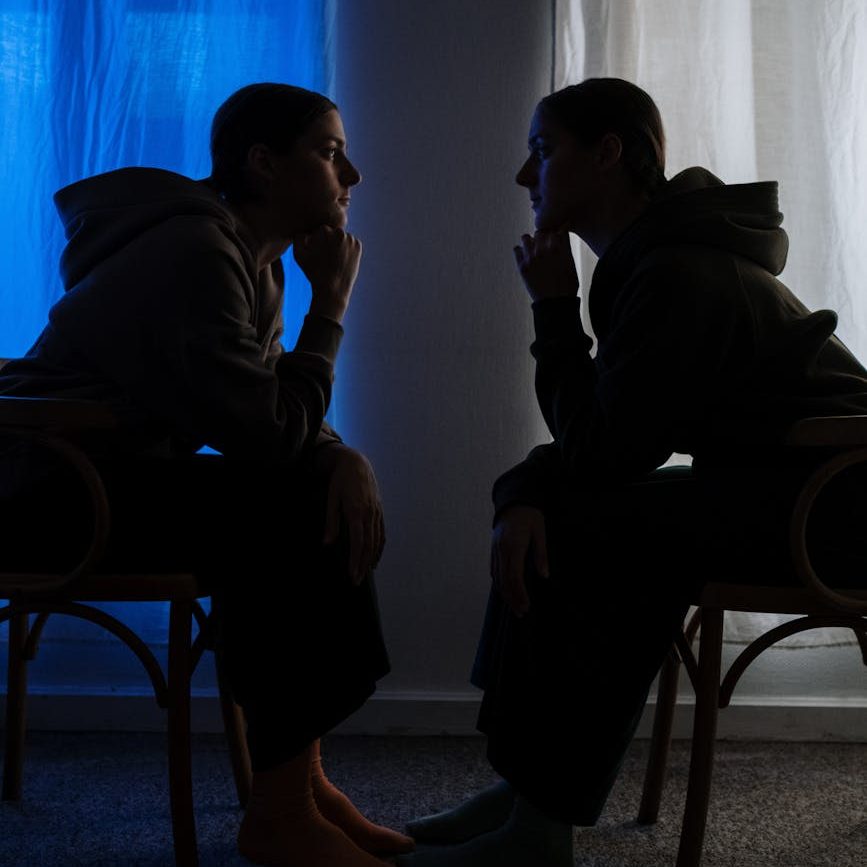
The Introvert-Extrovert Chat Paradox

Picture of two people looking at each other, depicting introversion and extroversion

Something that has caught my eye often over the years is the difference between how introverts and extroverts communicate in real life and online. I wonder if you’ve noticed it too.

I’m an introvert who loves writing and blogging. But I’m someone with a fairly extroverted chatting personality.

On the other hand, many extroverts I know are surprisingly quiet on chat. Some even come across as shy. Meanwhile, introverts like me can appear far more outgoing and expressive online.

This is where things get interesting.

Imagine a friendship that begins through real-life interactions. Someone gets to know your actual personality, and then later comes across your online personality or chat personality. What if they don’t like that version of you as much? The opposite can happen too. Someone may enjoy your confident, talkative online presence but struggle to connect with the quieter, more reserved version of you in real life.

I think this is where many misunderstandings and personality clashes happen today.

This post is simply an observation. It’s just something I’ve noticed while navigating friendship and online conversations.

As someone in my 40s, I didn’t grow up with this confusion because there was no online personality to manage. The people around you knew only one version of you.

I did start blogging during my college days. Over time, I developed an online personality that was more outgoing and expressive. The internet felt like a safe space where I could communicate freely. As someone who was studious and never benefited from what people call “pretty privilege,” writing online allowed me to share my thoughts without feeling judged.

My appearance may have changed over the years, but my introverted nature never really did. The internet continues to be a comfortable space where I could express my feelings and connect with others in a way that felt natural to me.

Today, we live in a digital age where friendships and even relationships are shaped by multiple versions of ourselves. Real-life conversations, text messages, social media interactions, blogs, and online communities collectively play a role in how others judge us.

Maybe that’s why getting to know someone has become both easier and more complicated than ever before.

***

Photo by cottonbro studio

Sometimes the Best Part of Travel Is the People You Meet

Bhutan Landscape Photo

For me, the best part of travel is rarely just the destination. It is almost always the people I meet along the way. Sometimes they are fellow Indians I happen to run into while traveling abroad. Other times, they are locals who live there. Either way, travel experiences often become more meaningful because of the people you unexpectedly connect with.

It always amazes me how you can visit a completely new place and instantly click with someone. Someone you had almost zero chance of meeting in your life. Someone you may never meet again. There is something both beautiful and bittersweet about that.

For a brief moment, you feel understood. You find a kind of ease in being yourself. It makes you wish there was someone like that back home. A friend with whom conversations flow naturally, and silence is comfortable. But when the trip ends, you leave with the quiet realization that a part of that connection belongs to that place and moment. And you need to regrettably acknowledge and accept that fact and move on.

Now that I am back in India after my trip to the North East, I realize something interesting. What stays with me is not the destination or the sightseeing. It is the people I connected with during my travels. The random conversations, the shared laughter, and the small moments that made the journey special.

Those encounters also reminded me of something important. Even in my 40s, making new friends is still very much possible. Travel has a funny way of proving that meaningful connections can happen at any stage of life.

Of course, we can stay connected online. Social media and messaging apps make it easy to keep in touch with people you meet while traveling. But it is never quite the same as meeting someone face to face. There is a kind of chemistry in real-life interactions that online conversations cannot fully capture. The smiles, the sparkle in someone’s eyes, the playful teasing, the expressions, and the shared energy of the moment.

That is one reason why travel feels both rejuvenating and humbling. It lifts you into a small dreamlike bubble for a while. You feel lighter, freer, and more open to people and experiences.

But eventually, every trip ends. You leave that bubble behind and return to everyday life. Routine, work, responsibilities, and schedules slowly start filling your days again. Your mind may not be fully ready for reality for a few days. Part of you is still wandering through those travel memories.

Life, however, has a gentle way of bringing you back to the familiar. Slowly, day by day, you settle back into your usual rhythm. The memories of the trip remain, but over time they soften. The details blur a little. The feelings become less intense.

Until the next journey begins.

***

Photo by All teams name