Nobody Wants This: Exploring Conversion & Interfaith Relationships in India

Nobody Wants This Poster

I recently watched Nobody Wants This Season 2. If you haven’t seen Season 1 of this Netflix series, I really think you should. It deals with a topic that most interfaith love stories never touch — conversion. It’s a sensitive issue, especially among Abrahamic religions. So it felt quite bold that the makers decided to go into it at all.

Season 1 had already touched on the idea of conversion. But Season 2 takes it a little further. This time, you see the boyfriend, who is a Jewish rabbi, and his family, constantly pushing his Christian girlfriend, who seems more atheist or maybe agnostic, to convert. It adds a new layer to their story and makes the whole situation feel even more complicated.

However, this post is not a detailed review of the series, but the many thoughts that came to my mind while watching it, mainly concerning conversion and how it is seen in India.

There are many abroad who have a distorted idea of religious freedom in India, no thanks to misleading, half-baked news articles, often written by left-leaning Hindus or non-Hindus, and I wish to debunk those notions as well and present them from the perspective of a centre-right Hindu who was, till two years ago, a leftist.

Be prepared for a long post, because this is a topic I feel strongly about. If you’re short on time, you may want to save or bookmark it and read it when you’re free.

A Hindu’s View on Conversion

Before I begin, I want to make my religious beliefs clear. I’m not a religious Hindu in the traditional sense, but I’m still a staunch Hindu. If that sounds confusing, it’s only because Hinduism allows this kind of pluralism. You can be spiritual, non-religious, or even an atheist, and still remain Hindu.

The faith makes space for many ways of thinking, which is why someone like me fits comfortably within it. I’m not ostracized for eating beef, nor am I ostracized for not following religious beliefs properly. I can question and I can push back against religious rules I don’t believe in without repercussions.

This freedom that my belief generously allows me is exactly why I strongly stand by the community and call myself a “staunch Hindu.” I advocate for the rights of my community, which a religious Hindu in India may not always do, as they wish to appear secular and tolerant of even the injustices against us.

Now that my beliefs are out of the way, I want to say that even as a non-traditional, progressive Hindu feminist, I don’t support conversion. I don’t understand why anyone has to give up their identity for love, marriage, or even politics, no matter how much anyone would try to justify it.

Most Hindus in India feel the same way, which is why you rarely see the community protesting against anti-conversion laws in some states. Among ourselves, we often say the same thing quietly: “What’s the need to convert?” Of course, many reasons are given. I address them later in this post.

Then we see Indian-origin Hindu politicians in America converting to Christianity to stay relevant and gain acceptance, and it makes us pause. It makes us wonder, “Is America really the land of the free?” And on what basis do they judge India on religious matters when they themselves have not reached full religious secularism yet?

However, in Abrahamic religions, conversion is considered a matter of freedom of faith. This is acknowledged. But this is also a major reason for communal tensions in a Hindu-majority country like India. Most Hindus do not believe in conversion or proselytization, while Abrahamic faiths consider it a part of their practice.

Hindus are of the belief that everyone should be free to practice their faith without disturbing others or disrespecting anyone else’s faith. Proselytization goes against that idea. It feels disrespectful because it implies someone’s existing faith is not good enough. It involves putting down those beliefs, so they are convinced enough to join the new one. So, this “freedom of faith” often comes at the expense of disrespecting others, which was tolerated for the longest period of time, till the Hindu community got the strength to say “enough is enough.”

This pushback is the part that’s often presented to the world as a “lack of religious freedom” in India. Or, to put it more frankly, the lack of freedom to convert Hindus. This clash of beliefs has no solution, and I see it continuing even after a change of government. It’s a label the country has to live with, because there can be no middle ground when people feel their identity is being erased.

A thought I often hear is, “There are so many Christian-majority and Muslim-majority countries in the world. Why can’t they just leave us alone?” It reflects the frustration many Hindus feel when they see constant pressure to convert despite already being a global minority.

Pressure to Convert in Interfaith Marriages

The topic of conversion in marriages is prevalent in Indian Reddit circles. Almost every other day, you see someone saying, “My partner’s parents want me to convert. What should I do?”

From what I’ve seen, it’s usually the Hindu who is expected to convert. And often, the Hindu partner is unaware of what that really means. They hear lines like, “You just need to get baptized. After that, you can follow your own culture,” and they assume there’s no conversion involved. Many agree because they don’t realize the deeper implications. We walk into these situations thinking others are as pluralistic and flexible as we are, and that’s where the misunderstanding begins.

Conversion is also very normalized. When I ask my Christian friends if someone needs to convert to marry into their community, they casually say “yes,” as if it’s the most ordinary thing in the world.

We recently saw this when JD Vance openly and coolly said he hopes his wife, Usha Vance, a Hindu, converts someday. Ironically, the same line appears in Nobody Wants This Season 2 as well, where the Jewish rabbi says he hopes his Christian girlfriend converts one day.

Vance wants Usha Vance to convert to Christianity

For us Hindus, it’s a culture shock, almost regressive, because we never expect something like this from others. At the same time, Abrahamics and international news channels are confused when they report that there’s outrage in India over Vance’s statement. They have no idea why Hindus are angry. So they brand it as “far-right Hindutva.”

Why Do Hindus Dislike Conversion?

Most Hindus find the idea of conversion strange, because the religion itself accepts that God can appear in many forms. It is naturally pluralistic. So someone like me, who is not religious, or even someone who is an atheist, is still seen as a Hindu, because schools like Carvaka already accept that. We also tend to readily accept other gods because of this pluralism. We don’t consider them as fake. We don’t believe that ours is the “only true god” either.

This pluralistic mindset of Hindus is both a boon and a bane. A boon because we naturally accept all faiths, and a bane because we expect the same openness from others, and we don’t always receive it.

On top of that, many Hindus today focus more on careers and less on having children. So there is a natural tendency to protect the current Hindu population from inducements. The Chattisgarh High Court reiterated the same thing recently:

Conversion by inducement a social menace
Chhattisgarh High Court Condemning Induced Conversions

With all this in mind, it’s natural that the majority of Hindus don’t look at conversion in a positive way. Our faith is already mocked by many Abrahamics around the world, who use words like “demon-worshipping pagans.” This makes it even more important to push back against that narrative and simply exist as we are.

Hindus, in short, want the freedom to be seen and respected in their own identity. But this way of thinking is often dismissed by, ironically, the very same people who speak loudly about secularism and freedom of religion. If others believe Hindus can be freely converted, then Hindus also have the right to openly object to it.

Ghar Wapsi

Now, some may argue that even Hindus encourage conversion in the form of Ghar Wapsi (reverting to Hinduism). However, Ghar wapsi is not a core part of Hinduism. It is more of a reaction to the aggressive conversions that have been happening in the country.

Most people I know converted to Abrahamic religions because of perks, not out of faith. They were poor and needed money. They were promised financial benefits if they converted. The fact that they are openly admitting this is nothing any faith should feel proud of. The only reason to convert to another faith should be faith itself. You should feel that the new faith and its principles are right for you, not be influenced by inducements or pressure.

If you ask why the Hindu side can’t match these perks, the answer is simple: we don’t have multiple Hindu-majority nations funding such activities. India is the only major Hindu-majority country, so the playing field is not equal.

Ghar Wapsi is simply an attempt, based on faith alone, to help those who genuinely want to return to Hinduism.

Arguments Used to Justify Conversions in India

1. Charity

There’s this belief that the money given during conversions is out of pure kindness. But I know many Christians who are struggling, working extra hours just to manage their basic needs. If the intention is genuine help, why not support them first?

And, most importantly, why should any help come with the condition of conversion?

Real help doesn’t demand a change of faith. If it does, you have to wonder whether it’s truly help or part of an agenda.

2. Caste Discrimination in Hinduism

It’s also misleading to say that converted Christians escape discrimination to enter a better way of life after they leave Hinduism. Many are treated as “lower-level” Christians, and some have even gone back to Hinduism because of this.

Dalit Christians protesting against Church
Source: New Indian Express (July 2025)

Additionally, consider the points made below (took help from Google Search AI):
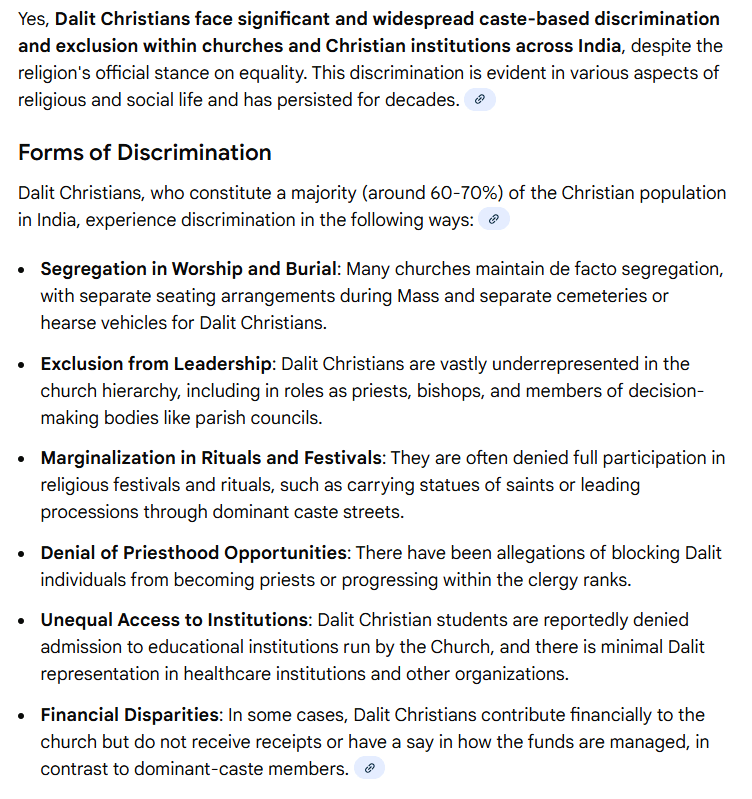
Dalit Christians facing discrimination in India

One person told me about a convert in her family who wants to return but cannot, because they signed a financial help agreement that now holds them back.

The good thing is that the caste system within Hindu society is slowly being dealt with. Families are becoming more open to inter-caste marriages, including in my own family. This change is happening faster in the South than in the North. It’s not perfect yet, but progress is real. In this situation, constantly blaming a community that is actively trying to fix the problem does not help.

Yes, many Hindus still support caste, and as long as they exist, the issue will continue. But this divide is also kept alive by leaders, both political and religious, because it benefits them. If caste truly disappears, many of these leaders lose their power to divide or convert Hindus, and that is why the system hasn’t faded away completely.

Instead of building bridges, the “narrative builders” choose to burn them by feeding divisive stories, which only pushes people of different castes further apart. Missionaries often highlight caste discrimination so aggressively because it helps them drive conversions. So you have to ask — are they really helping, or are they using the problem to serve their own goals?

4. Freedom of Faith

The tricky side of conversion in India is that Hindus openly say they are against it. But in Kerala, I often see Christian groups shift their stand based on who is converting and to which religion. They welcome anyone who joins their faith, but they loudly object when someone chooses to leave it.

Churches often use the term “love jihad” when a Christian woman converts to Islam for love. Yet the same groups talk about “freedom of faith” when a Hindu woman converts to Christianity for love.

Since both Abrahamic religions support proselytization as part of their belief system, you would expect them to be supportive of conversions into each other’s religion. But that rarely happens.

Complications of Conversion in Interfaith Relationships

Spoiler Ahead for Nobody Wants This Season 2

Click to reveal spoiler

Considering the many unwanted complications related to conversion, I was really hoping the female character in Nobody Wants This would take a stand. I wanted both partners to accept that two religions can live side by side without one needing to disappear. The ending didn’t go the way I hoped, but since there’s a Season 3 coming, I’m hoping they fix things and take the story in a better direction.

*Spoiler Ends*

In many interfaith relationships, I notice that the Hindu partner often gives in to the Abrahamic faith — if not through marriage, then through the children.

Take Usha Vance, for example. All three of her children were baptized because her husband couldn’t accept the kids growing up Hindu. That feels like a loss of her own identity. It shows that even an educated woman like her is not fully protected from this pressure.

If it were up to me, ideally, I would want the kids to grow up with both religions. But if we had to choose one religion for my “imaginary” children, I would fight hard to raise them in my own. Purely because Hinduism is naturally pluralistic, and it doesn’t invalidate any other faith. It would also matter to me because Hindus are a global minority, while the other religions face no existential crisis. It’s like the global majority religion being generous enough to make space for the growth of the minority.

Also, if I had to pick, I would choose a court marriage. But if the partner insists on a religious ceremony, then it would have to be a temple wedding. You don’t need to convert for that. You only need to respect the rituals. It’s simple, fair, and inclusive.

This is probably why I feel an interfaith marriage may not work for me. I believe in equality between religions, while an Abrahamic partner may not always see it the same way. There would be constant tension, and I am not the kind of Hindu who would compromise on my identity.

When I was younger, I probably would not have thought this way. Back then, love felt like everything. But growing older makes you see the bigger picture.

Pushback Against Conversions in India

More Hindus today realize that they don’t need to give up their beliefs for anything, which is why you see fewer people willing to convert.
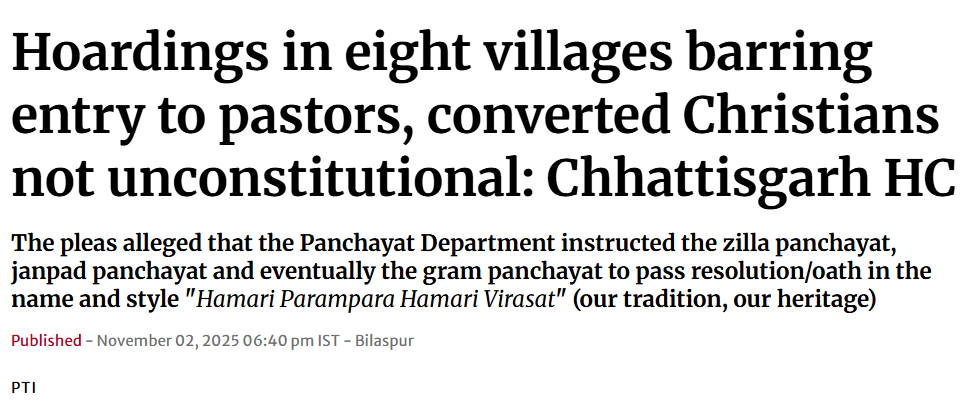
Banning of conversion in Indian villages
Hindu Villagers in India Fighting Back Against Conversion

This awareness is slowly growing. I recently saw a post on Reddit where an Indian Christian said they felt sad that many Hindus in India are no longer open to conversion or to “the way of the Lord.” To me, this is actually a positive sign for the Hindu community. It shows that more people are choosing to stay firm in their identity.

And honestly, this should be true for every religion, because love and true secularism do not require anyone to change who they really are.

Netflix Movie Spotlight: Baramulla

Baramulla Movie Poster

What defines horror? We often think of ghosts, possessed souls, or strange creatures with no clear form. Yet I realized there’s another type of horror that hits harder. The ones that combine these supernatural ideas with the harsh truths of real life. This is a type of blend that creates an impact, which stays with you long after the movie is over. This is where Baramulla is about.

What’s It About?

Baramulla opens with a policeman who moves to Kashmir and stays in an old house filled with secrets. He is there to investigate the disappearance of children in the area. Strange events start to unfold at once. The elder daughter senses a foul, “dog-like” smell in the house, even if there are no dogs. The caretaker carries a plate of food every day to a locked room. What lies behind these mysteries? Why are children vanishing? These questions drive the heart of the story.

Thoughts

I can’t, unfortunately, share everything I felt without giving away the main plot. Since I wanted to share my thoughts in full, I placed them in a separate “Spoilers Ahead” block after this section. You can skip it if you prefer to avoid spoilers.

Baramulla left me with many emotions. I was genuinely amazed by how the team crafted it.

The movie tries something that Indian cinema, to my knowledge, hasn’t attempted before in a horror movie. That is, blending the past and the present into a story that’s rooted in historical events. It reminds you that horror has layers. It’s not only about the unknown, but also the known. The horror of trust turning into betrayal. The horror of being dismissed or gaslit. The horror of violence, both mental and physical. Baramulla captures all of this with sharp clarity.

The performances are strong across the board. Personally, I would say it’s a must-watch.

Baramulla is now streaming on Netflix.

**Spoilers Ahead**

I felt emotional through many scenes. The acting was powerful and honest. The pain never felt exaggerated.

By now, you probably know that the film draws from the suffering Kashmiri Hindus faced in the late ’80s and ’90s. Many cast members are Kashmiri Hindus who had to flee their homes. Manav Kaul is one of them. He left Kashmir when he was in grade 4. He moved on to become a competitive swimmer in his late teenage years and participated in state and national-level championships. He has more than 14 national medals in swimming to his credit.

The end scenes also show Sanjay Suri, which is befitting, since his father was killed by terrorists in Srinagar when Suri was just 19. He moved to Delhi after that and became a known face in the film industry.

The producer and writer, Aditya Dhar, who is also Yami Gautam’s husband, is a Kashmiri Pandit. He has been using his craft to share Kashmir’s story with care and technical prowess.

Some Kashmiri Pandit celebrities, like Kunal Khemu, have chosen not to explore their past, and that is their personal choice. In an interview with Smita Prakash, he said he doesn’t know much about that period, even though his own family lived through it.

I feel it’s important for us to understand our history so we don’t repeat old mistakes. Stories like these should be passed from one generation to the next. My only regret is not asking my grandfather about his experiences—how Kerala felt during the Indian freedom struggle, and what life was like then. Those anecdotes have been lost forever, as he did not pass on the stories to his children as well.

It’s remarkable that so many Kashmiri Hindus who had to flee the valley are using art to express their experiences instead of resorting to violence. Their goal is empathy and understanding, something they were denied for a long time, not provocation. Choosing storytelling over violence is admirable, especially in a world where violence is often justified in the name of resistance.

There are also a few Kashmiri Hindus with left-leaning views who defend problematic groups and take part in “Free Kashmir” sloganeering, similar to how a very small number of non-Zionist Israelis speak in ways that don’t reflect the wider population.

Most Kashmiri Hindus (and some Kashmiri Muslims) have appreciated the movie. However, left-leaning Hindus are also criticizing the movie for “propaganda,” even though the events have been well documented. Films that depict and educate the viewers on crimes against Muslims in India are welcomed, while films showing crimes against Hindus are often dismissed as Islamophobic, nationalist, or propaganda. This imbalance is where many activists struggle. They accept one truth but not the other.

People like me have slowly stepped out of that mindset to face the whole truth.

It may take a while, but I really believe the truth will eventually reach wider acceptance sooner or later. And the stories can’t stop until the pain is finally acknowledged. They need to be told, retold, and carried forward. Only then will they finally find the place they deserve.

Umar Khalid, Sharjeel Imam, and the Bail Debate: The Right-Wing Take

Umar Khalid and Sharjeel Imam

The debate around Umar Khalid, Sharjeel Imam, and other Delhi riots accused who have not yet been granted bail has once again come into focus. From the right-wing perspective, the issue is not as simple as “judicial delay” or “denial of justice.” I thought of writing this post because many in India only trust left-wing channels, which causes them to miss important fact-based points shared by the right-wing.

Adjournments and CJI’s Remarks

First of all, let us understand what an adjournment is. Simply put, it is when a court hearing or trial is postponed to a later date instead of being completed on the scheduled day.

Out of the 14 adjournments in Umar Khalid’s case, 7 were initiated by his own legal team. This was mentioned by CJI D.Y. Chandrachud himself in his interview with Barkha Dutt.

Umar Khalid Bail Plea: Multiple Adjournments, Withdrawal
Source: Lawbeat

“I do not want to comment on the merits of the case but I must tell you one thing which is lost sight by a lot of people when it comes to Umar Khalid‘s case, can you imagine that the case was adjourned, they were at least seven if not more adjournments which were sought by the council appearing for Umar Khalid and eventually the application for bail was withdrawn.” – CJI Chandrachud

Justice Chandrachud noted that, on social media, a one-sided narrative often takes hold, leaving judges with no space to defend themselves. He added that if one looks closely at the actual proceedings in court, the reality is far more nuanced than what is portrayed online.

While some “fact checkers” online have attempted to dismiss this claim by relying on surface-level sources, it is reasonable to trust the CJI more on this matter. As head of the judiciary, he had direct access to both official and indirect records of adjournments.

The Delay Tactic

According to many on the right, Khalid and Imam’s legal strategy is clear. If the trial begins, conviction is almost certain. Thus, their team is accused of deliberately delaying proceedings by filing fresh petitions, often citing a “change in circumstances.” The idea is to drag the trial as long as possible and eventually claim bail on the grounds of delay.

Notably, some petitions that caused delays were also filed by other accused who are already out on bail.

The Judicial Tactic Explained

The strategy seen here is not unique. It is a common tactic in the Indian judiciary:

  1. Lawyers repeatedly file petitions (often citing new circumstances).
  2. Each petition leads to adjournments, dragging the trial.
  3. Eventually, the accused can argue that their right to a speedy trial (protected under Article 21 of the Constitution) has been violated.
  4. On that ground, they can seek bail due to judicial delay.

This slow erosion of the process not only stalls justice but also erodes public trust in the judiciary. Something that many argue is part of the plan.

CJI on Unseen Angles

In an interview with Barkha Dutt, CJI Chandrachud hinted that there are angles in the case that cannot be revealed to the public. Right-wing commentators believe this may refer to multiple coordinated fronts behind the Delhi riots.

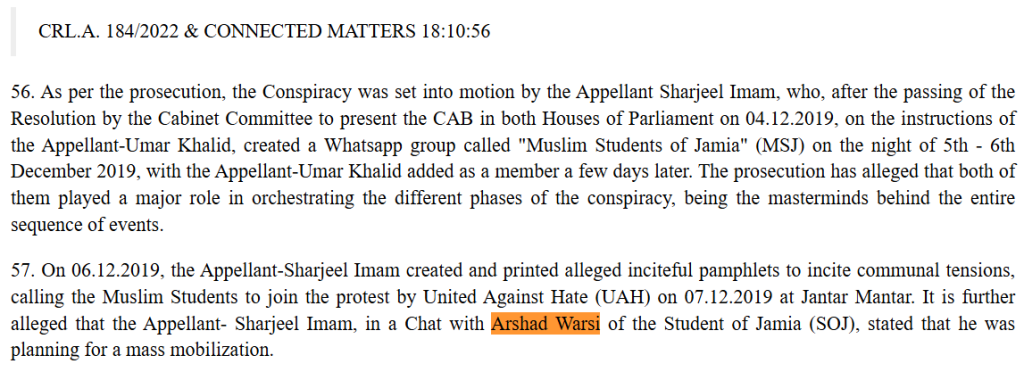
One example often cited is ISIS member Arshad Warsi (not the actor), who was in contact with Sharjeel Imam. Warsi allegedly helped decide the content of pamphlets that were distributed to mosques and Muslim neighbourhoods prior to the riots to incite violence. He was later arrested in the Pune ISIS module case.

Sharjeel Imam and Arshad Warsi
Sharjeel Imam’s connection with Arshad Warsi. Source: indiankanoon.org/doc/156202283/
Arrest of Arshad Warsi
Arshad Warsi arrested

There are also allegations of foreign funding and terror groups like PFI supporting the protests and unrest.

Umar Khalid PFI
Umar Khalid met with other accused people in the PFI office to discuss funds for riots. Source: indiankanoon.org/doc/156202283/

The Seriousness of the Delhi Riots

The 2020 Delhi riots were not minor incidents of unrest. They claimed the lives of 53 people, including Intelligence Bureau officer Ankit Sharma. For many, this underscores the gravity of the case and why justice cannot be indefinitely postponed.

Right-Wing Response

Right-wing commentators like Abhijit Iyer-Mitra and Kushal Mehra have now openly criticized the delay of trials. They argue that instead of dragging the matter endlessly, the trial should begin as soon as possible, and justice should be delivered. In their view, it is time to see through legal manoeuvres and bring the culprits to justice. The longer the delay, the more the perception of judicial inefficiency grows, and that benefits only those seeking to evade accountability.

It is also important to understand that, though we can call for quick trials, courts in India are bound to follow established legal procedures. Every step, adjournments, evidence submission, witness examination, bail hearings, has to comply with the Code of Criminal Procedure (CrPC), the Evidence Act, and constitutional safeguards like Article 21 (right to life and liberty, including speedy trial).

Judges cannot simply “override” these protocols, even if they suspect delaying tactics. If the defense files a petition citing “change in circumstances” or another procedural ground, the court is obliged to hear it and decide. Ignoring or fast-tracking outside the rules would open the door to appeals, accusations of bias, or even the case collapsing later.

Delays often frustrate people. However, they’re also part of the judiciary, ensuring the trial stands on solid legal ground.

Left-Wing Response

The left-wing argues that delays aren’t only due to Khalid’s side and that long undertrial detention is unfair. While these points deserve acknowledgment, they don’t erase the fact that half the adjournments were filed by Khalid’s own team and that Sibal’s strategy clearly aims at running down the clock.

They also say Hindu mobs who killed during the riots haven’t faced equal scrutiny. But the distinction is clear: Hindu rioters were violent on the ground, yes, but they did not make the kind of provocative, mass-scale mobilizing speeches Khalid and Sharjeel Imam did that led to loss of lives. Khalid mobilized crowds by invoking the Kashmir issue, while Sharjeel Imam spoke about separating Assam from India and attempted to provoke people through pamphlets referencing the Babri Masjid dispute. Videos of their speeches can be accessed easily on social media platforms. That’s why the charges against them are different and why delaying the trial feels like a deliberate tactic.

My Take

It is important to examine cases from every angle instead of blindly accepting one-sided propaganda. Dhruv Rathee does not question the opposition, while journalists like Shiv Aroor do not question the ruling party. So it’s up to us, the citizens, to collect points from both sides and analyze it.

I have tried to provide proof for all the points in this post, but they can also be independently validated online. I would highly recommend going through the Indian Kanoon link (indiankanoon.org/doc/156202283/) to read more about the case.

Rather than dismissing everything right-wing as lies, citizens should review the available evidence and ask: Is a separatist attitude acceptable for the country? Does this kind of behaviour warrant bail? This cannot simply be brushed off as freedom of speech, because in this case, speech directly incited violence and led to the loss of 53 lives and the injury of thousands.

In India, there are rarely open-and-shut cases. Even Ajmal Kasab, a convicted terrorist, was given a fair trial. By that standard, it is certain that Sharjeel Imam and Umar Khalid will also receive a fair hearing once their trial begins, especially since their offences, while serious, are not on the same level as Kasab’s. That is why the trial should begin without further delay. So their actions can be properly examined, and justice delivered swiftly.

Communal Harmony in India: Easier Than We Think?

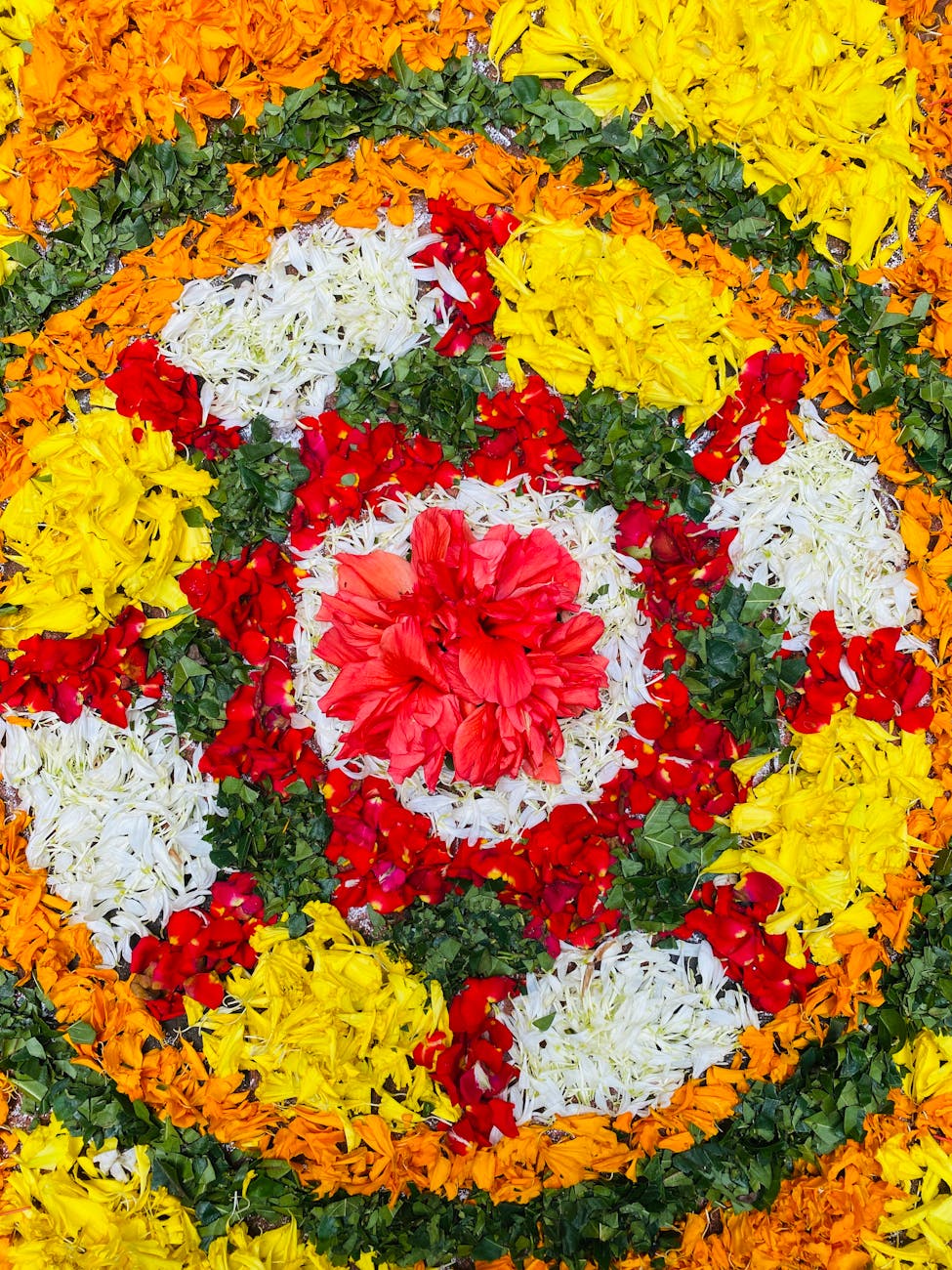
Onam flowers

After celebrating Onam and engaging in numerous social activities, my introvert battery hit rock bottom. I needed a desperate recharge. So what do I do? Naturally, I retreated to every introvert’s most favourite new-gen comfort zone: scrolling endless Instagram reels. Nothing says “I’ve had enough of people” quite like being a couch potato, locked up in your house, while going through everyone else’s social lives.

As I scrolled through the multiple Onam-related posts, I couldn’t help but appreciate the inclusivity in Kerala. Malayalees across religions, whether they are Hindus, Christians, or Muslims, celebrated Onam with equal enthusiasm. Everyone welcomed Mahabali with open arms. A few voices did try to stop their communities, saying Onam is a “Hindu festival,” but not many paid attention. That’s a good sign. People are choosing to step out of religious bubbles to celebrate together.

Still, Kerala, often praised as a secular state, has been showing sporadic worrying signs of exclusion. Just before Onam, a teacher told students not to participate in the festival because “our religion doesn’t allow it.” The outrage led to her suspension, but this mindset isn’t limited to one person. How widespread is the thought? No one can quantify. It’s impossible to analyze each and every Indian’s thought. However, there is an increasing number of cases that advocate for exclusionary behaviour. You are penalized for celebrating other festivals, or for respecting someone else’s god, or for chanting something as simple as “Bharat Mata ki Jai.”

India guarantees freedom of religion for all communities. But if we use that freedom only to exclude ourselves from others, we risk creating deeper divides. True communal harmony comes from participation: joining in festivals, enjoying each other’s food, and refusing to see other faiths as “untouchable.”

For India to stay secular, this effort has to come from all of us. We’ve come far since independence, but there’s still a long way to go. It’s up to us to ensure religion doesn’t become a wall, but a bridge.

***

Photo by Saran Indokera

Dealing with Annoying Questions When You’re Single

Photo by Karolina Grabowska

It’s not easy being a single woman in India.

Everyone is out to advise you on how you should live your life. One hot topic is marriage. The marriage “advisors” (could range from your parents to your friendly neighborhood milk delivery guy) might fight every day with their partners but will not skip a beat to lecture the singles about the benefits of holy matrimony and how much happiness it brings. Outside of their public rants and frustrations involving their better half, there might be a peaceful paradise that they guard secretly, so I would give them the benefit of the doubt and take their word for it. But marriage is not for everyone. I had to get in one to realize it was not for me.

Many in India succumb to arranged marriages because of pressure from family, friends, neighbors, colleagues – almost everyone. I had once faced it. I couldn’t take the pressure and ended up getting married. The relationship suffered from incompatibility issues, and divorce was the best option.

It is a hopeless place – being the epicenter of parental pressure. It can break even those with nerves of steel. It’s not wrong to say that not every Indian gets the chance to experience intimate love because they are forced into marriage before they are ready. It becomes a compromise of sorts where each partner partakes in responsibilities and demands that society expects them to fulfill in the name of love. In between all the cacophony of the daily routine, intimacy loses its way. Life in itself becomes time-tabled because you have things to do and mouths to feed. Where is the time for love in an Indian household?

So how can someone get past this pressure and live peacefully in India as a single person? How to say no to marriage?

Here are some ways you can deal with insufferable questions:

  1. Whenever someone starts with their unsolicited advice, don’t take it with a smile. It is imperative to make your point clear – that you are not looking for unwanted advice.
  2. If no one understands you, move out and reduce contact. This is a harsh step, but if your freedom is important to you, unfortunately, it is the only way. Not everyone can step away as it requires some emotional and financial stability.
  3. Make peace with the idea that you will be emotionally blackmailed by everyone around you. It will never stop, even if you relocate because you can still be contacted via phone calls or WhatsApp. You can only hope they will get used to your way of life one day. In my case, people got fed up with talking to me about topics I am not interested in – like marriage. No one irritates me anymore with the “when are you getting married?” questions. However, it took a divorce for people to leave me alone.

In India, regrettably, most people give in to pressure. They do not wish to offend or disappoint their loved ones. This is understandable, but it also means giving away your freedom of choice to someone. You cannot have it all in India. You’ll have to choose one – your freedom or keeping your loved ones happy.

As a single woman, it was not easy to reach the “other side.” It was like a bumpy adventure with its own blocks and complications. It takes mental strength to go against the norm and stick with it. It is not easy but definitely not impossible.

An Ode to Staying Unmarried Forever

Photo by Vlada Karpovich on Pexels

I am in my late 30s, and I might never get married.

Initially, I wanted to. I terribly did. When I was in my teens, I never pictured myself as an unmarried woman with no children. In my dreams, I had a dashing husband, the cutest of kids, and all the usual, regular mush coated with a sugary sweetness that had the full potential to make anyone diabetic.

Then life happened.

Life happens for everyone of course, but for me, my journey took a complete U-turn from what I expected.

I did not get a dreamy husband.

I was not a dreamy wife.

I did not get any dreamy children.

My fairy tale turned out to be a horror story in disguise.. and I got divorced.

I thought my life was going to end. How is a woman in her late 20s going to live without a husband? It used to hurt initially. The thought that life would be so unfair, blessing others with the good things in life while I was left with nothing but despair, was too much for me to fathom. A desolate soul in search of a deeper meaning in the form of marital status – that was me.

In hindsight, I never enjoyed my marital life – if you take away the husband part of it as well. The regular chores, and the responsibilities, made me think, “Is this what I am going to do the rest of my life?” I had no time for hobbies, things that mattered to me, my work, or anything that kept me alive, active, and fulfilled. Marital life is indeed a busy world, and you should not step into it unless you are ready to take on the responsibilities, compromises, and adjustments that come with cohabitation.

I was never ready for it.

Within a few years of my divorced life, I realized how much I was adjusting and compromising in my married life. When I left the relationship, it was as if a chain was broken, and I finally attained wings to fly. This freedom felt like finally finding water in a desert. My thirst, however, did not get quenched. Instead, I found it ever-increasing. The thirst to enjoy the things I want, the thirst to not be answerable to anyone for the first time in my life, the thirst to just be. It was liberating, it was extraordinary, and it felt like love. I never knew love in the form of freedom. I thought love could only be found in people. It took a break from one kind of love for me to discover another. The type of love that I had never experienced before because all through my life I was told: “marriage is important.”

I never realized a woman could live without getting married. I have seen others living a content life without tying the knot, but I used to look at them with compassion. The thought that marriage is mandatory and the only thing that can make a woman happy was so ingrained and indoctrinated in me that any other way of living was callously dismissed.

Why did it take a divorce for me to find freedom? The answer might be that the people in my vicinity finally stopped pressurizing me to get into something I was not comfortable with i.e., marriage.

Note the usage of the word “unmarried” instead of “single.” A good relationship is like a cherry on the cake. It is a bonus—a plus. But I feel if a relationship is what makes you feel “complete,” then it would mean that you are lacking otherwise. This is far from the truth. We should celebrate individuality as much as coupledom, if not more. In the end, it all boils down to choice. There is never really one single right path. But you should have the complete freedom to choose the path you desire.

My dream is no longer marriage. It feels like I have seen the other side, and now I choose the other side – the path less taken. My dream is now to selfishly enjoy my freedom till the end of life. To those wondering how the path is – it is not easy. It is definitely not easy. You always have this big FOMO because everyone around you is following a path entirely different from yours – they find someone they love, they marry, and they live happily(?) ever after.

What happens when you don’t marry? For a reclusive person like me, it is a journey of self-discovery, freedom, and fulfillment. For another, it might be that of melancholy. It truly is subjective. But it is a life that is definitely worthy, liveable, and sustainable.

To end this with the ever-famous lines by Robert Frost:

I shall be telling this with a sigh

Somewhere ages and ages hence:

Two roads diverged in a wood, and I—

I took the one less traveled by, And that has made all the difference.