An Ode to Saying Please and Thank You at Work

Say Thank You at Work
Photo by Polina Zimmerman

How often have we dealt with authoritative emails at work?

The ones that sound unnecessarily aggressive and bossy, instead of courteous yet firm.

After my previous rant on surviving performance reviews, I looked into a couple of emails of supervisors generally well-liked at the office, and those who weren’t.

The ones who were liked (Batch A), were polite and empathetic in their emails:

  • Could you please finish this task by Saturday?
  • Thank you for completing this!

In contrast, the ones who weren’t liked (Batch B), wrote their emails like this:

  • Do this by Saturday!
  • Dead silence after completing any task

See the difference? Would you like to get emails from Batch B? No one is fond of unnecessary aggression.

It is such a refresher nowadays to hear supervisors being polite. A “Thank you” or a “Please,” even if formal makes you look humane and not cold and distant. It motivates employees to do better. Politeness does not mean being weak. You can be firm and polite!

Something Batch A does often (to show the emergency of the situation):

  • Please send this across by Saturday! This is very important.

No unwanted aggression here. A simple message that conveys the seriousness of the task. Most people are smart enough to get the gist of such a message.

Employees perform their best when their supervisors are empathetic and kind. The attrition rate (the rate at which people leave) is always high in companies with bad managers. A 2016 survey in India showed that employees are willing to stay longer and work harder if they were well appreciated in their companies. About 59% felt they were unappreciated by their bosses. That’s more than half of the survey sample! No small number there. Sometimes, all it takes is a “thank you” or a “please,” to make things better.

So why are we so stingy with appreciating others or using cordial language at work?

Each supervisor is shaped by their own experiences in the corporate world. Some might have faced similar situations, a boss being too self-centered or supercilious or manipulative, and they end up thinking this is the only way to climb up the career ladder.

Sadly, this is partially true.

A recent study disturbingly stated that narcissistic, manipulative people tend to become CEOs faster (29% more) than their less self-entitled peers. We look at people at the top for inspiration, and we see a lot of them acting entitled and impolite, and we think “That’s how we become successful.

But is it really? Is this the downside of being successful? Should we dump our emotions, empathy, kindness in the garbage in the quest for power?

I have been in the corporate world for so long, and I have seen and experienced so much, that the first thought when I see a CEO or a leader on LinkedIn is not Wow! I want to be this person,” but “How many people did you demotivate and destroy to reach where you are? How many fake stories have you cooked up to save yourself, by shifting the blame onto your juniors? How good are you at playing politics in office?” This seems very dark and harsh I know. But it is mostly the truth. There are exceptions but the many leaders I have seen have sold their souls to the corporate devil. They will do anything to get on the super boss’ good books and won’t hesitate to drag anyone else down in the process.

Sometimes, from what I have seen, I feel it’s best to stay away from the rat race.

So you don’t end up becoming a rat.

An Ode to Surviving Performance Reviews by Demotivating Managers

Demotivating Manager

It is that demotivating season again.

I say demotivating because my last two performance reviews were negative. I might keep repeating “demotivating” throughout the article because that is how I feel right now.

So demotivated, dazed, confused, furious.

All because of one manager.

Somehow he has made up his mind to never encourage anyone. The only positive word I have ever seen come out of his mouth is “Good.” But he is ever ready to nullify that with 100 negatives.

The worrying part is many in my company feel that way.

2020 was the year I was most proud of myself. I learned things on my own. I built things from scratch. Got everything up and going with minimal errors after several hours of overtime. The least I expected was an “I appreciate your hard work.” An acknowledgement of what I have done.

But nothing came.

Don’t be that manager.

I am at my productive best when I am reporting to a good manager. I am at my worst when the manager is negative. This is true for many. We want to do our best, help the company reach the top when our work is valued.

Don’t get me wrong. I love constructive feedback. But not feedback that is laced only with negatives.

If you are a performance reviewer, here are some “How not to be a demotivating boss” tips:

  • Start the conversation in a light tone. A “Hi, how are you?” at the start never killed anyone. It gives the employee some time to breathe and relax. Remember, most employees get into a performance review with extreme anxiety. Help them out by being courteous and kind.
  • Start with the positives. And by positives, I do not mean just saying a single “Good.” Be descriptive. Tell them what you liked about their work. Use the same number of sentences that you would use while giving constructive criticism. 3 full sentences describing the negatives? Follow it up with 3 honest sentences about their positives. Balance it out.
  • Do not make the employee feel like they have done nothing for the company.
  • Ease into the negatives. Give some time for the employee to respond or tell you what’s on their mind. Don’t ramble non-stop. The moment you start the negatives is when you need to be the kindest. Frame negatives in a nice way, then stop and take a step back, wait for them to respond, ask if they have to anything to say. Be open-minded to listening to them.

You look around and you see many employees dissatisfied with their managers. Why is that? Because there is a huge communication gap. Any thoughts and reviews are left for the last moment i.e. during the performance review. Some companies like Microsoft, Accenture, Adobe and Deloitte have done away with annual performance reviews because of this reason alone.

The best way to give feedback is right after a task is completed. This helps them change their course if need be. Don’t wait till annual performance reviews – to throw unpleasant surprises.

I got a raise and a bonus. So it was not all bad. But all it takes is one person’s words to ruin the high you feel, right? Is that the price you pay for a salary?

By the end of it all, I told him “That was very demotivating.” Probably it was the first time he heard it from someone. Most employees prefer to ignore such bosses. My retort was followed by a one-minute silence. Of all the things I said this year, I am most proud of this one dialogue.

My manager then went on to give several excuses on how the intention was not to demotivate but to give feedback.

But feedback should be a mix of good and bad. Backed up with encouraging words on how you believe the employee can do what’s been suggested. If it is not, it is not feedback, it is being demotivational. As simple as that.

So I would like to say kudos to me for surviving yet another performance review with a demotivating manager. I expect more to come. And I plan to survive them all. By ranting here, and to my friends, and family, and anyone who would listen.

The day my boss says something nice, I will let you know. Stay tuned?

Leaving the company doesn’t make sense because as far as I know most of the people around have terrible bosses. I rather stick to one familiar demotivating one that becomes overbearing during performance review time rather than explore new ones.

If you are feeling demotivated too, rant! To someone.

That is what my colleagues and I do anyway.

One day, hopefully, all managers will learn how to give feedback constructively. Till then, the corporate servants will have to time and again, feel the extreme disappointment of not feeling valued by that one manager, who simply doesn’t know how to give a good performance review.

And I also hope one day we start earning enough passive income from our websites, investments and, other sources. So that we can run far away from everything that is, you guessed it, demotivational! Every corporate slave’s secret dream.

An Ode to the Most Underrated Career Skill

Googling.

Before you laugh, hear me out.

How is Googling a skill? Anyone can search on Google, right?

Yes, but not everyone does. Why? Because most people do not like to research or read.

In the tech industry, many of the answers are easily available online. Just a search away. It is very rare that you are the first one to face an issue. For a lot of coders, Stack Overflow is like a second home.

Whichever industry you are in currently, Googling is a good skill to have. It is right there, all the details, 24×7, for free. If you are able to research and find out an answer on Google for most of your problems, then in my opinion, that IS a skill. To learn more, to be self-reliant, without being overly dependent on others, is a skill.

Even if you get help from someone, you should STILL Google about it to learn more. Most people are too busy to get into in-depth teaching. They will just touch the topic at a high-level. I always make it a point to do some Googling when someone offers me a solution. It has helped me a lot in building on my base knowledge.

Why Do So Many People Dislike Googling?

People are hesitant to Google for an answer even if it is much easier than waiting for an answer from someone.

We are all naturally lazy (including yours truly). We just want all the answers to come to us without effort. We like to be spoon-fed without lifting a finger (even if it is for a search engine that automatically does the rest of the work for you). But growth happens (as cliché as the next line might sound) – “outside our comfort zone.”

I realized many people are bad at Googling when I posted snippets of some random articles on my Instagram story (with the title, website name et all), and my friends still asked me for the link instead of searching on Google using the article name. Mind you, to provide them the article link, I had to go through the exact same steps – search using the article name on Google, copy the URL and paste it on our chat. I did not have the link stored anywhere for easy access.

It continues even today.

Even after explaining to them how to search on Google.

I am not a passive aggressive type, so I find it difficult to use the infamous “sure, let me Google that for you” when someone asks me something that can be easily Googled.

Some Neat Googling Tips & Tricks

Most of the time, we can get what we want by just entering the search query on Google.

But what if we want something extra?

Well, for the curious cats, here are some cool Google search tips and tricks you can use to get a desired result.

  • Double Quotes

My most favourite.

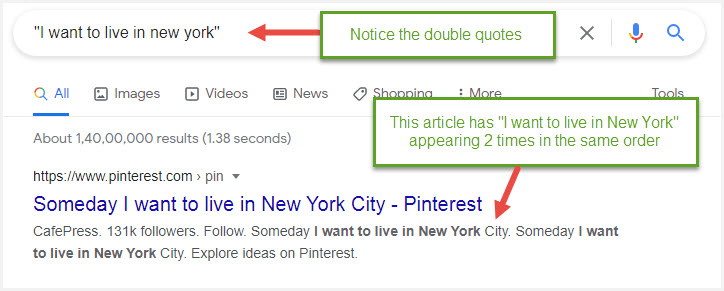
Use double quotes if you want the exact phrase in the same order to appear in your search results.

For example, “I want to live in New York” will give results where the phrase appears in the exact same order.

Remove the quotes, and you will have the keywords scattered all over the article, and not exactly in the same order.

Using double quotes is also a great way to search for articles using just their titles.

In the example below, I want to search for posts that have mentioned “I want to live in new york” in the exact same order.

Using Double Quotes to Search for the Exact Phrase on Google
  • Define

Defines a word and also includes an audio clipping on how to pronounce it correctly.

Use Define: followed by the word.

Use Define: to Find Out How a Word is Defined and Pronounced
  • Search

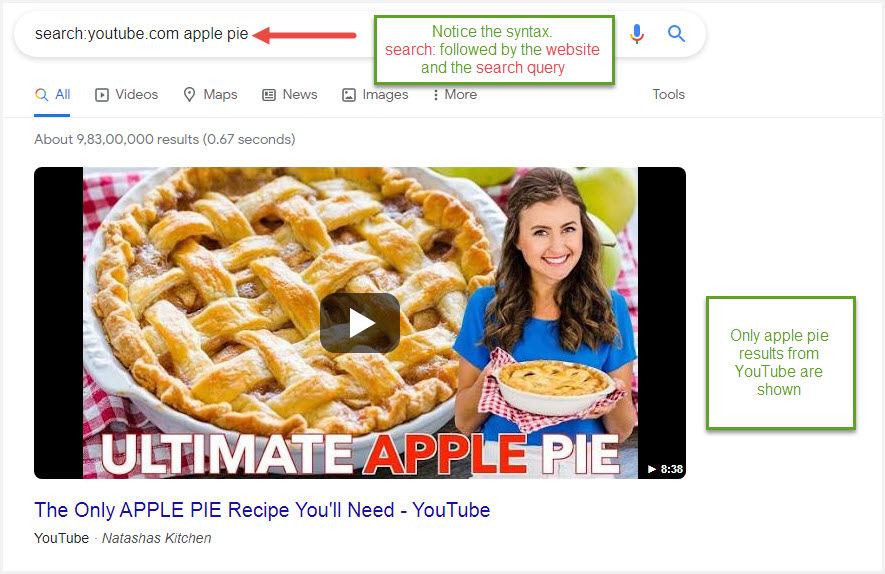
Searches for results on a specific site.

Use Search: followed by the website URL and search query.

In the example below, I want to search all recipes for apple pie on YouTube.

Use Search: to View Search Results from a Specific Site
  • Asterisk *

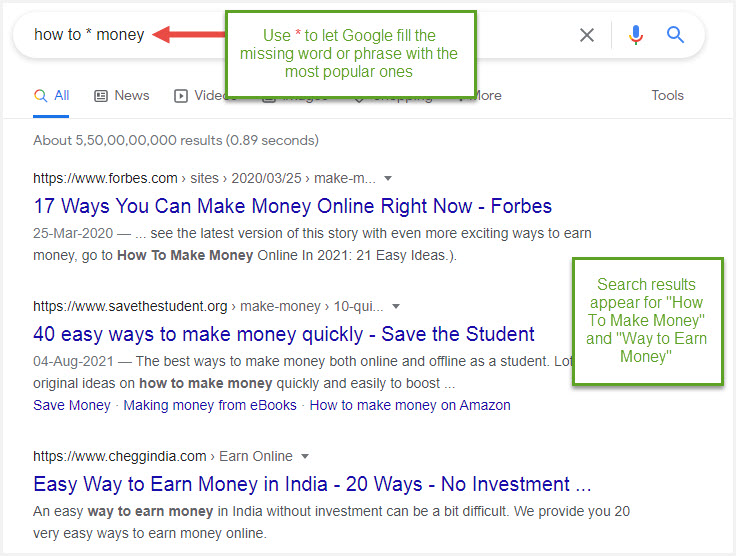
Use the * asterisk symbol to let Google do the guessing work. This allows you to see the most popular search phrases that match a part of your query.

Insert * wherever you want Google to add in the most popular search words/phrases. In the example below, I have used how to * money, so it will consider popular search phrases like how to make money, how to earn money etc.

Use Asterisk (*) to Search for Missing Words
  • Related

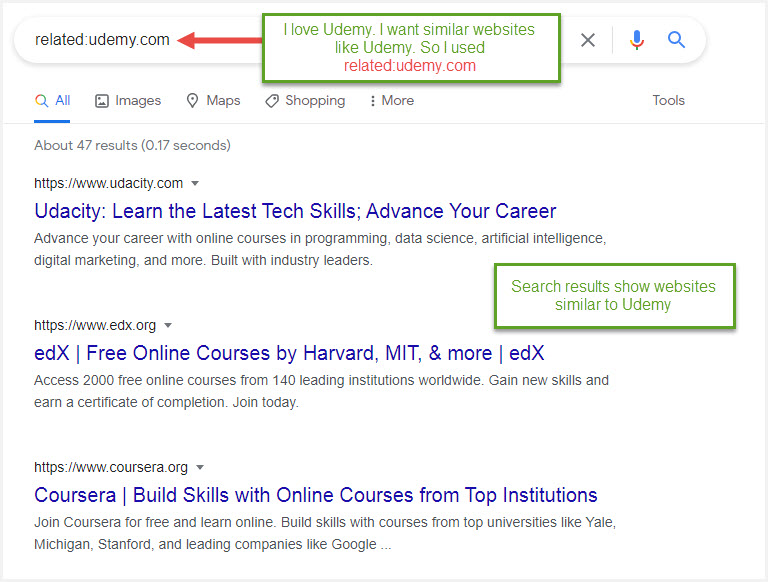
If you find a website you really like, and wish to see similar ones, use Related: followed by the URL of the website you liked.

In the example below, I want websites similar to Udemy that offers courses online.

Use Related: to Find Related Websites
  • Tilde ~

This is a great way to include synonyms.

Use ~ before the word that requires synonyms.

Use Tilde (~) to Find Synonyms
  • Location-specific

If you wish to see search results only related to a specific location use location: after the search phrase.

Use Location: to Find Specific Location Results
  • File Type

In case you are looking for content in a particular format, use filetype: followed by the type of file (example: pdf).

Use Filetype: to Search for Specific Formats
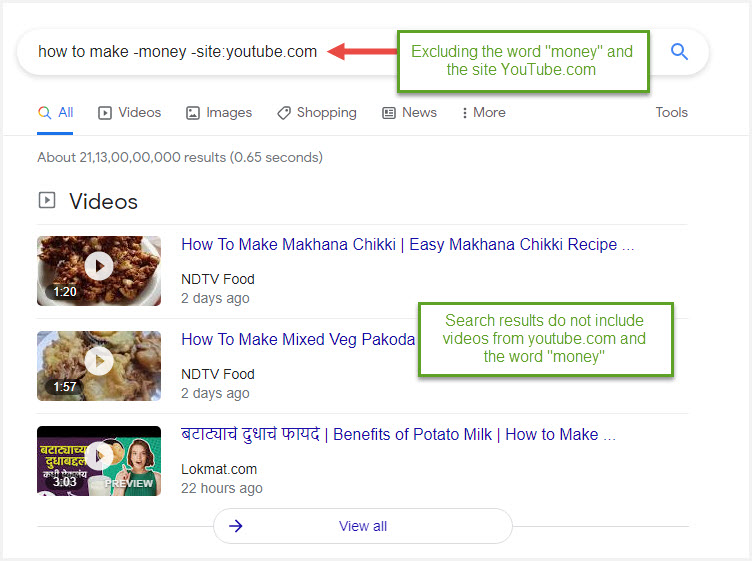
  • Exclude

Exclude something from search results by using dash .

For example, let us consider the example below, when you type -money, this means you want Google to exclude the word “money” from the search results. I have additionally added another exclusion, that is the website YouTube.com.

Exclude Certain Words & Sites from Results (Potato Milk?! You learn something new everyday :))

An Ode to Working for the Right Company (MNC or Startup)

Take a look at Twitter, and you will see never-ending debates on whether startups or MNCs are the best.

Having worked in both, here are my 2 cents.

MNCs or established, large companies might be the better option for you if you want:

  • Higher pay: Big companies are willing to pay the best of the best for talent
  • Better job security: They have been in the business for a longer time and are more stable
  • Well equipped work space: They have the money to invest in the best tools and resources needed for upgrading your work
  • Better perks: Health benefits, freebies

Cons:

  • Office politics: This was the worst part for me.
  • Feeling undervalued: There are a lot of employees, and it is practically impossible for the higher order to listen to everyone. Your opinions or inputs tend to be given less importance.
  • Not flexible: Most of the companies want you to stick to their rules. Employees are rarely consulted on what *they* want.

Startups or smaller companies might be the better option if you want:

  • More job satisfaction: The pride you feel when your company is growing is unmatched. You played a role in it, and that is a huge achievement.
  • Less office politics
  • A tightly-knit workspace where everyone is easily reachable including the CEO
  • A job where you are valued

Cons:

  • Lesser pay: Small companies can hardly compete with MNCs when it comes to offering the best pay package
  • High pressure: Lots of work, less work-life balance
  • Cash-strapped: Hardly any freebies; access only to those tools that are absolutely essential for your work

Of course, this does not apply to all the MNCs and Startups out there. Each one is different. But from my experience, this is what I have encountered.

Honestly, I feel everyone should try both at least once to see what it is like.

Then go the Marie Kondo way perhaps – choose the one that sparks joy.

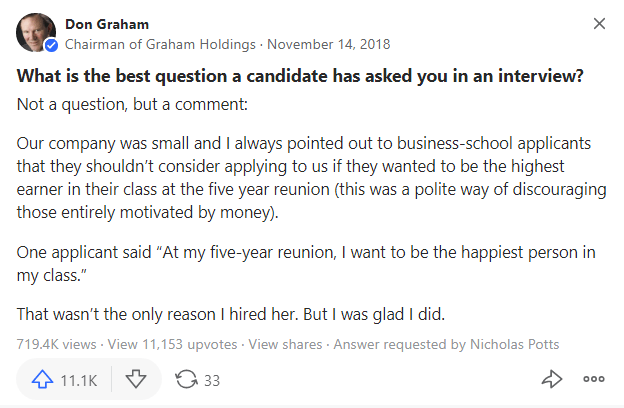
To finish this off, posting a snippet I saw on Quora. It made me smile.

Job Satisfaction

An Ode to Unknowingly Being Productive

By Squarecomics

I often wonder why people complain, “I haven’t done anything productive today.”

It is practically impossible.

Why? Let me explain.

What is productivity? By definition, it means, causing or providing a good result.

Anything and everything you do is productive because unconsciously, we are all learning and evolving from even the smallest tasks that we do.

Yes, we are always learning. And learning is productive. I’m not talking only about creative classes or actively honing new skills for work. Those are the things we take up consciously. The visibles.

I am talking about learning from things around you. The invisibles.

  • Learning a different perspective, a different way of looking at things. This could be from books, even a show you randomly watched, or some random post on the internet including a meme!
  • Learning how peaceful it can be to sit and stare at nature for a while
  • Learning to forgive and/or forget
  • Learning to solve your issues
  • Learning your family’s needs
  • Learning how to interact better
  • Learning to step back a bit and breathe
  • Learning new ideas

The list goes on.

Jennifer Aniston had famously quoted “No regrets, only lessons” indicating we learn even from our mistakes, if not today then tomorrow.

But the point is, to many of us, these little things don’t count. Probably because these changes are not happening aggressively, screaming for our attention. These changes are very silent. And peaceful. But the thing I find most astonishing is that over time, they compound. Each little change is like a building block, contributing towards forming the person that we will eventually become.

It is only years from now, when you look back, do you realize how much you have changed in this process of learning from everyday things.

You have evolved. That I think, is a beautiful thing to reflect on.

An Ode to Being Selfishly Independent

Photo by Jaxson Bryden on Pexels.com

“Why don’t you get married? It will make your parents happy. It is selfish not to think about them.”

“If not now, then when?”

“Your biological clock is ticking. We need to see our grandchildren before we die.”

These are some dialogues, I and many, have heard at least once in our lifetime.

Now if we marry someone outside our religion or caste, the society chimes in with:

“The poor parents. Their child married someone from a different religion. Why don’t kids understand the sacrifices parents make?”

Your happiness gets the least precedence.

We are almost always emotionally blackmailed into following the norms set up by society. The questions and self-doubts then arise in our mind – “Why am I so weird? Why don’t I feel happy following what others are following” You think – “If so many people are saying the same thing, it must be right,” – when the truth is something else.

It took some unlearning for me to realize, there are no fixed protocols to be followed to live a happy, fulfilling life. No researcher has written a book saying “this is how everyone should behave or else the world would crumble in a day” Rules are formed because they make life less confusing, but they do not necessarily make life more fulfilling.

The blueprint of life is out there – study, study some more, get a job, get married, have children, work until you die. There are examples to follow, whereas, for someone who is single, there is no chart as such – you work, and then what? This lack of clarity, makes many shy away from choosing a different life. People want stability, and following the rules makes them believe they have certainty in their life, irrespective of whether they are mentally at peace or not.

After studies are done, an adult should have the freedom to chart his own blueprint. Conditions apply, of course. If the adult wants to be a terrorist, having his own blueprint would be a disaster.

I am saddened that society made me doubt myself for so long (I’m in my 30s) by indoctrinating me with the feeling that I, on my own, am not good enough. I need a partner, followed by kids, to be termed complete. We see so many celebrating their wedding, engagement anniversaries but have we seen anyone say “Yay! I have been happily single for a year now!” Obviously not, because we have been conditioned to believe, being single and happy is not something to celebrate.

Time and again, I have seen many friends being forced by their parents into marriage, jobs, religious practices, and then living an unhappy life afterward. And the irony is, they haven’t learned from this. The tradition will continue to the next generation from what I have deciphered from their talks. Because society has taught them this is the norm, this is the way it should be, and they should follow it, no questions asked.

It is all so subjective, this happiness. But more often than not, we have to mold them as per societal constructs, even if it is not what we are ready for at the moment. Forcing can make an individual follow the path you want, but the gratification you hope they would achieve through this process can likely be lost. The whole exercise (be it anything) loses its meaning if it has to be drilled down and is not coming from the heart.

Why are we following everything to a tee, to make others happy, when we ourselves get only one chance to live the way we want?

Why aren’t we giving enough freedom for our kids to think, to choose?

Why aren’t we giving enough importance to our happiness? If not in this life, then when?

Isn’t it selfish to demand your loved ones, who are now adults, to unquestioningly follow the rules you have set or the dreams you have selfishly conjured up in your mind for them?

I have stopped falling into this trap. I am no saint and I don’t aim to be. And I hope everyone gets a chance to be selfishly independent too – to realize how insanely happy and beautiful this life can be, just the way it should be.