Shocking Anti-Hindu Hate in Western Societies

The 2023 report “Anti-Hindu Hate in Schools” by Charlotte Littlewood highlights a critical but under-researched issue: the presence of anti-Hindu sentiment in UK schools.

While this blog post draws upon insights from the report, the broader focus is on Hinduphobia as a global phenomenon – what it means, how it manifests, and the constructive steps that are being taken to address its rise.

The full report can be accessed here: henryjacksonsociety.org/wp-content/uploads/2023/04/HJS-Anti-Hindu-Hate-in-Schools-Briefing-final.pdf

The urgency to examine Hinduphobia stems from the way Hinduism is being misunderstood or misrepresented in Western societies. Many people, lacking a nuanced understanding of the religion, make casual remarks that are often bigoted in nature. They may be considered harmless or culturally acceptable in Western contexts.

This gap in awareness often results in prejudices being normalized, with little accountability or recognition of the harm caused.

What is Hinduphobia?

Hinduphobia is not a term widely recognized in mainstream discourse. In my view, “anti-Hindu bigotry” is a more accurate description, as the issue is not rooted in fear, but in prejudice, hostility, and a lack of understanding. It often stems from the fact that Hinduism operates differently from Abrahamic religious frameworks. This unfamiliarity can lead to stereotyping, dismissal, or open hostility, rather than genuine inquiry or respect.

As per the study, the working definition of Hinduphobia is as follows:

Hinduphobia is a set of antagonistic, destructive, and derogatory attitudes and behaviours towards Sanatana Dharma (Hinduism) and Hindus that may manifest as prejudice, fear, or hatred.

Hinduphobic rhetoric reduces the entirety of Sanatana Dharma to a rigid, oppressive, and regressive tradition. This discourse actively erases and denies the persecution of Hindus while disproportionately painting Hindus as violent. These stereotypes are used to justify the dissolution, external reformation, and demonization of the range of indigenous Indic knowledge traditions known as Sanatana Dharma.

The complete range of Hinduphobic acts extends from microaggressions to genocide. Hinduphobic projects include the destruction and desecration of Hindu sacred spaces; aggressive and forced proselytization of Hindu populations; targeted violence towards Hindu people, community institutions, and organizations; and ethnic cleansing and genocide.

Examples of Hinduphobia

The study lays out several examples that can be identified as Hinduphobia, many of which occur casually in everyday settings. These instances often go unnoticed or unchallenged, largely because Hinduphobia is not yet treated as a serious form of bigotry.

  • Calling for, encouraging, or justifying violence against Hindus, often rooted in extremist or distorted views of religion and history.
  • Kidnapping Hindu women and children for forced marriage and religious conversion.
  • Denying, downplaying, or accusing Hindus of fabricating their persecution, including instances of genocide.
  • Advocating for the destruction of Hinduism, framing it as inherently irredeemable.
  • Discrediting individuals who speak about Hinduphobia by labeling them as agents of violent or oppressive ideologies.
  • Attributing all social issues in Indian society, such as caste, misogyny, sati, communal violence, or temple destruction, solely to Hinduism.
  • Evoking historical trauma (e.g., iconoclasm, cow slaughter, forced conversions) to intimidate Hindus in modern discourse.
  • Making baseless claims about the political motives of those simply practicing Hinduism.
  • Linking antisocial behavior directly to Hinduism, often by selectively sampling data or falsely attributing individual actions to the faith as a whole.
  • Caricaturing Hindu scriptures through selective citation, mistranslation, or exaggeration, and presenting these distortions as representative of the entire tradition.
  • Claiming that Hinduism or Sanatana Dharma is not a valid or cohesive spiritual system.
  • Erasing Hindu civilizational contributions and superimposing Western norms over its historical and cultural identity.
  • Conflating diasporic Hindu identity with Indian citizenship, nationalism, or ethnicity.

As per my own observation, a contributing factor is the lens through which Hindus are viewed. The bigotry is shaped by the globalized “oppressor vs. oppressed” narrative, often based on selective or misunderstood portrayals of India. As a result, anti-Hindu activities at home or anywhere else are often seen as justified acts of revenge, grounded in the belief that “Hindus in India are oppressing minorities.” A quick look at social media during incidents involving anti-Hindu sentiments offers clear evidence of this bias.

Reactions often downplay or dismiss the issue, and in many cases, even justify the hatred by invoking political narratives, rather than addressing the prejudice for what it is.

Context and Need of the Study

The context and need for the study on rising Hinduphobia in UK schools are explained as follows: 

“Hinduism is the third largest religion in the UK making up 1.7% of the population according to the most recent census. From 4 to 20 September 2022, there was civil unrest in Leicester, extending to Birmingham, including vandalism of property, assaults, stabbings, and attacks on places of worship.

The Henry Jackson Society briefing paper, “Hindu-Muslim civil unrest in Leicester: Hindutva and the creation of a false narrative,” evidenced community tensions relating to youth violence and noise control issues in relation to festivals that had been falsely dressed as “Hindutva extremism” and even “Hindu terrorism”, creating fear and resulting in attacks on Hindu temples and properties.

The Network Contagion Research Institute (NCRI) investigated the role social media played in the civil unrest. It concluded that social media narratives have characterised “a vulnerable, diasporic community – British Hindus – as an aggressive, hypernationalist, and fascist threat. Other narratives depicted Leicester Hindus as heretically evil and filthy, playing on age-old Hinduphobic tropes.”

Both the HJS report and the NCRI report noted the use of anti-Hindu slurs such as “cow piss drinkers” and references to polytheism, vegetarianism, physical weakness and mocking of Hindu deities and symbols.   

When researchers began examining the unrest between Hindu and Muslim communities in Leicester, they encountered a notable gap: a lack of existing studies on anti-Hindu hate. This absence of research was one of the key motivations behind conducting a dedicated study on the subject.

The report also highlights how Hinduphobia has historically appeared in popular literature and academic discourse. For instance, E. M. Forster’s 1924 novel A Passage to India is cited as portraying Hindus as “perverted,” “clownish,” and “queer.”

Similarly, sociologist Max Weber viewed Hinduism as excessively otherworldly, a perception that contributed to the broader “theological othering” of Hindus. This form of othering continues today in the form of anti-Hindu slurs that mock the religion’s many deities and unique customs.

Another example comes from Allen Greenberger’s 1969 study on Indian stereotypes, where he described common portrayals of Indians as a “childlike race” who were “happy in their passivity, fatalistically so.”

Such characterizations may still influence how the media interprets Hindu behavior and presence. For instance, during and after the Leicester unrest, the press in the UK was criticized for failing to engage with the local Hindu community, instead relying on self-identified Muslim spokespersons who reportedly spread false narratives about Hindus in Leicester.

Moreover, rather than addressing the specific complexities on the ground, mainstream media coverage often diverted attention to political issues in India, as though those could explain or justify tensions in the UK. This approach not only homogenizes Hindus globally but also dismisses their individual and community experiences in diverse contexts like Leicester.

Abrahamic Othering

An interesting terminology used in the report was “Abrahamic Othering.”

The term ‘Hinduism’ was coined by British writers to refer to the family of Vedic religious traditions. Some modern Hindus prefer the name ‘Vedic religion’ or ‘Sanatana Dharma’ (‘eternal law’) rather than the label ‘Hinduism’.

Hinduism has multiple deities understood to be expressions of one ultimate Reality, be it God for theists or consciousness for monists. Hinduism does not follow one scripture but a number of scriptures that are given different emphases by different branches of the faith. Some argue the differences in the denominations are so great that they are separate religions entirely.

The preconceptions of Abrahamic faiths do not map neatly onto Hindu belief. Articulating Hinduism through the Abrahamic lens of Gods and scriptures is therefore problematic.

Respondents to this survey suggested that at least some UK schools continue to teach Hinduism through an Abrahamic lens without appreciating the limits of this approach. This fits with the findings and concerns of the Commission on Religious Education. Given the decentralised nature of religious curriculums in England and the lack of subject inspections in maintained schools, and given the considerable challenge of treating Hinduism sensitively in a UK context, such a finding is disappointing but unsurprising.

There are reports from some surveyed parents that lessons about Hinduism produce confusion and misconceptions about the Hindu belief in the existence of multiple Gods – 106 references were made to inaccurate perceptions of Hinduism with respect to polytheism/idol worship/multiple Gods.

Discrimination Against Hindus in UK Classrooms

Some of the discrimination observed in UK classrooms mirrored the forms of hate witnessed during the Leicester unrest between Hindu and Muslim communities.

In both settings, derogatory remarks were directed at Hindu identity and practices, including mockery of vegetarianism and the belittling of Hindu deities. These same types of insults were used by Islamist extremists during the rallies targeting the Hindu community in Leicester, highlighting a disturbing continuity between localized classroom prejudice and broader communal tensions.

Conclusion Based on Case Studies

Many case studies were conducted as part of the research, and based on these, the following conclusion was drawn:

This report highlights the prevalence of discrimination against Hindus in British schools, with 51% of Hindu parents surveyed reporting that their child has suffered anti-Hindu hate at school.

It is alarming that it is so hard to access information from schools on patterns of religiously-motivated bullying, and that the schools who did respond to this study’s FOI request either did not keep records of faith-based hate incidents or appeared to record very few incidents.

It is also alarming that only 19% of parents surveyed believe schools are able to identify anti-Hindu hate, indicating that the issue is not being addressed adequately. It may be that there is a tendency to downplay such incidents as ‘playground banter’.

However, several studies have observed that faith-based bullying has the potential to be more impactful than other forms of bullying, precisely because it targets not just the victim, but “their entire family, heritage, and culture”.

Schools should reflect on the harm such slurs cause, as well as the wider community divisions they may be helping to foster.

Constructive Steps

Small but significant steps are being taken to address Hinduphobia in Western nations.

Georgia recently became the first U.S. state to introduce a bill formally recognizing Hinduphobia and anti-Hindu bigotry. Similarly, the Scottish Parliament passed its first-ever motion to combat Hinduphobia, marking an important milestone in acknowledging the issue. The motion was influenced by a report on Hinduphobia in Scotland, which can be accessed here: nen.press/2025/02/28/gandhian-peace-society-shares-new-report.

These developments are a positive step toward challenging anti-Hindu bias and promoting awareness that, like all faiths, Hinduism, or Sanatan Dharma, deserves equal respect and protection from discrimination.

***

Main Photo by Himesh Mehta

An Ode to Retiring Rich

Photo by Monica Silvestre on Pexels

I have seen senior citizens in India struggling 5-10 years post-retirement because they didn’t have enough savings. Their financial freedom is ultimately compromised as they become dependent on their children.

One example is my own father.

My dad was the only earning member of the entire family. My mother derived her happiness by not involving herself in financial matters. Numbers made her anxious, and she was fine letting dad make all the financial decisions. He enjoyed a plush job in the Middle East, and we had a wonderfully privileged life. I am eternally grateful for everything that he has provided for us. I went to the best of schools/universities and worked for a bit in the Middle East. Then we all decided to pack our bags and head back to India after dad’s retirement – a much-needed rest for him after 30+ years of service.

Everything went on fine until the 5th year of my dad’s retirement. His anxiety was apparent; he was concerned whether his corpus would last his entire lifespan. I had already started working by then, and I started pitching in. Slowly his mental health deteriorated. It may have been due to a combination of stress and disappointment in his financial matters and his physical health issues. The doctors were unable to help him. My dad, who was an active, cheeky, energetic man, turned silent, desolate, and serious. Since I stayed near my parents, I was a witness to all that they went through concerning their finance. My dad wanted to resume work in his mid-60s, despite his physical limitations, no thanks to his depleting retirement corpus.

I am unsure what went wrong because I never discussed it with my dad. He’s no more (he passed away a couple of years back). When I look at his bank balance, I have so many questions. The most glaring one was – “Where did all the money go?” Then there are others “Did he not save?” “Maybe he saved, but it was not enough for inflation?” “Did he make any bad investment choices?” “Did he not invest in the right retirement schemes?” “Would it have helped if he had invested in some equity, mutual fund, or pension scheme?” My dad had only invested in Fixed Deposits.

You learn by observing the people around you. It was only after I saw my dad’s financial condition that I became aggressive with my own savings and investments. I have no idea whether my plan will work for me in the long run, but I can try. I do not have many lifestyle demands, and I am a minimalist, so that helps.

In the quest to achieve financial independence, I have been reading a lot of personal finance books. My initial few reads were meant for the American audience and they did not help me much. I wanted to read books specific to India. That’s how I first landed upon Monika Halan’s Let’s Talk Money. This has to be my favorite Indian personal finance book so far. Everything is explained clearly and concisely. I have re-read it a couple of times in the hope that her words would sync in deep and become second nature for me. She offers instructions on how to invest for each age group.

The next book that is good for Indians looking into learning personal finance is PV Subramanyam’s Retire Rich. He is a Chartered Accountant who gives some good, solid, no-nonsense advice on how you can carry about your investments. His policy is investing in yourself first, before anything else. Keep aside some money for your retirement and invest in other people and things only after that.

A non-Indian book that greatly impacted me was “The Psychology of Money.” My favorite quotes from the book are also listed on this blog.

Retiring rich is undoubtedly a priority for me. Keep in mind that the word “rich” is subjective. I want to retire “rich” enough for my own needs, but that amount might not be “rich” enough for you. So the first step is to calculate your retirement corpus based on your annual expenses. There are enough online retirement calculators to help you out. If you are in your 20s, start saving/investing now. I am in my 30s now, and my only regret is that I did not start sooner.

An Ode to Wise Words From Ian Tuhovsky on Improving Communication Skills at Work and Otherwise

Photo by Helena Lopes on Pexels

Ian Tuhovsky’s Communication Skills book is more than the quotes on this page. He mentions tips and tricks for effective networking, creating a unique personality in business, remembering names, giving a great presentation, and so on. But more than all the how-tos, it’s his need for us to understand our fellow humans better, which truly resonated with me. He wants us to acknowledge the fact that everyone has a different mental model uniquely formed by their own experiences and that it’s not fair to judge them through our personal filters. Only a deeply empathetic person can write this way.

The most intriguing part of the book to me was his take on reading people’s eye movements to analyze their thoughts better. I have never tried it out, so I can’t really say for sure if it holds true. As we all know, non-verbal communication speaks as much (if not more) as verbal. By keenly observing others, we can improve our communication skills.

Here are some of my favorite quotes, stories, and thoughts from the book. They provide a lot of insight into how and why we need to communicate in a certain way at work or in our personal lives to achieve desired results.

We all are programmed to give and receive love, fulfilling our needs at the same time. When someone is not doing that and behaving in a way we don’t like, it’s not natural. They’re probably suffering and that’s what makes them hurt other people. The reason for that is they just don’t get it. They don’t have the skillset to cope with the situation, they don’t have the right tools or they don’t know how to use them. Very often, when you change your perspective, the things you look at literally change.

When you accept and understand it, you notice that every human being has a different map of the world. Eventually you’ll come to the realization that every person on this planet has different life experiences, different beliefs, different values and expectations. Interpretation of the same information may be completely different when made by different people. There is no one objective truth. Everyone is right according to their own map of the world.

What people say to you—it’s about them. When you say anything, it’s about you. It reflects who you are. It’s all about the way we are perceiving the events, the reality.

Anything people say to you doesn’t have any meaning except for the meaning you give it.

Our brain does not really recognize negations—a proposition not to think about pink elephants will end up with failure, because what you hear (despite the negation), the brain will process anyway. Next time, when someone tells you, “I do not want to get at you, but…” you will know that they most probably want to get at you. Instead of saying to your employee: “Don’t respond to a customer that way,” explain how exactly you want that person to respond. Rule number three: what you say must be positively formulated.

When someone isn’t seemingly very intelligent and has never acted too smart in many areas of life according to your opinion, then you can’t really transplant their brain, can you? However, what you CAN do is refer to their behaviors, because these—as opposed to inborn capabilities or personality traits—are quite easy to change. Additionally, it’s much harder to offend someone when relating only to their behavior. Instead of, “You are stupid,” say: “When you go to meet your client next time, please read much more about their company so you really know what you are talking about, okay?” Instead of, “You are so intelligent!” it’s sometimes better to say: “When you expressed your opinion about that book yesterday, it was so immersive and well-detailed, you really inspired me to read it!”

The problem is that when someone thinks they have done something wrong, they will not have the opportunity to empathize with your pain. They will allocate all of their energy into defending themselves. Therefore, there is no point in blaming others when we feel bad. It makes no sense at all on a practical level of reason. If we want to solve the matter constructively, we have to allow that person to understand what is going on inside of us, how we really feel. To express your anger wisely, it is worth it to restrain yourself from throwing swear words, plates, cutlery and photo frames.

The mere act of smiling, even artificially, causes the release of endorphins in the brain. Activity of the muscles responsible for smiling is so strongly associated with our well-being that it works both ways. So if you want to feel better in a second, just smile a couple of times, even if you do not have the desire to. Try it yourself, even now.

You should never look people in the eyes for more than seven seconds, non-stop. It’s a typical communication-newbie mistake, kind of a creepy thing to do, even though we’ve been conditioned to look people in the eyes in our Western culture. Also, remember not to open your eyes too wide (the same thing, sign of aggression…or psychosis).

Don’t treat people the way you like to be treated, treat them the way THEY want to be treated. That’s a big rapport take-away to remember!

In his book Introducing NLP, Joseph O’Connor writes: “A good speaker forms his message the way it fits the other person’s world. He uses language compatible with their metaprograms, changing the shape of information in advance and making sure that they will be able to understand it easily.”

An Ode to Microsoft Edge’s Immersive Reader

I am not sure how many people actually know of this sleek user-friendly tool on Microsoft Edge. It is called the Immersive Reader. Staying true to its name, it is a great tool for readers to indulge in.

Take a look at this article with distracting elements (navbar, widgets, ads).

Article without immersive reader enabled

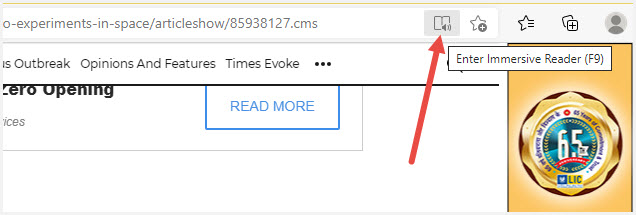
Now, click on the Immersive Reader option next to your URL bar.

Click to enable

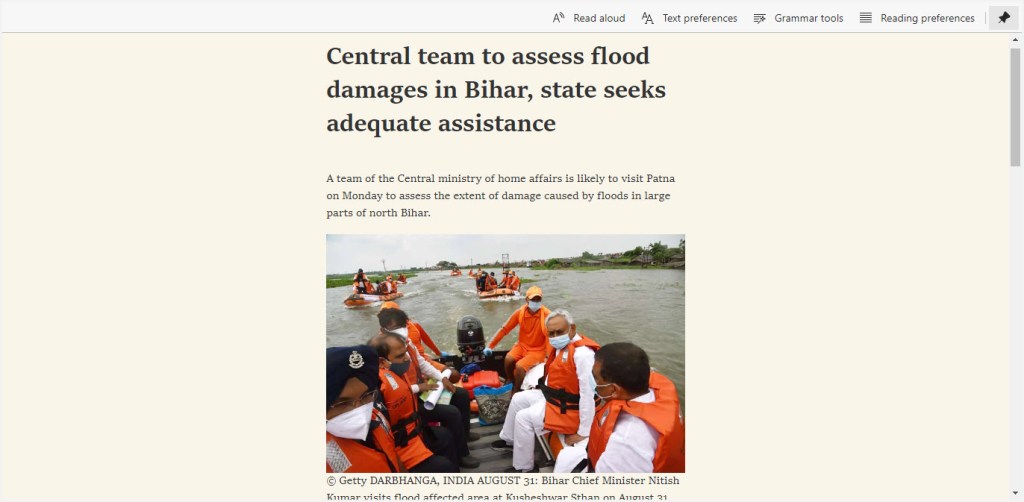
And, voila! You can now read the article peacefully.

Immersive Reader Enabled

I feel this is great for reading long articles. It has a very Kindle-like experience to it. You can increase the font size using the “Text Preferences” tool. You can change the theme as well. There are many options which I have not yet explored. As a reader, I want to focus just on the article, with the freedom to increase its font size if need be. This tool offers all that and more.

You can also use the “Read Aloud” feature if you want the article to be read out to you. The voice is as natural as it can get, not sounding robotic.

The Immersive Reader is still in its early stages. It does not always render the correct page, and you have to wait till the page loads completely to see the icon. But so far, I am extremely pleased.

If you do not see the Immersive Reader icon on Microsoft Edge:

  • Make sure you are viewing an article and not the home page
  • Wait till the page loads completely
  • If you still do not see the icon, use read:// before the URL. For example if the URL is 𝚑𝚝𝚝𝚙𝚜://𝚠𝚠𝚠.𝚖𝚜𝚗.𝚌𝚘𝚖/𝚎𝚗-𝚒𝚗/𝚗𝚎𝚠𝚜/𝚘𝚝𝚑𝚎𝚛/𝚌𝚎𝚗𝚝𝚛𝚊𝚕-𝚝𝚎𝚊𝚖-𝚝𝚘-𝚊𝚜𝚜𝚎𝚜𝚜-𝚏𝚕𝚘𝚘𝚍-𝚍𝚊𝚖𝚊𝚐𝚎𝚜-𝚒𝚗-𝚋𝚒𝚑𝚊𝚛-𝚜𝚝𝚊𝚝𝚎-𝚜𝚎𝚎𝚔𝚜-𝚊𝚍𝚎𝚚𝚞𝚊𝚝𝚎-𝚊𝚜𝚜𝚒𝚜𝚝𝚊𝚗𝚌𝚎/ then use 𝚛𝚎𝚊𝚍://𝚑𝚝𝚝𝚙𝚜://𝚠𝚠𝚠.𝚖𝚜𝚗.𝚌𝚘𝚖/𝚎𝚗-𝚒𝚗/𝚗𝚎𝚠𝚜/𝚘𝚝𝚑𝚎𝚛/𝚌𝚎𝚗𝚝𝚛𝚊𝚕-𝚝𝚎𝚊𝚖-𝚝𝚘-𝚊𝚜𝚜𝚎𝚜𝚜-𝚏𝚕𝚘𝚘𝚍-𝚍𝚊𝚖𝚊𝚐𝚎𝚜-𝚒𝚗-𝚋𝚒𝚑𝚊𝚛-𝚜𝚝𝚊𝚝𝚎-𝚜𝚎𝚎𝚔𝚜-𝚊𝚍𝚎𝚚𝚞𝚊𝚝𝚎-𝚊𝚜𝚜𝚒𝚜𝚝𝚊𝚗𝚌𝚎/ to launch the article in the Immersive Reader.

An Ode to the Most Underrated Career Skill

Googling.

Before you laugh, hear me out.

How is Googling a skill? Anyone can search on Google, right?

Yes, but not everyone does. Why? Because most people do not like to research or read.

In the tech industry, many of the answers are easily available online. Just a search away. It is very rare that you are the first one to face an issue. For a lot of coders, Stack Overflow is like a second home.

Whichever industry you are in currently, Googling is a good skill to have. It is right there, all the details, 24×7, for free. If you are able to research and find out an answer on Google for most of your problems, then in my opinion, that IS a skill. To learn more, to be self-reliant, without being overly dependent on others, is a skill.

Even if you get help from someone, you should STILL Google about it to learn more. Most people are too busy to get into in-depth teaching. They will just touch the topic at a high-level. I always make it a point to do some Googling when someone offers me a solution. It has helped me a lot in building on my base knowledge.

Why Do So Many People Dislike Googling?

People are hesitant to Google for an answer even if it is much easier than waiting for an answer from someone.

We are all naturally lazy (including yours truly). We just want all the answers to come to us without effort. We like to be spoon-fed without lifting a finger (even if it is for a search engine that automatically does the rest of the work for you). But growth happens (as cliché as the next line might sound) – “outside our comfort zone.”

I realized many people are bad at Googling when I posted snippets of some random articles on my Instagram story (with the title, website name et all), and my friends still asked me for the link instead of searching on Google using the article name. Mind you, to provide them the article link, I had to go through the exact same steps – search using the article name on Google, copy the URL and paste it on our chat. I did not have the link stored anywhere for easy access.

It continues even today.

Even after explaining to them how to search on Google.

I am not a passive aggressive type, so I find it difficult to use the infamous “sure, let me Google that for you” when someone asks me something that can be easily Googled.

Some Neat Googling Tips & Tricks

Most of the time, we can get what we want by just entering the search query on Google.

But what if we want something extra?

Well, for the curious cats, here are some cool Google search tips and tricks you can use to get a desired result.

  • Double Quotes

My most favourite.

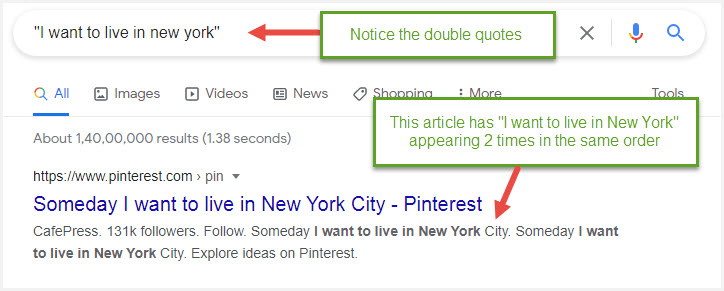
Use double quotes if you want the exact phrase in the same order to appear in your search results.

For example, “I want to live in New York” will give results where the phrase appears in the exact same order.

Remove the quotes, and you will have the keywords scattered all over the article, and not exactly in the same order.

Using double quotes is also a great way to search for articles using just their titles.

In the example below, I want to search for posts that have mentioned “I want to live in new york” in the exact same order.

Using Double Quotes to Search for the Exact Phrase on Google
  • Define

Defines a word and also includes an audio clipping on how to pronounce it correctly.

Use Define: followed by the word.

Use Define: to Find Out How a Word is Defined and Pronounced
  • Search

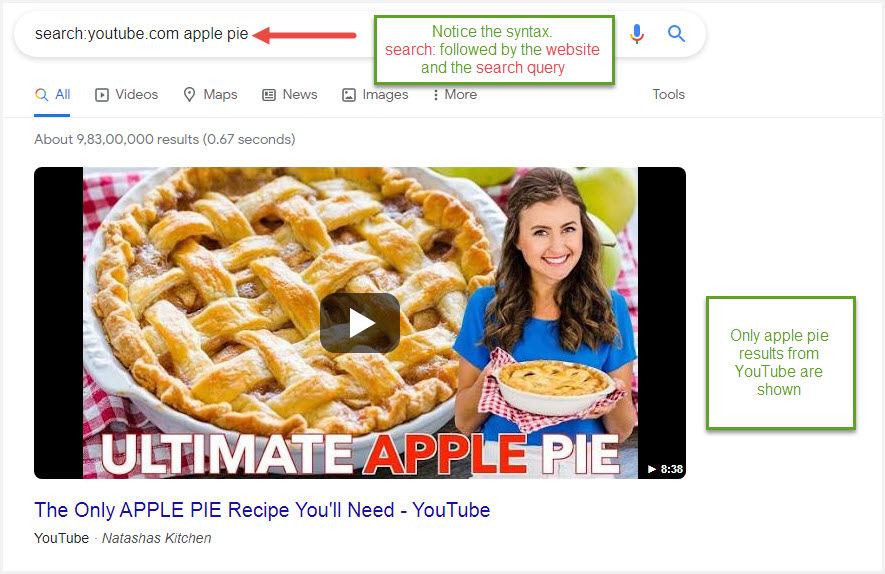
Searches for results on a specific site.

Use Search: followed by the website URL and search query.

In the example below, I want to search all recipes for apple pie on YouTube.

Use Search: to View Search Results from a Specific Site
  • Asterisk *

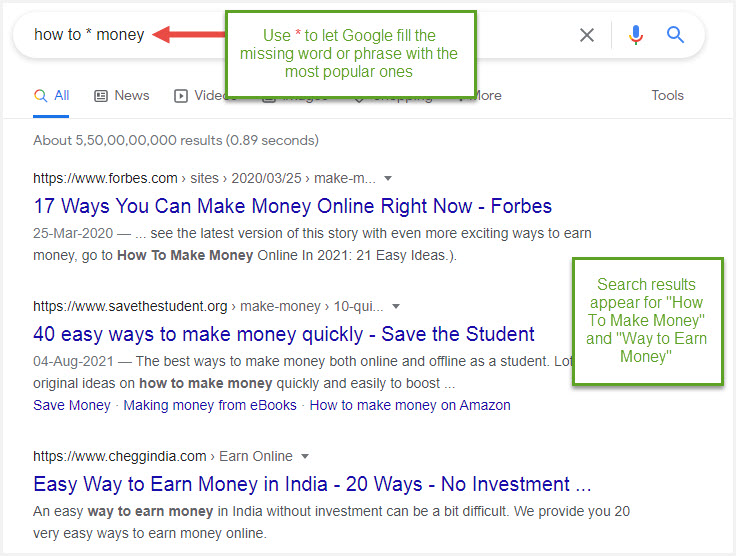
Use the * asterisk symbol to let Google do the guessing work. This allows you to see the most popular search phrases that match a part of your query.

Insert * wherever you want Google to add in the most popular search words/phrases. In the example below, I have used how to * money, so it will consider popular search phrases like how to make money, how to earn money etc.

Use Asterisk (*) to Search for Missing Words
  • Related

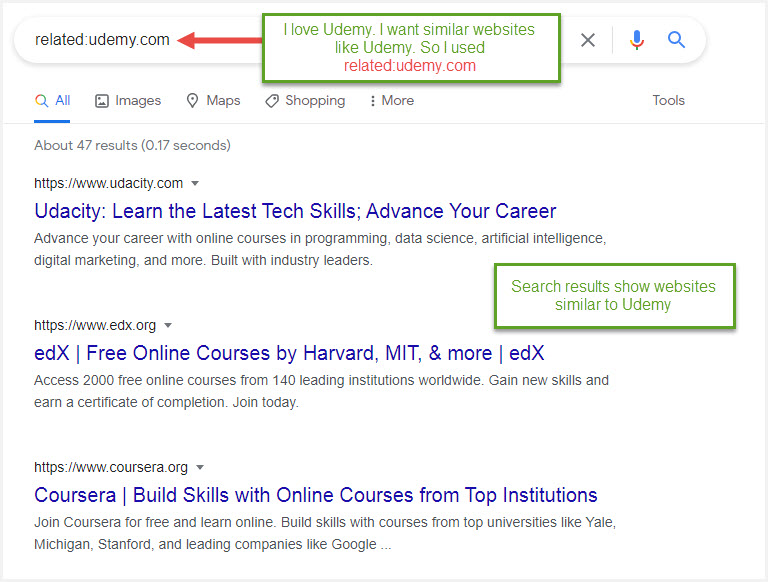
If you find a website you really like, and wish to see similar ones, use Related: followed by the URL of the website you liked.

In the example below, I want websites similar to Udemy that offers courses online.

Use Related: to Find Related Websites
  • Tilde ~

This is a great way to include synonyms.

Use ~ before the word that requires synonyms.

Use Tilde (~) to Find Synonyms
  • Location-specific

If you wish to see search results only related to a specific location use location: after the search phrase.

Use Location: to Find Specific Location Results
  • File Type

In case you are looking for content in a particular format, use filetype: followed by the type of file (example: pdf).

Use Filetype: to Search for Specific Formats
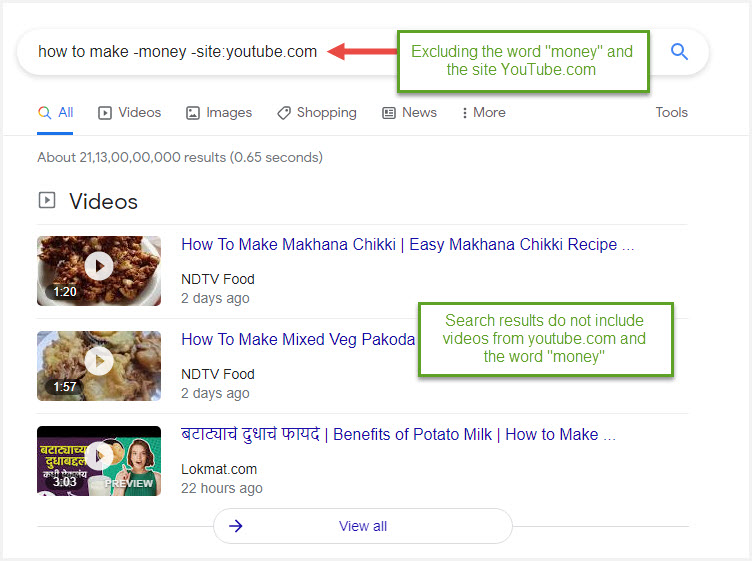
  • Exclude

Exclude something from search results by using dash .

For example, let us consider the example below, when you type -money, this means you want Google to exclude the word “money” from the search results. I have additionally added another exclusion, that is the website YouTube.com.

Exclude Certain Words & Sites from Results (Potato Milk?! You learn something new everyday :))

An Ode to the 16 Personality Types

Personality Types
Source: Wikimedia Commons

Many years ago, I tried a test for the first time – The Myers-Briggs Personality Test.

I am a type INFJ (advocate) and I was impressed by how true the description was. It felt like my innermost feelings and thoughts were out on display for everyone to see. So much so that, I started sending a link of the INFJ description page to anyone who was curious about my personality. I am pretty sure I won’t be able to come up with a more befitting description than the one on the site.

Also, that one person who you thought for sure was an extrovert, might just as well turn out be an introvert! What we show to the public, is seldom the truth, and this test kind of captures the gist.

The quiz is quite long but give it a go if you love digging deep into personality types and you have some time for self-analysis. You can find all personality type descriptions under the “Personality Types” tab of the website.

Another fun thing to do – make your loved ones take the test and compare results!