Hindus Least Likely to Migrate, India Is Top Source and Destination Country: Pew Survey

Did you know that around 3.6% of the world’s population lives outside their country of origin? The Pew Research Center has come up with some interesting insights on the religious composition of the world’s migrants in their latest survey. Who migrates more? What are the top three origin and destination countries for each community? Which country hosts the most number of immigrants? The survey answers all these pertinent questions and more with detailed insights.

This post includes infographics created by the CNN-News18 creative team.

Reasons for migration

Why do people migrate? The survey reveals several reasons, such as the need to find jobs, to live with other family members, or for better education. However, religion also plays a part in migration. Migrants have often moved to escape persecution. There is also the need to live with people with similar religious beliefs.

Migrant Groups by Religion

To quote the survey, “Many migrants have moved to escape religious persecution or to live among people who hold similar religious beliefs. Often people move and take their religion with them, contributing to gradual changes in their new country’s religious makeup.“

Worldwide migrant counts have increased for all major religious groups

Religious groups most and least likely to migrate

Hindus tend to migrate less as compared to other religious groups and Christians are most likely to migrate from their place of origin.  

Hindus are less likely to migrate

As per the survey, “Christians are the largest migrant group, but Jews are most likely to have migrated.”
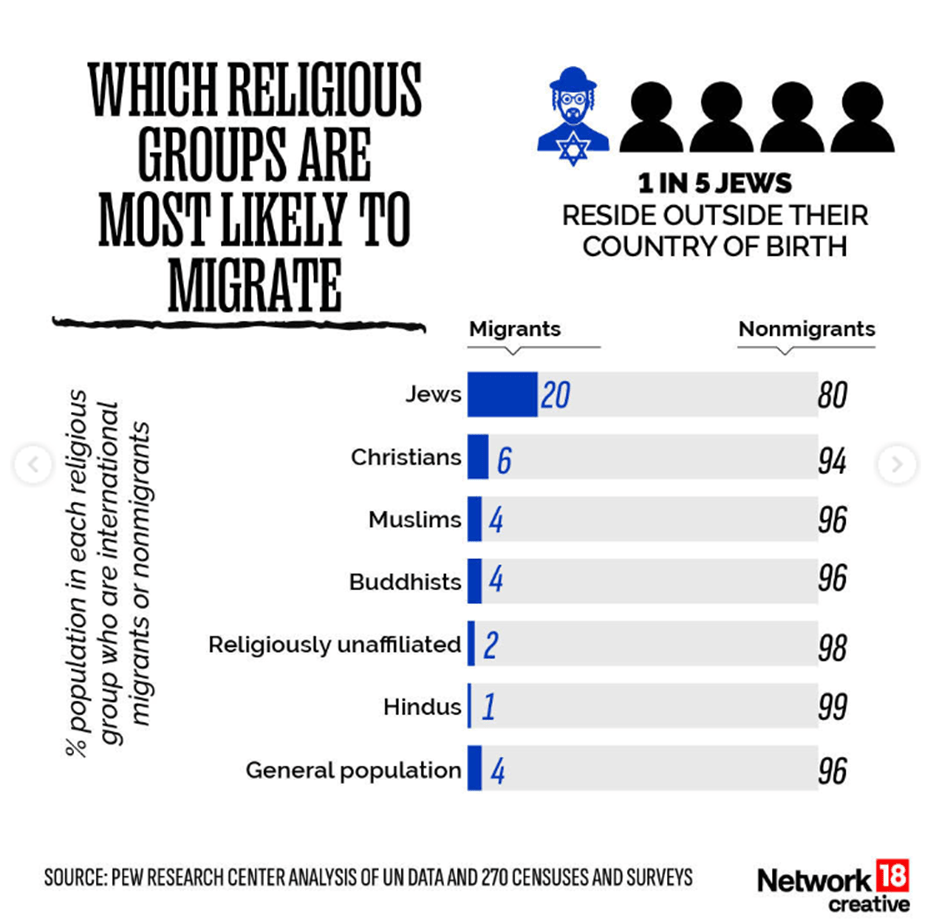
Jews are most likely to migrate

The top source and destination country for Christian migrants

To quote the survey, “Christians make up a much larger share of migrants (47%) than they do of the world’s population (30%). Mexico is the most common origin country for Christian migrants, and the United States is their most common destination.“

Top source and destination countries for Christian migrants

The top source and destination country for Muslim migrants

In relation to Muslim migrants, the survey says, “Muslims account for a slightly larger share of migrants (29%) than of the world’s population (25%). Syria is the most common origin country for Muslim migrants, and Muslims often move to places in the Middle East-North Africa region, like Saudi Arabia.” Interestingly, Muslims tend to prefer migrating to “richer” regions that follow their religion. The top destinations for the community are Muslim-majority nations, such as Turkey, Saudi Arabia, and UAE.

Top source and destination countries for Muslim migrants

The top source and destination country for Hindu migrants

As per the survey, “Hindus are starkly underrepresented among international migrants (5%) compared with their share of the global population (15%). India is both the most common country of origin and the top destination for Hindu migrants.” Hindu migrants to India are most likely to originate from neighboring regions like Afghanistan, Pakistan, and Bangladesh, where minorities face severe persecution. This is evident from statistics indicating a drastic decrease in minority numbers within these regions over the years.

Top source and destination countries for Hindu migrants

The Pew Survey offers a lot more detailed insights, so I would highly recommend going through it.

The Most Intriguing Fact in “Kashmir Narratives” by Colonel Ajay Raina

I recently bought a book titled Kashmir Narratives. It is authored by Colonel Ajay Raina, a retired Indian Army officer. To quote his bio on Amazon, “I am the only son of refugee parents who were young kids when the 1947 bloodied partition saw the creation of two new States of India and Pakistan and when the biggest ever migration of humans took place on this earth. Post my education, I got commissioned into the Indian Army as an officer in 1990 and served till the end of 2017.“

I happened to see his interview somewhere and decided to buy the book. It has a lot of information on Kashmir, focusing on its history, but what I found particularly interesting was the information on the condition of the plebiscite in Kashmir. Before we get to that, let’s understand what a plebiscite is.

What is a plebiscite?

A plebiscite is a direct vote by the people of a region (in this case, Kashmir) on an important public issue. In simpler words, in relation to Kashmir, a plebiscite allows Kashmiris to vote for its future – specifically, whether the region would join India or Pakistan. Interestingly, only these two options were presented, with no option explicitly listed of allowing Kashmir to function as an independent state.

How did the idea of a plebiscite in Kashmir emerge?

The idea of a plebiscite came into effect following the partition of British India in 1947 when the princely states were given the option to join either India or Pakistan.

Jammu and Kashmir initially chose to remain independent. However, after an invasion by tribal forces from Pakistan, Maharaja Hari Singh sought military assistance from India and signed the Instrument of Accession, formally acceding to India. This led to the first Indo-Pakistani war in 1947-48.

To resolve the conflict, the UN intervened, and the United Nations Security Council (UNSC) passed Resolution 47 in 1948. This resolution called for a ceasefire, the withdrawal of Pakistani forces from the region, and a significant reduction of Indian army officers. This was to allow for a free and fair plebiscite under UN supervision without any sort of intimidation. The plebiscite was supposed to let the people of Jammu and Kashmir decide their allegiance to either India or Pakistan. The result of the plebiscite would have depended on the majority vote.

However, the plebiscite was never conducted due to several reasons, including disagreements between India and Pakistan over the conditions set by the UN.

Clause (a) in Resolution 47

Plebiscite Condition in Kashmir

Most of us aren’t aware of Clause (a) in Resolution 47 passed by the UNSC. It states the condition of a plebiscite in Kashmir. Refer to UN Digital Library – Resolution 47 (1948) – Page 4:

To secure the withdrawal from the State of Jammu and Kashmir of tribesmen and Pakistani nationals not normally resident therein who have entered the State for the purpose of fighting, and to prevent any intrusion into the State of such elements and any furnishing of material aid to those fighting in the State.

The clause requires the complete withdrawal of Pakistani forces from the region. However, this condition remains unfulfilled as militants keep infiltrating the area.

Interestingly, India keeps getting the majority of the blame for not allowing a plebiscite, while it’s clear that Pakistan hasn’t fulfilled its part of the resolution. The resolution placed initial responsibility on Pakistan to withdraw its forces from the region. Only after this withdrawal was India supposed to reduce its military presence. This was then to be followed by a plebiscite. Because neither side fully complied with the conditions set out in the resolution, the situation has remained unresolved.

Final thoughts

I can’t help but wonder, had the “freedom seekers” in Kashmir known about this condition for a plebiscite, would they have applied more force on Pakistani militants to move out of the region? As stated, the first step toward a plebiscite is to ensure the Pakistani militants have withdrawn completely.

The UN has not formally retracted Resolution 47. It is currently in a dormant state. However, there is a possibility of Resolution 47 being re-invoked if the UNSC decides to revisit it.

An Ode to Seeking Justice By Exercising Your Power to Vote

The Night Is Ours - Kolkata Protest

In Kerala, recently, CPM faced a sharp setback. A state known to be deeply faithful to its comrades turned its back on the communist party in the Lok Sabha Elections. CPM could secure only one seat. This was a big shocker for the party when the results were announced. It wasn’t for the people, however. The grievances were such.

What went wrong? Plenty. Fund mismanagement, corruption, hooliganism, dictatorial tendencies, lack of acknowledgment of mistakes, farmer deaths, pension delays, etc. The list seems endless. A sort of arrogance had crept in after CPM’s second consecutive term. It was reflected in their attitude towards commoners and overall leadership. People started catching on to their lies and false promises.

How did Malayalees react? Through their votes. CPM could secure only one seat in Kerala in the recent Lok Sabha Elections 2024, facing an overall 2-4% dip in vote share. They suffered a severe blow even in their strongholds like Kasaragod, Kannur, Vadakara, and Palakkad.

Kerala is a prime example of how to get your revenge against political parties if they fail to meet your standards. No freebies were promised in the state, so the votes were cast purely on the basis of the political party’s performance.

The only way a common man in India can express his disappointment towards political parties is through his votes. Yet, Indians do not show up when the time comes. Excuses pop up, “We have work,” “We don’t want to travel,” “What’s going to happen, anyway?” Due to this, the parties that were a disappointment continue to be in power.

The point I am trying to make is concerning West Bengal. The government had already shown its true colors before the election. They tried to cover up the Sandeshkali rapes and protected the party member from arrest. Police officers were attacked when they went to arrest the party member. Hooliganism was its max. Everyone witnessed it. Yet, the party won again.

Someone said if an election were to be held tomorrow in West Bengal, TMC would again win. This is unfortunate. In such cases, is the government alone to blame? Aren’t we the citizens enabling such a behavior, too? TMC’s supporters turned up en masse to save and vote for the party while the others relaxed at home in the sweltering heat. There was post-poll violence in the state because TMC members were furious they did not secure enough votes as before. Yet, somehow, we refused to acknowledge what we saw. We continued to believe the words of the party who was placing the blame on everyone else except itself. We celebrated the “saving” of democracy, unaware that the party we voted for was no better.

Indians are expressing their anger on social media and the streets now, but they forget they can do it the Kerala way too. When the time comes, hit where it hurts – through your votes. This is the only way to get a political party to introspect and correct themselves. It is a powerful tool. Use it.

***

Photo Courtesy: PTI Photo/Swapan Mahapatra

An Ode to Intermingling With Other Faiths

An Ode to Intermingling with Other Faiths

Yesterday, a Muslim friend visited, and we ended up discussing religion. She’s a practicing Muslim but not overly devout; for instance, she only wears a hijab when her mother-in-law visits.

During our conversation, she shared something beautiful:

People do things in the hope of reaching paradise. There’s so much fear surrounding it. But no one has ever returned from death to confirm if paradise truly exists. What we have now is paradise, isn’t it? You and I, of different faiths, sitting here together, conversing, laughing, and enjoying each other’s company—what better paradise could there be?

I asked her how she developed this perspective when everyone around her follows religious rules so strictly. She said it might be because she attended a non-religious school instead of an Islamic one. She emphasized how important it is to interact with other communities rather than only associating with people from our own. Her husband shares the same outlook. While he offers Namaz five times a day, he hasn’t imposed any religious restrictions on his wife or children. They are the only ones in their family who approach religion this way.

This principle is applicable to all communities. The more we engage with people from different backgrounds, the more open-minded and accepting we become of diverse ideas and perspectives. Conversely, isolating ourselves can lead to more rigid and extreme viewpoints.

I believe this may be why Indians tend to integrate more easily in foreign countries. Growing up in a society where different faiths coexist has shaped our ability to adapt. This is why I feel we should be sharing our culture with the world rather than adopting foreign ones. India’s inclusive culture, which embraces all faiths, is truly beautiful. I hope we continue to honor and preserve it.

***

Photo by Markus Spiske

Quick Bytes: Different Perspectives on the Abrogation of Section 370

Different Perspectives on the Abrogation of Section 370

It’s the fifth anniversary of the Abrogation of Section 370. I couldn’t help but reflect on differing opinions about this watershed moment in the nation’s history. There are politicians like Omar Abdullah and Mehbooba Mufti who consider it a disaster. Then, there are BJP supporters who think it’s the best thing that happened to Kashmir.

How do you know who is right?

It’s a given that our biases influence the sides we choose. When we believe something is unjust, we tend to seek out information that aligns with that perspective. Conversely, when we aim to be more optimistic, we focus on positive news.

In the context of Kashmir, you see different types of YouTube videos. If a vlogger or YouTuber seeks to demonstrate that the Abrogation of Article 370 was misguided, they will seek out discontented Kashmiri locals who share that viewpoint. On the other hand, those looking to justify the decision would seek out locals who support it. No matter one’s perspective, there will always be individuals who support each side of the story. Both sides are also convinced that only their version is the correct one.

However, it’s important to consider the facts.

As per Firstpost’s new article, “The incidents of organized stone pelting, connected with terrorist-separatist agendas, went from a staggering 1,767 in 2018 to zero in 2023“. More facts are provided in the article, which is worth a read.

The writer poses a valid question to Omar Abdullah, who keeps talking about how nothing has changed in Kashmir:

The question arises now that, for the first time in two decades, since four years, which is 1460 days and counting, not one youth has died, but you are saying that the situation overall is terrible. Are we then to assume that normalcy is stone-pelting and youngsters dying every week? The end of stone-pelting and no civilians dying is actually a terrible development for your politics.

Ultimately, your perception of a situation is influenced by your bias. But I can’t help but wonder with all the discontent over the Abrogation of 370: Is the prevention of youth fatalities from stone-pelting incidents of less importance than advocating a political agenda?

***

Photo by Imad Clicks

An Ode to Unrestricted Quality Education for Indian Muslim Women

Indian Muslim Women Education

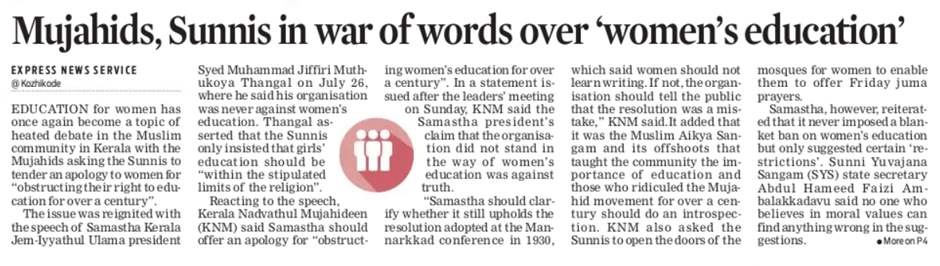
I came across this news today. It is comforting to know that there are members of the Muslim community in India who are fighting for unrestricted women’s education.

Samastha earlier had conveyed that a Muslim woman’s education should be encouraged but within religious restrictions. This became a point of debate across the state of Kerala, with many progressives calling it problematic. However, the most striking response came from a group within the community – the KNM. The organization is demanding that Samastha apologize for its take. KNM is not without its faults, but the stand they took on this particular issue is noteworthy.

Samastha and KNM

To the uninitiated, the “Samastha” group in Kerala refers to “Samastha Kerala Jamiyyathul Ulama,” an influential Sunni Muslim scholarly body in the state. Samastha plays a significant role in managing religious and educational institutions, including madrasas and mosques, and often issues guidelines on religious matters.

The term “Mujahids” in the context of Kerala typically refers to the Kerala Nadvathul Mujahideen (KNM), a prominent Islamic reformist organization in the state. The KNM often contrasts with traditionalist groups like Samastha, promoting a more modern interpretation of Islam, such as advocating the opening of the doors of mosques for Muslim women to enable them to offer Friday juma prayers.

Restricting Women’s Education on Religious Lines

If we connect religion with education, the progress of women in our country will be hindered. Afghanistan is a live example of this. Currently, girls in Afghanistan are generally allowed to attend school only up to the sixth grade. The Taliban, who regained control of the country in August 2021, have imposed severe restrictions on girls’ education beyond this level. Secondary education for girls (grades 7-12) has been largely suspended, and there have also been significant restrictions on female university students, including the closure of universities to women in late 2022. These measures have been widely condemned by international organizations and human rights groups. The global campaign #LetHerLearn, which advocates for Afghan women’s right to education, is gaining traction.

India is no Afghanistan. Here, women are allowed to study without restrictions regardless of religion. Women who are limited to religious studies may face challenges in the corporate world. It would severely restrict their job opportunities in a secular country like India, where well-paid corporate jobs often require you to engage with a global audience and follow strict academic and professional protocols that might not always adhere to religious lines.

Jobs cannot be built around religion in a democracy. Corporate jobs often require specific skills such as critical thinking, teamwork, leadership, and digital literacy. Religious studies may not always focus on developing these skills, which can impact the ability to perform effectively in a corporate setting.

Unfortunate Consequences

What happens when there are limited job opportunities for women due to religious restrictions? They will end up staying at home. Marriage becomes the only option. Financial independence becomes a distant dream.

It is ultimately up to the Indian Muslim woman to decide. If she wishes to pursue further studies, she should not be shamed.

Indian Muslim women deserve quality education, just like anyone else in India. We should have more Indian Muslim women in top positions in the corporate world. Currently, they are practically non-existent outside of Muslim countries. However, to make this happen, there need to be some reforms within the community that will help the women integrate more seamlessly into the existing corporate structure.

***

Picture Courtesy: The New Indian Express (July 2nd 2024, Kerala Edition)