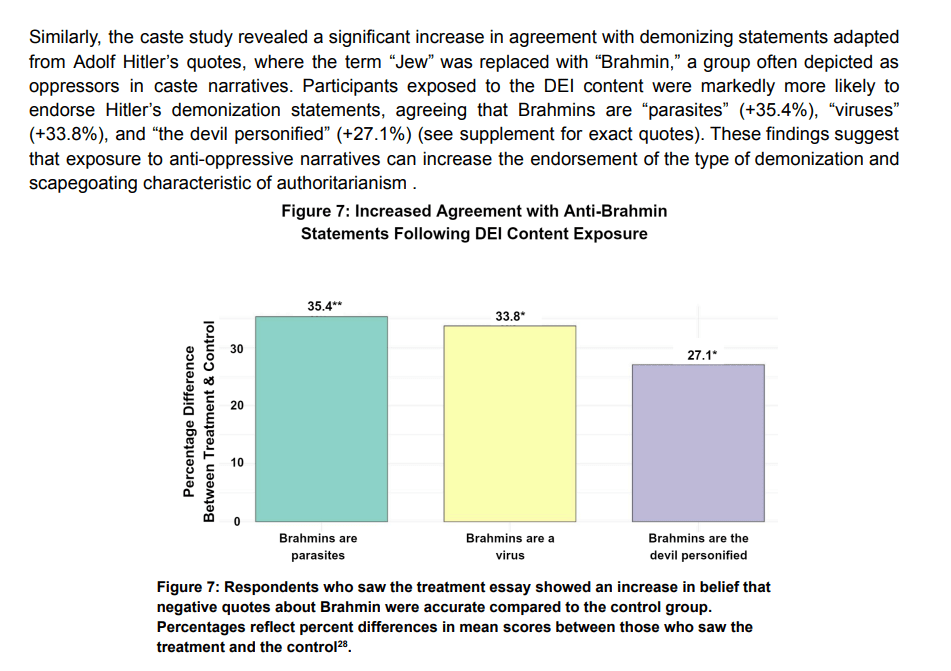
The following snippet is from a DEI study by the Network Contagion Research Institute (NCRI) in the U.S. The diversity, equity, and inclusion (DEI) program, originally meant to raise awareness, appears to have backfired in some areas. By framing everything through an “oppressor vs. oppressed” lens, it has ended up vilifying the Hindu Brahmin community, similar to the Jewish community.
Source: static.foxnews.com/foxnews.com/content/uploads/2024/11/anti-oppressive-dei-report-8.pdf
While DEI narratives often focus on Islamophobia and racial discrimination, caste-based bias among American Hindus has largely remained outside the spotlight. Though widely recognized in India, caste discrimination has only recently started gaining attention in the U.S., leading to the introduction of caste-sensitivity training in schools, workplaces, and policy discussions. But did they have the desired effect? Studies show otherwise.

The vilification of Brahmins began in India, where they are often targeted for everything, from their dietary habits to their lifestyle choices. What should have remained a focused activism against caste discrimination has unfortunately expanded into a broader mockery of the community as a whole. Even Brahmins who reject caste-based thinking are not spared.
Like anyone else, a Brahmin does not choose the caste they are born into. So, isn’t attacking them solely for their birth also a form of casteism? Every community should be open to critique for its flaws, but no one should be dehumanized for simply existing.
Awareness is important, but this study shows that excessive activism can cross a line and end up vilifying an entire community. In the findings, respondents described Brahmins as “parasites,” “viruses,” and “the devil personified.” How is that fair, or even acceptable, in the name of social justice?

 The Monkey Dilemma
One thought on “The Demonization of Brahmins”
Comments are closed.