
The Sad Part of Travel No One Warns You About

Travel Photo

Most people say travel is rejuvenating, but no one really talks about what happens after the trip ends. This feels especially true for people with desk jobs, regular 9-to-5 schedules, or the kind of overtime-heavy work culture that has become common in India.

Once you return from travelling, you are often left with an unsettling feeling. You begin to realise how much of your life is spent restricted to a desk, tied to routines and responsibilities, while there is an entire world outside waiting to be explored. New cities, different cultures, mountain roads, local food, conversations with strangers, and experiences that make life feel bigger than your daily routine. Travel has a strange way of making ordinary life suddenly feel very small.

The truth is that most of our lives are spent working. We spend decades chasing stability, salaries, deadlines, and financial security. Only after retirement do many people finally get the chance to explore the world properly, spend more time on meaningful things, or simply move through life at a slower pace without constantly watching the clock.

After my recent trip, I finally understood why many people choose to limit travelling to retirement. Because when you travel while still working, the months that follow are spent thinking about retirement itself. You start questioning the structure of life in a way you probably never did before.

I think most people are not really craving luxury nowadays. They want peace. A chance to step away from competition, pressure, expectations, and the endless cycle of productivity. But financial responsibilities keep most of us attached to the lives we currently live. And if you think about it, it really is a sad state of affairs. So much of life passes without us truly knowing the world outside our routines. We spend our healthiest years working, saving, and postponing experiences for “someday.” Then, when we finally have enough time and freedom to explore, our physical health may no longer allow us to travel the way we once dreamed of.

Sometimes it genuinely feels like a trap. That is just how modern life is designed. The very rich can afford to live slowly, travel often, and experience the world freely, while the rest of us remain tied to jobs so we can eventually retire with enough money to live comfortably later in life. Until then, most people continue surviving between deadlines, stress, and short vacations that end far too quickly.

It has now been two months since my trip ended, and the feeling of missing the mountains still has not faded. I miss the slow life and mental peace I experienced there deeply. Returning has brought a quiet sadness that has stayed with me ever since. During those ten days of travelling, I experienced bliss as I consciously stayed away from the internet and social media. Honestly, it felt like a relief. When you are travelling, you do not really need distractions because the world around you becomes interesting enough on its own. Every moment feels fuller and more present.

Back home, though, life goes back to screens, schedules, and desk work. And sometimes the internet becomes the only way to explore the world when your real life feels limited to routines.

So now I sit with these thoughts quite often. There is a sombre feeling attached to them. I acknowledge these emotions and quietly hope that one day I return to the version of myself that existed before the trip, when I did not constantly think about whether I was missing out on life, the world, new people, or new experiences. Back then, work and everyday routines felt enough. I was content simply engaging daily with the people I already knew and focusing on responsibilities without questioning life too much.

But travel changes something inside you. That is the difficult part about it. It is both beautiful and cruel at the same time. It opens your eyes to how much more life has to offer, while also reminding you how little time most people actually get to experience it. As the euphoria of the trip fades, the ache lingers.

***

Photo by George Pak

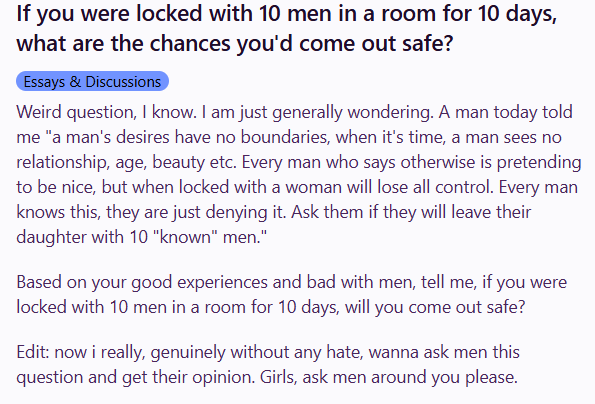
If You Were Locked in a Room with 10 Men for 10 Days

I came across this post on Reddit recently. It immediately made me think about my own experiences.

At the end of the day, it really comes down to energy, doesn’t it?

When I was in the North East, and it started snowing heavily, I stepped into a small shed with a heater. The shed was full of North Eastern men, including my guide. I was the only woman there at that moment.

And yet, I did not feel unsafe even for a second.

That moment stayed with me because it showed me something important about how we perceive safety while traveling or being around strangers.

Now imagine a similar situation somewhere else in India. There are some men I know personally, even a few colleagues, with whom I would feel uncomfortable being stuck in a small space. Not because they have ever done anything that could be complained about. Nothing like that. But the energy they give off simply does not make me feel comfortable.

Safety often has less to do with whether we know someone and more to do with the vibes they give off and whether we are comfortable with those vibes.

Many women will relate to this. We tend to have strong instincts when it comes to unsafe environments. Research often suggests that these instincts developed over time as part of human evolution. Women had to learn to read subtle cues in order to stay safe.

That is why sometimes we feel calm around complete strangers, while at other times we feel uneasy around people we already know.

If women were allowed to choose the people they would spend those 10 days locked up with, most of us would probably make the right call about who we feel safe around.

The real problem arises when that choice is taken away from us, and the men we are to be locked up with, whether known or unknown, are chosen by someone else. When that happens, the chances of discomfort or even unsafe situations naturally increase.

For me, that snowy day in the North East was a reminder that safety is not always about familiarity. Sometimes it is simply about the energy people carry, and the signals our instincts quietly pick up.

My Yali Capkini Journey: Rage, Romance and Baklava Cravings

Yali Capkini Poster Image

I started watching the Turkish drama Yali Capkini (Golden Boy) on Amazon Prime (MX Player) for a very simple reason. The lead pair looked good. I honestly assumed I would drop it after a few episodes because good looks alone rarely keep me hooked. Chemistry matters. A solid storyline matters. Surprisingly, Yali Capkini seems to tick every box so far.

This is the first time I am watching a Turkish series, and it gave me a small window into how Turkish Muslims live. It feels very different from what we usually see in Indian society, where things tend to be more conservative. Turkish culture comes across as more liberal, and a lot of that credit goes to Atatürk’s reforms, which pushed women’s rights forward. The show reflects that beautifully. Women face no criticism for dressing modernly, can speak up for themselves, and aren’t afraid to assert their rights. At the same time, the drama also shows conservative families who believe women should stay home and raise children. One scene shows a father accusing his daughter of being a disbeliever just because she drew a Christmas tree. In Pakistani dramas, the word “kafir” gets thrown around easily, but from what I’ve seen here, it isn’t normalised in Turkish shows. In fact, later, you see characters happily celebrating Christmas trees and decor.

If you plan to watch Yali Capkini, keep a box of Baklava ready. There are so many references to the sweet that you will start craving it instantly. I highly recommend trying Swaadesi Baklava, which should be available in most local Indian stores and also online. In the show, coffee and Baklava feel like supporting characters. They show up during happy moments and sad ones. Just like how many of us enjoy a cup of chai on a rainy day, the characters in this drama keep turning to their coffee and Baklava at any time of the day.

Now, coming to the main characters. Ferit, played by Mert Ramazan Demir, has to be one of the most toxic characters I have ever seen in a drama or movie. Since Yali Capkini’s story is written by a psychiatrist, the male character’s behaviour feels layered and too realistic at times. He is the kind of partner who says “So what?” when you tell him he hurt you, yet he reacts strongly if you give him the same treatment. His emotional manipulation, hot and cold behaviour, and constant lying create a type of rage that builds up inside you. His words sting more than any physical act. Anyone who has ever dealt with a toxic partner would relate, and this applies to both women and men who have experienced suffocating or manipulative relationships. The way most female characters in the drama react to disrespect is infuriating, but it is still close to reality. We all know someone who tells women to “adjust” or “compromise” to keep the relationship going.

The female lead, Seyran, played by Afra Saraçoğlu, is stunning, with eyes that instantly remind you of Aishwarya Rai. She is fiery, refuses to accept injustice, and that naturally irritates Ferit and his family, who are used to submissive women. She is easily the best performer in the show and delivers every scene with perfection.

There are very less feel-good scenes here. The series feels like pure rage bait. Still, it keeps you hooked. I haven’t completed it yet because Season 1 alone has more than 100 episodes. Then there is Season 2 and 3. I am not sure I will finish everything if the constant toxicity gets too irritating, but for now, I still have the motivation to continue.

Yali Capkini is available in both Turkish and Hindi on Amazon and MX Player. The English subtitles aren’t perfect, and sometimes don’t make any sense, but I still recommend watching it with subtitles rather than switching to the Hindi dub. The Hindi audio uses overly respectful language even when characters talk to someone younger, and it takes away from the natural flow of the scenes. That was my only issue.

Why ‘The Girlfriend’ Left Me Thinking About Parenting and Love

The Girlfriend Telugu Movie Photo

I started watching the Telugu film The Girlfriend with low expectations. I assumed it would be yet another romantic drama that glorifies toxic relationships and emotional manipulation in the name of love. To my surprise, the movie took a more thoughtful and layered route.

Minor spoilers ahead for context

The Girlfriend doesn’t just explore unhealthy love. It also dives into toxic parenting and how childhood conditioning shapes adult behaviour. The female lead is quiet, agreeable, and used to shrinking herself. The film makes it clear that her personality isn’t random. Her upbringing trained her to feel guilty for wanting space, choices, or independence. So when she picks a controlling partner, it feels strangely familiar to her. She’s not frightened of it at first, but she faces a tinge of uncertainty throughout. She tries to treat her partner’s behaviour towards her as normal because she has spent years adjusting to her father’s controlling behaviour. But deep down, there’s a quiet discomfort she can’t ignore. Something feels off, and her instincts begin to push back. This duality is what makes the character so different. This push and pull that many of us have experienced in our own relations with others who are not right for us.

The male lead, on the other hand, is aggressive, impulsive, and driven by ego. He worships Virat Kohli, maybe because he admires the cricketer’s aggressiveness and his devotion towards his wife, Anushka Sharma. He has a charming personality and enjoys a lot of attention. People around him like him, and he knows it. He’s used to getting what he wants, even in friendships. His behaviour reflects a narcissistic mindset where his needs come first, and empathy barely exists. Yet he remains popular, which feels very realistic. In real life, people like him often get the benefit of the doubt because their confidence and charm make them likable, even when behind closed doors, they’re not. This is why it’s often hard for someone with a narcissistic partner to justify leaving. People around them struggle to believe anything is wrong. The scene where he delivers that long, dramatic monologue in front of everyone when she ends the relationship is unforgettable and true to life. It’s an attempt to stage himself as the victim, even when he himself was the one in the relationship with the problematic dynamic.

When the movie shows the male lead’s mother, the pattern becomes clear. She mirrors the heroine’s personality. Anxious. Passive. Always accommodating. His father dominated the household, and his mother absorbed the behaviour without protest. In his partner, he doesn’t just see love. He sees a repetition of his family dynamic. In his own dysfunctional world, this is the definition of love.

This is what makes the film interesting. Many romantic movies in Indian cinema focus only on the lovers. But The Girlfriend highlights how family culture, parenting style, and generational trauma influence relationships. It reminds you that behaviour has context.

It made me think of my own past. My ex-husband had a similar attitude at home. I remember watching him take all his mother’s freshly washed clothes and throw them outside the house, onto the dirt-filled ground, just because she left them drying near the house’s entrance. She didn’t scold him. She didn’t even react. She simply smiled and picked them up to wash again. She later told me she was once abandoned on the roadside at night by her husband after an argument. She narrated it casually, as if it were normal. That’s when I understood why her son expected unquestioning loyalty and forgiveness from his own partner, me.

Watching the movie felt personal because it portrayed something many Indian families silently live with. Not abuse in the usual cinematic sense, but the subtle cycle of fear, guilt, silence, and acceptance.

I liked The Girlfriend mainly because of how honestly it handled the parenting angle. The performances were solid, especially from Rashmika Mandanna and Dheekshith Shetty. Their chemistry felt natural, and the relationship dynamics never felt exaggerated or forced. The emotional tension, confusion, fear, and hope all felt real. It’s rare to see an Indian movie explore love, trauma, and family influence with this level of subtlety. If you enjoy character-driven cinema with emotionally complex and layered characters, this one is worth watching.

The Girlfriend is streaming on Netflix and runs for 2 hours and 18 minutes.

7 Memorable Quotes from The Love Queen of Malabar

Kamala Surayya

The Love Queen of Malabar is a captivating exploration of the life of Kamala Das, also known as Kamala Surayya, one of India’s most celebrated poets. Written by Merrily Weisbord, the book is thought-provoking, highly controversial, poetic, melancholic, and at times, shocking.

Kamala Das shares her deepest emotions with Merrily, treating her as a confidante in revealing thoughts that range from lyrical to unexpected. While the book may not appeal to everyone, it left a lasting impression on me—an eye-opener that offered a rare glimpse into the intimate world of a literary icon.

I have carefully selected some non-controversial quotes from the book. Not everything Kamala says can be shared publicly due to its sensitive nature. However, the quotes listed here provide insight into Kamala’s thoughtful persona and capture the essence of Merrily’s book.

“A writer moves away from family, old relationships, very far with the speed of a falling star,” she says. “Otherwise the writer is destroyed, and only the member of the family remains: the mother, sister, daughter, wife. The writer at some point must ask, Do I want to be a well-loved member of the family? Or do I want to be a good writer? You can’t be both at the same time. The days when you are with the children and are being a very good mother, you cease to be the writer. You feel repelled by the pen and the paper, which are definitely going to come between you and your loved ones.”

“Because the writer can give all of herself only to that task of writing. She will have to write against her loved one, put him under the microscope, dissect him, analyze his thoughts, his words. After a while he is no longer the man you held in your arms at night. You have cut him into little slivers, everything is burst open, he is seeds and pulp and juice all spread out in little bits on your writer’s table. After that, you can’t go to his arms the same way.”

If I had not learned to write how would I have written away my loneliness or grief? Garnering them within my heart would have grown heavy as a vault, one that only death might open, a release then I would not be able to feel or sense.

“Ask the books that I read why I changed,” she says. “Ask the authors dead and alive who communicated with me and gave me the courage to be myself.”

“Make a woman laugh, then make her cry, that is the secret of a good film. Not make her cry, cry, cry. What message is that for women today?”

Her dislike of organized religion is so much more pronounced than on my last visit that I wonder if any beliefs remain to comfort her. “Yes,” she answers. “A concept of God. A presence in my room. I’m not alone. I visualize a shower of moonlight falling on someone in prayer. It is a soothing exercise. I feel bathed in light, and I know there is a God.”

She tells me that even in Kerala, which prides itself on religious coexistence, she is still being attacked from both sides. The Hindu Sangh Parivar, an association of Hindu nationalist organizations, protests her ownership of the snake shrine on her own ancestral property at Nalapat because she is a Muslim. The Muslims are “disgusted” with her because she speaks against their practices and clergy, refusing to support sectarian politics she finds unpalatable. “They feel they are losing their grip on me.”