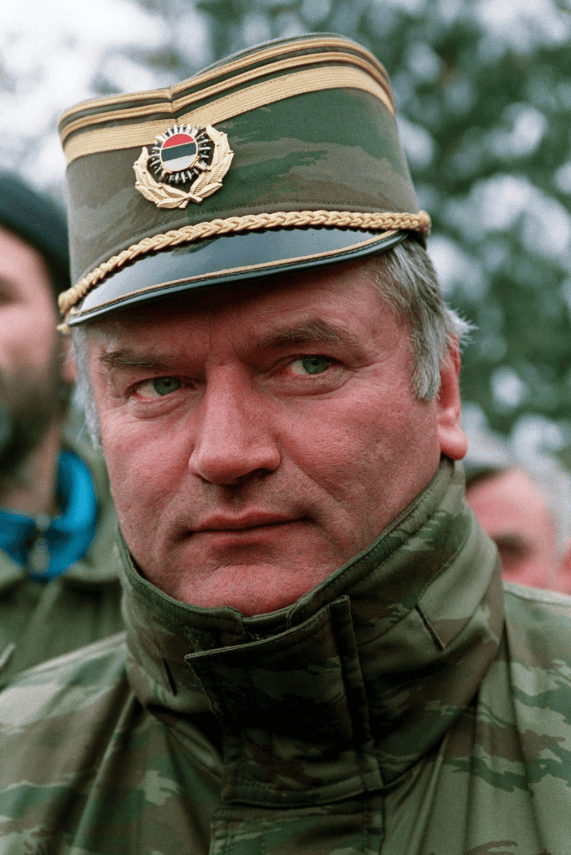
I came across a news report about thousands of people attending the funeral of the man referred to as the “Butcher of Bosnia.” His name is Ratko Mladić. The report said that he was convicted of genocide for his role in the killing of more than 8000 mostly Muslim Bosniak men and boys in Srebrenica, Bosnia and Herzegovina. He died in prison at the age of 84 in August this year.
I was totally taken aback by this information and I had to look into why such a controversial figure is being considered a hero by many. I found that his supporters remember him as a military commander who defended their community against what they saw as “perceived threats” from Bosniak Muslims during the Bosnian War, which began in 1992.
I can’t help but notice a pattern here: violence is often justified nowadays by this very “perceived threat” – the belief that another community poses a threat to our existence, religion, culture, or way of life. Maybe this pattern has always been there, or maybe social media has simply made these attitudes much more visible.
Let’s take a look at some examples.
Israel’s ongoing conflict with Palestinians is framed by supporters of Israel around threats to its existence, while Palestinians and their supporters describe the consequences in terms of occupation, displacement, and violence against civilians.
Hitler is also being glorified on TikTok today, with his actions being presented through the deeply disturbing logic that he “helped eradicate” a community, Jews, whom they view as a threat to the world.
Afzal Guru and Ajmal Kasab are considered heroes by many because their actions are framed as acts of resistance against perceived threats or justified through a particular political narrative.
Savarkar is hated by many, even more strongly than some historical figures associated with mass violence, but he is also considered a hero by many who believe Hinduism and Hindu identity have been under threat.
I remember feeling absolute dread (a feeling of threat) when thousands attended Yakub Memon’s funeral in Mumbai.
And that is what makes this whole subject so uncomfortable.
Mourning, glorifying, or defending people who have done questionable things simply because they supposedly acted against “perceived threats to our existence” is becoming mainstream.
Closer to home, Hindus have attacked minorities in India because they believe their religion or cultural identity is under threat.
Christians in places like Tamil Nadu have also staged protests when public spaces in their area are used for festivals associated with other religions, with some viewing this as a threat to their own religious identity or traditions.
Then there are Kashmiri Pandits, who are being portrayed as a threat to the “culture” or “religion” of the land even when they are simply celebrating their festivals in a place with which they have a deep historical connection.
The circumstances are obviously different. But the underlying psychology is worth examining.
Once we convince ourselves that another community is an existential threat, almost anything can start being rationalised in the name of protecting our own.
And that leaves me wondering: who is going to do what next in the name of a “perceived threat”?
No community is completely free from this tendency, and no community can automatically claim moral superiority. Across religions, nationalities, ethnic groups, and political movements, people have at different points convinced themselves that their identity, culture, religion, or very existence is under threat.
Once “they are a threat” starts gaining ground, the question is no longer simply who is right or wrong. The question becomes how far people are willing to go to bring down or harm the people they have decided are the threat.
The debate around Umar Khalid, Sharjeel Imam, and other Delhi riots accused who have not yet been granted bail has once again come into focus. From the right-wing perspective, the issue is not as simple as “judicial delay” or “denial of justice.” I thought of writing this post because many in India only trust left-wing channels, which causes them to miss important fact-based points shared by the right-wing.
Adjournments and CJI’s Remarks
First of all, let us understand what an adjournment is. Simply put, it is when a court hearing or trial is postponed to a later date instead of being completed on the scheduled day.
Out of the 14 adjournments in Umar Khalid’s case, 7 were initiated by his own legal team. This was mentioned by CJI D.Y. Chandrachud himself in his interview with Barkha Dutt.
Source: Lawbeat
“I do not want to comment on the merits of the case but I must tell you one thing which is lost sight by a lot of people when it comes to Umar Khalid‘s case, can you imagine that the case was adjourned, they were at least seven if not more adjournments which were sought by the council appearing for Umar Khalid and eventually the application for bail was withdrawn.” – CJI Chandrachud
Justice Chandrachud noted that, on social media, a one-sided narrative often takes hold, leaving judges with no space to defend themselves. He added that if one looks closely at the actual proceedings in court, the reality is far more nuanced than what is portrayed online.
While some “fact checkers” online have attempted to dismiss this claim by relying on surface-level sources, it is reasonable to trust the CJI more on this matter. As head of the judiciary, he had direct access to both official and indirect records of adjournments.
The Delay Tactic
According to many on the right, Khalid and Imam’s legal strategy is clear. If the trial begins, conviction is almost certain. Thus, their team is accused of deliberately delaying proceedings by filing fresh petitions, often citing a “change in circumstances.” The idea is to drag the trial as long as possible and eventually claim bail on the grounds of delay.
Notably, some petitions that caused delays were also filed by other accused who are already out on bail.
The Judicial Tactic Explained
The strategy seen here is not unique. It is a common tactic in the Indian judiciary:
Lawyers repeatedly file petitions (often citing new circumstances).
Each petition leads to adjournments, dragging the trial.
Eventually, the accused can argue that their right to a speedy trial (protected under Article 21 of the Constitution) has been violated.
On that ground, they can seek bail due to judicial delay.
This slow erosion of the process not only stalls justice but also erodes public trust in the judiciary. Something that many argue is part of the plan.
CJI on Unseen Angles
In an interview with Barkha Dutt, CJI Chandrachud hinted that there are angles in the case that cannot be revealed to the public. Right-wing commentators believe this may refer to multiple coordinated fronts behind the Delhi riots.
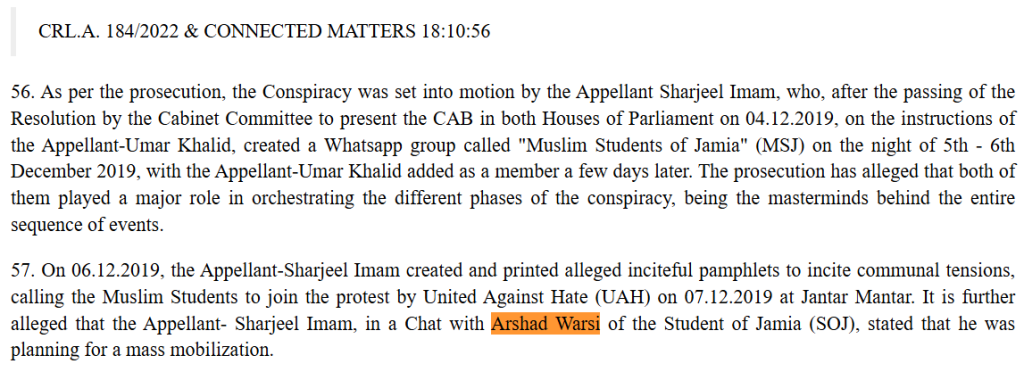
One example often cited is ISIS member Arshad Warsi (not the actor), who was in contact with Sharjeel Imam. Warsi allegedly helped decide the content of pamphlets that were distributed to mosques and Muslim neighbourhoods prior to the riots to incite violence. He was later arrested in the Pune ISIS module case.
Sharjeel Imam’s connection with Arshad Warsi. Source: indiankanoon.org/doc/156202283/Arshad Warsi arrested
There are also allegations of foreign funding and terror groups like PFI supporting the protests and unrest.
Umar Khalid met with other accused people in the PFI office to discuss funds for riots. Source: indiankanoon.org/doc/156202283/
The Seriousness of the Delhi Riots
The 2020 Delhi riots were not minor incidents of unrest. They claimed the lives of 53 people, including Intelligence Bureau officer Ankit Sharma. For many, this underscores the gravity of the case and why justice cannot be indefinitely postponed.
Right-Wing Response
Right-wing commentators like Abhijit Iyer-Mitra and Kushal Mehra have now openly criticized the delay of trials. They argue that instead of dragging the matter endlessly, the trial should begin as soon as possible, and justice should be delivered. In their view, it is time to see through legal manoeuvres and bring the culprits to justice. The longer the delay, the more the perception of judicial inefficiency grows, and that benefits only those seeking to evade accountability.
It is also important to understand that, though we can call for quick trials, courts in India are bound to follow established legal procedures. Every step, adjournments, evidence submission, witness examination, bail hearings, has to comply with the Code of Criminal Procedure (CrPC), the Evidence Act, and constitutional safeguards like Article 21 (right to life and liberty, including speedy trial).
Judges cannot simply “override” these protocols, even if they suspect delaying tactics. If the defense files a petition citing “change in circumstances” or another procedural ground, the court is obliged to hear it and decide. Ignoring or fast-tracking outside the rules would open the door to appeals, accusations of bias, or even the case collapsing later.
Delays often frustrate people. However, they’re also part of the judiciary, ensuring the trial stands on solid legal ground.
Left-Wing Response
The left-wing argues that delays aren’t only due to Khalid’s side and that long undertrial detention is unfair. While these points deserve acknowledgment, they don’t erase the fact that half the adjournments were filed by Khalid’s own team and that Sibal’s strategy clearly aims at running down the clock.
They also say Hindu mobs who killed during the riots haven’t faced equal scrutiny. But the distinction is clear: Hindu rioters were violent on the ground, yes, but they did not make the kind of provocative, mass-scale mobilizing speeches Khalid and Sharjeel Imam did that led to loss of lives. Khalid mobilized crowds by invoking the Kashmir issue, while Sharjeel Imam spoke about separating Assam from India and attempted to provoke people through pamphlets referencing the Babri Masjid dispute. Videos of their speeches can be accessed easily on social media platforms. That’s why the charges against them are different and why delaying the trial feels like a deliberate tactic.
My Take
It is important to examine cases from every angle instead of blindly accepting one-sided propaganda. Dhruv Rathee does not question the opposition, while journalists like Shiv Aroor do not question the ruling party. So it’s up to us, the citizens, to collect points from both sides and analyze it.
I have tried to provide proof for all the points in this post, but they can also be independently validated online. I would highly recommend going through the Indian Kanoon link (indiankanoon.org/doc/156202283/) to read more about the case.
Rather than dismissing everything right-wing as lies, citizens should review the available evidence and ask: Is a separatist attitude acceptable for the country? Does this kind of behaviour warrant bail? This cannot simply be brushed off as freedom of speech, because in this case, speech directly incited violence and led to the loss of 53 lives and the injury of thousands.
In India, there are rarely open-and-shut cases. Even Ajmal Kasab, a convicted terrorist, was given a fair trial. By that standard, it is certain that Sharjeel Imam and Umar Khalid will also receive a fair hearing once their trial begins, especially since their offences, while serious, are not on the same level as Kasab’s. That is why the trial should begin without further delay. So their actions can be properly examined, and justice delivered swiftly.
It took some time to complete Karin Slaughter’s Pretty Girls. This is not because the plot wasn’t interesting, but because I was trying to divide my time equally among other interests in life. The storytelling is intense, descriptive, and graphic. So, I had to take breaks. Anyone who cannot handle violence should stay away from the book. It’s by far the most violent book I have ever read.
The crime thriller follows the story of three sisters. One of them has been missing for years, while the other two navigate their lives without their eldest sister’s presence. Their parents are separated, unable to cope with their daughter’s absence. What happened to their eldest? Why aren’t the cops providing clear answers? This mystery forms the crux of the story.
If you enjoy thrillers, I’d highly recommend Pretty Girls. Personally, I felt the descriptions were a bit lengthy at times, which slowed the pace for me. However, readers who appreciate detailed scenes and emotional depth may find that aspect especially engaging.
Ending this review with some interesting quotes from the book:
That she ended up with a boy who had grown up less than twenty miles from her childhood home was just further proof that no matter how far you ran, you always ended up back where you started.
People did not change their basic, core personalities. Their values tended to stay the same.
“The world stops for you when you’re pretty. That’s why women spend billions on crap for their faces. Their whole life, they’re the center of attention. People want to be around them just because they’re attractive. Their jokes are funnier. Their lives are better. And then suddenly, they get bags under their eyes or they put on a little weight and no one cares about them anymore. They cease to exist.”
“Reductio ad Hitlerum.” Claire couldn’t stop quoting Paul. “It’s when you compare someone to Hitler to win an argument.”
“Dyadic Completion,” Paul would’ve told Claire. “The human brain tends to assume that, if there’s a victim, there has to be a villain.”
He reminds me of the worst kind of student I used to have—the kind who is certain that they already know everything worth knowing
It’s the fifth anniversary of the Abrogation of Section 370. I couldn’t help but reflect on differing opinions about this watershed moment in the nation’s history. There are politicians like Omar Abdullah and Mehbooba Mufti who consider it a disaster. Then, there are BJP supporters who think it’s the best thing that happened to Kashmir.
How do you know who is right?
It’s a given that our biases influence the sides we choose. When we believe something is unjust, we tend to seek out information that aligns with that perspective. Conversely, when we aim to be more optimistic, we focus on positive news.
In the context of Kashmir, you see different types of YouTube videos. If a vlogger or YouTuber seeks to demonstrate that the Abrogation of Article 370 was misguided, they will seek out discontented Kashmiri locals who share that viewpoint. On the other hand, those looking to justify the decision would seek out locals who support it. No matter one’s perspective, there will always be individuals who support each side of the story. Both sides are also convinced that only their version is the correct one.
However, it’s important to consider the facts.
As per Firstpost’s new article, “The incidents of organized stone pelting, connected with terrorist-separatist agendas, went from a staggering 1,767 in 2018 to zero in 2023“. More facts are provided in the article, which is worth a read.
The writer poses a valid question to Omar Abdullah, who keeps talking about how nothing has changed in Kashmir:
The question arises now that, for the first time in two decades, since four years, which is 1460 days and counting, not one youth has died, but you are saying that the situation overall is terrible. Are we then to assume that normalcy is stone-pelting and youngsters dying every week? The end of stone-pelting and no civilians dying is actually a terrible development for your politics.
Ultimately, your perception of a situation is influenced by your bias. But I can’t help but wonder with all the discontent over the Abrogation of 370: Is the prevention of youth fatalities from stone-pelting incidents of less importance than advocating a political agenda?





You must be logged in to post a comment.