Some Indian Muslims like Arfa, Rana, Zubair, and Naseeruddin Shah feel India is intolerant and unsafe for Muslims.
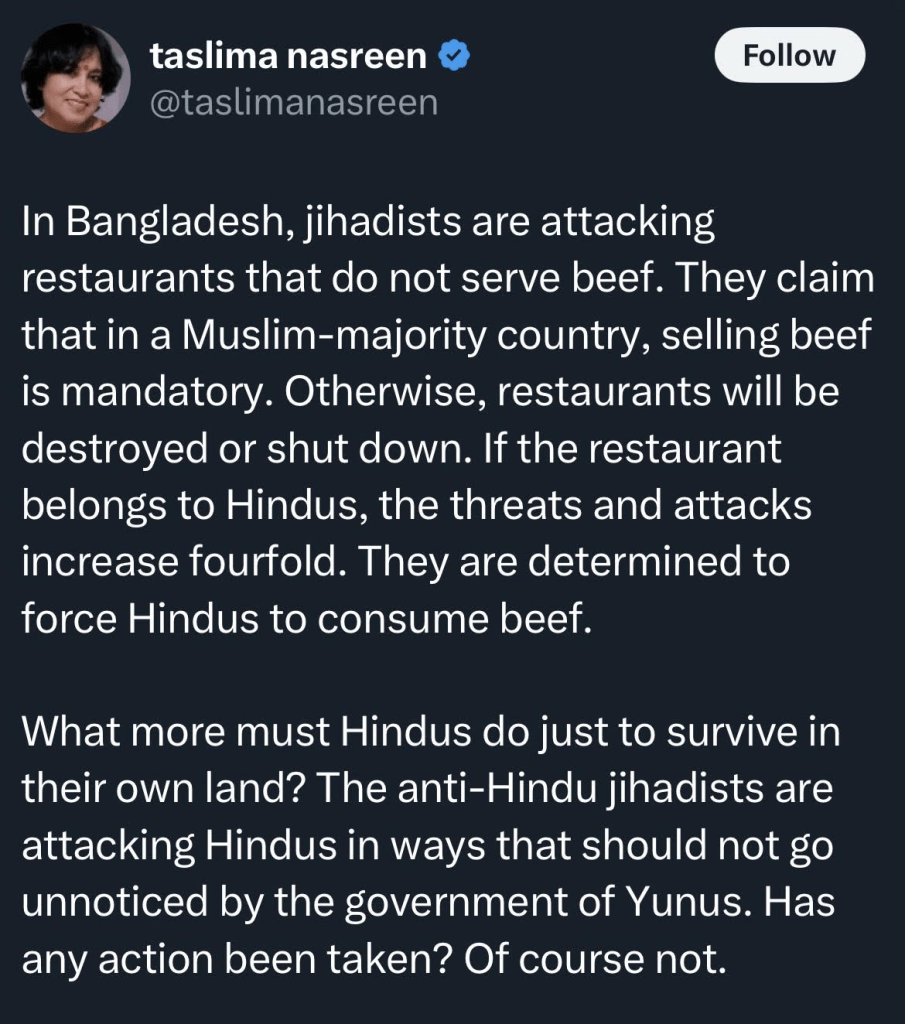
Yet, Muslims like Taslima Nasreen and Sheikh Hasina feel safer in India than in their own Muslim-majority countries. They have escaped their countries to avoid getting persecuted and can openly criticize extremists in India.
Souce: x.com/taslimanasreen
In India, you can criticize any religion freely, like PC George in Kerala targeting Islam, or Stalin in Tamil Nadu attacking Sanatana Dharma.
Source: livelaw.in
But at the same time, mocking/disrespecting Hinduism or Islam can also lead to lynching or beheading.
This shows the complicated nature of India’s religious tolerance. It’s not fully black or white; there are many layers of grey.
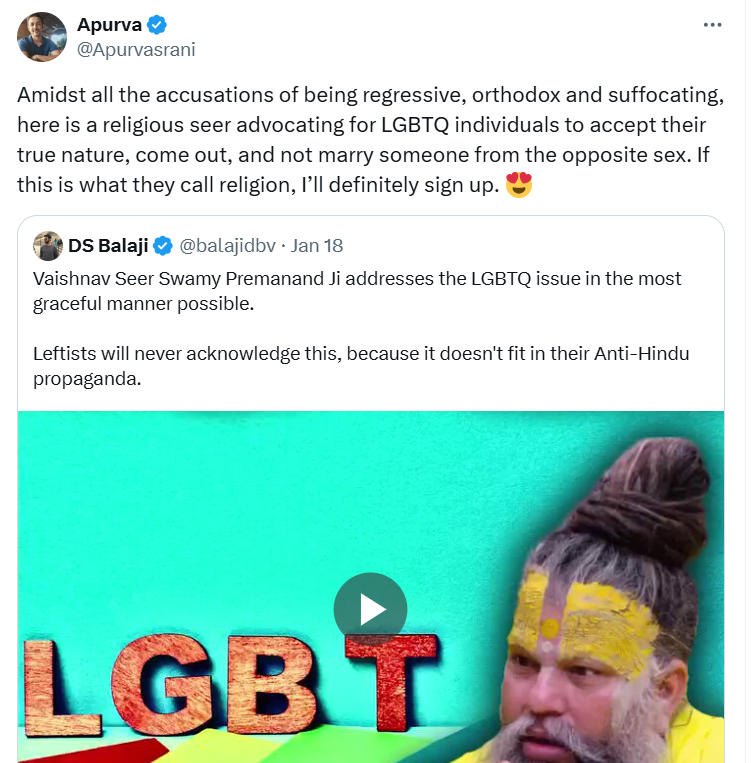
A country, accused of religious intolerance, is also a country where seers like Swamy Premanand Ji openly advocate for LGBTQ issues. He advises young members of the LGBTQ community not to succumb to parental pressure to marry according to societal norms, as it could harm both their own life and that of their partner.
From these examples, it is quite clear that India is a nation with diverse perspectives. Yet international media often portrays it as a regressive and intolerant society, probably because they rely heavily on left-leaning biased sources for their information. This depiction is unfair to the country’s social fabric, which embraces various ideologies.
It is important to note that much of the left-leaning media in India tends to present only one side of the story, resulting in incomplete or biased information. In an era where media bias is prevalent, it is strongly recommended to read news from both left- and right-leaning sources to gain a comprehensive understanding of the issue. Without this balanced approach, people may remain unaware of where genuine reforms are needed and could be misled by those with specific agendas.
The downside of one-sided stories is that they can foster an extreme victim mentality, making people believe that any violence or attack is justified due to past suffering. For instance, some celebrated the LA fires, posting that the USA deserved it for funding weapons for Israel, without considering that pro-Palestinians could have lost their homes too. If a tragedy strikes India, similar comments might surface. This is partly due to media narratives that fuel such sentiments and intensify hatred.
In an increasingly polarized world, it is crucial to report news with accountability. Both extremes are harmful—religious extremism that forces others to conform through coercion and an extreme victim mentality that blinds individuals to any positive aspects, making them focus solely on negative narratives. Currently, in India, I am seeing more of the latter than the former. Media is partly responsible for this.
I was once a leftist. However, at that time, I didn’t consider all sides of a story. Even though I am a Hindu, I was often dismissive of conflicts in which Hindus were victims in India, such as the Kashmiri Pandit genocide, the 1992 Ajmer rapes, the Moplah riots, and others. I coldly labeled the narratives as right-wing propaganda. I was radicalized to the extent I wasn’t open to other perspectives.
On October 7th, 2023, I experienced a significant shift in my perspective. I witnessed people justifying acts of violence, including rape and saw secular politicians in my country referring to it as resistance. This left me shocked. It wasn’t the BJP that influenced my change, but rather the people around me. The only individuals expressing outrage about these events were from the right wing, which took me by surprise.
Over the next couple of months, I underwent a monumental shift in my ideology that startled me. It felt like old layers of my beliefs were peeling away, making way for new understandings—a painful process. I came to realize that the principles of fairness and equality I had believed in until then were merely a façade. I also understood that I would likely be alone in this revelation.
The world operates in a contradictory and troubling way. People often expect unwavering support from others, yet when it’s their turn to show empathy, they respond with scoffing, mockery, and belittlement towards heinous crimes. They easily justify acts of violence, murder, and rape with statements like, “So what? They deserved it.”
It took me months to calm my anger and process the betrayal I felt when I discovered that some of my friends had become radicalized to the point of believing that rapes were justified. Until that moment, I had viewed the world through rose-colored glasses, believing it to be a kind place.
I then looked at my country with a fresh perspective and realized that similar patterns were at play here. Hindus seemed to have to compromise more than other communities in the name of secularism. I observed that many conflicts where the victims were predominantly Hindus were dismissed as propaganda, belittled, mocked, or invalidated, much like the rapes of Israelis on October 7.
I now identify as a right-winger. I consider myself center-right and hold no animosity toward anyone. In the past, I hesitated to label myself as a right-winger because almost everyone I know leans left. However, over time, I’ve moved past the fear of labels. People can judge or categorize me as they wish; as we age, labels become less significant. My shift in ideology is not due to any political party or its propaganda, but rather my observations of people’s behavior and their viciousness.
I have become more patriotic and now want everyone in India to adopt a “nation first” mentality. This is something I missed when I was a leftist; I felt that people weren’t sufficiently pro-India. I realize now that the center-right community is where I truly belong.
We, the center-right, believe in the following principles:
We are patriotic and uphold a “nation first” mentality.
We reject extremism from both the far-right and the far-left.
We take pride in the achievements of India.
We advocate for equal rights for everyone, regardless of their community.
We oppose appeasement politics.
We strongly support enhanced security measures.
We have zero tolerance for radical groups.
There are several negative aspects of the far-right that frustrate people like me. They should be held accountable by the government. However, I still feel positive about my country under strong leadership that has the courage to confront extremism.
Unfortunately, in India, when you openly call out extremism, you are declared Islamophobic. When radicals get arrested due to active participation in extremist groups, the country is declared Islamophobic. The global media often gets their news about India from the local left-leaning media which is notorious for giving one-sided stories. In this day and age of media bias, it is imperative to refer to both the left and right-wing channels to get a full balanced view.
It’s true that Islamophobia exists in India and the country should do more to protect its minorities. However, even if the BJP takes positive steps, it is unlikely to reduce the extreme victim mentality prevalent in the community that refuses to acknowledge any good done by the party. For example, the BJP introduced the Shadi Shagun Yojana scheme in which a Muslim girl is given Rs 51000/ when she marries after her graduation (BA, BSc, BCom, BE etc.). BJP banned the Triple Talaq. This is for Muslims alone. Most of the recipients of other welfare schemes have been members of the Muslim community. No ruler would have tried to uplift the Muslim community if they were Islamophobic. Riots and young children getting murdered due to terrorist activities in Kashmir have also drastically reduced. But these plus points are often blatantly ignored and many choose to judge Modi by the actions of the far-right.
A question to consider is: If Modi is still judged for the 2002 Gujarat riots, why isn’t Congress held accountable for the 1984 Sikh riots that they enabled, which were equally horrific? Politicians have contributed to deepening societal divisions by fueling narratives. Riots and violence instigated by one party are often deemed forgivable, while those provoked by another are considered unforgivable.
My political ideology is not fixed. I may shift from center-right to center-left in the future if I find that the center-left in India has become bold enough to openly oppose Islamist extremism as well, not just Hindutva. As of now, they do not meet that standard.
To end with a quote on pseudo-secularism in India:
To those who claim we are now living in a totalitarian, fascist, Hindu Rashtra, one must ask:
What kind of Hindu Rashtra is this where Ram Navami, Hanuman Jayanti, Durga pooja processions, and even Garba celebrations, are attacked and stoned with impunity?
What kind of Hindu Rashtra is this where Hindus are forced to be refugees in their own land, where one can settle 40,000 Rohingya Muslims but not 700,000 Kashmiri Hindus, the land’s original inhabitants; where the judiciary says it is too late to prosecute those who raped, murdered, and ethnically cleansed lacs of Hindus?
What kind of Hindu Rashtra is this where Hindu temples are exclusively controlled by the State, and where the government usurps hundreds of thousands of acres of temple land and is responsible for more than 100,000 temples losing lakhs of crores in rental income?
What kind of Hindu Rashtra is this where the Right to Education Act discriminates only against Hindus and their schools, forcing tens of thousands of them to shut down?
What kind of Hindu Rashtra is this where a communal violence law was about to be enacted through with only the Hindus would have been held guilty in a communal riot even if they were in a minority for example in Kashmir?
What kind of Hindu Rashtra is this where court judgments like the Sabarimala and legislative enactments like the Hindu Code Bill purport to reform only Hindu religious practices but dare not touch practices of other religions, and if they do, the decisions are promptly reversed like in the Shah Bano case?
What kind of Hindu Rashtra is this where the Waqf Act gives overarching powers to Muslims to declare a 1500-year-old Hindu temple to be on Islamic land when Islam is only 1300 years old?
If this is how a Hindu is rewarded in a Hindu Rashtra, he’d much rather be in a Muslim Rashtra because then at least there’d be no pretence of equality.
I’ve always viewed Hinduism as a mainstream religion. However, I recently learned that there are people, especially outside India, who consider Hinduism as “pagan.” Surprisingly, even within India, some Hindus refer to themselves as “the last polytheistic pagans remaining on earth.”
However, an article on Scroll by Arvind Sharma presented an interesting explanation of why Hinduism cannot be considered Pagan.
This pluralistic nature of Hinduism could explain why India, a Hindu-majority country, is able to embrace the beliefs of diverse communities. Communal clashes happen, but everyone is free to complain. There is no existential threat. The freedom to complain is in itself an underrated freedom. People in several countries cannot question their government or the majority religion. Sadly, we often take this freedom for granted.
Currently, there is no self-declared Hindu nation; all nations with a Hindu majority identify as secular. Even if a country were to declare itself a “Hindu nation” in the future, the principle of secularism would likely endure, as the idea of secularism is deeply embedded within Hinduism itself. So, a Hindu nation will not be one that would force people into converting to Hinduism, but one that is already in effect and on full display in Hindu-majority nations. Take the case of India. LGBT couples can have a joint bank account in India, abortion is legal, and atheism is tolerated. You are free to worship your god, not worship a god, or go to any religious place of your choice. No one is going to force you to wear a religious symbol or yank it off you.
Is India perfect? Definitely not. It’s like any other pluralistic nation. There is discrimination, but not to the extent the media, especially Western media, reports. Some even peddle fake news as the reality, without hearing both sides of the story.
The problem with religious propaganda is that it attracts the wrong kind of people. Recently, Rahul Gandhi said that Sikhs are unable to practice their religion freely in India. This came as a shock to many, including Sikhs in the country, as there have been no such allegations in the last decade from the community. However, the leader of a separatist group was happy and quoted Rahul’s words to reinforce the group’s agenda to form an independent nation for Sikhs that spans parts of India. Similarly, allegations against India of being Islamophobic have triggered radical Islamist groups like ISIS. The group frequently references India (particularly Hindus) in their newsletters, using the country’s internal clashes to advance its agenda and emphasize to its followers the need for “disciplining” us.
Seeking justice is acceptable. However, I hope people, especially Indians, are mindful of exaggerating communal events in the country, as they often end up catching the attention of extremists, who then use the news to create propaganda videos and material for fueling hatred and recruiting new members to their groups. When the time comes, extremists do not look at political party affiliations, religion, race, color, caste, region, or language before they cause havoc. Everyone is the same for them. Being wary of social media activism is essential for our country’s well-being. We should double-check details from both left-wing and right-wing sources to get a full idea of the story. Most journalists in India today are biased, which is why due diligence is required before endorsing/believing stories.
Before signing off, I wish to share this tweet by Shehla Rashid, which beautifully debunks the communal allegations against India.
Yesterday, a Muslim friend visited, and we ended up discussing religion. She’s a practicing Muslim but not overly devout; for instance, she only wears a hijab when her mother-in-law visits.
During our conversation, she shared something beautiful:
People do things in the hope of reaching paradise. There’s so much fear surrounding it. But no one has ever returned from death to confirm if paradise truly exists. What we have now is paradise, isn’t it? You and I, of different faiths, sitting here together, conversing, laughing, and enjoying each other’s company—what better paradise could there be?
I asked her how she developed this perspective when everyone around her follows religious rules so strictly. She said it might be because she attended a non-religious school instead of an Islamic one. She emphasized how important it is to interact with other communities rather than only associating with people from our own. Her husband shares the same outlook. While he offers Namaz five times a day, he hasn’t imposed any religious restrictions on his wife or children. They are the only ones in their family who approach religion this way.
This principle is applicable to all communities. The more we engage with people from different backgrounds, the more open-minded and accepting we become of diverse ideas and perspectives. Conversely, isolating ourselves can lead to more rigid and extreme viewpoints.
I believe this may be why Indians tend to integrate more easily in foreign countries. Growing up in a society where different faiths coexist has shaped our ability to adapt. This is why I feel we should be sharing our culture with the world rather than adopting foreign ones. India’s inclusive culture, which embraces all faiths, is truly beautiful. I hope we continue to honor and preserve it.
It is with utter dismay I am reading the news about the attack on Hindus in Bangladesh. Secular Muslims in the country are trying to protect the Hindus. This is positive news, and you can’t help but feel grateful for such people in the community. However, radicals are still deliberately targeting the houses and religious places of Hindus. How can they be stopped?
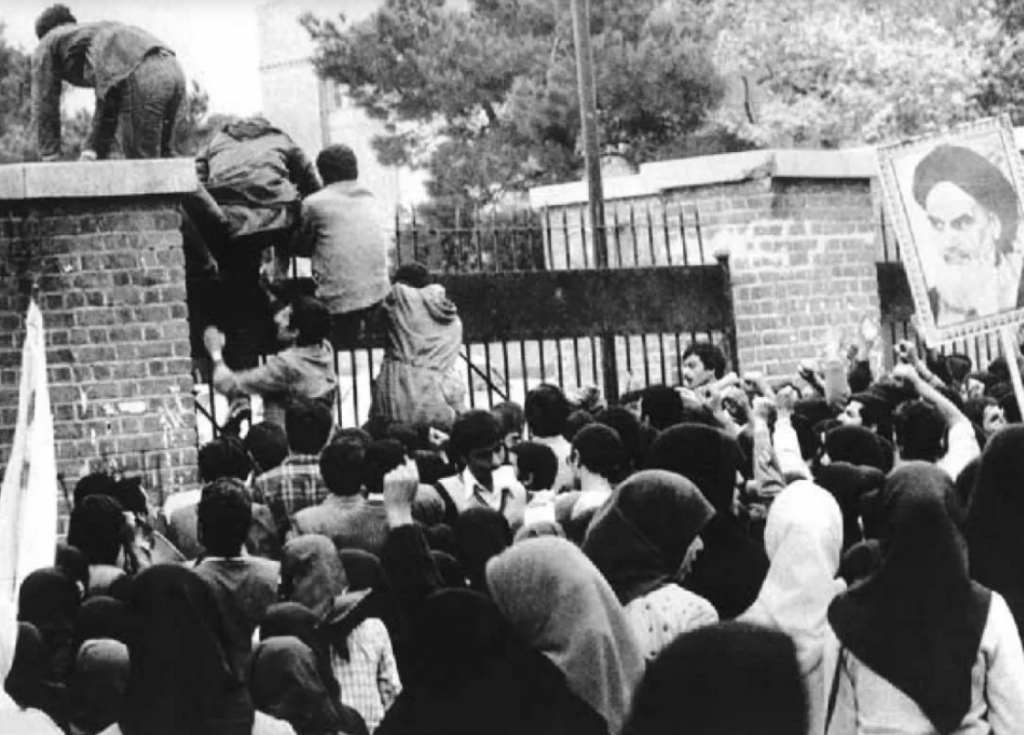
Often, we have seen that in the struggle between radicals and seculars, the radicals emerge victorious. This has happened previously in Iran. A student uprising in Iran in 1979 played a significant role in the downfall of secularism and the emergence of the Islamic regime.
Student protestors climbing the gate of the U.S. Embassy in Tehran on November 4, 1979 / Wikimedia Commons
The reasons for the uprising back then were quite similar:
Widespread discontent with the Shah’s authoritarian rule, political repression, and economic issues.
Iranian students, both domestically and abroad, were active in organizing protests, disseminating anti-Shah literature, and galvanizing public opinion against the regime. They played a crucial role in spreading revolutionary ideas and mobilizing the masses.
A simple act of protesting an “authoritarian” rule in Iran brought in a more religious regime that was dictatorial in its tendencies. So how successful would one consider this student uprising, unless the original intention of the riots was not social justice, but a religious takeover? Shah, considered secular in nature, fled the country never to return, which in all probability will be Sheikh Hasina’s trajectory too. Comparisons are inevitable. Iran is still struggling to bring back its golden days of secularism. Will Bangladesh end up being the same? Only time will tell.
I saw Bangladeshi residents expressing their joy over Sheikh Hasina’s ouster, which is valid, as she was unnecessarily brutal in her approach. But I also saw them in private groups worrying about the future of the country and whether they will fall into the hands of radical Islamists. Some even said they would leave the country if it came to that.
What does this mean for India? Sheikh Hasina was considered pro-India in her approach. She kept the fundamentalists like the Jamaat-e-Islami and anti-India elements under check. This is of significance as India shares a long border with Bangladesh and any sort of instability has the potential to spill over to neighboring regions.
The new leader, Muhammad Yunus, is a Nobel Laureate. He has proven himself an intellectual, but how effective would he be as a politician and a peace-keeper? Will he be pro-India and continue to maintain peaceful relations with our country, promising to secure the borders and protect the minority community in Bangladesh? Or will he be a puppet for the radicals? Questions only time can answer.
As usual, the leftist ecosystem in India is working overtime to convince us that the Hindus in Bangladesh are not in trouble. This is not surprising. It is a standard approach when minorities in Pakistan, Bangladesh, and even within India (Kashmiri Pandits) are attacked. The events are quickly negated or justified and brushed under the carpet. A close observation of their responses provides enough proof of their bias. In my 40+ years, I have never seen them acknowledge attacks against Hindus. There is always a “reason” for it.
If by chance you point out the attacks, you are labeled a right-wing communal Sanghi (a BJP supporter). However, if you support any other community, you are a social justice warrior, an activist, and a secular. This double standard is difficult to fathom, and I have seen many becoming BJP supporters because of this hypocrisy.
In India, I am witnessing more secular Muslims openly supporting Bangladeshi Hindus than the so-called secular Hindus. Due to the indifference of left-leaning Indian Hindus, the community will continue to suffer persecution at the hands of radicals. There is not enough support. For the support to pour in, people need to first acknowledge the fact that there is an issue.
It is with some relief I read that all political parties in India are on the same page regarding the Bangladesh issue. The opposition hasn’t yet negated the Bangladeshi Hindu’s plight. They voiced concern for the minorities in Bangladesh and said they would work in unity with the central government. A nuanced approach their supporters need to learn.
Hopefully, peace will soon be restored in Bangladesh, rendering my concerns unnecessary. Until that day arrives, my worries persist.
Nadia Murad had luck on her side the day she escaped ISIS. The door was unlocked, and no guards surrounded the area. She says their negligence could have stemmed from the assumption that she was too weak, both physically and mentally, to attempt an escape. To add to the luck factor, the family she eventually sought help from while on the move turned out to be empathetic rather than deceitful, a fortunate outcome not experienced by most Yazidi women who tried to escape.
Keeping luck aside, Nadia exhibited a quality that day uncommon for someone in her position – courage. To muster the strength and determination to capitalize on an opportunity, especially when you are exhausted, is heart-wrenchingly admirable.
The Last Girl chronicles the harrowing journey of a woman who had to go through hell on earth as the perpetrators sought heaven on “the other side.”
Nadia’s story serves as a lesson – never take your peace or soldiers of the nation for granted. You are safe because the soldiers of your country are spending countless hours and energy to ensure no harm comes your way. You realize the importance of this only when you read and research extensively, go through history, and pay attention to actions.
The book is heartbreaking. You feel incredible sadness for Yazidis. But you also feel sorry for the people who get radicalized to the extent that they end up thinking violence is the answer. How can we save them? How can we protect our youngsters? How can we extinguish their hate and make them realize we are all, ultimately, children of the same universe?
Reader discretion is advised: The following content may contain sensitive or mature themes that could be distressing to some individuals.
Here are some of the quotes from the book that caught my attention:
People say that Yazidism isn’t a “real” religion because we have no official book like the Bible or the Koran. Because we pray toward the sun, we are called pagans. Our belief in reincarnation, which helps us cope with death and keep our community together, is rejected. Some Yazidis avoid certain foods, like lettuce, and are mocked for their strange habits. Others don’t wear blue because they see it as the color of Tawusi Melek and too holy for a human, and even that choice is ridiculed.
We (Yazidis) would, over generations, get used to a small pain or injustice until it became normal enough to ignore. I imagine this must be why we had come to accept certain insults, like our food being refused, that probably felt like a crime to whoever first noticed it. Even the threat of another firman was something Yazidis had gotten used to, although that adjustment was more like a contortion. It hurt.
I used to pray for my own future—to finish school and open my salon—and the futures of my siblings and my mother. Now I pray for the survival of my religion and my people.
For a young Yazidi girl, life only got better after the Americans and the Kurds took over. Kocho was expanding, I was going to school, and we were gradually lifting ourselves out of poverty. A new constitution gave more power to the Kurds and demanded that minorities be part of the government. I knew that my country was at war, but it didn’t seem like it was our fight.
I still think that being forced to leave your home out of fear is one of the worst injustices a human being can face. Everything you love is stolen, and you risk your life to live in a place that means nothing to you and where, because you come from a country now known for war and terrorism, you are not really wanted. So you spend the rest of your years longing for what you left behind while praying not to be deported.
Rape has been used throughout history as a weapon of war. I never thought I would have something in common with women in Rwanda—before all this, I didn’t know that a country called Rwanda existed—and now I am linked to them in the worst possible way, as a victim of a war crime that is so hard to talk about that no one in the world was prosecuted for committing it until just sixteen years before ISIS came to Sinjar.
Everyone thinks Yazidi women are weak because we are poor and live outside the cities, and I have heard people say female fighters with ISIS are, in their own way, proving their strength among men. But none of them—not Morteja’s mother, not even a suicide bomber—was a fraction as strong as my mother, who overcame so many struggles and who never would have let another woman be sold into slavery, no matter her religion.
Fear was better. With fear, there is the assumption that what is happening isn’t normal. Hopelessness is close to death.
I was quickly learning that my story, which I still thought of as a personal tragedy, could be someone else’s political tool, particularly in a place like Iraq. I would have to be careful what I said, because words mean different things to different people, and your story can easily become a weapon to be turned on you.
Every time I tell my story, I feel that I am taking some power away from the terrorists.
I have begged Sunni leaders to more strongly denounce ISIS publicly; they have so much power to stop the violence. I have worked alongside all the men and women with Yazda to help survivors like me who have to live every day with what we have been through, as well as to convince the world to recognize what happened to the Yazidis as genocide and to bring ISIS to justice.
I told them I wasn’t raised to give speeches. I told them that it was in their power to help protect vulnerable people all over the world. I told them that I wanted to look the men who raped me in the eye and see them brought to justice. More than anything else, I said, I want to be the last girl in the world with a story like mine.






 The Monkey Dilemma
You must be logged in to post a comment.