As someone who’s chronically online and keeps up with news from all kinds of sources, mainstream, regional, left, and right, I’ve noticed something important: Christians in Kerala don’t really have a go-to political party anymore.
For a long time, people assumed the Indian National Congress (INC) was the party in Kerala that understood what every community wanted. But that idea seems to be changing fast on the ground.
Communal Conflicts in Kerala: Who Supports Whom?
If you’re new to Kerala politics, here’s a simple way to understand how parties respond to communal issues here:
Hindu vs Minority: CPM and Congress usually back the minority community.
Upper Caste Hindu vs Lower Caste Hindu: CPM and Congress generally side with the lower caste.
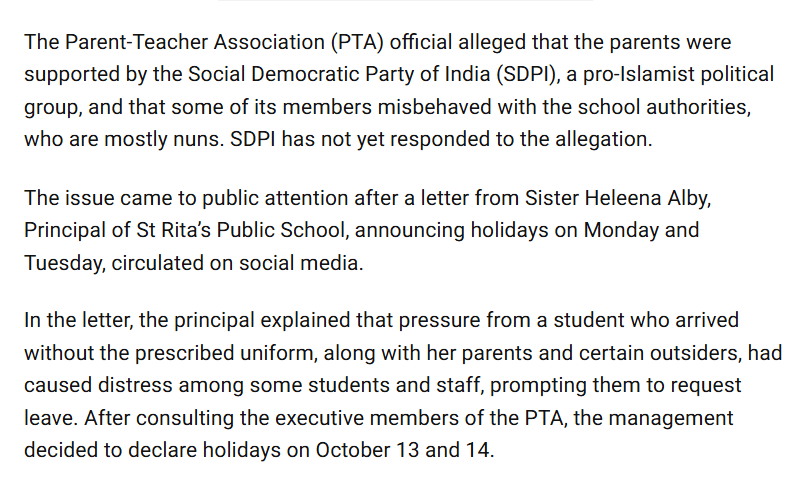
Christian vs Muslim: CPM and Congress often stay neutral at first, saying things like “we’ll look into it,” but in the end, they tend to side with Muslims. Examples include the Munambam Waqf issue, Professor Joseph’s case, Sona Eldhose’s conversion, and incidents involving SDPI bullying, such as the hijab case at the Christian-run St Rita’s school in Kochi (details in the image below).
News Source: “Hijab controversy forces school in Kochi to close temporarily after parents’ protest” (Mathrubhumi.com)
If you look at any case in Kerala, the pattern more or less stays the same. I’m not sure about regional politics in other states, but I suspect it’s similar elsewhere.
While BJP clearly positions itself as a Hindu party, there’s a growing sense in Kerala that Congress and CPM lean pro-Muslim. Why? It’s not really about religion. It’s about vote-bank politics. Christians are a minority among minorities in Kerala, so pandering to them doesn’t win many votes and can even cost support from other minority groups.
Growth of Chrisanghis in Kerala
Now, in Kerala, there’s a growing group called “Chrisanghis,” a term left-leaning voices like Arundhati Roy have used. These are Christians who support the BJP. Arundhati recently warned Christians in Kerala not to become Chrisanghis, citing conversion attacks in the North as a concern.
So why do some Christians support the BJP? It’s because they view Islamist groups like SDPI and Jamaat-e-Islami as a bigger threat than BJP. Many point to the persecution of Christians in countries like Nigeria by Islamist groups and feel that, compared to such threats, the BJP’s Hindutva agenda poses a lesser danger. At the same time, parties like Congress and CPM often downplay or ignore the activities of these Islamist groups in India, mostly for political gain, leading some Christians to see BJP as a safer option.
News Source: “Congress in a fix as Jamaat arm readies to back theocratic state” (NewIndianExpress.com)
Notably, Jamaat-e-Islami has frequently been in the news, even recently, for persecuting minorities in Pakistan and Bangladesh. In India, its branch presents a secular image, likely to gain acceptance and influence within mainstream politics, using it as a pathway to gain power.
It’s also true that Kerala’s two mainstream parties have largely ignored such concerns from the Christian community. Their typical response is often, “Don’t fall for RSS/BJP propaganda,” even when the issues have nothing to do with RSS or BJP.
Thoughts
So what can the Christian population in India do in this situation? On one side, there’s a pro-Hindu or “Hindutva” party that will never fully accept conversions under “freedom of religion,” and on the other, there are parties that haven’t supported Christians when they faced threats from Islamist groups.
From my perspective, Christians should keep all parties guessing about where their votes will go. They shouldn’t strongly back any party, since none fully meets their needs. Take the Munambam Waqf issue, for example: the removal of Section 40 in the Waqf Bill allowed the Kerala High Court to rule the Waqf claim over Munambam land as illegal, protecting Christian landowners. Congress leaders like Hibi Eden tried to persuade residents to drop their case, saying nothing would come of it, while the only BJP MP from Kerala, Suresh Gopi, stood by the people, largely comprising Christian fisherfolk, and supported the amendment that ensured their land rights.
When missionaries face attacks by far-right Hindus in the North, that’s when Opposition parties step in. But in cases like the Chhattisgarh nuns’ arrests over alleged conversions, the local Congress in Chhattisgarh hardly protested, as taking a stand would have cost them votes. On the other hand, in Kerala, protesting the arrest of the nuns would have earned them support, which is why several Opposition leaders from Kerala traveled to Chhattisgarh to show solidarity.
This shows that Christians can’t rely fully on any party and should strategically make their political influence felt.
This is how politics works: there are no fixed principles for political parties. They act based on the local political context. Christians in India should remember this and avoid fully backing or rejecting any party. Instead, they can use this knowledge strategically and wisely, since different parties support them in different situations.
After celebrating Onam and engaging in numerous social activities, my introvert battery hit rock bottom. I needed a desperate recharge. So what do I do? Naturally, I retreated to every introvert’s most favourite new-gen comfort zone: scrolling endless Instagram reels. Nothing says “I’ve had enough of people” quite like being a couch potato, locked up in your house, while going through everyone else’s social lives.
As I scrolled through the multiple Onam-related posts, I couldn’t help but appreciate the inclusivity in Kerala. Malayalees across religions, whether they are Hindus, Christians, or Muslims, celebrated Onam with equal enthusiasm. Everyone welcomed Mahabali with open arms. A few voices did try to stop their communities, saying Onam is a “Hindu festival,” but not many paid attention. That’s a good sign. People are choosing to step out of religious bubbles to celebrate together.
Still, Kerala, often praised as a secular state, has been showing sporadic worrying signs of exclusion. Just before Onam, a teacher told students not to participate in the festival because “our religion doesn’t allow it.” The outrage led to her suspension, but this mindset isn’t limited to one person. How widespread is the thought? No one can quantify. It’s impossible to analyze each and every Indian’s thought. However, there is an increasing number of cases that advocate for exclusionary behaviour. You are penalized for celebrating other festivals, or for respecting someone else’s god, or for chanting something as simple as “Bharat Mata ki Jai.”
India guarantees freedom of religion for all communities. But if we use that freedom only to exclude ourselves from others, we risk creating deeper divides. True communal harmony comes from participation: joining in festivals, enjoying each other’s food, and refusing to see other faiths as “untouchable.”
For India to stay secular, this effort has to come from all of us. We’ve come far since independence, but there’s still a long way to go. It’s up to us to ensure religion doesn’t become a wall, but a bridge.
For a major part of my life, I considered Hinduism just a religion. But as you grow older, you enter a stage when you wish to know more. That’s when I realized Hinduism is more than a religion. It’s a broad philosophical framework that accepts a wide range of beliefs, including atheism.
Did you know Hindus can believe in multiple gods or a single god if they wish, but they are also free not to believe in any god if they wish not to? Non-believers are still considered Hindu. They are not ostracized or excluded from the community. This openness is reflected in ancient Hindu schools of thought, such as the Carvaka and Samkhya schools. These schools, although lesser known, even among Hindus, are testaments to Hindu philosophy’s pluralistic nature.
Carvaka: The Atheist School of Hinduism
Carvaka is an ancient Indian philosophy that openly rejects belief in God, the soul, karma, reincarnation, and life after death.
The core idea of Carvaka is that only tangible things, such as those we can see, touch, or directly experience, are real. The rest is fluff. Its thinkers believe that Gods and heavens are man-made concepts designed to control people.
The main focus of the Carvaka school is to live a happy life in the present, without tying your actions to living a good afterlife, because there’s none. The Carvaka philosophy endorses materialism, which is good news for those who are all about living the good life.
In short, Carvaka says, “Enjoy your life here and now, because that’s all there is.”
Samkhya: A Spiritual but God-Free Philosophy
Samkhya is a Hindu school of philosophy that is spiritual but does not rely on the concept of a creator god. Its core idea is that the universe consists of two things: Purusha (pure consciousness) and Prakriti (nature). The goal is to free yourself from suffering by understanding that your true self is not your body or mind, but pure awareness.
Samkhya does not completely deny the existence of God, but rather states that belief in God is not necessary for achieving spiritual liberation. You must have seen this philosophy being practiced through methods such as Yoga.
Personal Beliefs & Their Acceptance in Hinduism
I’m not religious. However, I’m not an atheist either. I’m someone who ardently believes we are all praying to the same universal energy, just under different names, with different rules.
If there’s only one true religion, how does one explain miracles occurring in every faith?
I have had my prayers answered when I was a traditional Hindu believer, praying to Goddess Durga. My prayers were also answered when I prayed to the universe. This has shaped my impression that God is universal, one divine energy known by many names. Each path may look different, but they all lead to the same source. The only thing that matters when you pray is the depth of your emotions.
Hinduism accommodates thoughts like mine. I’m not judged or ostracized for holding such views. The religion does not demand that I conform to rigid principles. Instead, it allows space to question and for my beliefs to evolve. This openness and freedom are what make Hinduism deeply meaningful to me. I can still call myself a Hindu, even without being traditionally religious.
This openness in Hinduism extends beyond individual beliefs to matters like gender and sexuality. Ancient texts and temple sculptures across India depict a spectrum of gender identities, showing that Hinduism has historically acknowledged and embraced LGBTQ individuals. Few traditional religions offer this level of acceptance. That is what makes Hinduism not just a religion, but an inclusive way of life.
A Message to Hindu Youth: Your Religion Is More Open Than You Think
Despite its pluralistic, “modern” nature, many Hindu youth today feel that Hinduism isn’t “cool” enough. Perhaps because its rich philosophy is rarely taught during childhood. Outside India, Hinduism isn’t widely practiced or represented on global platforms, and the Western media often reduces it to stereotypes. There is also a lot of misinformation spread about Hinduism by people who know very little about the religion.
What many don’t realize is that Hinduism is one of the most liberal and inclusive systems of thought in the world. It is secular in spirit, embracing all forms of belief, including atheism. Hindus are free to question religious leaders and traditions without fear of punishment, reflecting the openness and reformative spirit that lies at the core of their faith. This is why you see many Hindus questioning even our religious leaders.
Conclusion
While some Hindu hardliners insist on rigid practices, such views do not represent the true essence of Hinduism. There is no single rulebook. Instead, there are diverse schools of thought that uphold intellectual freedom and individual choice. That is something to be proud of. I hope Hindus remember this when they encounter misrepresentation, hate, and misinformation about our religion and culture online or offline. Rather than accepting distorted narratives, we should take pride in the fact that Hinduism offers space for everyone: believers, skeptics, and reformers alike.
There’s so much I want to say about Being Hindu in Bangladesh, a book written by Avishek Biswas and Deep Halder, but I don’t think my words would do justice to my emotions. Whatever I write would be a watered-down version of what I felt while reading.
The authors are sons of refugees who once fled Bangladesh. They wrote this book during Sheikh Hasina’s rule, a time when they could safely visit Hindu areas and speak openly with locals, scholars, and researchers about the past.
It was a deeply uncomfortable read. Especially as I kept coming across recent posts from people in Bangladesh on Reddit, worried about the country slipping back into radicalism. It felt like history was repeating itself. On top of that, there were people, including the global and Indian left-leaning media, trying to downplay the communal angle in Bangladesh so as not to flare up Islamophobia. As an ex-leftist, this behaviour is all too familiar. I was once part of that ecosystem.
Despite being a Hindu, I could not acknowledge the persecution that Hindus faced in neighbouring regions. The data was there for everyone to witness, yet I was blind. I believe this is true for many Hindus. We are raised with strong secular values, which often makes it uncomfortable to openly acknowledge or speak about atrocities against our own community. Personally, it was difficult to break out of that mindset and accept the reality that Hindus did face genocide in Pakistan, Bangladesh, and Kashmir. Adding to that is the consistent bias of left-leaning media, which often avoided reporting anti-Hindu communal incidents both in India and abroad. This selective activism played a key role in my decision to step away from the leftist ecosystem.
Sahidul’s narrative states: ‘The genocide orchestrated and masterminded by Pakistan, began on the night of March 25, 1971 … Three million were killed (in East Pakistan), 200,000 to 300,000 women were violated in the most diabolic ethnic cleansing since the days of the Holocaust. And these are just rough estimates. How much does the world or even the subcontinent talk about it?
Most Painful Part of the Book
The most aching part for me was the quiet optimism in the book. Written during Sheikh Hasina’s rule, the authors were hopeful about the secular path Bangladesh was taking. They welcomed the ban on JeI and the arrests of those involved in the Hindu genocide of 1971. I read those pages, and then Al Jazeera’s headline from a few days back: “Bangladesh Supreme Court lifts ban on Jamaat-e-Islami.” I feel a mixture of emotions.
The authors also appreciated the death sentence awarded to a Jamaat leader involved in the 1971 genocide of Hindus. That sentence, too, has now been overturned in current-day Bangladesh under Yunus’s rule. Makes you wonder – is justice so fickle?
Opposition to Bengali Because It Was Too “Hindu”
From the book, I learned that Pakistan was opposed to Bengali in East Pakistan (now Bangladesh) because they considered the language “too Hindu” as opposed to Urdu. When East Pakistan demanded a new nation on the basis of Bengali culture, Pakistan thought Hindus were responsible for this “brainwashing”, which is what led to the genocide.
The Pakistani Army launched Operation Searchlight for complete cleansing of the Bengali and Hindu identity. Even the press secretary of the third president of Pakistan, Yahya Khan, said that this operation was to ‘brainwash the people, wean them off their Bengali mores and make them true Pakistanis … The Hindu influence must be eradicated root and branch and the people who were misguiding the innocent and illiterate masses must be liquidated.’
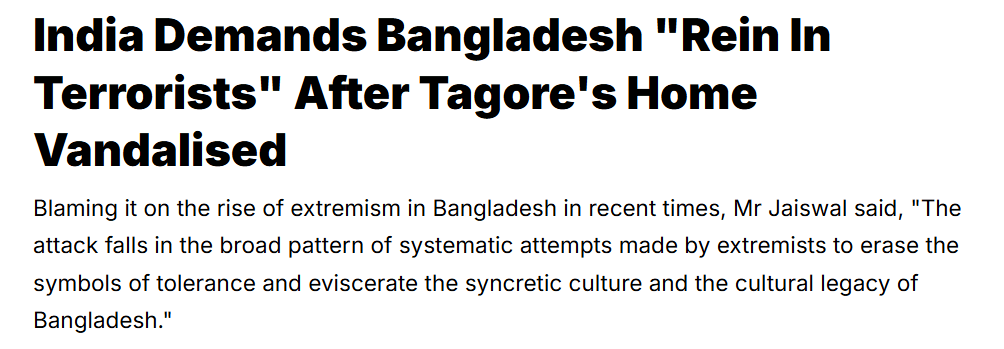
Tagore’s Home Vandalized in Bangladesh. News Source: NDTV
Truth be told, I was thinking while reading the book, how long would it take for the pro-Pakistan radicals in Bangladesh to go after anything related to Tagore, the Hindu writer of Bangladesh’s anthem “Amar Sonar Bangla” (My Golden Bengal), and then the vandalism of Tagore’s home happened. I wouldn’t be surprised if they replace the anthem, too, at some point in the future.
Jogendra Nath Mandal – The Dalit Leader Who Chose Pakistan
It’s from the book that I came across the name Jogendra Nath Mandal for the first time. He was a Dalit leader and a close associate of Dr. Ambedkar. At the time of Partition, Mandal chose to side with Pakistan, believing it would offer Dalits greater freedom and rights than a Hindu-majority India. He motivated many Dalits to migrate with him, promising an escape from caste oppression.
Mandal, the man who wanted Pakistan to become a land of Dalits and Muslims.
But what they found was a harsher reality. Regret followed soon after. Mandal eventually fled Pakistan and returned to India. Sadly, many Dalits who followed him to Pakistan lacked his privilege and means and were left behind. His popularity waned after that, and he died a lonely death in West Bengal. To quote the book:
Mandal had come to India from East Pakistan as a broken man. Arguably, the tallest Dalit politician in pre-partition East Bengal, Mandal had lost most of his followers after he chose Pakistan over India, stood with Muhammad Ali Jinnah and became the law and labour minister. Mandal had thought Dalits and Muslims would behave like brothers in the newly-created Pakistan. They didn’t, and as communal tension rose and Hindus left East Pakistan for India in large numbers, Jogendranath Mandal came to be looked at as a short-sighted leader at best and a self-serving politician at worst.
Dr. Ambedkar, upon learning about the persecution of Dalits in Pakistan, urged them to return to India. However, most were unable to leave, trapped by circumstances beyond their control.
I encourage everyone to read the following Reddit post that offers a more complete account of Jogendra Nath Mandal’s life. It includes his resignation letter to the Prime Minister of Pakistan and Dr. Ambedkar’s heartfelt appeal to Dalits living there.
Mandal’s story reminds us never to forget history or its lessons. These accounts were documented by key figures of that era for a reason. Not to be ignored, but to help us reflect, understand, learn, and avoid repeating the same mistakes in the future.
Quotable Quotes from Being Hindu in Bangladesh
‘Yes, only two people might have died in Noakhali in last year’s violence. But look around and you will find boys and men without an arm or a leg walking around. They will remind you of what was.’
What was it like in 1946? When freedom from 200 years of British rule was becoming a reality, Bengali-Hindu women and men, in village after village in Noakhali district of undivided Bengal, the same place where we now are, were r*ped and killed, or forcibly converted. Then too, it had started with fake news.
‘I have never been able to forget those days,’ she says, ‘when neighbours became rioters and friends became murderers. The stench of blood haunts me to this day.’
‘I remember he would come and tell us to make sure no one made any sound, and make sure that the children remained silent. It should appear from outside that the college building was deserted. Or else, a mob could come and kill us all. But my seven-month-old sister cried out in hunger. We gave her some treacle to make her stop crying, but she would start wailing soon after. My father told us that we had to kill her as she simply wouldn’t stop crying. And her wails would bring the mob to us. She cried and cried, till she cried no more.’
In other riots, religion was the point of disagreement. In Noakhali, religion was also the instrument that ended the disagreement. The attacks in Noakhali on Hindus by Muslims ended when the Hindus became Muslims.
‘But it’s a mistake that all democratic governments make in trying to control one set of extremists. They often play with the other set that looks less worse than the other (but) in the course of time, they all become Frankensteins’ he said.
There’s something about discovering forgotten buildings where powerful men once lived, touring villages where they spent their boyhood. It is like sifting through dog-eared, yellowed pages of history. So much of what once was still hangs in the air. So many stories are kept alive by village elders who saw history take shape.
Conclusion
The book details several atrocities that are too graphic to include in this blog post. I strongly encourage everyone to read Being Hindu in Bangladesh for a clearer and unbiased understanding of the condition of Hindus in the country.
The 2023 report “Anti-Hindu Hate in Schools” by Charlotte Littlewood highlights a critical but under-researched issue: the presence of anti-Hindu sentiment in UK schools.
While this blog post draws upon insights from the report, the broader focus is on Hinduphobia as a global phenomenon – what it means, how it manifests, and the constructive steps that are being taken to address its rise.
The full report can be accessed here: henryjacksonsociety.org/wp-content/uploads/2023/04/HJS-Anti-Hindu-Hate-in-Schools-Briefing-final.pdf
The urgency to examine Hinduphobia stems from the way Hinduism is being misunderstood or misrepresented in Western societies. Many people, lacking a nuanced understanding of the religion, make casual remarks that are often bigoted in nature. They may be considered harmless or culturally acceptable in Western contexts.
This gap in awareness often results in prejudices being normalized, with little accountability or recognition of the harm caused.
What is Hinduphobia?
Hinduphobia is not a term widely recognized in mainstream discourse. In my view, “anti-Hindu bigotry” is a more accurate description, as the issue is not rooted in fear, but in prejudice, hostility, and a lack of understanding. It often stems from the fact that Hinduism operates differently from Abrahamic religious frameworks. This unfamiliarity can lead to stereotyping, dismissal, or open hostility, rather than genuine inquiry or respect.
As per the study, the working definition of Hinduphobia is as follows:
Hinduphobia is a set of antagonistic, destructive, and derogatory attitudes and behaviours towards Sanatana Dharma (Hinduism) and Hindus that may manifest as prejudice, fear, or hatred.
Hinduphobic rhetoric reduces the entirety of Sanatana Dharma to a rigid, oppressive, and regressive tradition. This discourse actively erases and denies the persecution of Hindus while disproportionately painting Hindus as violent. These stereotypes are used to justify the dissolution, external reformation, and demonization of the range of indigenous Indic knowledge traditions known as Sanatana Dharma.
The complete range of Hinduphobic acts extends from microaggressions to genocide. Hinduphobic projects include the destruction and desecration of Hindu sacred spaces; aggressive and forced proselytization of Hindu populations; targeted violence towards Hindu people, community institutions, and organizations; and ethnic cleansing and genocide.
Examples of Hinduphobia
The study lays out several examples that can be identified as Hinduphobia, many of which occur casually in everyday settings. These instances often go unnoticed or unchallenged, largely because Hinduphobia is not yet treated as a serious form of bigotry.
Calling for, encouraging, or justifying violence against Hindus, often rooted in extremist or distorted views of religion and history.
Kidnapping Hindu women and children for forced marriage and religious conversion.
Denying, downplaying, or accusing Hindus of fabricating their persecution, including instances of genocide.
Advocating for the destruction of Hinduism, framing it as inherently irredeemable.
Discrediting individuals who speak about Hinduphobia by labeling them as agents of violent or oppressive ideologies.
Attributing all social issues in Indian society, such as caste, misogyny, sati, communal violence, or temple destruction, solely to Hinduism.
Evoking historical trauma (e.g., iconoclasm, cow slaughter, forced conversions) to intimidate Hindus in modern discourse.
Making baseless claims about the political motives of those simply practicing Hinduism.
Linking antisocial behavior directly to Hinduism, often by selectively sampling data or falsely attributing individual actions to the faith as a whole.
Caricaturing Hindu scriptures through selective citation, mistranslation, or exaggeration, and presenting these distortions as representative of the entire tradition.
Claiming that Hinduism or Sanatana Dharma is not a valid or cohesive spiritual system.
Erasing Hindu civilizational contributions and superimposing Western norms over its historical and cultural identity.
Conflating diasporic Hindu identity with Indian citizenship, nationalism, or ethnicity.
As per my own observation, a contributing factor is the lens through which Hindus are viewed. The bigotry is shaped by the globalized “oppressor vs. oppressed” narrative, often based on selective or misunderstood portrayals of India. As a result, anti-Hindu activities at home or anywhere else are often seen as justified acts of revenge, grounded in the belief that “Hindus in India are oppressing minorities.” A quick look at social media during incidents involving anti-Hindu sentiments offers clear evidence of this bias.
Reactions often downplay or dismiss the issue, and in many cases, even justify the hatred by invoking political narratives, rather than addressing the prejudice for what it is.
Context and Need of the Study
The context and need for the study on rising Hinduphobia in UK schools are explained as follows:
“Hinduism is the third largest religion in the UK making up 1.7% of the population according to the most recent census. From 4 to 20 September 2022, there was civil unrest in Leicester, extending to Birmingham, including vandalism of property, assaults, stabbings, and attacks on places of worship.
The Henry Jackson Society briefing paper, “Hindu-Muslim civil unrest in Leicester: Hindutva and the creation of a false narrative,” evidenced community tensions relating to youth violence and noise control issues in relation to festivals that had been falsely dressed as “Hindutva extremism” and even “Hindu terrorism”, creating fear and resulting in attacks on Hindu temples and properties.
The Network Contagion Research Institute (NCRI) investigated the role social media played in the civil unrest. It concluded that social media narratives have characterised “a vulnerable, diasporic community – British Hindus – as an aggressive, hypernationalist, and fascist threat. Other narratives depicted Leicester Hindus as heretically evil and filthy, playing on age-old Hinduphobic tropes.”
Both the HJS report and the NCRI report noted the use of anti-Hindu slurs such as “cow piss drinkers” and references to polytheism, vegetarianism, physical weakness and mocking of Hindu deities and symbols.
When researchers began examining the unrest between Hindu and Muslim communities in Leicester, they encountered a notable gap: a lack of existing studies on anti-Hindu hate. This absence of research was one of the key motivations behind conducting a dedicated study on the subject.
The report also highlights how Hinduphobia has historically appeared in popular literature and academic discourse. For instance, E. M. Forster’s 1924 novel A Passage to India is cited as portraying Hindus as “perverted,” “clownish,” and “queer.”
Similarly, sociologist Max Weber viewed Hinduism as excessively otherworldly, a perception that contributed to the broader “theological othering” of Hindus. This form of othering continues today in the form of anti-Hindu slurs that mock the religion’s many deities and unique customs.
Another example comes from Allen Greenberger’s 1969 study on Indian stereotypes, where he described common portrayals of Indians as a “childlike race” who were “happy in their passivity, fatalistically so.”
Such characterizations may still influence how the media interprets Hindu behavior and presence. For instance, during and after the Leicester unrest, the press in the UK was criticized for failing to engage with the local Hindu community, instead relying on self-identified Muslim spokespersons who reportedly spread false narratives about Hindus in Leicester.
Moreover, rather than addressing the specific complexities on the ground, mainstream media coverage often diverted attention to political issues in India, as though those could explain or justify tensions in the UK. This approach not only homogenizes Hindus globally but also dismisses their individual and community experiences in diverse contexts like Leicester.
Abrahamic Othering
An interesting terminology used in the report was “Abrahamic Othering.”
The term ‘Hinduism’ was coined by British writers to refer to the family of Vedic religious traditions. Some modern Hindus prefer the name ‘Vedic religion’ or ‘Sanatana Dharma’ (‘eternal law’) rather than the label ‘Hinduism’.
Hinduism has multiple deities understood to be expressions of one ultimate Reality, be it God for theists or consciousness for monists. Hinduism does not follow one scripture but a number of scriptures that are given different emphases by different branches of the faith. Some argue the differences in the denominations are so great that they are separate religions entirely.
The preconceptions of Abrahamic faiths do not map neatly onto Hindu belief. Articulating Hinduism through the Abrahamic lens of Gods and scriptures is therefore problematic.
Respondents to this survey suggested that at least some UK schools continue to teach Hinduism through an Abrahamic lens without appreciating the limits of this approach. This fits with the findings and concerns of the Commission on Religious Education. Given the decentralised nature of religious curriculums in England and the lack of subject inspections in maintained schools, and given the considerable challenge of treating Hinduism sensitively in a UK context, such a finding is disappointing but unsurprising.
There are reports from some surveyed parents that lessons about Hinduism produce confusion and misconceptions about the Hindu belief in the existence of multiple Gods – 106 references were made to inaccurate perceptions of Hinduism with respect to polytheism/idol worship/multiple Gods.
Discrimination Against Hindus in UK Classrooms
Some of the discrimination observed in UK classrooms mirrored the forms of hate witnessed during the Leicester unrest between Hindu and Muslim communities.
In both settings, derogatory remarks were directed at Hindu identity and practices, including mockery of vegetarianism and the belittling of Hindu deities. These same types of insults were used by Islamist extremists during the rallies targeting the Hindu community in Leicester, highlighting a disturbing continuity between localized classroom prejudice and broader communal tensions.
Conclusion Based on Case Studies
Many case studies were conducted as part of the research, and based on these, the following conclusion was drawn:
This report highlights the prevalence of discrimination against Hindus in British schools, with 51% of Hindu parents surveyed reporting that their child has suffered anti-Hindu hate at school.
It is alarming that it is so hard to access information from schools on patterns of religiously-motivated bullying, and that the schools who did respond to this study’s FOI request either did not keep records of faith-based hate incidents or appeared to record very few incidents.
It is also alarming that only 19% of parents surveyed believe schools are able to identify anti-Hindu hate, indicating that the issue is not being addressed adequately. It may be that there is a tendency to downplay such incidents as ‘playground banter’.
However, several studies have observed that faith-based bullying has the potential to be more impactful than other forms of bullying, precisely because it targets not just the victim, but “their entire family, heritage, and culture”.
Schools should reflect on the harm such slurs cause, as well as the wider community divisions they may be helping to foster.
Constructive Steps
Small but significant steps are being taken to address Hinduphobia in Western nations.
Georgia recently became the first U.S. state to introduce a bill formally recognizing Hinduphobia and anti-Hindu bigotry. Similarly, the Scottish Parliament passed its first-ever motion to combat Hinduphobia, marking an important milestone in acknowledging the issue. The motion was influenced by a report on Hinduphobia in Scotland, which can be accessed here: nen.press/2025/02/28/gandhian-peace-society-shares-new-report.
These developments are a positive step toward challenging anti-Hindu bias and promoting awareness that, like all faiths, Hinduism, or Sanatan Dharma, deserves equal respect and protection from discrimination.
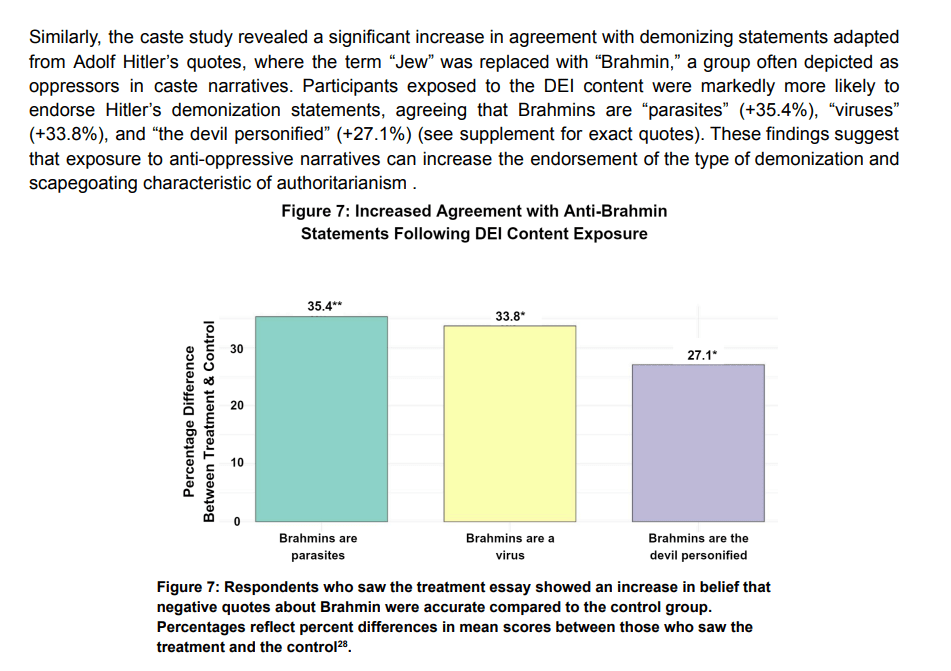
The following snippet is from a DEI study by the Network Contagion Research Institute (NCRI) in the U.S. The diversity, equity, and inclusion (DEI) program, originally meant to raise awareness, appears to have backfired in some areas. By framing everything through an “oppressor vs. oppressed” lens, it has ended up vilifying the Hindu Brahmin community, similar to the Jewish community.
While DEI narratives often focus on Islamophobia and racial discrimination, caste-based bias among American Hindus has largely remained outside the spotlight. Though widely recognized in India, caste discrimination has only recently started gaining attention in the U.S., leading to the introduction of caste-sensitivity training in schools, workplaces, and policy discussions. But did they have the desired effect? Studies show otherwise.
The vilification of Brahmins began in India, where they are often targeted for everything, from their dietary habits to their lifestyle choices. What should have remained a focused activism against caste discrimination has unfortunately expanded into a broader mockery of the community as a whole. Even Brahmins who reject caste-based thinking are not spared.
Like anyone else, a Brahmin does not choose the caste they are born into. So, isn’t attacking them solely for their birth also a form of casteism? Every community should be open to critique for its flaws, but no one should be dehumanized for simply existing.
Awareness is important, but this study shows that excessive activism can cross a line and end up vilifying an entire community. In the findings, respondents described Brahmins as “parasites,” “viruses,” and “the devil personified.” How is that fair, or even acceptable, in the name of social justice?



 The Monkey Dilemma
You must be logged in to post a comment.