
The Butcher of Bosnia and the Illusion of Threat

Butcher of Bosnia Image

I came across a news report about thousands of people attending the funeral of the man referred to as the “Butcher of Bosnia.” His name is Ratko Mladić. The report said that he was convicted of genocide for his role in the killing of more than 8000 mostly Muslim Bosniak men and boys in Srebrenica, Bosnia and Herzegovina. He died in prison at the age of 84 in August this year.

I was totally taken aback by this information and I had to look into why such a controversial figure is being considered a hero by many. I found that his supporters remember him as a military commander who defended their community against what they saw as “perceived threats” from Bosniak Muslims during the Bosnian War, which began in 1992.

I can’t help but notice a pattern here: violence is often justified nowadays by this very “perceived threat” – the belief that another community poses a threat to our existence, religion, culture, or way of life. Maybe this pattern has always been there, or maybe social media has simply made these attitudes much more visible.

Let’s take a look at some examples.

Israel’s ongoing conflict with Palestinians is framed by supporters of Israel around threats to its existence, while Palestinians and their supporters describe the consequences in terms of occupation, displacement, and violence against civilians.

Hitler is also being glorified on TikTok today, with his actions being presented through the deeply disturbing logic that he “helped eradicate” a community, Jews, whom they view as a threat to the world.

Afzal Guru and Ajmal Kasab are considered heroes by many because their actions are framed as acts of resistance against perceived threats or justified through a particular political narrative.

Savarkar is hated by many, even more strongly than some historical figures associated with mass violence, but he is also considered a hero by many who believe Hinduism and Hindu identity have been under threat.

I remember feeling absolute dread (a feeling of threat) when thousands attended Yakub Memon’s funeral in Mumbai.

And that is what makes this whole subject so uncomfortable.

Mourning, glorifying, or defending people who have done questionable things simply because they supposedly acted against “perceived threats to our existence” is becoming mainstream.

Closer to home, Hindus have attacked minorities in India because they believe their religion or cultural identity is under threat.

Christians in places like Tamil Nadu have also staged protests when public spaces in their area are used for festivals associated with other religions, with some viewing this as a threat to their own religious identity or traditions.

Then there are Kashmiri Pandits, who are being portrayed as a threat to the “culture” or “religion” of the land even when they are simply celebrating their festivals in a place with which they have a deep historical connection.

The circumstances are obviously different. But the underlying psychology is worth examining.

Once we convince ourselves that another community is an existential threat, almost anything can start being rationalised in the name of protecting our own.

And that leaves me wondering: who is going to do what next in the name of a “perceived threat”?

No community is completely free from this tendency, and no community can automatically claim moral superiority. Across religions, nationalities, ethnic groups, and political movements, people have at different points convinced themselves that their identity, culture, religion, or very existence is under threat.

Once “they are a threat” starts gaining ground, the question is no longer simply who is right or wrong. The question becomes how far people are willing to go to bring down or harm the people they have decided are the threat.
The Truth Behind Why Bail Was Denied to Umar Khalid and Sharjeel Imam

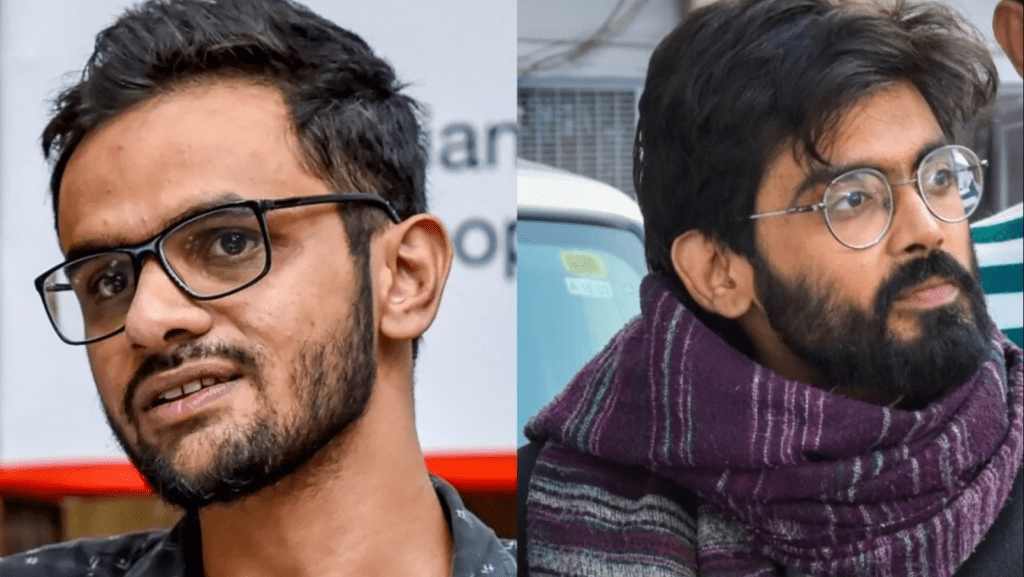
Umar Khalid and Sharjeel Imam Photo

With the Umar Khalid and Sharjeel Imam cases once again drawing global attention, especially after Umar Khalid’s father met US politician Zohran Mamdani, it’s the right time to scrutinize why the Supreme Court rejected bail pleas for both activists. The issue has sparked renewed discussion around India’s anti-terror law, the UAPA, and how it is applied in high-profile cases.

In the age of social media, misinformation often travels across the world long before the truth gets its moment. That makes it all the more important to examine each argument carefully and understand the reasoning behind the court’s responses. We are living in a time where selective fact-checking is common, misinformation is circulated to serve political agendas, and inconvenient truths are pushed out of sight. From what I have seen, some of the material relevant to this case has still not reached the wider public because it is rarely covered by mainstream media. As a result, distrust continues to linger.

Of course, for some people, no amount of truth really matters. What they seek is validation for their existing biases or political leanings. This post is not meant for that audience. No amount of proof can change such a mindset. It is written for readers willing to acknowledge facts when presented.

Getting back to the case, according to the prosecution, Umar Khalid and Sharjeel Imam were not just participants but masterminds who mobilised or influenced others during the events in question. The defence, however, put forward two key arguments while seeking their release on bail. Let’s take a closer look at what those arguments were and why the court chose not to accept them.

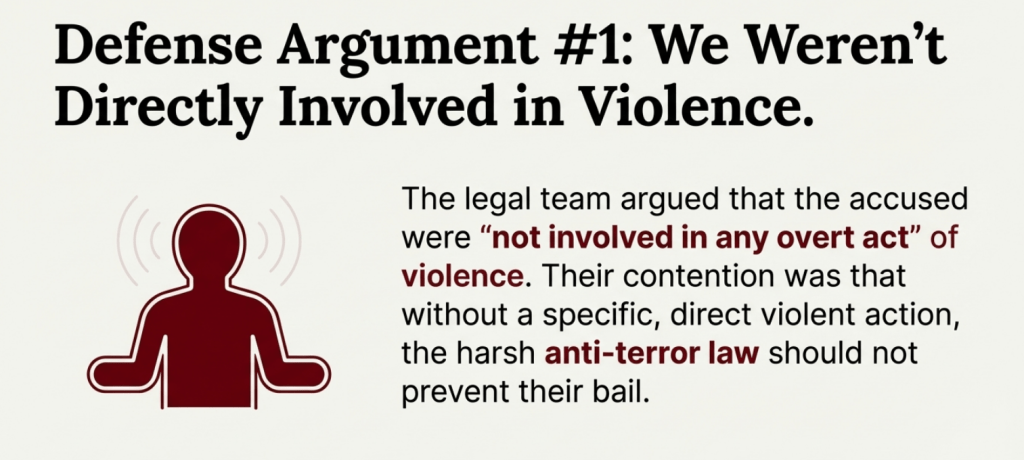
Defense Argument #1:
Not Directly Involved in Violence

Sharjeel Imam Umar Khalid Bail Defense Argument #1 Photo

One of the most repeated arguments, especially in Umar Khalid’s case, is that he was not present at the riot spots when the violence took place.

Court Response

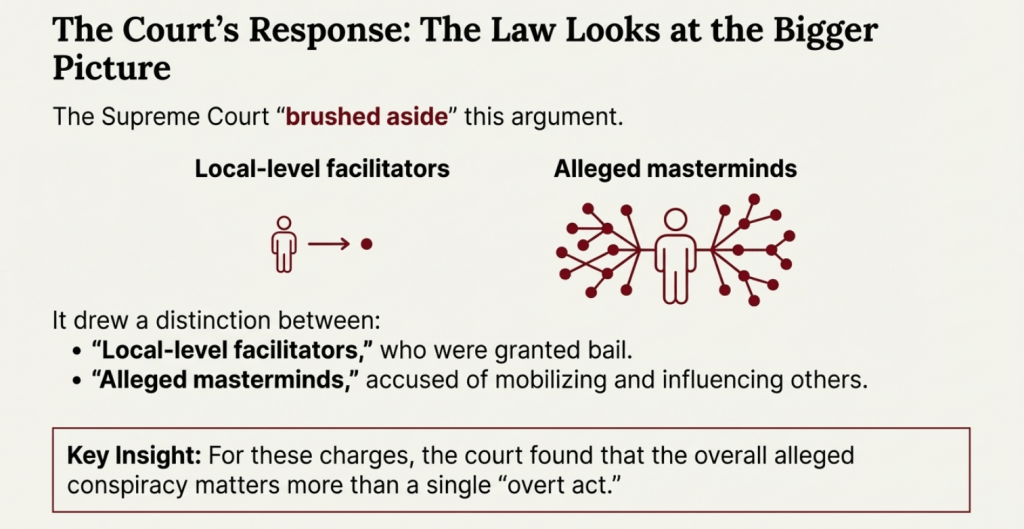
The court indicated that the act of masterminding the riots, even without direct presence, was in itself sufficient. The court’s position was clear and firm: nothing comes above the interests of national security. On a prima facie assessment of the material placed before it, which includes videos, audios, posts, and messages, the court held that both Umar Khalid and Sharjeel Imam faced similar allegations of being the masterminds, which weighed heavily against granting bail. Due to their involvement in the larger plan, several people were killed and injured, including an intelligence officer.

Sharjeel Imam Umar Khalid Bail Defense Argument #1 Court Response Photo

It should be noted that provocative words alone can be enough to incite violence. This is not something new. Something similar was seen even before the Gujarat riots, where RSS members were found to have mobilised people through provocative speeches. Many who provoked never participated in the violence, but their words were enough. They were taken into custody and remained there for years.

This raises an important question: what makes those cases different from the cases of Sharjeel Imam and Umar Khalid, so that the latter deserves bail? Both instances were the same: provocative speeches leading to mass mobilization. The 2020 Delhi riots too had a communal angle, with tensions between different communities being stirred during the violence. Videos of the provocative communal speeches are available widely on X. WhatsApp groups were formed along religious lines, which added to the sense of division at the time.

Rather than relying on political influencers or commentators, I recommend reading the official case files to understand the facts as presented in court. You can find these by searching Google with terms like “Delhi NCT Sharjeel Imam pdf” and then looking within the document for specific details.

Often, religion is used as a tool to strengthen or manipulate one’s case, and that appears to have happened here as well. As someone who has gone through the provocative videos and social media posts of the two, it is difficult to see them as innocent. I cannot quote or reproduce those statements here because of their sensitive nature, but they are publicly available and can be found on social media platforms like X by searching their names.

Sharjeel Imam’s Facebook account is still active, while Umar Khalid has deleted his. I would recommend going through Sharjeel’s Facebook posts to see for yourself how passionately he tried to convince people to hit the streets. Some posts had a communal dimension as well. The content includes rhetoric that can be interpreted as calls for violence and even secession, which adds serious weight to the charges against them.

Defense Argument #2:
The Trial Delay

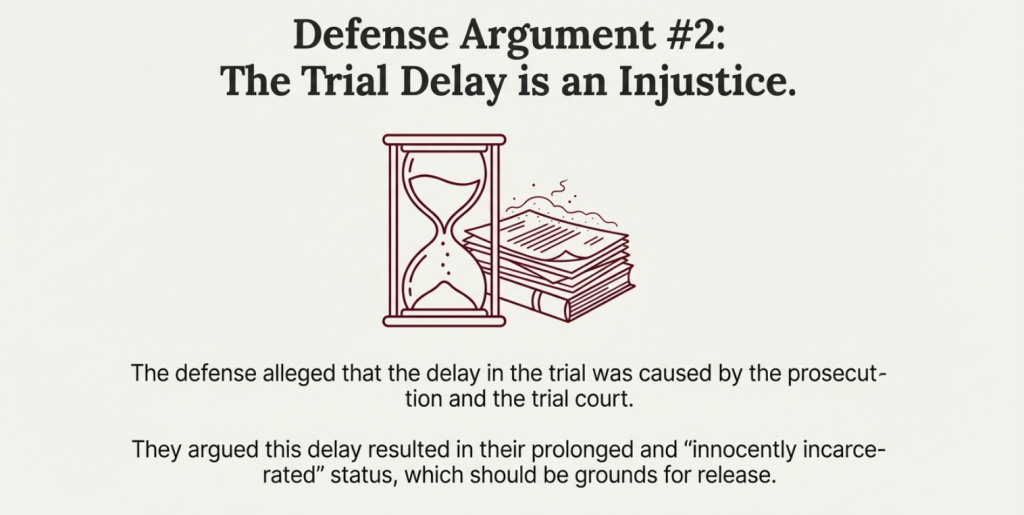
One more argument that often comes up is the long delay in the trials of Sharjeel Imam and Umar Khalid.

Sharjeel Imam Umar Khalid Bail Defense Argument #2 Photo

Court Response

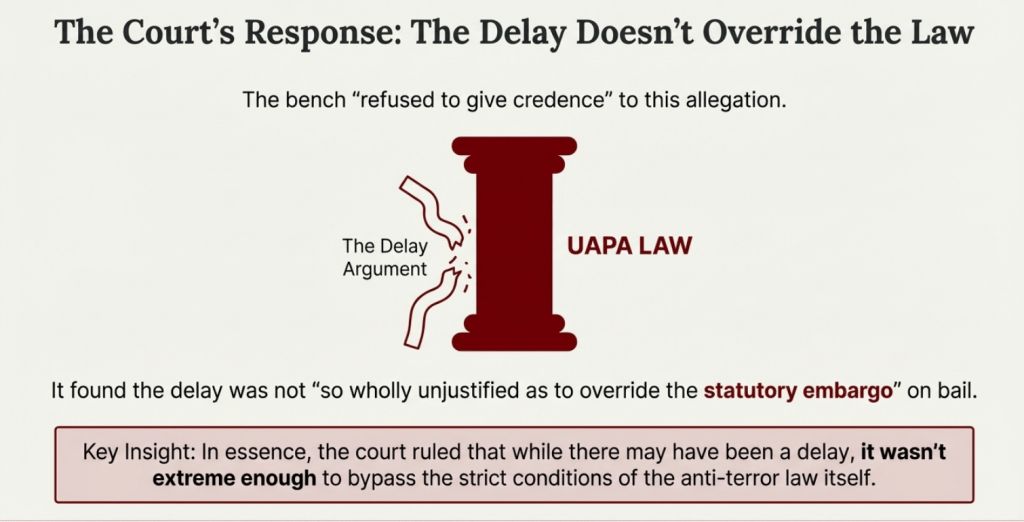
The court maintained that a delay in the trial does not dilute the gravity of the case.

Also Read: CJI’s Remarks on Umar Khalid’s Trial Delays

Sharjeel Imam Umar Khalid Bail Defense Argument #1 Court Response Photo

The Final Verdict

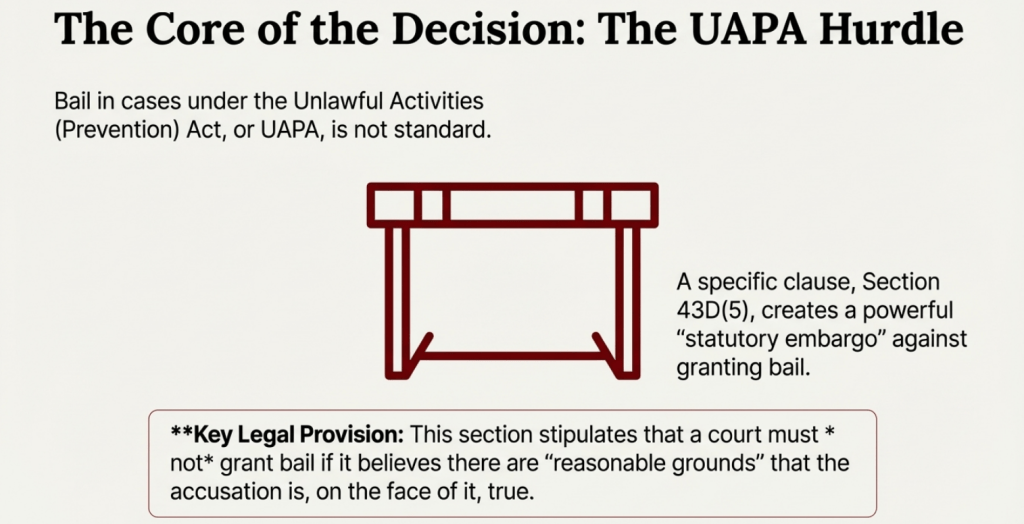
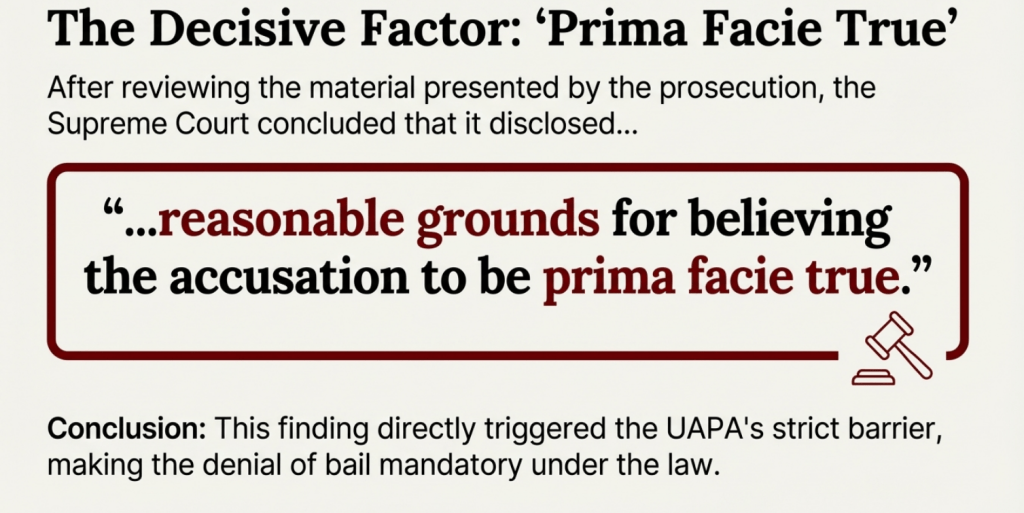
The court observed that the polarising material appeared prima facie true, and this played a key role in denying bail to them as alleged masterminds.

Sharjeel Imam Umar Khalid Bail Rejection Decision Image
Sharjeel Imam Umar Khalid Proof Prima Facie True Image

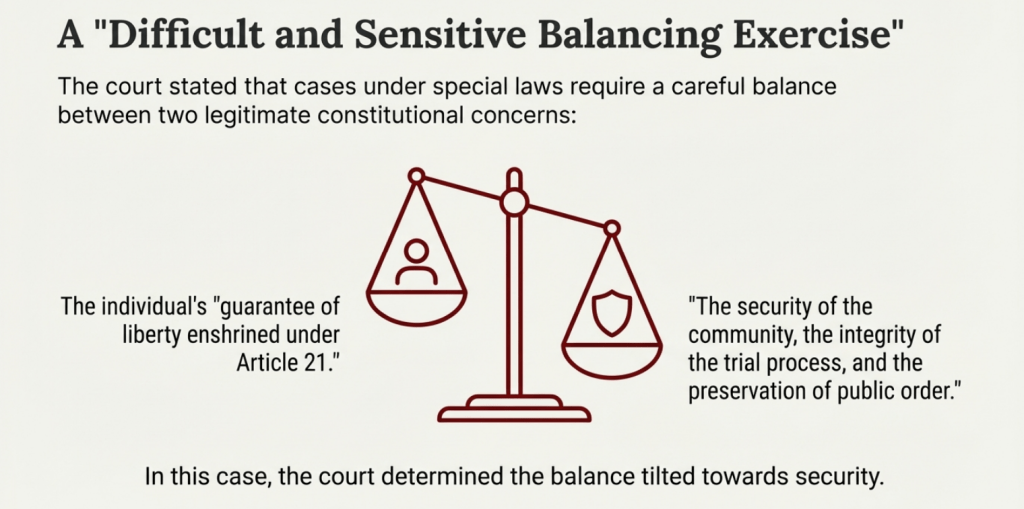
The court admitted that balancing individual rights with the nation’s security is never an easy task.

Sharjeel Imam Umar Khalid Bail Is a Difficult and Sensitive Balancing Exercise Image
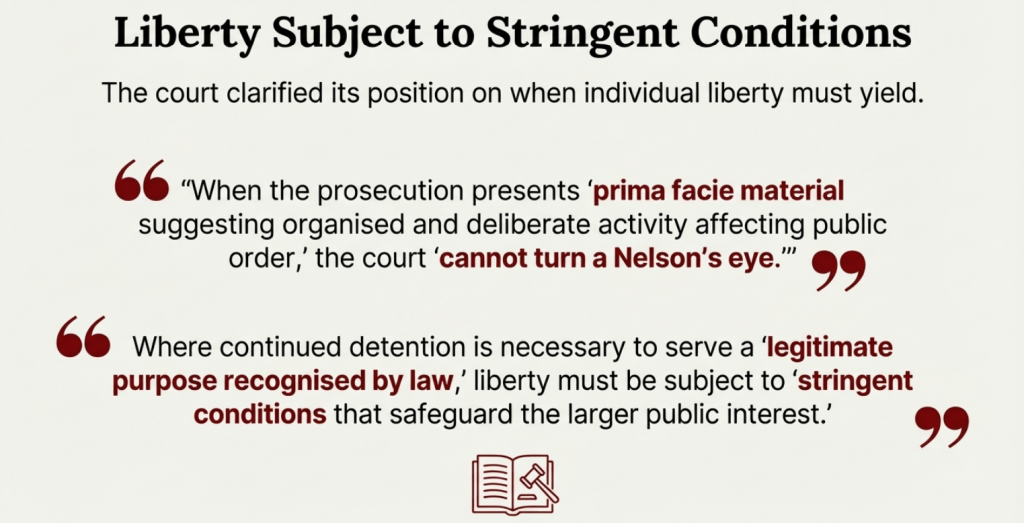
Sharjeel Imam Umar Khalid Liberty Subject to Stringent Conditions Image
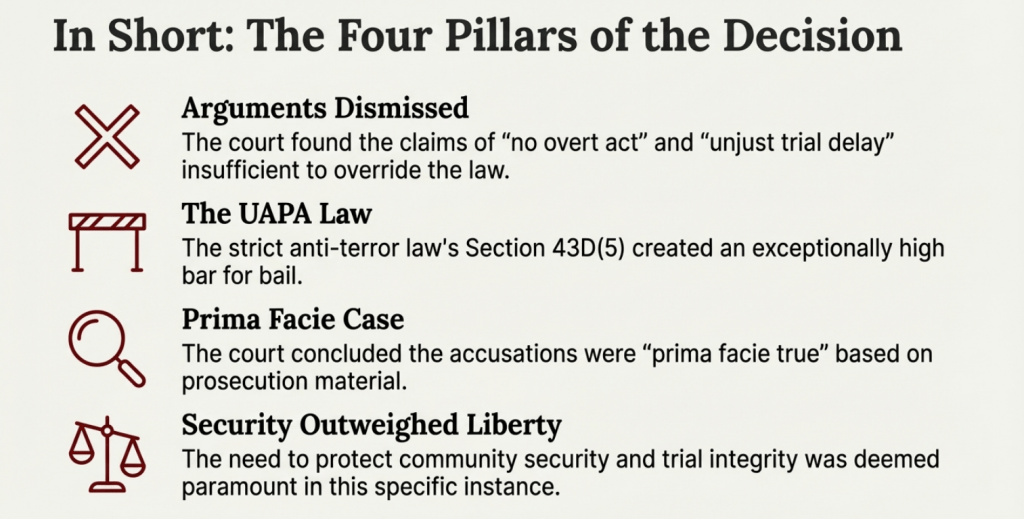
Sharjeel Imam Umar Khalid Bail Rejection Summary Image

Umar Khalid and Sharjeel Imam were not denied bail because of unfairness or a failure of the legal system. Their bail was rejected because the court found the material presented before it to be valid and credible.

However, unless this material, such as videos or posts, is made available for public viewing in a structured and responsible manner, many people will continue to believe that the legal system itself is fractured. Since I have seen the provocative videos and social media posts and gone through the case details, I do not doubt the court’s reasoning.

But the lack of transparency leaves room for misunderstanding. It also creates space for political parties and interest groups to selectively present facts and shape narratives for their own benefit. Should there not be a mechanism to clearly explain why and how such decisions are taken, along with supporting material, so that the ordinary citizen does not have to rely on fragments found on their own?

Netflix Movie Spotlight: Baramulla

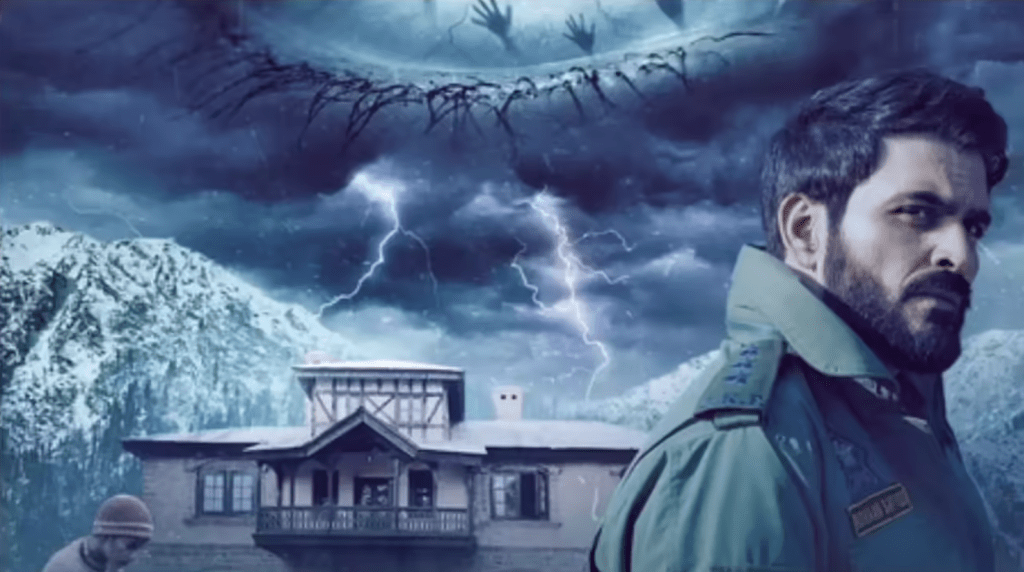
Baramulla Movie Poster

What defines horror? We often think of ghosts, possessed souls, or strange creatures with no clear form. Yet I realized there’s another type of horror that hits harder. The ones that combine these supernatural ideas with the harsh truths of real life. This is a type of blend that creates an impact, which stays with you long after the movie is over. This is where Baramulla is about.

What’s It About?

Baramulla opens with a policeman who moves to Kashmir and stays in an old house filled with secrets. He is there to investigate the disappearance of children in the area. Strange events start to unfold at once. The elder daughter senses a foul, “dog-like” smell in the house, even if there are no dogs. The caretaker carries a plate of food every day to a locked room. What lies behind these mysteries? Why are children vanishing? These questions drive the heart of the story.

Thoughts

I can’t, unfortunately, share everything I felt without giving away the main plot. Since I wanted to share my thoughts in full, I placed them in a separate “Spoilers Ahead” block after this section. You can skip it if you prefer to avoid spoilers.

Baramulla left me with many emotions. I was genuinely amazed by how the team crafted it.

The movie tries something that Indian cinema, to my knowledge, hasn’t attempted before in a horror movie. That is, blending the past and the present into a story that’s rooted in historical events. It reminds you that horror has layers. It’s not only about the unknown, but also the known. The horror of trust turning into betrayal. The horror of being dismissed or gaslit. The horror of violence, both mental and physical. Baramulla captures all of this with sharp clarity.

The performances are strong across the board. Personally, I would say it’s a must-watch.

Baramulla is now streaming on Netflix.

**Spoilers Ahead**

I felt emotional through many scenes. The acting was powerful and honest. The pain never felt exaggerated.

By now, you probably know that the film draws from the suffering Kashmiri Hindus faced in the late ’80s and ’90s. Many cast members are Kashmiri Hindus who had to flee their homes. Manav Kaul is one of them. He left Kashmir when he was in grade 4. He moved on to become a competitive swimmer in his late teenage years and participated in state and national-level championships. He has more than 14 national medals in swimming to his credit.

The end scenes also show Sanjay Suri, which is befitting, since his father was killed by terrorists in Srinagar when Suri was just 19. He moved to Delhi after that and became a known face in the film industry.

The producer and writer, Aditya Dhar, who is also Yami Gautam’s husband, is a Kashmiri Pandit. He has been using his craft to share Kashmir’s story with care and technical prowess.

Some Kashmiri Pandit celebrities, like Kunal Khemu, have chosen not to explore their past, and that is their personal choice. In an interview with Smita Prakash, he said he doesn’t know much about that period, even though his own family lived through it.

I feel it’s important for us to understand our history so we don’t repeat old mistakes. Stories like these should be passed from one generation to the next. My only regret is not asking my grandfather about his experiences—how Kerala felt during the Indian freedom struggle, and what life was like then. Those anecdotes have been lost forever, as he did not pass on the stories to his children as well.

It’s remarkable that so many Kashmiri Hindus who had to flee the valley are using art to express their experiences instead of resorting to violence. Their goal is empathy and understanding, something they were denied for a long time, not provocation. Choosing storytelling over violence is admirable, especially in a world where violence is often justified in the name of resistance.

There are also a few Kashmiri Hindus with left-leaning views who defend problematic groups and take part in “Free Kashmir” sloganeering, similar to how a very small number of non-Zionist Israelis speak in ways that don’t reflect the wider population.

Most Kashmiri Hindus (and some Kashmiri Muslims) have appreciated the movie. However, left-leaning Hindus are also criticizing the movie for “propaganda,” even though the events have been well documented. Films that depict and educate the viewers on crimes against Muslims in India are welcomed, while films showing crimes against Hindus are often dismissed as Islamophobic, nationalist, or propaganda. This imbalance is where many activists struggle. They accept one truth but not the other.

People like me have slowly stepped out of that mindset to face the whole truth.

It may take a while, but I really believe the truth will eventually reach wider acceptance sooner or later. And the stories can’t stop until the pain is finally acknowledged. They need to be told, retold, and carried forward. Only then will they finally find the place they deserve.

From 26/11 to Delhi Blasts: Why the “False Flag” Narrative Must End in India

What surprises me more than the terror attacks in India is the speed with which some Indians dismiss them as “false flag operations.” For instance, a look at the comments under Faye D’Souza’s Instagram post about the Delhi terror blasts shows several users mocking the incident and blaming the Indian government instead of the perpetrators. Many genuinely seem to believe it’s a political ploy to influence votes rather than an act of terror.

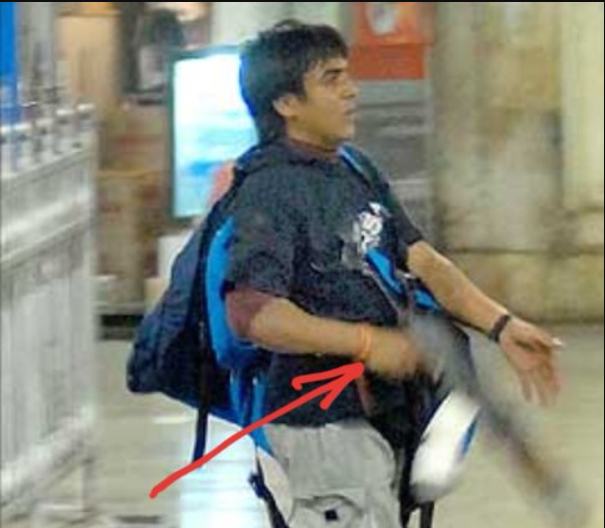
The “false flag” narrative isn’t new. It has surfaced after nearly every major terror attack in India. Even the 26/11 Mumbai attacks were, at first, misrepresented by some as an internal operation. The claim gained attention mainly because Ajmal Kasab, one of the attackers, wore a saffron thread on his wrist. Those spreading the theory strangely assumed such a thread could only belong to members of BJP or RSS. They overlooked the possibility that it might have been deliberately used to mislead investigators.

Ajmal Kasab with Saffron Thread on His Wrist

Kasab’s real plan, as later revealed, was to die appearing as a “Hindu” and thus shift suspicion away from Pakistan-based handlers, reinforcing the myth of “saffron terror.” Thankfully, due to the extraordinary courage and sacrifice of Assistant Sub-Inspector Tukaram Omble, Kasab was captured alive and later confessed to being a Pakistani national trained by terrorists.

Tukaram Omble and Mumbai 26/11 Attacks
Tukaram Omble

By then, however, the false-flag theory had already gained widespread circulation. Well-known public figures even released a book titled 26/11: RSS ki Saazish? that promoted the “false flag” theory surrounding the attacks.

Influential Figures Promoting RSS ki Saazish Book
Influential Indian Figures Promoting “26/11: RSS ki Saazish?” Book

The “false flag” narrative resurfaced after the Pulwama terror attack, when a suicide bomber from Jaish-e-Mohammed (JeM) drove an explosive-laden vehicle into a CRPF convoy in Pulwama, Jammu & Kashmir, killing 40 soldiers. Following the attack, some voices in Pakistan, including senior officials, suggested that India might have staged the incident to influence the upcoming 2019 elections. Commentators in India echoed similar theories online, framing the tragedy as politically motivated rather than acknowledging it as an act of cross-border terrorism.

Then came the recent Pahalgam attacks, where Pakistani media outlets and online commentators claimed that India had staged the incident to divert attention from domestic issues and influence elections. They described it as part of an alleged “Indian playbook” of false-flag operations. Soon after, similar talking points appeared in sections of Indian social media and commentary spaces.

In each case, claims of “false flag operations” lacked credible evidence and were primarily rooted in conspiracy theories first circulated in Pakistan and later amplified by certain opinion groups in India.

The Global “False Flag” Obsession

It’s worrying that many people in India tend to believe external narratives about terror attacks rather than trusting verified investigations at home.

This pattern might have been up for serious debate if it only happened locally, but the deflection from religious extremism appears to be a global trend. To cite a few examples:

  • The 9/11 attacks are still viewed by some as a “false flag” orchestrated by the U.S. or Israel to malign Muslims. This is a theory long disproved but still used by extremist groups to recruit followers. They thrive on anger, convincing vulnerable minds that violence is the only response to perceived oppression. In India, extremist recruiters have similarly exploited stories like the Babri Masjid while dismissing events like the Godhra train burning as conspiracies, weaving grievance into a tool for radicalization.
  • The October 7 attacks in Israel were also met with widespread conspiracy claims, framed as a false flag operation meant to discredit certain groups.
  • Likewise, criticism of regimes such as Iran’s leadership, the Taliban, or Hamas is often dismissed as Western propaganda. This is another form of deflection that prevents honest introspection.

Conspiracies Shield Extremists

It’s time to move past the overused “false flag” narrative.

Each time a terror attack is dismissed as a conspiracy, it insults the victims, weakens trust, and blurs the line between truth and propaganda. These baseless claims don’t protect anyone. They only embolden extremists and deepen divisions.

Real courage and national unity will come from confronting facts, condemning violence without bias, and demanding accountability from those who spread hate, no matter where it comes from.

Ending the false flag obsession is the first step toward restoring integrity in how we respond to terrorism.