An Ode to Surviving Performance Reviews by Demotivating Managers

Demotivating Manager

It is that demotivating season again.

I say demotivating because my last two performance reviews were negative. I might keep repeating “demotivating” throughout the article because that is how I feel right now.

So demotivated, dazed, confused, furious.

All because of one manager.

Somehow he has made up his mind to never encourage anyone. The only positive word I have ever seen come out of his mouth is “Good.” But he is ever ready to nullify that with 100 negatives.

The worrying part is many in my company feel that way.

2020 was the year I was most proud of myself. I learned things on my own. I built things from scratch. Got everything up and going with minimal errors after several hours of overtime. The least I expected was an “I appreciate your hard work.” An acknowledgement of what I have done.

But nothing came.

Don’t be that manager.

I am at my productive best when I am reporting to a good manager. I am at my worst when the manager is negative. This is true for many. We want to do our best, help the company reach the top when our work is valued.

Don’t get me wrong. I love constructive feedback. But not feedback that is laced only with negatives.

If you are a performance reviewer, here are some “How not to be a demotivating boss” tips:

  • Start the conversation in a light tone. A “Hi, how are you?” at the start never killed anyone. It gives the employee some time to breathe and relax. Remember, most employees get into a performance review with extreme anxiety. Help them out by being courteous and kind.
  • Start with the positives. And by positives, I do not mean just saying a single “Good.” Be descriptive. Tell them what you liked about their work. Use the same number of sentences that you would use while giving constructive criticism. 3 full sentences describing the negatives? Follow it up with 3 honest sentences about their positives. Balance it out.
  • Do not make the employee feel like they have done nothing for the company.
  • Ease into the negatives. Give some time for the employee to respond or tell you what’s on their mind. Don’t ramble non-stop. The moment you start the negatives is when you need to be the kindest. Frame negatives in a nice way, then stop and take a step back, wait for them to respond, ask if they have to anything to say. Be open-minded to listening to them.

You look around and you see many employees dissatisfied with their managers. Why is that? Because there is a huge communication gap. Any thoughts and reviews are left for the last moment i.e. during the performance review. Some companies like Microsoft, Accenture, Adobe and Deloitte have done away with annual performance reviews because of this reason alone.

The best way to give feedback is right after a task is completed. This helps them change their course if need be. Don’t wait till annual performance reviews – to throw unpleasant surprises.

I got a raise and a bonus. So it was not all bad. But all it takes is one person’s words to ruin the high you feel, right? Is that the price you pay for a salary?

By the end of it all, I told him “That was very demotivating.” Probably it was the first time he heard it from someone. Most employees prefer to ignore such bosses. My retort was followed by a one-minute silence. Of all the things I said this year, I am most proud of this one dialogue.

My manager then went on to give several excuses on how the intention was not to demotivate but to give feedback.

But feedback should be a mix of good and bad. Backed up with encouraging words on how you believe the employee can do what’s been suggested. If it is not, it is not feedback, it is being demotivational. As simple as that.

So I would like to say kudos to me for surviving yet another performance review with a demotivating manager. I expect more to come. And I plan to survive them all. By ranting here, and to my friends, and family, and anyone who would listen.

The day my boss says something nice, I will let you know. Stay tuned?

Leaving the company doesn’t make sense because as far as I know most of the people around have terrible bosses. I rather stick to one familiar demotivating one that becomes overbearing during performance review time rather than explore new ones.

If you are feeling demotivated too, rant! To someone.

That is what my colleagues and I do anyway.

One day, hopefully, all managers will learn how to give feedback constructively. Till then, the corporate servants will have to time and again, feel the extreme disappointment of not feeling valued by that one manager, who simply doesn’t know how to give a good performance review.

And I also hope one day we start earning enough passive income from our websites, investments and, other sources. So that we can run far away from everything that is, you guessed it, demotivational! Every corporate slave’s secret dream.

An Ode to Working for the Right Company (MNC or Startup)

Take a look at Twitter, and you will see never-ending debates on whether startups or MNCs are the best.

Having worked in both, here are my 2 cents.

MNCs or established, large companies might be the better option for you if you want:

  • Higher pay: Big companies are willing to pay the best of the best for talent
  • Better job security: They have been in the business for a longer time and are more stable
  • Well equipped work space: They have the money to invest in the best tools and resources needed for upgrading your work
  • Better perks: Health benefits, freebies

Cons:

  • Office politics: This was the worst part for me.
  • Feeling undervalued: There are a lot of employees, and it is practically impossible for the higher order to listen to everyone. Your opinions or inputs tend to be given less importance.
  • Not flexible: Most of the companies want you to stick to their rules. Employees are rarely consulted on what *they* want.

Startups or smaller companies might be the better option if you want:

  • More job satisfaction: The pride you feel when your company is growing is unmatched. You played a role in it, and that is a huge achievement.
  • Less office politics
  • A tightly-knit workspace where everyone is easily reachable including the CEO
  • A job where you are valued

Cons:

  • Lesser pay: Small companies can hardly compete with MNCs when it comes to offering the best pay package
  • High pressure: Lots of work, less work-life balance
  • Cash-strapped: Hardly any freebies; access only to those tools that are absolutely essential for your work

Of course, this does not apply to all the MNCs and Startups out there. Each one is different. But from my experience, this is what I have encountered.

Honestly, I feel everyone should try both at least once to see what it is like.

Then go the Marie Kondo way perhaps – choose the one that sparks joy.

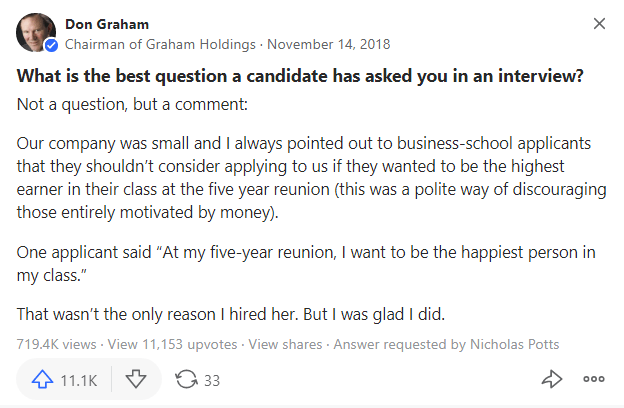
To finish this off, posting a snippet I saw on Quora. It made me smile.

Job Satisfaction

An Ode to Naval Ravikant’s Quotable Quotes

Naval Ravikant. Image Courtesy: Wikimedia Commons

It is only recently that I came to know about Naval Ravikant.

A popular Indian YouTuber was raving about him in a recent video of his. It led me to this highly popular twitter thread titled “How To Get Rich Without Getting Lucky” and the thought-provoking Joe Rogan episode. I was hooked.

Naval Ravikant is an entrepreneur and angel investor. He had invested in a number of popular startups in Silicon Valley early-on like Twitter and Uber. What makes him different from other businessmen is his thirst for knowledge beyond investing. He is a deep thinker who is intrigued about human psychology and can passionately discuss topics such as meditation, emotional health, happiness and peace. For him, it is not all about money, but he does not dismiss wealth. He believes in a good mix of both, which is refreshing, because we usually see influencers either scorning wealth or being too into it.

Naval Ravikant does not want to monetize his knowledge, because a) he’s already rich b) he says it defeats his purpose of altruism. This makes you want to trust him.

After going through many tweets of his (he is quite popular on Twitter), and the Joe Rogan video, I ended up downloading the free book called “The Almanack of Naval Ravikant” which is a compilation of his best advice and anecdotes.

Here are a few Naval Ravikant quotes that left a mark on me from the book:

Making money is not a thing you do – it’s a skill you learn.

Specific knowledge is found much more by pursuing your innate talents, your genuine curiosity, and your passion. It is not by going to school for whatever is the hottest job; it is not by going into whatever field investors say is the hottest.

The internet enables any niche interest, as long as you’re the best person at it to scale out. And the great news is because every human is different, everyone is the best at something – being themselves.

Escape people through authenticity. Basically, when you are competing with people, it is because you’re copying them. It is because you are trying to do the same thing. But every human being is different. Don’t copy.

The most important skill for getting rich is becoming a perpetual learner. You have to know how to learn anything you want to learn.

Compound interest also happens in your reputation. If you have a sterling reputation and you keep building it for decades upon decades, people will notice. Your reputation will literally end up being thousands or tens of thousands of times more valuable than somebody else who was very talented but is not keeping the compound interest in reputation going.

Knowledge only you know or only a small set of people knows is going to come out of your passions and your hobbies, oddly enough. If you have hobbies around your intellectual curiosity, you’re more likely to develop these passions.

We waste our time with short-term thinking and busywork. Warren Buffett spends a year deciding and a day acting. That act lasts decades.

Value your time at an hourly rate, and ruthlessly spend to save time at that rate. You will never be worth more than you think you’re worth.

Literally, being anti-wealth will prevent you from becoming wealthy, because you will not have the right mindset for it, you won’t have the right spirit, and you won’t be dealing with people on the right level.

The problem is, to win at a status game, you have to put somebody else down. That’s why you should avoid status games in your life—they make you into an angry, combative person. You’re always fighting to put other people down, to put yourself and the people you like up.

Retirement is when you stop sacrificing today for an imaginary tomorrow. When today is complete, in and of itself, you’re retired.

Money is not the root of all evil; there’s nothing evil about it. But the lust for money is bad. The lust for money is not bad in a social sense. It’s not bad in the sense of “you’re a bad person for lusting for money.” It’s bad for you. Lusting for money is bad for us because it is a bottomless pit. It will always occupy your mind. If you love money, and you make it, there’s never enough.

To the extent money buys freedom, it’s great. But to the extent it makes me less free, which it definitely does at some level as well, I don’t like it.

The most common bad advice I hear is: “You’re too young.” Most of history was built by young people. They just got credit when they were older. The only way to truly learn something is by doing it. Yes, listen to guidance. But don’t wait.

Let’s get you rich first. I’m very practical about it because, you know, Buddha was a prince. He started off really rich, then he got to go off in the woods.

It’s only after you’re bored you have the great ideas. It’s never going to be when you’re stressed, or busy, running around or rushed. Make the time.

The smaller the company, the more everyone feels like a principal. The less you feel like an agent, the better the job you’re going to do. The more closely you can tie someone’s compensation to the exact value they’re creating, the more you turn them into a principal, and the less you turn them into an agent.

An Ode to Learning Personal Finance On Your Own

Photo by Anna Nekrashevich on Pexels

I am no personal finance guru.

I am no millionaire. Far from it.

I am just another person hoping for financial freedom one day.

But since the last few years, I have been enjoying reading about personal finance, researching and then taking action. As mentioned in my previous post, I have no clue where this journey will take me, but it has been an enlightening one so far.

I must have been 10 or 11 when a friend’s father asked a question to a bunch of kids (including me) at a party – “How much of your salary should you save once you start earning?” I remember just staring back at him. I had no clue. To be fair, which 10-11 year old would? Our parents don’t usually ask us such things. He answered “20%” and since then that percentage has stuck in my mind, living rent-free, refusing to leave.

20%. I took this number with me. When I started working, it was the first thing I thought of. Makes me wonder – if only kids were taught personal finance at school. They would grow up to be better at managing money.

I am 36. There are times I wish I had started my journey on learning about personal finance a bit sooner. I try to comfort myself saying I did not have the resources I do now back then. Our resources were our parents, relatives, friends and all those people we regularly interacted with. In short, people who were not financial experts. My 20s and early half of my 30s were mostly spent in a bubble, thinking Fixed Deposits (FDs) are the way to go. When I started researching, all the info I got just blew my mind.

If you are in your 20s, this is the best time to learn about personal finance and invest because there are so many valuable free guides online. Plus, you have age on your side!

It was only recently, in the last couple of years, that I learnt saving your money alone is just not enough. You need to invest as well to create wealth.

Here are a couple of things I have learnt from my personal finance journey so far:

  • Read books, watch videos, listen to podcasts, read personal accounts on Quora and Reddit.
  • Diversify not just your investments, but your knowledge sources as well. Get your knowledge on personal finance in various formats. Don’t just stick to one.
  • Latch on to the things that the different sources keep repeating. I find these repeated pearls of wisdom are of more value and reliability than the things that do not get repeated.
  • Use social media to gain knowledge. Follow “Personal Finance”, “Investing” topics on Twitter. Related tweets will pop up on your feed. You will find some of the best personal (and honest) anecdotes and tips this way.
  • If you are on Instagram, search for personal finance pages/experts and follow them. Same for Facebook and any other social media platform.
  • Start investing in equity as early as you can.
  • Be patient with your investments. When I started off investing, the value of my portfolio went down considerably, but then picked up in 3 years. My emotions varied from “Did I make the right choice? Maybe I should exit.” when I first started off to “Why didn’t I start this sooner?” after 3 years.
  • Live below your means. I am trying not to increase my standard of living as my income increases. Instead, I am trying to increase my savings/investments.
  • 20% – always keep this percentage in mind.
  • Do not trust every advice you see on the Internet (including this post!) – do your own research, and customize your own personal finance itinerary depending on your risk profile. Whatever step you take, make sure you take it as soon as you can after doing a proper research.

An Ode to Saving

Photo by maitree rimthong on Pexels

An excerpt from a book I am reading right now called “A Random Walk Down Wall Street“:

Two suggestions have been made to overcome people’s reluctance to save. The first is to overcome inertia and status quo bias by changing the framing of the choice. We know that if we ask employees actively to sign up for a 401(k) savings plan, many will decline to join. But if the problem is framed differently, so that one must actively “opt out” of the savings plan, participation rates will be much greater. Corporations that frame their 401(k) savings plans with an automatic enrollment feature (where a conscious decision must be made to fill out an “opt out” declaration) have far higher participation rates than do plans where employees must actively “opt in” to the plan.

There is this aversion to saving because it leaves us with less money to spend. Even if it’s a small amount like say $1, most would prefer to spend rather than save it. It is a never ending cycle that doesn’t change even with an increase in income. This explains why many of us are bad at saving. We are just not ready to take that first step, no matter how small it is. Psychological techniques like the one quoted above are then needed to motivate people to save.

I learnt “why” it was so essential to save by observing the people around me. I grew up in a home where budgeting never happened. We lived in the moment. That along with inflation left my parents next to nothing at the time of retirement. It kind of motivated me to learn more about personal finance, budgeting and investing.

I now take a note of all my credits and debits. I save some, I invest some. I also started investing in index funds, something my family never did before. I have no idea how successful I will be in this “new” personal finance route that has not been traditionally followed by my family, but you never know unless you try. I am reading a lot, not just books that compliment my current outlook, but the ones that thrash it as well, so I can see both sides of the story. I have never learnt so much about personal finance as I have now.

Getting back to the topic, why are people so averse to saving?

  • We are conditioned to believe that thinking about money is bad, that only greedy people think about money etc. We are then less inclined to learn about managing money.
  • We are not thinking about inflation. Our purchasing power is decreasing. It isn’t the same as it was 10 years ago. Not many understand the seriousness of this, leading to lack of motivation to save.
  • We think the interest we earn from our savings account is enough to get us through. But if you take inflation into consideration, you will realize that the money you invest in Fixed Deposits and Savings Accounts are giving us negative returns! We are actually losing money investing in these instruments. This “all is good” bubble that people (including me) thrive in makes them less motivated to save.
  • We do not wish to limit our spending. There is a constant internal struggle between wanting to buy it all and also wishing to save. More often that not, the latter wins.

These are just few points at the top of my mind but I am sure many financial experts would be able to cite more reasons.

It is always difficult to take that first step. It is always tough for me whenever I increase my savings. I struggle with that thought inside my head that reminds me my spending capital has reduced.

The trick is to get past that resistance. Once it becomes a way of life, you will realize it’s not so tough after all, and you will end up wishing that you had started sooner.

Edited to add: This wonderful advertisement from the 1960s that perfectly encapsulates the power of savings.

The Pleasure of Walking Tall

An Ode to Not Being Ambitious

Photo by Aline Viana Prado on Pexels.com

I recently watched a podcast by Kenny Sebastian on YouTube (Simple Ken – Episode 19), and something the guest said resonated a lot with me.

I am not at all ambitious. I have zero ambition. My ambition in my life is to be happy. I am not really competitive. For me to see another person doing well, I don’t really care, as long as it is not affecting my happiness. If you are really happy with yourself, another person’s achievements won’t concern you. There are many people who can look happy from outside, but miserable from inside.

I just want enough money to live a comfortable life. I mean, my own money, not taken from someone else. There is an amount that will make me comfortable, and I am okay with earning that amount or a little bit higher, but I am not reaching for something more.

It just makes me happier and calmer.

Tara Molloth

I am a minimalist, so each and every word struck a chord with me. I found it refreshing, because it is not something you hear people say openly. It is almost like a sin to say you are not ambitious nowadays in this fast-paced world.

Why isn’t this way of life more common?

Why isn’t happiness an ambition?

It’s okay to take a step back and breathe. It is okay to slow down. It is okay to not want the same things as others. It is okay to feel happy with little.

Our world is so obsessed with stellar achievements, ambitions, agenda, goals and to be on the move all the time that we often forget the key ingredient for survival: happiness.

  • To be happy with your work. Is that big fat paycheck, the sole reason you are sticking to the job you hate, really worth your mental peace?
  • To be happy in our relationships. Why do people sometimes suffer so much for so little?
  • To be happy with what we have. Why do we have to indulge in more when we are already content with our current standard of living?

Is “more” always the answer to happiness? If that were the case, celebrities would never be diagnosed with depression.

We have never been more fanatical about perfection. What is even more concerning is happiness being valued in terms of material possessions. That we *should* have the perfect car, perfect job, perfect house etc.

Your dream is sometimes not your dream, but a dream that someone else subconsciously has painted for you. We could be satisfied with far less, but we always push ourselves to do more, because truth be told, society is not impressed with frugality. As an example, look around, and see how many people are complimenting someone for their money-saving skills. We never say “Wow, you saved so much money by buying a small house/car/TV” We never show off our small expenses, but are quick to pose in front of a fancy restaurant or expensive car or check-in to business class lounges on Facebook.

The showstoppers, the ones with a deep pocket are admired, whereas the ones who enjoy a quiet and peaceful life are looked down upon. But then the world doesn’t care if you slip into debt or depression either.

Don’t let everyone’s preconceived notions steal you away from your one true goal and ambition: happiness.