I’ll start by saying I’m in my 40s, so I’m not exactly the target audience for this film. Still, I enjoyed seeing fresh faces on screen. Actors who look natural, expressive, and free from the usual heavy Botox work.
What’s It About?
Saiyaara opens with the female lead at the registrar’s office, ready to formalize her marriage. She’s a dreamer and a poet, someone who finds inspiration in life’s fleeting moments. Even in the office, she pulls out her diary to capture the beauty of what she believes is the start of a new chapter. But life takes an unexpected turn.
She soon crosses paths with the male lead, an angst-ridden singer determined to make it big. The film traces their love story and the way they navigate the highs and lows of their relationship.
Thoughts
The story felt like a mix of Aashiqui2 and Rockstar. As I’m not drawn to melancholy, tragic romances, it didn’t resonate with me as much as I’d hoped. That said, it was refreshing to see young, expressive talent on screen.
Director Mohit Suri specifically sought an actress without cosmetic enhancements (a “botox-free beauty”), and I think that was a brilliant choice. As an audience member, I’ve found lip jobs and other obvious procedures very distracting, so the natural look was a welcome change.
The lead actress (Aneet Padda) is adorable, and the actor (Ahaan Panday) is quite charming, too. Their chemistry was lovely. Personally, I would have loved to watch this pair in a light-hearted romcom instead. Hopefully soon. We need more youthful, happy, meet-cute romantic stories in Bollywood.
I think a lot about how we as a culture have turned “forever” into the only acceptable definition of success. Like… if you open a coffee shop and run it for a while and it makes you happy but then stuff gets too expensive and stressful and you want to do something else so you close it, it’s a “failed” business. If you write a book or two, then decide that you don’t actually want to keep doing that, you’re a “failed” writer. If you marry someone, and that marriage is good for a while, and then stops working and you get divorced, it’s a “failed” marriage.
The only acceptable “win condition” is “you keep doing that thing forever”. A friendship that lasts for a few years but then its time is done and you move on is considered less valuable or not a “real” friendship. A hobby that you do for a while and then are done with is a “phase” – or, alternatively, a “pity” that you don’t do that thing any more. A fandom is “dying” because people have had a lot of fun with it but are now moving on to other things.
I just think that something can be good, and also end, and that thing was still good. And it’s okay to be sad that it ended, too. But the idea that anything that ends is automatically less than this hypothetical eternal state of success… I don’t think that’s doing us any good at all.
It’s never “the person successfully got out of a bad marriage or bad friendship,” which, in my opinion, is one of the toughest things to do, at least in India. There are always a hundred people telling you to save the marriage or friendship, even if it sucks your soul. They go all out to make you feel guilty. When you do manage to get out of it eventually, it’s labelled a “failed” relationship.
Have we got our definition of success all wrong? The way it stands today, it often makes us cling to things that are no longer healthy, just for the sake of appearances. We try to make them work, even when we know they’re a lost cause, because society’s approval depends on it. We want people to look at us from afar and say, “Yes, they’re doing well in life.” This happened to me when I was trying to get out of my bad marriage. Society did not see my anguish; they simply wanted me to save the marriage.
Over time, I’ve grown less dependent on that kind of validation. Experience teaches you that to find true happiness, you need to first understand what happiness is to you, not others. I no longer feel the need to prove anything to anyone. There’s a calmness that comes with stepping out of the race. But it does not come without effort. In a world that constantly pushes you to do more, choosing to stay still and steady is often misunderstood. Living a life that balances financial independence (not luxury) with peace of mind rarely gets branded as “success.” However, luxury and fame without peace of mind are often labelled as the ultimate life.
Success takes on different meanings, even outside personal or professional life. Take politics, for instance. Many Indians see Modi’s stance against Trump’s tariffs and his refusal to bow down to demands (such as where India should purchase their oil from) as a mark of success. Others, however, view it as a diplomatic setback for India. And then there are those who believe it was actually a diplomatic failure for the U.S., considering India is among the fastest-growing economies in the world.
Of course, success looks different for everyone. We judge others by our own yardsticks. But clarity comes when you start asking yourself:
What do I actually want? Do I want wealth in heaps, or do I want balance?
What are the trade-offs, and am I okay with them?
How long am I willing to sacrifice? Am I truly passionate enough to give up other things I hold dear for this one pursuit?
When you have that honest conversation with yourself, defining success on your own terms rather than society’s, life feels lighter. And you stop depending on others for validation and how you should live your life. This does not apply to kids and young adults, though, who still need guidance on how to navigate life. A child cannot simply say, “Screw studies, it makes me upset,” and get away with it in the name of freedom of choice.
Effort is important, but so is knowing when to hold on and when to let go. True freedom comes only after achieving some level of financial independence. So that should be the first pursuit, regardless of gender.
I recently watched a thoughtful discussion by Zarna Garg on interracial romance, featuring her own family. Based in the US, their candid conversation offers a refreshing glimpse into how Indian-American families are navigating such topics. It was heartening to see everyone, parents and kids, engage so openly. In many Indian households, these conversations either happen too late or not at all, often wrapped in hesitation or silence. But here was a family talking honestly about dating, identity, and interracial relationships. A big shoutout to them for their openness and clarity. It’s these dialogues that make a real difference.
Watch the video below:
Thoughts
I’ve spent most of my life abroad before choosing to return to India. Yet even while living overseas, I always knew my relationships would be with Indian men. Perhaps it’s because I studied in an Indian school and mostly socialized within the Indian community, even outside the country. I look Indian, dress Indian, and speak with an Indian accent. So it was natural to feel more comfortable with Indian men.
However, in today’s globalized world, with increasing interracial mingling, millennials like me must come to terms with the fact that more non-Indians are likely to become part of our families. Someone recently remarked how the world is blending in such a way that you can no longer easily tell someone’s ethnicity. Even appearances are getting “globalized.” It was an eye-opener. I’ve come to realize this holds especially true in the Indian context. Today’s new-generation kids often no longer look or sound traditionally Indian, especially the kids in Indian metros. Their accents, fashion, and even body language reflect a more global identity.
A few months ago, a relative married a Spanish man, the first white partner in our family. Surprisingly, everyone, including the older generation, was welcoming. No drama. No resistance. That in itself feels like progress. Our extended family no longer fusses over caste or religion in love marriages. Marrying someone from a “lower caste” has become normal (though I personally reject terms like “lower” and “upper” caste, which are inherently divisive). Only a few super-senior relatives seem to hold on to rigid views, but even that seems to be fading.
I wonder if this shift is due to the older generation’s growing access to YouTube and social media. Many now watch global discussions on love, identity, and acceptance. One moment really stood out: a senior aunt watched Kaathal, a Malayalam film about same-sex love, and casually remarked, “Being gay or lesbian is fine. It’s not a disease.” That kind of acceptance would’ve been unthinkable even a decade ago. But it’s happening now, and that matters.
More recently, one of my nieces fell in love with a white guy. It’s a bit more delicate because it hits closer to home. While I’m happy she found someone, I can’t help but feel a bit anxious. Our cultures are worlds apart, and it’s not just the couple that has to adjust, but the families too. At this age, do I or her parents have the patience? I’m unsure. On second thought, it doesn’t concern me or her family, as the relationship is hers to navigate. Still, as Zarna Garg wisely said in her family discussion, any relationship can thrive if the core values align: education, family, career, loyalty, and health. Everything else is secondary and can be worked around.
One comment from Zarna’s husband lingered with me. He mentioned that their eldest daughter has only dated white men, and he took it personally. He had read somewhere that girls whose fathers aren’t ideal husbands are more likely to do this. That struck a chord. My niece also has a pattern of dating white men, and to be honest, her father isn’t exactly the perfect partner either. Could there be a subconscious link? I wouldn’t dare bring it up now, especially since she lives abroad, but maybe someday in person.
There’s so much our generation is still figuring out. As millennials in our 40s, we stand between tradition and transition. We want to be open-minded and inclusive, but also grounded. At times, it worries us to see the younger generation drifting away from tradition. There’s a quiet fear: will our culture someday fade into oblivion? But these are changing times, and change demands a degree of acceptance. We may not always agree, but we must learn to adapt. I also see a growing trend among young parents today: trying too hard to be politically correct, often avoiding difficult conversations just to stay in their children’s good books. This might be a measure to ensure they don’t repeat their parents’ mistakes of being too restrictive. But experience teaches us that hard truths, spoken with love, are just as necessary today as it was yesterday.
Some of the advice I dismissed in my 20s now makes perfect sense. You only begin to understand your parents once you reach their age. That’s how life unfolds. You gain clarity with time. Until then, all we can do is trust, adapt, and hope it all works out in the end.
The protagonist of Convenience Store Woman by Sayaka Murata is unlike anyone I’ve encountered in any book. Keiko is quietly charming, yet deeply unconventional. She’s content with her simple routine at a convenience store, a place she has worked for over 18 years. This does not gel well with people around her who expect her to climb the career ladder, or “at least get married”, instead of sticking to this “lowly” job. They are unable to comprehend her happiness or her emotional detachment in situations where strong feelings are typically expected. In her own words, she’s a “foreign object.”
There are parts of Keiko’s personality I could relate to, especially her tendency to operate more from the brain than the heart. I’ve often questioned this trait in myself, particularly in political matters, where I naturally lean toward a calculated, strategic view rather than reacting emotionally. This sometimes makes people see me as cold. But that’s where my similarities with Keiko end.
I tend to get deeply emotional about things that may not always move others in the same way. My responses aren’t absent, like Keiko’s. I cry easily when I see children being affectionate with their parents or when animals are hurt. I feel emotional and distraught when I see small children picking up guns or stones in conflict zones. I want them to study and grow up contributing to society in peaceful ways. I well up seeing warmth in society. For example, when the visually impaired children sang “Happy Birthday” to our Indian President Murmu, she cried, I cried, we all cried. I’m also deeply moved by the struggles of elderly people, perhaps because I’ve spent time with them and seen what many others, especially those living far from their parents, often overlook. I do feel deeply, just not always in ways others expect, a bit like Keiko.
If you are wondering what makes Keiko strange, this snippet from the book gives an idea:
I wouldn’t say I loved Convenience Store Woman, but it was certainly thought-provoking, especially how society treats you as a “foreign object” that needs to be discarded if you don’t follow the rules. Society insists Keiko must adapt to its norms to be seen as “normal.” It does not matter to them how fulfilled or happy she is. Keiko’s struggle to meet societal expectations forms the core of the novel. Many of us might relate to this struggle with conformity. Not everyone is wired to follow every rule or expectation to the letter.
Ending this post with some thought-provoking quotes from the book:
The normal world has no room for exceptions and always quietly eliminates foreign objects. Anyone who is lacking is disposed of.
He seemed to have this odd circuitry in his mind that allowed him to see himself only as the victim and never the perpetrator l thought as I watched him.
It occurred to me that it wasn’t such a stretch to say that contemporary society was still stuck in the Stone Age after all. So the manual for life already existed. It was just that it was already ingrained in everyone’s heads, and there wasn’t any need to put it in writing. The specific form of what is considered an “ordinary person” had been there all along, unchanged since prehistoric times I finally realized.
“Look, anyone who doesn’t fit in with the village loses any right to privacy. They’ll trample all over you as they please. You either get married and have kids or go hunting and earn money, and anyone who doesn’t contribute to the village in one of these forms is a heretic.”
There’s so much I want to say about Being Hindu in Bangladesh, a book written by Avishek Biswas and Deep Halder, but I don’t think my words would do justice to my emotions. Whatever I write would be a watered-down version of what I felt while reading.
The authors are sons of refugees who once fled Bangladesh. They wrote this book during Sheikh Hasina’s rule, a time when they could safely visit Hindu areas and speak openly with locals, scholars, and researchers about the past.
It was a deeply uncomfortable read. Especially as I kept coming across recent posts from people in Bangladesh on Reddit, worried about the country slipping back into radicalism. It felt like history was repeating itself. On top of that, there were people, including the global and Indian left-leaning media, trying to downplay the communal angle in Bangladesh so as not to flare up Islamophobia. As an ex-leftist, this behaviour is all too familiar. I was once part of that ecosystem.
Despite being a Hindu, I could not acknowledge the persecution that Hindus faced in neighbouring regions. The data was there for everyone to witness, yet I was blind. I believe this is true for many Hindus. We are raised with strong secular values, which often makes it uncomfortable to openly acknowledge or speak about atrocities against our own community. Personally, it was difficult to break out of that mindset and accept the reality that Hindus did face genocide in Pakistan, Bangladesh, and Kashmir. Adding to that is the consistent bias of left-leaning media, which often avoided reporting anti-Hindu communal incidents both in India and abroad. This selective activism played a key role in my decision to step away from the leftist ecosystem.
Sahidul’s narrative states: ‘The genocide orchestrated and masterminded by Pakistan, began on the night of March 25, 1971 … Three million were killed (in East Pakistan), 200,000 to 300,000 women were violated in the most diabolic ethnic cleansing since the days of the Holocaust. And these are just rough estimates. How much does the world or even the subcontinent talk about it?
Most Painful Part of the Book
The most aching part for me was the quiet optimism in the book. Written during Sheikh Hasina’s rule, the authors were hopeful about the secular path Bangladesh was taking. They welcomed the ban on JeI and the arrests of those involved in the Hindu genocide of 1971. I read those pages, and then Al Jazeera’s headline from a few days back: “Bangladesh Supreme Court lifts ban on Jamaat-e-Islami.” I feel a mixture of emotions.
The authors also appreciated the death sentence awarded to a Jamaat leader involved in the 1971 genocide of Hindus. That sentence, too, has now been overturned in current-day Bangladesh under Yunus’s rule. Makes you wonder – is justice so fickle?
Opposition to Bengali Because It Was Too “Hindu”
From the book, I learned that Pakistan was opposed to Bengali in East Pakistan (now Bangladesh) because they considered the language “too Hindu” as opposed to Urdu. When East Pakistan demanded a new nation on the basis of Bengali culture, Pakistan thought Hindus were responsible for this “brainwashing”, which is what led to the genocide.
The Pakistani Army launched Operation Searchlight for complete cleansing of the Bengali and Hindu identity. Even the press secretary of the third president of Pakistan, Yahya Khan, said that this operation was to ‘brainwash the people, wean them off their Bengali mores and make them true Pakistanis … The Hindu influence must be eradicated root and branch and the people who were misguiding the innocent and illiterate masses must be liquidated.’
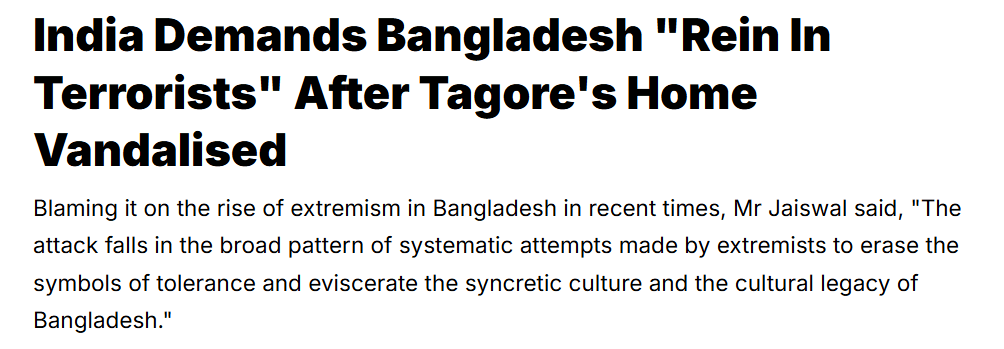
Tagore’s Home Vandalized in Bangladesh. News Source: NDTV
Truth be told, I was thinking while reading the book, how long would it take for the pro-Pakistan radicals in Bangladesh to go after anything related to Tagore, the Hindu writer of Bangladesh’s anthem “Amar Sonar Bangla” (My Golden Bengal), and then the vandalism of Tagore’s home happened. I wouldn’t be surprised if they replace the anthem, too, at some point in the future.
Jogendra Nath Mandal – The Dalit Leader Who Chose Pakistan
It’s from the book that I came across the name Jogendra Nath Mandal for the first time. He was a Dalit leader and a close associate of Dr. Ambedkar. At the time of Partition, Mandal chose to side with Pakistan, believing it would offer Dalits greater freedom and rights than a Hindu-majority India. He motivated many Dalits to migrate with him, promising an escape from caste oppression.
Mandal, the man who wanted Pakistan to become a land of Dalits and Muslims.
But what they found was a harsher reality. Regret followed soon after. Mandal eventually fled Pakistan and returned to India. Sadly, many Dalits who followed him to Pakistan lacked his privilege and means and were left behind. His popularity waned after that, and he died a lonely death in West Bengal. To quote the book:
Mandal had come to India from East Pakistan as a broken man. Arguably, the tallest Dalit politician in pre-partition East Bengal, Mandal had lost most of his followers after he chose Pakistan over India, stood with Muhammad Ali Jinnah and became the law and labour minister. Mandal had thought Dalits and Muslims would behave like brothers in the newly-created Pakistan. They didn’t, and as communal tension rose and Hindus left East Pakistan for India in large numbers, Jogendranath Mandal came to be looked at as a short-sighted leader at best and a self-serving politician at worst.
Dr. Ambedkar, upon learning about the persecution of Dalits in Pakistan, urged them to return to India. However, most were unable to leave, trapped by circumstances beyond their control.
I encourage everyone to read the following Reddit post that offers a more complete account of Jogendra Nath Mandal’s life. It includes his resignation letter to the Prime Minister of Pakistan and Dr. Ambedkar’s heartfelt appeal to Dalits living there.
Mandal’s story reminds us never to forget history or its lessons. These accounts were documented by key figures of that era for a reason. Not to be ignored, but to help us reflect, understand, learn, and avoid repeating the same mistakes in the future.
Quotable Quotes from Being Hindu in Bangladesh
‘Yes, only two people might have died in Noakhali in last year’s violence. But look around and you will find boys and men without an arm or a leg walking around. They will remind you of what was.’
What was it like in 1946? When freedom from 200 years of British rule was becoming a reality, Bengali-Hindu women and men, in village after village in Noakhali district of undivided Bengal, the same place where we now are, were r*ped and killed, or forcibly converted. Then too, it had started with fake news.
‘I have never been able to forget those days,’ she says, ‘when neighbours became rioters and friends became murderers. The stench of blood haunts me to this day.’
‘I remember he would come and tell us to make sure no one made any sound, and make sure that the children remained silent. It should appear from outside that the college building was deserted. Or else, a mob could come and kill us all. But my seven-month-old sister cried out in hunger. We gave her some treacle to make her stop crying, but she would start wailing soon after. My father told us that we had to kill her as she simply wouldn’t stop crying. And her wails would bring the mob to us. She cried and cried, till she cried no more.’
In other riots, religion was the point of disagreement. In Noakhali, religion was also the instrument that ended the disagreement. The attacks in Noakhali on Hindus by Muslims ended when the Hindus became Muslims.
‘But it’s a mistake that all democratic governments make in trying to control one set of extremists. They often play with the other set that looks less worse than the other (but) in the course of time, they all become Frankensteins’ he said.
There’s something about discovering forgotten buildings where powerful men once lived, touring villages where they spent their boyhood. It is like sifting through dog-eared, yellowed pages of history. So much of what once was still hangs in the air. So many stories are kept alive by village elders who saw history take shape.
Conclusion
The book details several atrocities that are too graphic to include in this blog post. I strongly encourage everyone to read Being Hindu in Bangladesh for a clearer and unbiased understanding of the condition of Hindus in the country.
A recent set of DEI studies explores a critical question: Do the ideas and narratives central to many DEI trainings truly promote inclusivity and empathy?
Or do they end up deepening divisions and fueling hostility toward groups labeled as oppressors?
DEI Study Source: static.foxnews.com/foxnews.com/content/uploads/2024/11/anti-oppressive-dei-report-8.pdf
Social Experiment #1 – Exposing One Group to DEI Essays
The study found that individuals exposed to DEI material were more likely to perceive problems even where none existed. For example, one group was presented with a DEI essay by Ibram X. Kendi and Robin DiAngelo, while another group was not. Both groups were then asked to analyze the following scenario:
A student applied to an elite East Coast university in Fall 2024. During the application process, he was interviewed by an admissions officer. Ultimately, the student’s application was rejected.
A simple, straightforward survey. The scenario was deliberately created without mentioning the race or ethnicity of either the student or the admissions officer and contained no indicators of racism. Participants were then asked to evaluate the scenario using questions meant to assess how much racism they perceived in the interaction.
Results: The analysis showed that participants who read the Ibram X. Kendi/Robin DiAngelo essay developed a hostile attribution bias. They viewed the admissions officer as significantly more prejudiced compared to those who read a neutral essay. Despite no evidence of discrimination in the scenario:
Perceived discrimination rose by 21%
Perceived unfair treatment increased by 12%
Perceived harm to the applicant rose by 26%
Perceived microaggressions jumped by 35%
These strong results led NCRI to replicate the experiment with a national sample of college students, confirming that the effects were not limited to the original set of students. The follow-up study found similar outcomes.
Social Experiment #2 – Exposure to Anti-Islamophobia Training
Similarly, a nationally representative sample was recruited via Amazon Prime Panels to assess the impact of anti-Islamophobia content. Participants were shown two identical terrorism trial scenarios, one involving Ahmed Akhtar and the other George Green, both convicted of the same crime. In the group that did not receive anti-Islamophobia training, both trials were perceived as equally fair, showing no inherent bias or perception of Islamophobia. However, in the group exposed to anti-Islamophobia content, perceptions shifted: while views on George’s trial remained unchanged, Ahmed’s trial was rated as significantly less fair.
This indicates that exposure to anti-Islamophobia messaging led participants to perceive bias where none existed, introducing a new bias in favor of Ahmed despite both cases being identical.
These results suggest that anti-Islamophobia training may lead people to assume discrimination against Muslims, even in the absence of actual bias.
Concerns: How much is too much?
This reflects a broader concern. The DEI programs that heavily emphasize victimhood and systemic oppression may unintentionally distort perceptions of fairness, as also seen in the case of Hindu Brahmins. While these trainings aim to highlight real injustices, they also foster hostile attribution bias, a tendency to see prejudice where none exists.
Such distortions risk undermining public trust in institutions, even when those institutions are acting fairly. This is especially troubling given that these institutions, such as ISPU, also provide Islamophobia sensitivity training to federal agents.
Food for Thought
It makes us, Indians, reflect on our own perspectives too. How much of what we believe is shaped by personal thought and observation, and how much is simply absorbed from what we’ve read, heard, or been told?
We’re constantly surrounded by voices telling us what’s right, what’s wrong, what to support, and what to reject, so much so that we often stop thinking critically. We rely on others to give us the “truth,” but how can we be sure those sources are unbiased or even complete?
In the pursuit of justice, I see a troubling pattern: one group being demonized, while another’s wrongdoings are overlooked. That’s not justice, it’s imbalance.
True justice can only be achieved when we hold all sides accountable, without bias, without exception. To do that, we need to cultivate a rational, balanced mindset, one that isn’t rigid or exclusionary. Listen to all sides, and stand with the truth, not with narratives that vilify entire communities or sections of society.




 The Monkey Dilemma
You must be logged in to post a comment.