An Ode to Surviving Performance Reviews by Demotivating Managers

Demotivating Manager

It is that demotivating season again.

I say demotivating because my last two performance reviews were negative. I might keep repeating “demotivating” throughout the article because that is how I feel right now.

So demotivated, dazed, confused, furious.

All because of one manager.

Somehow he has made up his mind to never encourage anyone. The only positive word I have ever seen come out of his mouth is “Good.” But he is ever ready to nullify that with 100 negatives.

The worrying part is many in my company feel that way.

2020 was the year I was most proud of myself. I learned things on my own. I built things from scratch. Got everything up and going with minimal errors after several hours of overtime. The least I expected was an “I appreciate your hard work.” An acknowledgement of what I have done.

But nothing came.

Don’t be that manager.

I am at my productive best when I am reporting to a good manager. I am at my worst when the manager is negative. This is true for many. We want to do our best, help the company reach the top when our work is valued.

Don’t get me wrong. I love constructive feedback. But not feedback that is laced only with negatives.

If you are a performance reviewer, here are some “How not to be a demotivating boss” tips:

  • Start the conversation in a light tone. A “Hi, how are you?” at the start never killed anyone. It gives the employee some time to breathe and relax. Remember, most employees get into a performance review with extreme anxiety. Help them out by being courteous and kind.
  • Start with the positives. And by positives, I do not mean just saying a single “Good.” Be descriptive. Tell them what you liked about their work. Use the same number of sentences that you would use while giving constructive criticism. 3 full sentences describing the negatives? Follow it up with 3 honest sentences about their positives. Balance it out.
  • Do not make the employee feel like they have done nothing for the company.
  • Ease into the negatives. Give some time for the employee to respond or tell you what’s on their mind. Don’t ramble non-stop. The moment you start the negatives is when you need to be the kindest. Frame negatives in a nice way, then stop and take a step back, wait for them to respond, ask if they have to anything to say. Be open-minded to listening to them.

You look around and you see many employees dissatisfied with their managers. Why is that? Because there is a huge communication gap. Any thoughts and reviews are left for the last moment i.e. during the performance review. Some companies like Microsoft, Accenture, Adobe and Deloitte have done away with annual performance reviews because of this reason alone.

The best way to give feedback is right after a task is completed. This helps them change their course if need be. Don’t wait till annual performance reviews – to throw unpleasant surprises.

I got a raise and a bonus. So it was not all bad. But all it takes is one person’s words to ruin the high you feel, right? Is that the price you pay for a salary?

By the end of it all, I told him “That was very demotivating.” Probably it was the first time he heard it from someone. Most employees prefer to ignore such bosses. My retort was followed by a one-minute silence. Of all the things I said this year, I am most proud of this one dialogue.

My manager then went on to give several excuses on how the intention was not to demotivate but to give feedback.

But feedback should be a mix of good and bad. Backed up with encouraging words on how you believe the employee can do what’s been suggested. If it is not, it is not feedback, it is being demotivational. As simple as that.

So I would like to say kudos to me for surviving yet another performance review with a demotivating manager. I expect more to come. And I plan to survive them all. By ranting here, and to my friends, and family, and anyone who would listen.

The day my boss says something nice, I will let you know. Stay tuned?

Leaving the company doesn’t make sense because as far as I know most of the people around have terrible bosses. I rather stick to one familiar demotivating one that becomes overbearing during performance review time rather than explore new ones.

If you are feeling demotivated too, rant! To someone.

That is what my colleagues and I do anyway.

One day, hopefully, all managers will learn how to give feedback constructively. Till then, the corporate servants will have to time and again, feel the extreme disappointment of not feeling valued by that one manager, who simply doesn’t know how to give a good performance review.

And I also hope one day we start earning enough passive income from our websites, investments and, other sources. So that we can run far away from everything that is, you guessed it, demotivational! Every corporate slave’s secret dream.

An Ode to Working for the Right Company (MNC or Startup)

Take a look at Twitter, and you will see never-ending debates on whether startups or MNCs are the best.

Having worked in both, here are my 2 cents.

MNCs or established, large companies might be the better option for you if you want:

  • Higher pay: Big companies are willing to pay the best of the best for talent
  • Better job security: They have been in the business for a longer time and are more stable
  • Well equipped work space: They have the money to invest in the best tools and resources needed for upgrading your work
  • Better perks: Health benefits, freebies

Cons:

  • Office politics: This was the worst part for me.
  • Feeling undervalued: There are a lot of employees, and it is practically impossible for the higher order to listen to everyone. Your opinions or inputs tend to be given less importance.
  • Not flexible: Most of the companies want you to stick to their rules. Employees are rarely consulted on what *they* want.

Startups or smaller companies might be the better option if you want:

  • More job satisfaction: The pride you feel when your company is growing is unmatched. You played a role in it, and that is a huge achievement.
  • Less office politics
  • A tightly-knit workspace where everyone is easily reachable including the CEO
  • A job where you are valued

Cons:

  • Lesser pay: Small companies can hardly compete with MNCs when it comes to offering the best pay package
  • High pressure: Lots of work, less work-life balance
  • Cash-strapped: Hardly any freebies; access only to those tools that are absolutely essential for your work

Of course, this does not apply to all the MNCs and Startups out there. Each one is different. But from my experience, this is what I have encountered.

Honestly, I feel everyone should try both at least once to see what it is like.

Then go the Marie Kondo way perhaps – choose the one that sparks joy.

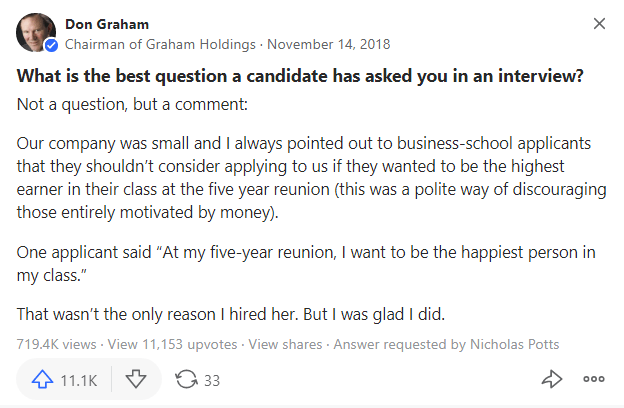
To finish this off, posting a snippet I saw on Quora. It made me smile.

Job Satisfaction

An Ode to Saying No to Dowry

Photo by Baljit Johal on Pexels

Yet another day in Kerala. Yet another dowry death.

Vismaya, a 23 year old, who died days after sharing her pics of abuse with a relative, has yet again prompted many to chant “A divorced daughter is better than a dead daughter.” Her parents were very much aware of the abuse she was going through, so was her brother and cousin, but unfortunately, not one of them could save her. There is no single person to blame here. Almost everyone is at fault, including the society.

I am a divorcee. Fortunately, my parents were super supportive, and gave my safety the utmost priority when I chose to leave my husband’s place after yet another episode of abuse. The day I left home was the day my parents came to know that I was facing physical and emotional trauma over many months. I did not want to worry them. Maybe Vismaya felt the same. The difference was, my parents did not tell me to compromise.

Mine was an arranged marriage. My parents and I were, are and always will be strictly against dowry. We always had made it clear when a proposal came by that no dowry would be given. My in-laws and husband said they had no demands, though traditionally their family practiced it.

On our wedding day, amidst all the flurry of activity, it felt odd when my husband quipped happily “(So and so) told me you are wearing a lot of jewelry; that I am a very lucky guy.” It was a hint of what was to come.

The emotional blackmail began on the first day of marriage. My ex-husband’s old relative, with a full authoritative tone, told me to put my jewelry in a locker at their chosen bank. When I naively told him that we usually put our jewelry in our own lockers, he was adamant that I keep it in a new one at the current location. This was odd to me, because I have never heard of such a thing happening in my family before. The women of the family always kept their jewelry in existing lockers. There was no question of transferring or shifting it to the husband’s place. Plus, it is so redundant – why open another locker when you already have one? There can only be one answer.

I consulted my mother, who panicked and told me not to do anything till they arrived. So I kept stalling their attempts to put my assets in their locker. My mother came to visit soon and took away the jewelry. This angered my ex-husband, and things (predictably) went downhill from then on. I remember asking him “Did you marry me for my money?

Physical abuse soon began. Not enough to get me hospitalized, but enough to give me bruises. “There are so many women getting hospitalized, that’s what real physical abuse is!” – he justified his actions to me. I forgave, but could never forget because he would keep repeating it. At the end, I ended the relationship and walked out. I realized my tears did not matter to him, nor my well being or happiness. I was married for just one year.

To all the unmarried women who are reading this, this is something you should note. You will hardly see anyone talk about this anywhere online – how dowry nowadays is rarely mentioned before marriage, camouflaged and hidden, all ready to make a move on its prey when the time is right. Many predators, cunning to the core, have realized that this right time to get what they are eyeing, is not before marriage but after it – when the woman is the most vulnerable, getting accustomed to a new place, confused and dazed. No one is explicitly going to use the word “dowry” but you will get to know from their actions.

Please remember, your current assets are yours alone. This needs to be strictly mentioned before marriage. You need to underline your deal breakers, so that there is no room for confusion. If after marriage, you decide to mutually hold future assets together, that is entirely up to you. But do not let anyone emotionally manipulate you into gaining access to your safety and security. Once you lose control of that, you lose control of your life.

I survived the worst phase of my life because I had solid support. Whenever I see a death or abuse case, it feels overwhelming. A lot of “if only” phrases come to mind.

  • If only, the family had supported her enough. Instead of telling her to compromise, they had told her to come home or “We are coming to pick you up” instead.
  • If only, the victim realized her life is not meant for suffering, to endure everything in silence. That staying married, even if toxic, is not the ultimate goal in life. Happiness is.
  • If only, the society made it easier for women to call it quits when her relationship with her partner becomes irreparable. Instead, mostly, we are told to compromise and adjust more.
  • If only, all men had the guts to strictly say no to dowry, go against tradition.
  • If only, a man’s parents did not put social status on such a high pedestal.

If only…

Many women, like Vismaya, would then still be alive.

An Ode to Feminism and Personality Prints

Photo by Markus Winkler on Pexels.com

Feminism runs in my family, in parts.

I come from a family of outspoken (sometimes bordering on the line of offensive) women, about whom the men in the house would jokingly warn new entrants to be wary of.

We inherit a chunk of values subconsciously from the ones around us. The early lessons often imparted by family. The few beads of feminism that I took away from mine:

Importance of education and hatred for dowry – I learned from my grandfather, who would tell his daughters “I am ready to sell everything to get you girls a good education” and who would ask prospects to kindly leave if they ever asked for dowry.

Importance of courage, debating, learning, re-learning, and speaking out – I learned from my mother. She has been at the receiving end of many jibes that came her way for raising her daughters to be the feminists that we are. Instead of feeling the burden of everyone’s favorite dialogue “It’s the mother’s fault,” she rose to the challenge and took it as a compliment.

Importance of financial independence – I learned from my aunts, who owing to personal incidents had to depend on themselves to keep their family afloat.

Importance of gender equality – I learned from my dad, who was absolutely fine with doing household chores, cooking, and cleaning. P.S: He used to make the best mutton curry.

Importance of freedom – I learned from my sister, who values her independence more than anything else in this world. Nothing can stop her from pursuing her dreams in life.

We always learn little lessons from everyone around us, without even knowing. When I look back, to think where I got my current ideologies from, these are the people who pop up in my mind. I learned a little bit from each and together they have defined my set of values.

An individual can be unique not just in physical appearance or fingerprints, but even by their “personality print” which is the sum total of all their experiences in life. Next time you feel you are not special, think about it this way. There is literally no one like you – with the same set of values, journey, experiences, understanding. Just like fingerprints, no two personality prints are alike. You are uniquely you. Is there any better reason to celebrate?

An Ode to Learning New Things in the Midst of a Pandemic

Photo by cottonbro on Pexels.com

2020 has been eventful. There have been a lot of lifestyle changes because of the Covid-19 pandemic. Many absolutely hating the year from the very core of their heart.

Contrary to the popular (or should I say infamous?) opinion about 2020, I on the other hand, consider it as one of my most constructive years.

An ode to one of my most happening years where I:

  • Travelled solo to Goa for the first time right before the pandemic commenced
  • Had the most wonderful trip to kick start the year
  • Danced on-stage for the first time
  • Broke off from a long dead, mentally exhausting relationship
  • Learnt how to keep my sanity when I was home all the time (new hobbies, in case you are wondering)
  • Learnt new things like hand sewing, machine sewing, job-related courses, a new language – all in the comfort of my home
  • Started the curly girl method to embrace my natural hair. It has been 3 months since I straightened my hair. Less fuss!
  • Got back to reading. 15 books and counting (hey, that’s a lot for me!)
  • Got back to writing
  • Started this blog!
  • More productive at work than ever before. It helped that I did not have anyone at home who is dependent on me.

For these things I am really grateful for 2020. For all the lessons it imparted.

It feels like a new beginning. A new life in a way.

I honestly believe (at the risk of sounding preachy) life is all about what you choose to focus on. At times like these, it can be difficult to filter out the good. But a reality check of what’s happening around always brings me back to being grateful for having a home, for being safe and healthy so far.

Let’s not take what we have for granted. It is a great opportunity to do things we wouldn’t have done if we were on the move all the time. For that, I wouldn’t want to cancel 2020. I want to sit down, have a proper conversation with the year, to see what it wants to teach us, what it has to offer and what it hopes we learn by the end of it.