After celebrating Onam and engaging in numerous social activities, my introvert battery hit rock bottom. I needed a desperate recharge. So what do I do? Naturally, I retreated to every introvert’s most favourite new-gen comfort zone: scrolling endless Instagram reels. Nothing says “I’ve had enough of people” quite like being a couch potato, locked up in your house, while going through everyone else’s social lives.
As I scrolled through the multiple Onam-related posts, I couldn’t help but appreciate the inclusivity in Kerala. Malayalees across religions, whether they are Hindus, Christians, or Muslims, celebrated Onam with equal enthusiasm. Everyone welcomed Mahabali with open arms. A few voices did try to stop their communities, saying Onam is a “Hindu festival,” but not many paid attention. That’s a good sign. People are choosing to step out of religious bubbles to celebrate together.
Still, Kerala, often praised as a secular state, has been showing sporadic worrying signs of exclusion. Just before Onam, a teacher told students not to participate in the festival because “our religion doesn’t allow it.” The outrage led to her suspension, but this mindset isn’t limited to one person. How widespread is the thought? No one can quantify. It’s impossible to analyze each and every Indian’s thought. However, there is an increasing number of cases that advocate for exclusionary behaviour. You are penalized for celebrating other festivals, or for respecting someone else’s god, or for chanting something as simple as “Bharat Mata ki Jai.”
India guarantees freedom of religion for all communities. But if we use that freedom only to exclude ourselves from others, we risk creating deeper divides. True communal harmony comes from participation: joining in festivals, enjoying each other’s food, and refusing to see other faiths as “untouchable.”
For India to stay secular, this effort has to come from all of us. We’ve come far since independence, but there’s still a long way to go. It’s up to us to ensure religion doesn’t become a wall, but a bridge.
I recently watched a thoughtful discussion by Zarna Garg on interracial romance, featuring her own family. Based in the US, their candid conversation offers a refreshing glimpse into how Indian-American families are navigating such topics. It was heartening to see everyone, parents and kids, engage so openly. In many Indian households, these conversations either happen too late or not at all, often wrapped in hesitation or silence. But here was a family talking honestly about dating, identity, and interracial relationships. A big shoutout to them for their openness and clarity. It’s these dialogues that make a real difference.
Watch the video below:
Thoughts
I’ve spent most of my life abroad before choosing to return to India. Yet even while living overseas, I always knew my relationships would be with Indian men. Perhaps it’s because I studied in an Indian school and mostly socialized within the Indian community, even outside the country. I look Indian, dress Indian, and speak with an Indian accent. So it was natural to feel more comfortable with Indian men.
However, in today’s globalized world, with increasing interracial mingling, millennials like me must come to terms with the fact that more non-Indians are likely to become part of our families. Someone recently remarked how the world is blending in such a way that you can no longer easily tell someone’s ethnicity. Even appearances are getting “globalized.” It was an eye-opener. I’ve come to realize this holds especially true in the Indian context. Today’s new-generation kids often no longer look or sound traditionally Indian, especially the kids in Indian metros. Their accents, fashion, and even body language reflect a more global identity.
A few months ago, a relative married a Spanish man, the first white partner in our family. Surprisingly, everyone, including the older generation, was welcoming. No drama. No resistance. That in itself feels like progress. Our extended family no longer fusses over caste or religion in love marriages. Marrying someone from a “lower caste” has become normal (though I personally reject terms like “lower” and “upper” caste, which are inherently divisive). Only a few super-senior relatives seem to hold on to rigid views, but even that seems to be fading.
I wonder if this shift is due to the older generation’s growing access to YouTube and social media. Many now watch global discussions on love, identity, and acceptance. One moment really stood out: a senior aunt watched Kaathal, a Malayalam film about same-sex love, and casually remarked, “Being gay or lesbian is fine. It’s not a disease.” That kind of acceptance would’ve been unthinkable even a decade ago. But it’s happening now, and that matters.
More recently, one of my nieces fell in love with a white guy. It’s a bit more delicate because it hits closer to home. While I’m happy she found someone, I can’t help but feel a bit anxious. Our cultures are worlds apart, and it’s not just the couple that has to adjust, but the families too. At this age, do I or her parents have the patience? I’m unsure. On second thought, it doesn’t concern me or her family, as the relationship is hers to navigate. Still, as Zarna Garg wisely said in her family discussion, any relationship can thrive if the core values align: education, family, career, loyalty, and health. Everything else is secondary and can be worked around.
One comment from Zarna’s husband lingered with me. He mentioned that their eldest daughter has only dated white men, and he took it personally. He had read somewhere that girls whose fathers aren’t ideal husbands are more likely to do this. That struck a chord. My niece also has a pattern of dating white men, and to be honest, her father isn’t exactly the perfect partner either. Could there be a subconscious link? I wouldn’t dare bring it up now, especially since she lives abroad, but maybe someday in person.
There’s so much our generation is still figuring out. As millennials in our 40s, we stand between tradition and transition. We want to be open-minded and inclusive, but also grounded. At times, it worries us to see the younger generation drifting away from tradition. There’s a quiet fear: will our culture someday fade into oblivion? But these are changing times, and change demands a degree of acceptance. We may not always agree, but we must learn to adapt. I also see a growing trend among young parents today: trying too hard to be politically correct, often avoiding difficult conversations just to stay in their children’s good books. This might be a measure to ensure they don’t repeat their parents’ mistakes of being too restrictive. But experience teaches us that hard truths, spoken with love, are just as necessary today as it was yesterday.
Some of the advice I dismissed in my 20s now makes perfect sense. You only begin to understand your parents once you reach their age. That’s how life unfolds. You gain clarity with time. Until then, all we can do is trust, adapt, and hope it all works out in the end.
The protagonist of Convenience Store Woman by Sayaka Murata is unlike anyone I’ve encountered in any book. Keiko is quietly charming, yet deeply unconventional. She’s content with her simple routine at a convenience store, a place she has worked for over 18 years. This does not gel well with people around her who expect her to climb the career ladder, or “at least get married”, instead of sticking to this “lowly” job. They are unable to comprehend her happiness or her emotional detachment in situations where strong feelings are typically expected. In her own words, she’s a “foreign object.”
There are parts of Keiko’s personality I could relate to, especially her tendency to operate more from the brain than the heart. I’ve often questioned this trait in myself, particularly in political matters, where I naturally lean toward a calculated, strategic view rather than reacting emotionally. This sometimes makes people see me as cold. But that’s where my similarities with Keiko end.
I tend to get deeply emotional about things that may not always move others in the same way. My responses aren’t absent, like Keiko’s. I cry easily when I see children being affectionate with their parents or when animals are hurt. I feel emotional and distraught when I see small children picking up guns or stones in conflict zones. I want them to study and grow up contributing to society in peaceful ways. I well up seeing warmth in society. For example, when the visually impaired children sang “Happy Birthday” to our Indian President Murmu, she cried, I cried, we all cried. I’m also deeply moved by the struggles of elderly people, perhaps because I’ve spent time with them and seen what many others, especially those living far from their parents, often overlook. I do feel deeply, just not always in ways others expect, a bit like Keiko.
If you are wondering what makes Keiko strange, this snippet from the book gives an idea:
I wouldn’t say I loved Convenience Store Woman, but it was certainly thought-provoking, especially how society treats you as a “foreign object” that needs to be discarded if you don’t follow the rules. Society insists Keiko must adapt to its norms to be seen as “normal.” It does not matter to them how fulfilled or happy she is. Keiko’s struggle to meet societal expectations forms the core of the novel. Many of us might relate to this struggle with conformity. Not everyone is wired to follow every rule or expectation to the letter.
Ending this post with some thought-provoking quotes from the book:
The normal world has no room for exceptions and always quietly eliminates foreign objects. Anyone who is lacking is disposed of.
He seemed to have this odd circuitry in his mind that allowed him to see himself only as the victim and never the perpetrator l thought as I watched him.
It occurred to me that it wasn’t such a stretch to say that contemporary society was still stuck in the Stone Age after all. So the manual for life already existed. It was just that it was already ingrained in everyone’s heads, and there wasn’t any need to put it in writing. The specific form of what is considered an “ordinary person” had been there all along, unchanged since prehistoric times I finally realized.
“Look, anyone who doesn’t fit in with the village loses any right to privacy. They’ll trample all over you as they please. You either get married and have kids or go hunting and earn money, and anyone who doesn’t contribute to the village in one of these forms is a heretic.”
There’s so much I want to say about Being Hindu in Bangladesh, a book written by Avishek Biswas and Deep Halder, but I don’t think my words would do justice to my emotions. Whatever I write would be a watered-down version of what I felt while reading.
The authors are sons of refugees who once fled Bangladesh. They wrote this book during Sheikh Hasina’s rule, a time when they could safely visit Hindu areas and speak openly with locals, scholars, and researchers about the past.
It was a deeply uncomfortable read. Especially as I kept coming across recent posts from people in Bangladesh on Reddit, worried about the country slipping back into radicalism. It felt like history was repeating itself. On top of that, there were people, including the global and Indian left-leaning media, trying to downplay the communal angle in Bangladesh so as not to flare up Islamophobia. As an ex-leftist, this behaviour is all too familiar. I was once part of that ecosystem.
Despite being a Hindu, I could not acknowledge the persecution that Hindus faced in neighbouring regions. The data was there for everyone to witness, yet I was blind. I believe this is true for many Hindus. We are raised with strong secular values, which often makes it uncomfortable to openly acknowledge or speak about atrocities against our own community. Personally, it was difficult to break out of that mindset and accept the reality that Hindus did face genocide in Pakistan, Bangladesh, and Kashmir. Adding to that is the consistent bias of left-leaning media, which often avoided reporting anti-Hindu communal incidents both in India and abroad. This selective activism played a key role in my decision to step away from the leftist ecosystem.
Sahidul’s narrative states: ‘The genocide orchestrated and masterminded by Pakistan, began on the night of March 25, 1971 … Three million were killed (in East Pakistan), 200,000 to 300,000 women were violated in the most diabolic ethnic cleansing since the days of the Holocaust. And these are just rough estimates. How much does the world or even the subcontinent talk about it?
Most Painful Part of the Book
The most aching part for me was the quiet optimism in the book. Written during Sheikh Hasina’s rule, the authors were hopeful about the secular path Bangladesh was taking. They welcomed the ban on JeI and the arrests of those involved in the Hindu genocide of 1971. I read those pages, and then Al Jazeera’s headline from a few days back: “Bangladesh Supreme Court lifts ban on Jamaat-e-Islami.” I feel a mixture of emotions.
The authors also appreciated the death sentence awarded to a Jamaat leader involved in the 1971 genocide of Hindus. That sentence, too, has now been overturned in current-day Bangladesh under Yunus’s rule. Makes you wonder – is justice so fickle?
Opposition to Bengali Because It Was Too “Hindu”
From the book, I learned that Pakistan was opposed to Bengali in East Pakistan (now Bangladesh) because they considered the language “too Hindu” as opposed to Urdu. When East Pakistan demanded a new nation on the basis of Bengali culture, Pakistan thought Hindus were responsible for this “brainwashing”, which is what led to the genocide.
The Pakistani Army launched Operation Searchlight for complete cleansing of the Bengali and Hindu identity. Even the press secretary of the third president of Pakistan, Yahya Khan, said that this operation was to ‘brainwash the people, wean them off their Bengali mores and make them true Pakistanis … The Hindu influence must be eradicated root and branch and the people who were misguiding the innocent and illiterate masses must be liquidated.’
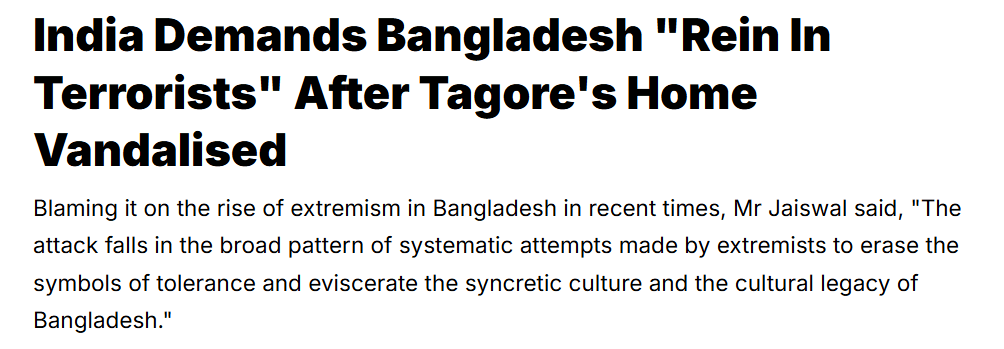
Tagore’s Home Vandalized in Bangladesh. News Source: NDTV
Truth be told, I was thinking while reading the book, how long would it take for the pro-Pakistan radicals in Bangladesh to go after anything related to Tagore, the Hindu writer of Bangladesh’s anthem “Amar Sonar Bangla” (My Golden Bengal), and then the vandalism of Tagore’s home happened. I wouldn’t be surprised if they replace the anthem, too, at some point in the future.
Jogendra Nath Mandal – The Dalit Leader Who Chose Pakistan
It’s from the book that I came across the name Jogendra Nath Mandal for the first time. He was a Dalit leader and a close associate of Dr. Ambedkar. At the time of Partition, Mandal chose to side with Pakistan, believing it would offer Dalits greater freedom and rights than a Hindu-majority India. He motivated many Dalits to migrate with him, promising an escape from caste oppression.
Mandal, the man who wanted Pakistan to become a land of Dalits and Muslims.
But what they found was a harsher reality. Regret followed soon after. Mandal eventually fled Pakistan and returned to India. Sadly, many Dalits who followed him to Pakistan lacked his privilege and means and were left behind. His popularity waned after that, and he died a lonely death in West Bengal. To quote the book:
Mandal had come to India from East Pakistan as a broken man. Arguably, the tallest Dalit politician in pre-partition East Bengal, Mandal had lost most of his followers after he chose Pakistan over India, stood with Muhammad Ali Jinnah and became the law and labour minister. Mandal had thought Dalits and Muslims would behave like brothers in the newly-created Pakistan. They didn’t, and as communal tension rose and Hindus left East Pakistan for India in large numbers, Jogendranath Mandal came to be looked at as a short-sighted leader at best and a self-serving politician at worst.
Dr. Ambedkar, upon learning about the persecution of Dalits in Pakistan, urged them to return to India. However, most were unable to leave, trapped by circumstances beyond their control.
I encourage everyone to read the following Reddit post that offers a more complete account of Jogendra Nath Mandal’s life. It includes his resignation letter to the Prime Minister of Pakistan and Dr. Ambedkar’s heartfelt appeal to Dalits living there.
Mandal’s story reminds us never to forget history or its lessons. These accounts were documented by key figures of that era for a reason. Not to be ignored, but to help us reflect, understand, learn, and avoid repeating the same mistakes in the future.
Quotable Quotes from Being Hindu in Bangladesh
‘Yes, only two people might have died in Noakhali in last year’s violence. But look around and you will find boys and men without an arm or a leg walking around. They will remind you of what was.’
What was it like in 1946? When freedom from 200 years of British rule was becoming a reality, Bengali-Hindu women and men, in village after village in Noakhali district of undivided Bengal, the same place where we now are, were r*ped and killed, or forcibly converted. Then too, it had started with fake news.
‘I have never been able to forget those days,’ she says, ‘when neighbours became rioters and friends became murderers. The stench of blood haunts me to this day.’
‘I remember he would come and tell us to make sure no one made any sound, and make sure that the children remained silent. It should appear from outside that the college building was deserted. Or else, a mob could come and kill us all. But my seven-month-old sister cried out in hunger. We gave her some treacle to make her stop crying, but she would start wailing soon after. My father told us that we had to kill her as she simply wouldn’t stop crying. And her wails would bring the mob to us. She cried and cried, till she cried no more.’
In other riots, religion was the point of disagreement. In Noakhali, religion was also the instrument that ended the disagreement. The attacks in Noakhali on Hindus by Muslims ended when the Hindus became Muslims.
‘But it’s a mistake that all democratic governments make in trying to control one set of extremists. They often play with the other set that looks less worse than the other (but) in the course of time, they all become Frankensteins’ he said.
There’s something about discovering forgotten buildings where powerful men once lived, touring villages where they spent their boyhood. It is like sifting through dog-eared, yellowed pages of history. So much of what once was still hangs in the air. So many stories are kept alive by village elders who saw history take shape.
Conclusion
The book details several atrocities that are too graphic to include in this blog post. I strongly encourage everyone to read Being Hindu in Bangladesh for a clearer and unbiased understanding of the condition of Hindus in the country.
As the year comes to a close, it’s time to reflect on the lessons learned this year. I have the utmost gratitude for those who showered me with love, kindness, and patience. However, I also felt discomfort knowing that not everyone who greets me with gifts, smiles, and sweet words considers me as someone worth their time.
Small things that irked me this year:
A relative who never supported my writing ventures expected me to support her new Instagram page.
People being frighteningly okay with one kind of death over another based on religion, beliefs, and ideologies.
When people whom I consider dear went to events without informing me.
The lessons I learned from each of these:
You need not feel guilt for treating people like they treat you. You are not a holy saint but a living, breathing, ordinary human being who harbors a myriad of emotions. Having expectations from people you care about is healthy so that boundaries aren’t crossed. Consistent compromises can affect your mental health and even bring down your self-esteem.
People are inherently biased. This fact is uncomfortable and dark but true. The way we look at anything is colored by our upbringing, our own experiences, and our way of life. So, for example, when you see someone advocating for human rights, you need to be wary of their agenda – is it genuine? Do they advocate for the rights of all humans or only a select few?
We have to accept that we are not everyone’s cup of tea. This holds more true for someone like me, an unmarried woman who says the most unorthodox things and is a social hermit by nature. When you live a life that is the most authentic to you, you will not gain many friends, as you are largely unrelatable. This self-realization will help reduce unnecessary expectations from people who genuinely require something else from the people around them, not what you have to offer.
Instead of blaming people, the solution often lies within. It’s impossible to change everyone and everything to your liking. The answer sometimes is to accept the reality and move on. Maybe in this quest, you will find your tribe that understands and accepts the person that you are, and things will feel less forced and more genuine.
For me, it’s often not the acts, like seasonal gift-giving, that show someone’s true nature, but in the little things – remembering you and asking you to tag along to events they know you would enjoy, uninhibited support to passions that mean a lot to you, and not finding you weird when you show your vulnerable side. It’s also the acknowledgment of the fact that you expected something more and them making an effort to meet that expectation the next time around. Touch wood, I have a select few who understand me the way I want to be understood. But being a hypersensitive individual could mean you get disturbed when people you expected to cheer you take a step back and treat you and the things you love with indifference.
But such is life. Every year, you learn new lessons and new aspects of people around you that you never observed before. You communicate your grievances. But if the subpar treatment continues, you accept, adapt, and move on. It’s the only way to live. The disappointment may linger for some time, but then the lessons merge and become a part of you, and eventually, you start embracing the new normal. That is until you learn your next lesson.
P.S.: This would be my last post for the month and year. Holidays beckon. I wish you and your family a happy, joyous new year!
I purchased A Thousand Cuts because I wanted to know Professor T.J. Joseph’s side of the story. Those who don’t closely follow news from South India might not have heard of him. I will offer an introduction before moving on to the quotes from his book.
Who is Professor TJ Joseph?
Professor T.J. Joseph is a retired college professor from Kerala, India. He gained significant attention after he became a victim of religious extremism. The tragedy that occurred in 2010 shook Kerala to the core and impacted the communal harmony of the state. Never had Kerala witnessed such a radical act in modern history. How and why did this happen?
The Tragic 2010 Incident
In 2010, while working as a Malayalam professor at Newman College in Kerala, Professor Joseph set up a question paper for an exam. One of the questions unexpectedly became viral due to its controversial nature. Professor T.J. Joseph did not mean any harm when he drafted the question. He had simply taken influence from a book that he had read. But alas, many misunderstood the actual intention behind the question and accused the Professor of blasphemy.
Despite offering an apology, communal tensions refused to die down. The religious were angry. Fearing for his life, and feeling utterly unsafe in his surroundings, he ran away from home. After moving from one district to another, he finally decided there was no point in hiding, especially when he had done no wrong. He returned home, only to be eventually attacked by PFI members. He was mercilessly beaten up, and his right hand, which the extremists accused of writing the “dreaded” question, was severed in front of his family, neighbors, and other village folk who stood shellshocked, too scared to intervene. It took multiple complex surgical procedures to re-attach his hand.
Kerala is a state that is renowned for its communal harmony. But it is also known for its appeasement politics. The state government, politicians, and media did little to help Professor TJ Joseph. His Church abandoned him out of fear and ego. The Professor ended up losing his job in the college on the grounds of misconduct, although he was later reinstated after public outcry and intervention by authorities. He was the sole breadwinner in his family, and his wife and children had to endure many hardships due to his job loss. His wife, Salomi, slowly went into depression and died by suicide. The chapter on his wife is the only chapter without a title. It’s as if words aren’t enough to encapsulate the depth of his grief.
I bought his book because I had only heard the media’s version of his story till now. We all know by now how the media often tries to cover up facts based on their own biases. The present state of mainstream media made me purchase the book. I am glad I did it. The details are chilling. The points I am giving are only a summary of the things that happened. When you read the book, you are transported into Professor Joseph’s world of art, cinema, poetry, desperation, fear, courage, and resolve. He explains every little incident in vibrant detail. You can’t help but shed a few tears. I feel Kerala collectively failed him. Yet, his optimism and his dry sense of humor prevail and serve as a source of inspiration. Here’s a teacher who is teaching everyone in his own unique way how to combat the extremes that life throws at you.
Professor T.J. Joseph’s case remains one of the most shocking cases of religiously motivated violence in Kerala. The incident sparked widespread anger and discussions about freedom of expression and religious intolerance. The PFI members involved were later arrested and convicted. But, sadly, as a society, we still remain religiously intolerant. If you take a peek at the comments under any of his videos or news articles, you will know what I mean.
Quotes from Professor TJ Joseph’s Book
In an apology of a democracy, the interests of the mob got weightage over anything else, even if those interests were born out of ignorance, against truth and flagrantly unethical. Vote banks comprise such mobs. They shoulder the chair of power.
Marital life is a kind of war. An extraordinary war that lasts a lifetime. In a normal war, the one who defeats the opponent wins the war. In a marriage, the one who defeats the other will also lose. Therefore, marriage is a war where one must win without defeating the significant other.
My rationale was that as I had taught thousands of students, a large number of whom were Muslims, even if some misguided elements wanted to harm me, wouldn’t they first ask my students, and wouldn’t my students stand up for me and disabuse them of their wrong notions about me?
The mind of a student of literature must be dispassionate. Only in a place where there is no entrenched emotion can all emotion enter. Only in spaces where no one belief has nested itself can enlightenment enter and soar.
As I lay there accepting gifts and graces, I thought I must not merely forgive my attackers but thank them as well. For until then, I had never received so much love and care.
The attack on me was condemned even by Muslim organizations. The Church authorities alone remained silent.
I have been told that the gang that attacked me was made up of active members of an organization called Popular Front of India (PFI) and its political wing known as the Social Democratic Party of India (SDPI). All the members of the attack gang were then sent to various safe houses and shifted from one to another frequently with the help of many sympathizers.
The fish seller in our area in Muvattupuzha was a Muslim. Earlier, if we asked for half a kilo, we would receive exactly half a kilo. That has changed since: when we ask for half a kilo, we get at least three-fourths of a kilo. Only when I threatened to stop buying his fish if he didn’t accept payment did he, very reluctantly, start to accept money from me again.
Pinarayi Vijayan said that the whole of Kerala was on my side and that there was no difference between the extremists from PFI who had chopped off my hand and the church diocese that owned and managed the college.
At one time, having run out of funds, when I was at the end of my tether, Yukthivadi Sanghatana (Rationalists Organization) turned up with the money they had collected for me. I asked myself, why would they need other gods when they are themselves playing the role of God?
After I was attacked and maimed, I appealed to the state chief minister and home minister to withdraw the blasphemy case filed by the police against me of their own accord. The government had no will or courage to withdraw a case they had got instituted for communal appeasement.
The view that the suicide was caused by the unjust and immoral ways of the Newman College authorities predominated. One thing is certain, a dead Salomi is more powerful than a live Salomi. Because what she couldn’t achieve while alive, she could, by dying—bring the management to change their mind.




 The Monkey Dilemma
You must be logged in to post a comment.