In 1921, Kerala witnessed the Moplah Riots, where numerous Hindus were killed in communal violence. However, to this day, Congress and CPI(M) refuse to acknowledge it as a communal riot and instead label it a “class struggle between Hindu landlords and Muslim peasants.”
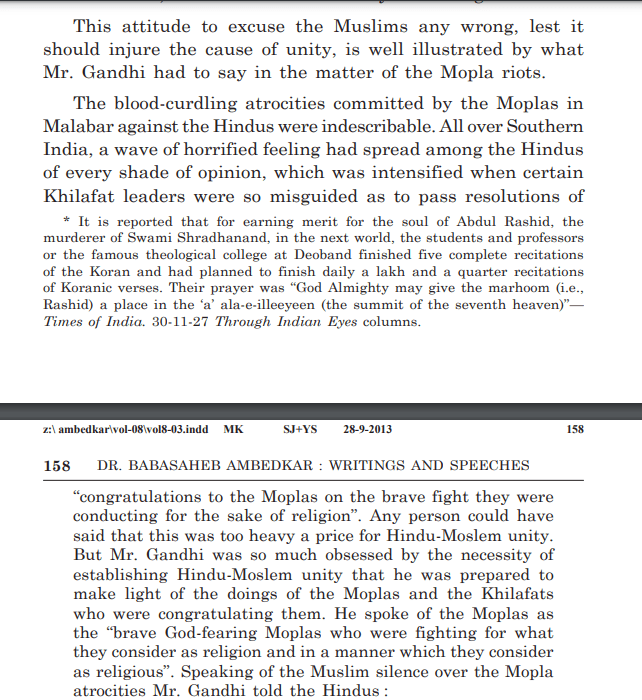
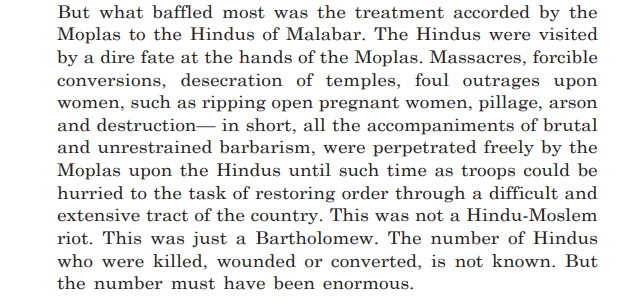
I also believed the class struggle narrative until I read B.R. Ambedkar’s book, The Partition of India. He clearly highlights the communal nature of the Moplah Riots, mentioning temple destruction, mass killings, and forced conversions of Hindus.
Some clippings from the book:
Source: Dr. Babasaheb Ambedkar : Writings and Speeches (Vol. 8)
If Hindus were specifically targeted, their temples destroyed, and they were forcibly converted, how can this not be considered a communal riot? Ambedkar’s account challenges the attempt to whitewash history by reducing it to just a landlord-peasant conflict.
Here is the question I asked AI and the response it generated:
Question: Were temples destroyed during the Moplah riots?
Answer: Yes, several temples were destroyed, looted, or desecrated during the Moplah Riots of 1921 in the Malabar region of Kerala.
Historical Accounts of Temple Destruction:
Looting and Desecration:
Many Hindu temples were attacked, idols were broken, and valuables were looted.
Records mention temples like the Thirumandhamkunnu Bhagavathy Temple being desecrated.
Forced Conversions and Killings:
The riots targeted Hindus, with reports of forced conversions, massacres, and mass displacement.
Many Hindus fled their villages, leaving temples unprotected.
British Reports and Historical Records:
British colonial reports and contemporary eyewitness accounts mention temple destruction.
Annie Besant and Veer Savarkar documented attacks on Hindu religious sites.
Conclusion:
Yes, temples were destroyed and desecrated during the Moplah Riots, which started as an anti-British uprising but later turned into violent communal attacks against Hindus in Malabar.
So how can it be concluded as merely a class struggle? Next time, someone dismisses the communal angle of the Moplah Riots as propaganda, one should ask, “Why were temples destroyed if the riots weren’t communal? Why did conversions happen? Was Ambedkar lying in his book?“
This is just one of the many lies spread by Congress and CPI(M). Why do they do it? Only they know. Perhaps to ensure Hindus keep supporting them, or maybe to prevent the majority community from developing resentment.
The second reason might have been understandable if only they didn’t paint Hindus as villains in other communal conflicts. The lack of consistency exposes their bias.
I purchased A Thousand Cuts because I wanted to know Professor T.J. Joseph’s side of the story. Those who don’t closely follow news from South India might not have heard of him. I will offer an introduction before moving on to the quotes from his book.
Who is Professor TJ Joseph?
Professor T.J. Joseph is a retired college professor from Kerala, India. He gained significant attention after he became a victim of religious extremism. The tragedy that occurred in 2010 shook Kerala to the core and impacted the communal harmony of the state. Never had Kerala witnessed such a radical act in modern history. How and why did this happen?
The Tragic 2010 Incident
In 2010, while working as a Malayalam professor at Newman College in Kerala, Professor Joseph set up a question paper for an exam. One of the questions unexpectedly became viral due to its controversial nature. Professor T.J. Joseph did not mean any harm when he drafted the question. He had simply taken influence from a book that he had read. But alas, many misunderstood the actual intention behind the question and accused the Professor of blasphemy.
Despite offering an apology, communal tensions refused to die down. The religious were angry. Fearing for his life, and feeling utterly unsafe in his surroundings, he ran away from home. After moving from one district to another, he finally decided there was no point in hiding, especially when he had done no wrong. He returned home, only to be eventually attacked by PFI members. He was mercilessly beaten up, and his right hand, which the extremists accused of writing the “dreaded” question, was severed in front of his family, neighbors, and other village folk who stood shellshocked, too scared to intervene. It took multiple complex surgical procedures to re-attach his hand.
Kerala is a state that is renowned for its communal harmony. But it is also known for its appeasement politics. The state government, politicians, and media did little to help Professor TJ Joseph. His Church abandoned him out of fear and ego. The Professor ended up losing his job in the college on the grounds of misconduct, although he was later reinstated after public outcry and intervention by authorities. He was the sole breadwinner in his family, and his wife and children had to endure many hardships due to his job loss. His wife, Salomi, slowly went into depression and died by suicide. The chapter on his wife is the only chapter without a title. It’s as if words aren’t enough to encapsulate the depth of his grief.
I bought his book because I had only heard the media’s version of his story till now. We all know by now how the media often tries to cover up facts based on their own biases. The present state of mainstream media made me purchase the book. I am glad I did it. The details are chilling. The points I am giving are only a summary of the things that happened. When you read the book, you are transported into Professor Joseph’s world of art, cinema, poetry, desperation, fear, courage, and resolve. He explains every little incident in vibrant detail. You can’t help but shed a few tears. I feel Kerala collectively failed him. Yet, his optimism and his dry sense of humor prevail and serve as a source of inspiration. Here’s a teacher who is teaching everyone in his own unique way how to combat the extremes that life throws at you.
Professor T.J. Joseph’s case remains one of the most shocking cases of religiously motivated violence in Kerala. The incident sparked widespread anger and discussions about freedom of expression and religious intolerance. The PFI members involved were later arrested and convicted. But, sadly, as a society, we still remain religiously intolerant. If you take a peek at the comments under any of his videos or news articles, you will know what I mean.
Quotes from Professor TJ Joseph’s Book
In an apology of a democracy, the interests of the mob got weightage over anything else, even if those interests were born out of ignorance, against truth and flagrantly unethical. Vote banks comprise such mobs. They shoulder the chair of power.
Marital life is a kind of war. An extraordinary war that lasts a lifetime. In a normal war, the one who defeats the opponent wins the war. In a marriage, the one who defeats the other will also lose. Therefore, marriage is a war where one must win without defeating the significant other.
My rationale was that as I had taught thousands of students, a large number of whom were Muslims, even if some misguided elements wanted to harm me, wouldn’t they first ask my students, and wouldn’t my students stand up for me and disabuse them of their wrong notions about me?
The mind of a student of literature must be dispassionate. Only in a place where there is no entrenched emotion can all emotion enter. Only in spaces where no one belief has nested itself can enlightenment enter and soar.
As I lay there accepting gifts and graces, I thought I must not merely forgive my attackers but thank them as well. For until then, I had never received so much love and care.
The attack on me was condemned even by Muslim organizations. The Church authorities alone remained silent.
I have been told that the gang that attacked me was made up of active members of an organization called Popular Front of India (PFI) and its political wing known as the Social Democratic Party of India (SDPI). All the members of the attack gang were then sent to various safe houses and shifted from one to another frequently with the help of many sympathizers.
The fish seller in our area in Muvattupuzha was a Muslim. Earlier, if we asked for half a kilo, we would receive exactly half a kilo. That has changed since: when we ask for half a kilo, we get at least three-fourths of a kilo. Only when I threatened to stop buying his fish if he didn’t accept payment did he, very reluctantly, start to accept money from me again.
Pinarayi Vijayan said that the whole of Kerala was on my side and that there was no difference between the extremists from PFI who had chopped off my hand and the church diocese that owned and managed the college.
At one time, having run out of funds, when I was at the end of my tether, Yukthivadi Sanghatana (Rationalists Organization) turned up with the money they had collected for me. I asked myself, why would they need other gods when they are themselves playing the role of God?
After I was attacked and maimed, I appealed to the state chief minister and home minister to withdraw the blasphemy case filed by the police against me of their own accord. The government had no will or courage to withdraw a case they had got instituted for communal appeasement.
The view that the suicide was caused by the unjust and immoral ways of the Newman College authorities predominated. One thing is certain, a dead Salomi is more powerful than a live Salomi. Because what she couldn’t achieve while alive, she could, by dying—bring the management to change their mind.
600 families in a small coastal area in Kerala risk losing the properties they paid for. Reason: The Waqf claims the land is theirs.
What is Waqf?
A waqf is an Islamic endowment of property or assets designated for religious, charitable, or social purposes.
In India, waqf properties are managed by the Waqf Board, a government body responsible for overseeing and regulating these endowments.
What is the Munambam Waqf Issue?
The Munambam Waqf issue is a complicated land dispute. This land, which covers approximately 404 acres, is located in a place called Munambam in the Ernakulam district of Kerala.
Historically, the land belonged to the Kutchi Memon community. They migrated to Kerala for trade and were granted this land by the Travancore kingdom. In 1950, part of the land was donated to Farook College as Waqf property, intended for educational purposes. Farook College went on to sell this land to the current property owners of Munambam.
In recent years, the Kerala Waqf Board has claimed ownership of the land. This has led to significant tensions among local residents, most of whom are Christian families and fishermen who have lived there for decades with legal ownership. This is not a communal issue, as even Muslim families have been affected by Waqf.
The claims by the Waqf Board have prevented the residents from managing their properties. They cannot pay taxes or sell their land to meet personal needs, such as funding their child’s education or obtaining health treatments. The residents assert that the claims by the Waqf Board are invalid, as they fairly paid for the property.
Politicians from Congress and CPI(M) insist the property is not Waqf to console the residents. However, the Waqf Board says the land is indeed Waqf and the 600 Munambam families are encroachers who need to eventually vacate the area.
The Munambam residents were initially told to approach the Waqf tribunal to fight their case, as the court is unauthorized to handle Waqf land matters. This requirement is enabled by the current Waqf Act introduced by Congress, forcing victims to seek justice from the perpetrators themselves. Across India, there are 70,000 such cases pending, which the court cannot address until the Act is reformed.
How to Resolve this Issue?
To prevent this issue from escalating, political parties must ensure that the vulnerable families in Munambam are provided justice. If they paid for the property, it is theirs to keep. Another community’s beliefs should not be imposed on them. It will lead to matters turning communal.
Concerns
This is not the only Waqf dispute in the country. The Waqf Board is claiming acres of land in other states of India, one of which houses a temple that is older than Islam itself.
The opposition parties, especially Congress, need to ensure the poor do not suffer because of discriminatory laws. For that to happen, all political parties need to work together to reform the existing Waqf law in India that allows such unfair claims.
I’m observing that the Waqf issue in Munambam is causing more Christians in Kerala to support the BJP. The matter has also drawn the attention of churches, which are advocating for reforms to protect property rights in cases like this.
If the reforms do not get passed in the winter session of parliament due to the appeasement politics of the opposition parties, the political landscape might shift significantly in favor of the BJP. It might change the political beliefs of many, who until now used to treat the BJP as untouchables.
The opposition parties’ best course of action is to back the Waqf reforms and avoid misleading the underprivileged with false promises. Words are not enough at this moment. The parties need to proactively initiate a discussion with the Waqf Board and ensure the poor get justice.
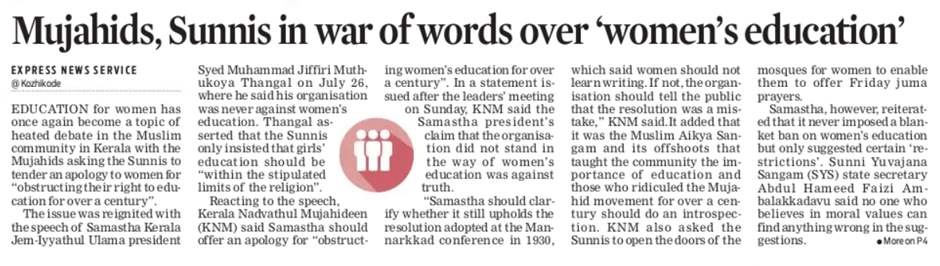
I came across this news today. It is comforting to know that there are members of the Muslim community in India who are fighting for unrestricted women’s education.
Samastha earlier had conveyed that a Muslim woman’s education should be encouraged but within religious restrictions. This became a point of debate across the state of Kerala, with many progressives calling it problematic. However, the most striking response came from a group within the community – the KNM. The organization is demanding that Samastha apologize for its take. KNM is not without its faults, but the stand they took on this particular issue is noteworthy.
Samastha and KNM
To the uninitiated, the “Samastha” group in Kerala refers to “Samastha Kerala Jamiyyathul Ulama,” an influential Sunni Muslim scholarly body in the state. Samastha plays a significant role in managing religious and educational institutions, including madrasas and mosques, and often issues guidelines on religious matters.
The term “Mujahids” in the context of Kerala typically refers to the Kerala Nadvathul Mujahideen (KNM), a prominent Islamic reformist organization in the state. The KNM often contrasts with traditionalist groups like Samastha, promoting a more modern interpretation of Islam, such as advocating the opening of the doors of mosques for Muslim women to enable them to offer Friday juma prayers.
Restricting Women’s Education on Religious Lines
If we connect religion with education, the progress of women in our country will be hindered. Afghanistan is a live example of this. Currently, girls in Afghanistan are generally allowed to attend school only up to the sixth grade. The Taliban, who regained control of the country in August 2021, have imposed severe restrictions on girls’ education beyond this level. Secondary education for girls (grades 7-12) has been largely suspended, and there have also been significant restrictions on female university students, including the closure of universities to women in late 2022. These measures have been widely condemned by international organizations and human rights groups. The global campaign #LetHerLearn, which advocates for Afghan women’s right to education, is gaining traction.
India is no Afghanistan. Here, women are allowed to study without restrictions regardless of religion. Women who are limited to religious studies may face challenges in the corporate world. It would severely restrict their job opportunities in a secular country like India, where well-paid corporate jobs often require you to engage with a global audience and follow strict academic and professional protocols that might not always adhere to religious lines.
Jobs cannot be built around religion in a democracy. Corporate jobs often require specific skills such as critical thinking, teamwork, leadership, and digital literacy. Religious studies may not always focus on developing these skills, which can impact the ability to perform effectively in a corporate setting.
Unfortunate Consequences
What happens when there are limited job opportunities for women due to religious restrictions? They will end up staying at home. Marriage becomes the only option. Financial independence becomes a distant dream.
It is ultimately up to the Indian Muslim woman to decide. If she wishes to pursue further studies, she should not be shamed.
Indian Muslim women deserve quality education, just like anyone else in India. We should have more Indian Muslim women in top positions in the corporate world. Currently, they are practically non-existent outside of Muslim countries. However, to make this happen, there need to be some reforms within the community that will help the women integrate more seamlessly into the existing corporate structure.
***
Picture Courtesy: The New Indian Express (July 2nd 2024, Kerala Edition)
Sidharth was found dead at a college campus in Wayanad. The police initially downplayed things and declared that it was death by suicide. It was when a few friends visited Sidharth’s dad and emotionally told him there was more to the issue than what meets the eye that things started falling to light.
A post-mortem was conducted. Several attack wounds were found on Sidharth’s body. His stomach was found empty, indicating he had not eaten (or was not allowed to eat) for a day (or more). There were wounds on his neck, which experts say is unusual in a typical case of suicidal hanging (reference).
SFI students were found guilty of torturing Sidharth. He was stripped to his underwear, beaten mercilessly to exhaustion, had his phone taken away so he couldn’t contact anyone, and left without food and water (allegedly for days).
Why Was Sidharth Tortured?
Why SFI members in the Wayanad campus tortured Sidharth is unknown. Many stories are floating online:
Some SFI members say Sidharth was involved in a sexual molestation case (which was filed days after his death). SFI has been using that reason to justify the beatings and wounds.
Yet some others say it’s a severe case of ragging. However, which student faces ragging in his second year?
Some say it is because he proposed to a Muslim girl on Valentine’s Day. Prominent personalities, like the Governor of Kerala, have constantly accused SFI of harboring members of the PFI (a banned terrorist group) (reference). PFI (like ISIS) is said to be strictly against men from other communities pursuing Muslim women. They are said to “school” such people violently so that no one else would dare to commit such a “sin” again.
Then there are others who say it was a case of jealousy. The boys around Sidharth apparently did not like his growing popularity.
One section of the media says Sidharth was beaten up simply because he danced with senior female batchmates on Valentine’s Day.
However, nothing justifies his death. No student deserves to be brutally tortured this way, no matter what the issue.
Arrest of SFI Members
All SFI members accused of torturing Sidharth have been arrested (details).
Meanwhile, the Chief Minister of Kerala, Pinarayi Vijayan, is painfully silent. The champion of free speech and democracy has nothing to say about the issue. No condolences, no visits to Sidharth’s parents, and no strict actions against the SFI cadre. Why? Because his own student party is involved. If other parties had committed the same crime, he would have been the first person to thrash them.
Students in Kerala are scared to speak up against SFI. They wish to complete their studies in peace. It took a few North Indian students to report this case to the police. Only one Malayalee girl so far has been brave enough to come forward (details), requesting anonymity, condemning the SFI members of their crime. She revealed with tears how even friends turned foes and acted like vultures preying on the victim. She said she was scared, which is why she didn’t speak up sooner.
The same youngsters who are quick to criticize BJP and RSS maintain pin-drop silence when SFI/CPM is involved. This is concrete proof of the unprecedented authority SFI/CPM commands in Kerala – people are scared to criticize them. This stands in contrast to the type of authoritarianism attributed to the BJP, as criticism of the BJP does not evoke fear among the populace.
The Kerala Story
It is saddening that students in Kerala are threatened and bullied by party goons and are stopped from speaking against injustice.
How can parents send their kids to a college in Kerala with peace of mind if even our Chief Minister turns a blind eye to crimes in the state? Pinarayi has come up with many reforms to improve education, but why isn’t he focusing on the safety and security on college campuses? Why doesn’t his government take strict actions against SFI members who commit crimes as soon as he hears such news that is backed by concrete evidence? It took the governor, Mr Arif Khan, to suspend the VC after he was found incompetent to ensure decorum in the Wayanad campus.
SFI seems to have autonomy in many colleges. They are the only party present because they don’t allow the formation of other parties. Is this democracy? Is this freedom of speech?
Kerala is not the perfect peaceful state as it is portrayed to be.
Justice for Sidharth
How far will this case go? Will it be buried from the limelight in a few months? Will Sidharth’s parents get justice?
It’s heartbreaking to see his father’s emotional, tear-laden eyes in news channel discussions, while the SFI members watch on impassively without an iota of regret or compassion. Instead of defending their party, SFI and CPM members should be focusing on how to prevent such incidents in the future. Their lack of accountability is infuriating.
Congress party members, especially the Youth Wing, have shown remarkable solidarity by organizing marches against SFI and CPM in Kerala. In my opinion, Congress and other parties should call for the ouster of CPM from the I.N.D.I.A block until they ensure all criminals involved in Sidharth’s death are sentenced to several years of non-bailable imprisonment. They shouldn’t be released on meager grounds, which the CPM is capable of doing once the election is done and dusted. Many have lost hope in the state government. They don’t expect a fair trial.
BJP and RSS have been disappointingly absent. BJP members have supported Sidharth, but it is not the aggressive type we would have expected out of them. To win in Kerala, they must step up, be on the ground, and fight for causes with vigor. They should openly show solidarity, walk with the people, and address their issues.
Social Media Awareness
Social media is uncomfortably silent about this issue. Many in India would have fought for Sidharth if they knew there was a problem. But they aren’t aware because the media is not reporting the issue enough, and people in Kerala are scared to speak up about it. The ruling party in Kerala also knows how to cover up and downplay issues with lies and excuses, which their leftist supporters endorse without question.
I would request all political parties, whether the left or the right, and their supporters to forget their ideological & political differences and unite to fight against such crimes in Kerala. Only then will there be faith and forgiveness, a feeling of safety and security.
I wish I could link an explainer video for those unaware of Sidharth’s case. But sadly, no mainstream English-speaking or Hindi-speaking YouTuber, like Dhruv Rathee or Soch by Mohak Mangal, has covered this issue. More people should speak up so that no other student here again faces this kind of crime.
If you are a Keralite who prefers not to speak against political parties, I would advise you to use the most powerful tool in your possession – your vote – to express your disappointment. Similar crimes have happened way too often in Kerala, and we keep forgiving them. We should stop being lenient.
If you wish to learn more about Sidharth’s case, search for #JusticeForSidharth or #JusticeForSidharthan on Twitter or Facebook. Here’s hoping you would lend your voice to this fight against injustice.




 The Monkey Dilemma
You must be logged in to post a comment.