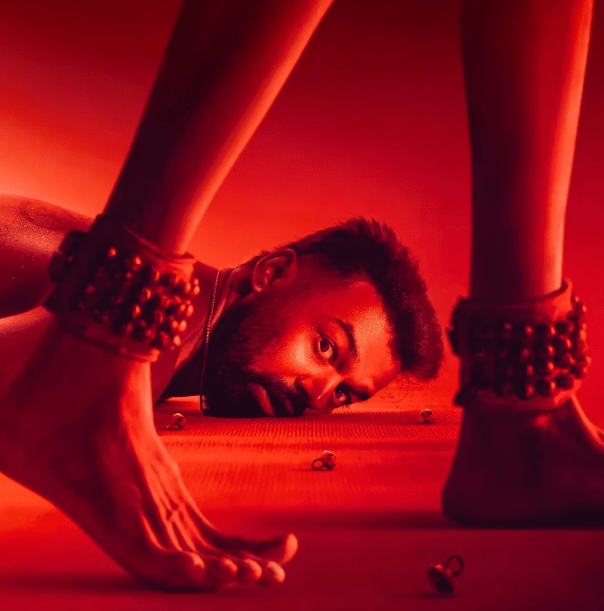
Feminichi Fathima is a Malayalam movie I had been waiting to watch for a long time. The film received strong appreciation at several film festivals. Many critics also spoke highly of it in their reviews. Now that it has finally released on OTT, the wait feels worth it. After watching the film, I can say it truly lives up to the praise it received.
The movieis a bold and thoughtful effort by director Fasil Muhammed to explore feminism from the perspective of a Muslim woman. This is a refreshing shift in Indian cinema, where feminist narratives are often shown through a cultural Hindu lens. Films like The Great Indian Kitchen (Mrs. in Hindi) and Thappad shaped much of that earlier conversation. Against that backdrop, this film feels timely and necessary. It adds a new voice to discussions on gender, faith, and everyday patriarchy.
What’s It About?
Fathima is married into a conservative and deeply religious family in the Malappuram district in Kerala. Her husband is a usthad (a religious leader) who expects his household to follow every rule without question. Life in the home is seen only through a strict, conservative lens.
Trouble begins when their young son wets the mattress. Fathima cleans it and leaves it outside to dry, but a dog later urinates on it. Since dogs are viewed as ritually impure, her husband reacts with anger and disgust. What follows is Fathima’s quiet struggle to fix the situation, facing resistance at every step.
The film makes a strong point that a woman in religious clothing can also be a feminichi (a slur often used by Malayalee misogynists to dismiss feminists).
Thoughts
Shamla Hamza and Kumar Sunil deliver standout performances. Shamla Hamza, in particular, is remarkable throughout the movie. It is hard to believe this is only her second project, after 1001 Nunakal, released in 2022. She performs with the ease and control of a seasoned actor. Her expressions carry much of the film’s emotional weight. Shamla winning the Kerala State Film Award for Best Actress feels well deserved. The storyline is fresh and quietly rebellious, which makes her performance even more powerful.
In many ways, the film feels braver than other feminist movies. Dissent is rarely encouraged in conservative Muslim families, which makes this narrative more powerful. The story shows how questioning norms itself becomes an act of courage. That is what sets this Malayalam feminist film apart. It opens space for conversations that are often silenced. Ideally, it will inspire more Feminichi Fathimas to speak up and stand for their rights.
Even though the subject is heavy, the movie never becomes overwhelming. It avoids melodrama and keeps emotions grounded. Light comedy is woven into the narrative. This balance makes the film feel surprisingly breezy. The pacing is tight and engaging throughout. You can easily watch the full 1.5 hours in one sitting without needing a break.
I would call this movie a must-watch for anyone interested in meaningful Malayalam cinema. Feminichi Fathima is now streaming on Manorama Max. You can also watch it via Amazon Prime with a Manorama Max subscription. English subtitles are available.
I recently came across a video featuring an interview with Stalin Devan, the activist managing the legal research and paperwork for Munambam. In this interview with Shajan Skariah, Stalin shares that Father Joshy added him to a WhatsApp group with the Munambam residents and said, “Explain one point from the Act every day in simple words.” Over time, Stalin became their legal guide, and his efforts are one of the main reasons the community now understands the law so well.
The interview was informative in many ways. At a time when there is still no clear update from politicians or the media on what is actually delaying the resolution for Munambam, even after the Waqf Amendment Bill was passed, Stalin explains the situation with complete clarity.
A screenshot of the video
The Three Possible Legal Outcomes for Munambam
According to Stalin, there are three possible solutions for Munambam:
The government restores revenue rights immediately. This can be done at any time if the Chief Minister approves an administrative order restoring those rights.
If the Supreme Court upholds the High Court order declaring the land not Waqf, all cases, tribunal, revenue, and others will automatically end.
If the Supreme Court rules otherwise, the next legal step will rely on the amended law using Section 2A.
Why Section 2A Cannot Be Used Yet
Earlier, I assumed that recent positive court developments were on the basis of Section 2A. I later realised that was incorrect. Stalin’s interview clarified it. He said:
“We must wait for the rules to be notified. Only after the rules come into force can we use the amendment. As soon as the rules are published, we will file a new petition before the Waqf Tribunal. Once the new rules take effect, the Waqf Board’s order cannot survive.”
It was only through him that I learned the rules tied to the amendment have not yet been fully implemented (central rules were notified in July 2025, but further steps, such as central and state compliance and the ongoing Supreme Court matter, are still pending). Once implementation of the rules is complete, Munambam will be able to use the amendment (Section 2A) fully to establish its rights.
This is where politics begins to overlap with law.
Where Politics Meets Law
Stalin said:
“When everything is resolved, people should celebrate and then withdraw the protest with dignity. But politics entered the issue, and some withdrew support — not because the problem is unresolved, but because they feared the BJP might gain political mileage.”
This is why I feel that even though BJP is the party that helped Munambam with the establishment of new Waqf amendments that can prove favourable to Munambam residents, the Congress-led alliance (UDF) may still win the election there.
Strategically, it makes sense. Now that they’ve pushed the BJP to change the Waqf rules, Christian voters can continue supporting the party they feel protects their religious interests, especially one that does not interfere with missionary activity.
UDF has traditionally been the preferred choice of many Christian voters in Kerala. However, their position on the Waqf Amendment has not aligned with what Munambam residents expected or hoped for. Even so, Christian voters may still continue supporting UDF, largely because they align with the coalition’s lack of anti-conversion sentiment.
Why Timing Matters to BJP and CPM
Here’s where it gets interesting. What follows is only my analysis, not a confirmed claim:
As mentioned earlier, the amendment becomes fully usable only after the remaining implementation steps (central and state action, portal uploads, surveys, and Supreme Court clarity). That process can take months, sometimes more than a year.
Because of that, the timing is now in the hands of both the Central Government (BJP) and the Kerala Government (CPM). Residents say Rijiju has not been active recently. It is possible that the central leadership is waiting to see how the political situation evolves before re-engaging. The BJP may already understand that, even with the support they are offering, they might still not gain full trust or support from the Munambam Christian community. Religious identity often influences decisions more than political assistance. BJP may choose to wait and see whether their support translates into goodwill before offering more help or speeding up the process. In short, they might be waiting for election results to analyze public sentiment.
Meanwhile, CPM has not yet updated or published Waqf lists in the state gazette or uploaded them to the central portal. This is of utmost importance to implement the waqf amendment. CPM has not given explicit technical reasons for the delay.
Current Status of the Waqf Amendment Process (December 5, 2025)
Central Government (BJP)
The Act itself was published and came into force in April 2025. Rules were notified in July 2025. But implementation is still pending: WAMSI portal digitization is incomplete, nationwide surveys and audits have not been done, and the Supreme Court stay since September blocks key provisions.
The central government’s delay primarily reflects implementation challenges. However, political considerations may also play a role, as governments often pace sensitive rollouts based on election outcomes and political advantage.
Kerala Government (CPM)
CPM has not published Waqf lists in the Kerala state gazette. Nor have they uploaded lists to the central portal (90-day deadline under Section 2A). Waqf Tribunal and Board procedures are not aligned yet.
The Kerala government’s delay appears more political in nature. They seem to be officially resisting the amendment.
My view is that the full rollout (central setup, state compliance, and Supreme Court resolution) will now unfold at a pace influenced by political timing. Legally, the delay should not be indefinite, but in practice, regulations and execution can remain pending for a long time if the government chooses.
Why Munambam’s Leadership Is Remaining Neutral
Politics has made the situation complicated.
Many in the Munambam Land Protection Council do not want the BJP to gain politically, but they appear to be trying to remain neutral as the process is still unfinished. The ball is still in the court of both CPM and BJP. This may also explain why Church leaders reportedly asked Joseph Benny, the head of the Munambam Land Protection Council, to withdraw from the election as a UDF candidate. Any outright political affiliation may prove disadvantageous to Munambam residents at this stage.
When my mother heard Janhvi Kapoor speak Malayalam in Param Sundari, she said, “That’s how Tamilians in Kerala speak.” So I’m guessing Janhvi’s character in Param Sundari is meant to be Tamilian. She does say a line in Tamil at the beginning, which might be the clue.
Still, it’s odd that her ammavan (Renji Panicker) speaks flawless Malayalam, while his son Venu, who grew up in Kerala, speaks Malayalam with a Tamilian accent. Not exactly consistent. Maybe he picked it up from his best friend, Janhvi’s character?
You will have to make similar conclusions and cook up your own stories to stay at peace with several things in the movie.
What’s It About?
Param, a wealthy start-up enthusiast, heads to Kerala to prove to his father that his newly funded dating app is worth the investment. At a resort there, he meetsSundari, and a love story quietly begins to unfold.
Thoughts
If you ignore the stereotypes, the sardar friend’s racist jokes, and the painfully bad Malayalam, it’s actually not such a bad movie. The first word that catches you off guard is when they pronounce Alappuzha as “Aalapozi.” I’m not sure if it was intentional. But yeah, leave behind your brain while watching this one.
The real star, of course, is Kerala. My state has been beautifully captured from start to finish. So, kudos to the filmmakers for that.
Janhvi looks lovely and delivers a stronger performance than Sidharth Malhotra. He also looks way older than her in the movie.
Like many, I found the movie’s name, Diés Iraé, tricky to pronounce. I’m quite sure I’m still saying it wrong. But the offbeat name adds to its charm. For those who don’t know, Diés Iraé is Latin for “Day of Wrath.” It’s a term from Christian theology referring to the day when souls are judged.
The first time I heard about Diés Iraé was when I went to watch Lokah. The trailer of the movie immediately captured my attention. The execution looked stylish, and Pranav Mohanlal looked good. I knew then that I had to watch this movie in a theatre.
What’s It About?
A young, wealthy man who lives life to the fullest begins experiencing strange supernatural events in his home after visiting the house of an ex-fling who was found dead in a well. The restless spirit haunting him seems furious for unknown reasons and determined to destroy his life.
Thoughts
Since Diés Iraé is a horror film, only adults were allowed inside the theatre. An ID card was required. The theatre I went to was almost empty, which I actually didn’t mind. It meant no one was around to make unwanted comments or jokes. This has become a real problem in many Kerala theatres. I faced this issue when I went to watch Bramayugam. I hope the film industry or theatre authorities take strict action against such behavior. If they want to attract more viewers, they must ensure a respectful environment. Otherwise, serious movie lovers will simply wait for the OTT release and enjoy the film peacefully at home.
Getting back to Diés Iraé, I wouldn’t call it mind-blowing. The special effects were impressive, though. Nothing looked fake or unintentionally funny. Pranav Mohanlal delivered a decent performance, and he looked great on screen, which helped balance out a few of his less convincing moments.
There are a few jump scares, so be prepared for that.
Overall, the story felt average. If you’ve seen a lot of horror films, this one might not surprise or scare you much. Still, the execution was solid, and the fact that a film of this scale and quality came from Kerala is definitely something to be proud of.
The creepiest part was seeing the line “inspired by true events.” I didn’t dare look up what those events were. Some things are better left unresearched if you want to sleep peacefully at night.
I would say Diés Iraé is a good one-time watch. At under two hours, it’s a quick and engaging film that keeps you entertained throughout.
Odum Kuthira Chaadum Kuthira is a Malayalam movie that didn’t get glowing reviews. Still, I decided to give it a shot, because over time, I’ve learned that my taste rarely matches what others say. I’ve liked movies that everyone else trashed, and I’ve dropped shows that got rave reviews.
Take Bads of Bollywood, for instance. I quit after three episodes. The humor just didn’t click with me. The Emmy winner, Severance, on Apple TV? I made it to five episodes before giving up. It was too slow for my liking, and yes, I shamelessly looked up the spoilers for both because I couldn’t sit through the rest.
Serious movie fans and critics might think my choices are questionable. And that’s fine. I’m not trying to be anyone’s go-to person for movie recommendations. I watch movies for one simple reason: to be entertained. If a film or show keeps me hooked, that’s all that matters. I’ve also noticed how people often get shamed for liking a movie that others dislike, or for disliking one that everyone praises. This makes many stay silent about their opinions. My attempt at being open is simply to break away from that.
So, with that mindset, I started watching Odum Kuthira Chaadum Kuthira. I didn’t expect much, but I ended up being pleasantly surprised.
What’s It About?
Odum Kuthira Chaadum Kuthira opens with the wedding preparations of a quirky couple. On the night before the wedding, the bride visits the groom with an unusual request: she wants him to arrive at the venue on a horse. It’s her dream, she says. Or rather, it’s something that keeps recurring in her dreams. She believes the dream will stop only if he makes that grand entry for real. The ever-romantic groom agrees without hesitation. But what follows is a chain of chaotic events that quickly spiral out of control.
Thoughts
Unlike most recent Malayalam movies, Odum Kuthira Chaadum Kuthira is not dark, intellectual, or overly smart. The type critics will rave about. And it’s not meant to be. It’s a crackpot of a film filled with quirky, eccentric characters, and that’s exactly why I liked it. I enjoy seeing wacky personalities on screen, the kind you’d find in Andaz Apna Apna. This kind of comedy works for me. It’s not vulgar, it doesn’t demean women, and it’s genuinely funny.
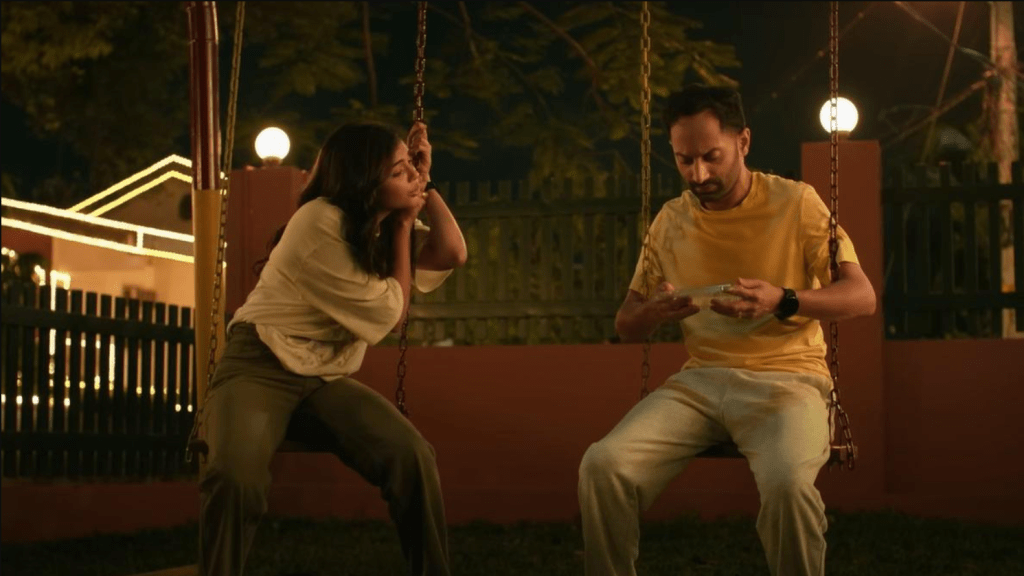
The movie feels like a group of friends coming together to create something chaotic just for fun. More like a personal, experimental project than a polished production. Kudos to Fahadh Faasil and the team for taking that risk. I especially liked Lal’s character as Fahadh’s father, and I thought Revathi Pillai shared better chemistry with Fahadh than Kalyani Priyadarshan did.
I wish the ending were better. It was underwhelming, but that did not take away the fact that I enjoyed the majority of the movie.
Watch it if you’re in the mood for something silly, unserious, and refreshingly offbeat. Don’t expect a masterpiece: just expect a fun, wacky ride to unwind after a long day at work. Odum Kuthira Chaadum Kuthira is now streaming on Netflix.
As someone who’s chronically online and keeps up with news from all kinds of sources, mainstream, regional, left, and right, I’ve noticed something important: Christians in Kerala don’t really have a go-to political party anymore.
For a long time, people assumed the Indian National Congress (INC) was the party in Kerala that understood what every community wanted. But that idea seems to be changing fast on the ground.
Communal Conflicts in Kerala: Who Supports Whom?
If you’re new to Kerala politics, here’s a simple way to understand how parties respond to communal issues here:
Hindu vs Minority: CPM and Congress usually back the minority community.
Upper Caste Hindu vs Lower Caste Hindu: CPM and Congress generally side with the lower caste.
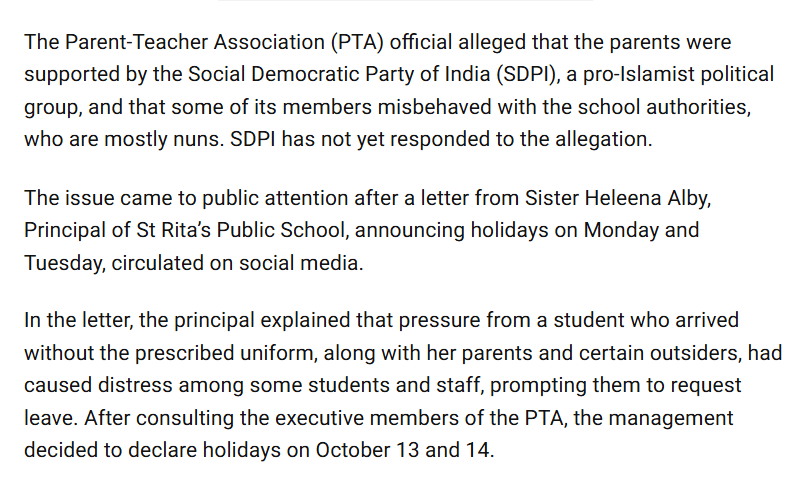
Christian vs Muslim: CPM and Congress often stay neutral at first, saying things like “we’ll look into it,” but in the end, they tend to side with Muslims. Examples include the Munambam Waqf issue, Professor Joseph’s case, Sona Eldhose’s conversion, and incidents involving SDPI bullying, such as the hijab case at the Christian-run St Rita’s school in Kochi (details in the image below).
News Source: “Hijab controversy forces school in Kochi to close temporarily after parents’ protest” (Mathrubhumi.com)
If you look at any case in Kerala, the pattern more or less stays the same. I’m not sure about regional politics in other states, but I suspect it’s similar elsewhere.
While BJP clearly positions itself as a Hindu party, there’s a growing sense in Kerala that Congress and CPM lean pro-Muslim. Why? It’s not really about religion. It’s about vote-bank politics. Christians are a minority among minorities in Kerala, so pandering to them doesn’t win many votes and can even cost support from other minority groups.
Growth of Chrisanghis in Kerala
Now, in Kerala, there’s a growing group called “Chrisanghis,” a term left-leaning voices like Arundhati Roy have used. These are Christians who support the BJP. Arundhati recently warned Christians in Kerala not to become Chrisanghis, citing conversion attacks in the North as a concern.
So why do some Christians support the BJP? It’s because they view Islamist groups like SDPI and Jamaat-e-Islami as a bigger threat than BJP. Many point to the persecution of Christians in countries like Nigeria by Islamist groups and feel that, compared to such threats, the BJP’s Hindutva agenda poses a lesser danger. At the same time, parties like Congress and CPM often downplay or ignore the activities of these Islamist groups in India, mostly for political gain, leading some Christians to see BJP as a safer option.
News Source: “Congress in a fix as Jamaat arm readies to back theocratic state” (NewIndianExpress.com)
Notably, Jamaat-e-Islami has frequently been in the news, even recently, for persecuting minorities in Pakistan and Bangladesh. In India, its branch presents a secular image, likely to gain acceptance and influence within mainstream politics, using it as a pathway to gain power.
It’s also true that Kerala’s two mainstream parties have largely ignored such concerns from the Christian community. Their typical response is often, “Don’t fall for RSS/BJP propaganda,” even when the issues have nothing to do with RSS or BJP.
Thoughts
So what can the Christian population in India do in this situation? On one side, there’s a pro-Hindu or “Hindutva” party that will never fully accept conversions under “freedom of religion,” and on the other, there are parties that haven’t supported Christians when they faced threats from Islamist groups.
From my perspective, Christians should keep all parties guessing about where their votes will go. They shouldn’t strongly back any party, since none fully meets their needs. Take the Munambam Waqf issue, for example: the removal of Section 40 in the Waqf Bill allowed the Kerala High Court to rule the Waqf claim over Munambam land as illegal, protecting Christian landowners. Congress leaders like Hibi Eden tried to persuade residents to drop their case, saying nothing would come of it, while the only BJP MP from Kerala, Suresh Gopi, stood by the people, largely comprising Christian fisherfolk, and supported the amendment that ensured their land rights.
When missionaries face attacks by far-right Hindus in the North, that’s when Opposition parties step in. But in cases like the Chhattisgarh nuns’ arrests over alleged conversions, the local Congress in Chhattisgarh hardly protested, as taking a stand would have cost them votes. On the other hand, in Kerala, protesting the arrest of the nuns would have earned them support, which is why several Opposition leaders from Kerala traveled to Chhattisgarh to show solidarity.
This shows that Christians can’t rely fully on any party and should strategically make their political influence felt.
This is how politics works: there are no fixed principles for political parties. They act based on the local political context. Christians in India should remember this and avoid fully backing or rejecting any party. Instead, they can use this knowledge strategically and wisely, since different parties support them in different situations.








You must be logged in to post a comment.