I finally watched The Kerala Story 2 trailer because the noise around it became impossible to avoid. I had stayed away from watching it till then, hoping we would collectively ignore it.
The trailer begins with a call to “convert India into a Muslim nation.” That kind of rhetoric comes from extremist outfits like PFI, not from everyday Muslims. It’s in PFI’s “India 1947” doctrine, available online. But the moment a film shows Islamist extremists, people immediately react as if the entire Muslim community is being insulted. That jump is what frustrates me. The trailer is clearly about extremists, not ordinary people (also confirmed by the makers).
I keep seeing reels saying, “Where in Kerala is this? This is nothing like Kerala.” Exactly. It is not about the regular Muslims we meet every day. It is about fringe groups.
When the movies, Bombay or Empuraan, showed Hindu extremists attacking Muslims, no one claimed the film insulted all Hindus, and that it was an insult to Bombay and a generalization. When films show fringe Hindutva groups, we do not accuse the filmmakers of attacking every Hindu. So why is criticism of Islamist extremism treated as an attack on Muslims as a whole? This inability to separate ideology from community makes any honest conversation impossible. And political groups thrive on that confusion.
I thought the film would be ignored this time. I watched the trailer only to understand the hype. Otherwise, I would not have bothered. And once again, the makers got free publicity because controversy sells.
The director’s NDTV interview
In an NDTV interview, the director was asked why he named it after Kerala again even though the film covers incidents in multiple states. His answer was very simple. He said he got attention for the first film because of the name “Kerala.” So he used it again to get the same effect. It was a marketing strategy. And we fell for it.
He also mentioned that the film connects certain cases to networks like Chhangur Baba’s. According to him, these networks have a specific goal in mind. Again, he presented this as the reasoning behind the storyline, not as a statement on all Muslims.
The song and the real-life cases
The song O Maayi Ri, sung beautifully by Shreya Ghoshal, reminded me of the emotional interviews with the mothers of victims (some notable victims include Nimisha, Sonia Sebastian, and Merrin Jacob). They begged for their daughters to be brought back from ISIS camps in Afghanistan. The girls, as per officials, were too radicalized to be brought back home. No country easily brings back citizens who have a soft corner for a terror group. Many countries around the world refuse repatriation because of national security concerns.
And Kerala has had some troubling conversion-related cases too.
There is the case of Sona Eldhose, who was allegedly forced to go to Ponnanifor conversion.
There is also the story of Kamala Surayya, discussed in the book The Love Queen of Malabar. According to the book, she was encouraged to convert with the promise of marriage made by a mainstream political figure. Once she converted, he backed away. The book also mentions foreign funding from the Gulf that influenced the situation.
These cases do not define Kerala as a state, but they exist. They cannot be erased from the larger conversation.
Kerala’s habit of defending itself too quickly
What irritates me is how quickly Keralites jump into defensive mode. The moment someone brings up extremist incidents or conversion cases, people post “This is the real Kerala story” along with photos of communal harmony and Onam celebrations. Those moments are beautiful, but they do not cancel out the darker stories. Kerala can be progressive and safe while still having pockets of extremism. That duality is real. Acceptance does not mean defamation. In fact, acceptance is the first step toward accountability.
My issue with the beef discourse
Beef in Kerala has become a political symbol. I eat beef, but I am not here to prove that “I am a Hindu who eats beef. I’m so cool.” I am also not going to claim that Hindus who eat beef are not real Hindus. Those extremes mean nothing to me.
There are actual cases of people being forced to eat beef by partners or relatives. A basic online search shows plenty of such stories. So mocking that scene in the trailer becomes insensitive because coercion is not fictional for some people.
What makes the discourse more insensitive is the constant use of beef as a political prop in Kerala. Historically, beef has been used to hurt Hindu sentiments and harass certain groups. As someone who eats beef, I have never felt proud of it in a political sense. It is food. We can all eat what we like, but weaponising it feels disrespectful.
Even the MSF, the youth wing of the Muslim League, called out the SFI beef fests happening on campuses. They said it is insulting to those Hindus in Kerala who consider beef unholy. They added that they themselves would find it offensive if there were pork fests. Whether political or not, they made a fair point. Sensitivity should work both ways.
The political angle behind the controversy
This is something I have been observing closely. In my opinion, the controversy did not naturally explode. It was amplified politically. The first major reaction came from CM Pinarayi Vijayan on X. Once he reacted, his supporters followed, and the discussion spiralled from there.
I believe his response was a political strategy to position himself as the protector of secularism in Kerala. He had lost support earlier due to his association with Vellapally Natesan and also the Sabarimala gold case. His tweet seemed carefully framed as the Kerala election is near. He even highlighted that Kerala has not seen any communal riots in the last ten years, which also happens to be the period during which he served as Chief Minister.
Whether intentional or not, the film’s visibility multiplied because of this political reaction.
Why the title still annoys me
The title “Kerala Story Goes Beyond” suggests that Kerala is some central hub of Islamist extremism, which is simply not true. Kerala is safe. Hindus are safe. Fringe groups exist, but the narrative of “Hindu genocide” is false.
At the same time, filmmakers have always used region names to provoke reactions. Movies like Bombay did not lead anyone to generalise the entire city. Shows like Delhi Crime did not make people say Delhi is entirely unsafe.
But names like Kashmir or Kerala grab attention instantly. Filmmakers know this. It is part of the business. And audiences fall for it every single time.
Final thoughts
Kerala has many stories of harmony, culture, and peaceful coexistence. But Kerala also has some unsettling stories involving extremism, manipulation, and political strategy. Both realities can exist together. Loving a state does not mean denying the uncomfortable parts. Real progress and intellect come from honest acknowledgement.
I recently watched Nobody Wants This Season 2. If you haven’t seen Season 1 of this Netflix series, I really think you should. It deals with a topic that most interfaith love stories never touch — conversion. It’s a sensitive issue, especially among Abrahamic religions. So it felt quite bold that the makers decided to go into it at all.
Season 1 had already touched on the idea of conversion. But Season 2 takes it a little further. This time, you see the boyfriend, who is a Jewish rabbi, and his family, constantly pushing his Christian girlfriend, who seems more atheist or maybe agnostic, to convert. It adds a new layer to their story and makes the whole situation feel even more complicated.
However, this post is not a detailed review of the series, but the many thoughts that came to my mind while watching it, mainly concerning conversion and how it is seen in India.
There are many abroad who have a distorted idea of religious freedom in India, no thanks to misleading, half-baked news articles, often written by left-leaning Hindus or non-Hindus, and I wish to debunk those notions as well and present them from the perspective of a centre-right Hindu who was, till two years ago, a leftist.
Be prepared for a long post, because this is a topic I feel strongly about. If you’re short on time, you may want to save or bookmark it and read it when you’re free.
A Hindu’s View on Conversion
Before I begin, I want to make my religious beliefs clear. I’m not a religious Hindu in the traditional sense, but I’m still a staunch Hindu. If that sounds confusing, it’s only because Hinduism allows this kind of pluralism. You can be spiritual, non-religious, or even an atheist, and still remain Hindu.
The faith makes space for many ways of thinking, which is why someone like me fits comfortably within it. I’m not ostracized for eating beef, nor am I ostracized for not following religious beliefs properly. I can question and I can push back against religious rules I don’t believe in without repercussions.
This freedom that my belief generously allows me is exactly why I strongly stand by the community and call myself a “staunch Hindu.” I advocate for the rights of my community, which a religious Hindu in India may not always do, as they wish to appear secular and tolerant of even the injustices against us.
Now that my beliefs are out of the way, I want to say that even as a non-traditional, progressive Hindu feminist, I don’t support conversion. I don’t understand why anyone has to give up their identity for love, marriage, or even politics, no matter how much anyone would try to justify it.
Most Hindus in India feel the same way, which is why you rarely see the community protesting against anti-conversion laws in some states. Among ourselves, we often say the same thing quietly: “What’s the need to convert?” Of course, many reasons are given. I address them later in this post.
Then we see Indian-origin Hindu politicians in America converting to Christianity to stay relevant and gain acceptance, and it makes us pause. It makes us wonder, “Is America really the land of the free?” And on what basis do they judge India on religious matters when they themselves have not reached full religious secularism yet?
However, in Abrahamic religions, conversion is considered a matter of freedom of faith. This is acknowledged. But this is also a major reason for communal tensions in a Hindu-majority country like India. Most Hindus do not believe in conversion or proselytization, while Abrahamic faiths consider it a part of their practice.
Hindus are of the belief that everyone should be free to practice their faith without disturbing others or disrespecting anyone else’s faith. Proselytization goes against that idea. It feels disrespectful because it implies someone’s existing faith is not good enough. It involves putting down those beliefs, so they are convinced enough to join the new one. So, this “freedom of faith” often comes at the expense of disrespecting others, which was tolerated for the longest period of time, till the Hindu community got the strength to say “enough is enough.”
This pushback is the part that’s often presented to the world as a “lack of religious freedom” in India. Or, to put it more frankly, the lack of freedom to convert Hindus. This clash of beliefs has no solution, and I see it continuing even after a change of government. It’s a label the country has to live with, because there can be no middle ground when people feel their identity is being erased.
A thought I often hear is, “There are so many Christian-majority and Muslim-majority countries in the world. Why can’t they just leave us alone?” It reflects the frustration many Hindus feel when they see constant pressure to convert despite already being a global minority.
Pressure to Convert in Interfaith Marriages
The topic of conversion in marriages is prevalent in Indian Reddit circles. Almost every other day, you see someone saying, “My partner’s parents want me to convert. What should I do?”
From what I’ve seen, it’s usually the Hindu who is expected to convert. And often, the Hindu partner is unaware of what that really means. They hear lines like, “You just need to get baptized. After that, you can follow your own culture,” and they assume there’s no conversion involved. Many agree because they don’t realize the deeper implications. We walk into these situations thinking others are as pluralistic and flexible as we are, and that’s where the misunderstanding begins.
Conversion is also very normalized. When I ask my Christian friends if someone needs to convert to marry into their community, they casually say “yes,” as if it’s the most ordinary thing in the world.
We recently saw this when JD Vance openly and coolly said he hopes his wife, Usha Vance, a Hindu, converts someday. Ironically, the same line appears in Nobody Wants This Season 2 as well, where the Jewish rabbi says he hopes his Christian girlfriend converts one day.
For us Hindus, it’s a culture shock, almost regressive, because we never expect something like this from others. At the same time, Abrahamics and international news channels are confused when they report that there’s outrage in India over Vance’s statement. They have no idea why Hindus are angry. So they brand it as “far-right Hindutva.”
Why Do Hindus Dislike Conversion?
Most Hindus find the idea of conversion strange, because the religion itself accepts that God can appear in many forms. It is naturally pluralistic. So someone like me, who is not religious, or even someone who is an atheist, is still seen as a Hindu, because schools like Carvaka already accept that. We also tend to readily accept other gods because of this pluralism. We don’t consider them as fake. We don’t believe that ours is the “only true god” either.
This pluralistic mindset of Hindus is both a boon and a bane. A boon because we naturally accept all faiths, and a bane because we expect the same openness from others, and we don’t always receive it.
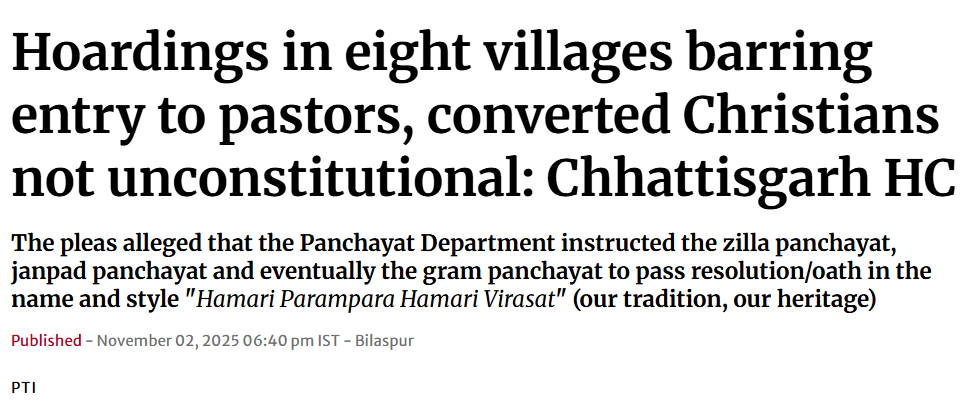
On top of that, many Hindus today focus more on careers and less on having children. So there is a natural tendency to protect the current Hindu population from inducements. The Chattisgarh High Court reiterated the same thing recently:
Chhattisgarh High Court Condemning Induced Conversions
With all this in mind, it’s natural that the majority of Hindus don’t look at conversion in a positive way. Our faith is already mocked by many Abrahamics around the world, who use words like “demon-worshipping pagans.” This makes it even more important to push back against that narrative and simply exist as we are.
Hindus, in short, want the freedom to be seen and respected in their own identity. But this way of thinking is often dismissed by, ironically, the very same people who speak loudly about secularism and freedom of religion. If others believe Hindus can be freely converted, then Hindus also have the right to openly object to it.
Ghar Wapsi
Now, some may argue that even Hindus encourage conversion in the form of Ghar Wapsi (reverting to Hinduism). However, Ghar wapsi is not a core part of Hinduism. It is more of a reaction to the aggressive conversions that have been happening in the country.
Most people I know converted to Abrahamic religions because of perks, not out of faith. They were poor and needed money. They were promised financial benefits if they converted. The fact that they are openly admitting this is nothing any faith should feel proud of. The only reason to convert to another faith should be faith itself. You should feel that the new faith and its principles are right for you, not be influenced by inducements or pressure.
If you ask why the Hindu side can’t match these perks, the answer is simple: we don’t have multiple Hindu-majority nations funding such activities. India is the only major Hindu-majority country, so the playing field is not equal.
Ghar Wapsi is simply an attempt, based on faith alone, to help those who genuinely want to return to Hinduism.
Arguments Used to Justify Conversions in India
1. Charity
There’s this belief that the money given during conversions is out of pure kindness. But I know many Christians who are struggling, working extra hours just to manage their basic needs. If the intention is genuine help, why not support them first?
And, most importantly, why should any help come with the condition of conversion?
Real help doesn’t demand a change of faith. If it does, you have to wonder whether it’s truly help or part of an agenda.
2. Caste Discrimination in Hinduism
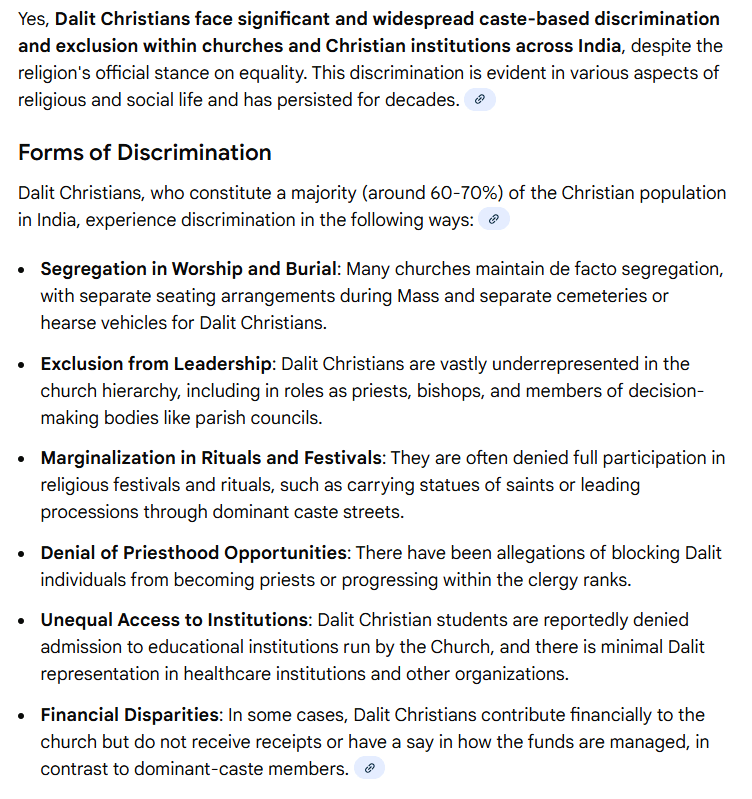
It’s also misleading to say that converted Christians escape discrimination to enter a better way of life after they leave Hinduism. Many are treated as “lower-level” Christians, and some have even gone back to Hinduism because of this.
Source: New Indian Express (July 2025)
Additionally, consider the points made below (took help from Google Search AI):
One person told me about a convert in her family who wants to return but cannot, because they signed a financial help agreement that now holds them back.
The good thing is that the caste system within Hindu society is slowly being dealt with. Families are becoming more open to inter-caste marriages, including in my own family. This change is happening faster in the South than in the North. It’s not perfect yet, but progress is real. In this situation, constantly blaming a community that is actively trying to fix the problem does not help.
Yes, many Hindus still support caste, and as long as they exist, the issue will continue. But this divide is also kept alive by leaders, both political and religious, because it benefits them. If caste truly disappears, many of these leaders lose their power to divide or convert Hindus, and that is why the system hasn’t faded away completely.
Instead of building bridges, the “narrative builders” choose to burn them by feeding divisive stories, which only pushes people of different castes further apart. Missionaries often highlight caste discrimination so aggressively because it helps them drive conversions. So you have to ask — are they really helping, or are they using the problem to serve their own goals?
4. Freedom of Faith
The tricky side of conversion in India is that Hindus openly say they are against it. But in Kerala, I often see Christian groups shift their stand based on who is converting and to which religion. They welcome anyone who joins their faith, but they loudly object when someone chooses to leave it.
Churches often use the term “love jihad” when a Christian woman converts to Islam for love. Yet the same groups talk about “freedom of faith” when a Hindu woman converts to Christianity for love.
Since both Abrahamic religions support proselytization as part of their belief system, you would expect them to be supportive of conversions into each other’s religion. But that rarely happens.
Complications of Conversion in Interfaith Relationships
Spoiler Ahead for Nobody Wants This Season 2
Click to reveal spoiler
Considering the many unwanted complications related to conversion, I was really hoping the female character in Nobody Wants This would take a stand. I wanted both partners to accept that two religions can live side by side without one needing to disappear. The ending didn’t go the way I hoped, but since there’s a Season 3 coming, I’m hoping they fix things and take the story in a better direction.
*Spoiler Ends*
In many interfaith relationships, I notice that the Hindu partner often gives in to the Abrahamic faith — if not through marriage, then through the children.
Take Usha Vance, for example. All three of her children were baptized because her husband couldn’t accept the kids growing up Hindu. That feels like a loss of her own identity. It shows that even an educated woman like her is not fully protected from this pressure.
If it were up to me, ideally, I would want the kids to grow up with both religions. But if we had to choose one religion for my “imaginary” children, I would fight hard to raise them in my own. Purely because Hinduism is naturally pluralistic, and it doesn’t invalidate any other faith. It would also matter to me because Hindus are a global minority, while the other religions face no existential crisis. It’s like the global majority religion being generous enough to make space for the growth of the minority.
Also, if I had to pick, I would choose a court marriage. But if the partner insists on a religious ceremony, then it would have to be a temple wedding. You don’t need to convert for that. You only need to respect the rituals. It’s simple, fair, and inclusive.
This is probably why I feel an interfaith marriage may not work for me. I believe in equality between religions, while an Abrahamic partner may not always see it the same way. There would be constant tension, and I am not the kind of Hindu who would compromise on my identity.
When I was younger, I probably would not have thought this way. Back then, love felt like everything. But growing older makes you see the bigger picture.
Pushback Against Conversions in India
More Hindus today realize that they don’t need to give up their beliefs for anything, which is why you see fewer people willing to convert.
Hindu Villagers in India Fighting Back Against Conversion
This awareness is slowly growing. I recently saw a post on Reddit where an Indian Christian said they felt sad that many Hindus in India are no longer open to conversion or to “the way of the Lord.” To me, this is actually a positive sign for the Hindu community. It shows that more people are choosing to stay firm in their identity.
And honestly, this should be true for every religion, because love and true secularism do not require anyone to change who they really are.
For a major part of my life, I considered Hinduism just a religion. But as you grow older, you enter a stage when you wish to know more. That’s when I realized Hinduism is more than a religion. It’s a broad philosophical framework that accepts a wide range of beliefs, including atheism.
Did you know Hindus can believe in multiple gods or a single god if they wish, but they are also free not to believe in any god if they wish not to? Non-believers are still considered Hindu. They are not ostracized or excluded from the community. This openness is reflected in ancient Hindu schools of thought, such as the Carvaka and Samkhya schools. These schools, although lesser known, even among Hindus, are testaments to Hindu philosophy’s pluralistic nature.
Carvaka: The Atheist School of Hinduism
Carvaka is an ancient Indian philosophy that openly rejects belief in God, the soul, karma, reincarnation, and life after death.
The core idea of Carvaka is that only tangible things, such as those we can see, touch, or directly experience, are real. The rest is fluff. Its thinkers believe that Gods and heavens are man-made concepts designed to control people.
The main focus of the Carvaka school is to live a happy life in the present, without tying your actions to living a good afterlife, because there’s none. The Carvaka philosophy endorses materialism, which is good news for those who are all about living the good life.
In short, Carvaka says, “Enjoy your life here and now, because that’s all there is.”
Samkhya: A Spiritual but God-Free Philosophy
Samkhya is a Hindu school of philosophy that is spiritual but does not rely on the concept of a creator god. Its core idea is that the universe consists of two things: Purusha (pure consciousness) and Prakriti (nature). The goal is to free yourself from suffering by understanding that your true self is not your body or mind, but pure awareness.
Samkhya does not completely deny the existence of God, but rather states that belief in God is not necessary for achieving spiritual liberation. You must have seen this philosophy being practiced through methods such as Yoga.
Personal Beliefs & Their Acceptance in Hinduism
I’m not religious. However, I’m not an atheist either. I’m someone who ardently believes we are all praying to the same universal energy, just under different names, with different rules.
If there’s only one true religion, how does one explain miracles occurring in every faith?
I have had my prayers answered when I was a traditional Hindu believer, praying to Goddess Durga. My prayers were also answered when I prayed to the universe. This has shaped my impression that God is universal, one divine energy known by many names. Each path may look different, but they all lead to the same source. The only thing that matters when you pray is the depth of your emotions.
Hinduism accommodates thoughts like mine. I’m not judged or ostracized for holding such views. The religion does not demand that I conform to rigid principles. Instead, it allows space to question and for my beliefs to evolve. This openness and freedom are what make Hinduism deeply meaningful to me. I can still call myself a Hindu, even without being traditionally religious.
This openness in Hinduism extends beyond individual beliefs to matters like gender and sexuality. Ancient texts and temple sculptures across India depict a spectrum of gender identities, showing that Hinduism has historically acknowledged and embraced LGBTQ individuals. Few traditional religions offer this level of acceptance. That is what makes Hinduism not just a religion, but an inclusive way of life.
A Message to Hindu Youth: Your Religion Is More Open Than You Think
Despite its pluralistic, “modern” nature, many Hindu youth today feel that Hinduism isn’t “cool” enough. Perhaps because its rich philosophy is rarely taught during childhood. Outside India, Hinduism isn’t widely practiced or represented on global platforms, and the Western media often reduces it to stereotypes. There is also a lot of misinformation spread about Hinduism by people who know very little about the religion.
What many don’t realize is that Hinduism is one of the most liberal and inclusive systems of thought in the world. It is secular in spirit, embracing all forms of belief, including atheism. Hindus are free to question religious leaders and traditions without fear of punishment, reflecting the openness and reformative spirit that lies at the core of their faith. This is why you see many Hindus questioning even our religious leaders.
Conclusion
While some Hindu hardliners insist on rigid practices, such views do not represent the true essence of Hinduism. There is no single rulebook. Instead, there are diverse schools of thought that uphold intellectual freedom and individual choice. That is something to be proud of. I hope Hindus remember this when they encounter misrepresentation, hate, and misinformation about our religion and culture online or offline. Rather than accepting distorted narratives, we should take pride in the fact that Hinduism offers space for everyone: believers, skeptics, and reformers alike.
The 2023 report “Anti-Hindu Hate in Schools” by Charlotte Littlewood highlights a critical but under-researched issue: the presence of anti-Hindu sentiment in UK schools.
While this blog post draws upon insights from the report, the broader focus is on Hinduphobia as a global phenomenon – what it means, how it manifests, and the constructive steps that are being taken to address its rise.
The full report can be accessed here: henryjacksonsociety.org/wp-content/uploads/2023/04/HJS-Anti-Hindu-Hate-in-Schools-Briefing-final.pdf
The urgency to examine Hinduphobia stems from the way Hinduism is being misunderstood or misrepresented in Western societies. Many people, lacking a nuanced understanding of the religion, make casual remarks that are often bigoted in nature. They may be considered harmless or culturally acceptable in Western contexts.
This gap in awareness often results in prejudices being normalized, with little accountability or recognition of the harm caused.
What is Hinduphobia?
Hinduphobia is not a term widely recognized in mainstream discourse. In my view, “anti-Hindu bigotry” is a more accurate description, as the issue is not rooted in fear, but in prejudice, hostility, and a lack of understanding. It often stems from the fact that Hinduism operates differently from Abrahamic religious frameworks. This unfamiliarity can lead to stereotyping, dismissal, or open hostility, rather than genuine inquiry or respect.
As per the study, the working definition of Hinduphobia is as follows:
Hinduphobia is a set of antagonistic, destructive, and derogatory attitudes and behaviours towards Sanatana Dharma (Hinduism) and Hindus that may manifest as prejudice, fear, or hatred.
Hinduphobic rhetoric reduces the entirety of Sanatana Dharma to a rigid, oppressive, and regressive tradition. This discourse actively erases and denies the persecution of Hindus while disproportionately painting Hindus as violent. These stereotypes are used to justify the dissolution, external reformation, and demonization of the range of indigenous Indic knowledge traditions known as Sanatana Dharma.
The complete range of Hinduphobic acts extends from microaggressions to genocide. Hinduphobic projects include the destruction and desecration of Hindu sacred spaces; aggressive and forced proselytization of Hindu populations; targeted violence towards Hindu people, community institutions, and organizations; and ethnic cleansing and genocide.
Examples of Hinduphobia
The study lays out several examples that can be identified as Hinduphobia, many of which occur casually in everyday settings. These instances often go unnoticed or unchallenged, largely because Hinduphobia is not yet treated as a serious form of bigotry.
Calling for, encouraging, or justifying violence against Hindus, often rooted in extremist or distorted views of religion and history.
Kidnapping Hindu women and children for forced marriage and religious conversion.
Denying, downplaying, or accusing Hindus of fabricating their persecution, including instances of genocide.
Advocating for the destruction of Hinduism, framing it as inherently irredeemable.
Discrediting individuals who speak about Hinduphobia by labeling them as agents of violent or oppressive ideologies.
Attributing all social issues in Indian society, such as caste, misogyny, sati, communal violence, or temple destruction, solely to Hinduism.
Evoking historical trauma (e.g., iconoclasm, cow slaughter, forced conversions) to intimidate Hindus in modern discourse.
Making baseless claims about the political motives of those simply practicing Hinduism.
Linking antisocial behavior directly to Hinduism, often by selectively sampling data or falsely attributing individual actions to the faith as a whole.
Caricaturing Hindu scriptures through selective citation, mistranslation, or exaggeration, and presenting these distortions as representative of the entire tradition.
Claiming that Hinduism or Sanatana Dharma is not a valid or cohesive spiritual system.
Erasing Hindu civilizational contributions and superimposing Western norms over its historical and cultural identity.
Conflating diasporic Hindu identity with Indian citizenship, nationalism, or ethnicity.
As per my own observation, a contributing factor is the lens through which Hindus are viewed. The bigotry is shaped by the globalized “oppressor vs. oppressed” narrative, often based on selective or misunderstood portrayals of India. As a result, anti-Hindu activities at home or anywhere else are often seen as justified acts of revenge, grounded in the belief that “Hindus in India are oppressing minorities.” A quick look at social media during incidents involving anti-Hindu sentiments offers clear evidence of this bias.
Reactions often downplay or dismiss the issue, and in many cases, even justify the hatred by invoking political narratives, rather than addressing the prejudice for what it is.
Context and Need of the Study
The context and need for the study on rising Hinduphobia in UK schools are explained as follows:
“Hinduism is the third largest religion in the UK making up 1.7% of the population according to the most recent census. From 4 to 20 September 2022, there was civil unrest in Leicester, extending to Birmingham, including vandalism of property, assaults, stabbings, and attacks on places of worship.
The Henry Jackson Society briefing paper, “Hindu-Muslim civil unrest in Leicester: Hindutva and the creation of a false narrative,” evidenced community tensions relating to youth violence and noise control issues in relation to festivals that had been falsely dressed as “Hindutva extremism” and even “Hindu terrorism”, creating fear and resulting in attacks on Hindu temples and properties.
The Network Contagion Research Institute (NCRI) investigated the role social media played in the civil unrest. It concluded that social media narratives have characterised “a vulnerable, diasporic community – British Hindus – as an aggressive, hypernationalist, and fascist threat. Other narratives depicted Leicester Hindus as heretically evil and filthy, playing on age-old Hinduphobic tropes.”
Both the HJS report and the NCRI report noted the use of anti-Hindu slurs such as “cow piss drinkers” and references to polytheism, vegetarianism, physical weakness and mocking of Hindu deities and symbols.
When researchers began examining the unrest between Hindu and Muslim communities in Leicester, they encountered a notable gap: a lack of existing studies on anti-Hindu hate. This absence of research was one of the key motivations behind conducting a dedicated study on the subject.
The report also highlights how Hinduphobia has historically appeared in popular literature and academic discourse. For instance, E. M. Forster’s 1924 novel A Passage to India is cited as portraying Hindus as “perverted,” “clownish,” and “queer.”
Similarly, sociologist Max Weber viewed Hinduism as excessively otherworldly, a perception that contributed to the broader “theological othering” of Hindus. This form of othering continues today in the form of anti-Hindu slurs that mock the religion’s many deities and unique customs.
Another example comes from Allen Greenberger’s 1969 study on Indian stereotypes, where he described common portrayals of Indians as a “childlike race” who were “happy in their passivity, fatalistically so.”
Such characterizations may still influence how the media interprets Hindu behavior and presence. For instance, during and after the Leicester unrest, the press in the UK was criticized for failing to engage with the local Hindu community, instead relying on self-identified Muslim spokespersons who reportedly spread false narratives about Hindus in Leicester.
Moreover, rather than addressing the specific complexities on the ground, mainstream media coverage often diverted attention to political issues in India, as though those could explain or justify tensions in the UK. This approach not only homogenizes Hindus globally but also dismisses their individual and community experiences in diverse contexts like Leicester.
Abrahamic Othering
An interesting terminology used in the report was “Abrahamic Othering.”
The term ‘Hinduism’ was coined by British writers to refer to the family of Vedic religious traditions. Some modern Hindus prefer the name ‘Vedic religion’ or ‘Sanatana Dharma’ (‘eternal law’) rather than the label ‘Hinduism’.
Hinduism has multiple deities understood to be expressions of one ultimate Reality, be it God for theists or consciousness for monists. Hinduism does not follow one scripture but a number of scriptures that are given different emphases by different branches of the faith. Some argue the differences in the denominations are so great that they are separate religions entirely.
The preconceptions of Abrahamic faiths do not map neatly onto Hindu belief. Articulating Hinduism through the Abrahamic lens of Gods and scriptures is therefore problematic.
Respondents to this survey suggested that at least some UK schools continue to teach Hinduism through an Abrahamic lens without appreciating the limits of this approach. This fits with the findings and concerns of the Commission on Religious Education. Given the decentralised nature of religious curriculums in England and the lack of subject inspections in maintained schools, and given the considerable challenge of treating Hinduism sensitively in a UK context, such a finding is disappointing but unsurprising.
There are reports from some surveyed parents that lessons about Hinduism produce confusion and misconceptions about the Hindu belief in the existence of multiple Gods – 106 references were made to inaccurate perceptions of Hinduism with respect to polytheism/idol worship/multiple Gods.
Discrimination Against Hindus in UK Classrooms
Some of the discrimination observed in UK classrooms mirrored the forms of hate witnessed during the Leicester unrest between Hindu and Muslim communities.
In both settings, derogatory remarks were directed at Hindu identity and practices, including mockery of vegetarianism and the belittling of Hindu deities. These same types of insults were used by Islamist extremists during the rallies targeting the Hindu community in Leicester, highlighting a disturbing continuity between localized classroom prejudice and broader communal tensions.
Conclusion Based on Case Studies
Many case studies were conducted as part of the research, and based on these, the following conclusion was drawn:
This report highlights the prevalence of discrimination against Hindus in British schools, with 51% of Hindu parents surveyed reporting that their child has suffered anti-Hindu hate at school.
It is alarming that it is so hard to access information from schools on patterns of religiously-motivated bullying, and that the schools who did respond to this study’s FOI request either did not keep records of faith-based hate incidents or appeared to record very few incidents.
It is also alarming that only 19% of parents surveyed believe schools are able to identify anti-Hindu hate, indicating that the issue is not being addressed adequately. It may be that there is a tendency to downplay such incidents as ‘playground banter’.
However, several studies have observed that faith-based bullying has the potential to be more impactful than other forms of bullying, precisely because it targets not just the victim, but “their entire family, heritage, and culture”.
Schools should reflect on the harm such slurs cause, as well as the wider community divisions they may be helping to foster.
Constructive Steps
Small but significant steps are being taken to address Hinduphobia in Western nations.
Georgia recently became the first U.S. state to introduce a bill formally recognizing Hinduphobia and anti-Hindu bigotry. Similarly, the Scottish Parliament passed its first-ever motion to combat Hinduphobia, marking an important milestone in acknowledging the issue. The motion was influenced by a report on Hinduphobia in Scotland, which can be accessed here: nen.press/2025/02/28/gandhian-peace-society-shares-new-report.
These developments are a positive step toward challenging anti-Hindu bias and promoting awareness that, like all faiths, Hinduism, or Sanatan Dharma, deserves equal respect and protection from discrimination.
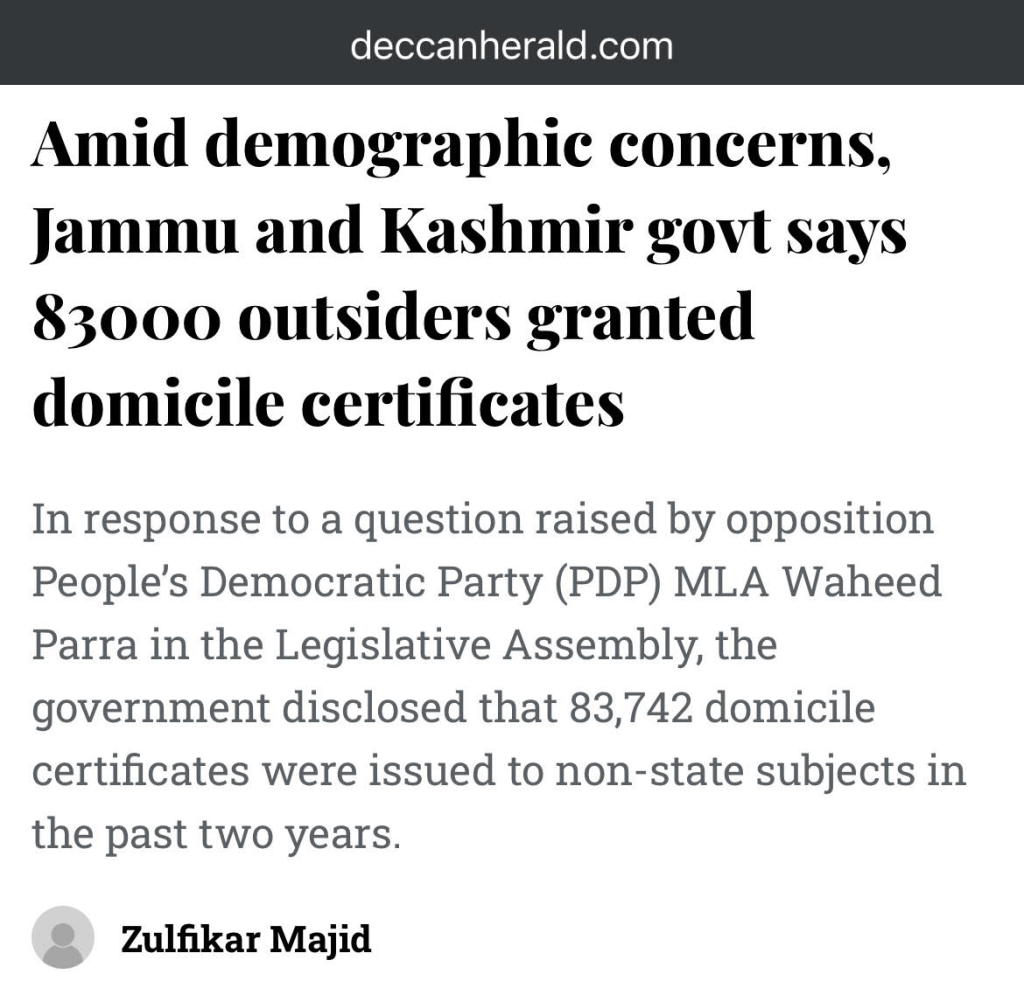
Say the words “demographic concerns” in any other Indian state, and you’d likely be branded a bigot. But in Kashmir, the “insider vs outsider” narrative is not only common, it’s actively pushed. If the Chief Minister, Omar Abdullah, has sworn allegiance to the Constitution of India, why the reluctance to openly embrace fellow Indians as equals? Kashmiris are free to work and settle anywhere in the country without being called outsiders. So why can’t someone from another Indian state do the same in Kashmir without facing hostility?
What India needs now more than ever is a spirit of unity. Not this constant “us vs them” divide.
These incidents make it clear: no one is truly secular, not even those who constantly criticize Hindu majoritarianism like Omar Abdullah. Let’s be honest. In Muslim-majority Kashmir, a fashion show during Ramadan sparked outrage, with people claiming it was against their “culture.” In parts of Malappuram and Kozhikode in Kerala, there have been cases where people were told not to eat in public during Ramadan. Meanwhile, in some Hindu-majority regions of North India, meat shops are ordered shut during Hindu festivals. Different standards, same mindset.
This isn’t just an Indian phenomenon. In the UK and the US, you’ll often hear people say, “We are a Christian country. This isn’t our culture!” whenever Hindu or Muslim festivals are celebrated in public spaces. The reaction is the same, just the setting changes.
Wherever you go, majority vs minority dynamics are always at play. What feels like a “religious restriction” to one person might feel like cultural protection to another. It all depends on your bias and perspective. Take Iran, for instance. Many of us might see it as deeply restrictive for women. But some Iranian Muslim women might see it as ideal because it strictly upholds their religious values. That’s religious bias in action – shaped by belief, identity, and comfort with the dominant culture.
Most people are secular only on paper. In reality, they tend to place their own religious beliefs a notch above others. They’re usually comfortable with the rules their faith imposes, no matter how restrictive those rules might seem to someone outside that belief system. It’s less about universal values and more about what feels familiar and justified to them.
I’ve always viewed Hinduism as a mainstream religion. However, I recently learned that there are people, especially outside India, who consider Hinduism as “pagan.” Surprisingly, even within India, some Hindus refer to themselves as “the last polytheistic pagans remaining on earth.”
However, an article on Scroll by Arvind Sharma presented an interesting explanation of why Hinduism cannot be considered Pagan.
This pluralistic nature of Hinduism could explain why India, a Hindu-majority country, is able to embrace the beliefs of diverse communities. Communal clashes happen, but everyone is free to complain. There is no existential threat. The freedom to complain is in itself an underrated freedom. People in several countries cannot question their government or the majority religion. Sadly, we often take this freedom for granted.
Currently, there is no self-declared Hindu nation; all nations with a Hindu majority identify as secular. Even if a country were to declare itself a “Hindu nation” in the future, the principle of secularism would likely endure, as the idea of secularism is deeply embedded within Hinduism itself. So, a Hindu nation will not be one that would force people into converting to Hinduism, but one that is already in effect and on full display in Hindu-majority nations. Take the case of India. LGBT couples can have a joint bank account in India, abortion is legal, and atheism is tolerated. You are free to worship your god, not worship a god, or go to any religious place of your choice. No one is going to force you to wear a religious symbol or yank it off you.
Is India perfect? Definitely not. It’s like any other pluralistic nation. There is discrimination, but not to the extent the media, especially Western media, reports. Some even peddle fake news as the reality, without hearing both sides of the story.
The problem with religious propaganda is that it attracts the wrong kind of people. Recently, Rahul Gandhi said that Sikhs are unable to practice their religion freely in India. This came as a shock to many, including Sikhs in the country, as there have been no such allegations in the last decade from the community. However, the leader of a separatist group was happy and quoted Rahul’s words to reinforce the group’s agenda to form an independent nation for Sikhs that spans parts of India. Similarly, allegations against India of being Islamophobic have triggered radical Islamist groups like ISIS. The group frequently references India (particularly Hindus) in their newsletters, using the country’s internal clashes to advance its agenda and emphasize to its followers the need for “disciplining” us.
Seeking justice is acceptable. However, I hope people, especially Indians, are mindful of exaggerating communal events in the country, as they often end up catching the attention of extremists, who then use the news to create propaganda videos and material for fueling hatred and recruiting new members to their groups. When the time comes, extremists do not look at political party affiliations, religion, race, color, caste, region, or language before they cause havoc. Everyone is the same for them. Being wary of social media activism is essential for our country’s well-being. We should double-check details from both left-wing and right-wing sources to get a full idea of the story. Most journalists in India today are biased, which is why due diligence is required before endorsing/believing stories.
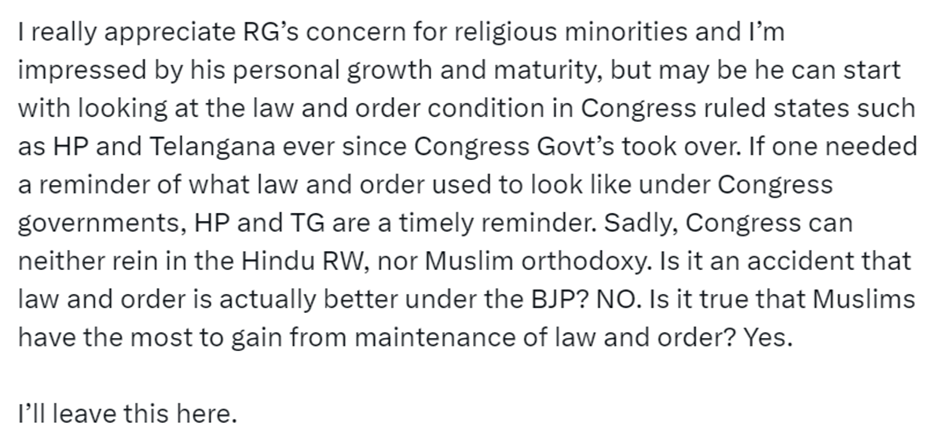
Before signing off, I wish to share this tweet by Shehla Rashid, which beautifully debunks the communal allegations against India.





 The Monkey Dilemma
You must be logged in to post a comment.