I actually wanted to watch Paradha in the theatre, because I thought the cast was interesting. It had my lovely curly-haired favourites: Anupama Parameshwaran and Darshana Rajendran, who are known faces in the South. But then I got caught up with other priorities and missed booking a ticket that weekend. Later, I came across some reviews that made me second-guess whether it was worth watching on the big screen and decided to skip going to the theatre. Recently, when it was released on Amazon Prime, I finally decided to watch it.
The movie made me realize that not every review online is meant for you. Reviews often reflect the reviewer’s personal taste, but we tend to assume we’ll feel the same way. I’ve had similar experiences with other films, too, where the reviews were harsh, yet I ended up enjoying them. I still don’t get the importance of movie reviews, because whether we like a movie or not is subjective. But here I am, giving my own movie reviews from a highly subjective viewpoint. I think we should treat reviews as such: personal opinions of someone who loves watching movies, and not the absolute truth.
What’s It About?
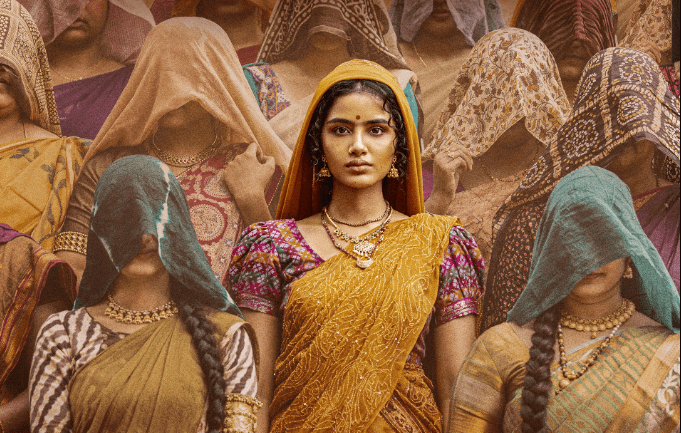
Paradha, true to its name, centers on Subbu (Anupama Parameshwaran), a young Hindu woman from a remote Indian village where the tradition of paradha (dupatta veiling) is strictly practiced. While this custom is largely cultural in many parts of India, the film presents it as a religious mandate. The villagers worship Goddess Jwalamma, who they believe commanded that women remain hidden behind a veil. From puberty onward, every girl is forced to follow this rule, with severe consequences for defiance. Subbu, however, finds herself caught in a controversy that threatens her marriage to the man she loves.
Thoughts
Though the story begins with a devout woman who strictly follows religious practices, Paradha is not just about her. It portrays women from different walks of life, each facing gender discrimination in unique ways.
The first woman is deeply religious, bound by the strict purdah or dupatta system. The second, married outside the village, has left purdah behind but remains traditional in other aspects. The third rejects religious traditions altogether, embraces modern values, and focuses on her career. The fourth is a policewoman who’s happily married, enjoying full freedom, and choosing to follow certain traditions out of personal preference rather than compulsion. The movie keeps the narrative balanced this way.
Paradha is a feminist film centered on women’s empowerment, and it may not appeal to everyone. It highlights how women, even the most progressive, continue to face discrimination, no matter how far they try to escape from it.
I really enjoyed the movie. The climax was chilling, and the performances, especially by Anupama Parameshwaran, Darshana Rajendran, and Sangeetha, were superb. It’s a brave film, because criticizing patriarchy is never easy. Often, women themselves defend restrictive practices by saying, “It’s our choice.” But true choice exists only when opting out doesn’t bring harsh criticism or punishment. Many women follow norms not out of freedom, but because they have no other option. The movie captures this truth powerfully.
Paradha is now streaming on Amazon Prime. I watched it in the original Telugu with English subtitles.
After celebrating Onam and engaging in numerous social activities, my introvert battery hit rock bottom. I needed a desperate recharge. So what do I do? Naturally, I retreated to every introvert’s most favourite new-gen comfort zone: scrolling endless Instagram reels. Nothing says “I’ve had enough of people” quite like being a couch potato, locked up in your house, while going through everyone else’s social lives.
As I scrolled through the multiple Onam-related posts, I couldn’t help but appreciate the inclusivity in Kerala. Malayalees across religions, whether they are Hindus, Christians, or Muslims, celebrated Onam with equal enthusiasm. Everyone welcomed Mahabali with open arms. A few voices did try to stop their communities, saying Onam is a “Hindu festival,” but not many paid attention. That’s a good sign. People are choosing to step out of religious bubbles to celebrate together.
Still, Kerala, often praised as a secular state, has been showing sporadic worrying signs of exclusion. Just before Onam, a teacher told students not to participate in the festival because “our religion doesn’t allow it.” The outrage led to her suspension, but this mindset isn’t limited to one person. How widespread is the thought? No one can quantify. It’s impossible to analyze each and every Indian’s thought. However, there is an increasing number of cases that advocate for exclusionary behaviour. You are penalized for celebrating other festivals, or for respecting someone else’s god, or for chanting something as simple as “Bharat Mata ki Jai.”
India guarantees freedom of religion for all communities. But if we use that freedom only to exclude ourselves from others, we risk creating deeper divides. True communal harmony comes from participation: joining in festivals, enjoying each other’s food, and refusing to see other faiths as “untouchable.”
For India to stay secular, this effort has to come from all of us. We’ve come far since independence, but there’s still a long way to go. It’s up to us to ensure religion doesn’t become a wall, but a bridge.
For a major part of my life, I considered Hinduism just a religion. But as you grow older, you enter a stage when you wish to know more. That’s when I realized Hinduism is more than a religion. It’s a broad philosophical framework that accepts a wide range of beliefs, including atheism.
Did you know Hindus can believe in multiple gods or a single god if they wish, but they are also free not to believe in any god if they wish not to? Non-believers are still considered Hindu. They are not ostracized or excluded from the community. This openness is reflected in ancient Hindu schools of thought, such as the Carvaka and Samkhya schools. These schools, although lesser known, even among Hindus, are testaments to Hindu philosophy’s pluralistic nature.
Carvaka: The Atheist School of Hinduism
Carvaka is an ancient Indian philosophy that openly rejects belief in God, the soul, karma, reincarnation, and life after death.
The core idea of Carvaka is that only tangible things, such as those we can see, touch, or directly experience, are real. The rest is fluff. Its thinkers believe that Gods and heavens are man-made concepts designed to control people.
The main focus of the Carvaka school is to live a happy life in the present, without tying your actions to living a good afterlife, because there’s none. The Carvaka philosophy endorses materialism, which is good news for those who are all about living the good life.
In short, Carvaka says, “Enjoy your life here and now, because that’s all there is.”
Samkhya: A Spiritual but God-Free Philosophy
Samkhya is a Hindu school of philosophy that is spiritual but does not rely on the concept of a creator god. Its core idea is that the universe consists of two things: Purusha (pure consciousness) and Prakriti (nature). The goal is to free yourself from suffering by understanding that your true self is not your body or mind, but pure awareness.
Samkhya does not completely deny the existence of God, but rather states that belief in God is not necessary for achieving spiritual liberation. You must have seen this philosophy being practiced through methods such as Yoga.
Personal Beliefs & Their Acceptance in Hinduism
I’m not religious. However, I’m not an atheist either. I’m someone who ardently believes we are all praying to the same universal energy, just under different names, with different rules.
If there’s only one true religion, how does one explain miracles occurring in every faith?
I have had my prayers answered when I was a traditional Hindu believer, praying to Goddess Durga. My prayers were also answered when I prayed to the universe. This has shaped my impression that God is universal, one divine energy known by many names. Each path may look different, but they all lead to the same source. The only thing that matters when you pray is the depth of your emotions.
Hinduism accommodates thoughts like mine. I’m not judged or ostracized for holding such views. The religion does not demand that I conform to rigid principles. Instead, it allows space to question and for my beliefs to evolve. This openness and freedom are what make Hinduism deeply meaningful to me. I can still call myself a Hindu, even without being traditionally religious.
This openness in Hinduism extends beyond individual beliefs to matters like gender and sexuality. Ancient texts and temple sculptures across India depict a spectrum of gender identities, showing that Hinduism has historically acknowledged and embraced LGBTQ individuals. Few traditional religions offer this level of acceptance. That is what makes Hinduism not just a religion, but an inclusive way of life.
A Message to Hindu Youth: Your Religion Is More Open Than You Think
Despite its pluralistic, “modern” nature, many Hindu youth today feel that Hinduism isn’t “cool” enough. Perhaps because its rich philosophy is rarely taught during childhood. Outside India, Hinduism isn’t widely practiced or represented on global platforms, and the Western media often reduces it to stereotypes. There is also a lot of misinformation spread about Hinduism by people who know very little about the religion.
What many don’t realize is that Hinduism is one of the most liberal and inclusive systems of thought in the world. It is secular in spirit, embracing all forms of belief, including atheism. Hindus are free to question religious leaders and traditions without fear of punishment, reflecting the openness and reformative spirit that lies at the core of their faith. This is why you see many Hindus questioning even our religious leaders.
Conclusion
While some Hindu hardliners insist on rigid practices, such views do not represent the true essence of Hinduism. There is no single rulebook. Instead, there are diverse schools of thought that uphold intellectual freedom and individual choice. That is something to be proud of. I hope Hindus remember this when they encounter misrepresentation, hate, and misinformation about our religion and culture online or offline. Rather than accepting distorted narratives, we should take pride in the fact that Hinduism offers space for everyone: believers, skeptics, and reformers alike.
There’s so much I want to say about Being Hindu in Bangladesh, a book written by Avishek Biswas and Deep Halder, but I don’t think my words would do justice to my emotions. Whatever I write would be a watered-down version of what I felt while reading.
The authors are sons of refugees who once fled Bangladesh. They wrote this book during Sheikh Hasina’s rule, a time when they could safely visit Hindu areas and speak openly with locals, scholars, and researchers about the past.
It was a deeply uncomfortable read. Especially as I kept coming across recent posts from people in Bangladesh on Reddit, worried about the country slipping back into radicalism. It felt like history was repeating itself. On top of that, there were people, including the global and Indian left-leaning media, trying to downplay the communal angle in Bangladesh so as not to flare up Islamophobia. As an ex-leftist, this behaviour is all too familiar. I was once part of that ecosystem.
Despite being a Hindu, I could not acknowledge the persecution that Hindus faced in neighbouring regions. The data was there for everyone to witness, yet I was blind. I believe this is true for many Hindus. We are raised with strong secular values, which often makes it uncomfortable to openly acknowledge or speak about atrocities against our own community. Personally, it was difficult to break out of that mindset and accept the reality that Hindus did face genocide in Pakistan, Bangladesh, and Kashmir. Adding to that is the consistent bias of left-leaning media, which often avoided reporting anti-Hindu communal incidents both in India and abroad. This selective activism played a key role in my decision to step away from the leftist ecosystem.
Sahidul’s narrative states: ‘The genocide orchestrated and masterminded by Pakistan, began on the night of March 25, 1971 … Three million were killed (in East Pakistan), 200,000 to 300,000 women were violated in the most diabolic ethnic cleansing since the days of the Holocaust. And these are just rough estimates. How much does the world or even the subcontinent talk about it?
Most Painful Part of the Book
The most aching part for me was the quiet optimism in the book. Written during Sheikh Hasina’s rule, the authors were hopeful about the secular path Bangladesh was taking. They welcomed the ban on JeI and the arrests of those involved in the Hindu genocide of 1971. I read those pages, and then Al Jazeera’s headline from a few days back: “Bangladesh Supreme Court lifts ban on Jamaat-e-Islami.” I feel a mixture of emotions.
The authors also appreciated the death sentence awarded to a Jamaat leader involved in the 1971 genocide of Hindus. That sentence, too, has now been overturned in current-day Bangladesh under Yunus’s rule. Makes you wonder – is justice so fickle?
Opposition to Bengali Because It Was Too “Hindu”
From the book, I learned that Pakistan was opposed to Bengali in East Pakistan (now Bangladesh) because they considered the language “too Hindu” as opposed to Urdu. When East Pakistan demanded a new nation on the basis of Bengali culture, Pakistan thought Hindus were responsible for this “brainwashing”, which is what led to the genocide.
The Pakistani Army launched Operation Searchlight for complete cleansing of the Bengali and Hindu identity. Even the press secretary of the third president of Pakistan, Yahya Khan, said that this operation was to ‘brainwash the people, wean them off their Bengali mores and make them true Pakistanis … The Hindu influence must be eradicated root and branch and the people who were misguiding the innocent and illiterate masses must be liquidated.’
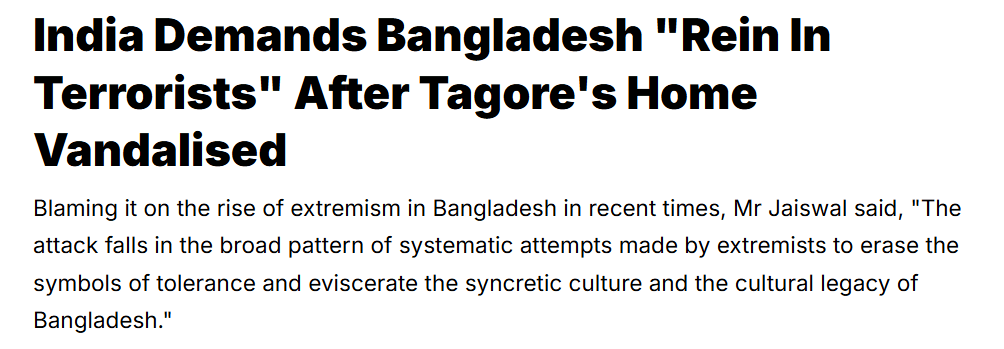
Tagore’s Home Vandalized in Bangladesh. News Source: NDTV
Truth be told, I was thinking while reading the book, how long would it take for the pro-Pakistan radicals in Bangladesh to go after anything related to Tagore, the Hindu writer of Bangladesh’s anthem “Amar Sonar Bangla” (My Golden Bengal), and then the vandalism of Tagore’s home happened. I wouldn’t be surprised if they replace the anthem, too, at some point in the future.
Jogendra Nath Mandal – The Dalit Leader Who Chose Pakistan
It’s from the book that I came across the name Jogendra Nath Mandal for the first time. He was a Dalit leader and a close associate of Dr. Ambedkar. At the time of Partition, Mandal chose to side with Pakistan, believing it would offer Dalits greater freedom and rights than a Hindu-majority India. He motivated many Dalits to migrate with him, promising an escape from caste oppression.
Mandal, the man who wanted Pakistan to become a land of Dalits and Muslims.
But what they found was a harsher reality. Regret followed soon after. Mandal eventually fled Pakistan and returned to India. Sadly, many Dalits who followed him to Pakistan lacked his privilege and means and were left behind. His popularity waned after that, and he died a lonely death in West Bengal. To quote the book:
Mandal had come to India from East Pakistan as a broken man. Arguably, the tallest Dalit politician in pre-partition East Bengal, Mandal had lost most of his followers after he chose Pakistan over India, stood with Muhammad Ali Jinnah and became the law and labour minister. Mandal had thought Dalits and Muslims would behave like brothers in the newly-created Pakistan. They didn’t, and as communal tension rose and Hindus left East Pakistan for India in large numbers, Jogendranath Mandal came to be looked at as a short-sighted leader at best and a self-serving politician at worst.
Dr. Ambedkar, upon learning about the persecution of Dalits in Pakistan, urged them to return to India. However, most were unable to leave, trapped by circumstances beyond their control.
I encourage everyone to read the following Reddit post that offers a more complete account of Jogendra Nath Mandal’s life. It includes his resignation letter to the Prime Minister of Pakistan and Dr. Ambedkar’s heartfelt appeal to Dalits living there.
Mandal’s story reminds us never to forget history or its lessons. These accounts were documented by key figures of that era for a reason. Not to be ignored, but to help us reflect, understand, learn, and avoid repeating the same mistakes in the future.
Quotable Quotes from Being Hindu in Bangladesh
‘Yes, only two people might have died in Noakhali in last year’s violence. But look around and you will find boys and men without an arm or a leg walking around. They will remind you of what was.’
What was it like in 1946? When freedom from 200 years of British rule was becoming a reality, Bengali-Hindu women and men, in village after village in Noakhali district of undivided Bengal, the same place where we now are, were r*ped and killed, or forcibly converted. Then too, it had started with fake news.
‘I have never been able to forget those days,’ she says, ‘when neighbours became rioters and friends became murderers. The stench of blood haunts me to this day.’
‘I remember he would come and tell us to make sure no one made any sound, and make sure that the children remained silent. It should appear from outside that the college building was deserted. Or else, a mob could come and kill us all. But my seven-month-old sister cried out in hunger. We gave her some treacle to make her stop crying, but she would start wailing soon after. My father told us that we had to kill her as she simply wouldn’t stop crying. And her wails would bring the mob to us. She cried and cried, till she cried no more.’
In other riots, religion was the point of disagreement. In Noakhali, religion was also the instrument that ended the disagreement. The attacks in Noakhali on Hindus by Muslims ended when the Hindus became Muslims.
‘But it’s a mistake that all democratic governments make in trying to control one set of extremists. They often play with the other set that looks less worse than the other (but) in the course of time, they all become Frankensteins’ he said.
There’s something about discovering forgotten buildings where powerful men once lived, touring villages where they spent their boyhood. It is like sifting through dog-eared, yellowed pages of history. So much of what once was still hangs in the air. So many stories are kept alive by village elders who saw history take shape.
Conclusion
The book details several atrocities that are too graphic to include in this blog post. I strongly encourage everyone to read Being Hindu in Bangladesh for a clearer and unbiased understanding of the condition of Hindus in the country.
The Pahalgam terror attack has deeply shaken most Indians. There is widespread anger over how Pakistan repeatedly escapes accountability, always armed with excuses and justifications.
India’s global PR remains weak, and our narrative often struggles to gain international traction. This was evident when Indians in New York pointed out the lack of coverage in local newspapers about the deadly attack. On an international subreddit, the news only gained attention after the now-viral zipline video was shared.
Many aspects of the attack are both infuriating and frustrating. The mood in India is one of outrage and a strong demand for retribution. Blocking Pakistani channels or celebrities no longer feels like enough, and emotional appeals from Pakistanis leaving India are falling on deaf ears. This attack has hardened public sentiment, and barring a few outliers, Indians squarely hold Pakistan responsible for the atrocity.
What Happened in Pahalgam?
To those unaware of the Pahalgam terrorist attacks in Kashmir, here’s a summary:
On April 22, 2025, five armed militants attacked tourists in Baisaran Valley near Pahalgam, Jammu and Kashmir, killing 26 civilians (24 Hindu tourists, one Christian tourist, and one Muslim pony operator). Survivors reported that the assailants asked victims to state their religion or recite Islamic verses before executing them, indicating a targeted assault based on religious identity. Men were exclusively targeted. Women and children were let go to send a message to the government.
Some survivors reported that militants pulled down the pants of men to check for religious affiliation (circumcision) before executing them. A local Muslim pony operator, Syed Adil Hussain Shah, was also killed while attempting to protect tourists.
The Resistance Front, linked to Lashkar-e-Taiba, initially claimed responsibility, citing opposition to India’s residency policies in Kashmir, but later retracted the claim, possibly due to pressure from the Pakistan army and government.
The attack has escalated tensions between India and Pakistan, with India accusing Pakistan of supporting cross-border terrorism, leading to diplomatic and military standoffs.
Here are some personal reflections on the incident.
Pakistan is Unequivocally Responsible for the Pahalgam Attacks
The terrorists involved have either been identified as Pakistani nationals or as locals trained in Pakistan. Multiple foreign intelligence agencies, many from India’s key allies, have confirmed this, a fact echoed even by senior opposition leaders like Shashi Tharoor. The strong international support for India’s right to retaliate, especially from countries with robust intelligence networks, further validates this conclusion.
Pakistan’s claim of non-involvement is a hollow defense. It has a long history of denying its role in cross-border terrorism, despite being globally recognized as a terrorism hub. Numerous international reports support this assessment that Pakistan harbours terrorists. Yet Pakistan continues its unwillingness to acknowledge or address its complicity.
The U.S. State Department’s Country Reports on Terrorism (2023) have consistently highlighted Pakistan’s role in supporting terrorist groups. A 2023 CRS brief titled “Terrorist and Other Militant Groups in Pakistan” acknowledges that Pakistan has not addressed the presence and activities of India-focused terrorist organizations within its borders. Pakistan has faced accusations from various countries, including Afghanistan, Iran, apart from India, regarding its involvement in supporting terrorist activities.
Reports about Pakistani grooming gangs in the UK have recently gained wider attention. Channel 4 released a documentary titled “Groomed” to highlight the challenges posed by radical elements within the Pakistani community. However, many Pakistanis continue to deny these allegations, reflecting a broader reluctance to acknowledge responsibility.
Now, consider the situation in Balochistan. The Pakistani state consistently denies any human rights violations against the Baloch people or Afghan refugees within its borders. Despite numerous reports by international observers and activists highlighting enforced disappearances, military crackdowns, and systemic discrimination, the official narrative remains one of denial.
This consistent pattern of denial of wrongdoing can be observed among many Pakistanis. Rarely does one encounter a Pakistani voice calling for introspection or addressing internal societal issues. Their narratives often center around victimhood rather than accountability.
This is enough proof for us Indians to not blame our own citizens or institutions. We unequivocally hold Pakistan responsible for consistently enabling and orchestrating attacks on Indian soil.
Indians Are Tired of Pakistan-Sponsored Terrorist Attacks
The prevailing sentiment across the country is one of anger and exhaustion. Not since 26/11 has India witnessed such a brutal and calculated attack. But unlike then, today’s social media era has magnified public outrage, capturing raw emotions in real-time and amplifying them.
The Pahalgam attack has visibly polarized the population. Even those who once advocated for peaceful ties with Pakistan have changed their stance.
There is overwhelming support for any strong retaliation the Indian government may undertake. What is unacceptable, however, is inaction. The nation now waits to see how India’s leadership and armed forces will respond.
No Peace Talks
While Pakistan is appealing to the U.S. to urge India to show restraint, a line has clearly been crossed. One that makes peace talks impossible for India.
When Pakistanis ask India to consider the impact of war on innocent civilians, I can’t help but ask: Did they think of the 26 innocent lives lost in Pahalgam? Tourists who simply wanted a peaceful vacation were mercilessly killed. Empathy cannot be one-sided. True peace can only come when Pakistan stops meddling in India’s affairs.
Before the attacks, Pakistani military officer Asim Munir made blatant communal anti-Hindu and anti-India remarks. Shockingly, many in Pakistan praised him for it, calling him “based.” One wonders how Pakistani Hindus must have felt, hearing their own army chief endorse such dangerous rhetoric.
When a state is founded on religious division, lasting peace becomes elusive. With religion used as a political weapon, expecting normal, diplomatic ties is no longer feasible.
“Terrorism Has No Religion”
This is one of the most misleading narratives circulating in India today. Unless we openly acknowledge the religious motivations behind certain attacks, we cannot begin to address the root of the problem. The same voices that insist terrorism has no religion are quick to label incidents as “Saffron Terror” when Hindus are involved. If we must condemn all forms of terror, then Islamist terror should also be called what it is, without fear or double standards.
Many are quick to dismiss the religious angle of the Pahalgam attack as “Godi media” spin. But listen to the testimonies of the victims’ families. Wives of those killed have said the attackers asked about religion and demanded if the victims knew the Kalima. These weren’t random killings — Hindus and a Christian family were segregated and targeted based on their religion. They were shot because they couldn’t recite the Kalima. The one Muslim who lost his life was a case of collateral damage. He died while attempting to rescue tourists, not because he was targeted for his religion. His death, though tragic, was not the result of religious persecution. Denying this truth about religion-based terror doesn’t preserve harmony; it disrespects the grief of the families and gaslights the country.
Yes, these acts may be part of Pakistan’s larger plan to incite communal unrest within India. But brushing it aside for the sake of “secular optics” is irresponsible. Islamist terrorism must be named and condemned, just as we expect when extremism comes from the other side.
That said, this must not translate into hatred toward Indian Muslims. The goal should be unity, not division, at this hour, as Pakistan seeks to fuel our internal conflicts.
Online Narrative Building
A false narrative is being pushed by Pakistani accounts equating Kashmir to Gaza. Selective photos of demolished houses are being circulated to claim that innocent civilians are being targeted. The truth? Only a few houses, specifically linked to Lashkar-e-Taiba terrorists, have been taken down.
Why demolish these homes? Because it works. Uttar Pradesh saw a sharp drop in violence when this policy was applied. It strikes at the emotional core — many of these terrorists fear repercussions for their families more than for themselves. Harsh measures are sometimes the only language hardliners understand.
Don’t fall for the curated propaganda pushed by well-networked handlers online. Check the facts. Stand by the truth.
Believe the Victims
When the families of Hindu victims share that they received no help from locals, believe them. That is their lived experience. Gaslighting them to protect a broader narrative is unfair and unjust.
Yes, some locals helped tourists — that’s also true. But acknowledging one truth doesn’t mean erasing the other. Both realities can coexist. Let’s not silence genuine pain to score points in debates.
Let Justice Prevail
Pakistan must be held accountable for spilling innocent Indian blood and disrupting Kashmir’s path to peace and progress. This time, the punishment must be appropriate so that next time they will think twice before sponsoring terrorism.
Religious fundamentalism is gradually rising in Kerala. Yet few dare to question it. Perhaps because it originates outside the Hindu community.
Members of the Muslim League, an ally of Congress in Kerala, now openly claim that the hijab is not a choice and are pushing for gender segregation in public spaces like the Mec7 exercise program. Recently, a religious leader criticized a Muslim widow for traveling to Manali, insisting that widows should remain at home and devote themselves to prayer. Others are now openly urging community members to refrain from participating in non-Muslim festivals, further deepening social divisions. Meanwhile, Hamas and Hezbollah supporters freely display posters of their leaders in Kerala, despite these groups’ ties to Pakistani terrorist organizations like JeM and LeT, which have carried out multiple attacks in India.
Was there any outrage from political parties or within the community? None at all.
When you point out the lack of internal criticism, the common response is that speaking out invites real danger and that reforms take time. While it’s true that advocating change within the Muslim community is difficult and radicals may threaten dissenters, how long must we wait? Another century? Should we remain silent and allow religious fundamentalism to grow unchecked? If no meaningful reforms have happened so far, what guarantees change in the future? If the community cannot challenge extremist views now, how will they resist when these forces become even stronger and impose their rules on others?
We are already seeing glimpses of this with the Waqf Board’s land disputes, where properties legally owned by other communities are being claimed. Why should non-Muslims be bound by Waqf rules? If the land originally belonged to Muslims, the claims may hold merit. However, many of these properties now belong to other communities. If they were encroachments, why did the Waqf Board fail to prevent them? In cases where the land was legally sold, why is it being reclaimed now? The Board’s mismanagement highlights the urgent need for Waqf reforms to prevent future disputes.
Unfortunately, political parties are misleading the Muslim community, falsely claiming that reforms would lead to property seizures. The reality is that corrupt politicians have more to lose than ordinary Muslims, especially the poor. Many are likely benefiting from Waqf properties, living in luxury through corruption. The revenue generated from Waqf assets is disproportionately low compared to their vast holdings, raising questions about where the money is going. Instead of being used for community development, it is likely being siphoned for personal gain.
This is why reforms are crucial. However, many in the community rely on their leaders for information, unaware that they are being misled. These leaders manipulate facts for their own interests, radicalizing and mobilizing people with lies. This is why it’s important that citizens seek information from multiple sources—both left- and right-leaning—to avoid being deceived.
It is a mistake to believe that only the BJP spreads communal hatred. Congress leaders have also exploited the Manipur issue, framing it as a Hindu vs. Christian conflict when it is, in fact, an ethnic dispute. When Hamas posters appear in Kerala and critics raise concerns, Congress dismisses them as “Islamophobia.” This selective outrage makes them unreliable as leaders. They are vocal against Hindu extremism but silent when it comes to Islamist fundamentalism.
Some progressive Muslims argue that meaningful reforms require both external pressure, such as government intervention, and internal efforts from within the community. However, in India, any government-led push for reform risks being labeled Islamophobic. This, in turn, gives radicals more ammunition and invites criticism from the Western world, which often misinterprets such actions as oppression rather than necessary change. Moreover, since Hindus form the majority, any move by the Indian government is framed as an attack on Muslims, further polarizing the discourse and making genuine reform even harder to achieve.
At this point, the situation feels like a deadlock. Either we wait indefinitely for internal reforms, which may never come, or the government steps in, triggering backlash and further polarization. Both paths are fraught with challenges, and in either case, things could turn messy. The fear of being labeled Islamophobic limits external intervention, while internal resistance to change keeps fundamentalist views unchecked. This leaves little room for meaningful progress, making the prospect of reform seem increasingly distant.


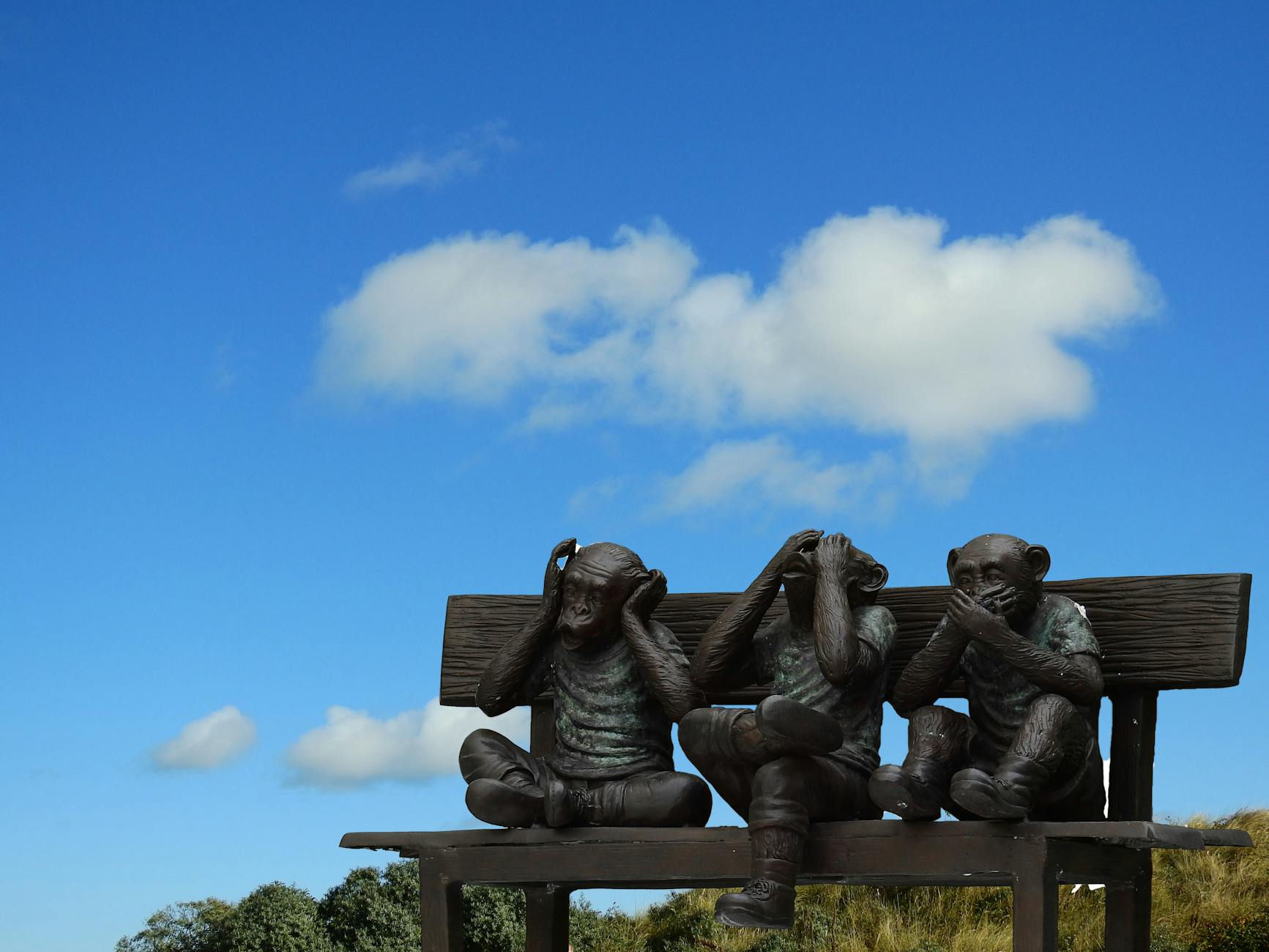
 The Monkey Dilemma
You must be logged in to post a comment.