Rohit Saraf Feels Like Old-School Romance and I Love It

Rohit Saraf Photo

I often find myself missing the old Bollywood romance era. Films by Yash Chopra or early Karan Johar had a kind of magic that is hard to find today. The lead pairs had real chemistry, the kind that made you feel every emotion with them. When they looked at each other with misty eyes, you felt like you were falling in love too.

But in many new-generation films, that spark seems lost. I don’t know whether it’s the acting, the writing, or the shift in filmmaking trends. Modern romance feels rushed, predictable, too dark, melancholic, or sometimes just flat. The warmth, passion, and emotional storytelling that defined classic Hindi cinema is fading, and I genuinely miss it.

In today’s film landscape, Rohit Saraf feels like a breath of fresh air. He brings back that soft, believable romance many of us grew up loving. One thing that stands out about him is his effortless chemistry with his co-stars.

My favorite project of his isn’t even a Hindi film. It’s the Tamil romance Kamali From Nadukkaveri, where his performance and chemistry with the lead actress, Anandhi, is genuine and sweet. I would also suggest watching his earlier series on Zee5 titled Woh Bhi Din The. He filmed it when he was much younger. The emotional connection between the characters feels very real. Also, let’s not forget his impeccable chemistry with Pearle Maaney in Ludo, which remains one of my favourites.

In Sunny Sanskari Ki Tulsi Kumari, Rohit Saraf continues that image of the ideal romantic partner. His chemistry with Janhvi Kapoor feels natural and much stronger compared to the chemistry between the main lead pair. Honestly, their scenes had more warmth and emotional pull. I found myself wishing the makers had focused on that storyline instead of pushing the romance between Janhvi and Varun Dhawan. It felt like the more organic love story was sitting right there, but never fully explored.

Personnally, I feel Rohit Saraf deserves more recognition for keeping that old-school romantic charm alive.

Maybe it’s time filmmakers start looking for the right lead pair for Rohit Saraf. If they get that pairing right, many of us women could finally relive the era of Kajol and Shah Rukh Khan or Aamir Khan and Juhi Chawla. Those iconic pairs made romance feel real, soft, and unforgettable.

A couple with that kind of natural chemistry is missing in today’s Hindi films, and audiences like me are definitely craving it.
Dating as a Divorced Woman

I recently watched Jovita George’s “Dating After Divorce” video on YouTube. First of all, kudos to her for creating such a video. This kind of content is still not very common, and many women, especially in the Malayalee community, hesitate to talk openly about their divorce stories. So seeing Jovita share her experience really impressed me. It has also motivated me to talk about my own journey with relationships (and also friendships) after divorce. So here goes.

Lessons and Red Flags

I will start not with relationships, but with the judgments you face as a divorced woman.

This may not be everyone’s experience, but after my divorce, I often sensed a certain judgment from people around me, not always from my male friends, but from the women in their lives.

For example, a male friend’s wife suddenly became suspicious of me, as if divorced women are seen as people who “prey” on married men. No one says it openly, but the distrust in their eyes makes it obvious. This was especially frustrating because I have always been careful around married men, even those who were flirtatious. I never encouraged them as I was always mindful of what their wife would feel. Yet society is quick to judge a woman the moment a man interacts with her.

It also became clear that many men, both married and unmarried, see a divorced woman as “easy.” They approach you often for casual fun. “Friends with Benefits.” Because you are deemed as someone who’s not serious about relationships, because you chose to “throw away” a marriage. It feels sad, but it happens.

This stereotype gets even stronger because of how movies and dramas show divorced women. They’re often portrayed as someone trying to break another woman’s marriage — the evil, overly glamorous vamp who cares only about herself. You hardly ever see a divorced woman on screen who’s just like anyone else, someone who wants warmth, kindness, and love.

So a divorced woman who wants something serious needs to stay alert and filter out these shallow bonds.

Finding Love Again After Divorce

I eventually got into a long, serious relationship. We met through mutual friends, and at first it felt promising. But it soon went downhill. I realised he was never truly serious. And the reason was my divorce status. That hit hard. It felt like he was embarrassed by who I was.

That’s something divorced women should watch out for — a man can say he’s serious, but you only know the truth when his actions match his words.

The gaslighting made it even worse. He made me think I shouldn’t feel the way I did, even when I felt disrespected. It was mentally draining, yet I held on because I wanted the relationship to work. His anger and verbal jabs made me anxious, and over time, they chipped away at my confidence.

When that relationship ended, I was shattered. I had loved him despite all the red flags. But the truth was hard to face — I don’t think he even saw me as a friend. There was no warmth, no respect. It’s tough to process that after all the compromises you make.

That experience changed me. It made me far more cautious about getting into a relationship again.

Slow and Steady

After that, I met someone by chance. A divorced man, part of my school group. He’s someone just as cautious as I am, so we take things slow. Both of us carry scars from our past. Probably why we’re kind to each other. Even when we fight, we stay respectful. That matters a lot to me, considering my past hasn’t been so kind. He feels like home because he is steady and respectful. Still, after what I went through, a part of me wonders how long it will last, even though we’ve been together for years now.

We’re not chasing marriage. We just want respect and companionship. How long this will last, I really don’t know. When you’ve seen bad relationships, there’s always that little voice saying good times don’t last. He could be the one, or maybe not. Time will decide.

So this is what dating after divorce has been like for me.

And here’s a reminder for divorced women — other people’s judgments only hurt when you believe them yourself. Don’t bring yourself down just to fit their expectations.

***

Photo by Rina Mayer

Interracial Romance and the Indian Mindset

Interracial Romance in Indian Families

I recently watched a thoughtful discussion by Zarna Garg on interracial romance, featuring her own family. Based in the US, their candid conversation offers a refreshing glimpse into how Indian-American families are navigating such topics. It was heartening to see everyone, parents and kids, engage so openly. In many Indian households, these conversations either happen too late or not at all, often wrapped in hesitation or silence. But here was a family talking honestly about dating, identity, and interracial relationships. A big shoutout to them for their openness and clarity. It’s these dialogues that make a real difference.

Watch the video below:

Thoughts

I’ve spent most of my life abroad before choosing to return to India. Yet even while living overseas, I always knew my relationships would be with Indian men. Perhaps it’s because I studied in an Indian school and mostly socialized within the Indian community, even outside the country. I look Indian, dress Indian, and speak with an Indian accent. So it was natural to feel more comfortable with Indian men.

However, in today’s globalized world, with increasing interracial mingling, millennials like me must come to terms with the fact that more non-Indians are likely to become part of our families. Someone recently remarked how the world is blending in such a way that you can no longer easily tell someone’s ethnicity. Even appearances are getting “globalized.” It was an eye-opener. I’ve come to realize this holds especially true in the Indian context. Today’s new-generation kids often no longer look or sound traditionally Indian, especially the kids in Indian metros. Their accents, fashion, and even body language reflect a more global identity.

A few months ago, a relative married a Spanish man, the first white partner in our family. Surprisingly, everyone, including the older generation, was welcoming. No drama. No resistance. That in itself feels like progress. Our extended family no longer fusses over caste or religion in love marriages. Marrying someone from a “lower caste” has become normal (though I personally reject terms like “lower” and “upper” caste, which are inherently divisive). Only a few super-senior relatives seem to hold on to rigid views, but even that seems to be fading.

I wonder if this shift is due to the older generation’s growing access to YouTube and social media. Many now watch global discussions on love, identity, and acceptance. One moment really stood out: a senior aunt watched Kaathal, a Malayalam film about same-sex love, and casually remarked, “Being gay or lesbian is fine. It’s not a disease.” That kind of acceptance would’ve been unthinkable even a decade ago. But it’s happening now, and that matters.

More recently, one of my nieces fell in love with a white guy. It’s a bit more delicate because it hits closer to home. While I’m happy she found someone, I can’t help but feel a bit anxious. Our cultures are worlds apart, and it’s not just the couple that has to adjust, but the families too. At this age, do I or her parents have the patience? I’m unsure. On second thought, it doesn’t concern me or her family, as the relationship is hers to navigate. Still, as Zarna Garg wisely said in her family discussion, any relationship can thrive if the core values align: education, family, career, loyalty, and health. Everything else is secondary and can be worked around.

One comment from Zarna’s husband lingered with me. He mentioned that their eldest daughter has only dated white men, and he took it personally. He had read somewhere that girls whose fathers aren’t ideal husbands are more likely to do this. That struck a chord. My niece also has a pattern of dating white men, and to be honest, her father isn’t exactly the perfect partner either. Could there be a subconscious link? I wouldn’t dare bring it up now, especially since she lives abroad, but maybe someday in person.

There’s so much our generation is still figuring out. As millennials in our 40s, we stand between tradition and transition. We want to be open-minded and inclusive, but also grounded. At times, it worries us to see the younger generation drifting away from tradition. There’s a quiet fear: will our culture someday fade into oblivion? But these are changing times, and change demands a degree of acceptance. We may not always agree, but we must learn to adapt. I also see a growing trend among young parents today: trying too hard to be politically correct, often avoiding difficult conversations just to stay in their children’s good books. This might be a measure to ensure they don’t repeat their parents’ mistakes of being too restrictive. But experience teaches us that hard truths, spoken with love, are just as necessary today as it was yesterday.

Some of the advice I dismissed in my 20s now makes perfect sense. You only begin to understand your parents once you reach their age. That’s how life unfolds. You gain clarity with time. Until then, all we can do is trust, adapt, and hope it all works out in the end.

***

Photo by Bhavitya Indora

An Ode to Love Languages

My 5 Love Languages Test Result

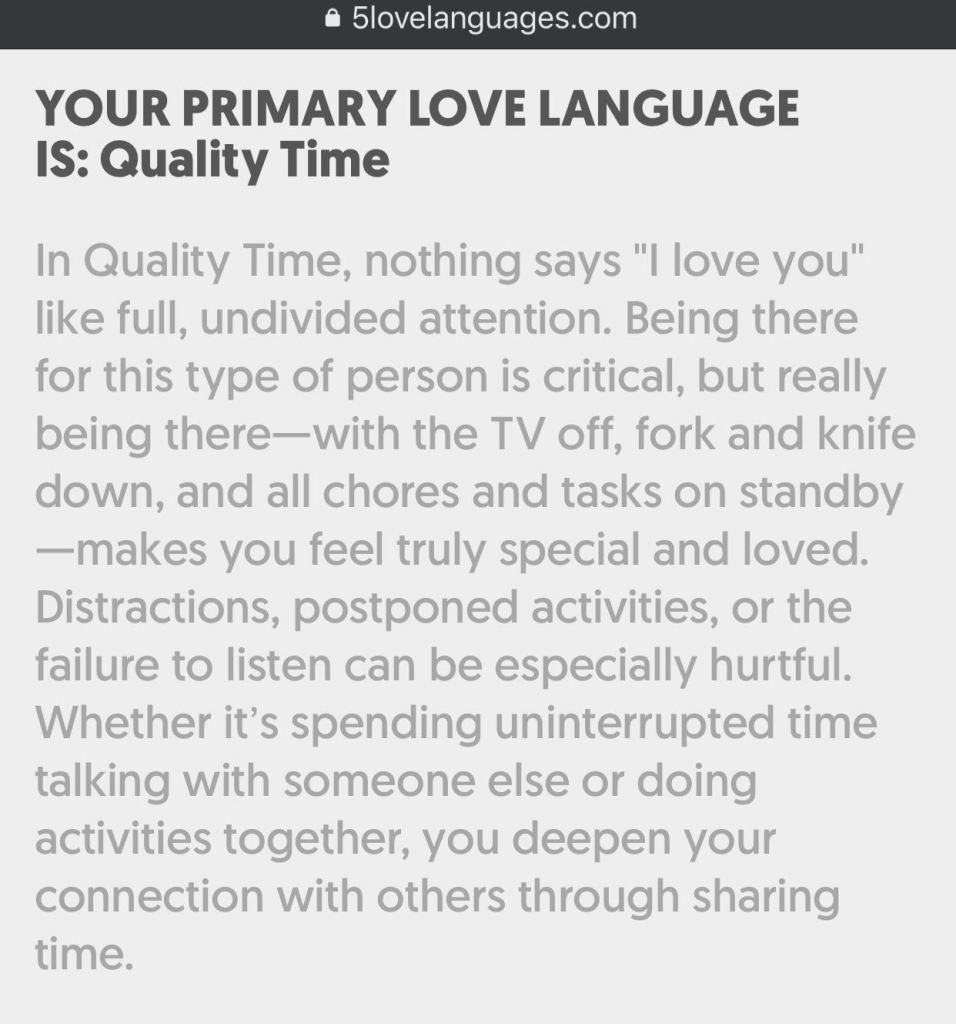
The 5 Love Languages Test is something I stumbled across recently. Give it a go if you have nothing better to do this weekend. Mine is quite accurate, quality time is an absolute essential for me.

The whole idea behind the quiz is that love languages can clash: your way of showing love is not your partner’s way. For example, gifts are not a must for me at all. Just some quality time would do. This need not be the same for everyone. I know many who absolutely adore gifts. Some like a lot of physical touch, whereas others don’t. Some would want words of affirmation, whereas for others actions mean a lot more than words.

I believe knowing your partner’s love language can help in understanding them better. Why they don’t express the way you want them to, why the things you do are never enough for them etc. Maybe how you display love is different from their perception of love. Different people, different wants.

Maybe the love is there, but we are not seeing it because we are scrutinizing it with our own definition of love.