I recently bought a book titled Kashmir Narratives. It is authored by Colonel Ajay Raina, a retired Indian Army officer. To quote his bio on Amazon, “I am the only son of refugee parents who were young kids when the 1947 bloodied partition saw the creation of two new States of India and Pakistan and when the biggest ever migration of humans took place on this earth. Post my education, I got commissioned into the Indian Army as an officer in 1990 and served till the end of 2017.“
I happened to see his interview somewhere and decided to buy the book. It has a lot of information on Kashmir, focusing on its history, but what I found particularly interesting was the information on the condition of the plebiscite in Kashmir. Before we get to that, let’s understand what a plebiscite is.
What is a plebiscite?
A plebiscite is a direct vote by the people of a region (in this case, Kashmir) on an important public issue. In simpler words, in relation to Kashmir, a plebiscite allows Kashmiris to vote for its future – specifically, whether the region would join India or Pakistan. Interestingly, only these two options were presented, with no option explicitly listed of allowing Kashmir to function as an independent state.
How did the idea of a plebiscite in Kashmir emerge?
The idea of a plebiscite came into effect following the partition of British India in 1947 when the princely states were given the option to join either India or Pakistan.
Jammu and Kashmir initially chose to remain independent. However, after an invasion by tribal forces from Pakistan, Maharaja Hari Singh sought military assistance from India and signed the Instrument of Accession, formally acceding to India. This led to the first Indo-Pakistani war in 1947-48.
To resolve the conflict, the UN intervened, and the United Nations Security Council (UNSC) passed Resolution 47 in 1948. This resolution called for a ceasefire, the withdrawal of Pakistani forces from the region, and a significant reduction of Indian army officers. This was to allow for a free and fair plebiscite under UN supervision without any sort of intimidation. The plebiscite was supposed to let the people of Jammu and Kashmir decide their allegiance to either India or Pakistan. The result of the plebiscite would have depended on the majority vote.
However, the plebiscite was never conducted due to several reasons, including disagreements between India and Pakistan over the conditions set by the UN.
Clause (a) in Resolution 47
Most of us aren’t aware of Clause (a) in Resolution 47 passed by the UNSC. It states the condition of a plebiscite in Kashmir. Refer to UN Digital Library – Resolution 47 (1948) – Page 4:
To secure the withdrawal from the State of Jammu and Kashmir of tribesmen and Pakistani nationals not normally resident therein who have entered the State for the purpose of fighting, and to prevent any intrusion into the State of such elements and any furnishing of material aid to those fighting in the State.
The clause requires the complete withdrawal of Pakistani forces from the region. However, this condition remains unfulfilled as militants keep infiltrating the area.
Interestingly, India keeps getting the majority of the blame for not allowing a plebiscite, while it’s clear that Pakistan hasn’t fulfilled its part of the resolution. The resolution placed initial responsibility on Pakistan to withdraw its forces from the region. Only after this withdrawal was India supposed to reduce its military presence. This was then to be followed by a plebiscite. Because neither side fully complied with the conditions set out in the resolution, the situation has remained unresolved.
Final thoughts
I can’t help but wonder, had the “freedom seekers” in Kashmir known about this condition for a plebiscite, would they have applied more force on Pakistani militants to move out of the region? As stated, the first step toward a plebiscite is to ensure the Pakistani militants have withdrawn completely.
The UN has not formally retracted Resolution 47. It is currently in a dormant state. However, there is a possibility of Resolution 47 being re-invoked if the UNSC decides to revisit it.
I recently completed Fredrik Backman’s Anxious People. The book is about a failed bank robbery that turns into a hostage situation during an open-house apartment viewing. The story unfolds as a group of diverse characters, each with their own personal struggles and secrets, are brought together in an unexpected and tense situation.
“Anxious People” includes dollops of humor and empathy. Backman delves into the complexities of human emotions, vulnerabilities, and how human connection and shared experiences can bind even the most distinct characters. Ultimately, humanity and kindness win.
Fredrik Backman has a knack for words. His quotes in Beartown were a class apart and remain one of the most popular pages on this blog. His writing in Anxious People is no different. In no time, he captures your heart with his words to describe emotions that are generally not easy to translate into words.
Here are some of my most favorite quotes from the book:
This story is about a lot of things, but mostly about idiots. So it needs saying from the outset that it’s always very easy to declare that other people are idiots, but only if you forget how idiotically difficult being human is.
Our hearts are bars of soap that we keep losing hold of; the moment we relax, they drift off and fall in love and get broken, all in the wink of an eye. We’re not in control.
He presses his thumbs hard against his eyebrows, as if he hopes they’re two buttons and if he keeps them pressed at the same time for ten seconds he’ll be able to restore life to its factory settings.
Because you’ve probably been depressed yourself, you’ve had days when you’ve been in terrible pain in places that don’t show up in X-rays, when you can’t find the words to explain it even to the people who love you.
At the end of your career you’re trying to find a point to it all, and at the start of it you’re looking for a purpose.
Older men rarely know what to say to younger men to let them know that they care. It’s so hard to find the words when all you really want to say is: ‘I can see you’re hurting.’
‘Do you know what the worst thing about being a parent is? That you’re always judged by your worst moments. You can do a million things right, but if you do one single thing wrong you’re for ever that parent who was checking his phone in the park when your child was hit in the head by a swing. We don’t take our eyes off them for days at a time, but then you read just one text message and it’s as if all your best moments never happened. No one goes to see a psychologist to talk about all the times they weren’t hit in the head by a swing as a child. Parents are defined by their mistakes.’
She said you can’t protect your kids from life, because life gets us all in the end.
That’s an impossible thing for sons to grasp, and a source of shame for fathers to have to admit: that we don’t want our children to pursue their own dreams or walk in our footsteps. We want to walk in their footsteps while they pursue our dreams.
There was a time when a bank was a bank. But now there are evidently ‘cashless’ banks, banks without any money, which is surely something of a travesty? It’s hardly surprising that people get confused and society is going to the dogs when it’s full of caffeine-free coffee, gluten-free bread, alcohol-free beer.
We give those we love nicknames, because love requires a word that belongs to us alone.
Good grief, no one could cope with being newly infatuated, year after year. When you’re infatuated you can’t think about anything else, you forget about your friends, your work, your lunch. If we were infatuated all the time we’d starve to death. And being in love means being infatuated … from time to time. You have to be sensible.
The problem is that everything is relative, happiness is based on expectations, and we have the Internet now. A whole world constantly asking us: ‘But is your life as perfect as this? Well? How about now? Is it as perfect as this? If it isn’t, change it!’
The worst thing a divorce does to a person isn’t that it makes all the time you devoted to the relationship feel wasted, but that it steals all the plans you had for the future.
‘And … winners earn a lot of money, which is also important, I assume? What do you do with yours?’
‘I buy distance from other people.’
The psychologist had never heard that response before. ‘How do you mean?’
‘Expensive restaurants have bigger gaps between the tables. First class on aeroplanes has no middle seats. Exclusive hotels have separate entrances for guests staying in suites. The most expensive thing you can buy in the most densely populated places on the planet is distance.’
You can always tell by the way people who love each other argue: the longer they’ve been together, the fewer words they need to start a fight.
When you’re a child you long to be an adult and decide everything for yourself, but when you’re an adult you realize that’s the worst part of it.
We can’t change the world, and a lot of the time we can’t even change people. No more than one bit at a time. So we do what we can to help whenever we get the chance, sweetheart. We save those we can.
We do our best. Then we try to find a way to convince ourselves that that will just have to … be enough. So we can live with our failures without drowning.
One of the most human things about anxiety is that we try to cure chaos with chaos. Someone who has got themselves into a catastrophic situation rarely retreats from it, we’re far more inclined to carry on even faster. We’ve created lives where we can watch other people crash into the wall but still hope that somehow we’re going to pass straight through it. The closer we get, the more confidently we believe that some unlikely solution is miraculously going to save us, while everyone watching us is just waiting for the crash.
Boats that stay in the harbour are safe, sweetheart, but that’s not what boats were built for.
Young people today. You’re so aware of how you affect your children. I heard a paediatrician say on television that a generation ago, parents used to come to him and say, “Our child’s wetting the bed, what’s wrong with him?” Now, a generation later, they come to him and say, “Our child’s wetting the bed, what’s wrong with us?” You take the blame for everything.
Nothing must happen to you
No, what am I saying
Everything must happen to you
And it must be wonderful
They say that a person’s personality is the sum of their experiences. But that isn’t true, at least not entirely, because if our past was all that defined us, we’d never be able to put up with ourselves. We need to be allowed to convince ourselves that we’re more than the mistakes we made yesterday. That we are all of our next choices, too, all of our tomorrows.
Perhaps it’s true what they say, that up to a certain age a child loves you unconditionally and uncontrollably for one simple reason: you’re theirs. Your parents and siblings can love you for the rest of your life, too, for precisely the same reason.
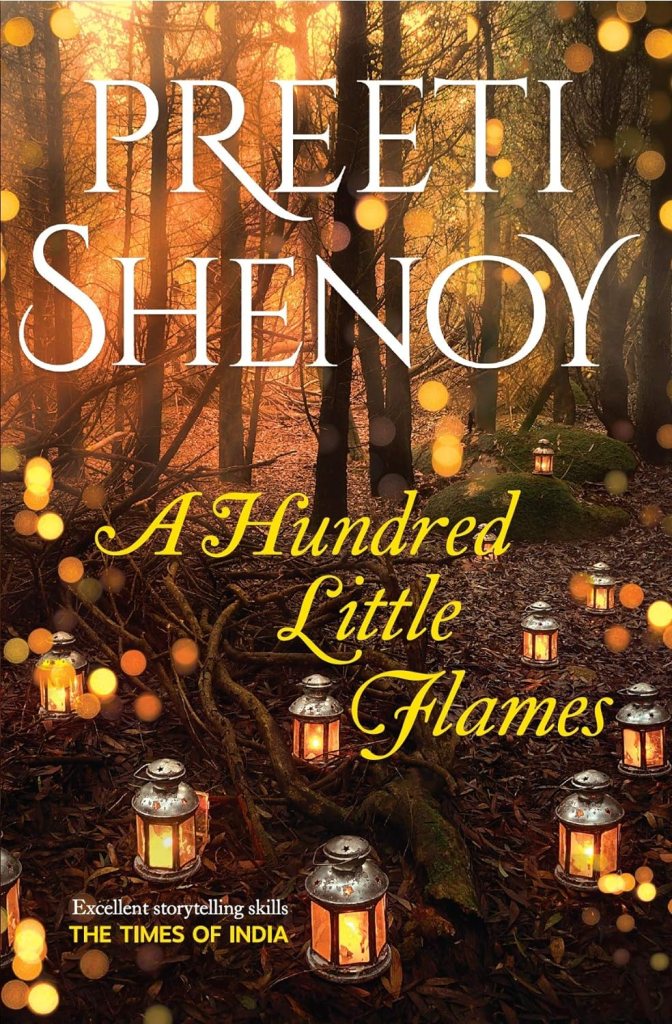
I recently finished reading A Hundred Little Flames by Preeti Shenoy. I bought the book assuming it would be a romantic novel (and I was proven right, but not in the way I expected). I had not taken the time to read the synopsis or reviews. I wanted the element of surprise, so I chose the book merely by looking at the title.
This is my first Preeti Shenoy book, so I was unsure what to expect. I was not looking for an ultra-cheesy romance but something wholesome and warm. I am happy to report that I got what I needed.
The main character, a young urban male residing in India, is pushed to leave his cozy job in a metro due to unprecedented situations and return to Kerala to visit his grandfather. As my base is in Kerala (Palakkad), this particular bit captured my attention. It played a major factor in my buying the book. How Preeti Shenoy beautifully narrated the ethereal, laidback beauty of a typical village in Kerala won my heart.
There are many layers to this book. And many lessons. Here are some of my observations:
As most might know, Kerala is an aging state. The youngsters are leaving for better opportunities, while the parents and the elderly are choosing to stay behind. The many anxieties of an old person living a lonely life in Kerala are explained with much sensitivity in this book. It is something I witness whenever I visit home. Apart from my family, my elderly neighbors rush to me when they need help. There is always some mobile phone, gadget, or internet-related issue to be resolved. Their doubts could be as simple as “Will my WhatsApp DP appear to everyone on my contact list? Or only those whom I chat with?” These senior citizens often hesitate to call their children for help. “They will be busy,” they tell me. So they rely on youngsters around them to help with online work like booking vaccination slots during COVID-19, registering an online complaint, etc.
When they fall sick, they usually depend on neighbors to help them reach the hospital. Their children are able to arrive only a few days later, if at all they can. Their stay often does not last beyond a week. “We don’t have any leaves left,” they say. The fact that their children are out of reach might pinch the parents a bit during such pressing times. But they endure it, saying kids should enjoy themselves and life goes on.
As a silent observer, I often see the anxiety written on their faces and their mild helplessness. There’s concern regarding whom to ask for help. I guess, when we age, we all reach such a stage.
All these elements are captured well in Preeti Shenoy’s book – the problems of the elderly. I wonder if she has stayed with a senior citizen for an extended period, as only such people get to experience what an elderly goes through on a day-to-day basis.
Apart from this, I also immensely enjoyed the sweet, poetic love story depicted in the book. It caught me by surprise. The story was delicately told, and the characters were perfectly etched out. A warm romance with many layers, where the couple engages in a striking serenade of comforting words. The book shows how love is not always a straight, perfect line. It can be complex and unpredictable, hurtful even. Yet, love persists. The book captures this complexity brilliantly. It has an old-world charm to it. I am of the impression it would make a great movie.
I would definitely recommend buying the book. It is engaging from page one, and it will hook you into a world that is peaceful, and bright, yet somber and bittersweet all at the same time.
Happy New Year everyone! I took a long vacation from everything, the longest I have had since forever. I did not go anywhere, as I was not looking for a holiday, but rather a break from routine. So that’s what I did. I broke all rules – only ate, drank, slept, read, couch-potatoed, and relaxed, in the comfort of my home. I am back rejuvenated and ready to tackle the challenges of 2024 (I hope!).
I kickstarted the year by reading the BTS book “Beyond the Story: 10-Year Record of BTS“. I would consider the book as a love letter to the BTS army. Every member consistently conveys heartfelt gratitude to their well-wishers, creating a genuine connection with fans. This sincerity is rare in the celebrity world, where affection can often feel one-sided. Unlike some stars who may ignore or treat fans with disdain, BTS provides solace by reciprocating love, albeit within the constraints of stardom. It makes fans feel truly valued, a sentiment not often experienced in the realm of fame.
As a baby army (who is not a baby at all), I am still learning about BTS. The book gave me an inkling of how their mind worked. It is heartening to see men openly talk about their mental health issues and the scars that their demanding professions can bring.
BTS faced several challenges, yet here they are, the superstars who can put a smile on your face, not just through their music but their playful antics as well. I love watching an episode of Run BTS before winding up for the day.
The book was insightful in many ways. I wish it had more anecdotes from their personal life. I wanted to know more about their daily life, what they did outside of work to unwind, their favorite food, thoughts on love, family, etc. However, I respect their decision to keep the book entirely work-related.
BTS’ Beyond the Story had several sweet and thought-provoking quotes. Here are my favorites:
The old saying is that even the mountains and rivers change in ten years, so we must change, too. And whenever there is new choreography, I know it will take longer for me to pick it up compared to everyone else, so I always think, ‘I’ve got to get this down as quickly as possible so there are no problems later.’
Jin
It was really hard to respect the fact that we were all different people. I used to be very extreme and trapped in a black-and-white mindset. My immature mind would think, ‘Why is he thinking that way? Shouldn’t a normal human being think this way?’ And eventually I went beyond thinking, ‘That guy is different from me,’ to accepting, ‘That person is just being themselves.’ It did take a bit of time.
Suga
We’re a team, and the seven of us need to become one to do a good job at whatever it is we’re doing. I’m not the only one who should do well, my belief is that all need to do a good job, and so I think I did my best in the parts I could do.
J-Hope
Maybe I made a mistake yesterday, but yesterday’s me is still me. Today, I am who I am with all of my faults and my mistakes. Tomorrow, I might be a tiny bit wiser, and that’ll be me too. These faults and mistakes are what I am, making up the brightest stars in the constellation of my life. I have come to love myself for who I am, for who I was, and for who I hope to become.
RM
There were a few things that happened, but in the end, I returned to BTS. I met up with my friends outside of the group, and spent time with them, getting things off my chest, but bringing the things that happened within the group into the outside world resolved nothing, and I couldn’t find the answers I wanted. And I think that’s how I ended up relying on the members even more.
Jimin
I was such a mischievous boy. Even when we’d been selected to debut, all I could think about was how to have fun (laughs). Even at the trainee dorm I kept thinking things like, ‘What If I ordered some fried chicken and pizza and started a party?’
V
When I’m asked now what makes me happy, it’s the fact of being able to have concerns like this. That’s my happiness. If I was actually unhappy now, I don’t believe I’d be able to think about what I’d call happiness. So, being able to think things like, ‘Is this what makes me happy,’ ‘No, this is what makes me happy,’ isn’t that happiness?
I was surprised when I learned Wicca is openly practised in India.
Till then, I had only read about it in blogs written by people in the U.S.
Witches are just like ordinary people, blending in seamlessly with society. They don’t ride broomsticks or cast spells on unsuspecting individuals. The real ones tell you not to use the universal energy for negative agendas – “It will hit you back,” they warn. This differs from the stereotypical witches in movies and television dramas, who are portrayed as evil and adept at spewing words of hatred.
As I went through articles and posts by real witches advocating for the principle of “Do no bad to others,” I couldn’t help but notice the similarity to the teachings of practitioners of more mainstream religions who promote similar values. I often wonder if we are all indeed praying collectively to the same energy. Even a book on atheism, The God Delusion by Richard Dawkins, does not negate the power of nature and its mystical ways.
Personally, it’s gratifying to know that we all are more united than we think we are – not divided by religion, caste, or community. We are one, all seeking the same things in life – hoping to be heard, protected, and blessed by a higher energy to navigate life more smoothly. The possibility that we must all be asking favors from the same being, using different names, is a heady feeling. It erases any semblance of boundaries. It assures you that humanity is above all. If more individuals shared this perspective, the divisive “us vs. them” mentality could diminish, allowing us to function from a unified standpoint.
I read about Ipsita Roy Chakraverti in a local newspaper. I was mindblown by the fact that a witch existed in India. Such things are usually kept secret in a conservative country like mine, but here was a woman who was unabashedly vocal about her practice and teachings. It was then I learned that Ipsita has authored many books on witchcraft. I decided to try “Beloved Witch” as curiosity got the better of me.
Ipsita is different from other witches in the sense that she does not shy away from promoting her powers. She’s not modest and understands her worth, which is why you often see her showering herself with compliments in the book.
I found it refreshing that Ipsita encourages you to use the all-encompassing universal energy for your own greedy benefits but warns you to be prepared for repercussions. She does not say, “Don’t do this.” Instead, she says, “Do it. But whatever happens after that is your responsibility.” So basically, she’s like a parent telling her young ones to seek adventure, giving them the liberty to learn from their own mistakes.
Now that I am done with my views on the subject, I am going to present some of my favorite thought-provoking quotes and anecdotes from Ipsita’s book. Hope you enjoy them as much as I did!
The earth is a great storehouse of energy. Merge with that source he told me, and you shall be whatever you wish to be.
She’ll flick some ash off from her cigarette (no, smoking is not permitted in the chalet, but she’ll sneak around the garden shed and wink at us). As the ash plops down and crumbles away, she’ll say, ‘That’s worldly fame for you. Fun while it lasts but don’t count on it to be around. Besides, it leaves a bad taste in the mouth.’
The following quote is what I had blogged about previously. It was after writing the post that I read this book, so it was a pleasant surprise for me to see those thoughts come to life in print.
Somehow, eastern yoginis never ‘flew’ but western witches were supposed to ride the broom over hill and dale. I have often wondered about this. And this is what I have discovered. What did the broom symbolize? It stood for hearth and home to which a woman was tied by male domination. As she ‘flew’ away on it, it meant that she was breaking the bonds. It symbolized her freedom. It might as well have been a flying carpet.
Colourful stories abounded about how a long-suffering wife would fly away into the night on this piece of domestic bondage, while her husband slept snugly unaware in his bed. She would revel all night long under the moon and return only at dawn to sweep the hearth with the very broom which had carried her off to her secret trysts.
It has been said that witches were women who were never afraid to ‘fly’. Maybe that is why they had to be burnt.
Women, strong, beautiful or independent minded were called witches so that they could be eliminated. The men who tortured and burnt innocent women in medieval Europe, live on in other places, in different guises. Witch-hunting never stopped. It just took on a more deceptive mask.
Of course, in my experience with thousands of women who have come to me for help, I would say that every strong woman is a witch and she is always hunted. It goes against the nature of most men to tolerate a woman they cannot dominate.
Witch-hunting is present not only in rural Bengal, Bihar, Orissa, Uttar Pradesh or Madhya Pradesh. It prevails everywhere in the world where women stand up for themselves and what they believe in. It is there whenever women refuse to be the pawns or playthings of a callous society. Who is a witch? Or more important, what does she do? As she is a Wiccan, it would be fair to say that she practises Wicca or wiccecraefte or the skills of the wise. She was the original wise woman, the shaman, the healer, the counsellor, the lawyer, the stateswoman of her community. Her power became a threat to men, to organised religion — and hence the persecution, the witch-hunts and the slander.
‘Dr Radhakrishnan, do people in our country work best when they are shouted at or spoken to with sarcasm?’ I asked. He smiled that famous smile of his. Serene, indulgent and amused. ‘Yes, I think three hundred years of servitude have taken their toll. The Indian mind wants and needs love, compassion and understanding but has been weakened by fear. Hence it reacts the most quickly to harshness for that is what it fears. You see, our people have had to put up with so many masters, that even now we understand only the language of compulsion.’
Manifestation and visualization are concepts endorsed by a lot of people, including yours truly. As made clear from the following quote, it is practised in witchcraft as well.
Visualization of what you desire is an important part of every Wiccan ritual.
I hated the thought of my parents making a will because it implied that one day I would be on my own on this planet. And if I was capable of love, they were the only ones I did love. Wills also confirm the worst in human nature. It makes one realize that without legal documents and safeguards, people are vile, greedy and corrupt. There is something very sad in this realization.
‘I agree with Nietzsche about what the free spirit needs. It abhors habits and rules. Everything which goes on and on.’
‘But can marriage become stifling then?’ I asked her. ‘I suppose it can, to certain natures. Such a nature, even if it marries, needs space. You know, don’t you, that Nietzsche compared marriage to a spider’s web. Finally, the threads become traps. That is why, after a time, the spider stuck in the middle, painfully tears apart the mesh enclosing him, even though it will suffer from the wounds — because it must tear these threads off itself, away from its body, away from its soul. It must learn to hate where it used to love and vice versa.’
Wicca was not a dark and sinister practice, it was above board and publicly practised for anybody to check and experience. I proved it to the country. I also brought back the ancient science of quartz therapy to India. Wicca showed the way, once the path had been cleared.
Amongst the men, a very famous Wiccan was said to be none other than Robin Hood. He lived in the green woods, a lover of nature. He had around him a coven of twelve members, he being the thirteenth. He was certainly anti-establishment and fought against all forms of exploitation of the poor and helpless. He was also against organized religion. The woods were his church.
The power seekers wanted control in their own hands. Control over the populace, control over laws and governance. Those with independent, free thinking ways and minds, were a threat. Hence the persecution of Wiccans. Specially if they were women. They became the ‘evil witches’ who always tried to harm people, specially children. Folklore and fairy tales abounded equating witchery with wickedness.
What is wicked? Evil is so relative. What is wrong today, may not be considered so tomorrow. Besides right and wrong are such personal, individual things. I have always set my own standards, keeping only one thing in mind. I do not willingly and purposefully harm another in body, mind or spirit. I do not initiate mischief.
Life was the greatest school, the best laboratory for the most interesting experiments with the human species.Look at them, listen to them, mingle with them and learn.
So is there a heaven where you go if you have been ‘good’? I think we make our own heavens (and hells?) right here — and we continue living in them with those we want near, even after we pass on from our physical bodies.
So we are now into the final set of quotes from The Intelligent Investor by Benjamin Graham. I have taken great care to choose the quotes that would make sense to a larger audience and not just equity investors. The book, in my opinion, is quite dry. But then, what can you expect from an investing book? Nevertheless, the advice imparted by Benjamin Graham is worth considering. Being not much of a speculator myself, his thoughts resonated with me.
Without further ado, let’s start Part 3.
It is easy for us to tell you not to speculate; the hard thing will be for you to follow this advice. Let us repeat what we said at the outset: If you want to speculate do so with your eyes open, knowing that you will probably lose money in the end; be sure to limit the amount at risk and to separate it completely from your investment program.
The investor can scarcely take seriously the innumerable predictions which appear almost daily and are his for the asking. Yet in many cases he pays attention to them and even acts upon them. Why? Because he has been persuaded that it is important for him to form some opinion of the future course of the stock market, and because he feels that the brokerage or service forecast is at least more dependable than his own.
Those formulas that gain adherents and importance do so because they have worked well over a period, or sometimes merely because they have been plausibly adapted to the statistical record of the past. But as their acceptance increases, their reliability tends to diminish. This happens for two reasons: First, the passage of time brings new conditions which the old formula no longer fits. Second, in stock-market affairs the popularity of a trading theory has itself an influence on the market’s behavior which detracts in the long run from its profit-making possibilities.
The most realistic distinction between the investor and the speculator is found in their attitude toward stock-market movements. The speculator’s primary interest lies in anticipating and profiting from market fluctuations. The investor’s primary interest lies in acquiring and holding suitable securities at suitable prices.
The happiness of those who want to be popular depends on others; the happiness of those who seek pleasure fluctuates with moods outside their control; but the happiness of the wise grows out of their own free acts.
Marcus Aurelius
If you listen to financial TV, or read most market columnists, you’d think that investing is some kind of sport, or a war, or a struggle for survival in a hostile wilderness. But investing isn’t about beating others at their game. It’s about controlling yourself at your own game.
The whole point of investing is not to earn more money than average, but to earn enough money to meet your own needs.
Putting up to a third of your stock money in mutual funds that hold foreign stocks (including those in emerging markets) helps insure against the risk that our own backyard may not always be the best place in the world to invest.
The most basic possible definition of a good business is this: It generates more cash than it consumes. Good managers keep finding ways of putting that cash to productive use. In the long run, companies that meet this definition are virtually certain to grow in value, no matter what the stock market does.
When you research a company’s financial reports, start reading on the last page and slowly work your way toward the front. Anything that the company doesn’t want you to find is buried in the back—which is precisely why you should look there first.
Graham’s criterion of financial strength still works: If you build a diversified basket of stocks whose current assets are at least double their current liabilities, and whose long-term debt does not exceed working capital, you should end up with a group of conservatively financed companies with plenty of staying power.
A small percentage of investors can excel at picking their own stocks. Everyone else would be better off getting help, ideally through an index fund.
At some point in its life, almost every stock is a bargain; at another time, it will be expensive. Although there are good and bad companies, there is no such thing as a good stock; there are only good stock prices, which come and go.
As Graham liked to say, in the short run the market is a voting machine, but in the long run it is a weighing machine. Yahoo! won the short-term popularity contest. But in the end, it’s earnings that matter—and Yahoo! barely had any.
If you buy a stock purely because its price has been going up—instead of asking whether the underlying company’s value is increasing—then sooner or later you will be extremely sorry. That’s not a likelihood. It is a certainty.
Losing some money is an inevitable part of investing, and there’s nothing you can do to prevent it. But, to be an intelligent investor, you must take responsibility for ensuring that you never lose most or all of your money.
For the intelligent investor, Graham’s “margin of safety” performs the same function: By refusing to pay too much for an investment, you minimize the chances that your wealth will ever disappear or suddenly be destroyed.
Ultimately, financial risk resides not in what kinds of investments you have, but in what kind of investor you are. If you want to know what risk really is, go to the nearest bathroom and step up to the mirror. That’s risk, gazing back at you from the glass.
You must be logged in to post a comment.