A socially awkward 42-year-old Sanskrit professor from Jamshedpur meets a free-spirited 32-year-old Bengali French teacher through an arranged marriage setup. He’s orthodox, she’s liberal. This description may feel like the movie is based on a war of languages (keeping up with the trend). But it’s not. At its core, Aap Jaisa Koi delves into the multifaceted nature of relationships. It brings a fresh and nuanced take on modern love, tradition, and society’s double standards.
I’ve often wondered why our romantic cinema sticks to the same old formulas when dynamics within relationships and individuals involved are far more complex. Our movie industry usually focuses on the stereotypical boy-meets-girl story, where the characters fall in love, and then external forces play the villain. There are no other angles to the story. In real life, the friction often lies within the relationship itself – compatibility issues, cultural/morality issues, and more. Such issues are often subtle at first but end up being harder to fix. They aren’t dramatic but quietly playing in the background and are dismissed as unimportant. But each day, it chips away at a part of your soul. Some deal with it openly, whereas others act ignorant to maintain harmony in the household.
There are a lot of relationship angles left unexplored in Indian cinema. Someday, I’d love to see a romantic story about two divorcees giving love a second chance. That dynamic carries a quiet vulnerability: the fear of repeating past pain, the hesitation of stepping into something that once broke you. It’s raw, real, and deeply human. However, just like how society stigmatizes divorcees, I think our Indian cinema stigmatizes them too. India is not a country devoid of divorcees, yet they are rarely shown in cinema.
Unlike many Indian films, K-dramas explore these internal dynamics with depth and nuance. That’s why Aap Jaisa Koi felt refreshing. It brings a romance that’s familiar in setting but different in treatment. It spends extra time focusing on emotions and character development. The dialogues are so warm and real, they might just bring tears to your eyes. A few lines had that effect on me. Not because they were sad, but because they were crafted with such thoughtfulness. It felt like poetry. If you’re a non-Indian reader who enjoys K-dramas for their focus on emotions, give this one a shot. I think you’ll genuinely enjoy it.
Aside from the crackling chemistry, the movie has some dreamy music. Mila Tujhe is my favourite of the lot. In a romantic drama, music plays a crucial role. It should be tender, laced with hope, longing, and desire, not melancholy, to heighten emotions and pull you in completely. That’s exactly what the Aap Jaisa Koi soundtrack does. The couple’s chemistry draws you in, and the music wraps around it, making the experience all the more immersive.
Fatima Sana Shaikh is an actress I’d love to see more of. Whether she’s playing a traditional hijabi in Modern Love: Mumbai or a fiery Bengali in Aap Jaisa Koi, she brings authenticity to every role. There’s so much untapped potential in her, and it’s time filmmakers gave her the space she truly deserves. Her character in Aap Jaisa Koi is a feminist, yet deeply rooted in tradition. She looks ethereal in beautiful, traditional sarees. In Bollywood, modern women are often stereotyped as party-goers in Western clothes, but this film takes a different route. It reminds us that modernity is a mindset, not a dress code. You can be progressive and still stay connected to your culture. Meanwhile, many who dress trendy are found to be regressive in their thoughts. Clothes are not a true indicator of someone’s personality. To know a person, you need to know their thoughts.
Madhavan, as always, does full justice to a role that’s equal parts comical and endearing. His comic timing is spot on, and he effortlessly switches expressions, reminding us once again of his natural screen presence.
Aap Jaisa Koi is a feel-good romance that stays with you. I enjoyed it. The movie is streaming on Netflix.
A good romantic comedy or family drama is hard to come by these days. Sometimes, I feel we really need more light-hearted stories on screen. Something to make us laugh and unwind. What I watch often influences my mood. I’m sure I’m not the only one. If it’s a tense or serious film or YouTube video, I tend to become irritable or withdrawn. But when I watch a well-made romcom, I feel lighter, more cheerful, and life suddenly seems brighter. So why don’t we see more of this feel-good content anymore? In that sense, Family By Choice stands out. It’s exactly the kind of uplifting drama we need right now.
What’s It About?
Family By Choice tells the story of three individuals, a girl and two boys, brought together by unexpected circumstances to live under one roof. The girl’s father takes the boys in and raises them as his own. Over time, they develop a strong bond that transcends blood. It’s a touching reminder that love isn’t always defined by family ties. Sometimes, those closest to you feel distant, while strangers become your true support. This is the heart of Family By Choice.
Thoughts
Family By Choice is everything I look for in a feel-good series. It’s not perfect, but it struck a chord with me. The bond between the three main characters is simply adorable. What stood out most was how each of them retained their core personality traits even as they grew up. One boy remains the quiet, poker-faced introvert. The other continues to mask his pain behind a cheerful smile. The girl stays fiery, hyper, and full of energy. That kind of character consistency is rare in dramas and movies. Usually, we see drastic changes as the characters grow up, which is understandable, since life tends to shape our personalities. However, here, it was refreshing to see their core traits remain unchanged.
All three characters are incredibly funny and share great on-screen chemistry. I especially liked how the female lead is written. She’s strong yet not over-the-top, modern yet grounded, a layered character you rarely encounter on-screen. Jung Chae-yeon is absolutely adorable. This was my first time watching her in a drama, and I was genuinely impressed by her performance. Hwang In-Youp and Bae Hyun-Sung are brilliant too. They bring charm and depth to their roles. Special mention to the child actors. They were brilliant.
Though we often talk about a parent’s unconditional love, the series explores the painful reality that not every parent needs to be the same. Some can be emotionally toxic and too consumed by their own needs to truly see their children. In such cases, it raises an important question. Should a child continue the relationship for the sake of duty, or is creating distance necessary for mental well-being? The series handles this theme with great sensitivity.
Family By Choice is streaming on Viki. The series has 16 episodes, with each episode lasting roughly an hour.
For a major part of my life, I considered Hinduism just a religion. But as you grow older, you enter a stage when you wish to know more. That’s when I realized Hinduism is more than a religion. It’s a broad philosophical framework that accepts a wide range of beliefs, including atheism.
Did you know Hindus can believe in multiple gods or a single god if they wish, but they are also free not to believe in any god if they wish not to? Non-believers are still considered Hindu. They are not ostracized or excluded from the community. This openness is reflected in ancient Hindu schools of thought, such as the Carvaka and Samkhya schools. These schools, although lesser known, even among Hindus, are testaments to Hindu philosophy’s pluralistic nature.
Carvaka: The Atheist School of Hinduism
Carvaka is an ancient Indian philosophy that openly rejects belief in God, the soul, karma, reincarnation, and life after death.
The core idea of Carvaka is that only tangible things, such as those we can see, touch, or directly experience, are real. The rest is fluff. Its thinkers believe that Gods and heavens are man-made concepts designed to control people.
The main focus of the Carvaka school is to live a happy life in the present, without tying your actions to living a good afterlife, because there’s none. The Carvaka philosophy endorses materialism, which is good news for those who are all about living the good life.
In short, Carvaka says, “Enjoy your life here and now, because that’s all there is.”
Samkhya: A Spiritual but God-Free Philosophy
Samkhya is a Hindu school of philosophy that is spiritual but does not rely on the concept of a creator god. Its core idea is that the universe consists of two things: Purusha (pure consciousness) and Prakriti (nature). The goal is to free yourself from suffering by understanding that your true self is not your body or mind, but pure awareness.
Samkhya does not completely deny the existence of God, but rather states that belief in God is not necessary for achieving spiritual liberation. You must have seen this philosophy being practiced through methods such as Yoga.
Personal Beliefs & Their Acceptance in Hinduism
I’m not religious. However, I’m not an atheist either. I’m someone who ardently believes we are all praying to the same universal energy, just under different names, with different rules.
If there’s only one true religion, how does one explain miracles occurring in every faith?
I have had my prayers answered when I was a traditional Hindu believer, praying to Goddess Durga. My prayers were also answered when I prayed to the universe. This has shaped my impression that God is universal, one divine energy known by many names. Each path may look different, but they all lead to the same source. The only thing that matters when you pray is the depth of your emotions.
Hinduism accommodates thoughts like mine. I’m not judged or ostracized for holding such views. The religion does not demand that I conform to rigid principles. Instead, it allows space to question and for my beliefs to evolve. This openness and freedom are what make Hinduism deeply meaningful to me. I can still call myself a Hindu, even without being traditionally religious.
This openness in Hinduism extends beyond individual beliefs to matters like gender and sexuality. Ancient texts and temple sculptures across India depict a spectrum of gender identities, showing that Hinduism has historically acknowledged and embraced LGBTQ individuals. Few traditional religions offer this level of acceptance. That is what makes Hinduism not just a religion, but an inclusive way of life.
A Message to Hindu Youth: Your Religion Is More Open Than You Think
Despite its pluralistic, “modern” nature, many Hindu youth today feel that Hinduism isn’t “cool” enough. Perhaps because its rich philosophy is rarely taught during childhood. Outside India, Hinduism isn’t widely practiced or represented on global platforms, and the Western media often reduces it to stereotypes. There is also a lot of misinformation spread about Hinduism by people who know very little about the religion.
What many don’t realize is that Hinduism is one of the most liberal and inclusive systems of thought in the world. It is secular in spirit, embracing all forms of belief, including atheism. Hindus are free to question religious leaders and traditions without fear of punishment, reflecting the openness and reformative spirit that lies at the core of their faith. This is why you see many Hindus questioning even our religious leaders.
Conclusion
While some Hindu hardliners insist on rigid practices, such views do not represent the true essence of Hinduism. There is no single rulebook. Instead, there are diverse schools of thought that uphold intellectual freedom and individual choice. That is something to be proud of. I hope Hindus remember this when they encounter misrepresentation, hate, and misinformation about our religion and culture online or offline. Rather than accepting distorted narratives, we should take pride in the fact that Hinduism offers space for everyone: believers, skeptics, and reformers alike.
There’s so much bad news everywhere. Wars, riots, terror attacks, persecution, and discrimination. I don’t know about you, but I’ve started to feel helpless, knowing I hold no power to fix these problems. As individuals, there’s only so much we can do. What is in our control is how we express our views, calmly and with clarity. But even that becomes difficult when those around us try to silence any perspective that doesn’t match their own. They get aggressive. We get perplexed. It becomes a vicious cycle. One that’s hard to escape. It drains our time, disturbs our emotional balance, and pushes away those who genuinely want to understand us.
In the midst of all this, I recently attended an online yoga session on International Yoga Day. We meditated together as a group, and it turned out to be one of the most peaceful and calming experiences I’ve had in a while. The meditation lasted only 7 minutes, but it had a noticeable, immediate impact. I felt centred. It helped me go about the rest of my day with a calm focus, even while handling everyday chores or reading the news. This is new for me. For the past few years, my mind has been troubled by witnessing the coldness with which society operates. There was a lingering sense of doom that had become hard to manage. So when meditation helped soften that heaviness, even slightly, it came as a welcome relief. I allowed myself to sit with that emotion and savour it.
The guide assured us that the control over our minds would improve even further with consistent practice. He said that even just 7 minutes of daily meditation can make a noticeable difference over time. I’m still new to the practice, so it’s too early for me to say how lasting the effects are. But one thing I can say for sure: you feel noticeably better after just the first session.
What made those few minutes so calming was the simple act of focusing only on the breath and the space between the eyebrows. In that short span, there were no screens, no distractions. Just stillness. It felt like a small step toward making peace with myself. This is what I experienced in my first few days of meditation. I’m not sure yet if I can commit to doing it every single day, but it’s something I genuinely want to try.
I’m not the body, I’m not the mind
As we meditated, this chant of “I’m not the body, I’m not the mind” by Sadhguru played in the background, accompanied by soothing flute music. It felt like an invitation to disconnect from the body and mind, to simply let yourself be. You don’t have to react to everything. You can observe your experiences as an outsider, from a third-person perspective. Feel your emotions, acknowledge them, but don’t let them consume you beyond control so that you lose sight of logic.
If you’re interested in trying the same meditation, you can do it at home by downloading the “Miracle of Mind by Sadhguru” app on your phone. The session includes the same calming chant and ends with a short 1-minute video from Sadhguru, offering simple insights on daily practice.
Now, I understand some may have reservations about Sadhguru due to political or personal views, or unverified claims. But I’d encourage you to look past that and focus instead on what this practice can offer you personally.
I’ve tried other meditation apps too, but they often felt too Western in their approach. This one, however, feels grounded in Indian sensibilities, with gentle flute music and guided instructions that actually help you stay focused. In a culture where complete silence isn’t always easy to adapt to, this format works well. It’s thoughtfully designed for an Indian audience, making meditation more accessible and less intimidating.
The protagonist of Convenience Store Woman by Sayaka Murata is unlike anyone I’ve encountered in any book. Keiko is quietly charming, yet deeply unconventional. She’s content with her simple routine at a convenience store, a place she has worked for over 18 years. This does not gel well with people around her who expect her to climb the career ladder, or “at least get married”, instead of sticking to this “lowly” job. They are unable to comprehend her happiness or her emotional detachment in situations where strong feelings are typically expected. In her own words, she’s a “foreign object.”
There are parts of Keiko’s personality I could relate to, especially her tendency to operate more from the brain than the heart. I’ve often questioned this trait in myself, particularly in political matters, where I naturally lean toward a calculated, strategic view rather than reacting emotionally. This sometimes makes people see me as cold. But that’s where my similarities with Keiko end.
I tend to get deeply emotional about things that may not always move others in the same way. My responses aren’t absent, like Keiko’s. I cry easily when I see children being affectionate with their parents or when animals are hurt. I feel emotional and distraught when I see small children picking up guns or stones in conflict zones. I want them to study and grow up contributing to society in peaceful ways. I well up seeing warmth in society. For example, when the visually impaired children sang “Happy Birthday” to our Indian President Murmu, she cried, I cried, we all cried. I’m also deeply moved by the struggles of elderly people, perhaps because I’ve spent time with them and seen what many others, especially those living far from their parents, often overlook. I do feel deeply, just not always in ways others expect, a bit like Keiko.
If you are wondering what makes Keiko strange, this snippet from the book gives an idea:
I wouldn’t say I loved Convenience Store Woman, but it was certainly thought-provoking, especially how society treats you as a “foreign object” that needs to be discarded if you don’t follow the rules. Society insists Keiko must adapt to its norms to be seen as “normal.” It does not matter to them how fulfilled or happy she is. Keiko’s struggle to meet societal expectations forms the core of the novel. Many of us might relate to this struggle with conformity. Not everyone is wired to follow every rule or expectation to the letter.
Ending this post with some thought-provoking quotes from the book:
The normal world has no room for exceptions and always quietly eliminates foreign objects. Anyone who is lacking is disposed of.
He seemed to have this odd circuitry in his mind that allowed him to see himself only as the victim and never the perpetrator l thought as I watched him.
It occurred to me that it wasn’t such a stretch to say that contemporary society was still stuck in the Stone Age after all. So the manual for life already existed. It was just that it was already ingrained in everyone’s heads, and there wasn’t any need to put it in writing. The specific form of what is considered an “ordinary person” had been there all along, unchanged since prehistoric times I finally realized.
“Look, anyone who doesn’t fit in with the village loses any right to privacy. They’ll trample all over you as they please. You either get married and have kids or go hunting and earn money, and anyone who doesn’t contribute to the village in one of these forms is a heretic.”
There’s so much I want to say about Being Hindu in Bangladesh, a book written by Avishek Biswas and Deep Halder, but I don’t think my words would do justice to my emotions. Whatever I write would be a watered-down version of what I felt while reading.
The authors are sons of refugees who once fled Bangladesh. They wrote this book during Sheikh Hasina’s rule, a time when they could safely visit Hindu areas and speak openly with locals, scholars, and researchers about the past.
It was a deeply uncomfortable read. Especially as I kept coming across recent posts from people in Bangladesh on Reddit, worried about the country slipping back into radicalism. It felt like history was repeating itself. On top of that, there were people, including the global and Indian left-leaning media, trying to downplay the communal angle in Bangladesh so as not to flare up Islamophobia. As an ex-leftist, this behaviour is all too familiar. I was once part of that ecosystem.
Despite being a Hindu, I could not acknowledge the persecution that Hindus faced in neighbouring regions. The data was there for everyone to witness, yet I was blind. I believe this is true for many Hindus. We are raised with strong secular values, which often makes it uncomfortable to openly acknowledge or speak about atrocities against our own community. Personally, it was difficult to break out of that mindset and accept the reality that Hindus did face genocide in Pakistan, Bangladesh, and Kashmir. Adding to that is the consistent bias of left-leaning media, which often avoided reporting anti-Hindu communal incidents both in India and abroad. This selective activism played a key role in my decision to step away from the leftist ecosystem.
Sahidul’s narrative states: ‘The genocide orchestrated and masterminded by Pakistan, began on the night of March 25, 1971 … Three million were killed (in East Pakistan), 200,000 to 300,000 women were violated in the most diabolic ethnic cleansing since the days of the Holocaust. And these are just rough estimates. How much does the world or even the subcontinent talk about it?
Most Painful Part of the Book
The most aching part for me was the quiet optimism in the book. Written during Sheikh Hasina’s rule, the authors were hopeful about the secular path Bangladesh was taking. They welcomed the ban on JeI and the arrests of those involved in the Hindu genocide of 1971. I read those pages, and then Al Jazeera’s headline from a few days back: “Bangladesh Supreme Court lifts ban on Jamaat-e-Islami.” I feel a mixture of emotions.
The authors also appreciated the death sentence awarded to a Jamaat leader involved in the 1971 genocide of Hindus. That sentence, too, has now been overturned in current-day Bangladesh under Yunus’s rule. Makes you wonder – is justice so fickle?
Opposition to Bengali Because It Was Too “Hindu”
From the book, I learned that Pakistan was opposed to Bengali in East Pakistan (now Bangladesh) because they considered the language “too Hindu” as opposed to Urdu. When East Pakistan demanded a new nation on the basis of Bengali culture, Pakistan thought Hindus were responsible for this “brainwashing”, which is what led to the genocide.
The Pakistani Army launched Operation Searchlight for complete cleansing of the Bengali and Hindu identity. Even the press secretary of the third president of Pakistan, Yahya Khan, said that this operation was to ‘brainwash the people, wean them off their Bengali mores and make them true Pakistanis … The Hindu influence must be eradicated root and branch and the people who were misguiding the innocent and illiterate masses must be liquidated.’
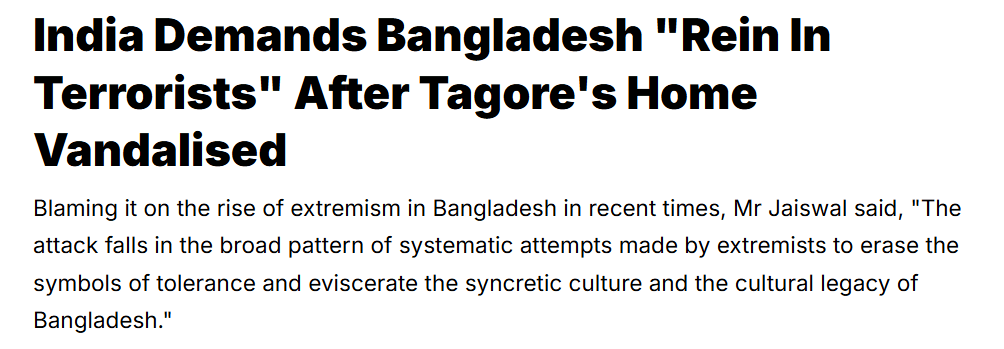
Tagore’s Home Vandalized in Bangladesh. News Source: NDTV
Truth be told, I was thinking while reading the book, how long would it take for the pro-Pakistan radicals in Bangladesh to go after anything related to Tagore, the Hindu writer of Bangladesh’s anthem “Amar Sonar Bangla” (My Golden Bengal), and then the vandalism of Tagore’s home happened. I wouldn’t be surprised if they replace the anthem, too, at some point in the future.
Jogendra Nath Mandal – The Dalit Leader Who Chose Pakistan
It’s from the book that I came across the name Jogendra Nath Mandal for the first time. He was a Dalit leader and a close associate of Dr. Ambedkar. At the time of Partition, Mandal chose to side with Pakistan, believing it would offer Dalits greater freedom and rights than a Hindu-majority India. He motivated many Dalits to migrate with him, promising an escape from caste oppression.
Mandal, the man who wanted Pakistan to become a land of Dalits and Muslims.
But what they found was a harsher reality. Regret followed soon after. Mandal eventually fled Pakistan and returned to India. Sadly, many Dalits who followed him to Pakistan lacked his privilege and means and were left behind. His popularity waned after that, and he died a lonely death in West Bengal. To quote the book:
Mandal had come to India from East Pakistan as a broken man. Arguably, the tallest Dalit politician in pre-partition East Bengal, Mandal had lost most of his followers after he chose Pakistan over India, stood with Muhammad Ali Jinnah and became the law and labour minister. Mandal had thought Dalits and Muslims would behave like brothers in the newly-created Pakistan. They didn’t, and as communal tension rose and Hindus left East Pakistan for India in large numbers, Jogendranath Mandal came to be looked at as a short-sighted leader at best and a self-serving politician at worst.
Dr. Ambedkar, upon learning about the persecution of Dalits in Pakistan, urged them to return to India. However, most were unable to leave, trapped by circumstances beyond their control.
I encourage everyone to read the following Reddit post that offers a more complete account of Jogendra Nath Mandal’s life. It includes his resignation letter to the Prime Minister of Pakistan and Dr. Ambedkar’s heartfelt appeal to Dalits living there.
Mandal’s story reminds us never to forget history or its lessons. These accounts were documented by key figures of that era for a reason. Not to be ignored, but to help us reflect, understand, learn, and avoid repeating the same mistakes in the future.
Quotable Quotes from Being Hindu in Bangladesh
‘Yes, only two people might have died in Noakhali in last year’s violence. But look around and you will find boys and men without an arm or a leg walking around. They will remind you of what was.’
What was it like in 1946? When freedom from 200 years of British rule was becoming a reality, Bengali-Hindu women and men, in village after village in Noakhali district of undivided Bengal, the same place where we now are, were r*ped and killed, or forcibly converted. Then too, it had started with fake news.
‘I have never been able to forget those days,’ she says, ‘when neighbours became rioters and friends became murderers. The stench of blood haunts me to this day.’
‘I remember he would come and tell us to make sure no one made any sound, and make sure that the children remained silent. It should appear from outside that the college building was deserted. Or else, a mob could come and kill us all. But my seven-month-old sister cried out in hunger. We gave her some treacle to make her stop crying, but she would start wailing soon after. My father told us that we had to kill her as she simply wouldn’t stop crying. And her wails would bring the mob to us. She cried and cried, till she cried no more.’
In other riots, religion was the point of disagreement. In Noakhali, religion was also the instrument that ended the disagreement. The attacks in Noakhali on Hindus by Muslims ended when the Hindus became Muslims.
‘But it’s a mistake that all democratic governments make in trying to control one set of extremists. They often play with the other set that looks less worse than the other (but) in the course of time, they all become Frankensteins’ he said.
There’s something about discovering forgotten buildings where powerful men once lived, touring villages where they spent their boyhood. It is like sifting through dog-eared, yellowed pages of history. So much of what once was still hangs in the air. So many stories are kept alive by village elders who saw history take shape.
Conclusion
The book details several atrocities that are too graphic to include in this blog post. I strongly encourage everyone to read Being Hindu in Bangladesh for a clearer and unbiased understanding of the condition of Hindus in the country.




 The Monkey Dilemma
You must be logged in to post a comment.