A lot of love stories released lately haven’t worked for me. I tried Saiyaara, but it felt more Gen Z-oriented. While they cried, I yawned. As a 40+ year-old, I am not quite sure if that yawn stemmed from a vitamin deficiency or because I was genuinely bored. It’s a tricky age group.
Then, I gave Metro In Dino a shot, only to find every character cheating on their partner… while singing songs, of course, because that’s how it is in Bollywood. Your loved one could have died, but you still end up singing a romantic song for your partner. Remember Suraj Hua Maddham?
While I was on this quest for a good love story, I realized there’s no chance of my stumbling upon a feel-good romcom that meets my dreamy requirements. So I thought, why not pick an old movie that already matches my soul? That’s how I ended up choosing this dark, unsettling Black Mirror-type romance, The One I Love.
What’s It About?
A couple struggling with marital issues goes on a retreat to a remote resort. This place, recommended by their therapist, is where many of his former patients have found healing. The home is warm and spacious, disconnected from the outside world, seemingly perfect for reconciliation. But soon, strange and unexpected events happen, which draw out very different responses from each partner.
Thoughts
I enjoyed the movie. It was gripping and featured some excellent performances.
I felt that even though the movie was released in 2014, it resonates with today’s AI age, where many people turn to artificial means to fulfill emotional needs their partners can’t always meet. The filmmaker probably foresaw a future where this would take shape in some shape or form.
I especially felt for the female lead, who genuinely seemed happy with the new experience. She was finally getting what she had always craved, even if it couldn’t last. It leaves you wondering what you might have done in her place. If you’re emotionally craving for a deeper bond, and you accidentally stumble upon it after years of acceptance that you would never experience it in your lifetime, how would you react?
You look at the character, see her face light up with a happiness that was missing in the previous scenes, and you can’t help but wish she could experience that bliss a bit longer. Routine has a way of dulling your emotions. You do not wish to take things for granted, but it happens anyway. These relatable human emotions make you empathize as well as get annoyed with Sophie (played by the talented Elisabeth Moss).
I would say The One I Love was a good watch. It’s currently available for free (not on rent in India, thankfully) on Amazon Prime.
As someone living in India, I enjoy hearing the stories of the Indian-American diaspora. In many ways, we are alike, yet also very different. While India itself holds a wide diversity of thoughts, the experiences of Indian-origin people abroad offer something unique – they make you see your own country from a fresh perspective. Zarna Garg’s This American Woman was one such story that offered me a deep dive into that view.
I have to admit, at first, I was put off by Zarna’s description of India in the few Instagram reels I came across. My patriotism made me defensive. But over time, she grew on me, and I realized that everyone sees a country through their own lens. As an ex-NRI myself, my perspective on India is very different from Zarna’s and her family’s. They see the USA as the best, while I believe India is the best – and that’s okay. Different views deserve respect. It was this curiosity about Zarna’s unique journey that ultimately led me to buy her book.
I loved this book. It made me both laugh and cry. Zarna’s life reads like a movie. Born in Mumbai, she ran away to the US as a teenager after her father tried to force her into an arranged marriage following her mother’s death. From there, she stayed with her sister and slowly built her life in America. Her journey has been tough, leaving her with mental blocks about returning to India. Yet she tells it all with such lightness, as if life itself is a comedy not meant to be taken too seriously.
Pain is my destiny and my company and my affinity. Embracing pain and not wasting time wondering “Why me?” will put you on the fast track to success.
What truly brought me to tears was the chapter her daughter dedicated to her. Even now, writing about it makes my eyes well up (though, to be fair, it might also be that time of the month – we women never really know what’s behind the tears). It’s a chapter worth reading. Everyone faces moments of self-doubt, especially women who’ve had to set aside their careers for family. But when that same family becomes your greatest support system, it’s a blessing. Zarna has that blessing in Zoya.
“For many parents, their children’s careers are their greatest accomplishment, but for me my mom’s is mine” – Zoya
The final part with Zarna’s brother was truly heart-warming. The speech she delivers on stage is pure heart.
I would strongly recommend reading This American Woman. It’s inspirational, funny, and heartwarming, capturing life in its own uniquely Indian-American way.
I was in the mood for something light and funny. Since I’m a bit under the weather, my brain just can’t deal with anything too serious right now. I needed some humour to melt the moodiness away. The sticky Kerala humidity, returning after a long bout of pleasant rainy weather, hasn’t helped either. So when I read the synopsis of Inspector Zende, I thought, yup, this is exactly what I need to watch.
What’s It About?
Inspector Zende is inspired by the real-life story of the officer who caught Charles Sobhraj not once, but twice. In the film, the criminal goes by the name Carl Bhojraj, and the plot follows the inspector’s relentless pursuit to nab him a second time.
Thoughts
I really enjoyed the way the movie was narrated. It was light-hearted and fun. Sure, it drags a little in the middle, but overall, I loved how they kept the tone humorous from start to finish. Given the serious subject, they could easily have gone for a heavy treatment, but thankfully, they didn’t. This is exactly the kind of film I’d like to see more of.
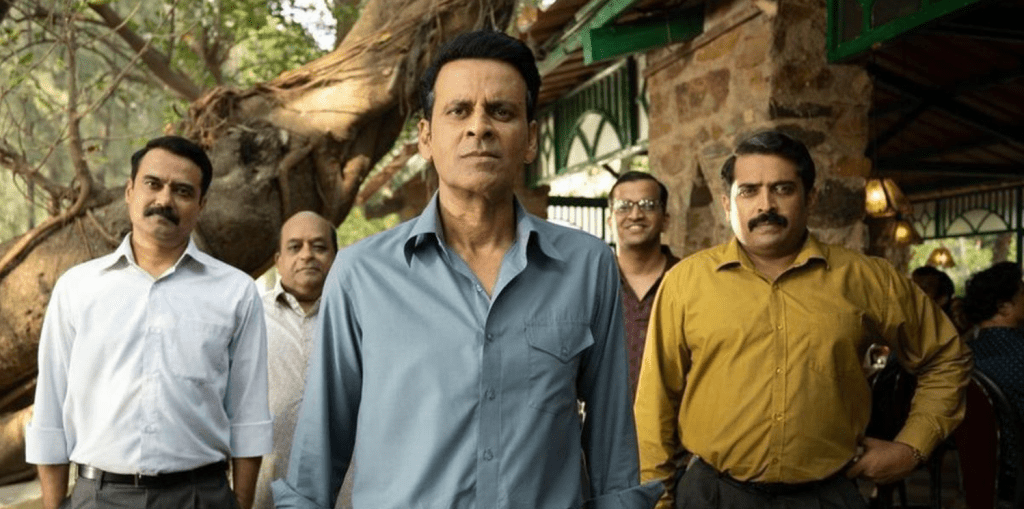
Manoj Bajpayee was brilliant as Inspector Zende. We’ve seen him excel in intense police roles before, but here he shines just as much in a lighter, comic avatar. And honestly, I can’t think of anyone other than Jim Sarbh who could have pulled off Carl Bhojraj so well.
If you’re in the mood for something breezy, I’d definitely recommend Inspector Zende on Netflix.
I’ll start by saying I’m in my 40s, so I’m not exactly the target audience for this film. Still, I enjoyed seeing fresh faces on screen. Actors who look natural, expressive, and free from the usual heavy Botox work.
What’s It About?
Saiyaara opens with the female lead at the registrar’s office, ready to formalize her marriage. She’s a dreamer and a poet, someone who finds inspiration in life’s fleeting moments. Even in the office, she pulls out her diary to capture the beauty of what she believes is the start of a new chapter. But life takes an unexpected turn.
She soon crosses paths with the male lead, an angst-ridden singer determined to make it big. The film traces their love story and the way they navigate the highs and lows of their relationship.
Thoughts
The story felt like a mix of Aashiqui2 and Rockstar. As I’m not drawn to melancholy, tragic romances, it didn’t resonate with me as much as I’d hoped. That said, it was refreshing to see young, expressive talent on screen.
Director Mohit Suri specifically sought an actress without cosmetic enhancements (a “botox-free beauty”), and I think that was a brilliant choice. As an audience member, I’ve found lip jobs and other obvious procedures very distracting, so the natural look was a welcome change.
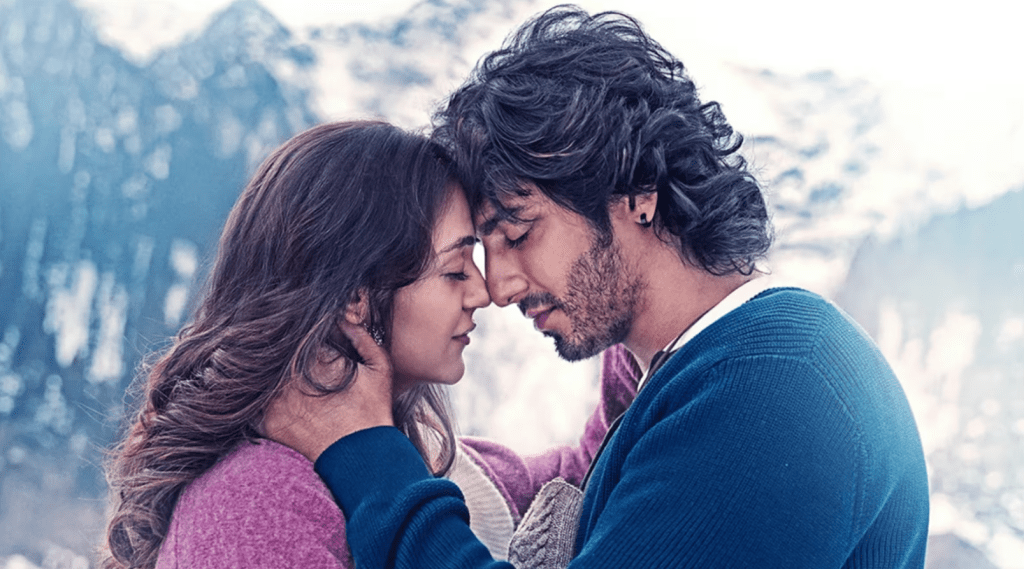
The lead actress (Aneet Padda) is adorable, and the actor (Ahaan Panday) is quite charming, too. Their chemistry was lovely. Personally, I would have loved to watch this pair in a light-hearted romcom instead. Hopefully soon. We need more youthful, happy, meet-cute romantic stories in Bollywood.
The debate around Umar Khalid, Sharjeel Imam, and other Delhi riots accused who have not yet been granted bail has once again come into focus. From the right-wing perspective, the issue is not as simple as “judicial delay” or “denial of justice.” I thought of writing this post because many in India only trust left-wing channels, which causes them to miss important fact-based points shared by the right-wing.
Adjournments and CJI’s Remarks
First of all, let us understand what an adjournment is. Simply put, it is when a court hearing or trial is postponed to a later date instead of being completed on the scheduled day.
Out of the 14 adjournments in Umar Khalid’s case, 7 were initiated by his own legal team. This was mentioned by CJI D.Y. Chandrachud himself in his interview with Barkha Dutt.
Source: Lawbeat
“I do not want to comment on the merits of the case but I must tell you one thing which is lost sight by a lot of people when it comes to Umar Khalid‘s case, can you imagine that the case was adjourned, they were at least seven if not more adjournments which were sought by the council appearing for Umar Khalid and eventually the application for bail was withdrawn.” – CJI Chandrachud
Justice Chandrachud noted that, on social media, a one-sided narrative often takes hold, leaving judges with no space to defend themselves. He added that if one looks closely at the actual proceedings in court, the reality is far more nuanced than what is portrayed online.
While some “fact checkers” online have attempted to dismiss this claim by relying on surface-level sources, it is reasonable to trust the CJI more on this matter. As head of the judiciary, he had direct access to both official and indirect records of adjournments.
The Delay Tactic
According to many on the right, Khalid and Imam’s legal strategy is clear. If the trial begins, conviction is almost certain. Thus, their team is accused of deliberately delaying proceedings by filing fresh petitions, often citing a “change in circumstances.” The idea is to drag the trial as long as possible and eventually claim bail on the grounds of delay.
Notably, some petitions that caused delays were also filed by other accused who are already out on bail.
The Judicial Tactic Explained
The strategy seen here is not unique. It is a common tactic in the Indian judiciary:
Lawyers repeatedly file petitions (often citing new circumstances).
Each petition leads to adjournments, dragging the trial.
Eventually, the accused can argue that their right to a speedy trial (protected under Article 21 of the Constitution) has been violated.
On that ground, they can seek bail due to judicial delay.
This slow erosion of the process not only stalls justice but also erodes public trust in the judiciary. Something that many argue is part of the plan.
CJI on Unseen Angles
In an interview with Barkha Dutt, CJI Chandrachud hinted that there are angles in the case that cannot be revealed to the public. Right-wing commentators believe this may refer to multiple coordinated fronts behind the Delhi riots.
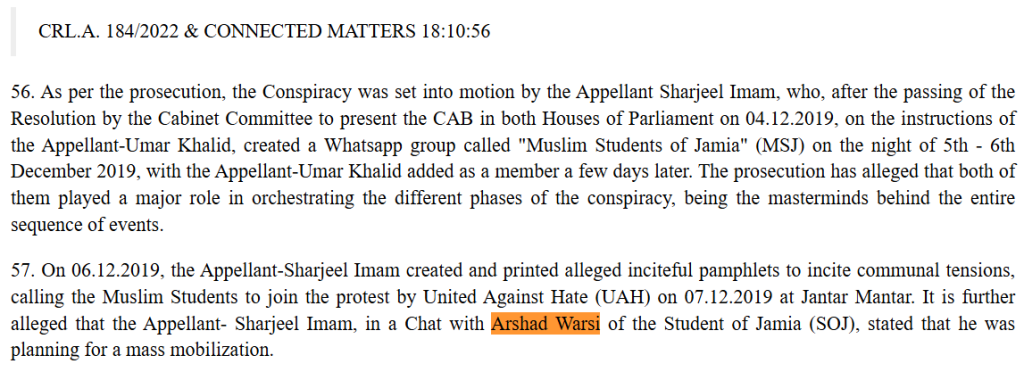
One example often cited is ISIS member Arshad Warsi (not the actor), who was in contact with Sharjeel Imam. Warsi allegedly helped decide the content of pamphlets that were distributed to mosques and Muslim neighbourhoods prior to the riots to incite violence. He was later arrested in the Pune ISIS module case.
Sharjeel Imam’s connection with Arshad Warsi. Source: indiankanoon.org/doc/156202283/Arshad Warsi arrested
There are also allegations of foreign funding and terror groups like PFI supporting the protests and unrest.
Umar Khalid met with other accused people in the PFI office to discuss funds for riots. Source: indiankanoon.org/doc/156202283/
The Seriousness of the Delhi Riots
The 2020 Delhi riots were not minor incidents of unrest. They claimed the lives of 53 people, including Intelligence Bureau officer Ankit Sharma. For many, this underscores the gravity of the case and why justice cannot be indefinitely postponed.
Right-Wing Response
Right-wing commentators like Abhijit Iyer-Mitra and Kushal Mehra have now openly criticized the delay of trials. They argue that instead of dragging the matter endlessly, the trial should begin as soon as possible, and justice should be delivered. In their view, it is time to see through legal manoeuvres and bring the culprits to justice. The longer the delay, the more the perception of judicial inefficiency grows, and that benefits only those seeking to evade accountability.
It is also important to understand that, though we can call for quick trials, courts in India are bound to follow established legal procedures. Every step, adjournments, evidence submission, witness examination, bail hearings, has to comply with the Code of Criminal Procedure (CrPC), the Evidence Act, and constitutional safeguards like Article 21 (right to life and liberty, including speedy trial).
Judges cannot simply “override” these protocols, even if they suspect delaying tactics. If the defense files a petition citing “change in circumstances” or another procedural ground, the court is obliged to hear it and decide. Ignoring or fast-tracking outside the rules would open the door to appeals, accusations of bias, or even the case collapsing later.
Delays often frustrate people. However, they’re also part of the judiciary, ensuring the trial stands on solid legal ground.
Left-Wing Response
The left-wing argues that delays aren’t only due to Khalid’s side and that long undertrial detention is unfair. While these points deserve acknowledgment, they don’t erase the fact that half the adjournments were filed by Khalid’s own team and that Sibal’s strategy clearly aims at running down the clock.
They also say Hindu mobs who killed during the riots haven’t faced equal scrutiny. But the distinction is clear: Hindu rioters were violent on the ground, yes, but they did not make the kind of provocative, mass-scale mobilizing speeches Khalid and Sharjeel Imam did that led to loss of lives. Khalid mobilized crowds by invoking the Kashmir issue, while Sharjeel Imam spoke about separating Assam from India and attempted to provoke people through pamphlets referencing the Babri Masjid dispute. Videos of their speeches can be accessed easily on social media platforms. That’s why the charges against them are different and why delaying the trial feels like a deliberate tactic.
My Take
It is important to examine cases from every angle instead of blindly accepting one-sided propaganda. Dhruv Rathee does not question the opposition, while journalists like Shiv Aroor do not question the ruling party. So it’s up to us, the citizens, to collect points from both sides and analyze it.
I have tried to provide proof for all the points in this post, but they can also be independently validated online. I would highly recommend going through the Indian Kanoon link (indiankanoon.org/doc/156202283/) to read more about the case.
Rather than dismissing everything right-wing as lies, citizens should review the available evidence and ask: Is a separatist attitude acceptable for the country? Does this kind of behaviour warrant bail? This cannot simply be brushed off as freedom of speech, because in this case, speech directly incited violence and led to the loss of 53 lives and the injury of thousands.
In India, there are rarely open-and-shut cases. Even Ajmal Kasab, a convicted terrorist, was given a fair trial. By that standard, it is certain that Sharjeel Imam and Umar Khalid will also receive a fair hearing once their trial begins, especially since their offences, while serious, are not on the same level as Kasab’s. That is why the trial should begin without further delay. So their actions can be properly examined, and justice delivered swiftly.
After celebrating Onam and engaging in numerous social activities, my introvert battery hit rock bottom. I needed a desperate recharge. So what do I do? Naturally, I retreated to every introvert’s most favourite new-gen comfort zone: scrolling endless Instagram reels. Nothing says “I’ve had enough of people” quite like being a couch potato, locked up in your house, while going through everyone else’s social lives.
As I scrolled through the multiple Onam-related posts, I couldn’t help but appreciate the inclusivity in Kerala. Malayalees across religions, whether they are Hindus, Christians, or Muslims, celebrated Onam with equal enthusiasm. Everyone welcomed Mahabali with open arms. A few voices did try to stop their communities, saying Onam is a “Hindu festival,” but not many paid attention. That’s a good sign. People are choosing to step out of religious bubbles to celebrate together.
Still, Kerala, often praised as a secular state, has been showing sporadic worrying signs of exclusion. Just before Onam, a teacher told students not to participate in the festival because “our religion doesn’t allow it.” The outrage led to her suspension, but this mindset isn’t limited to one person. How widespread is the thought? No one can quantify. It’s impossible to analyze each and every Indian’s thought. However, there is an increasing number of cases that advocate for exclusionary behaviour. You are penalized for celebrating other festivals, or for respecting someone else’s god, or for chanting something as simple as “Bharat Mata ki Jai.”
India guarantees freedom of religion for all communities. But if we use that freedom only to exclude ourselves from others, we risk creating deeper divides. True communal harmony comes from participation: joining in festivals, enjoying each other’s food, and refusing to see other faiths as “untouchable.”
For India to stay secular, this effort has to come from all of us. We’ve come far since independence, but there’s still a long way to go. It’s up to us to ensure religion doesn’t become a wall, but a bridge.










You must be logged in to post a comment.