
Godless Yet Hindu: How Hinduism Welcomes Every Kind of Belief

For a major part of my life, I considered Hinduism just a religion. But as you grow older, you enter a stage when you wish to know more. That’s when I realized Hinduism is more than a religion. It’s a broad philosophical framework that accepts a wide range of beliefs, including atheism.

Did you know Hindus can believe in multiple gods or a single god if they wish, but they are also free not to believe in any god if they wish not to? Non-believers are still considered Hindu. They are not ostracized or excluded from the community. This openness is reflected in ancient Hindu schools of thought, such as the Carvaka and Samkhya schools. These schools, although lesser known, even among Hindus, are testaments to Hindu philosophy’s pluralistic nature.

Carvaka: The Atheist School of Hinduism

Carvaka is an ancient Indian philosophy that openly rejects belief in God, the soul, karma, reincarnation, and life after death.

The core idea of Carvaka is that only tangible things, such as those we can see, touch, or directly experience, are real. The rest is fluff. Its thinkers believe that Gods and heavens are man-made concepts designed to control people.

The main focus of the Carvaka school is to live a happy life in the present, without tying your actions to living a good afterlife, because there’s none. The Carvaka philosophy endorses materialism, which is good news for those who are all about living the good life.

In short, Carvaka says, “Enjoy your life here and now, because that’s all there is.”

Samkhya: A Spiritual but God-Free Philosophy

Samkhya is a Hindu school of philosophy that is spiritual but does not rely on the concept of a creator god. Its core idea is that the universe consists of two things: Purusha (pure consciousness) and Prakriti (nature). The goal is to free yourself from suffering by understanding that your true self is not your body or mind, but pure awareness.

Samkhya does not completely deny the existence of God, but rather states that belief in God is not necessary for achieving spiritual liberation. You must have seen this philosophy being practiced through methods such as Yoga.

Personal Beliefs & Their Acceptance in Hinduism

I’m not religious. However, I’m not an atheist either. I’m someone who ardently believes we are all praying to the same universal energy, just under different names, with different rules.

If there’s only one true religion, how does one explain miracles occurring in every faith?

I have had my prayers answered when I was a traditional Hindu believer, praying to Goddess Durga. My prayers were also answered when I prayed to the universe. This has shaped my impression that God is universal, one divine energy known by many names. Each path may look different, but they all lead to the same source. The only thing that matters when you pray is the depth of your emotions.

Hinduism accommodates thoughts like mine. I’m not judged or ostracized for holding such views. The religion does not demand that I conform to rigid principles. Instead, it allows space to question and for my beliefs to evolve. This openness and freedom are what make Hinduism deeply meaningful to me. I can still call myself a Hindu, even without being traditionally religious.

This openness in Hinduism extends beyond individual beliefs to matters like gender and sexuality. Ancient texts and temple sculptures across India depict a spectrum of gender identities, showing that Hinduism has historically acknowledged and embraced LGBTQ individuals. Few traditional religions offer this level of acceptance. That is what makes Hinduism not just a religion, but an inclusive way of life.

A Message to Hindu Youth: Your Religion Is More Open Than You Think

Despite its pluralistic, “modern” nature, many Hindu youth today feel that Hinduism isn’t “cool” enough. Perhaps because its rich philosophy is rarely taught during childhood. Outside India, Hinduism isn’t widely practiced or represented on global platforms, and the Western media often reduces it to stereotypes. There is also a lot of misinformation spread about Hinduism by people who know very little about the religion.

What many don’t realize is that Hinduism is one of the most liberal and inclusive systems of thought in the world. It is secular in spirit, embracing all forms of belief, including atheism. Hindus are free to question religious leaders and traditions without fear of punishment, reflecting the openness and reformative spirit that lies at the core of their faith. This is why you see many Hindus questioning even our religious leaders.

Conclusion

While some Hindu hardliners insist on rigid practices, such views do not represent the true essence of Hinduism. There is no single rulebook. Instead, there are diverse schools of thought that uphold intellectual freedom and individual choice. That is something to be proud of. I hope Hindus remember this when they encounter misrepresentation, hate, and misinformation about our religion and culture online or offline. Rather than accepting distorted narratives, we should take pride in the fact that Hinduism offers space for everyone: believers, skeptics, and reformers alike.

***

Photo by Sujit Hirapara
An Ode to Calming My Monkey Mind Through Meditation

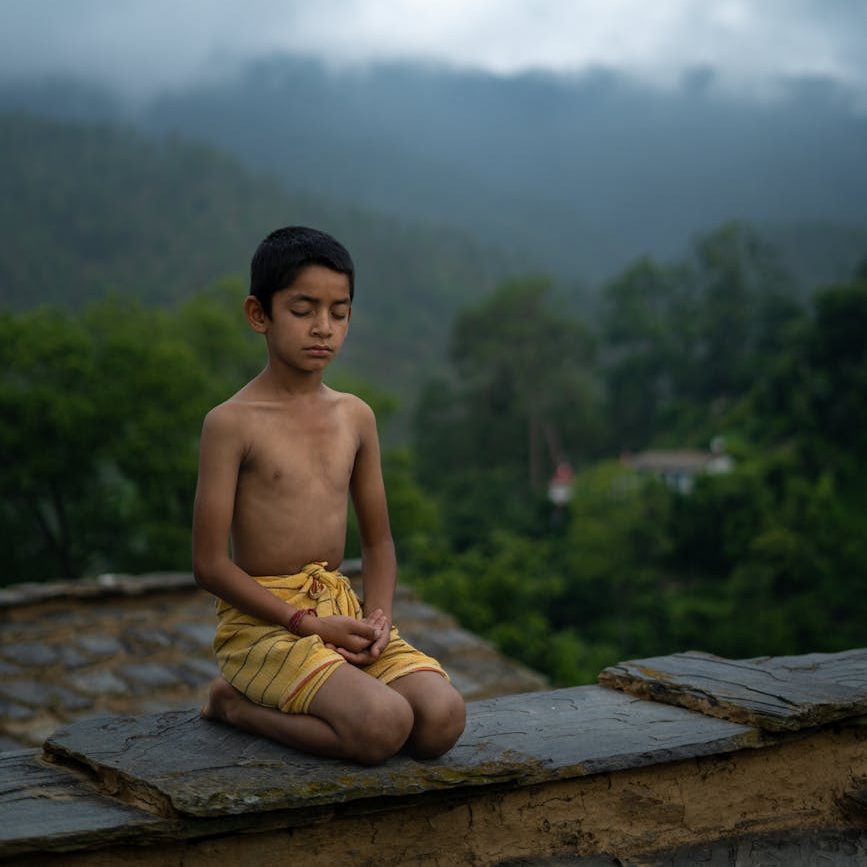
Indian Boy Meditating

There’s so much bad news everywhere. Wars, riots, terror attacks, persecution, and discrimination. I don’t know about you, but I’ve started to feel helpless, knowing I hold no power to fix these problems. As individuals, there’s only so much we can do. What is in our control is how we express our views, calmly and with clarity. But even that becomes difficult when those around us try to silence any perspective that doesn’t match their own. They get aggressive. We get perplexed. It becomes a vicious cycle. One that’s hard to escape. It drains our time, disturbs our emotional balance, and pushes away those who genuinely want to understand us.

In the midst of all this, I recently attended an online yoga session on International Yoga Day. We meditated together as a group, and it turned out to be one of the most peaceful and calming experiences I’ve had in a while. The meditation lasted only 7 minutes, but it had a noticeable, immediate impact. I felt centred. It helped me go about the rest of my day with a calm focus, even while handling everyday chores or reading the news. This is new for me. For the past few years, my mind has been troubled by witnessing the coldness with which society operates. There was a lingering sense of doom that had become hard to manage. So when meditation helped soften that heaviness, even slightly, it came as a welcome relief. I allowed myself to sit with that emotion and savour it.

The guide assured us that the control over our minds would improve even further with consistent practice. He said that even just 7 minutes of daily meditation can make a noticeable difference over time. I’m still new to the practice, so it’s too early for me to say how lasting the effects are. But one thing I can say for sure: you feel noticeably better after just the first session.

What made those few minutes so calming was the simple act of focusing only on the breath and the space between the eyebrows. In that short span, there were no screens, no distractions. Just stillness. It felt like a small step toward making peace with myself. This is what I experienced in my first few days of meditation. I’m not sure yet if I can commit to doing it every single day, but it’s something I genuinely want to try.

I’m not the body, I’m not the mind

As we meditated, this chant of “I’m not the body, I’m not the mind” by Sadhguru played in the background, accompanied by soothing flute music. It felt like an invitation to disconnect from the body and mind, to simply let yourself be. You don’t have to react to everything. You can observe your experiences as an outsider, from a third-person perspective. Feel your emotions, acknowledge them, but don’t let them consume you beyond control so that you lose sight of logic.

If you’re interested in trying the same meditation, you can do it at home by downloading the “Miracle of Mind by Sadhguru” app on your phone. The session includes the same calming chant and ends with a short 1-minute video from Sadhguru, offering simple insights on daily practice.

Now, I understand some may have reservations about Sadhguru due to political or personal views, or unverified claims. But I’d encourage you to look past that and focus instead on what this practice can offer you personally.

I’ve tried other meditation apps too, but they often felt too Western in their approach. This one, however, feels grounded in Indian sensibilities, with gentle flute music and guided instructions that actually help you stay focused. In a culture where complete silence isn’t always easy to adapt to, this format works well. It’s thoughtfully designed for an Indian audience, making meditation more accessible and less intimidating.

***

Photo by Yogendra Singh

How the DEI Program Fostered Biases

How the DEI Program in USA Contributed to Fostering Biases

A recent set of DEI studies explores a critical question: Do the ideas and narratives central to many DEI trainings truly promote inclusivity and empathy?

Or do they end up deepening divisions and fueling hostility toward groups labeled as oppressors?

DEI Study Source: static.foxnews.com/foxnews.com/content/uploads/2024/11/anti-oppressive-dei-report-8.pdf

Social Experiment #1 – Exposing One Group to DEI Essays

The study found that individuals exposed to DEI material were more likely to perceive problems even where none existed. For example, one group was presented with a DEI essay by Ibram X. Kendi and Robin DiAngelo, while another group was not. Both groups were then asked to analyze the following scenario:

A student applied to an elite East Coast university in Fall 2024. During the application process, he was interviewed by an admissions officer. Ultimately, the student’s application was rejected.  

A simple, straightforward survey. The scenario was deliberately created without mentioning the race or ethnicity of either the student or the admissions officer and contained no indicators of racism. Participants were then asked to evaluate the scenario using questions meant to assess how much racism they perceived in the interaction.

Results: The analysis showed that participants who read the Ibram X. Kendi/Robin DiAngelo essay developed a hostile attribution bias. They viewed the admissions officer as significantly more prejudiced compared to those who read a neutral essay. Despite no evidence of discrimination in the scenario:

  • Perceived discrimination rose by 21%
  • Perceived unfair treatment increased by 12%
  • Perceived harm to the applicant rose by 26%
  • Perceived microaggressions jumped by 35%

These strong results led NCRI to replicate the experiment with a national sample of college students, confirming that the effects were not limited to the original set of students. The follow-up study found similar outcomes.

Social Experiment #2 – Exposure to Anti-Islamophobia Training

Similarly, a nationally representative sample was recruited via Amazon Prime Panels to assess the impact of anti-Islamophobia content. Participants were shown two identical terrorism trial scenarios, one involving Ahmed Akhtar and the other George Green, both convicted of the same crime. In the group that did not receive anti-Islamophobia training, both trials were perceived as equally fair, showing no inherent bias or perception of Islamophobia. However, in the group exposed to anti-Islamophobia content, perceptions shifted: while views on George’s trial remained unchanged, Ahmed’s trial was rated as significantly less fair.

This indicates that exposure to anti-Islamophobia messaging led participants to perceive bias where none existed, introducing a new bias in favor of Ahmed despite both cases being identical.

These results suggest that anti-Islamophobia training may lead people to assume discrimination against Muslims, even in the absence of actual bias.

Concerns: How much is too much?

This reflects a broader concern. The DEI programs that heavily emphasize victimhood and systemic oppression may unintentionally distort perceptions of fairness, as also seen in the case of Hindu Brahmins. While these trainings aim to highlight real injustices, they also foster hostile attribution bias, a tendency to see prejudice where none exists.

Such distortions risk undermining public trust in institutions, even when those institutions are acting fairly. This is especially troubling given that these institutions, such as ISPU, also provide Islamophobia sensitivity training to federal agents.

Food for Thought

It makes us, Indians, reflect on our own perspectives too. How much of what we believe is shaped by personal thought and observation, and how much is simply absorbed from what we’ve read, heard, or been told?

We’re constantly surrounded by voices telling us what’s right, what’s wrong, what to support, and what to reject, so much so that we often stop thinking critically. We rely on others to give us the “truth,” but how can we be sure those sources are unbiased or even complete?

In the pursuit of justice, I see a troubling pattern: one group being demonized, while another’s wrongdoings are overlooked. That’s not justice, it’s imbalance.

True justice can only be achieved when we hold all sides accountable, without bias, without exception. To do that, we need to cultivate a rational, balanced mindset, one that isn’t rigid or exclusionary. Listen to all sides, and stand with the truth, not with narratives that vilify entire communities or sections of society.

***

Photo by cottonbro studio