I came across two well-researched pieces on Operation Sindoor that help paint a clearer picture of the military/political dynamics of the recent India-Pakistan conflict. Sharing them here. Add them to your reading list (they’re quite long).
Illusions and Realities of ‘Cross-Border Incidents’
The first set of articles is written by the renowned Austrian military historian Tom Cooper. While each side is claiming “victory”, Tom uses hard data to offer an objective breakdown of what likely happened on the ground and in the air.
Interestingly, he points out that Indians should be praising the Indian-made Akash defence system more than the Russian-made S-400s. According to him, it was the Akash that did most of the damage during the operation. That’s great news for us that our own indigenous defence systems are performing exceptionally well.
Part 1: xxtomcooperxx.substack.com/p/illusions-and-realities-of-cross
Part 2: xxtomcooperxx.substack.com/p/illusions-and-realities-of-cross-b6c
Setting the Record Straight on Kashmir
The next one is an opinion piece by Stanford student Samyukta Shrivatsa, challenging some of the misleading narratives around the conflict, including the flawed comparisons with Israel-Gaza.
Firstly, it’s heartwarming to see our Indian diaspora fighting for India in whatever capacity they can. Secondly, I’m glad she brought up the UN-backed plebiscite and its key condition – that Pakistan must first withdraw its “troops” (aka terrorists, tribals, army) for the plebiscite to take place. It’s a crucial detail in the UN Security Council Resolution 47 that many activists tend to overlook or deliberately ignore. A PDF of this resolution is readily available online for reference.
Makes you question – why isn’t the “lobby” putting more pressure on Pakistan to meet the first requirement of the UN resolution?
Even if India agrees to peace talks with Pakistan, who exactly are we supposed to talk to?
The Pakistan Army? The army chief, Asim Munir, has called Kashmir their “jugular vein” – they aren’t letting go. He raked up anti-Hindu, anti-India sentiments before the Pahalgam attacks. He stated, “Our forefathers believed that we were different from Hindus in every possible aspect of life,” and urged parents to instill this bigoted narrative in their children to preserve Pakistan’s identity.
The Pakistani Prime Minister? Just a puppet with no real power over the military. Funerals of designated Lashkar-e-Taiba (LeT) terrorists have been attended by members of the Pakistani Army, further reinforcing allegations of state complicity. Such actions raise serious concerns about the Pakistan government’s commitment to counterterrorism, especially when these individuals are recognized as terrorists by the international community.
Pakistani celebrities? They won’t even whisper a word against state-backed terrorism. They rarely acknowledge well-documented facts, such as Osama bin Laden having found safe haven within Pakistan’s borders. They speak about “having a voice” in Pakistan. Yet, none have dared to criticize Asim Munir for his communal, anti-Hindu remarks, despite knowing that Hindus are living within their own country as well.
The civilians? The majority views India as the villain and often denies the existence of terrorists within their own borders. This raises an important question: Do they not consider figures like Osama bin Laden, Hafiz Saeed, and Masood Azhar as terrorists? Are they seen merely as ordinary civilians? When they refer to “terrorists,” is it only groups like the Balochistan Liberation Army (BLA) and other factions causing unrest within Pakistan that they have in mind?
So really. Whom should we sit across the table with to discuss peace? There are no viable options.
Attacks Initiated by Pakistan
In all the following attacks initiated by Pakistan, India has demonstrated extreme restraint:
Attack
Year
Fatalities
Bombay Blasts
1993
257
Lajpat Nagar Blast
1996
13
J&K Assembly Blast
2001
38
Parliament Attack
2001
9
Raghunath Temple Attack
2002
12
Kurnool Train Crash
2002
20
Akshardham Attack
2002
33
Mumbai Bombings
2003
52
Delhi Blasts
2005
62
Varanasi Blasts
2006
28
Mumbai Train Blasts
2006
189
Samjhauta Express Blast
2007
68
Hyderabad Blasts
2007
42
Jaipur Blasts
2008
63
Ahmedabad Blasts
2008
56
Mumbai Attacks (26/11)
2008
166
Patna Bombings
2013
6
Pathankot Attack
2016
7
Uri Attack
2016
19
Pulwama Attack
2019
40
Pahalgam Attack
2025
26
India’s restraint in the face of repeated cross-border terrorism is often seen by Pakistan as a weakness. The ongoing attacks have led many Indians to believe that simply maintaining the status quo won’t bring lasting peace.
India’s Efforts Towards Peace Have Gone Unnoticed
India has made several efforts in the past to reach out and promote peace. We have celebrated Pakistani singers, actors, cricketers, and artists, and defended them when the Indian government initiated a ban against them.
Nusrat Fateh Ali Khan was revered, even after singing a controversial song with the line “Muslims should not allow kafirs (non-Muslims) in their homes.” Mahira Khan and Hania Aamir were regulars in Bollywood fashion pages, and Indian women admired Fawad Khan.
Yet, none of these figures had the courage to denounce the terror networks in their own backyard or question Asim Munir’s communal statements.
We extended every olive branch, but it was met with betrayal, silence, and violence. It’s time to stop romanticizing those who wear a false pro-India mask while harboring hatred.
Pakistan’s Blatant Radicalism
In the current war, the Indian Army has focused on precision strikes targeting terrorist camps and military assets, with considerable efforts to avoid civilian harm. The death of any innocent civilians in terrorist camps is deeply unfortunate, but could have been avoided by Pakistan. Why were civilians present in known terrorist camps? Were they placed there deliberately to attract international sympathy and deflect blame?
In contrast, Pakistan’s use of drones in civilian zones has drawn comparisons to Hamas-style tactics against Israel. If not for the advanced air defence systems in both India and Israel, the death toll could have been far higher.
Pakistan has often revealed its radical side openly. To cite a few examples:
In a recent interview with Sky News journalist Yalda Hakim, Pakistan’s Defence Minister Khawaja Asif acknowledged his country’s historical support for terrorist organizations. He stated, “We have been doing this dirty work for the United States for about three decades… and the West, including Britain.”
Khawaja Asif, while addressing a session of the Pakistan National Assembly, said that students in madrassas will serve as the country’s second line of defence in wars, when needed, implying they are disposable.
The former director general of the ISI, Asad Durrani, in an Al Jazeera interview, said the death of 150 APS Peshawar school children was “collateral damage” in pursuit of “broader” national interests.
Mubasher Lucman, founder of the Pakistani television network ARY Digital, during a podcast with journalist Naseem Hanif, stated that if Pakistan were to win a war against India, he would want to claim Indian movie actresses as maal-e-ghanimat—a term historically referring to war spoils, including enslaved women (sex slaves).
During a protest outside the Pakistan High Commission in London on April 25, 2025, following the Pahalgam terrorist attack in Jammu and Kashmir, Colonel Taimur Rahat, Pakistan’s Army and Air Advisor in the UK, made a provocative throat-slitting gesture towards Indian demonstrators. This is perhaps the first time a diplomat of any country has made such a shocking and radical gesture in public. The act not only defies diplomatic conduct but also reflects a deeply irresponsible and provocative mindset, especially in the context of a civilian tragedy.
Former Pakistani cricketer Danish Kaneria, one of the few Hindus to represent Pakistan at the international level, publicly accused former teammate Shahid Afridi of discriminatory behavior during their time together on the national team. Kaneria alleged that Afridi repeatedly pressured him to convert to Islam and excluded him from team activities, including meals.
Shahid Afridi’s cousin, Shaquib Afridi, was a commander of the Islamist terrorist group Harkat-ul-Ansar. He was killed by Indian security forces in Anantnag, Jammu and Kashmir, in 2003. Reports indicate that Shaquib had been active in the region for approximately two years prior to his death.
In an undated video that surfaced online, former Pakistani cricketer Shoaib Akhtar discussed the Islamic prophecy of Ghazwa-e-Hind, which refers to a prophesied battle for the Islamic conquest of India. In the video, Akhtar stated: “Ghazwa-e-Hind is mentioned in our sacred books. We will first capture Kashmir and then invade India from all sides for Ghazwa-e-Hind.“
Pakistani actor Hamza Ali Abbasi has publicly expressed support for Hafiz Saeed, the founder of Lashkar-e-Taiba and the alleged mastermind behind the 2008 Mumbai terror attacks.
In a televised discussion, Waqar Younis praised Pakistani cricketer Mohammad Rizwan for offering Namaz during a match, emphasizing it was done “in front of Hindus,” which he found particularly satisfying.
Zaid Hamid, a Pakistani political commentator, propagated conspiracy theories, claiming that the 2008 Mumbai attacks were orchestrated by “Hindu Zionists.” He has also stated that India will be “trounced and enslaved according to Sharia if Hindus don’t repent and embrace Islam.“
The videos and news articles for each controversy listed above are available online.
If Pakistani diplomats, politicians, cricketers, and celebrities act this way and are left largely uncriticized, what hope do you have from ordinary civilians?
The “Jugular Vein”: Kashmir
Pakistanis and the international community often focus on the “oppression of Kashmiri Muslims” and the call to “free Kashmir,” but they conveniently overlook the genocide of Kashmiri Hindus, a community forcibly displaced from their ancestral land. They are yet to return out of fear.
The genocide of Kashmiri Hindus (whitewashed as an “exodus”) is a tragic chapter in the region’s history. They, as the indigenous people of the land, have every right to return to their homes. Many Kashmiri Muslims are ready to welcome them back, acknowledging the need for healing and reconciliation. However, Pakistani-backed terrorists continue to block this process, instigating violence and creating an atmosphere of fear every time Kashmiri Hindus attempt to settle in Kashmir.
The narrative of “freedom” for Kashmir remains incomplete without acknowledging the rights and voices of the Kashmiri Hindu community. As the original inhabitants of the region, their cultural and historical ties to Kashmir that span thousands of years. Any move to integrate Kashmir into Pakistan would only deepen their marginalization. History bears witness: the Hindu population in Pakistan has sharply declined due to forced conversions, persecution, displacement, and violence. These facts raise serious concerns about the future of Kashmiri Hindus under such a scenario. To safeguard their identity, rights, and survival, it is vital that Kashmir remains an integral part of India.
It is time the international community recognizes this truth and supports the return of Kashmiri Hindus to their land, allowing for genuine reconciliation and the restoration of peace. Until this happens, international human rights activists should shift their focus to the “Free Balochistan” and “Free Iran from Islamic Regime” campaigns. Currently, they are more oppressed than Kashmiris, and their plight requires global attention.
UN Resolution
The United Nations (UN) has addressed the issue of Kashmir through Resolution 47, passed in 1948. The resolution emphasizes the right of the Kashmiri people to self-determination. It proposes that a plebiscite should be held to allow the people of Jammu and Kashmir to decide whether they wish to join India, Pakistan, or remain independent.
However, this resolution also includes conditions for the plebiscite, the most important being the withdrawal of “all Pakistani nationals” and “tribal forces” from the region to create a neutral environment for a fair vote. This is the first requirement in Resolution 47 that needs to be met. However, it does not get stressed enough.
The presence of Pakistani-backed terrorists in the region complicates the situation and directly contradicts the conditions of the UN resolution. Until Pakistan withdraws these forces and halts its support for terrorism, the possibility of implementing the UN resolution’s provisions remains unfulfilled.
I have covered this information in detail in a separate Kashmir Plebiscite blog post.
War or Peace?
Every past peace talk with Pakistan has failed. Not once, but multiple times.
Should India keep repeating the same cycle just to comfort a few people’s idealism? At what cost? More lives, more betrayal, and more denial?
I’m not advocating for war. But let’s be clear. Peace isn’t possible with a neighbour who constantly thirsts for our blood.
In such times, I choose to trust our Indian leaders, intelligence, and armed forces to make the best call for protecting the nation, not some random social media activist who would sell their soul for money.
If my country wants to teach the neighbour a lesson, I would support it. If it says it’s going to withdraw, I would support that too. In other words, the country comes above everything else. Jai Hind.
The Pahalgam terror attack has deeply shaken most Indians. There is widespread anger over how Pakistan repeatedly escapes accountability, always armed with excuses and justifications.
India’s global PR remains weak, and our narrative often struggles to gain international traction. This was evident when Indians in New York pointed out the lack of coverage in local newspapers about the deadly attack. On an international subreddit, the news only gained attention after the now-viral zipline video was shared.
Many aspects of the attack are both infuriating and frustrating. The mood in India is one of outrage and a strong demand for retribution. Blocking Pakistani channels or celebrities no longer feels like enough, and emotional appeals from Pakistanis leaving India are falling on deaf ears. This attack has hardened public sentiment, and barring a few outliers, Indians squarely hold Pakistan responsible for the atrocity.
What Happened in Pahalgam?
To those unaware of the Pahalgam terrorist attacks in Kashmir, here’s a summary:
On April 22, 2025, five armed militants attacked tourists in Baisaran Valley near Pahalgam, Jammu and Kashmir, killing 26 civilians (24 Hindu tourists, one Christian tourist, and one Muslim pony operator). Survivors reported that the assailants asked victims to state their religion or recite Islamic verses before executing them, indicating a targeted assault based on religious identity. Men were exclusively targeted. Women and children were let go to send a message to the government.
Some survivors reported that militants pulled down the pants of men to check for religious affiliation (circumcision) before executing them. A local Muslim pony operator, Syed Adil Hussain Shah, was also killed while attempting to protect tourists.
The Resistance Front, linked to Lashkar-e-Taiba, initially claimed responsibility, citing opposition to India’s residency policies in Kashmir, but later retracted the claim, possibly due to pressure from the Pakistan army and government.
The attack has escalated tensions between India and Pakistan, with India accusing Pakistan of supporting cross-border terrorism, leading to diplomatic and military standoffs.
Here are some personal reflections on the incident.
Pakistan is Unequivocally Responsible for the Pahalgam Attacks
The terrorists involved have either been identified as Pakistani nationals or as locals trained in Pakistan. Multiple foreign intelligence agencies, many from India’s key allies, have confirmed this, a fact echoed even by senior opposition leaders like Shashi Tharoor. The strong international support for India’s right to retaliate, especially from countries with robust intelligence networks, further validates this conclusion.
Pakistan’s claim of non-involvement is a hollow defense. It has a long history of denying its role in cross-border terrorism, despite being globally recognized as a terrorism hub. Numerous international reports support this assessment that Pakistan harbours terrorists. Yet Pakistan continues its unwillingness to acknowledge or address its complicity.
The U.S. State Department’s Country Reports on Terrorism (2023) have consistently highlighted Pakistan’s role in supporting terrorist groups. A 2023 CRS brief titled “Terrorist and Other Militant Groups in Pakistan” acknowledges that Pakistan has not addressed the presence and activities of India-focused terrorist organizations within its borders. Pakistan has faced accusations from various countries, including Afghanistan, Iran, apart from India, regarding its involvement in supporting terrorist activities.
Reports about Pakistani grooming gangs in the UK have recently gained wider attention. Channel 4 released a documentary titled “Groomed” to highlight the challenges posed by radical elements within the Pakistani community. However, many Pakistanis continue to deny these allegations, reflecting a broader reluctance to acknowledge responsibility.
Now, consider the situation in Balochistan. The Pakistani state consistently denies any human rights violations against the Baloch people or Afghan refugees within its borders. Despite numerous reports by international observers and activists highlighting enforced disappearances, military crackdowns, and systemic discrimination, the official narrative remains one of denial.
This consistent pattern of denial of wrongdoing can be observed among many Pakistanis. Rarely does one encounter a Pakistani voice calling for introspection or addressing internal societal issues. Their narratives often center around victimhood rather than accountability.
This is enough proof for us Indians to not blame our own citizens or institutions. We unequivocally hold Pakistan responsible for consistently enabling and orchestrating attacks on Indian soil.
Indians Are Tired of Pakistan-Sponsored Terrorist Attacks
The prevailing sentiment across the country is one of anger and exhaustion. Not since 26/11 has India witnessed such a brutal and calculated attack. But unlike then, today’s social media era has magnified public outrage, capturing raw emotions in real-time and amplifying them.
The Pahalgam attack has visibly polarized the population. Even those who once advocated for peaceful ties with Pakistan have changed their stance.
There is overwhelming support for any strong retaliation the Indian government may undertake. What is unacceptable, however, is inaction. The nation now waits to see how India’s leadership and armed forces will respond.
No Peace Talks
While Pakistan is appealing to the U.S. to urge India to show restraint, a line has clearly been crossed. One that makes peace talks impossible for India.
When Pakistanis ask India to consider the impact of war on innocent civilians, I can’t help but ask: Did they think of the 26 innocent lives lost in Pahalgam? Tourists who simply wanted a peaceful vacation were mercilessly killed. Empathy cannot be one-sided. True peace can only come when Pakistan stops meddling in India’s affairs.
Before the attacks, Pakistani military officer Asim Munir made blatant communal anti-Hindu and anti-India remarks. Shockingly, many in Pakistan praised him for it, calling him “based.” One wonders how Pakistani Hindus must have felt, hearing their own army chief endorse such dangerous rhetoric.
When a state is founded on religious division, lasting peace becomes elusive. With religion used as a political weapon, expecting normal, diplomatic ties is no longer feasible.
“Terrorism Has No Religion”
This is one of the most misleading narratives circulating in India today. Unless we openly acknowledge the religious motivations behind certain attacks, we cannot begin to address the root of the problem. The same voices that insist terrorism has no religion are quick to label incidents as “Saffron Terror” when Hindus are involved. If we must condemn all forms of terror, then Islamist terror should also be called what it is, without fear or double standards.
Many are quick to dismiss the religious angle of the Pahalgam attack as “Godi media” spin. But listen to the testimonies of the victims’ families. Wives of those killed have said the attackers asked about religion and demanded if the victims knew the Kalima. These weren’t random killings — Hindus and a Christian family were segregated and targeted based on their religion. They were shot because they couldn’t recite the Kalima. The one Muslim who lost his life was a case of collateral damage. He died while attempting to rescue tourists, not because he was targeted for his religion. His death, though tragic, was not the result of religious persecution. Denying this truth about religion-based terror doesn’t preserve harmony; it disrespects the grief of the families and gaslights the country.
Yes, these acts may be part of Pakistan’s larger plan to incite communal unrest within India. But brushing it aside for the sake of “secular optics” is irresponsible. Islamist terrorism must be named and condemned, just as we expect when extremism comes from the other side.
That said, this must not translate into hatred toward Indian Muslims. The goal should be unity, not division, at this hour, as Pakistan seeks to fuel our internal conflicts.
Online Narrative Building
A false narrative is being pushed by Pakistani accounts equating Kashmir to Gaza. Selective photos of demolished houses are being circulated to claim that innocent civilians are being targeted. The truth? Only a few houses, specifically linked to Lashkar-e-Taiba terrorists, have been taken down.
Why demolish these homes? Because it works. Uttar Pradesh saw a sharp drop in violence when this policy was applied. It strikes at the emotional core — many of these terrorists fear repercussions for their families more than for themselves. Harsh measures are sometimes the only language hardliners understand.
Don’t fall for the curated propaganda pushed by well-networked handlers online. Check the facts. Stand by the truth.
Believe the Victims
When the families of Hindu victims share that they received no help from locals, believe them. That is their lived experience. Gaslighting them to protect a broader narrative is unfair and unjust.
Yes, some locals helped tourists — that’s also true. But acknowledging one truth doesn’t mean erasing the other. Both realities can coexist. Let’s not silence genuine pain to score points in debates.
Let Justice Prevail
Pakistan must be held accountable for spilling innocent Indian blood and disrupting Kashmir’s path to peace and progress. This time, the punishment must be appropriate so that next time they will think twice before sponsoring terrorism.
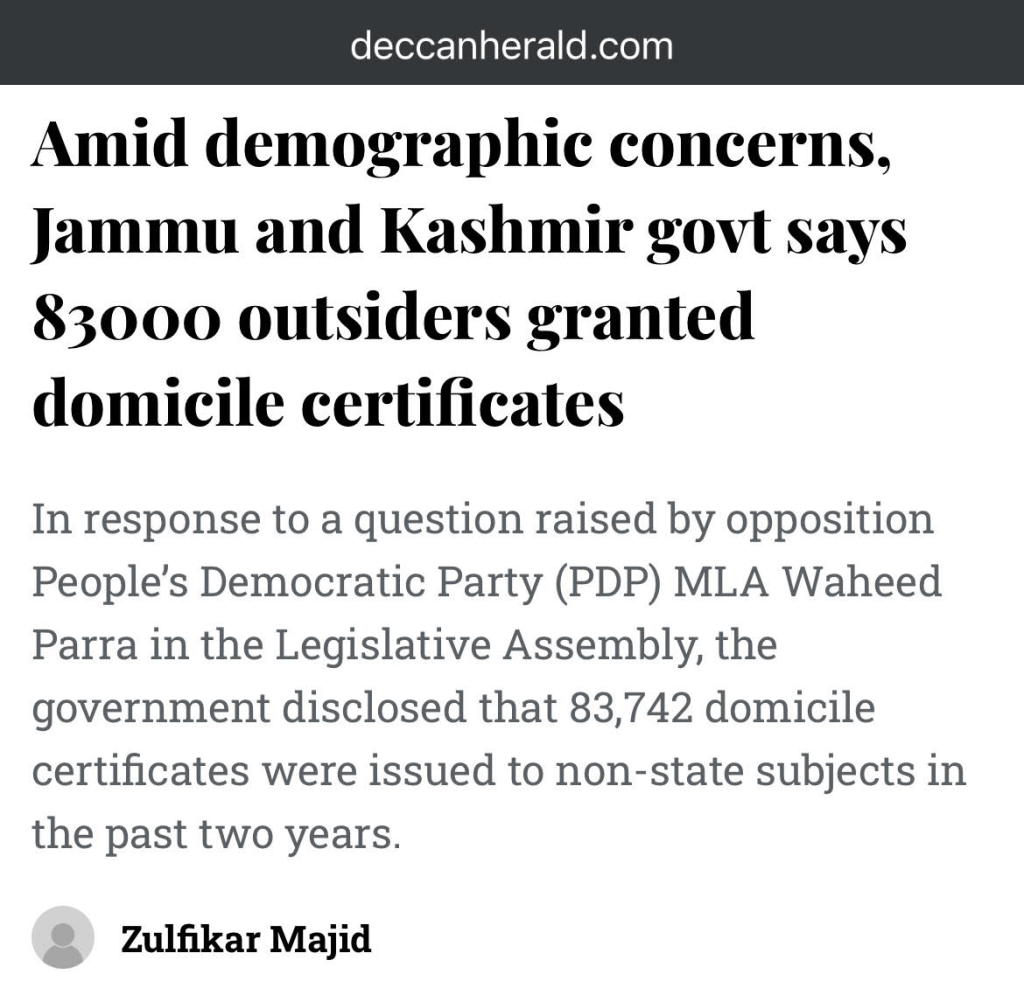
Say the words “demographic concerns” in any other Indian state, and you’d likely be branded a bigot. But in Kashmir, the “insider vs outsider” narrative is not only common, it’s actively pushed. If the Chief Minister, Omar Abdullah, has sworn allegiance to the Constitution of India, why the reluctance to openly embrace fellow Indians as equals? Kashmiris are free to work and settle anywhere in the country without being called outsiders. So why can’t someone from another Indian state do the same in Kashmir without facing hostility?
What India needs now more than ever is a spirit of unity. Not this constant “us vs them” divide.
These incidents make it clear: no one is truly secular, not even those who constantly criticize Hindu majoritarianism like Omar Abdullah. Let’s be honest. In Muslim-majority Kashmir, a fashion show during Ramadan sparked outrage, with people claiming it was against their “culture.” In parts of Malappuram and Kozhikode in Kerala, there have been cases where people were told not to eat in public during Ramadan. Meanwhile, in some Hindu-majority regions of North India, meat shops are ordered shut during Hindu festivals. Different standards, same mindset.
This isn’t just an Indian phenomenon. In the UK and the US, you’ll often hear people say, “We are a Christian country. This isn’t our culture!” whenever Hindu or Muslim festivals are celebrated in public spaces. The reaction is the same, just the setting changes.
Wherever you go, majority vs minority dynamics are always at play. What feels like a “religious restriction” to one person might feel like cultural protection to another. It all depends on your bias and perspective. Take Iran, for instance. Many of us might see it as deeply restrictive for women. But some Iranian Muslim women might see it as ideal because it strictly upholds their religious values. That’s religious bias in action – shaped by belief, identity, and comfort with the dominant culture.
Most people are secular only on paper. In reality, they tend to place their own religious beliefs a notch above others. They’re usually comfortable with the rules their faith imposes, no matter how restrictive those rules might seem to someone outside that belief system. It’s less about universal values and more about what feels familiar and justified to them.
Empuraan is facing criticism from the right wing for allegedly promoting a biased narrative. Many are calling it a political propaganda film with a pro-Congress stance. How true is the allegation?
Spoilers Ahead
I haven’t watched the movie yet, but I’ve heard that the first 30 minutes focus on the Gujarat Riots. It depicts some of the most horrific incidents from that time. Reportedly, the film includes a rape scene that’s highly debatable. This particular rape story has been circulating since the time of the Gujarat Riots but remains unverified, with no solid evidence to support it. Additionally, the Godhra train burning in the movie is reportedly depicted as something that happened by accident. This portrayal gives the impression that the film is based on the findings of the Banerjee Committee Report, a report that was later ruled invalid, unconstitutional, and politically manipulated by the court. The Nanavati-Mehta Commission Report is the report that was officially accepted as the authoritative account of events due to its presentation of evidence. This information was also covered in the recent film The Sabarmati Report.
The Banerjee Committee was set up in 2004 by the UPA government, led by the Congress party. The committee’s report was released just before the Bihar Assembly elections, apparently to influence the election results and weaken the BJP’s position. The report concluded that the Godhra train fire was accidental, contradicting the BJP’s stance that it was a pre-planned attack.
However, the Nanavati-Mehta Commission later confirmed that the train burning was a premeditated communal act, not an accident.
The investigation found that large quantities of petrol were purchased a day before the incident from a nearby petrol pump.
The forensic report confirmed the presence of petrol residues inside Coach S-6, where the fire broke out.
Eyewitnesses and forensic evidence suggested that petrol was thrown into the coach and set on fire, indicating a pre-planned attack rather than an accidental fire.
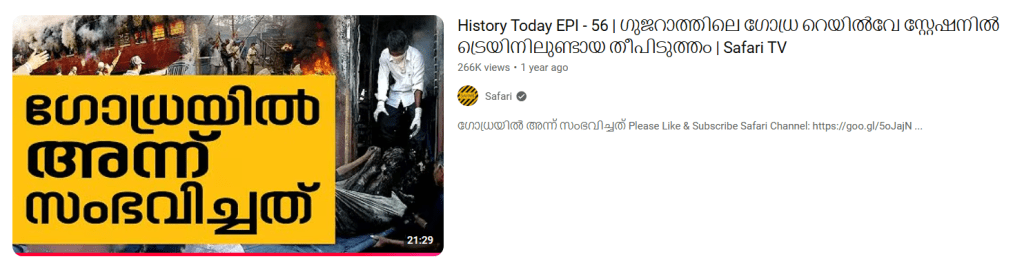
For Malayalees who prefer not to watch TheSabarmati Report, I recommend a documentary on YouTube by the Sanchari channel. It’s in Malayalam and provides a detailed account of the Godhra train burning. I am attaching a screenshot of the video below.
The documentary is likely one of the first of its kind in Malayalam. It offers a detailed look at the various angles of the Godhra train burning, the different reports that emerged, the political maneuvering involved, and the final conclusions drawn. If you are a Malayalee interested in research and fact-checking, I highly recommend watching this video.
Naturally, Congress is supporting Empuraan, just as the BJP backs right-wing films when they are released. Even if Empuraan turns out to be entirely pro-Congress, I support the creator’s right to make and release such a film. Several right-wing movies have been produced in India recently, so a left-leaning perspective is equally valid in a democratic space. However, as viewers, we must avoid taking any movie as absolute truth. Instead, we should conduct independent research, considering both left-leaning and right-leaning sources to develop a balanced understanding of the subject.
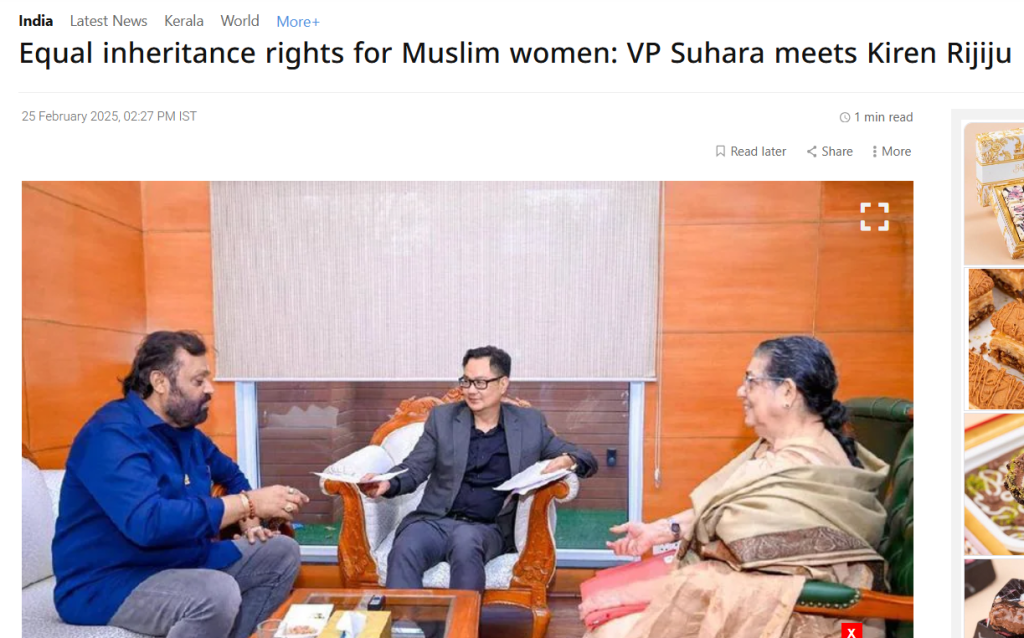
Social activist and NISA founder V.P. Suhara met Indian Minister Kiren Rijiju to demand equal inheritance rights for Muslim women in India, similar to those of Muslim men. Actor and BJP leader Suresh Gopi was also present at the meeting.
V.P. Suhara had earlier launched an indefinite hunger strike at Delhi’s Jantar Mantar, advocating for equal inheritance rights for Muslim women. However, the protest was forcibly stopped by the police. Before returning to Kerala, she announced plans to discuss the issue with key leaders in Delhi.
Did you see anyone in Kerala supporting her? Likely not. Instead, you’ll hear women with internalized misogyny saying, “We don’t want such reforms.” But these reforms aren’t for them. They are for women who seek more. Women who wish to follow traditional rules can continue to do so. Reforms do not prevent anyone from adhering to their beliefs, just as Triple Talaq is still practiced in India despite being banned. However, these reforms give Muslim women the legal option to seek justice if they are forced into following restrictive rules against their will.
When Muslim progressives like Suhara fight for women’s rights, you would expect so-called secular voices in India to stand with them. But these voices only seem to speak up when it comes to reforming Hinduism—whether it’s elephants in festivals, casteism, regressive practices, or allowing women in Brahmachari temples—because, let’s be honest, it’s far safer to push for changes in Hinduism. You see people from all communities, whether Hindu, Christian, or Muslim, openly advocate for these changes with confidence, knowing they face no serious repercussions. However, if you question some of the regressive practices in other communities, suddenly, you’re a bigot. The moment you point out that some proselytization techniques are predatory, you’re immediately accused of supporting the “restriction of religious freedom.” If you take a moment to observe people, you’ll notice countless little things that suddenly jolt you out of your slumber. You won’t need any political party to point this out to you. The double standards are there for the world to see.
When asked why the Muslim community largely does not openly advocate support for such reforms, progressive Muslims argue that it is dangerous to challenge established rules, unlike in other communities. They believe real change requires both internal and external pressure. While I acknowledge that speaking out within the Muslim community comes with risks, how long should we wait? Another century? Would it ever happen in our lifetime? Until then, are we expected to remain silent and unquestioning?
If the Indian government applies the “external pressure” suggested, it would inevitably lead to accusations of Islamophobia, further damaging the global perception of Indian Hindus and India’s image as a whole. Any attempt at reform would be spun as targeting a particular community, making meaningful change even harder to achieve.
Now, another group conveniently refuses to support this cause simply because the BJP—“the communal party”—is handling it. But name one other party that has ever stood up for Muslim women’s rights. The Opposition has always catered to Muslim men, not women, and will continue to dance to their tunes. This isn’t new; it has been the pattern for decades, ever since the Shah Bano case. If the BJP doesn’t take up the issue raised by Suhara, I can say with 100% certainty that no other party in India will.
***
Pic Source: Mathrubhumi.com (auto-translated from Malayalam)







You must be logged in to post a comment.