Personal observation: In almost every war, there’s always someone who doesn’t want it to end.
In the India–Pakistan war, many in India didn’t want the fighting to stop because they felt Pakistan hadn’t learned its lesson yet. Some even wanted the government to reclaim PoK (Pakistan-occupied Kashmir) during this time (which I strongly oppose).
When Israel attacked Iran’s nuclear sites, many anti-regime Iranians wanted the war to continue because they hoped the regime would fall.
The Israel–Gaza conflict is even more unusual. Many who kept calling for a ceasefire suddenly went quiet or were openly against it when finally announced. Maybe they had expected Israel to be driven out and a new Palestinian state to rise “from the river to the sea.” But that idea is unrealistic and only calls for more violence. Just like India will never give up Kashmir, Israel will never give up its land. Both countries get a lot of criticism for putting their own interests first. But, over the years, Jews and Indians have learned an important lesson: if they want their interests protected, they can’t rely on anyone else. When Indians get murdered in America, there’s next to no backlash. It’s the same case with Jews. History is also proof that when Hindus face persecution or genocide (Kashmiri Pandits, Sandeshkhali, Bangladeshi, and Pakistani Hindus), the world stays silent. In a world shaped by selective activism, these two communities have gradually learned to shed their passivity and docile nature, standing up for themselves without guilt. Indians, in my view, are still learning. Our tendency to stay silent runs deep. But since 2014, that’s starting to change, much to the annoyance of some. Apparently, a “good” Indian is still largely expected to be a silent one in the face of persecution and bigotry.
Anyway, the point is that in any war, there’s always duality. Those who push for the conflict to continue aren’t always on the “far-right.” Sometimes, they are far-left or far-right figures from other communities, disguised as leftist liberals. Take, for example, the India-Pakistan war. Many leftists in India wanted it to end and for peace to prevail. Yet recently, some of those same voices wanted Hamas to reject the peace deal, even at the cost of many lives.
I’ve often felt that the far-left and far-right are just two sides of the same coin. The recent wars and reactions to them over the years only validate this claim.
The debate around Umar Khalid, Sharjeel Imam, and other Delhi riots accused who have not yet been granted bail has once again come into focus. From the right-wing perspective, the issue is not as simple as “judicial delay” or “denial of justice.” I thought of writing this post because many in India only trust left-wing channels, which causes them to miss important fact-based points shared by the right-wing.
Adjournments and CJI’s Remarks
First of all, let us understand what an adjournment is. Simply put, it is when a court hearing or trial is postponed to a later date instead of being completed on the scheduled day.
Out of the 14 adjournments in Umar Khalid’s case, 7 were initiated by his own legal team. This was mentioned by CJI D.Y. Chandrachud himself in his interview with Barkha Dutt.
Source: Lawbeat
“I do not want to comment on the merits of the case but I must tell you one thing which is lost sight by a lot of people when it comes to Umar Khalid‘s case, can you imagine that the case was adjourned, they were at least seven if not more adjournments which were sought by the council appearing for Umar Khalid and eventually the application for bail was withdrawn.” – CJI Chandrachud
Justice Chandrachud noted that, on social media, a one-sided narrative often takes hold, leaving judges with no space to defend themselves. He added that if one looks closely at the actual proceedings in court, the reality is far more nuanced than what is portrayed online.
While some “fact checkers” online have attempted to dismiss this claim by relying on surface-level sources, it is reasonable to trust the CJI more on this matter. As head of the judiciary, he had direct access to both official and indirect records of adjournments.
The Delay Tactic
According to many on the right, Khalid and Imam’s legal strategy is clear. If the trial begins, conviction is almost certain. Thus, their team is accused of deliberately delaying proceedings by filing fresh petitions, often citing a “change in circumstances.” The idea is to drag the trial as long as possible and eventually claim bail on the grounds of delay.
Notably, some petitions that caused delays were also filed by other accused who are already out on bail.
The Judicial Tactic Explained
The strategy seen here is not unique. It is a common tactic in the Indian judiciary:
Lawyers repeatedly file petitions (often citing new circumstances).
Each petition leads to adjournments, dragging the trial.
Eventually, the accused can argue that their right to a speedy trial (protected under Article 21 of the Constitution) has been violated.
On that ground, they can seek bail due to judicial delay.
This slow erosion of the process not only stalls justice but also erodes public trust in the judiciary. Something that many argue is part of the plan.
CJI on Unseen Angles
In an interview with Barkha Dutt, CJI Chandrachud hinted that there are angles in the case that cannot be revealed to the public. Right-wing commentators believe this may refer to multiple coordinated fronts behind the Delhi riots.
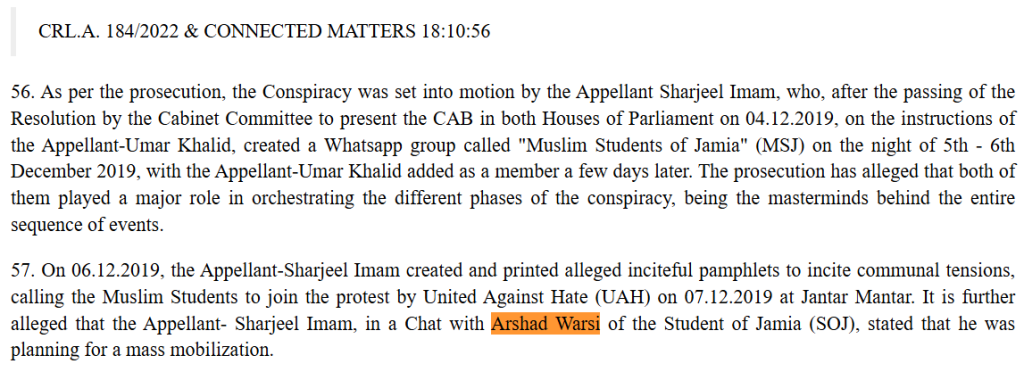
One example often cited is ISIS member Arshad Warsi (not the actor), who was in contact with Sharjeel Imam. Warsi allegedly helped decide the content of pamphlets that were distributed to mosques and Muslim neighbourhoods prior to the riots to incite violence. He was later arrested in the Pune ISIS module case.
Sharjeel Imam’s connection with Arshad Warsi. Source: indiankanoon.org/doc/156202283/Arshad Warsi arrested
There are also allegations of foreign funding and terror groups like PFI supporting the protests and unrest.
Umar Khalid met with other accused people in the PFI office to discuss funds for riots. Source: indiankanoon.org/doc/156202283/
The Seriousness of the Delhi Riots
The 2020 Delhi riots were not minor incidents of unrest. They claimed the lives of 53 people, including Intelligence Bureau officer Ankit Sharma. For many, this underscores the gravity of the case and why justice cannot be indefinitely postponed.
Right-Wing Response
Right-wing commentators like Abhijit Iyer-Mitra and Kushal Mehra have now openly criticized the delay of trials. They argue that instead of dragging the matter endlessly, the trial should begin as soon as possible, and justice should be delivered. In their view, it is time to see through legal manoeuvres and bring the culprits to justice. The longer the delay, the more the perception of judicial inefficiency grows, and that benefits only those seeking to evade accountability.
It is also important to understand that, though we can call for quick trials, courts in India are bound to follow established legal procedures. Every step, adjournments, evidence submission, witness examination, bail hearings, has to comply with the Code of Criminal Procedure (CrPC), the Evidence Act, and constitutional safeguards like Article 21 (right to life and liberty, including speedy trial).
Judges cannot simply “override” these protocols, even if they suspect delaying tactics. If the defense files a petition citing “change in circumstances” or another procedural ground, the court is obliged to hear it and decide. Ignoring or fast-tracking outside the rules would open the door to appeals, accusations of bias, or even the case collapsing later.
Delays often frustrate people. However, they’re also part of the judiciary, ensuring the trial stands on solid legal ground.
Left-Wing Response
The left-wing argues that delays aren’t only due to Khalid’s side and that long undertrial detention is unfair. While these points deserve acknowledgment, they don’t erase the fact that half the adjournments were filed by Khalid’s own team and that Sibal’s strategy clearly aims at running down the clock.
They also say Hindu mobs who killed during the riots haven’t faced equal scrutiny. But the distinction is clear: Hindu rioters were violent on the ground, yes, but they did not make the kind of provocative, mass-scale mobilizing speeches Khalid and Sharjeel Imam did that led to loss of lives. Khalid mobilized crowds by invoking the Kashmir issue, while Sharjeel Imam spoke about separating Assam from India and attempted to provoke people through pamphlets referencing the Babri Masjid dispute. Videos of their speeches can be accessed easily on social media platforms. That’s why the charges against them are different and why delaying the trial feels like a deliberate tactic.
My Take
It is important to examine cases from every angle instead of blindly accepting one-sided propaganda. Dhruv Rathee does not question the opposition, while journalists like Shiv Aroor do not question the ruling party. So it’s up to us, the citizens, to collect points from both sides and analyze it.
I have tried to provide proof for all the points in this post, but they can also be independently validated online. I would highly recommend going through the Indian Kanoon link (indiankanoon.org/doc/156202283/) to read more about the case.
Rather than dismissing everything right-wing as lies, citizens should review the available evidence and ask: Is a separatist attitude acceptable for the country? Does this kind of behaviour warrant bail? This cannot simply be brushed off as freedom of speech, because in this case, speech directly incited violence and led to the loss of 53 lives and the injury of thousands.
In India, there are rarely open-and-shut cases. Even Ajmal Kasab, a convicted terrorist, was given a fair trial. By that standard, it is certain that Sharjeel Imam and Umar Khalid will also receive a fair hearing once their trial begins, especially since their offences, while serious, are not on the same level as Kasab’s. That is why the trial should begin without further delay. So their actions can be properly examined, and justice delivered swiftly.
I’m a Palakkad native, and I had travelled home just to vote during the Lok Sabha elections. To make it clear, I have no loyalty to any political party and have voted for different parties over the years based on their performance and activism. I believe pledging unwavering support to any single party prevents us from critically examining their flaws. However, this time, voting for the CPI(M) was not an option, as I am well aware of its shortcomings during its second term in power.
I decided I would vote for Congress in the Lok Sabha elections. But then October 7 happened, and I saw Congress’s response to it, especially how they tried to silence Shashi Tharoor in Kerala for criticizing Hamas. It came as a shock and played a key role in changing my decision. That’s when I realized, unfortunately, this party is no different from those it criticizes. The Opposition parties in India excel at criticizing far-right Hindu groups, but avoid condemning far-right Islamist groups in society, fearing backlash from supporters.
People call out the BJP and RSS for sheltering far-right Hindus. But how is Congress different if it shelters far-right Islamists? Both cater to extremes. BJP voters are criticized for supporting a party that allegedly wants to turn India into a Hindu nation. Congress voters should ask themselves the same question: why support a party that mollycoddles groups that have once openly called for turning India into an Islamic nation? How would it make the majority of Hindus feel?
So, when people ask why Hindus vote for the BJP, the answer is simple. If the choice is between far-right Hindus and far-right Islamists, many Hindus will pick what feels safer. Left-leaning Hindus may sympathize with Islamist groups, seeing them as victims. But most in the community, just like any other community, vote on the basis of safety.
Congress and Islamist Ties
In the upcoming Nilambur by-election in Kerala, the Welfare Party has now openly declared its support for the Congress candidate.
To the uninitiated, the Welfare Party is the political arm of Jamaat-e-Islami Hind, a group known for its fundamentalist views. This group shares roots with the Jamaat movements in Pakistan and Bangladesh, which are often accused of anti-Hindu activities.
As per the New Indian Express report, “It’s learned that the Welfare Party, backed by Jamaat-e-Islami, has put forward various demands, including making it an associate party of the UDF. However, no assurance has been received in this regard so far.” This is a common far-right Islamist tactic in democracies across the world: try to join mainstream parties to gain power, resources, and reach. Once these groups gain enough strength, their true agenda emerges, often centered around enforcing religious doctrine. We see this happening in Bangladesh today. A similar pattern unfolded in Iran in 1979, when leftists and Islamists joined forces to establish an Islamic regime. This led to widespread persecution and the exodus of many Persians, some of whom sought refuge in India.
Many leftists, in both India and abroad, often align with Islamist groups unknowingly, driven by a genuine desire to support the persecuted and uphold justice. However, this well-meaning approach is frequently exploited by far-right Islamist groups for their own agenda. It’s fair to say that many on the left still operate with this same mindset, unaware of the long-term consequences.
Such Islamist groups remind me of the Persian movie “The Seed of the Sacred Fig” (playing on Amazon Prime), a 2024 crime drama film directed by Mohammad Rasoulof. The movie starts with an explanation of strangler figs, a type of parasite that grows on a host tree’s branches. As they grow, their roots reach the ground and thicken. Eventually, they wrap around the host tree, in a way “suffocating” it. Over time, the host tree dies from lack of light and nutrients, while the fig survives independently. I hope Congress and other left-leaning parties realize that they are the “hosts” in this equation.
Both the Welfare Party and SDPI have been trying to win Congress’s favour in Kerala. Their open support was clearly visible in places like Palakkad (my hometown). The fact that Congress is not distancing itself from these groups is a matter of concern. The party appears to seek the support and votes of such groups to win, which may explain its consistent silence or hesitation in condemning Islamist acts. But how far are they willing to go? Will there come a time when they finally strike deals with the devil because they can’t win anymore without their support or votes?
Valid Concerns
Can you really blame Hindus for refusing to vote for parties that associate with groups that seem more likely to drag India down a path similar to Pakistan or Afghanistan?
Let’s not forget the current state of Bangladesh. JEI has played a significant role in steering Bangladesh toward radical Islam. If India were ever to become an Islamic nation, it wouldn’t resemble the UAE or Bahrain. It would more likely mirror Pakistan or Bangladesh, where radical Islamist groups wield substantial influence. Unlike the Gulf nations, which strictly ban and suppress such groups, India still hesitates to even name them. The moment any criticism is raised, it’s quickly dismissed as Islamophobia by human rights activists.
No One’s Truly Secular
In the end, no one is truly secular. Most people vote thinking, “Which party is best for my community?” — not for the nation. That’s why, in Kerala, Congress is the preferred party for many Christians, and a large section of Muslims support the Muslim League. So why is the burden of voting on the basis of secularism placed only on Hindus?
I finished I Am a Trollby Swati Chaturvedi last night. It’s an insightful read if you’re unaware that the BJP, like all major parties, has a dedicated IT cell.
However, if you’re already familiar with the BJP’s IT cell, the book doesn’t offer much new, apart from a few interviews with former BJP insiders who strongly criticize the party. But in Indian politics, this isn’t unusual. Members who leave any party, be it the BJP or Congress, often openly highlight its flaws. This trend isn’t unique to the BJP.
The book also points out that Modi’s official Twitter handle follows some controversial right-wing accounts like OpIndia, which is a valid observation. This is somewhat unusual; I’m not aware of any left-leaning political leader or party officially following social media influencers or accounts considered far-left. In that sense, this could be something unique to the BJP, and worth re-evaluating if it raises credibility concerns.
All that aside, the author’s pro-Congress bias is evident. She claims Rahul Gandhi was becoming as popular as Modi and predicted strong results for the Congress in the 2019 elections (the book was published in 2017). She lays emphasis on Rahul Gandhi’s social media growth, rather than his on-ground political performance. Chaturvedi presents his increasing followers and engagement as indicators of his strength and popularity, which feels selective and somewhat misleading. To appear balanced, she briefly mentions 2–3 false narratives that were pushed by the Congress IT cell, but downplays their impact.
The writing has its issues. Critiquing someone’s views is fine, but body-shaming, stereotyping Indian men, and mocking someone’s English skills feels unprofessional, especially from a journalist aiming to be objective. For example, consider the sample below, where she generalizes right-wing “trolls”.
Chaturvedi also complains that trolls refuse to engage with her reasoning on why the BJP is problematic, yet admits she zones out when they begin to speak. This contradiction weakens her argument and suggests a similar unwillingness to listen.
Interestingly, the book indirectly acknowledges that mainstream media was largely pro-Congress in 2014 (and still is in states like Kerala), which made it difficult for the BJP to be heard without strong social media outreach (reference to this is below).
These are a few minor concerns I had with the book, but overall, it provides a revealing look into political online warfare, though not without its caveats.
As soon as I finished watching Netflix’s series on Osama Bin Laden, it recommended another American Manhunt documentary by Netflix. This one is about the Boston Marathon bombings. I had read about the attack before, but watching the documentary made a much deeper impact.
What Are the Boston Marathon Bombings?
The Boston Marathon bombings were a terrorist attack that took place on April 15, 2013, during the annual Boston Marathon in the United States. Two homemade bombs exploded near the finish line, killing 3 people and injuring over 260 others.
The attackers were two brothers, Tamerlan and Dzhokhar Tsarnaev, originally from Chechnya. They used pressure cooker bombs placed in backpacks. After the attack, a large manhunt followed. Tamerlan was killed in a shootout with police. Dzhokhar was captured, tried, and sentenced to death.
The Tsarnaev brothers claimed they carried out the Boston Marathon bombings as revenge for U.S. actions in Muslim countries like Iraq and Afghanistan. They believed that killing Americans was justified because of U.S. military involvement in those regions.
Dzhokhar wrote in a note that the attack was meant to defend Islam and punish the U.S. for killing Muslims abroad. However, they were not part of any organized terrorist group. Investigations found they were self-radicalized, influenced by extremist content online.
Their actions were widely condemned by Muslims and non-Muslims alike.
Thoughts
I’m not going to focus on the Tsarnaev brothers themselves, but rather on the general impression the documentary left on me.
You often see people justifying extremism, like the brothers did, whether it’s acts of violence or even celebrating natural disasters or someone’s illness, as payback for a country’s past actions. It’s all framed as if everything is justified. What’s troubling is that this mindset isn’t limited to radical groups. You sometimes see it in people around you: the so-called moderates. Some may appear balanced on the surface, but quietly endorse extremist views in subtle ways.
This exists across communities, not just one. There’s often only a thin line between those who wish for destruction and those who act on it. That line might be common sense, fear, or simply a lack of means. We may never know. The point is, the anger and hate that fuel such extreme actions are far more mainstream than we believe. I see it daily, on social media, and at times, even within my own circles. It’s not always loud or violent, but it’s there, simmering under the surface. The only time you get a glimpse of it is when disaster strikes.
For some, all it takes is a spark to turn toward extremism. For example, Tamerlan was a skilled amateur boxer with hopes of representing the U.S. in international competitions. However, after being denied a visa to compete abroad, he grew increasingly resentful. He reportedly believed the rejection was due to his Muslim identity and refused to accept any other reasons, which deepened his sense of alienation and fed into his radicalization. In a way, an extreme victim mentality played a significant role in his downfall. Tamerlan saw himself as targeted and wronged, interpreting setbacks as part of a broader injustice against Muslims. This mindset not only fueled his resentment but also made him more vulnerable to radical ideologies.
What’s alarming is the sheer scale of such hate. It has become disturbingly normalized. If a disaster strikes the U.S., or even India, I’m 100% sure there would be people to celebrate or justify it. And that, perhaps, is the most disturbing part: the way the line between the humane and the inhumane has begun to blur.
However, the hypocrisy lies in the fact that many of these individuals do not express the same anger toward countries like Iran, known for oppressing women, or Pakistan and Bangladesh, where minorities often face persecution. This selective outrage reveals a duality that many need to recognize and address.
I’ve watched many documentaries on Bin Laden, but what sets American Manhunt: Osama bin Laden on Netflix apart is that the U.S. intelligence officers themselves are narrating the incident. It shows a side of intelligence officers we rarely see or acknowledge: one that’s vulnerable, emotional, and capable of error, just like any of us.
The fact that they faced extreme guilt after 9/11, plus humiliation from those who expected them to have superhero capabilities, shows us that intelligence work is a thankless job. You’re not remembered for the hundred attacks you prevented, but for the one you didn’t.
We tend to view intelligence agencies as all-knowing, supreme beings capable of preventing every threat. But they are made up of people just like you and me – flawed, prone to mistakes, and constantly learning how to address loopholes.
Almost every terrorist attack in the world has been labelled an “intelligence failure.” In most cases, including Mumbai’s 26/11, intelligence agencies had some idea that an attack was likely. But without knowing exactly when, where, or how, they couldn’t act decisively. Acting on vague information risks wasting resources and creating false alarms.
We owe our intelligence officers greater respect and appreciation, not just criticism.
Another key takeaway was the deep distrust the U.S. had toward Pakistan. They chose not to inform Pakistani authorities about the Osama bin Laden raid, fearing it would be sabotaged. This seems to negate Pakistan’s constant claims of being a victim of terrorism rather than a supporter of it. After the raid, the Pakistan army tried to shoot down the U.S. Navy SEALs’ helicopter. If they are actively involved in the fight against terrorists, why resist when others take them down for you?
One U.S. intelligence officer mentioned that Al Qaeda had regular contact with Pakistani nuclear scientists. It makes you think of Pakistan’s constant nuclear blackmail. Are they using it against the U.S. as well by implying that if Pakistan collapses or goes bankrupt, its nuclear arsenal could fall into the wrong hands (such as the terror groups that want to take down America)? Is this how they get their IMF loans approved? Perhaps this fear is why the U.S. continues to be soft on Pakistan, even though it sheltered the prime suspect in the 9/11 attacks. We will never know.





You must be logged in to post a comment.