I love work. I want to continue working even after retirement.
But I also want to win a lottery so I can retire.
Not making sense? Hear me out.
I love doing the kind of work I do but I am not exactly a fan of the corporate culture. If you read my ode to freelancing, you would understand why.
Let me add something extra to what I wrote previously. I want to win a retirement lottery.. so I can retire and do my kind of work till the end of time. I do not have to worry about bills or putting food on the plate. I can concentrate on what I like, even if it might mean making less money. Yes, what I like, might not necessarily make me rich. It’s the hard fact of life. Not every interest pays well.
There are times I have wished wealth was distributed equally with everyone. So that each and every person living on this planet can do what they like, and not just the wealthy. I do not mean going on expensive holidays or owning luxurious homes. Just the basic freedom to do what one likes. That in itself can make anyone happy. But, that’s not how the world works, and it might never work that way. The top 1% own 43% of the world’s wealth. Society thrives on income discrimination. The fact is no one is self-made. It takes many people to make one man’s business successful, but all the monetary benefits go only to a select few.
Or, I have tried my best to. When there’s a genuine emergency, there is no option but to stay back.
Even at my first job, when a senior demanded I stay overtime to complete *his* work, I refused. I knew if he actually sat down to do his work, he wouldn’t require any help. He kept complaining about his age (he was in his 40s) and how he could not take too much burden at work anymore. This unreasonable emotional blackmail did not work either. The 40s is the new 30s or 20s or whatever you choose it to be. It is all in the mind. If you feel you are ageing and you cannot do much, then damn right, you cannot.
The end story is that I got what I wanted – not to work overtime.
I have to say I was privileged when I first started working. I was not in dire need of money. I had a support system. If I were desperate, I would have compromised more and said yes to a lot of work I did not want to do. Work was not a priority in my 20s. I was preoccupied with living my life, having fun, getting my heart broken, and spending all my money without saving a bit.
Many people compromise at work because they do not have a support system at home to fall back on. Maybe they are the sole earning member; maybe they are in a lot of debt. When the responsibilities pile on, which they will as you age, so does the burden of compromising. You tend to become more afraid of losing your job, and you play it safer and become more diplomatic.
I see many employees working overtime mainly to please their bosses. They take that first step – to work overtime. Their bosses never asked for it. I realized that once you start working overtime, there’s no going back. Your coworkers (and boss) would keep expecting you to put in those extra hours. “You have done it before, so why not now?“
Once you establish a boundary that you are available to work only during your scheduled hours, things become simpler. Everyone will stop nagging you to stay back. Your body will also nag you to leave work on time. Some stay back out of habit. They are used to working overtime, and it has become a part of their life now.
What makes us work harder than required might also be due to imposter syndrome. That feeling that you are not good enough and you need to try extra hard to safeguard your job. Some do this by working extra hours. But when the work you produce within your work hours is of good quality, working extra is really not required. Try to focus and give your work your full attention during work hours. This should be more than enough.
You might have to deal with people asking, “Leaving already?” when you exit on time. Pay them no heed. It’s your work-life balance that is at stake. If you feel working after hours is the only way to live, by all means, work overtime. If you wish to have a life outside of work, make it a point always to leave work on time! The ones who are spending too much time at office are creating the wrong standard for the rest who wish to maintain a work-life balance. Some (like my senior I mentioned at the start of this post) do not know proper time management. Or they are plain lazy. They spend hours chatting away with coworkers and then suddenly realize they have a lot of work to do at 4 PM. The rest who spend their working hours productively get reprimanded for leaving office on time—office politics at its best.
I am not as privileged as before. I need to work to earn my bread and butter. I do not have a robust support system, yet I cannot get myself to be at the office post my work hours. I have many interests – my job is only a part of it. To deprive myself of all other interests for the sake of my career is plain sacrilege.
To maintain sanity, pursuing your hobbies and interests is a must. Why wait till retirement to do what you like?
Having done it before, I know how fulfilling it can be. There are many advantages of being your own boss. You decide what projects to take up. You decide whether to say yes or no to a client. You decide how much time you want to spend on your work.
I started doing freelance work around 10 years back. I began my journey by carrying out some research on the best freelancer websites. Finally, I registered on Fiverr and instantly got some clients because of my portfolio. It was easier back then to find customers, unlike today, when the competition is fierce.
I was a freelance content writer. My work on Fiverr involved creating marketing copies for startups. My clients appreciated my work and gave me good reviews. Looking back, I am so proud of myself for getting the freelance writing gigs on my own. When I got my first $100 from freelancing, I felt on top of the moon. Frankly, even if it were just $10, I would have felt elated because this was proof that I could survive independently. It gave me confidence.
Throughout our life, we are on the lookout for confirmation that we are well equipped to face any challenges that come our way. We are skeptical, though, because we were never taught to venture out on our own. There was always someone to help us, guide us at every stage of our life – at school, competitions, college, corporate life. We could depend on someone (a parent or a teacher, or a manager) to help us out.
With freelancing, you are on your own.
You have to figure things out.
You have to decide how to get money.
You have to research and find out what sells.
It’s all you!
To be a successful freelancer, you need to hustle.
Needless to say, every little profit you get out of it feels like a big deal. Plus, the freedom to work from home and the ultimate control you have over your work is unmatched.
Freelancing is special. It gives you that sense of achievement and fulfillment when work starts coming your way. It is the feeling I yearn for now.
I stopped freelancing 2 years after starting it. The reasons being, my sleep cycle got messed up, and the pay did not match my hard work at the time. I would sleep at 5 AM and wake up at noon. There was no discipline in my life. I had a few passive income streams that paid a few bills, but more was needed. That’s when I decided to get back into the corporate world. I thought I would continue with my side hustles. But life had other plans. My work responsibilities at my day job increased. I had no time left for something I enjoyed.
Does freelancing count as work experience? Does it help your career? Let me tell you this. I got my job after the recruiter saw my freelancing work. All the hard work paid off. I know many freelancers (web developers, graphic designers, writers) getting a corporate job after building a solid portfolio of impressive projects. So I would consider it as a work experience. People are afraid of mentioning “freelancer” in their work resume. They are afraid that the recruiters might think it is a fancy way to say you haven’t worked for some time. The best way to prove naysayers wrong is by building a good portfolio of your freelancing work. No recruiter would say no to a freelancer who has done notable work.
Does freelancing pay well? Yes, it does. Freelancing is hard though, and it is not for everyone. Start small and easy. When you start getting overbooked for a month or two, increase your rate by 10-15%. You don’t have to wait till the annual performance review to get a raise!
Freelancing is the future of work. People are quitting big corporate jobs because working for yourself is mentally more peaceful. I would love to get back to it one day to be my own boss again.
There’s a funny quote out there that goes “I can’t wait to earn a lot of money and quit. So I can start doing the work I like.” Truer words have never been spoken.
I am a big fan of Fredrik Backman, even though I have read only 2 of his books.
The first one was A Man Called Ove. I completed the second one quite recently. It is a beautiful, emotional, intense story of a sleepy little cold town called Beartown. A place where people are laidback in all things except one – ice hockey. Their love for the sport transcends everything. It reminds me of professional football club fans. The same passion, the same energy, the same love. The same disappointment when their team loses or when a controversy pops up. If you are a sports fan or know someone who is, you would find this book extremely relatable.
Fredrik Backman is a genius when it comes to explaining moments and expressing emotions. I got goosebumps while reading through many of the quotes in Beartown.
I am listing some of my favorites here.
“The only thing the sport gives us are moments. But what the hell is life, Peter, apart from moments?”
“Being a parent makes you feel like a blanket that’s always too small. No matter how hard you try to cover everyone, there’s always someone who’s freezing.”
“Religion is something between you and other people; it’s full of interpretations and theories and opinions. But faith … that’s just between you and God.”
“People sometimes say that sorrow is mental but longing is physical. One is a wound, the other an amputated limb, a withered petal compared to a snapped stem.”
“One of all the terrible effects of grief is that we interpret its absence as egotism. It’s impossible to explain what you have to do in order to carry on after a funeral, how to put the pieces of a family back together again, how to live with the jagged edges. So what do you end up asking for? You ask for a good day. One single good day. A few hours of amnesia.”
“In a few years’ time she’ll read an old newspaper article about research showing that the part of the brain that registers physical pain is the same part that registers jealousy. And then Ana will understand why she hurt so badly.”
“A great deal is expected of anyone who’s been given a lot.”
“Community is the fact that we work towards the same goal, that we accept our respective roles in order to reach it. Values is the fact that we trust each other. That we love each other.”
“If Peter has learned one thing about human nature during all his years in hockey, it’s that almost everyone regards themselves as a good team player, but that very few indeed understand what that really means.”
“When you can accept the worst aspects of your teammates because you love the collective, that’s when you’re a team player.”
“Because the thing you can never be prepared for when you have children is your increased sensitivity. Not just feeling, but hypersensitivity. He didn’t know he was capable of feeling this much, to the point where he can hardly bear to be in his own skin.”
“One of the first things you learn as a leader, whether you choose the position or have it forced upon you, is that leadership is as much about what you don’t say as what you do say.”
“The easiest way to unite a group isn’t through love, because love is hard. It makes demands. Hate is simple.”
“Every child in every town in every country has at some point played games that are dangerous to the point of being lethal. Every gang of friends includes someone who always takes things too far, who is the first to jump from the highest rock, the last to jump across the rails when the train comes. That child isn’t the bravest, just the least frightened. And possibly the one who feels he or she doesn’t have as much to lose as the others.”
“The simplest and truest thing David knows about hockey is that teams win games. It doesn’t matter how good a coach’s tactics are: if they’re to stand any chance of working, first the players need to believe in them.”
“Fighting isn’t hard. It’s the starting and stopping that are hard.”
“There are few words that are harder to explain than ‘loyalty’. It’s always regarded as a positive characteristic, because a lot of people would say that many of the best things people do for each other occur precisely because of loyalty. The only problem is that many of the very worst things we do to each other occur because of the same thing.”
How often have we dealt with authoritative emails at work?
The ones that sound unnecessarily aggressive and bossy, instead of courteous yet firm.
After my previous rant on surviving performance reviews, I looked into a couple of emails of supervisors generally well-liked at the office, and those who weren’t.
The ones who were liked (Batch A), were polite and empathetic in their emails:
“Could you please finish this task by Saturday?“
“Thank you for completing this!“
In contrast, the ones who weren’t liked (Batch B), wrote their emails like this:
“Do this by Saturday!“
Dead silence after completing any task
See the difference? Would you like to get emails from Batch B? No one is fond of unnecessary aggression.
It is such a refresher nowadays to hear supervisors being polite. A “Thank you” or a “Please,” even if formal makes you look humane and not cold and distant. It motivates employees to do better. Politeness does not mean being weak. You can be firm and polite!
Something Batch A does often (to show the emergency of the situation):
“Please send this across by Saturday! This is very important.“
No unwanted aggression here. A simple message that conveys the seriousness of the task. Most people are smart enough to get the gist of such a message.
Employees perform their best when their supervisors are empathetic and kind. The attrition rate (the rate at which people leave) is always high in companies with bad managers. A 2016 survey in India showed that employees are willing to stay longer and work harder if they were well appreciated in their companies. About 59% felt they were unappreciated by their bosses. That’s more than half of the survey sample! No small number there. Sometimes, all it takes is a “thank you” or a “please,” to make things better.
So why are we so stingy with appreciating others or using cordial language at work?
Each supervisor is shaped by their own experiences in the corporate world. Some might have faced similar situations, a boss being too self-centered or supercilious or manipulative, and they end up thinking this is the only way to climb up the career ladder.
Sadly, this is partially true.
A recent study disturbingly stated that narcissistic, manipulative people tend to become CEOs faster (29% more) than their less self-entitled peers. We look at people at the top for inspiration, and we see a lot of them acting entitled and impolite, and we think “That’s how we become successful.”
But is it really? Is this the downside of being successful? Should we dump our emotions, empathy, kindness in the garbage in the quest for power?
I have been in the corporate world for so long, and I have seen and experienced so much, that the first thought when I see a CEO or a leader on LinkedIn is not “Wow! I want to be this person,” but “How many people did you demotivate and destroy to reach where you are? How many fake stories have you cooked up to save yourself, by shifting the blame onto your juniors? How good are you at playing politics in office?” This seems very dark and harsh I know. But it is mostly the truth. There are exceptions but the many leaders I have seen have sold their souls to the corporate devil. They will do anything to get on the super boss’ good books and won’t hesitate to drag anyone else down in the process.
Sometimes, from what I have seen, I feel it’s best to stay away from the rat race.
I am not sure how many people actually know of this sleek user-friendly tool on Microsoft Edge. It is called the Immersive Reader. Staying true to its name, it is a great tool for readers to indulge in.
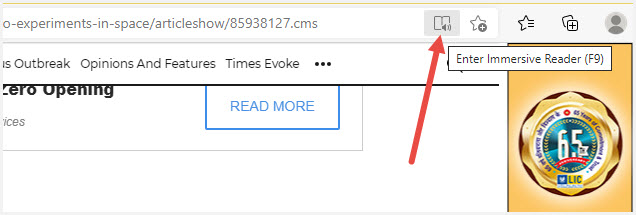
Take a look at this article with distracting elements (navbar, widgets, ads).
Article without immersive reader enabled
Now, click on the Immersive Reader option next to your URL bar.
Click to enable
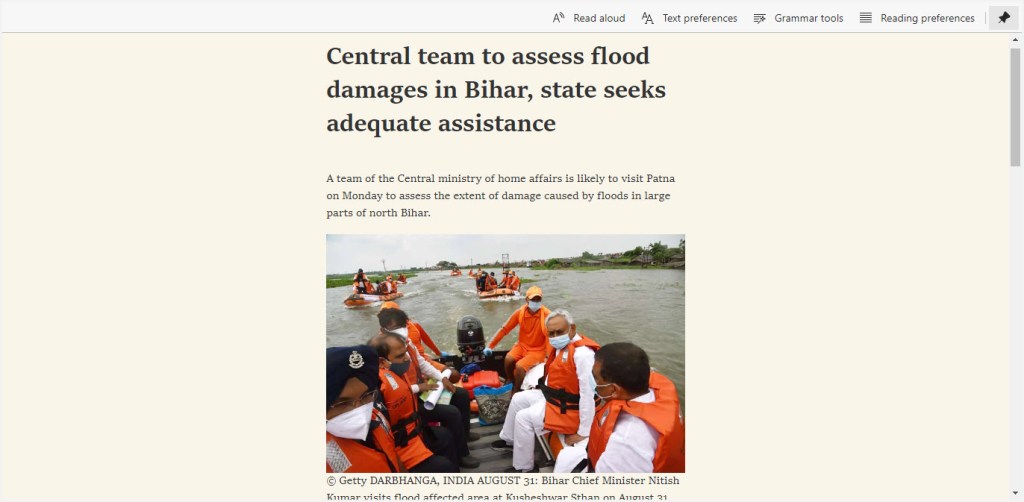
And, voila! You can now read the article peacefully.
Immersive Reader Enabled
I feel this is great for reading long articles. It has a very Kindle-like experience to it. You can increase the font size using the “Text Preferences” tool. You can change the theme as well. There are many options which I have not yet explored. As a reader, I want to focus just on the article, with the freedom to increase its font size if need be. This tool offers all that and more.
You can also use the “Read Aloud” feature if you want the article to be read out to you. The voice is as natural as it can get, not sounding robotic.
The Immersive Reader is still in its early stages. It does not always render the correct page, and you have to wait till the page loads completely to see the icon. But so far, I am extremely pleased.
If you do not see the Immersive Reader icon on Microsoft Edge:
Make sure you are viewing an article and not the home page
Wait till the page loads completely
If you still do not see the icon, use read:// before the URL. For example if the URL is 𝚑𝚝𝚝𝚙𝚜://𝚠𝚠𝚠.𝚖𝚜𝚗.𝚌𝚘𝚖/𝚎𝚗-𝚒𝚗/𝚗𝚎𝚠𝚜/𝚘𝚝𝚑𝚎𝚛/𝚌𝚎𝚗𝚝𝚛𝚊𝚕-𝚝𝚎𝚊𝚖-𝚝𝚘-𝚊𝚜𝚜𝚎𝚜𝚜-𝚏𝚕𝚘𝚘𝚍-𝚍𝚊𝚖𝚊𝚐𝚎𝚜-𝚒𝚗-𝚋𝚒𝚑𝚊𝚛-𝚜𝚝𝚊𝚝𝚎-𝚜𝚎𝚎𝚔𝚜-𝚊𝚍𝚎𝚚𝚞𝚊𝚝𝚎-𝚊𝚜𝚜𝚒𝚜𝚝𝚊𝚗𝚌𝚎/ then use 𝚛𝚎𝚊𝚍://𝚑𝚝𝚝𝚙𝚜://𝚠𝚠𝚠.𝚖𝚜𝚗.𝚌𝚘𝚖/𝚎𝚗-𝚒𝚗/𝚗𝚎𝚠𝚜/𝚘𝚝𝚑𝚎𝚛/𝚌𝚎𝚗𝚝𝚛𝚊𝚕-𝚝𝚎𝚊𝚖-𝚝𝚘-𝚊𝚜𝚜𝚎𝚜𝚜-𝚏𝚕𝚘𝚘𝚍-𝚍𝚊𝚖𝚊𝚐𝚎𝚜-𝚒𝚗-𝚋𝚒𝚑𝚊𝚛-𝚜𝚝𝚊𝚝𝚎-𝚜𝚎𝚎𝚔𝚜-𝚊𝚍𝚎𝚚𝚞𝚊𝚝𝚎-𝚊𝚜𝚜𝚒𝚜𝚝𝚊𝚗𝚌𝚎/ to launch the article in the Immersive Reader.







You must be logged in to post a comment.