‘Nobody Wants This’ Delves into a Rarely Explored Topic

Nobody Wants This Netflix

I decided to watch “Nobody Wants This”, starring Adam Brody and Kristen Bell, after reading positive reviews by friends and acquaintances on social media. The synopsis on Netflix initially failed to interest me, so it never made it to my watchlist. However, after going through reviews, I decided to give it a try. “I could always stop if I didn’t enjoy it,” I reasoned. Thankfully, I found the romcom drama refreshing.

I enjoyed the side characters more than the main leads, especially the Jewish family members. They were quirky, hilarious, and surprisingly felt close to home. My country, India, is not exactly the most open when it comes to interfaith relationships. Sure, it is happening more than ever, but some questions persist.

“How will the two adjust to different religious beliefs?”

“Whose religion would the kids inherit?”

“Would we lose our child to another religion?”

These are some common questions that arise in the minds of many Hindu families when their child’s interfaith relationship progresses to the marriage stage.

Netflix’s ‘Nobody Wants This’ interestingly tackles a subject that not many interfaith romcoms have done before – conversion. Should you convert if your partner from another faith insists on it, claiming (or emotionally blackmailing) marriage is impossible otherwise? I will be honest. I do not think one has to sacrifice their identity in love. Requiring conversion as a condition for marriage feels manipulative and unfair. If your partner truly loves you, why would they expect you to change your identity?

I wouldn’t have hesitated to convert for love in my younger days. Back then, love mattered more to me than anything else, even religion. However, as I matured and understood life better, I realized you can follow your heart without leaving your brain behind. You don’t have to bend over backward in love. That’s the beauty of aging – you realize that sacrificing your identity is never an option. Your partner has to accept the way you are.

Yet, some people, unable to disappoint their parents, push their partners to take this extreme step. If they can’t disagree with their parents over an important issue such as the partner’s identity, how will they ever be able to support the partner when issues involving parents over less important matters pop up in the future? Once you let go of your identity, more demands pour in – you are expected to raise your children following only one belief and break off all ties with your “old” religion. It is an overwhelming decision no one should be subjected to, especially on the people you love. One sacrifice is often followed by umpteen other sacrifices.

I am glad this aversion to conversion is gaining traction in India, with many refusing to convert for marriage. In fact, some people are even choosing to end their relationships over it. Why convert when our legal system allows couples from different faiths to marry in court?

The romcom touches on this sensitive topic of conversion and the ideological differences between the two communities. One is liberal, the other conservative. How to tackle differing opinions? The main characters aspire to provide you with an answer.

‘Nobody Wants This’ is streaming on Netflix. It has a total of 10 episodes, with each lasting around 30 minutes.

An Ode to Kabhi Main Kabhi Tum

Kabhi Main Kabhi Tum
Hania Aamir plays the character of Sharjeena in Kabhi Main Kabhi Tum

I came to know about the Pakistani drama Kabhi Main Kabhi Tum from YouTube recommendations. This was one of those times when YouTube got its algorithm right.

I wasn’t initially sure whether I would like the drama, but once I started, I was hooked. It is no surprise that Kabhi Main Kabhi Tum has gained popularity in India. The reasons are plenty.

Focus on Relationships

The story focuses on everyday relationships. It does not aim to convey any profound social message. The drama is not entirely progressive, but as the audience, the onus lies on us to accept the fictional world of those characters.

We are at an age where we look into political correctness in every movie or drama. This mentality somehow has ruined the movie-watching experience for people like me who prefer rawness over perfection. Indian filmmakers have become too cautious and afraid to offend, which is understandable considering the polarized times we live in. However, they can still develop unique story ideas that are family-oriented.

Most Indian movies and dramas getting appreciated nowadays are dark. If, by chance, a love story gets released, people are quick to dismiss it as cringe, misogynistic, or fake. Box office numbers also reveal that romantic movies have lost their appeal in India. Or maybe it’s because we are not coming up with a captivating love story. Due to this, many filmmakers stay away from making out-and-out romantic, feel-good movies.

So, considering the lack of romantic content, it’s understandable why many Indians are drifting towards Korean and Pakistani dramas like Kabhi Main Kabhi Tum that keep the old-world romance and family-centered stories alive.

The primary takers of romance are women. Most of us understand that the romance shown in movies is make-believe and not realistic, yet we crave a world that we can deep-dive into when we are stressed. Unfortunately, there are not enough choices for us nowadays. This is why dramas like Kabhi Main Kabhi Tum come as a refresher.

Clean Love Story

Kabhi Main Kabhi Tum meets the bill of sweet, clean love stories that we used to enjoy in the past. No one is making out the moment they meet; no one has an “I am cooler than you” attitude. The chemistry is there for your eyes to see. They look lovingly at each other with slight smiles, enjoy quiet dinners sitting on their bedroom floor, and mesh into each other’s lifestyles even if they are poles apart. Small things that make a significant impact.

Beautiful and Relatable Styling

I absolutely love Sharjeena’s free-flowing Pakistani outfits. The styling gives you a feeling that you, too, can pull off the outfit. The hair is not overstyled; the fit is comfortable and suitable for all body sizes, and there is a feeling of relatability when you see it. Nothing seems out of reach for the regular person.

No Realism Fatigue

I personally do not wish to experience realism fatigue while watching a movie or drama, so a good balance of relatability and aesthetics is ideal. To clarify, you might have seen several scenes in Indian dramas/movies shot in the bathroom where the main character is shown answering nature’s calls. They are realistic but not aesthetic. So, in my opinion, such scenes are better avoided in a make-believe world. We don’t need to know if the character peed or pooped or has a runny nose or sweaty face. Some things are better left for the real world.

Conclusion

I believe Indian filmmakers should take note of the popularity of Korean and Pakistani dramas in India. They should recognize that there is a market for such content, which they are currently neglecting to cater to. To create such wholesome dramas or movies, first and foremost, we need better storytellers. Korean dramas are written by female writers, which brings a unique female perspective to the stories. Perhaps Indian filmmakers should consider hiring female writers to bring back the charm of feel-good content in our films.

Quick Bytes: As a Centrist Hindu, I Did Not Find Netflix’s Maharaj Problematic

Netflix Maharaj Review

Indian politics cannot be easily categorized as “right” or “left” in the truest sense. However, it is easier for an apolitical person to understand whom you are referring to when you mention “left” (parties like CPI(M), but we generally include any non-BJP party in India) and “right” (NDA). I would call myself a centrist as I find a lot of things from both sides problematic. I can never swear allegiance to any one party, as I often look at the party’s performance and form my judgments based on that.

Now, the left-leaning crowd is naturally praising Maharaj, Netflix’s new movie starring Aamir Khan’s son, Junaid Khan. In contrast, the right-wing supporters are asking Hindus to boycott the movie. Truth be told, I haven’t read much about the Maharaj libel case, so I cannot pinpoint with utmost certainty which part of it is anti-Hindu. My opinion here is based on what I saw in the movie. Here’s why I, a centrist Hindu, did not find the movie problematic.

In Maharaj, Karsandas is portrayed as a reformist who is a practicing Hindu, but he asks questions and is not swayed easily by godmen. There is a monologue at the end where he says he fell more in love with his religion when he studied it in detail. He accuses the religious leader, Maharaj, of misusing it, misinterpreting the Sanskrit Vedas to further his vulgar agendas. This is not anti-Hindu in any manner. The court must have thought the same as well, which is why it got a clean chit.

The only material I referred to after watching the movie was a Wikipedia article on Karsandas. Interestingly, I found the following information, which was not covered in the movie.

He was deeply influenced by the English culture to an extent that he had dislike for institutional religious authority and had penchant for reading Christian sermons and later started translating English sermons & conduct manuals into Gujarati, thereby also bringing a distinctively Protestant ethic into Gujarati’s cultural world.

I am of the belief that community members and religious leaders should openly criticize the bad elements of their religion. If there is an extremist misusing and spoiling the name of your religion, why not openly oppose them? This applies to all communities. It’s only when you distance yourself from the fringe elements of religion that society truly reforms. As long as haters get support in the form of words or silence, radicals will continue to flourish.

An Ode to Coke Studio Pakistan

Coke Studio Pakistan Maghron La

I haven’t posted in a while. Work was so hectic that I couldn’t find time to watch the news, binge-watch Netflix shows, listen to songs, or indulge in leisure activities, including writing on this blog. Now that I am back on track and slowly letting my panic mode subside, I am finding time again for the good stuff in life. As I was catching up on things I missed, something caught my attention – Coke Studio Pakistan’s new season!

I’ve always been a big fan of Coke Studio Pakistan. I loved most of the songs from the previous season, and they are still on my playlist. I often expect the same quality from Coke Studio in India, but the music doesn’t quite measure up. Pakistan truly excels when it comes to producing songs.

Here are my top favorites from Season 15:

Maghron La – Sabri Sisters x Rozeo

A song that celebrates women in all her free-spiritedness, swag, and glory. I have been playing Maghron La on repeat, and it currently tops the list of songs that spark joy. It makes me feel good – something we don’t get enough of in this day and age where dark content has become the norm, whether online or offline.

The video matches the vibe of the song. Exceptionally well shot. It could very well have been a video from India. The culture, language, and outfits feel close to home. However, we don’t get to see such videos in India anymore. We are, unfortunately, trying to emulate the West in the way our movies are presented, often ignoring distinct cinematic elements unique to our country, such as song and dance. The sad part is that if you miss these elements, you have no choice but to wait for them to reappear. In such a circumstance, you can imagine my joy when I come across happy and peppy numbers like Maghron La.

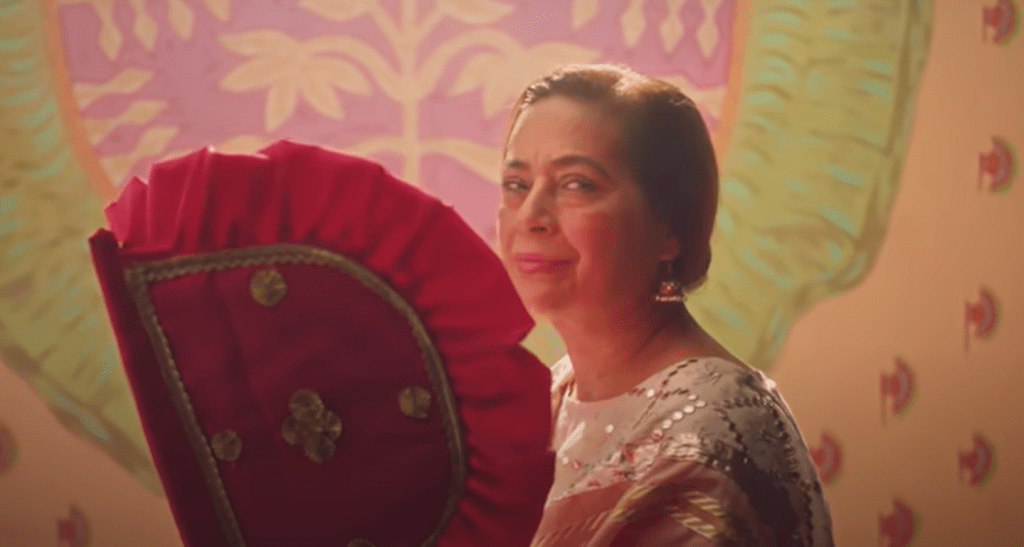
I couldn’t help but notice the woman at the end, looking longingly at the young, energetic girls dancing unabashedly. Is there a deeper meaning? Perhaps she craves a similar freedom that she was denied at their age. Maybe she wants to break free from the chains holding her back but considers it too late. The beauty of the video lies in its open interpretation, allowing viewers to find their own meanings.

Aayi Aayi – Noman Ali Rajper x Babar Mangi x Marvi Saiban

This song is special as it pays tribute to Thar. For the uninitiated, the Thar desert is shared by both Sindh in Pakistan and Rajasthan in India. The desert, also known as the Great Indian Desert, spans an area of about 200,000 square kilometers (77,000 square miles) and forms a natural boundary between the two countries. However, despite the boundaries, the culture of the people on both sides of the desert remains the same.

I got goosebumps watching the video. There was an indescribable feeling of oneness. A tingling reminder that we were one once upon a time.

Chal Chaliye – Sajjad Ali x Farheen Raza Jaffry

This one is for the romantics. A slow, soulful song that nudges you to follow your dreams. Sajjad Ali and Farheen have the most beautiful voices. Together they create magic.

Korean Drama Spotlight: Our Beloved Summer

Our Beloved Summer Review

I finally decided to watch this series because I was missing Choi Woo-shik. It marked the first time I consciously focused on his screen presence and savored his performance. Although he played a significant role in Parasite, my level of interest in K-entertainment was not as profound back then, leading me to immerse solely in the storyline, rather than appreciating the actors.

Disclaimer: This post shouldn’t be treated as a review because I am far from qualified to give an objective and professional take on dramas. It should be treated as a subjective viewpoint of a cinephile who loves to watch movies and dramas purely for entertainment. I have only one criterion – I shouldn’t get bored. The film will be judged on that factor alone.

What’s It About?

Our Beloved Summer chronicles the story of two childhood sweethearts whose first encounter occurs during a school assembly. As she walks determinedly towards the podium, a nostalgic Choi Woo-shik from the future whimsically describes the moment, saying, “I noticed her because she looked as if she was going to fight a war.”

They are eventually chosen for a documentary exploring the behavioral patterns of the top student (the girl) and the lowest-performing student (the boy). The narrative delves into their evolving love story, navigating the complexities of first love, eventual separation, and their paths crossing again years later as dedicated professionals.  

Thoughts

I loved Choi Woo-shik’s performance. You know he is a top-notch actor when the character he portrays on-screen is nothing like what he is in real life. Choi Woo-shik is a goofball who makes the most bizarre, sarcastic jokes in reality shows. He’s a laugh riot. On the other hand, this character (Woong) in Our Beloved Summer is aloof, serious, rarely smiles, and has an air of melancholy about him.

Personally, I found the story to be predictable and a bit dragging. The side characters appealed more to me than the main leads’ chemistry. It gave me a strong sense of second male/female lead syndrome. Woong’s manager and Yeon-soo’s friend injected much-needed humor into the otherwise “gray” storyline, providing a relieving touch to the narrative. They were outstanding.

Overall, the series did not feel like a light, breezy watch for the most part, as it focuses on the complexities of lost love. So, if you are looking for a meet-cute story where the characters gradually fall in love, Our Beloved Summer may probably not be for you. I recommend giving it a go if you are missing Choi Woo-shik, like me.

Our Beloved Summer is available on Netflix. It has 16 episodes, with each episode lasting almost an hour.

An Ode to the Two Best K-Thrillers of 2023 (So Far)

As you might already know, I am big-time into romantic kdramas. But as of now, I am on a short break and experimenting with other genres to detox my system from the sugar overload.

I enjoyed two Korean thrillers recently. One is a movie and the other a kdrama.

Revenant

Kim Tae Ri in Revenant

If you are into horror mysteries, this is a must-watch. Kim Tae Ri gives a superlative performance (as usual), but so do the others. No one is out of place. You will find yourself completely immersed in the story, taking in the characters, their miseries, thoughts, and feelings, almost becoming one with them.

Kim Tae Ri plays a food delivery girl struggling to juggle her many responsibilities. She has to work, study, and, last but not least, deal with her reckless single mother, who is a handful in more ways than one. One fine day, she learns that her mother has lied about many things, including her father’s life story. Supernatural events unfold, leading to the discovery of hidden secrets.

The series is fast-paced and lures you in with its many twists and turns. The jump scares are comparatively less (I can only remember one), so that’s a big plus. The horror element is conveyed brilliantly through the character’s subtle change in expressions and body language. Nothing is over the top.

Streaming on Disney+ Hotstar.

The Childe

Kim Seon Ho in The Childe

Kim Seon Ho brilliantly portrays a quirky killer who is out to get a Filipino-Korean boxer in search of his wealthy father.

The cat and mouse chase was super fun, and it helps that the main lead does all of it impeccably dressed in well-fitted suits. Kim Seon Ho oozes charm in the way he talks and moves. But he also has the most sinister smile. How this beautiful man from Hometown Cha Cha Cha managed to play such a twofold character is beyond me. Like Kim Tae Ri, Kim Seo Ho is perfection.

The movie gets violent at times but will not stop you from completing it. Take it from someone who hates violence and bloodshed.

The Childe is fast-paced, like Revenant, so I highly recommend the two to people with a short attention span (like yours truly). You can catch the movie at a theatre near you.