Relationships have never been a smooth sail for me. The kind of love glorified in movies and online platforms always felt like a distant dream. Agreed that cinema and social media do not always portray the complete picture. Yet, I envy people with uncomplicated relationships – they meet, like each other, and live happily ever after. Simple as that. For me, it has always been – we meet, we like each other, things fizzle out, distance, heartbreak, and increased caution.
I can cite many reasons for my past relationships not ending as I wanted them to. By this, I do not mean marriage, as that is not my end goal. I have been married once, and it was enough to make me realize that a traditional marriage, with its many rules and regulations, is not meant for someone unorthodox like me. It also wouldn’t be fair to impose my eccentric perspective on a family that adheres strictly to traditional marriage norms. In India, let’s face it, most families do want a marriage that sticks with the conventional route. Anyway, that’s a topic for another day.
What I seek is a long-lasting, peaceful, healthy, uncomplicated companionship rooted in friendship. The type that doesn’t make you stand on your toes or feel a sense of dread. The kind that doesn’t try to control or abuse. It is free-flowing and natural. A type of love that is as comforting as a warm cup of chai.
This post is not about my past relationships. It does not seek to give any motivational, positive advice. The thing I want to focus on is my feelings. There is always a fear lingering, no thanks to previous experiences.
I am currently in a relationship with the most caring man I have ever met. Someone who makes me feel at ease. I am at my most authentic self in his presence. However, sometimes, I look at his kindness with skepticism.
When you have had people playing with your feelings in the past, you eye even the sincere ones with suspicion. It’s a survival mechanism. You want to protect yourself from any impending heartbreak. You do that by asking yourself tough questions. You put yourself in a spot. You wonder if there will ever come a point when they, too, will start acting distant. Would the person, over time, forget that you two shared meaningful moments together, and end up talking in a manner devoid of any warmth or friendship as if you are a complete stranger wasting their time? Do you have it in you to deal with one more heartbreak, one more connection that transitions towards indifference?
These dark emotions are exclusive to us, the lovers with a broken track record.
It’s a terrible game your mind plays. Even your heart. You find yourself saying, “Be careful. Keep a safe distance always. It helps.” However, it is easier said than done. Gaining control over matters of the heart is not easy. It almost sounds robotic to do so. Humans often default to trust, hoping they’ve made the right choice and leaving the rest to fate. If events are destined, they’ll unfold regardless. Obsessing over control only brings suffocation and regret.
Life has this uncanny ability to unravel answers to your most pressing questions over time. That’s the one pro of aging – you gain this awareness that the answer will indeed arrive, if not now, then at a later stage. The sane thing to do would be to wait patiently instead of torturing yourself with questions that no one, even yourself, would be able to answer at the moment.
In recent years, I’ve shifted towards reading more non-fiction books. I’m not entirely sure why. There was a time when I exclusively indulged in fiction, but maybe as one grows older, there’s a desire for substance over escapism.
Currently, my topic of interest is my own country, India. For 40 years, I was mostly indifferent and satisfied with my understanding of India’s history. However, over the past few years, I’ve developed a strong desire to learn more. I’ve become curious about the psyche of our people, especially those who had to endure several seasons of conflict and unrest. I wish to understand our country’s past. What did our people go through during centuries of colonial rule? How did it mold our perspectives? What were the hurdles we faced before and after independence? As a nation, we have experienced true freedom only since 1947, which is less than a century. Considering this relatively short period, what valuable lessons should we absorb from our recent history as we navigate the present? At any point in history, did we feel a sense of unity? I am seeking hints because the present does not seem to offer any positive answers.
I never felt compelled to delve into books by influential leaders. It was during this quest to know more about India that I started reading Dr Ambedkar’s works. It feels surreal how a simple book could offer a glimpse into how Indians thought in the past, their sentiments, fears, anger, sorrow, etc. Everything feels like déjà vu.
History often repeats itself. By navigating the pages of Ambedkar’s book, you see glimpses of the present reflected in the past.
Some of his thought-provoking quotes include:
I measure the progress of a community by the degree of progress which women have achieved.
Cultivation of mind should be the ultimate aim of human existence.
History shows that where ethics and economics come in conflict, victory is always with economics. Vested interests have never been known to have willingly divested themselves unless there was sufficient force to compel them.
Religion must mainly be a matter of principles only. It cannot be a matter of rules. The moment it degenerates into rules, it ceases to be a religion, as it kills responsibility which is an essence of the true religious act.
I like the religion that teaches liberty, equality, and fraternity.
Law and order are the medicine of the body politic and when the body politic gets sick, medicine must be administered.
Life should be great rather than long.
Unlike a drop of water which loses its identity when it joins the ocean, man does not lose his being in the society in which he lives. Man’s life is independent. He is born not for the development of the society alone, but for the development of his self.
Dr. Ambedkar’s books offer numerous insights. I highly recommend Volume 8 to all Indians for a comprehensive analysis of the thoughts of Hindus and Muslims regarding the Partition of India. It deep-dives into arguments of each. Dr. Ambedkar fearlessly acknowledges and criticizes the cases from both communities while offering candid and constructive feedback. Ultimately, he leaves it up to you, the reader, to derive a conclusion.
For those interested in Dr. Ambedkar’s books, did you know that the MEA website allows you to download all volumes of his “Thoughts & Speeches” for free?
The Lok Sabha Election is around the corner. As with any other election, it is of prime importance that an Indian citizen makes informed decisions before casting their vote. By “informed decision,” I do not mean it should be based on what the media shows you. Or what your relative or friend tells you. It should be based on your own independent research. It is a prerequisite because almost every individual and media house is biased nowadays. They are responsible for spreading a particular narrative without looking at both sides.
We often look at a political party and vote. I believe voting for a party without considering their achievements and contributions could lead them to take us for a ride and get away with misusing our tax money. Instead, we should scrutinize performances. Real data. If we wish our country to prosper, we must be more vigilant and not blindly trust any political party, journalist, or media.
The most foolproof way to assess a party’s performance is by observing the changes in your immediate surroundings. Take a moment to observe—your neighborhood, people in your locality, infrastructure, law and order, and security. What aspects do you appreciate? What do you dislike? Who is responsible for this change that you like or dislike? The state or center? Consider creating a checklist. Form your opinion based on this checklist, not what a person from another district, state, or country tells you. If someone says the country isn’t peaceful because of selective news, but your own experience is positive, it’s best to rely on what you know firsthand to form a judgment. Because this is the most credible piece of news there is – it’s coming straight from your eyes.
Online research
During these times filled with agendas, it’s crucial to conduct independent online research. Google should be your best friend!
Keep in mind that most sources push specific narratives that suit their agenda, with left-leaning channels often criticizing the government and right-leaning ones rarely finding fault. If a source only focuses on one narrative, it’s likely biased. Avoid blindly trusting your favorite party, politician, or journalist. Instead, gather data from both left and right-leaning portals to get a more balanced picture. For this to effectively happen, you must keep your biases at bay.
I use Media Fact Check Bias to determine whether an online news portal is left or right-leaning. This information is helpful as it will give us a hint into what kind of bias to expect. The website also shows whether the portal is credible based on whether they have given proper credit, passed fact checks, etc.
An essential research doc to refer to is the RBI docs, such as the State Finances: A Study of Budgets of 2023-24. They provide insights into how your state government is managing your money. Look into their spending on infrastructure, education, research, wages, and salaries, how debt-ridden they are, etc. RBI is a neutral entity, so it’s the best place to get the most authentic information for your research. The doc also provides insightful information on how the states manage their funds.
To understand complex terms and sentences, AI chatbots like those found in Bing, ChatGPT, and Bard are a godsend. They simplify information, making it extremely helpful for research and learning. We’re fortunate to have these tools available to help us, making this an excellent time for conducting research and expanding our knowledge. Don’t know what “Revenue Deficit” is? Go on and ask a chatbot, “What is Revenue Deficit? Explain in simple language,” and watch the magic unfold.
What should I add to my checklist?
Here are some items to add to your checklist. Your answers, I repeat, should be based on your own personal experiences and individual research, not someone else’s.
Improvements in your locality
Do you see improvements in your locality?
If yes, who is responsible? The center or state?
Note down each improvement on an Excel sheet. Google to find out who is responsible for the achievement.
I recently did this for my state (Kerala). I was surprised that many developments were not due to my state government.
I wish journalists or media provided this information, but unfortunately, you won’t find a single website with all the details. You’ll have to gather the information yourself.
2019 manifesto
Have you looked into the current government’s 2019 manifesto? Have they fulfilled all their promises? Research and find out. Even if you do not like the party, you should keep your biases aside and look into the data. If you are too tired to look into it, I recommend Think School’s YouTube video. It is a balanced “BJP Report Card” that looks into each item in the manifesto and provides results based on facts.
Safety and security
Is your locality mostly peaceful? Do you feel safe and secure?
How are extremist groups (across all religions/political affiliations) dealt with in your state?
Would you consider your leaders (state and center) as terror sympathizers? Are they strong enough to proactively take action against terrorists?
A diverse country like India cannot be harmonious 365 days a year. Conflicts may arise from time to time, which is normal. The media often exaggerates, making every issue seem urgent.
However, the external and internal security of the country should not be ignored or taken lightly by any government or citizen. In today’s world, safety and security are paramount for every country, given the increasing threat of extremism globally. A capable leader must possess the strength and determination to proactively address such challenges.
Communal politics?
Now, this is tricky. India has always been polarized. Religion is what tore India and Pakistan apart. Communal conflicts have been a part of our history, often at a higher intensity than what we observe today. It would be naive to consider polarization as a recent development. The rise of social media over the past decade has simply made us more aware of these issues.
Politicians have played us like puppets since time immemorial by using religion as a string for votes. It is a tool that politicians can easily use to manipulate us. Therefore, I think voters shouldn’t give them that power. We should look at the broader picture and put the political parties to the test based on their achievements, not the petty politics they play.
Personally, I prefer not to look into the communal angle because I have seen both the left and right trying to agitate people in the name of religion. In India, the right is considered pro-Hindu, whereas the left is considered pro-Muslim, and they select and spread news according to that bias. This, in my opinion, creates more polarization. As long as religion exists in India, communalism will exist. When we cease to give it importance, the politicians will stop playing this game.
Conclusion
The checkpoints listed above are my personal guidelines. When each of us works on a checklist that reflects our country’s priorities, we empower ourselves to make informed decisions, ultimately contributing to a brighter future for India. As individuals sharing the same homeland, it’s incumbent upon us to support our nation’s prosperity by voting for strong leaders who align with its progress.
Let’s work together for a better future. Jai Hind!
I finally decided to watch this series because I was missing Choi Woo-shik. It marked the first time I consciously focused on his screen presence and savored his performance. Although he played a significant role in Parasite, my level of interest in K-entertainment was not as profound back then, leading me to immerse solely in the storyline, rather than appreciating the actors.
Disclaimer: This post shouldn’t be treated as a review because I am far from qualified to give an objective and professional take on dramas. It should be treated as a subjective viewpoint of a cinephile who loves to watch movies and dramas purely for entertainment. I have only one criterion – I shouldn’t get bored. The film will be judged on that factor alone.
What’s It About?
Our Beloved Summer chronicles the story of two childhood sweethearts whose first encounter occurs during a school assembly. As she walks determinedly towards the podium, a nostalgic Choi Woo-shik from the future whimsically describes the moment, saying, “I noticed her because she looked as if she was going to fight a war.”
They are eventually chosen for a documentary exploring the behavioral patterns of the top student (the girl) and the lowest-performing student (the boy). The narrative delves into their evolving love story, navigating the complexities of first love, eventual separation, and their paths crossing again years later as dedicated professionals.
Thoughts
I loved Choi Woo-shik’s performance. You know he is a top-notch actor when the character he portrays on-screen is nothing like what he is in real life. Choi Woo-shik is a goofball who makes the most bizarre, sarcastic jokes in reality shows. He’s a laugh riot. On the other hand, this character (Woong) in Our Beloved Summer is aloof, serious, rarely smiles, and has an air of melancholy about him.
Personally, I found the story to be predictable and a bit dragging. The side characters appealed more to me than the main leads’ chemistry. It gave me a strong sense of second male/female lead syndrome. Woong’s manager and Yeon-soo’s friend injected much-needed humor into the otherwise “gray” storyline, providing a relieving touch to the narrative. They were outstanding.
Overall, the series did not feel like a light, breezy watch for the most part, as it focuses on the complexities of lost love. So, if you are looking for a meet-cute story where the characters gradually fall in love, Our Beloved Summer may probably not be for you. I recommend giving it a go if you are missing Choi Woo-shik, like me.
Our Beloved Summer is available on Netflix. It has 16 episodes, with each episode lasting almost an hour.
When will we start looking at each other, not as left or right wing, but as Indians again? We lost ourselves somewhere along the way and fell into the muck head-first that political parties and fanatics laid out for us. They wanted to divide us on the basis of religion and politics. We can safely say now that they have succeeded.
We are more divided than ever before. We look at each other as villains, not citizens of the same soil.
Can we go back to the stage where we all felt like one? Did that phase ever exist? We were probably always this polarized, but the lack of social media helped cover it up.
I have only one dream – that we put our country first, above everything, including religion, caste, ideologies, political leanings, etc. It’s a huge ask. It’s definitely more challenging than spreading hatred. However, it is the need of the hour so our country can progress further.
For India to develop, we should work together. Politicians will not do it, so it’s up to us, the civilians, to make the effort. I hope to see India as a developed and prosperous country before I bid goodbye to this world. One can dream for one’s country, no matter how improbable. However, such dreams can materialize only if we come together as one, forgetting our differences and working towards the common goal, with nothing else to distract us.
When someone tries to separate us, we should look at each other with empathy and understanding. Instead of harboring a victim mentality, we should grow together. We should think, will the country prosper from our hatred and animosity? Is enmity worth it in the long run?
Elections are coming soon. We can expect more divisive politics. Be mindful of the games people play.
Judge not on the basis of what social media algorithms propagate or even what the newspapers or journalists report. Everyone seems biased at the moment. Judge on the basis of your own quality of life, personal experiences, and surroundings. Judge on the basis of your own contributions to the country – did you help in any way? Even maintaining peace and decorum during heights of conflict is a worthy contribution.
Truth be told, there were times I wished there was a law that banned religion-based talks on social media and news channels. If we stopped talking about religion, if we considered each other as humans first, there would undoubtedly be more empathy. But political parties thrive on identity politics. They can win only if religion is mentioned. So, a ban is out of the question. This is true for all major parties in India: BJP (considered pro-Hindu) and Congress (considered pro-Muslim). Everyone has a game to play based on religion, and we foolishly fall for it, fostering hate for one another.
When a religion or caste is constantly criticized, people affiliated with that religion or caste become more polarized. It’s the sad truth of life. Things don’t dramatically reform. It takes understanding, empathy, and kindness to one another to bring about change. Hate, abuse, and shaming do nothing other than deteriorate matters further.
Since childhood, we have been made to recite, “All Indians are our brothers and sisters,” and we have never questioned those words. I hope we return to that state someday, where we can see each other as one, part of the same soil.
Demian by Hermann Hesse is not for the orthodox. It nudges you into questioning your beliefs, principles, and basically anything that is part of this world. Nothing, according to Demian, is beyond questioning.
What do you do when you cannot connect with societal rules? You think differently than the people around you, and you like different things, leading to a sort of identity crisis. After a while, such people often give in and join the herd, unable to withstand the pressure of non-conformity. They end up living a dual life, one intricately manufactured for the world and one genuine, which may not see the light of day.
There are clear-cut protocols to follow if validation and respect from society mean a lot to you. If you deviate from those rules, you are considered flawed. In reality, humans are not perfect. All of us have a trace of evil in us. Some show it openly, others try to rein it in. The book tells you to make peace with your imperfections, deemed “evil” by society, for all these traits, no matter how good or bad they are, are your own. When our “good” and “evil” happily coexist without outward interference, you get to live a life that is most true to yourself. Demian, in essence, is about embracing your authenticity and being in harmony with your divine and not-so-divine.
Demian is not for everyone. It is for the questioners, the people who are not satisfied with the status quo. They want more, they seek more. Sometimes, the deeper thoughts in the book take a while to trickle in. The main character, Sinclair, often sounds eccentric and unclear. But that’s the whole point. You, the reader, need to acknowledge his uniqueness and accept him for who he is – a rule breaker.
The book’s main purpose is to lead readers into a new world of creation: “Hesse’s vision is reaching out to another generation searching for meaning in an age of anxiety and war.”
Here are some of my favorite thought-provoking quotes from Demian:
The bird fights its way out of the egg. The egg is the world. Whoever wants to be born must destroy a world. The bird flies to god. The god is called Abraxas.
Abraxas is soon clarified for Sinclair in a lecture by a teacher as “something like a deity whose symbolic task is to unite the divine and the un-divine.”
All I wanted to do was try to live the life that was inside me, trying to get out. Why was that so hard?
When writers write novels, they tend to act as though they were God, who can see and understand anything and everything about a person’s story, and they present that story as though God himself were telling it, without all the veils of disguise that are the fundamental nature of life. I cannot do that— any more than these writers can. But my story is more important to me than some writer’s story is to him, because it is my own, and it is the story of a human being— not an imagined, possible, ideal, or in some other way nonexistent person but a real, unique, living, breathing one.
We can understand each other, but each of us can truly grasp and interpret only himself.
When I imagined the devil, I could see him perfectly well on the street down the hill, in disguise or not, or at the fair, or in a pub — but never with us at home.
Such cracks and tears heal, they grow back together and are forgotten, but down in our most secret recesses, they continue to live and bleed.
For the first time I tasted death, and death tastes bitter because it is birth: anxiety and terror in the face of frightening renewal.
There is nothing in the world more hateful to a person than walking the path that leads to himself!
This whole God, in the Old Testament and the New Testament both, is a marvelous character, true, but he’s not what he’s supposed to be. He is good and noble, the Father, the high and beautiful, the sentimental— all true! But the world consists of other things too. And all those other things get chalked up to the devil; that whole part of the world, that whole half, is just suppressed and hushed up. The same way God is praised for being the Father of all life, while everything sexual, everything life in fact depends on, is simply hushed up or described wherever possible as the devil’s work, and sinful! I have nothing against honoring and worshipping this God Jehovah, not in the least. But I think we should honor everything, and worship everything— the whole world is sacred, not just this artificially partitioned official half! We need not only church service but a devil’s service. That’s what I think. Or else we need to create a God who includes the devil too, and whose eyes we don’t need to cover when the most natural things in the world take place in front of him.
‘Forbidden’ is not an eternal truth — it can change.
It is entirely possible to never do anything forbidden and still be an absolute scoundrel.
I think I like music because it has so little to do with morality. Everything else is moral or immoral, and I am looking for something that isn’t.
“You’ve told me you like music because it is outside of morality,” he said. “Well and good. But now stop being a moralist yourself! You can’t keep comparing yourself to other people— if nature has made you a bat, you can’t decide you want to be an ostrich. You sometimes feel like you don’t belong, you blame yourself for following a different path than most other people. You have to unlearn that. Stare into the fire, look at the clouds, and when ideas or intuitions come to you and the voices in your soul start to speak, trust them and don’t worry about whether your teacher or your daddy or any other lord above likes what they have to say! That’s what ruins a person. That’s how you end up on the law-abiding sidewalk, just another fossil.
When we hate someone, what we hate is something in him, or in our image of him, that is part of ourselves. Nothing that isn’t in us ever bothers us.
There is no reality other than what we have inside us. That is why most people live such unreal lives, because they see external images as reality and never give their own internal world a chance to express itself. You can be happy living like that, but once you know that there is another way, you can no longer choose to follow the path of the many. The path of the many is an easy one, Sinclair.
I just live in my dreams, that’s what you noticed. Other people live in dreams too, but they’re not their own dreams, that’s the difference.
We felt that we embodied nature’s will for the new, the individual, and the future, while the others’ lives showed only a will to persist in the old. They loved humanity as much as we did, but for them it was something already finished, to be preserved and protected, while for us it lay in a distant future we were all moving toward, whose image was still unknown, and whose laws had never been written.
He had loved and had found himself in the process. Most people love only in order to lose themselves.
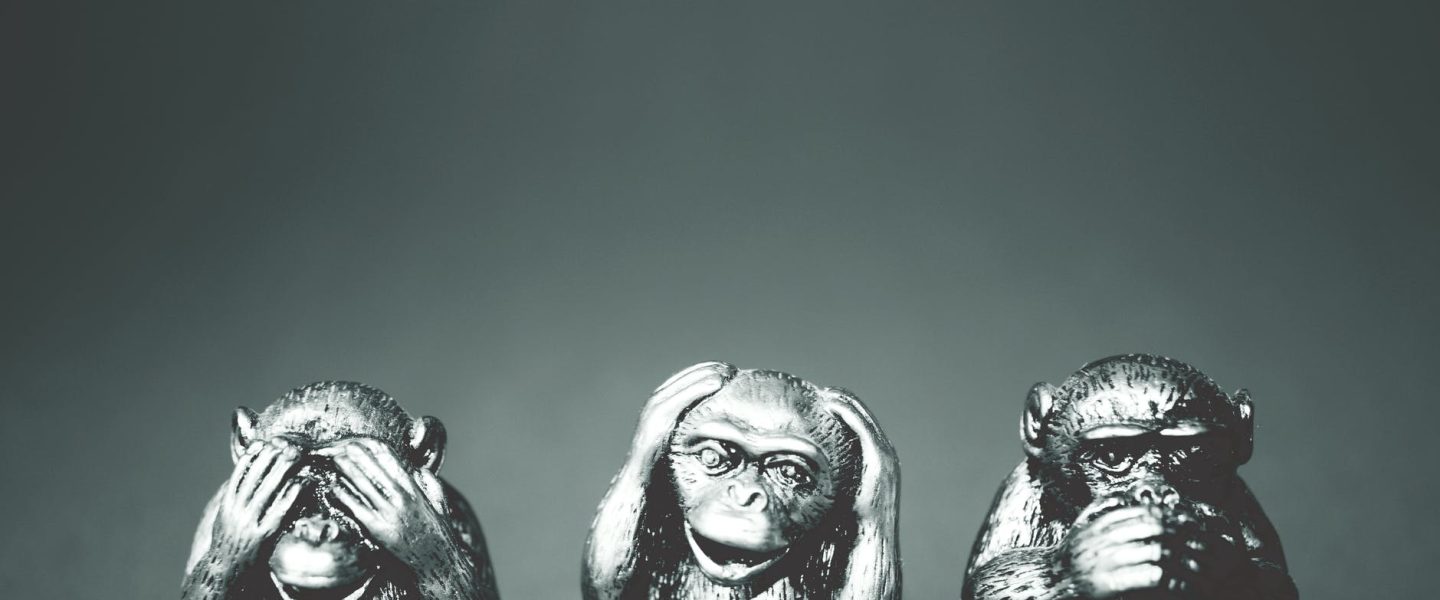





 The Monkey Dilemma
You must be logged in to post a comment.