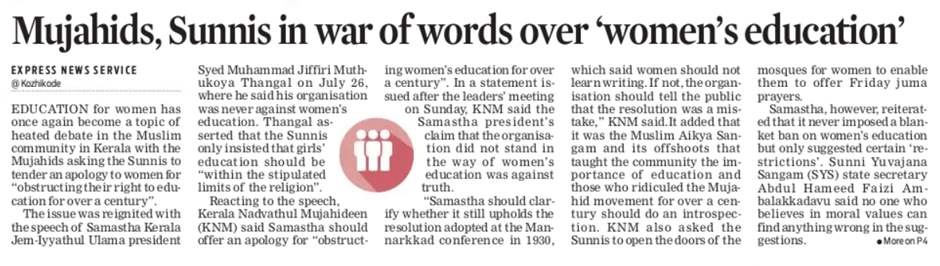
I came across this news today. It is comforting to know that there are members of the Muslim community in India who are fighting for unrestricted women’s education.
Samastha earlier had conveyed that a Muslim woman’s education should be encouraged but within religious restrictions. This became a point of debate across the state of Kerala, with many progressives calling it problematic. However, the most striking response came from a group within the community – the KNM. The organization is demanding that Samastha apologize for its take. KNM is not without its faults, but the stand they took on this particular issue is noteworthy.
Samastha and KNM
To the uninitiated, the “Samastha” group in Kerala refers to “Samastha Kerala Jamiyyathul Ulama,” an influential Sunni Muslim scholarly body in the state. Samastha plays a significant role in managing religious and educational institutions, including madrasas and mosques, and often issues guidelines on religious matters.
The term “Mujahids” in the context of Kerala typically refers to the Kerala Nadvathul Mujahideen (KNM), a prominent Islamic reformist organization in the state. The KNM often contrasts with traditionalist groups like Samastha, promoting a more modern interpretation of Islam, such as advocating the opening of the doors of mosques for Muslim women to enable them to offer Friday juma prayers.
Restricting Women’s Education on Religious Lines
If we connect religion with education, the progress of women in our country will be hindered. Afghanistan is a live example of this. Currently, girls in Afghanistan are generally allowed to attend school only up to the sixth grade. The Taliban, who regained control of the country in August 2021, have imposed severe restrictions on girls’ education beyond this level. Secondary education for girls (grades 7-12) has been largely suspended, and there have also been significant restrictions on female university students, including the closure of universities to women in late 2022. These measures have been widely condemned by international organizations and human rights groups. The global campaign #LetHerLearn, which advocates for Afghan women’s right to education, is gaining traction.
India is no Afghanistan. Here, women are allowed to study without restrictions regardless of religion. Women who are limited to religious studies may face challenges in the corporate world. It would severely restrict their job opportunities in a secular country like India, where well-paid corporate jobs often require you to engage with a global audience and follow strict academic and professional protocols that might not always adhere to religious lines.
Jobs cannot be built around religion in a democracy. Corporate jobs often require specific skills such as critical thinking, teamwork, leadership, and digital literacy. Religious studies may not always focus on developing these skills, which can impact the ability to perform effectively in a corporate setting.
Unfortunate Consequences
What happens when there are limited job opportunities for women due to religious restrictions? They will end up staying at home. Marriage becomes the only option. Financial independence becomes a distant dream.
It is ultimately up to the Indian Muslim woman to decide. If she wishes to pursue further studies, she should not be shamed.
Indian Muslim women deserve quality education, just like anyone else in India. We should have more Indian Muslim women in top positions in the corporate world. Currently, they are practically non-existent outside of Muslim countries. However, to make this happen, there need to be some reforms within the community that will help the women integrate more seamlessly into the existing corporate structure.
***
Picture Courtesy: The New Indian Express (July 2nd 2024, Kerala Edition)

 The Monkey Dilemma
You must be logged in to post a comment.