Haq: When a Film About Muslim Women Speaks to All Women

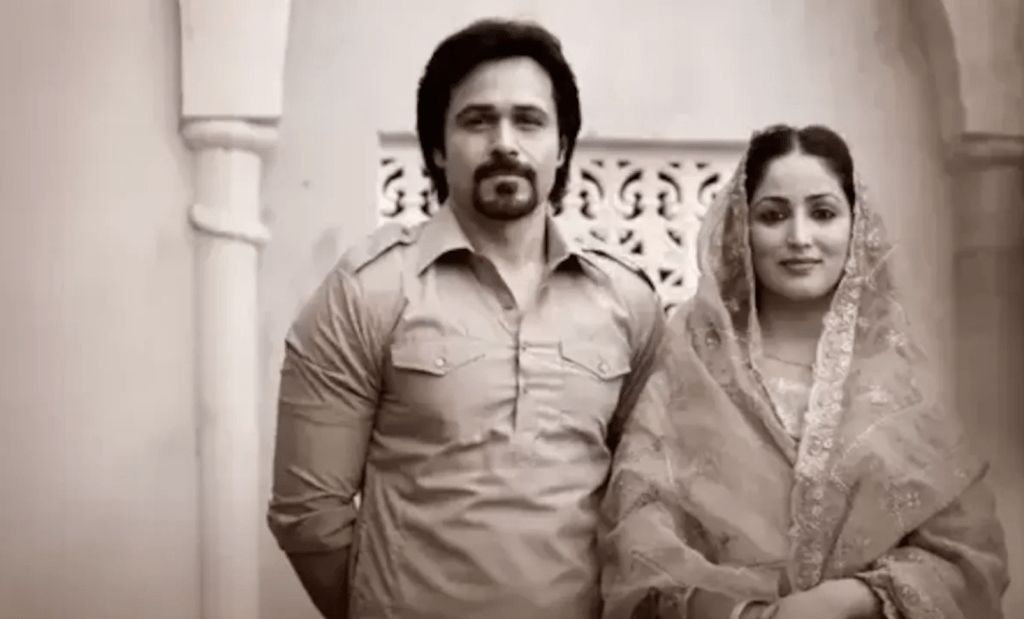
Haq Movie Poster

For the most part, Haq is not a story only about Muslim women. It is a story about women in general. Almost all of us know someone, married or unmarried, who has been cheated in love. We have seen that heartbreak up close, and we understand the emotional toll it takes.

When Shazia feels betrayed, we feel it too. When she wants the best for her children, that emotion feels familiar. When she fights for her rights, it resonates deeply. And when her father stands by her without hesitation, it reminds us of our own fathers and the quiet strength that support brings. These are emotions that are universal to women, cutting across religion, culture, and background.

The narrative becomes specifically about Muslim women only when the legal issues come into focus. That is where the real differences emerge, and the film clearly highlights how laws and systems can shape a woman’s fight for justice. It is to be noted that soon after the Triple Talaq ban was implemented in India, many Muslim women began approaching the courts to seek justice. While there was no open praise for the current government for such a ban, there was a quiet acceptance of the relief and protection the law offered them in real life. Many Muslim men, however, continue to view the ban as an insult to their faith rather than as a legal safeguard for women.

Getting back to the movie, Yami’s final monologue is powerful and leaves a strong impact. Emraan feels completely natural throughout and never once seems like he is performing. Sheeba Chaddha is equally convincing and brings depth to her role.

I especially want to credit Emraan for choosing to act in a film that openly talks about Muslim women’s rights. It takes conviction to support a story like this, especially as a Muslim, without dismissing it as Islamophobic. The film is clearly not that. Instead, it focuses on real issues and lived experiences, and his decision to back the narrative adds credibility and strength to the message being told.

Overall, I liked the film. The background music could have been better, and Yami is not fully convincing in a few scenes. Still, she more than makes up for it in the final act, which stays with you long after the film ends.

Haq is now streaming on Netflix.

An Ode to Feminichi Fathima

Feminichi Fathima Movie Poster

Feminichi Fathima is a Malayalam movie I had been waiting to watch for a long time. The film received strong appreciation at several film festivals. Many critics also spoke highly of it in their reviews. Now that it has finally released on OTT, the wait feels worth it. After watching the film, I can say it truly lives up to the praise it received.

The movie is a bold and thoughtful effort by director Fasil Muhammed to explore feminism from the perspective of a Muslim woman. This is a refreshing shift in Indian cinema, where feminist narratives are often shown through a cultural Hindu lens. Films like The Great Indian Kitchen (Mrs. in Hindi) and Thappad shaped much of that earlier conversation. Against that backdrop, this film feels timely and necessary. It adds a new voice to discussions on gender, faith, and everyday patriarchy.

What’s It About?

Fathima is married into a conservative and deeply religious family in the Malappuram district in Kerala. Her husband is a usthad (a religious leader) who expects his household to follow every rule without question. Life in the home is seen only through a strict, conservative lens.

Trouble begins when their young son wets the mattress. Fathima cleans it and leaves it outside to dry, but a dog later urinates on it. Since dogs are viewed as ritually impure, her husband reacts with anger and disgust. What follows is Fathima’s quiet struggle to fix the situation, facing resistance at every step.

The film makes a strong point that a woman in religious clothing can also be a feminichi (a slur often used by Malayalee misogynists to dismiss feminists).

Thoughts

Shamla Hamza and Kumar Sunil deliver standout performances. Shamla Hamza, in particular, is remarkable throughout the movie. It is hard to believe this is only her second project, after 1001 Nunakal, released in 2022. She performs with the ease and control of a seasoned actor. Her expressions carry much of the film’s emotional weight. Shamla winning the Kerala State Film Award for Best Actress feels well deserved. The storyline is fresh and quietly rebellious, which makes her performance even more powerful.

In many ways, the film feels braver than other feminist movies. Dissent is rarely encouraged in conservative Muslim families, which makes this narrative more powerful. The story shows how questioning norms itself becomes an act of courage. That is what sets this Malayalam feminist film apart. It opens space for conversations that are often silenced. Ideally, it will inspire more Feminichi Fathimas to speak up and stand for their rights.

Even though the subject is heavy, the movie never becomes overwhelming. It avoids melodrama and keeps emotions grounded. Light comedy is woven into the narrative. This balance makes the film feel surprisingly breezy. The pacing is tight and engaging throughout. You can easily watch the full 1.5 hours in one sitting without needing a break.

I would call this movie a must-watch for anyone interested in meaningful Malayalam cinema. Feminichi Fathima is now streaming on Manorama Max. You can also watch it via Amazon Prime with a Manorama Max subscription. English subtitles are available.

Short Film Spotlight: Anuja

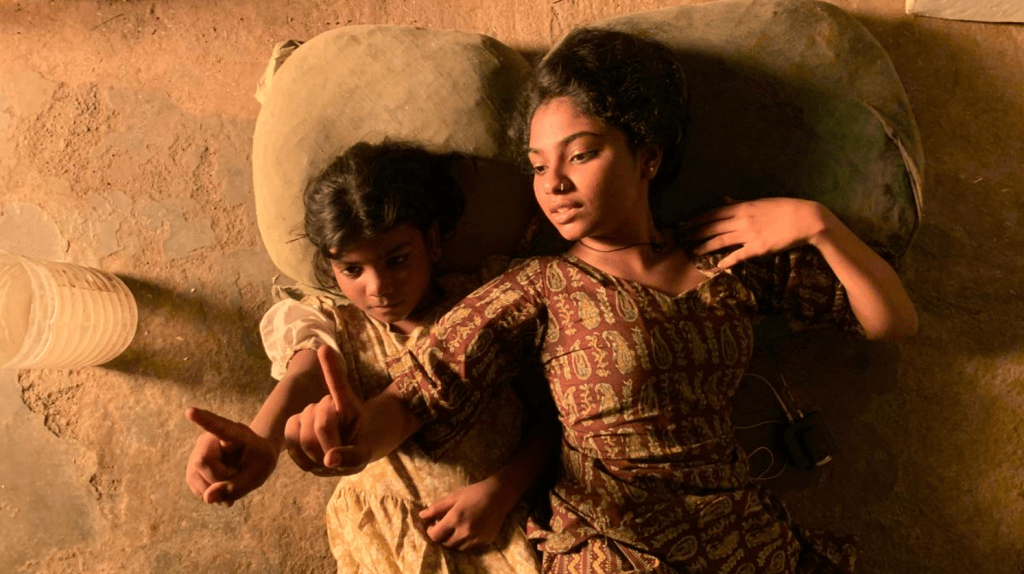
Anuja Short Film Poster

I was craving to watch a slice-of-life drama. Something simple, not too heavy or filled with dread. I honestly thought Anuja would be intense, given how the synopsis sounded. Plus, it’s a Hindi short film that was an Academy Award nominee.

Now, why would I mention the Academy Award nomination like it’s a bad thing? I have my reasons.

To be honest, Oscar nominees have rarely worked for me. In Malayalam, we call such films “award padam.” The kind that feels too abstract or complex for ordinary viewers (like yours truly). There was a time in my life, long ago, when I pretended to enjoy such films just to seem intellectual in front of my then-partner. But I couldn’t keep up the act, and that image fell apart the moment that relationship ended. Now, it seems I’m making up for that lost time. All I want to watch are feel-good films.

So when I saw that Anuja was an Oscar nominee, it didn’t excite me enough to hit play right away. It actually made me hesitate. After all, the Oscars have a reputation for picking Indian films that focus on pain and poverty, what many call “poverty porn,” which does not fully represent what India is today.

Still, I decided to give it a chance.

What’s It About?

A 9-year-old girl works with her sister in a garment factory in India. Despite being naturally bright and curious, she doesn’t attend school because of financial struggles. And, truthfully, she doesn’t want to either. Her elder sister, however, recognizes her potential and dreams of giving her the education she deserves.

Thoughts

The film was a pleasant surprise. I loved it. It was just 22 minutes, but packed with emotions.

It tells the story of child labourers. They are presented not as helpless victims, but as resilient children who find joy even in hardship. The truth is, we often see others through our own lens and may view them as “helpless.” But for them, this is simply life. They know no other kind of life, and they’re doing their best with what they have. That’s what the movie captures so beautifully — life as they see it, not as we do.

It’s a social hierarchy. Someone wealthier might be looking at me with pity, thinking I’m suffering. Yet I’m making the most of what I have, because that’s the life I know. We suffer mostly when we lose something we once had, when we can compare the before and after, and we truly miss the before.

I’ve often felt that those not well-off often make the best of what little they have, which is why they find happiness in the smallest things, like a bag of jalebi, for instance. Anuja captures that spirit beautifully: “The present may not be bright, but we can strive for a better tomorrow.

The film avoids moral preaching or lecturing. It’s simply about two sisters supporting each other in a harsh world.

The most moving part of the film is that Sajda Pathan, who plays Anuja, was once a child labourer in Delhi before being rescued by the Salaam Baalak Trust (SBT). She now lives at the NGO’s Day Care Center, founded in 1988 by filmmaker Mira Nair, who, interestingly, is also the mother of New York’s new Mayor, Zohran Mamdani.

Ananya Shanbhag also delivers an excellent performance as the elder sister, Palak.

I would definitely recommend the short film. Anuja is streaming on Netflix.

An Ode to Seeking Justice By Exercising Your Power to Vote

The Night Is Ours - Kolkata Protest

In Kerala, recently, CPM faced a sharp setback. A state known to be deeply faithful to its comrades turned its back on the communist party in the Lok Sabha Elections. CPM could secure only one seat. This was a big shocker for the party when the results were announced. It wasn’t for the people, however. The grievances were such.

What went wrong? Plenty. Fund mismanagement, corruption, hooliganism, dictatorial tendencies, lack of acknowledgment of mistakes, farmer deaths, pension delays, etc. The list seems endless. A sort of arrogance had crept in after CPM’s second consecutive term. It was reflected in their attitude towards commoners and overall leadership. People started catching on to their lies and false promises.

How did Malayalees react? Through their votes. CPM could secure only one seat in Kerala in the recent Lok Sabha Elections 2024, facing an overall 2-4% dip in vote share. They suffered a severe blow even in their strongholds like Kasaragod, Kannur, Vadakara, and Palakkad.

Kerala is a prime example of how to get your revenge against political parties if they fail to meet your standards. No freebies were promised in the state, so the votes were cast purely on the basis of the political party’s performance.

The only way a common man in India can express his disappointment towards political parties is through his votes. Yet, Indians do not show up when the time comes. Excuses pop up, “We have work,” “We don’t want to travel,” “What’s going to happen, anyway?” Due to this, the parties that were a disappointment continue to be in power.

The point I am trying to make is concerning West Bengal. The government had already shown its true colors before the election. They tried to cover up the Sandeshkali rapes and protected the party member from arrest. Police officers were attacked when they went to arrest the party member. Hooliganism was its max. Everyone witnessed it. Yet, the party won again.

Someone said if an election were to be held tomorrow in West Bengal, TMC would again win. This is unfortunate. In such cases, is the government alone to blame? Aren’t we the citizens enabling such a behavior, too? TMC’s supporters turned up en masse to save and vote for the party while the others relaxed at home in the sweltering heat. There was post-poll violence in the state because TMC members were furious they did not secure enough votes as before. Yet, somehow, we refused to acknowledge what we saw. We continued to believe the words of the party who was placing the blame on everyone else except itself. We celebrated the “saving” of democracy, unaware that the party we voted for was no better.

Indians are expressing their anger on social media and the streets now, but they forget they can do it the Kerala way too. When the time comes, hit where it hurts – through your votes. This is the only way to get a political party to introspect and correct themselves. It is a powerful tool. Use it.

***

Photo Courtesy: PTI Photo/Swapan Mahapatra

An Ode to Unrestricted Quality Education for Indian Muslim Women

Indian Muslim Women Education

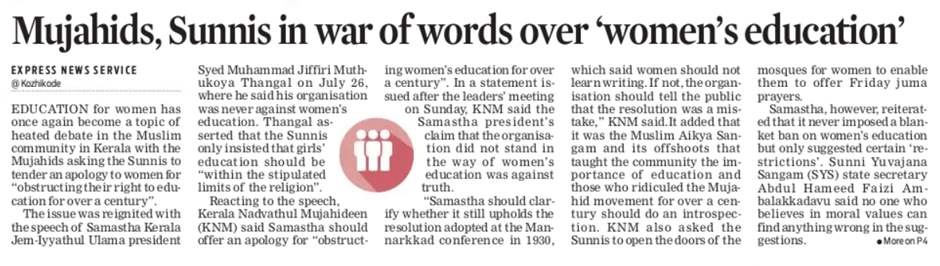
I came across this news today. It is comforting to know that there are members of the Muslim community in India who are fighting for unrestricted women’s education.

Samastha earlier had conveyed that a Muslim woman’s education should be encouraged but within religious restrictions. This became a point of debate across the state of Kerala, with many progressives calling it problematic. However, the most striking response came from a group within the community – the KNM. The organization is demanding that Samastha apologize for its take. KNM is not without its faults, but the stand they took on this particular issue is noteworthy.

Samastha and KNM

To the uninitiated, the “Samastha” group in Kerala refers to “Samastha Kerala Jamiyyathul Ulama,” an influential Sunni Muslim scholarly body in the state. Samastha plays a significant role in managing religious and educational institutions, including madrasas and mosques, and often issues guidelines on religious matters.

The term “Mujahids” in the context of Kerala typically refers to the Kerala Nadvathul Mujahideen (KNM), a prominent Islamic reformist organization in the state. The KNM often contrasts with traditionalist groups like Samastha, promoting a more modern interpretation of Islam, such as advocating the opening of the doors of mosques for Muslim women to enable them to offer Friday juma prayers.

Restricting Women’s Education on Religious Lines

If we connect religion with education, the progress of women in our country will be hindered. Afghanistan is a live example of this. Currently, girls in Afghanistan are generally allowed to attend school only up to the sixth grade. The Taliban, who regained control of the country in August 2021, have imposed severe restrictions on girls’ education beyond this level. Secondary education for girls (grades 7-12) has been largely suspended, and there have also been significant restrictions on female university students, including the closure of universities to women in late 2022. These measures have been widely condemned by international organizations and human rights groups. The global campaign #LetHerLearn, which advocates for Afghan women’s right to education, is gaining traction.

India is no Afghanistan. Here, women are allowed to study without restrictions regardless of religion. Women who are limited to religious studies may face challenges in the corporate world. It would severely restrict their job opportunities in a secular country like India, where well-paid corporate jobs often require you to engage with a global audience and follow strict academic and professional protocols that might not always adhere to religious lines.

Jobs cannot be built around religion in a democracy. Corporate jobs often require specific skills such as critical thinking, teamwork, leadership, and digital literacy. Religious studies may not always focus on developing these skills, which can impact the ability to perform effectively in a corporate setting.

Unfortunate Consequences

What happens when there are limited job opportunities for women due to religious restrictions? They will end up staying at home. Marriage becomes the only option. Financial independence becomes a distant dream.

It is ultimately up to the Indian Muslim woman to decide. If she wishes to pursue further studies, she should not be shamed.

Indian Muslim women deserve quality education, just like anyone else in India. We should have more Indian Muslim women in top positions in the corporate world. Currently, they are practically non-existent outside of Muslim countries. However, to make this happen, there need to be some reforms within the community that will help the women integrate more seamlessly into the existing corporate structure.

***

Picture Courtesy: The New Indian Express (July 2nd 2024, Kerala Edition)

An Ode to Women Taking Financial Decisions

Photo by Bich Tran

This is a topic close to my heart. As a single woman in her 30s, I often find myself having to deal with people second-guessing my financial decisions. I am always told to consult a man before taking things further. Don’t get me wrong. I am absolutely okay with consulting experts. The keyword being “experts.” This is a gender-neutral term not limited to men. If they had told me to consult an expert instead of a specific gender, I would have been fine. But that’s not the case. They pinpoint the gender – it should be a “he.”

In my experience, people in India are skeptical about a woman’s money-managing skills. There’s an absolutely valid reason for such cynicism. Over generations, men have been handling money, and women have been doing household chores. This mentality is deeply ingrained in us. It is only now that the roles are shifting, more women are joining the workforce, and men are learning to handle the kitchen by themselves. In the past, this role-shifting was unheard of, which might explain why breaking away from it now takes some conscious effort. It does not come naturally. People tend to look at you with distrust if you take up a role that goes against the gender stereotype.  

“I rather my husband not cook. He might make a mess.”

“I rather my wife not handle finances. She might make a mess.”

These dialogues are not fictional. They very much exist – especially in Indian households. True, some women may not be good at finance, but that applies to men too.

Here’s an actual conversation with my mother:

Me: “I have decided to invest in Sovereign Gold Bonds (SGBs).”

Mom: “Oh! Why don’t you consult XYZ uncle about this?”

Me: “But what would he know? He’s a mid-50s person who distrusts new investment schemes.”

“Okay. But are you sure?”

“Yes! I have done my research, and I understand this product well.”

That was the end of the discussion. My mother looked at me with doubt etched all over her face. I had to convince her that I was making an informed decision.

To date, I have not made a poor investment choice. I read both the pros and cons of all investment schemes before selecting. I stay away from products I do not understand. I avoid systems that are too risky. I only invest in government-regulated schemes, not impulsively, but after going through much examination. However, all this research is still insufficient for society to stop doubting my capability to handle finances. Because I am a woman. Instead, a man who has done half the study is trusted more because of his gender.

Women are encouraged to be financially savvy and aware. But my question is – when we do become financially literate, are there people who would trust us to efficiently handle our money?