So I’m thinking of making this a regular feature on the blog. I usually have slightly contrarian takes on most news stories anyway, so putting them together in a quick post feels like a good idea. Think of this as a simple roundup where I share my thoughts on a few current issues making headlines.
Here’s today’s quick take.
Iran–US/Israel War
The ongoing Iran–US–Israel conflict is dominating global news. From what I am seeing online, most Muslims and leftists appear to be supporting Iran in this war. The primary reason is Iran’s long-standing pro-Palestine position and its support for Palestinian causes and groups.
However, in my opinion, Iran is equally in the wrong for dragging Gulf countries into this conflict.
Iranian officials have said they are only targeting US bases in the region. But the reality seems very different. Civilian infrastructure is being hit, and innocent people have lost their lives. That cannot be justified.
At this point, it is important to acknowledge responsibility on both sides. The US and Israel are certainly to blame for starting the conflict, hitting a girl’s school, and causing massive damage and loss of civilian lives. At the same time, Iran also bears responsibility for expanding the war into countries in the GCC.
Several Gulf countries had already assured Iran that their land would not be used to attack Iran. Yet they are now facing retaliation simply because US bases exist on their soil.
Personally, this issue also feels close to home because I have relatives living in the GCC. It is extremely unsettling to see those countries becoming targets when they are not directly part of the conflict.
At the same time, expecting these countries to suddenly remove US military bases is not practical. Those bases exist largely as a security arrangement, especially considering long-standing tensions with Iran.
Instead of taking sides in this Iran–Israel–US conflict, the best outcome would simply be for all parties involved to step back and find a way to de-escalate the situation before it gets worse.
Monalisa’s Interfaith Marriage in Kerala
Another story that caught attention recently is the marriage of Monalisa Bhosle, the viral Kumbh Mela girl, who married her Muslim partner in Kerala.
On the surface, this is good news. Two people who liked each other decided to get married. Interfaith marriages should not automatically be seen negatively.
At the same time, it is natural to feel a little concerned about the girl’s situation. From what we know publicly, she did not receive much formal education and appears quite naive. The relationship reportedly developed online, and the couple had known each other for only around six months, when the girl was still a minor, before deciding to get married. The guy, as per reports, is 7-8 years older than her. That combination can make anyone a bit worried, regardless of religion.
Kerala already has a controversial reputation in some circles. Because of that, it felt unnecessary for state government officials to publicly participate in what was essentially a private wedding ceremony.
If, unfortunately, the marriage faces problems in the future (I hope not), the same incident could easily be used to criticize Kerala again.
A more mature approach by Kerala’s state government would have been to stay away from the public spotlight while offering quiet support if needed. Not every personal decision needs to be turned into a political or symbolic event.
Kavya Maran and Abrar Ahmed
The next topic is from the cricket world.
Kavya Maran’s decision to include Pakistani cricketer Abrar Ahmed in her Hundred League team, Sunrisers Leeds, has sparked debate among fans. Given the current political climate between India and Pakistan, reactions were bound to be strong.
But there is another angle to this story that people are not discussing enough.
In February 2026, reports suggested that league members were warned of strict action if there was any discrimination against Pakistani players.
So one possible explanation is that Kavya Maran was simply trying to follow league rules.
Other team owners may have quietly avoided selecting Pakistani players, but technically that could still be seen as discrimination if the league had issued such warnings.
I can somewhat relate to this situation on a psychological level. Many of us have experienced moments where we strictly follow rules, while others casually ignore them and face no consequences.
To be clear, this is not meant as a justification for selecting a Pakistani player. As an Indian, I stand with my country. But it may explain the thinking behind the decision.
Sometimes people are simply trying to stay within the rules, even when others around them are not.
With dark and heavy content flooding streaming platforms these days, my old soul keeps craving simple old school romance. I still enjoy serious shows, no doubt about that, but when the real world already feels intense, I prefer feel-good stories when I sit down to unwind. The type of content that I grew up watching.
I have stepped away from Pakistani dramas and films on YouTube because I didn’t want my views or money indirectly going anywhere near causes I don’t support. The disrespectful remarks on India after Pahalgam from their celebrities didn’t help either. The mental distance I felt afterwards was enough for me to stop endorsing their entertainment. Everyone is free to choose what they watch though. I chose to stop out of personal preference. People say politics and art/sports/religion should not be mixed, but in reality, they often overlap.
There’s definitely a void now that I’ve stopped watching Pakistani dramas, so I’ve been hunting for lighthearted Indian content instead that would lift my mood. And I’m happy I found it in the new romcom series Tu Juliet Jatt Di.
I cannot believe this is Jasmeet Kaur’s first project. She performs like a seasoned professional and is already more competent than many Hindi industry actresses who’ve been around for years. Syed Raza is impressive.
The chemistry between Syed Raza and Jasmeet Kaur is electric. I haven’t seen such crackling romance on screen in a long time. Most modern romances feel too serious. Think of movies like Saiyaara and Aashiqui 2, where the mood stays melancholic instead of happy or dreamy. There’s definitely an audience for that kind of storytelling, but I usually prefer something lighter and a little more positive.
We don’t get that fun vibe in Hindi movies anymore, the kind we once loved in Salaam Namaste, Kuch Kuch Hota Hai, Dilwale Dulhaniya Le Jayenge, Kal Ho Naa Ho, or, if we are to talk about something comparatively newer, then Wake Up Sid. Stories where silence and lingering eye contact made an impression, where romance was a slow-burn and intense, yet positive. When you watch stories like these, your mood shifts almost instantly. You walk away feeling lighter and a little happier than before. You feel like you yourself are in love, the feeling of butterflies in your stomach. That’s missing nowadays, isn’t it?
Critics and serious cinema lovers have been pushing the industry to take up more logical, serious, and believable stories that have put romcom fans like me in a fix. That’s why Tu Juliet Jatt Di feels refreshing. It’s playful, flirty, and full of swoonworthy moments. Sure, there are emotional scenes and melodramatic scenes, which may not feel like reality, but they don’t drag the mood down. Also, the heroine refuses to wallow. She’s bold, sharp, and unafraid to call out nonsense. Syed Raza as Nawab adds the right amount of mischief, something that’s missing in many love stories today.
Tu Juliet Jatt Di is loud, lively, chaotic, just like the old times. It’s not here to spread a social message or make you think. It’s here to offer pure entertainment that isn’t enveloped in hopelessness, violence, and despair. And what can be more entertaining than love?
If you enjoy Korean dramas or Pakistani romantic shows, you will, in full certainty, like this new Hindi series too.
Tu Juliet Jatt Di is currently streaming on Colors TV and Jio Hotstar.
For the most part, Haq is not a story only about Muslim women. It is a story about women in general. Almost all of us know someone, married or unmarried, who has been cheated in love. We have seen that heartbreak up close, and we understand the emotional toll it takes.
When Shazia feels betrayed, we feel it too. When she wants the best for her children, that emotion feels familiar. When she fights for her rights, it resonates deeply. And when her father stands by her without hesitation, it reminds us of our own fathers and the quiet strength that support brings. These are emotions that are universal to women, cutting across religion, culture, and background.
The narrative becomes specifically about Muslim women only when the legal issues come into focus. That is where the real differences emerge, and the film clearly highlights how laws and systems can shape a woman’s fight for justice. It is to be noted that soon after the Triple Talaq ban was implemented in India, many Muslim women began approaching the courts to seek justice. While there was no open praise for the current government for such a ban, there was a quiet acceptance of the relief and protection the law offered them in real life. Many Muslim men, however, continue to view the ban as an insult to their faith rather than as a legal safeguard for women.
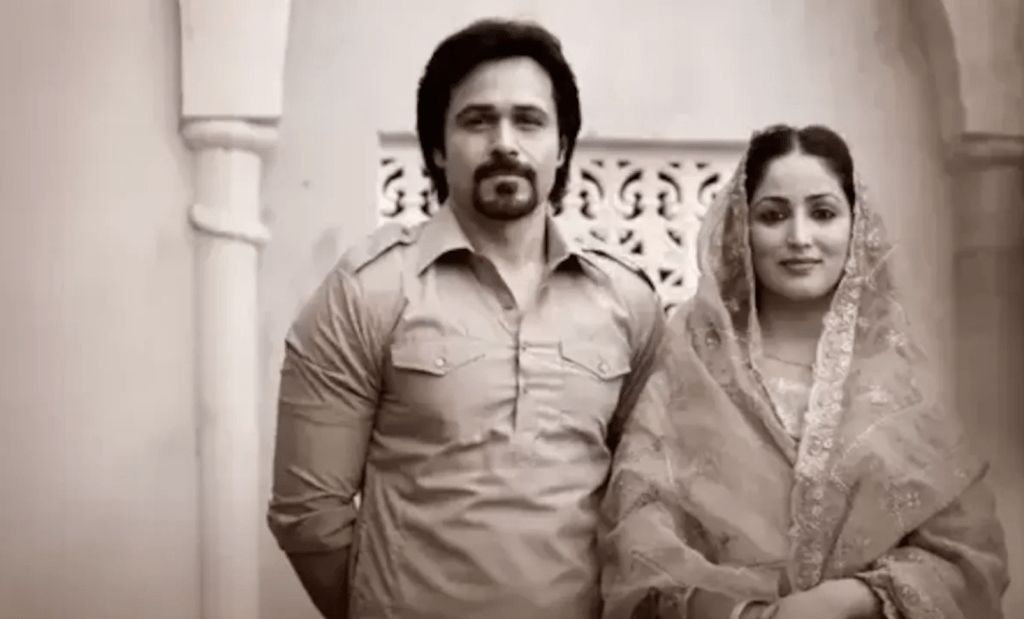
Getting back to the movie, Yami’s final monologue is powerful and leaves a strong impact. Emraan feels completely natural throughout and never once seems like he is performing. Sheeba Chaddha is equally convincing and brings depth to her role.
I especially want to credit Emraan for choosing to act in a film that openly talks about Muslim women’s rights. It takes conviction to support a story like this, especially as a Muslim, without dismissing it as Islamophobic. The film is clearly not that. Instead, it focuses on real issues and lived experiences, and his decision to back the narrative adds credibility and strength to the message being told.
Overall, I liked the film. The background music could have been better, and Yami is not fully convincing in a few scenes. Still, she more than makes up for it in the final act, which stays with you long after the film ends.
I started watching the Telugu film The Girlfriend with low expectations. I assumed it would be yet another romantic drama that glorifies toxic relationships and emotional manipulation in the name of love. To my surprise, the movie took a more thoughtful and layered route.
Minor spoilers ahead for context
The Girlfriend doesn’t just explore unhealthy love. It also dives into toxic parenting and how childhood conditioning shapes adult behaviour. The female lead is quiet, agreeable, and used to shrinking herself. The film makes it clear that her personality isn’t random. Her upbringing trained her to feel guilty for wanting space, choices, or independence. So when she picks a controlling partner, it feels strangely familiar to her. She’s not frightened of it at first, but she faces a tinge of uncertainty throughout. She tries to treat her partner’s behaviour towards her as normal because she has spent years adjusting to her father’s controlling behaviour. But deep down, there’s a quiet discomfort she can’t ignore. Something feels off, and her instincts begin to push back. This duality is what makes the character so different. This push and pull that many of us have experienced in our own relations with others who are not right for us.
The male lead, on the other hand, is aggressive, impulsive, and driven by ego. He worships Virat Kohli, maybe because he admires the cricketer’s aggressiveness and his devotion towards his wife, Anushka Sharma. He has a charming personality and enjoys a lot of attention. People around him like him, and he knows it. He’s used to getting what he wants, even in friendships. His behaviour reflects a narcissistic mindset where his needs come first, and empathy barely exists. Yet he remains popular, which feels very realistic. In real life, people like him often get the benefit of the doubt because their confidence and charm make them likable, even when behind closed doors, they’re not. This is why it’s often hard for someone with a narcissistic partner to justify leaving. People around them struggle to believe anything is wrong. The scene where he delivers that long, dramatic monologue in front of everyone when she ends the relationship is unforgettable and true to life. It’s an attempt to stage himself as the victim, even when he himself was the one in the relationship with the problematic dynamic.
When the movie shows the male lead’s mother, the pattern becomes clear. She mirrors the heroine’s personality. Anxious. Passive. Always accommodating. His father dominated the household, and his mother absorbed the behaviour without protest. In his partner, he doesn’t just see love. He sees a repetition of his family dynamic. In his own dysfunctional world, this is the definition of love.
This is what makes the film interesting. Many romantic movies in Indian cinema focus only on the lovers. But The Girlfriend highlights how family culture, parenting style, and generational trauma influence relationships. It reminds you that behaviour has context.
It made me think of my own past. My ex-husband had a similar attitude at home. I remember watching him take all his mother’s freshly washed clothes and throw them outside the house, onto the dirt-filled ground, just because she left them drying near the house’s entrance. She didn’t scold him. She didn’t even react. She simply smiled and picked them up to wash again. She later told me she was once abandoned on the roadside at night by her husband after an argument. She narrated it casually, as if it were normal. That’s when I understood why her son expected unquestioning loyalty and forgiveness from his own partner, me.
Watching the movie felt personal because it portrayed something many Indian families silently live with. Not abuse in the usual cinematic sense, but the subtle cycle of fear, guilt, silence, and acceptance.
I liked The Girlfriend mainly because of how honestly it handled the parenting angle. The performances were solid, especially from Rashmika Mandanna and Dheekshith Shetty. Their chemistry felt natural, and the relationship dynamics never felt exaggerated or forced. The emotional tension, confusion, fear, and hope all felt real. It’s rare to see an Indian movie explore love, trauma, and family influence with this level of subtlety. If you enjoy character-driven cinema with emotionally complex and layered characters, this one is worth watching.
The Girlfriend is streaming on Netflix and runs for 2 hours and 18 minutes.
It is by chance that I stumbled on the Co-Ed series on Amazon MX Player. The algorithm showed the trailer to me and I thought I would give it a try. I wasn’t expecting much but I was in for a surprise.
Co-Ed looks like a simple school drama at first, but it quickly turns into a lively mix of humour, friendship, and small twists that keep you curious. The writing feels fresh, and the young cast brings an energy that makes every episode, lasting around 20-30 minutes, easy to watch. I found myself hitting the next episode button without even thinking.
What’s It About?
Two twins step into a new chapter when their all-boys and all-girls schools merge to form a co-ed campus. The boy is nervous about sharing space with girls for the first time, while his sister walks in with full confidence. As they try to adjust to this sudden shift, their parents are also dealing with their own set of challenges at home. The mix of teenage chaos and family moments gives the series a relatable, everyday charm that keeps you curious about what happens next.
Thoughts
Co-Ed Season 1 took me by surprise. I didn’t expect to enjoy it this much.
Every actor in the series delivers a heartfelt performance. Honestly, they outshone many big names I watched this year. That says a lot. You slip into the world of the characters so easily that their joys and troubles feel like your own. You laugh with them and you end up tearing up with them too.
The parents in the story add another layer of emotion. Their struggles feel raw and real. I could sense the mother’s pain as she tries to hold everything together while staying proud of her small business. The question is, does her family see the same value in it? On the outside, the parents look like the perfect couple who split chores and support each other. But life is rarely that simple. It is often the quiet moments, the unsaid thoughts and the tiny frustrations that shape a home. Co-Ed captures all of this with surprising depth.
Rajeshwari Sachdev, Varun Badola, Adrija Sinha, Vedant Sinha, and Stuti Sahijwani are impressive in their respective roles. They complemented each other perfectly.
Shows like Co-Ed deserve a lot more attention. Viewers who enjoy warm, slice-of-life stories often find these gems by luck, not because they are promoted by popular reviewers.
For me, this one is a must-watch. You can stream it for free with ads on Amazon MX Player.
I recently watched Nobody Wants This Season 2. If you haven’t seen Season 1 of this Netflix series, I really think you should. It deals with a topic that most interfaith love stories never touch — conversion. It’s a sensitive issue, especially among Abrahamic religions. So it felt quite bold that the makers decided to go into it at all.
Season 1 had already touched on the idea of conversion. But Season 2 takes it a little further. This time, you see the boyfriend, who is a Jewish rabbi, and his family, constantly pushing his Christian girlfriend, who seems more atheist or maybe agnostic, to convert. It adds a new layer to their story and makes the whole situation feel even more complicated.
However, this post is not a detailed review of the series, but the many thoughts that came to my mind while watching it, mainly concerning conversion and how it is seen in India.
There are many abroad who have a distorted idea of religious freedom in India, no thanks to misleading, half-baked news articles, often written by left-leaning Hindus or non-Hindus, and I wish to debunk those notions as well and present them from the perspective of a centre-right Hindu who was, till two years ago, a leftist.
Be prepared for a long post, because this is a topic I feel strongly about. If you’re short on time, you may want to save or bookmark it and read it when you’re free.
A Hindu’s View on Conversion
Before I begin, I want to make my religious beliefs clear. I’m not a religious Hindu in the traditional sense, but I’m still a staunch Hindu. If that sounds confusing, it’s only because Hinduism allows this kind of pluralism. You can be spiritual, non-religious, or even an atheist, and still remain Hindu.
The faith makes space for many ways of thinking, which is why someone like me fits comfortably within it. I’m not ostracized for eating beef, nor am I ostracized for not following religious beliefs properly. I can question and I can push back against religious rules I don’t believe in without repercussions.
This freedom that my belief generously allows me is exactly why I strongly stand by the community and call myself a “staunch Hindu.” I advocate for the rights of my community, which a religious Hindu in India may not always do, as they wish to appear secular and tolerant of even the injustices against us.
Now that my beliefs are out of the way, I want to say that even as a non-traditional, progressive Hindu feminist, I don’t support conversion. I don’t understand why anyone has to give up their identity for love, marriage, or even politics, no matter how much anyone would try to justify it.
Most Hindus in India feel the same way, which is why you rarely see the community protesting against anti-conversion laws in some states. Among ourselves, we often say the same thing quietly: “What’s the need to convert?” Of course, many reasons are given. I address them later in this post.
Then we see Indian-origin Hindu politicians in America converting to Christianity to stay relevant and gain acceptance, and it makes us pause. It makes us wonder, “Is America really the land of the free?” And on what basis do they judge India on religious matters when they themselves have not reached full religious secularism yet?
However, in Abrahamic religions, conversion is considered a matter of freedom of faith. This is acknowledged. But this is also a major reason for communal tensions in a Hindu-majority country like India. Most Hindus do not believe in conversion or proselytization, while Abrahamic faiths consider it a part of their practice.
Hindus are of the belief that everyone should be free to practice their faith without disturbing others or disrespecting anyone else’s faith. Proselytization goes against that idea. It feels disrespectful because it implies someone’s existing faith is not good enough. It involves putting down those beliefs, so they are convinced enough to join the new one. So, this “freedom of faith” often comes at the expense of disrespecting others, which was tolerated for the longest period of time, till the Hindu community got the strength to say “enough is enough.”
This pushback is the part that’s often presented to the world as a “lack of religious freedom” in India. Or, to put it more frankly, the lack of freedom to convert Hindus. This clash of beliefs has no solution, and I see it continuing even after a change of government. It’s a label the country has to live with, because there can be no middle ground when people feel their identity is being erased.
A thought I often hear is, “There are so many Christian-majority and Muslim-majority countries in the world. Why can’t they just leave us alone?” It reflects the frustration many Hindus feel when they see constant pressure to convert despite already being a global minority.
Pressure to Convert in Interfaith Marriages
The topic of conversion in marriages is prevalent in Indian Reddit circles. Almost every other day, you see someone saying, “My partner’s parents want me to convert. What should I do?”
From what I’ve seen, it’s usually the Hindu who is expected to convert. And often, the Hindu partner is unaware of what that really means. They hear lines like, “You just need to get baptized. After that, you can follow your own culture,” and they assume there’s no conversion involved. Many agree because they don’t realize the deeper implications. We walk into these situations thinking others are as pluralistic and flexible as we are, and that’s where the misunderstanding begins.
Conversion is also very normalized. When I ask my Christian friends if someone needs to convert to marry into their community, they casually say “yes,” as if it’s the most ordinary thing in the world.
We recently saw this when JD Vance openly and coolly said he hopes his wife, Usha Vance, a Hindu, converts someday. Ironically, the same line appears in Nobody Wants This Season 2 as well, where the Jewish rabbi says he hopes his Christian girlfriend converts one day.
For us Hindus, it’s a culture shock, almost regressive, because we never expect something like this from others. At the same time, Abrahamics and international news channels are confused when they report that there’s outrage in India over Vance’s statement. They have no idea why Hindus are angry. So they brand it as “far-right Hindutva.”
Why Do Hindus Dislike Conversion?
Most Hindus find the idea of conversion strange, because the religion itself accepts that God can appear in many forms. It is naturally pluralistic. So someone like me, who is not religious, or even someone who is an atheist, is still seen as a Hindu, because schools like Carvaka already accept that. We also tend to readily accept other gods because of this pluralism. We don’t consider them as fake. We don’t believe that ours is the “only true god” either.
This pluralistic mindset of Hindus is both a boon and a bane. A boon because we naturally accept all faiths, and a bane because we expect the same openness from others, and we don’t always receive it.
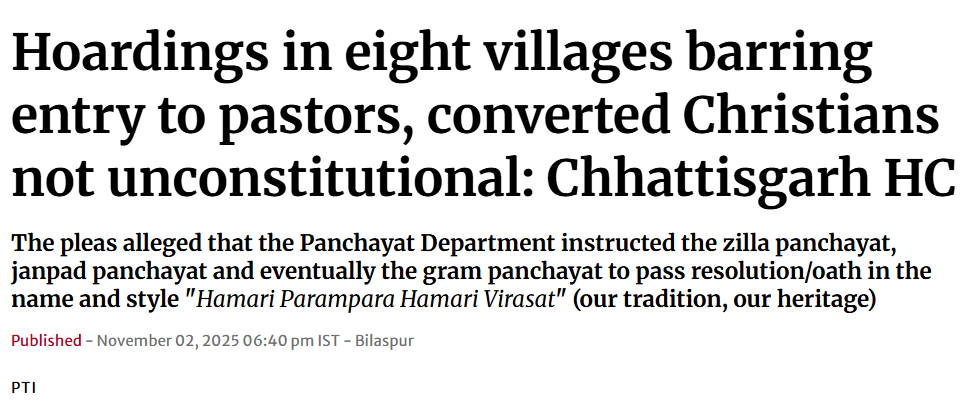
On top of that, many Hindus today focus more on careers and less on having children. So there is a natural tendency to protect the current Hindu population from inducements. The Chattisgarh High Court reiterated the same thing recently:
Chhattisgarh High Court Condemning Induced Conversions
With all this in mind, it’s natural that the majority of Hindus don’t look at conversion in a positive way. Our faith is already mocked by many Abrahamics around the world, who use words like “demon-worshipping pagans.” This makes it even more important to push back against that narrative and simply exist as we are.
Hindus, in short, want the freedom to be seen and respected in their own identity. But this way of thinking is often dismissed by, ironically, the very same people who speak loudly about secularism and freedom of religion. If others believe Hindus can be freely converted, then Hindus also have the right to openly object to it.
Ghar Wapsi
Now, some may argue that even Hindus encourage conversion in the form of Ghar Wapsi (reverting to Hinduism). However, Ghar wapsi is not a core part of Hinduism. It is more of a reaction to the aggressive conversions that have been happening in the country.
Most people I know converted to Abrahamic religions because of perks, not out of faith. They were poor and needed money. They were promised financial benefits if they converted. The fact that they are openly admitting this is nothing any faith should feel proud of. The only reason to convert to another faith should be faith itself. You should feel that the new faith and its principles are right for you, not be influenced by inducements or pressure.
If you ask why the Hindu side can’t match these perks, the answer is simple: we don’t have multiple Hindu-majority nations funding such activities. India is the only major Hindu-majority country, so the playing field is not equal.
Ghar Wapsi is simply an attempt, based on faith alone, to help those who genuinely want to return to Hinduism.
Arguments Used to Justify Conversions in India
1. Charity
There’s this belief that the money given during conversions is out of pure kindness. But I know many Christians who are struggling, working extra hours just to manage their basic needs. If the intention is genuine help, why not support them first?
And, most importantly, why should any help come with the condition of conversion?
Real help doesn’t demand a change of faith. If it does, you have to wonder whether it’s truly help or part of an agenda.
2. Caste Discrimination in Hinduism
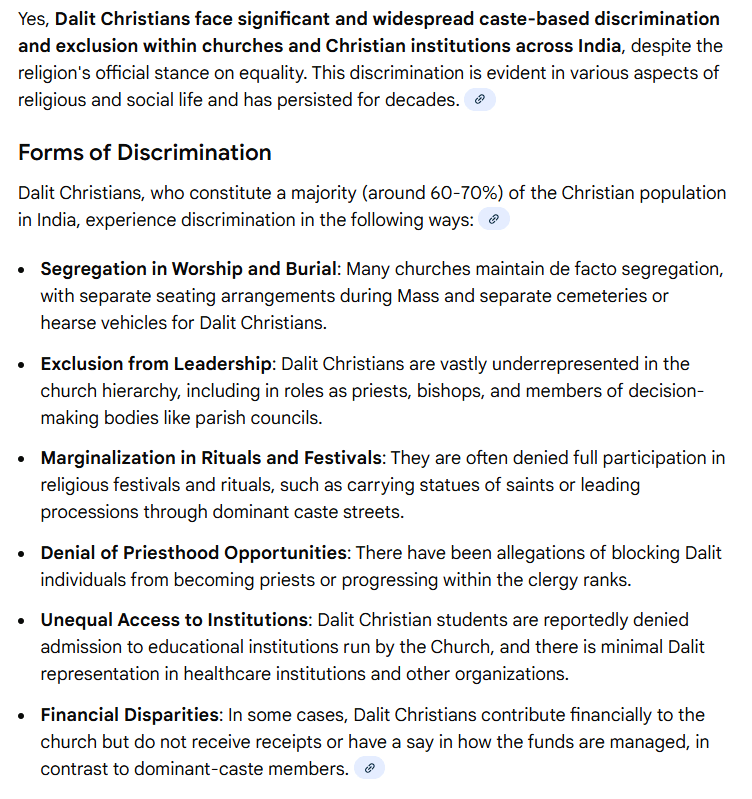
It’s also misleading to say that converted Christians escape discrimination to enter a better way of life after they leave Hinduism. Many are treated as “lower-level” Christians, and some have even gone back to Hinduism because of this.
Source: New Indian Express (July 2025)
Additionally, consider the points made below (took help from Google Search AI):
One person told me about a convert in her family who wants to return but cannot, because they signed a financial help agreement that now holds them back.
The good thing is that the caste system within Hindu society is slowly being dealt with. Families are becoming more open to inter-caste marriages, including in my own family. This change is happening faster in the South than in the North. It’s not perfect yet, but progress is real. In this situation, constantly blaming a community that is actively trying to fix the problem does not help.
Yes, many Hindus still support caste, and as long as they exist, the issue will continue. But this divide is also kept alive by leaders, both political and religious, because it benefits them. If caste truly disappears, many of these leaders lose their power to divide or convert Hindus, and that is why the system hasn’t faded away completely.
Instead of building bridges, the “narrative builders” choose to burn them by feeding divisive stories, which only pushes people of different castes further apart. Missionaries often highlight caste discrimination so aggressively because it helps them drive conversions. So you have to ask — are they really helping, or are they using the problem to serve their own goals?
4. Freedom of Faith
The tricky side of conversion in India is that Hindus openly say they are against it. But in Kerala, I often see Christian groups shift their stand based on who is converting and to which religion. They welcome anyone who joins their faith, but they loudly object when someone chooses to leave it.
Churches often use the term “love jihad” when a Christian woman converts to Islam for love. Yet the same groups talk about “freedom of faith” when a Hindu woman converts to Christianity for love.
Since both Abrahamic religions support proselytization as part of their belief system, you would expect them to be supportive of conversions into each other’s religion. But that rarely happens.
Complications of Conversion in Interfaith Relationships
Spoiler Ahead for Nobody Wants This Season 2
Click to reveal spoiler
Considering the many unwanted complications related to conversion, I was really hoping the female character in Nobody Wants This would take a stand. I wanted both partners to accept that two religions can live side by side without one needing to disappear. The ending didn’t go the way I hoped, but since there’s a Season 3 coming, I’m hoping they fix things and take the story in a better direction.
*Spoiler Ends*
In many interfaith relationships, I notice that the Hindu partner often gives in to the Abrahamic faith — if not through marriage, then through the children.
Take Usha Vance, for example. All three of her children were baptized because her husband couldn’t accept the kids growing up Hindu. That feels like a loss of her own identity. It shows that even an educated woman like her is not fully protected from this pressure.
If it were up to me, ideally, I would want the kids to grow up with both religions. But if we had to choose one religion for my “imaginary” children, I would fight hard to raise them in my own. Purely because Hinduism is naturally pluralistic, and it doesn’t invalidate any other faith. It would also matter to me because Hindus are a global minority, while the other religions face no existential crisis. It’s like the global majority religion being generous enough to make space for the growth of the minority.
Also, if I had to pick, I would choose a court marriage. But if the partner insists on a religious ceremony, then it would have to be a temple wedding. You don’t need to convert for that. You only need to respect the rituals. It’s simple, fair, and inclusive.
This is probably why I feel an interfaith marriage may not work for me. I believe in equality between religions, while an Abrahamic partner may not always see it the same way. There would be constant tension, and I am not the kind of Hindu who would compromise on my identity.
When I was younger, I probably would not have thought this way. Back then, love felt like everything. But growing older makes you see the bigger picture.
Pushback Against Conversions in India
More Hindus today realize that they don’t need to give up their beliefs for anything, which is why you see fewer people willing to convert.
Hindu Villagers in India Fighting Back Against Conversion
This awareness is slowly growing. I recently saw a post on Reddit where an Indian Christian said they felt sad that many Hindus in India are no longer open to conversion or to “the way of the Lord.” To me, this is actually a positive sign for the Hindu community. It shows that more people are choosing to stay firm in their identity.
And honestly, this should be true for every religion, because love and true secularism do not require anyone to change who they really are.







 The Monkey Dilemma
You must be logged in to post a comment.