Short Film Spotlight: Anuja

Anuja Short Film Poster

I was craving to watch a slice-of-life drama. Something simple, not too heavy or filled with dread. I honestly thought Anuja would be intense, given how the synopsis sounded. Plus, it’s a Hindi short film that was an Academy Award nominee.

Now, why would I mention the Academy Award nomination like it’s a bad thing? I have my reasons.

To be honest, Oscar nominees have rarely worked for me. In Malayalam, we call such films “award padam.” The kind that feels too abstract or complex for ordinary viewers (like yours truly). There was a time in my life, long ago, when I pretended to enjoy such films just to seem intellectual in front of my then-partner. But I couldn’t keep up the act, and that image fell apart the moment that relationship ended. Now, it seems I’m making up for that lost time. All I want to watch are feel-good films.

So when I saw that Anuja was an Oscar nominee, it didn’t excite me enough to hit play right away. It actually made me hesitate. After all, the Oscars have a reputation for picking Indian films that focus on pain and poverty, what many call “poverty porn,” which does not fully represent what India is today.

Still, I decided to give it a chance.

What’s It About?

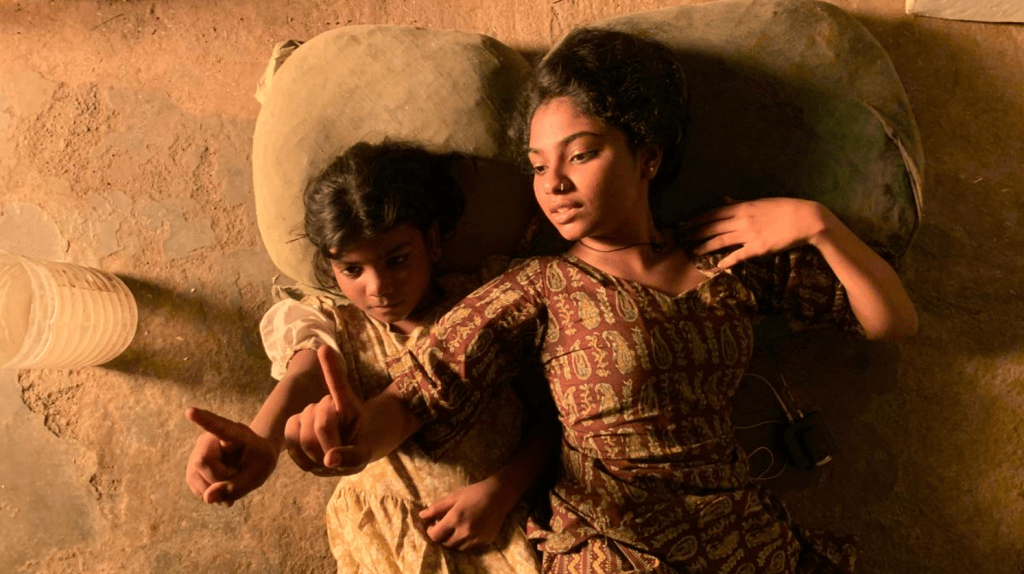
A 9-year-old girl works with her sister in a garment factory in India. Despite being naturally bright and curious, she doesn’t attend school because of financial struggles. And, truthfully, she doesn’t want to either. Her elder sister, however, recognizes her potential and dreams of giving her the education she deserves.

Thoughts

The film was a pleasant surprise. I loved it. It was just 22 minutes, but packed with emotions.

It tells the story of child labourers. They are presented not as helpless victims, but as resilient children who find joy even in hardship. The truth is, we often see others through our own lens and may view them as “helpless.” But for them, this is simply life. They know no other kind of life, and they’re doing their best with what they have. That’s what the movie captures so beautifully — life as they see it, not as we do.

It’s a social hierarchy. Someone wealthier might be looking at me with pity, thinking I’m suffering. Yet I’m making the most of what I have, because that’s the life I know. We suffer mostly when we lose something we once had, when we can compare the before and after, and we truly miss the before.

I’ve often felt that those not well-off often make the best of what little they have, which is why they find happiness in the smallest things, like a bag of jalebi, for instance. Anuja captures that spirit beautifully: “The present may not be bright, but we can strive for a better tomorrow.

The film avoids moral preaching or lecturing. It’s simply about two sisters supporting each other in a harsh world.

The most moving part of the film is that Sajda Pathan, who plays Anuja, was once a child labourer in Delhi before being rescued by the Salaam Baalak Trust (SBT). She now lives at the NGO’s Day Care Center, founded in 1988 by filmmaker Mira Nair, who, interestingly, is also the mother of New York’s new Mayor, Zohran Mamdani.

Ananya Shanbhag also delivers an excellent performance as the elder sister, Palak.

I would definitely recommend the short film. Anuja is streaming on Netflix.

Redefining What Success Means

Success Go Get It Image

I came across the following post online:

I think a lot about how we as a culture have turned “forever” into the only acceptable definition of success. Like… if you open a coffee shop and run it for a while and it makes you happy but then stuff gets too expensive and stressful and you want to do something else so you close it, it’s a “failed” business. If you write a book or two, then decide that you don’t actually want to keep doing that, you’re a “failed” writer. If you marry someone, and that marriage is good for a while, and then stops working and you get divorced, it’s a “failed” marriage.

The only acceptable “win condition” is “you keep doing that thing forever”. A friendship that lasts for a few years but then its time is done and you move on is considered less valuable or not a “real” friendship. A hobby that you do for a while and then are done with is a “phase” – or, alternatively, a “pity” that you don’t do that thing any more. A fandom is “dying” because people have had a lot of fun with it but are now moving on to other things.

I just think that something can be good, and also end, and that thing was still good. And it’s okay to be sad that it ended, too. But the idea that anything that ends is automatically less than this hypothetical eternal state of success… I don’t think that’s doing us any good at all.

It’s never “the person successfully got out of a bad marriage or bad friendship,” which, in my opinion, is one of the toughest things to do, at least in India. There are always a hundred people telling you to save the marriage or friendship, even if it sucks your soul. They go all out to make you feel guilty. When you do manage to get out of it eventually, it’s labelled a “failed” relationship.

Have we got our definition of success all wrong? The way it stands today, it often makes us cling to things that are no longer healthy, just for the sake of appearances. We try to make them work, even when we know they’re a lost cause, because society’s approval depends on it. We want people to look at us from afar and say, “Yes, they’re doing well in life.” This happened to me when I was trying to get out of my bad marriage. Society did not see my anguish; they simply wanted me to save the marriage.

Over time, I’ve grown less dependent on that kind of validation. Experience teaches you that to find true happiness, you need to first understand what happiness is to you, not others. I no longer feel the need to prove anything to anyone. There’s a calmness that comes with stepping out of the race. But it does not come without effort. In a world that constantly pushes you to do more, choosing to stay still and steady is often misunderstood. Living a life that balances financial independence (not luxury) with peace of mind rarely gets branded as “success.” However, luxury and fame without peace of mind are often labelled as the ultimate life.

Success takes on different meanings, even outside personal or professional life. Take politics, for instance. Many Indians see Modi’s stance against Trump’s tariffs and his refusal to bow down to demands (such as where India should purchase their oil from) as a mark of success. Others, however, view it as a diplomatic setback for India. And then there are those who believe it was actually a diplomatic failure for the U.S., considering India is among the fastest-growing economies in the world.

Of course, success looks different for everyone. We judge others by our own yardsticks. But clarity comes when you start asking yourself:

  • What do I actually want? Do I want wealth in heaps, or do I want balance?
  • What are the trade-offs, and am I okay with them?
  • How long am I willing to sacrifice? Am I truly passionate enough to give up other things I hold dear for this one pursuit?

When you have that honest conversation with yourself, defining success on your own terms rather than society’s, life feels lighter. And you stop depending on others for validation and how you should live your life. This does not apply to kids and young adults, though, who still need guidance on how to navigate life. A child cannot simply say, “Screw studies, it makes me upset,” and get away with it in the name of freedom of choice.

Effort is important, but so is knowing when to hold on and when to let go. True freedom comes only after achieving some level of financial independence. So that should be the first pursuit, regardless of gender.

***

Photo by Gerd Altmann