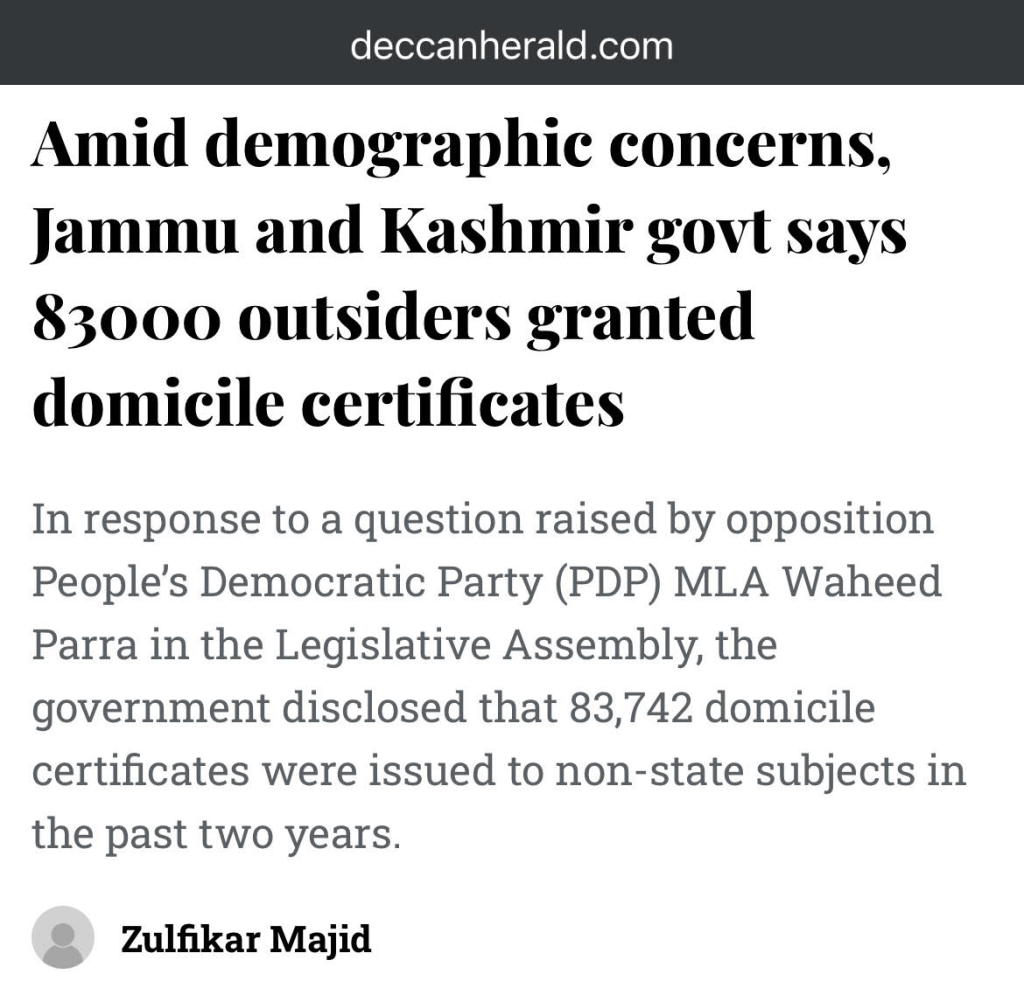
Say the words “demographic concerns” in any other Indian state, and you’d likely be branded a bigot. But in Kashmir, the “insider vs outsider” narrative is not only common, it’s actively pushed. If the Chief Minister, Omar Abdullah, has sworn allegiance to the Constitution of India, why the reluctance to openly embrace fellow Indians as equals? Kashmiris are free to work and settle anywhere in the country without being called outsiders. So why can’t someone from another Indian state do the same in Kashmir without facing hostility?
What India needs now more than ever is a spirit of unity. Not this constant “us vs them” divide.
These incidents make it clear: no one is truly secular, not even those who constantly criticize Hindu majoritarianism like Omar Abdullah. Let’s be honest. In Muslim-majority Kashmir, a fashion show during Ramadan sparked outrage, with people claiming it was against their “culture.” In parts of Malappuram and Kozhikode in Kerala, there have been cases where people were told not to eat in public during Ramadan. Meanwhile, in some Hindu-majority regions of North India, meat shops are ordered shut during Hindu festivals. Different standards, same mindset.
This isn’t just an Indian phenomenon. In the UK and the US, you’ll often hear people say, “We are a Christian country. This isn’t our culture!” whenever Hindu or Muslim festivals are celebrated in public spaces. The reaction is the same, just the setting changes.
Wherever you go, majority vs minority dynamics are always at play. What feels like a “religious restriction” to one person might feel like cultural protection to another. It all depends on your bias and perspective. Take Iran, for instance. Many of us might see it as deeply restrictive for women. But some Iranian Muslim women might see it as ideal because it strictly upholds their religious values. That’s religious bias in action – shaped by belief, identity, and comfort with the dominant culture.
Most people are secular only on paper. In reality, they tend to place their own religious beliefs a notch above others. They’re usually comfortable with the rules their faith imposes, no matter how restrictive those rules might seem to someone outside that belief system. It’s less about universal values and more about what feels familiar and justified to them.
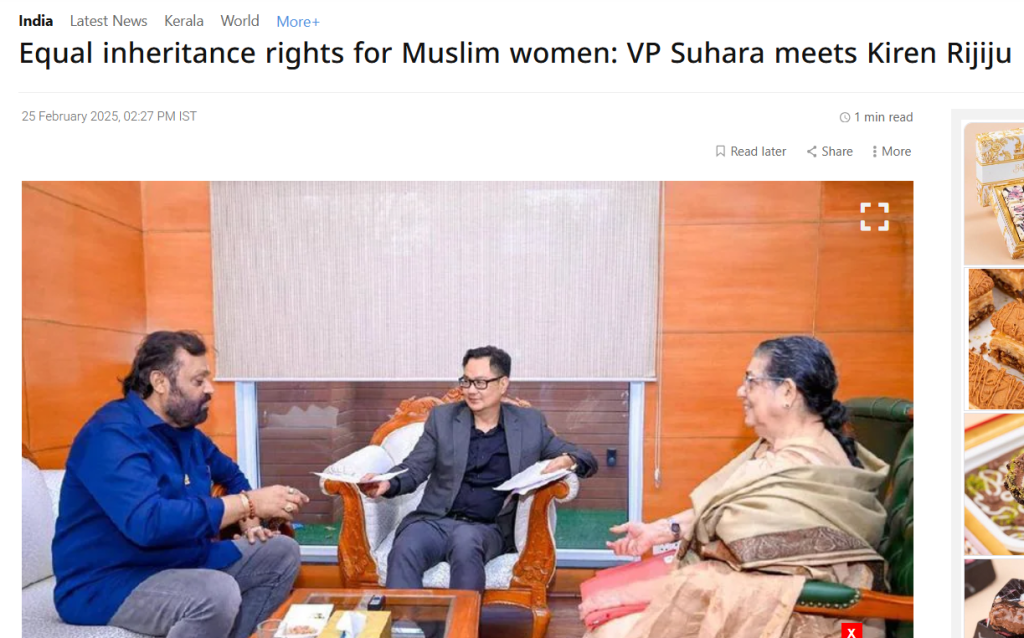
Social activist and NISA founder V.P. Suhara met Indian Minister Kiren Rijiju to demand equal inheritance rights for Muslim women in India, similar to those of Muslim men. Actor and BJP leader Suresh Gopi was also present at the meeting.
V.P. Suhara had earlier launched an indefinite hunger strike at Delhi’s Jantar Mantar, advocating for equal inheritance rights for Muslim women. However, the protest was forcibly stopped by the police. Before returning to Kerala, she announced plans to discuss the issue with key leaders in Delhi.
Did you see anyone in Kerala supporting her? Likely not. Instead, you’ll hear women with internalized misogyny saying, “We don’t want such reforms.” But these reforms aren’t for them. They are for women who seek more. Women who wish to follow traditional rules can continue to do so. Reforms do not prevent anyone from adhering to their beliefs, just as Triple Talaq is still practiced in India despite being banned. However, these reforms give Muslim women the legal option to seek justice if they are forced into following restrictive rules against their will.
When Muslim progressives like Suhara fight for women’s rights, you would expect so-called secular voices in India to stand with them. But these voices only seem to speak up when it comes to reforming Hinduism—whether it’s elephants in festivals, casteism, regressive practices, or allowing women in Brahmachari temples—because, let’s be honest, it’s far safer to push for changes in Hinduism. You see people from all communities, whether Hindu, Christian, or Muslim, openly advocate for these changes with confidence, knowing they face no serious repercussions. However, if you question some of the regressive practices in other communities, suddenly, you’re a bigot. The moment you point out that some proselytization techniques are predatory, you’re immediately accused of supporting the “restriction of religious freedom.” If you take a moment to observe people, you’ll notice countless little things that suddenly jolt you out of your slumber. You won’t need any political party to point this out to you. The double standards are there for the world to see.
When asked why the Muslim community largely does not openly advocate support for such reforms, progressive Muslims argue that it is dangerous to challenge established rules, unlike in other communities. They believe real change requires both internal and external pressure. While I acknowledge that speaking out within the Muslim community comes with risks, how long should we wait? Another century? Would it ever happen in our lifetime? Until then, are we expected to remain silent and unquestioning?
If the Indian government applies the “external pressure” suggested, it would inevitably lead to accusations of Islamophobia, further damaging the global perception of Indian Hindus and India’s image as a whole. Any attempt at reform would be spun as targeting a particular community, making meaningful change even harder to achieve.
Now, another group conveniently refuses to support this cause simply because the BJP—“the communal party”—is handling it. But name one other party that has ever stood up for Muslim women’s rights. The Opposition has always catered to Muslim men, not women, and will continue to dance to their tunes. This isn’t new; it has been the pattern for decades, ever since the Shah Bano case. If the BJP doesn’t take up the issue raised by Suhara, I can say with 100% certainty that no other party in India will.
***
Pic Source: Mathrubhumi.com (auto-translated from Malayalam)
Religious fundamentalism is gradually rising in Kerala. Yet few dare to question it. Perhaps because it originates outside the Hindu community.
Members of the Muslim League, an ally of Congress in Kerala, now openly claim that the hijab is not a choice and are pushing for gender segregation in public spaces like the Mec7 exercise program. Recently, a religious leader criticized a Muslim widow for traveling to Manali, insisting that widows should remain at home and devote themselves to prayer. Others are now openly urging community members to refrain from participating in non-Muslim festivals, further deepening social divisions. Meanwhile, Hamas and Hezbollah supporters freely display posters of their leaders in Kerala, despite these groups’ ties to Pakistani terrorist organizations like JeM and LeT, which have carried out multiple attacks in India.
Was there any outrage from political parties or within the community? None at all.
When you point out the lack of internal criticism, the common response is that speaking out invites real danger and that reforms take time. While it’s true that advocating change within the Muslim community is difficult and radicals may threaten dissenters, how long must we wait? Another century? Should we remain silent and allow religious fundamentalism to grow unchecked? If no meaningful reforms have happened so far, what guarantees change in the future? If the community cannot challenge extremist views now, how will they resist when these forces become even stronger and impose their rules on others?
We are already seeing glimpses of this with the Waqf Board’s land disputes, where properties legally owned by other communities are being claimed. Why should non-Muslims be bound by Waqf rules? If the land originally belonged to Muslims, the claims may hold merit. However, many of these properties now belong to other communities. If they were encroachments, why did the Waqf Board fail to prevent them? In cases where the land was legally sold, why is it being reclaimed now? The Board’s mismanagement highlights the urgent need for Waqf reforms to prevent future disputes.
Unfortunately, political parties are misleading the Muslim community, falsely claiming that reforms would lead to property seizures. The reality is that corrupt politicians have more to lose than ordinary Muslims, especially the poor. Many are likely benefiting from Waqf properties, living in luxury through corruption. The revenue generated from Waqf assets is disproportionately low compared to their vast holdings, raising questions about where the money is going. Instead of being used for community development, it is likely being siphoned for personal gain.
This is why reforms are crucial. However, many in the community rely on their leaders for information, unaware that they are being misled. These leaders manipulate facts for their own interests, radicalizing and mobilizing people with lies. This is why it’s important that citizens seek information from multiple sources—both left- and right-leaning—to avoid being deceived.
It is a mistake to believe that only the BJP spreads communal hatred. Congress leaders have also exploited the Manipur issue, framing it as a Hindu vs. Christian conflict when it is, in fact, an ethnic dispute. When Hamas posters appear in Kerala and critics raise concerns, Congress dismisses them as “Islamophobia.” This selective outrage makes them unreliable as leaders. They are vocal against Hindu extremism but silent when it comes to Islamist fundamentalism.
Some progressive Muslims argue that meaningful reforms require both external pressure, such as government intervention, and internal efforts from within the community. However, in India, any government-led push for reform risks being labeled Islamophobic. This, in turn, gives radicals more ammunition and invites criticism from the Western world, which often misinterprets such actions as oppression rather than necessary change. Moreover, since Hindus form the majority, any move by the Indian government is framed as an attack on Muslims, further polarizing the discourse and making genuine reform even harder to achieve.
At this point, the situation feels like a deadlock. Either we wait indefinitely for internal reforms, which may never come, or the government steps in, triggering backlash and further polarization. Both paths are fraught with challenges, and in either case, things could turn messy. The fear of being labeled Islamophobic limits external intervention, while internal resistance to change keeps fundamentalist views unchecked. This leaves little room for meaningful progress, making the prospect of reform seem increasingly distant.
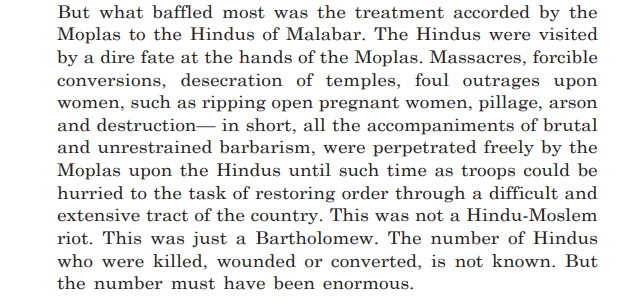
In 1921, Kerala witnessed the Moplah Riots, where numerous Hindus were killed in communal violence. However, to this day, Congress and CPI(M) refuse to acknowledge it as a communal riot and instead label it a “class struggle between Hindu landlords and Muslim peasants.”
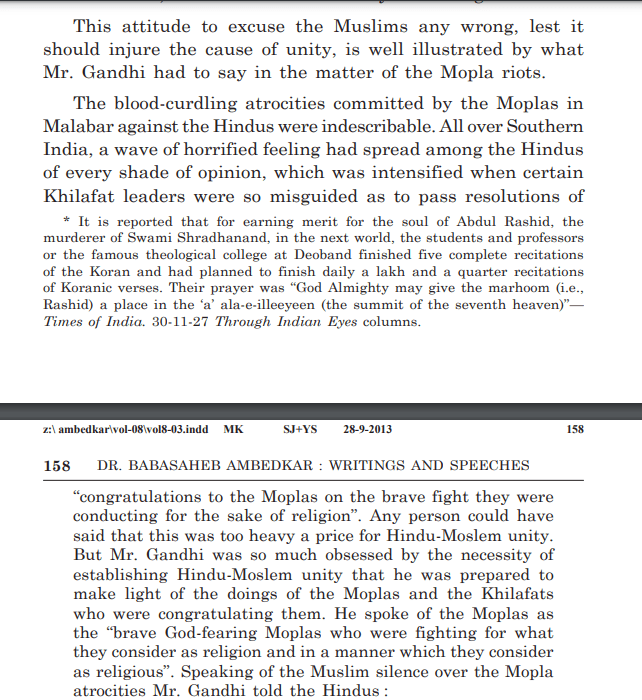
I also believed the class struggle narrative until I read B.R. Ambedkar’s book, The Partition of India. He clearly highlights the communal nature of the Moplah Riots, mentioning temple destruction, mass killings, and forced conversions of Hindus.
Some clippings from the book:
Source: Dr. Babasaheb Ambedkar : Writings and Speeches (Vol. 8)
If Hindus were specifically targeted, their temples destroyed, and they were forcibly converted, how can this not be considered a communal riot? Ambedkar’s account challenges the attempt to whitewash history by reducing it to just a landlord-peasant conflict.
Here is the question I asked AI and the response it generated:
Question: Were temples destroyed during the Moplah riots?
Answer: Yes, several temples were destroyed, looted, or desecrated during the Moplah Riots of 1921 in the Malabar region of Kerala.
Historical Accounts of Temple Destruction:
Looting and Desecration:
Many Hindu temples were attacked, idols were broken, and valuables were looted.
Records mention temples like the Thirumandhamkunnu Bhagavathy Temple being desecrated.
Forced Conversions and Killings:
The riots targeted Hindus, with reports of forced conversions, massacres, and mass displacement.
Many Hindus fled their villages, leaving temples unprotected.
British Reports and Historical Records:
British colonial reports and contemporary eyewitness accounts mention temple destruction.
Annie Besant and Veer Savarkar documented attacks on Hindu religious sites.
Conclusion:
Yes, temples were destroyed and desecrated during the Moplah Riots, which started as an anti-British uprising but later turned into violent communal attacks against Hindus in Malabar.
So how can it be concluded as merely a class struggle? Next time, someone dismisses the communal angle of the Moplah Riots as propaganda, one should ask, “Why were temples destroyed if the riots weren’t communal? Why did conversions happen? Was Ambedkar lying in his book?“
This is just one of the many lies spread by Congress and CPI(M). Why do they do it? Only they know. Perhaps to ensure Hindus keep supporting them, or maybe to prevent the majority community from developing resentment.
The second reason might have been understandable if only they didn’t paint Hindus as villains in other communal conflicts. The lack of consistency exposes their bias.
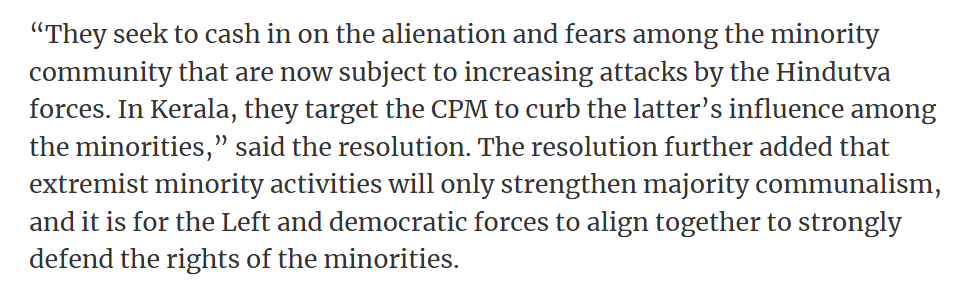
CPM mentions this about Islamist groups in the draft resolution:
Hindu extremists are using radical Muslim groups as fodder to fuel hatred between communities. But the reverse is also true—radical Muslim groups exploit the political climate to spread their own agenda. They feed off each other.
One side claims, “If Islamists stop, Hindu extremism will die down.” The other side counters, “If Hindu extremists stop, Islamists will weaken.”
There’s no middle ground. How do we break this cycle? Who should compromise? The answer is—both.
The only way forward is to call out radical elements within your own community—those who discourage interfaith interactions, prevent you from celebrating others’ festivals, and push you away from the secular fabric of the country. Peaceful coexistence is the only solution.
However, I mostly see this self-criticism coming from the Hindu community. Not everyone supports right-wing politics, a Hindu Rashtra, or extremist activities, and many Hindus actively speak out against radicalism within their own circles. But the same level of criticism isn’t visible in other communities. At least 95% of the Muslims I know have never condemned extremism within their own community, but they are very vocal about Hindu extremism. If only one side is willing to challenge its radicals, how can we truly achieve peaceful coexistence in a secular, democratic nation like India?
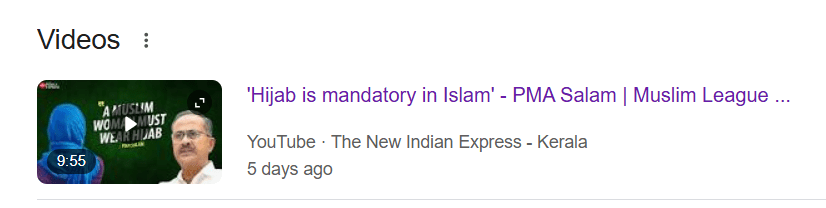
I feel this silence comes from fear—fear of being ostracized by their own community. In Kerala, the Muslim League openly stated that the hijab is not a choice for Muslim women; it is mandatory. When a journalist asked, “What if someone doesn’t want to wear it?” the leader reaffirmed, “If she’s a Muslim, we advise her to wear it.” There was no room for choice. Yet, despite often advocating for personal freedom, there was no backlash from within the Muslim community against this statement. This silence is unsettling. It makes people wonder—“If they won’t even speak up for their own freedom of choice, how can we expect them to stand up for ours?”
India is a secular nation, and preserving this secularism requires protecting religious freedom. When prominent leaders impose strict regulations on women, silence is not an option—it is a time to question them and hold them accountable. If not now, then when? Waiting until things spiral out of control will only make it harder to reclaim lost freedoms.
Western countries often criticize India, accusing it of restricting the religious freedom of minorities. For a long time, I was puzzled by this, as I saw minorities freely attending their religious places without any problems. On the other hand, Hindus in Jammu require police protection to visit their religious sites due to the ongoing threat of terrorism. So, where is this accusation truly coming from?
One of the main reasons many Christians oppose the BJP is that the party has significantly restricted international funds meant for proselytization. These funds were often misused in India to attract economically disadvantaged citizens into converting, with promises of financial assistance tied to conversion. As a result, conversions were driven more by economic pressures and manipulation than genuine faith.
Countries like the USA actively fund missionary programs, with groups such as the evangelical World Vision and the U.S. Commission on International Religious Freedom (USCIRF) advocating for unrestricted proselytization as a form of religious freedom. They often cite Article 18 of the United Nations’ Universal Declaration of Human Rights (UNDHR), which asserts that every individual “has the right to freedom of thought, conscience and religion; this right includes freedom to change his religion or belief…” This interpretation forms the basis for their criticism of India, accusing the country of limiting religious freedom and ranking it low in the religious freedom index. A 2012 article written by Dr Aseem Shukla explains this point brilliantly (hinduamerican.org/blog/proselytism-conversion-to-intolerance/).
This raises an important question: why offer monetary assistance only after conversion? Why not provide help based on humanitarian principles, without attaching religious conditions? When people are lured into faith through financial incentives, it undermines the integrity of the belief system itself. Shouldn’t conversions be driven by genuine faith and conviction, rather than economic manipulation or coercion?
Unfortunately, that’s not the reality for many. People are being lured into changing their religion through manipulation, whether through money or other means. I personally know several individuals who converted simply because they were promised financial support. What’s even more surprising is that younger generations are now making conversion a prerequisite for marriage. It’s hard to comprehend how, in today’s world, people still can’t accept different faiths and feel the need to demand conversion from their partner for the sake of marriage. Is this really secularism? Or love? I discussed this topic on this blog after watching a show, Nobody Wants This, on Netflix some time ago.
I’m currently reading a book about Kamala Das, The Love Queen of Malabar, written by a Canadian author, where it’s mentioned that Kamala was pressured to claim her conversion was out of faith, not love. The reasoning behind this was that saying she converted for love would diminish the strength of her faith. However, after her partner left her, she felt deeply depressed. The book suggests that the man she loved had been financially incentivized by foreign entities to convert Kamala. Later, Kamala wished to return to Hinduism but feared for her life and her family’s safety, including her grandchildren. Her sons even used to correct her whenever she, by habit, uttered the name of her former god, as they were afraid it might anger radicals and put their family at risk.
Why manipulate people into conversion? Let them choose to convert out of genuine faith – that is true religious freedom, not a process driven by external incentives.
The new government has largely restricted predatory conversion tactics by limiting international funds and addressing radical elements within society. This is one of the primary reasons the Indian government is widely criticized globally.
The propaganda against India has a broader base compared to the narratives propagated by BJP supporters. It’s easier for these narratives to spread, as the Christian and Muslim communities form larger global groups compared to the Hindu community. With such a widespread network, sensational news spreads quickly and easily. Adding to this challenge is the Hindu community’s general reluctance to actively counter exaggerated news, making it even harder to protect India’s image.
Many who believe in proselytization through unfair means seek the removal of the current government to restore previous practices. This is probably why they complain about every small issue and often manipulate facts to present one-sided stories. By focusing on selective narratives, they aim to undermine the current administration and bring back the old ways.
The narratives about India are often more complex than they appear in the media or through agenda-driven sources. They tend to present only one side of the story, exaggerating it to evoke emotional reactions. This is why it’s crucial to consult both left and right-wing media to gain a more balanced perspective. Otherwise, you risk forming judgments based on incomplete or biased information.
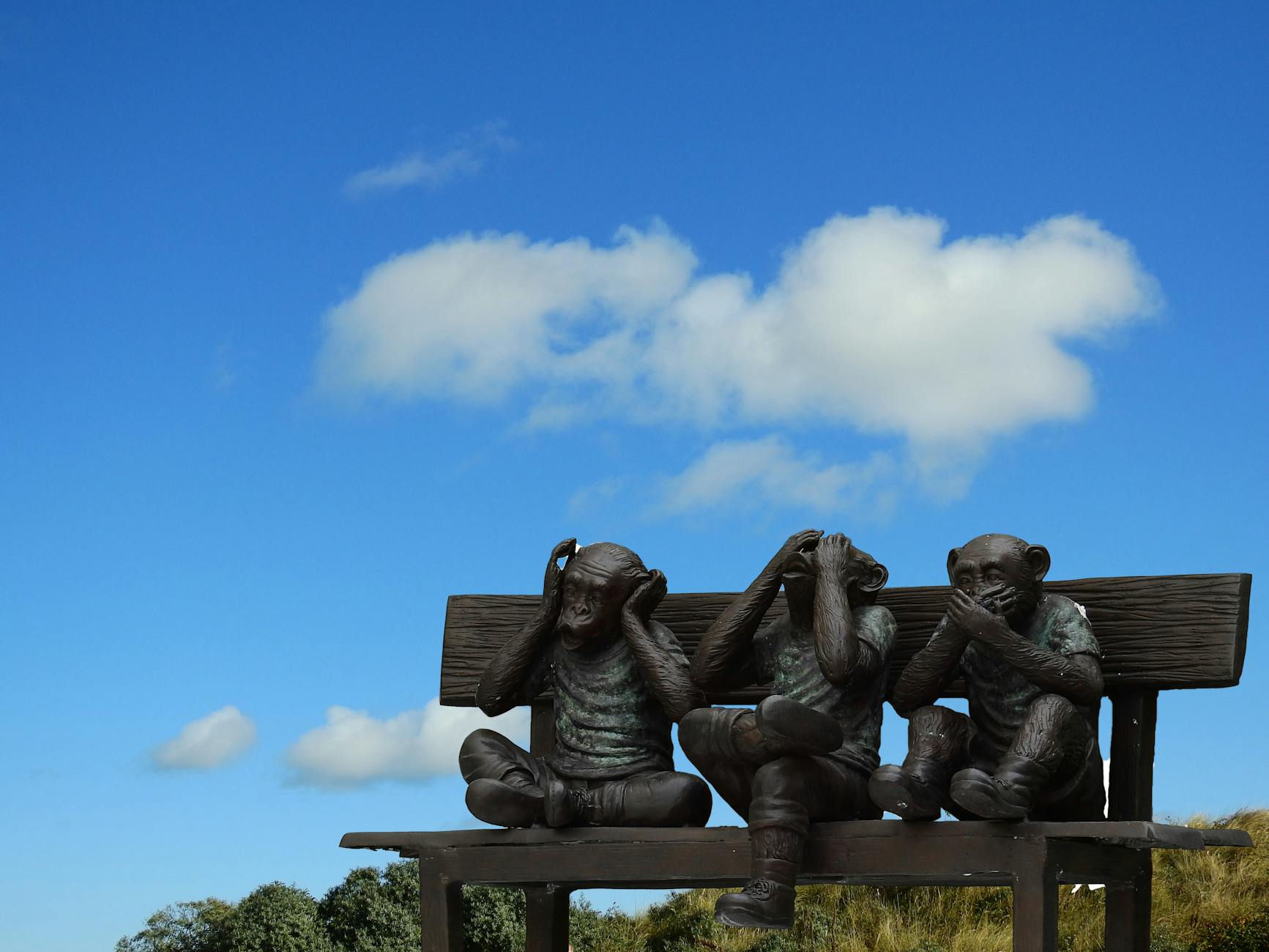



 The Monkey Dilemma
You must be logged in to post a comment.