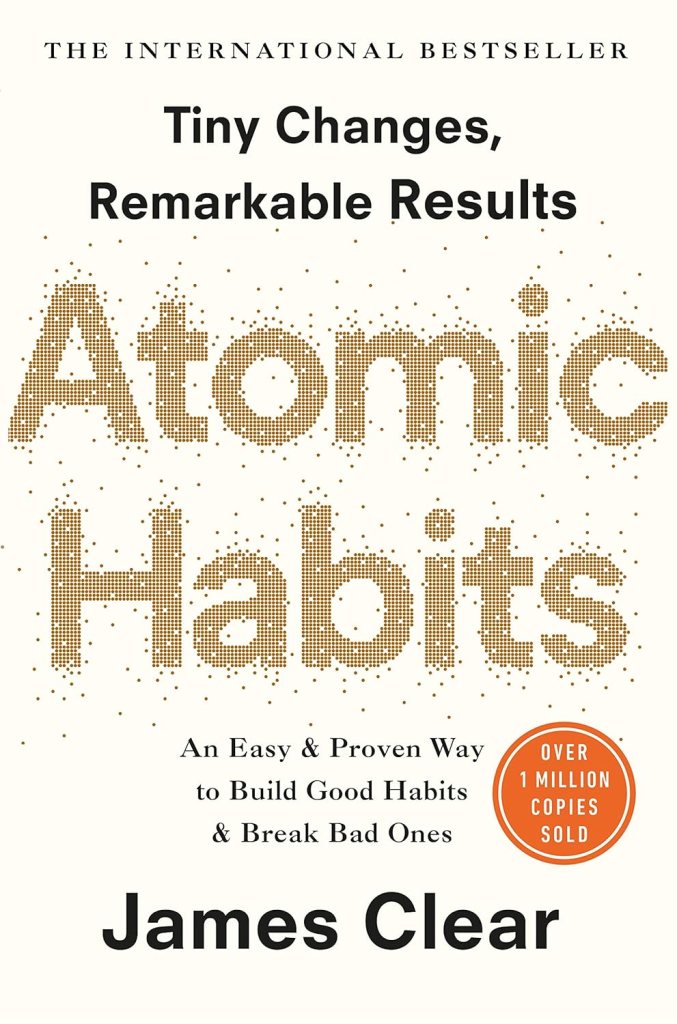
19 Inspirational Quotes from James Clear’s Atomic Habits

Atomic Habits by James Clear

I always gravitate towards non-fiction books hoping to learn something new. However, self-help books often contain repetitive information already covered by other authors. If you read a new non-fiction book on a certain topic, subsequent books on the same topic often contain similar tips and suggestions beneath different covers. There is always a déjà vu feeling lingering in the background, “This tip seems familiar,” or “Have I read this quote somewhere?

Atomic Habits does not fall into the I-Feel-I-Have-Read-It-Before category. A lot of it felt new. The author’s thought process was refreshing, and I was introduced to new perspectives and ideas that beautifully emphasize the power of small habits. James Clear has a knack for writing engagingly using clear (pun intended) and concise language. I would even go so far as to say that Atomic Habits was the best non-fiction book I read this year.

I will list some of the quotes from the book that left an impression on me. Hope you like them as much as I did.

Changes that seem small and unimportant at first will compound into remarkable results if you’re willing to stick with them for years.

Time magnifies the margin between success and failure. It will multiply whatever you feed it. Good habits make time your ally. Bad habits make time your enemy.

The San Antonio Spurs, one of the most successful teams in NBA history, have a quote from social reformer Jacob Riis hanging in their locker room: “When nothing seems to help, I go and look at a stonecutter hammering away at his rock, perhaps a hundred times without as much as a crack showing in it. Yet at the hundred and first blow it will split in two, and I know it was not that last blow that did it—but all that had gone before.”

If you want better results, then forget about setting goals. Focus on your system instead. The purpose of setting goals is to win the game. The purpose of building systems is to continue playing the game.

Small changes often appear to make no difference until you cross a critical threshold. The most powerful outcomes of any compounding process are delayed. You need to be patient.

The ultimate form of intrinsic motivation is when a habit becomes part of your identity. It’s one thing to say I’m the type of person who wants this. It’s something very different to say I’m the type of person who is this.

As the psychologist Carl Jung said, “Until you make the unconscious conscious, it will direct your life and you will call it fate.”

When and where you choose to insert a habit into your daily routine can make a big difference. If you’re trying to add meditation into your morning routine but mornings are chaotic and your kids keep running into the room, then that may be the wrong place and time. Consider when you are most likely to be successful. Don’t ask yourself to do a habit when you’re likely to be occupied with something else.

When scientists analyze people who appear to have tremendous self-control, it turns out those individuals aren’t all that different from those who are struggling. Instead, “disciplined” people are better at structuring their lives in a way that does not require heroic willpower and self-control. In other words, they spend less time in tempting situations.

I once heard a story about a man who uses a wheelchair. When asked if it was difficult being confined, he responded, “I’m not confined to my wheelchair—I am liberated by it. If it wasn’t for my wheelchair, I would be bed-bound and never able to leave my house.” This shift in perspective completely transformed how he lived each day. Reframing your habits to highlight their benefits rather than their drawbacks is a fast and lightweight way to reprogram your mind and make a habit seem more attractive.

The most effective form of learning is practice, not planning.

Habits are easier to build when they fit into the flow of your life. You are more likely to go to the gym if it is on your way to work because stopping doesn’t add much friction to your lifestyle. By comparison, if the gym is off the path of your normal commute—even by just a few blocks—now you’re going “out of your way” to get there.

The truth is, a habit must be established before it can be improved. If you can’t learn the basic skill of showing up, then you have little hope of mastering the finer details.

Even when you know you should start small, it’s easy to start too big. When you dream about making a change, excitement inevitably takes over and you end up trying to do too much too soon. The most effective way I know to counteract this tendency is to use the Two-Minute Rule, which states, “When you start a new habit, it should take less than two minutes to do.”

The takeaway is that you should build habits that work for your personality. People can get ripped working out like a bodybuilder, but if you prefer rock climbing or cycling or rowing, then shape your exercise habit around your interests. If your friend follows a low-carb diet but you find that low-fat works for you, then more power to you. If you want to read more, don’t be embarrassed if you prefer steamy romance novels over nonfiction. Read whatever fascinates you. You don’t have to build the habits everyone tells you to build. Choose the habit that best suits you, not the one that is most popular.

The Goldilocks Rule states that humans experience peak motivation when working on tasks that are right on the edge of their current abilities. Not too hard. Not too easy. Just right.

When a habit is truly important to you, you have to be willing to stick to it in any mood. Professionals take action even when the mood isn’t right. They might not enjoy it, but they find a way to put the reps in.

The only way to become excellent is to be endlessly fascinated by doing the same thing over and over. You have to fall in love with boredom.

The upside of habits is that we can do things without thinking. The downside is that we stop paying attention to little errors.

An Ode to Beloved Indian Witches

Indian witch reading a book

I was surprised when I learned Wicca is openly practised in India.

Till then, I had only read about it in blogs written by people in the U.S.

Witches are just like ordinary people, blending in seamlessly with society. They don’t ride broomsticks or cast spells on unsuspecting individuals. The real ones tell you not to use the universal energy for negative agendas – “It will hit you back,” they warn. This differs from the stereotypical witches in movies and television dramas, who are portrayed as evil and adept at spewing words of hatred.

As I went through articles and posts by real witches advocating for the principle of “Do no bad to others,” I couldn’t help but notice the similarity to the teachings of practitioners of more mainstream religions who promote similar values. I often wonder if we are all indeed praying collectively to the same energy. Even a book on atheism, The God Delusion by Richard Dawkins, does not negate the power of nature and its mystical ways.

Personally, it’s gratifying to know that we all are more united than we think we are – not divided by religion, caste, or community. We are one, all seeking the same things in life – hoping to be heard, protected, and blessed by a higher energy to navigate life more smoothly. The possibility that we must all be asking favors from the same being, using different names, is a heady feeling. It erases any semblance of boundaries. It assures you that humanity is above all. If more individuals shared this perspective, the divisive “us vs. them” mentality could diminish, allowing us to function from a unified standpoint.

I read about Ipsita Roy Chakraverti in a local newspaper. I was mindblown by the fact that a witch existed in India. Such things are usually kept secret in a conservative country like mine, but here was a woman who was unabashedly vocal about her practice and teachings. It was then I learned that Ipsita has authored many books on witchcraft. I decided to try “Beloved Witch” as curiosity got the better of me.

Ipsita is different from other witches in the sense that she does not shy away from promoting her powers. She’s not modest and understands her worth, which is why you often see her showering herself with compliments in the book.

I found it refreshing that Ipsita encourages you to use the all-encompassing universal energy for your own greedy benefits but warns you to be prepared for repercussions. She does not say, “Don’t do this.” Instead, she says, “Do it. But whatever happens after that is your responsibility.” So basically, she’s like a parent telling her young ones to seek adventure, giving them the liberty to learn from their own mistakes.

Now that I am done with my views on the subject, I am going to present some of my favorite thought-provoking quotes and anecdotes from Ipsita’s book. Hope you enjoy them as much as I did!

The earth is a great storehouse of energy. Merge with that source he told me, and you shall be whatever you wish to be.

She’ll flick some ash off from her cigarette (no, smoking is not permitted in the chalet, but she’ll sneak around the garden shed and wink at us). As the ash plops down and crumbles away, she’ll say, ‘That’s worldly fame for you. Fun while it lasts but don’t count on it to be around. Besides, it leaves a bad taste in the mouth.’

The following quote is what I had blogged about previously. It was after writing the post that I read this book, so it was a pleasant surprise for me to see those thoughts come to life in print.

Somehow, eastern yoginis never ‘flew’ but western witches were supposed to ride the broom over hill and dale. I have often wondered about this. And this is what I have discovered. What did the broom symbolize? It stood for hearth and home to which a woman was tied by male domination. As she ‘flew’ away on it, it meant that she was breaking the bonds. It symbolized her freedom. It might as well have been a flying carpet.

Colourful stories abounded about how a long-suffering wife would fly away into the night on this piece of domestic bondage, while her husband slept snugly unaware in his bed. She would revel all night long under the moon and return only at dawn to sweep the hearth with the very broom which had carried her off to her secret trysts.

It has been said that witches were women who were never afraid to ‘fly’. Maybe that is why they had to be burnt.

Women, strong, beautiful or independent minded were called witches so that they could be eliminated. The men who tortured and burnt innocent women in medieval Europe, live on in other places, in different guises. Witch-hunting never stopped. It just took on a more deceptive mask.

Of course, in my experience with thousands of women who have come to me for help, I would say that every strong woman is a witch and she is always hunted. It goes against the nature of most men to tolerate a woman they cannot dominate.

Witch-hunting is present not only in rural Bengal, Bihar, Orissa, Uttar Pradesh or Madhya Pradesh. It prevails everywhere in the world where women stand up for themselves and what they believe in. It is there whenever women refuse to be the pawns or playthings of a callous society. Who is a witch? Or more important, what does she do? As she is a Wiccan, it would be fair to say that she practises Wicca or wiccecraefte or the skills of the wise. She was the original wise woman, the shaman, the healer, the counsellor, the lawyer, the stateswoman of her community. Her power became a threat to men, to organised religion — and hence the persecution, the witch-hunts and the slander.

‘Dr Radhakrishnan, do people in our country work best when they are shouted at or spoken to with sarcasm?’ I asked. He smiled that famous smile of his. Serene, indulgent and amused. ‘Yes, I think three hundred years of servitude have taken their toll. The Indian mind wants and needs love, compassion and understanding but has been weakened by fear. Hence it reacts the most quickly to harshness for that is what it fears. You see, our people have had to put up with so many masters, that even now we understand only the language of compulsion.’

Manifestation and visualization are concepts endorsed by a lot of people, including yours truly. As made clear from the following quote, it is practised in witchcraft as well.

Visualization of what you desire is an important part of every Wiccan ritual.

I hated the thought of my parents making a will because it implied that one day I would be on my own on this planet. And if I was capable of love, they were the only ones I did love. Wills also confirm the worst in human nature. It makes one realize that without legal documents and safeguards, people are vile, greedy and corrupt. There is something very sad in this realization.

‘I agree with Nietzsche about what the free spirit needs. It abhors habits and rules. Everything which goes on and on.’

‘But can marriage become stifling then?’ I asked her. ‘I suppose it can, to certain natures. Such a nature, even if it marries, needs space. You know, don’t you, that Nietzsche compared marriage to a spider’s web. Finally, the threads become traps. That is why, after a time, the spider stuck in the middle, painfully tears apart the mesh enclosing him, even though it will suffer from the wounds — because it must tear these threads off itself, away from its body, away from its soul. It must learn to hate where it used to love and vice versa.’

Wicca was not a dark and sinister practice, it was above board and publicly practised for anybody to check and experience. I proved it to the country. I also brought back the ancient science of quartz therapy to India. Wicca showed the way, once the path had been cleared.

Amongst the men, a very famous Wiccan was said to be none other than Robin Hood. He lived in the green woods, a lover of nature. He had around him a coven of twelve members, he being the thirteenth. He was certainly anti-establishment and fought against all forms of exploitation of the poor and helpless. He was also against organized religion. The woods were his church.

The power seekers wanted control in their own hands. Control over the populace, control over laws and governance. Those with independent, free thinking ways and minds, were a threat. Hence the persecution of Wiccans. Specially if they were women. They became the ‘evil witches’ who always tried to harm people, specially children. Folklore and fairy tales abounded equating witchery with wickedness.

What is wicked? Evil is so relative. What is wrong today, may not be considered so tomorrow. Besides right and wrong are such personal, individual things. I have always set my own standards, keeping only one thing in mind. I do not willingly and purposefully harm another in body, mind or spirit. I do not initiate mischief.

Life was the greatest school, the best laboratory for the most interesting experiments with the human species.Look at them, listen to them, mingle with them and learn.

So is there a heaven where you go if you have been ‘good’? I think we make our own heavens (and hells?) right here — and we continue living in them with those we want near, even after we pass on from our physical bodies.

***

Photo by Bayram Musayev

An Ode to 5 Interesting Quotes from “Your Place or Mine?”

Your Place or Mine?

Before we begin, I want to point out that the quotes posted here are from Portia MacIntosh’s book Your Place or Mine? Not the movie. The book is an entertaining, cute, light-hearted story of two accidental roommates who eventually become much more than they signed up for. It’s a heady mix of fun and frolic, entertaining twists, and relatable scenarios that are part and parcel of life. It might not be the best romantic tale out there, but it keeps you hooked.

Here are some of my favorite quotes from the book:

Your wedding day is the most special day to ever occur… just like everyone else’s.

Watching a new movie is like rolling the dice, you don’t know if you’re going to love it or hate it, if you’re going to laugh or cry, if a dog is going to die and ruin the whole thing! So we reach for our old favourites for the comfort of the familiar, because you can always count on your favourite movies to make you feel better.

Grief is the cost of love. If you feel a lot of sadness to have lost someone, they must have given you a hell of a lot of love while they were alive. And I do love you, my darling. Never forget that. Until we meet again…

See, this is what happens when you get cocky, and you think everything is going your way. Life goes out of its way to laugh in your face, and show you just how bad things can be.

Sometimes I think that, when you’re going through a difficult time, you don’t realise just how tough things are while you’re going through them. It’s almost like you can’t think about it because, if you were to let yourself dwell on how unbearable things seem, the problems you were facing would seem impossible to overcome. But if you keep moving, you keep your head up and your eyes forward, you’ll be through it before you know it.

Photo by Pixabay

An Ode to 9 Thought-Provoking Life Quotes from Hermann Hesse’s Siddhartha

Gautama Buddha 3D Art

I recently finished Hermann Hesse’s Siddhartha. The book takes you through the life of the fictional protagonist, Siddhartha, who comes from an affluent family. He is restless and dissatisfied with life and feels the need to search for enlightenment and spiritual fulfillment. He eventually finds it on his own, though the path he took to attain enlightenment is rocky and full of challenges. This story is entirely fictional and not be confused with Gautama Buddha’s story.

Personally, I found the book a bit difficult to read as the topics discussed were quite deep and complex. The language was wordy, and it interfered with my focus somewhat. However, I still found many meaningful and beautiful quotes throughout the novel. Quotes that make you think, quotes that beautifully capture the very essence of life.

Here are some of the best:

Wisdom cannot be imparted. Wisdom that a wise man attempts to impart always sounds like foolishness to someone else. Knowledge can be communicated, but not wisdom. One can find it, live it, be fortified by it, do wonders through it, but one cannot communicate and teach it.

I have always believed, and I still believe, that whatever good or bad fortune may come our way we can always give it meaning and transform it into something of value.

The world is not imperfect or slowly evolving along a path to perfection. No, it is perfect at every moment; every sin already carries grace in it.

The river is everywhere at the same time, at the source and at the mouth, at the waterfall, at the ferry, at the current, in the ocean and in the mountains, everywhere, and that the present only exists for it, not the shadow of the past nor the shadow of the future.

The only way to live is to accept each minute as an unrepeatable miracle.

Wherever you are, when you can sense something of the eternal in yourself and in the world, you are close to the source of all being and all knowing.

When someone is seeking, it happens quite easily that he only sees the thing that he is seeking; that he is unable to find anything, unable to absorb anything, because he is only thinking of the thing he is seeking, because he has a goal, because he is obsessed with his goal.

Everyone can perform magic, everyone can reach his goals, if he is able to think, wait, and fast.

The opposite of every truth is just as true! Any truth can only be expressed and put into words when it is one-sided. Everything is one-sided which can be thought with thoughts and said with words. It is all one-sided, all just one half, all lacks completeness, roundness, oneness.

13 Thought-Provoking Quotes From Colleen Hoover’s It Ends With Us

Photo by Hernan Pauccara

I’ve read a couple of Colleen’s books before. I knew I was in for another treat when I picked “It Ends With Us” after reading a couple of positive reviews by fellow bloggers. In this book, the author’s personal perspective makes the story stand out among others. In her own words, “This was not entertainment for me. It was the most grueling thing I have ever written.” The despair is apparent in her characters – their anguish, suffering, and hopelessness. There were tears shed, not going to lie. It’s impossible not to. If you have ever lost a loved one, you would be able to relate to the agonizing emotions expressed so articulately in the book by Colleen. It Ends With Us is filled with introspective, profound quotes about life, love, and everything in between. Sharing a few of my favorites here.     

All humans make mistakes. What determines a person’s character aren’t the mistakes we make. It’s how we take those mistakes and turn them into lessons rather than excuses.

Life is a funny thing. We only get so many years to live it, so we have to do everything we can to make sure those years are as full as they can be. We shouldn’t waste time on things that might happen someday, or maybe even never.

Maybe love isn’t something that comes full circle. It just ebbs and flows, in and out, just like the people in our lives.

Imagine all the people you meet in your life. There are so many. They come in like waves, trickling in and out with the tide. Some waves are much bigger and make more of an impact than others. Sometimes the waves bring with them things from deep in the bottom of the sea and they leave those things tossed onto the shore. Imprints against the grains of sand that prove the waves had once been there, long after the tide recedes.

Sometimes even grown women need their mother’s comfort so we can just take a break from having to be strong all the time.

I think that’s one of the biggest signs a person has matured—knowing how to appreciate things that matter to others, even if they don’t matter very much to you.

Just because someone hurts you doesn’t mean you can simply stop loving them. It’s not a person’s actions that hurt the most. It’s the love. If there was no love attached to the action, the pain would be a little easier to bear.

If I had to compare this feeling (of separation) to something, I would compare it to death. Not just the death of anyone. The death of the one. The person who is closer to you than anyone else in the whole world. The one who, when you simply imagine their death, it makes your eyes tear up. It’s an astronomical amount of grief. An enormous amount of pain. It’s a sense that I’ve lost my best friend, my lover, my husband, my lifeline. But the difference between this feeling and death is the presence of another emotion that doesn’t necessarily follow in the event of an actual death. Hatred.

I feel like everyone fakes who they really are, when deep down we’re all equal amounts of screwed up. Some of us are just better at hiding it than others.

I don’t think being a little guarded is a negative thing. Naked truths aren’t always pretty.

Sometimes you can’t control where your mind goes. You just have to train it not to go there anymore.

Sometimes the things that matter to you most are also the things that hurt you the most. And in order to get over that hurt, you have to sever all the extensions that keep you tethered to that pain.

Cycles exist because they are excruciating to break. It takes an astronomical amount of pain and courage to disrupt a familiar pattern. Sometimes it seems easier to just keep running in the same familiar circles, rather than facing the fear of jumping and possibly not landing on your feet.

An Ode to Sound Investing Advice from the Intelligent Investor – Part 3

So we are now into the final set of quotes from The Intelligent Investor by Benjamin Graham. I have taken great care to choose the quotes that would make sense to a larger audience and not just equity investors. The book, in my opinion, is quite dry. But then, what can you expect from an investing book? Nevertheless, the advice imparted by Benjamin Graham is worth considering. Being not much of a speculator myself, his thoughts resonated with me.

Without further ado, let’s start Part 3.

It is easy for us to tell you not to speculate; the hard thing will be for you to follow this advice. Let us repeat what we said at the outset: If you want to speculate do so with your eyes open, knowing that you will probably lose money in the end; be sure to limit the amount at risk and to separate it completely from your investment program.

The investor can scarcely take seriously the innumerable predictions which appear almost daily and are his for the asking. Yet in many cases he pays attention to them and even acts upon them. Why? Because he has been persuaded that it is important for him to form some opinion of the future course of the stock market, and because he feels that the brokerage or service forecast is at least more dependable than his own.

Those formulas that gain adherents and importance do so because they have worked well over a period, or sometimes merely because they have been plausibly adapted to the statistical record of the past. But as their acceptance increases, their reliability tends to diminish. This happens for two reasons: First, the passage of time brings new conditions which the old formula no longer fits. Second, in stock-market affairs the popularity of a trading theory has itself an influence on the market’s behavior which detracts in the long run from its profit-making possibilities.

The most realistic distinction between the investor and the speculator is found in their attitude toward stock-market movements. The speculator’s primary interest lies in anticipating and profiting from market fluctuations. The investor’s primary interest lies in acquiring and holding suitable securities at suitable prices.

The happiness of those who want to be popular depends on others; the happiness of those who seek pleasure fluctuates with moods outside their control; but the happiness of the wise grows out of their own free acts.

Marcus Aurelius

If you listen to financial TV, or read most market columnists, you’d think that investing is some kind of sport, or a war, or a struggle for survival in a hostile wilderness. But investing isn’t about beating others at their game. It’s about controlling yourself at your own game.

The whole point of investing is not to earn more money than average, but to earn enough money to meet your own needs.

Putting up to a third of your stock money in mutual funds that hold foreign stocks (including those in emerging markets) helps insure against the risk that our own backyard may not always be the best place in the world to invest.

The most basic possible definition of a good business is this: It generates more cash than it consumes. Good managers keep finding ways of putting that cash to productive use. In the long run, companies that meet this definition are virtually certain to grow in value, no matter what the stock market does.

When you research a company’s financial reports, start reading on the last page and slowly work your way toward the front. Anything that the company doesn’t want you to find is buried in the back—which is precisely why you should look there first.

Graham’s criterion of financial strength still works: If you build a diversified basket of stocks whose current assets are at least double their current liabilities, and whose long-term debt does not exceed working capital, you should end up with a group of conservatively financed companies with plenty of staying power.

A small percentage of investors can excel at picking their own stocks. Everyone else would be better off getting help, ideally through an index fund.

At some point in its life, almost every stock is a bargain; at another time, it will be expensive. Although there are good and bad companies, there is no such thing as a good stock; there are only good stock prices, which come and go.

As Graham liked to say, in the short run the market is a voting machine, but in the long run it is a weighing machine. Yahoo! won the short-term popularity contest. But in the end, it’s earnings that matter—and Yahoo! barely had any.

If you buy a stock purely because its price has been going up—instead of asking whether the underlying company’s value is increasing—then sooner or later you will be extremely sorry. That’s not a likelihood. It is a certainty.

Losing some money is an inevitable part of investing, and there’s nothing you can do to prevent it. But, to be an intelligent investor, you must take responsibility for ensuring that you never lose most or all of your money.

For the intelligent investor, Graham’s “margin of safety” performs the same function: By refusing to pay too much for an investment, you minimize the chances that your wealth will ever disappear or suddenly be destroyed.

Ultimately, financial risk resides not in what kinds of investments you have, but in what kind of investor you are. If you want to know what risk really is, go to the nearest bathroom and step up to the mirror. That’s risk, gazing back at you from the glass.

Part 1

Part 2