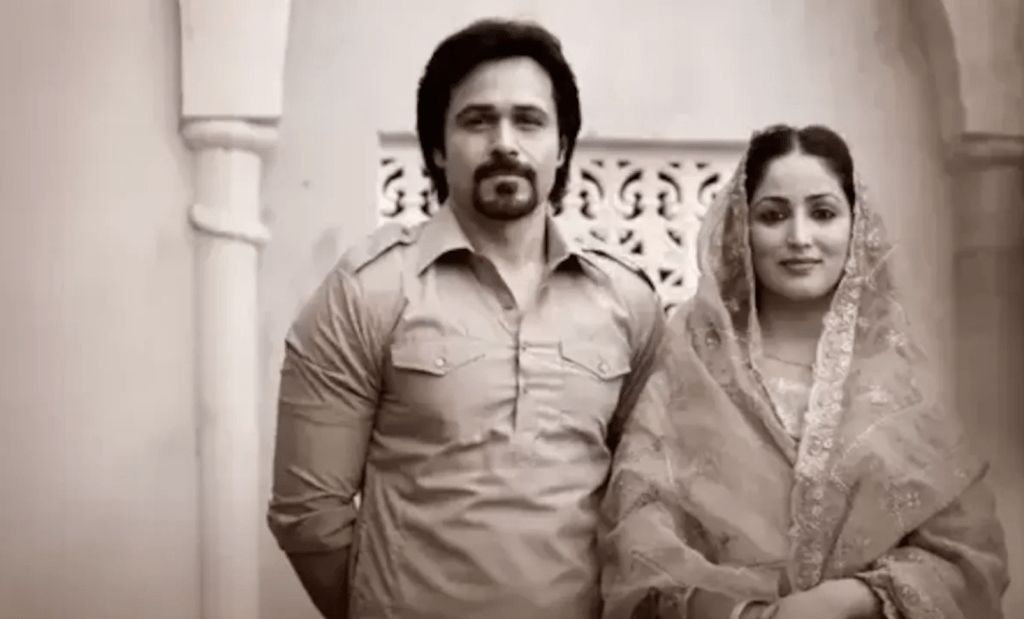
For the most part, Haq is not a story only about Muslim women. It is a story about women in general. Almost all of us know someone, married or unmarried, who has been cheated in love. We have seen that heartbreak up close, and we understand the emotional toll it takes.
When Shazia feels betrayed, we feel it too. When she wants the best for her children, that emotion feels familiar. When she fights for her rights, it resonates deeply. And when her father stands by her without hesitation, it reminds us of our own fathers and the quiet strength that support brings. These are emotions that are universal to women, cutting across religion, culture, and background.
The narrative becomes specifically about Muslim women only when the legal issues come into focus. That is where the real differences emerge, and the film clearly highlights how laws and systems can shape a woman’s fight for justice. It is to be noted that soon after the Triple Talaq ban was implemented in India, many Muslim women began approaching the courts to seek justice. While there was no open praise for the current government for such a ban, there was a quiet acceptance of the relief and protection the law offered them in real life. Many Muslim men, however, continue to view the ban as an insult to their faith rather than as a legal safeguard for women.
Getting back to the movie, Yami’s final monologue is powerful and leaves a strong impact. Emraan feels completely natural throughout and never once seems like he is performing. Sheeba Chaddha is equally convincing and brings depth to her role.
I especially want to credit Emraan for choosing to act in a film that openly talks about Muslim women’s rights. It takes conviction to support a story like this, especially as a Muslim, without dismissing it as Islamophobic. The film is clearly not that. Instead, it focuses on real issues and lived experiences, and his decision to back the narrative adds credibility and strength to the message being told.
Overall, I liked the film. The background music could have been better, and Yami is not fully convincing in a few scenes. Still, she more than makes up for it in the final act, which stays with you long after the film ends.
Feminichi Fathima is a Malayalam movie I had been waiting to watch for a long time. The film received strong appreciation at several film festivals. Many critics also spoke highly of it in their reviews. Now that it has finally released on OTT, the wait feels worth it. After watching the film, I can say it truly lives up to the praise it received.
The movieis a bold and thoughtful effort by director Fasil Muhammed to explore feminism from the perspective of a Muslim woman. This is a refreshing shift in Indian cinema, where feminist narratives are often shown through a cultural Hindu lens. Films like The Great Indian Kitchen (Mrs. in Hindi) and Thappad shaped much of that earlier conversation. Against that backdrop, this film feels timely and necessary. It adds a new voice to discussions on gender, faith, and everyday patriarchy.
What’s It About?
Fathima is married into a conservative and deeply religious family in the Malappuram district in Kerala. Her husband is a usthad (a religious leader) who expects his household to follow every rule without question. Life in the home is seen only through a strict, conservative lens.
Trouble begins when their young son wets the mattress. Fathima cleans it and leaves it outside to dry, but a dog later urinates on it. Since dogs are viewed as ritually impure, her husband reacts with anger and disgust. What follows is Fathima’s quiet struggle to fix the situation, facing resistance at every step.
The film makes a strong point that a woman in religious clothing can also be a feminichi (a slur often used by Malayalee misogynists to dismiss feminists).
Thoughts
Shamla Hamza and Kumar Sunil deliver standout performances. Shamla Hamza, in particular, is remarkable throughout the movie. It is hard to believe this is only her second project, after 1001 Nunakal, released in 2022. She performs with the ease and control of a seasoned actor. Her expressions carry much of the film’s emotional weight. Shamla winning the Kerala State Film Award for Best Actress feels well deserved. The storyline is fresh and quietly rebellious, which makes her performance even more powerful.
In many ways, the film feels braver than other feminist movies. Dissent is rarely encouraged in conservative Muslim families, which makes this narrative more powerful. The story shows how questioning norms itself becomes an act of courage. That is what sets this Malayalam feminist film apart. It opens space for conversations that are often silenced. Ideally, it will inspire more Feminichi Fathimas to speak up and stand for their rights.
Even though the subject is heavy, the movie never becomes overwhelming. It avoids melodrama and keeps emotions grounded. Light comedy is woven into the narrative. This balance makes the film feel surprisingly breezy. The pacing is tight and engaging throughout. You can easily watch the full 1.5 hours in one sitting without needing a break.
I would call this movie a must-watch for anyone interested in meaningful Malayalam cinema. Feminichi Fathima is now streaming on Manorama Max. You can also watch it via Amazon Prime with a Manorama Max subscription. English subtitles are available.
What defines horror? We often think of ghosts, possessed souls, or strange creatures with no clear form. Yet I realized there’s another type of horror that hits harder. The ones that combine these supernatural ideas with the harsh truths of real life. This is a type of blend that creates an impact, which stays with you long after the movie is over. This is where Baramulla is about.
What’s It About?
Baramulla opens with a policeman who moves to Kashmir and stays in an old house filled with secrets. He is there to investigate the disappearance of children in the area. Strange events start to unfold at once. The elder daughter senses a foul, “dog-like” smell in the house, even if there are no dogs. The caretaker carries a plate of food every day to a locked room. What lies behind these mysteries? Why are children vanishing? These questions drive the heart of the story.
Thoughts
I can’t, unfortunately, share everything I felt without giving away the main plot. Since I wanted to share my thoughts in full, I placed them in a separate “Spoilers Ahead” block after this section. You can skip it if you prefer to avoid spoilers.
Baramulla left me with many emotions. I was genuinely amazed by how the team crafted it.
The movie tries something that Indian cinema, to my knowledge, hasn’t attempted before in a horror movie. That is, blending the past and the present into a story that’s rooted in historical events. It reminds you that horror has layers. It’s not only about the unknown, but also the known. The horror of trust turning into betrayal. The horror of being dismissed or gaslit. The horror of violence, both mental and physical. Baramulla captures all of this with sharp clarity.
The performances are strong across the board. Personally, I would say it’s a must-watch.
Baramulla is now streaming on Netflix.
**Spoilers Ahead**
I felt emotional through many scenes. The acting was powerful and honest. The pain never felt exaggerated.
By now, you probably know that the film draws from the suffering Kashmiri Hindus faced in the late ’80s and ’90s. Many cast members are Kashmiri Hindus who had to flee their homes. Manav Kaul is one of them. He left Kashmir when he was in grade 4. He moved on to become a competitive swimmer in his late teenage years and participated in state and national-level championships. He has more than 14 national medals in swimming to his credit.
The end scenes also show Sanjay Suri, which is befitting, since his father was killed by terrorists in Srinagar when Suri was just 19. He moved to Delhi after that and became a known face in the film industry.
The producer and writer, Aditya Dhar, who is also Yami Gautam’s husband, is a Kashmiri Pandit. He has been using his craft to share Kashmir’s story with care and technical prowess.
Some Kashmiri Pandit celebrities, like Kunal Khemu, have chosen not to explore their past, and that is their personal choice. In an interview with Smita Prakash, he said he doesn’t know much about that period, even though his own family lived through it.
I feel it’s important for us to understand our history so we don’t repeat old mistakes. Stories like these should be passed from one generation to the next. My only regret is not asking my grandfather about his experiences—how Kerala felt during the Indian freedom struggle, and what life was like then. Those anecdotes have been lost forever, as he did not pass on the stories to his children as well.
It’s remarkable that so many Kashmiri Hindus who had to flee the valley are using art to express their experiences instead of resorting to violence. Their goal is empathy and understanding, something they were denied for a long time, not provocation. Choosing storytelling over violence is admirable, especially in a world where violence is often justified in the name of resistance.
There are also a few Kashmiri Hindus with left-leaning views who defend problematic groups and take part in “Free Kashmir” sloganeering, similar to how a very small number of non-Zionist Israelis speak in ways that don’t reflect the wider population.
Most Kashmiri Hindus (and some Kashmiri Muslims) have appreciated the movie. However, left-leaning Hindus are also criticizing the movie for “propaganda,” even though the events have been well documented. Films that depict and educate the viewers on crimes against Muslims in India are welcomed, while films showing crimes against Hindus are often dismissed as Islamophobic, nationalist, or propaganda. This imbalance is where many activists struggle. They accept one truth but not the other.
People like me have slowly stepped out of that mindset to face the whole truth.
It may take a while, but I really believe the truth will eventually reach wider acceptance sooner or later. And the stories can’t stop until the pain is finally acknowledged. They need to be told, retold, and carried forward. Only then will they finally find the place they deserve.
I’m a Palakkad native, and I had travelled home just to vote during the Lok Sabha elections. To make it clear, I have no loyalty to any political party and have voted for different parties over the years based on their performance and activism. I believe pledging unwavering support to any single party prevents us from critically examining their flaws. However, this time, voting for the CPI(M) was not an option, as I am well aware of its shortcomings during its second term in power.
I decided I would vote for Congress in the Lok Sabha elections. But then October 7 happened, and I saw Congress’s response to it, especially how they tried to silence Shashi Tharoor in Kerala for criticizing Hamas. It came as a shock and played a key role in changing my decision. That’s when I realized, unfortunately, this party is no different from those it criticizes. The Opposition parties in India excel at criticizing far-right Hindu groups, but avoid condemning far-right Islamist groups in society, fearing backlash from supporters.
People call out the BJP and RSS for sheltering far-right Hindus. But how is Congress different if it shelters far-right Islamists? Both cater to extremes. BJP voters are criticized for supporting a party that allegedly wants to turn India into a Hindu nation. Congress voters should ask themselves the same question: why support a party that mollycoddles groups that have once openly called for turning India into an Islamic nation? How would it make the majority of Hindus feel?
So, when people ask why Hindus vote for the BJP, the answer is simple. If the choice is between far-right Hindus and far-right Islamists, many Hindus will pick what feels safer. Left-leaning Hindus may sympathize with Islamist groups, seeing them as victims. But most in the community, just like any other community, vote on the basis of safety.
Congress and Islamist Ties
In the upcoming Nilambur by-election in Kerala, the Welfare Party has now openly declared its support for the Congress candidate.
To the uninitiated, the Welfare Party is the political arm of Jamaat-e-Islami Hind, a group known for its fundamentalist views. This group shares roots with the Jamaat movements in Pakistan and Bangladesh, which are often accused of anti-Hindu activities.
As per the New Indian Express report, “It’s learned that the Welfare Party, backed by Jamaat-e-Islami, has put forward various demands, including making it an associate party of the UDF. However, no assurance has been received in this regard so far.” This is a common far-right Islamist tactic in democracies across the world: try to join mainstream parties to gain power, resources, and reach. Once these groups gain enough strength, their true agenda emerges, often centered around enforcing religious doctrine. We see this happening in Bangladesh today. A similar pattern unfolded in Iran in 1979, when leftists and Islamists joined forces to establish an Islamic regime. This led to widespread persecution and the exodus of many Persians, some of whom sought refuge in India.
Many leftists, in both India and abroad, often align with Islamist groups unknowingly, driven by a genuine desire to support the persecuted and uphold justice. However, this well-meaning approach is frequently exploited by far-right Islamist groups for their own agenda. It’s fair to say that many on the left still operate with this same mindset, unaware of the long-term consequences.
Such Islamist groups remind me of the Persian movie “The Seed of the Sacred Fig” (playing on Amazon Prime), a 2024 crime drama film directed by Mohammad Rasoulof. The movie starts with an explanation of strangler figs, a type of parasite that grows on a host tree’s branches. As they grow, their roots reach the ground and thicken. Eventually, they wrap around the host tree, in a way “suffocating” it. Over time, the host tree dies from lack of light and nutrients, while the fig survives independently. I hope Congress and other left-leaning parties realize that they are the “hosts” in this equation.
Both the Welfare Party and SDPI have been trying to win Congress’s favour in Kerala. Their open support was clearly visible in places like Palakkad (my hometown). The fact that Congress is not distancing itself from these groups is a matter of concern. The party appears to seek the support and votes of such groups to win, which may explain its consistent silence or hesitation in condemning Islamist acts. But how far are they willing to go? Will there come a time when they finally strike deals with the devil because they can’t win anymore without their support or votes?
Valid Concerns
Can you really blame Hindus for refusing to vote for parties that associate with groups that seem more likely to drag India down a path similar to Pakistan or Afghanistan?
Let’s not forget the current state of Bangladesh. JEI has played a significant role in steering Bangladesh toward radical Islam. If India were ever to become an Islamic nation, it wouldn’t resemble the UAE or Bahrain. It would more likely mirror Pakistan or Bangladesh, where radical Islamist groups wield substantial influence. Unlike the Gulf nations, which strictly ban and suppress such groups, India still hesitates to even name them. The moment any criticism is raised, it’s quickly dismissed as Islamophobia by human rights activists.
No One’s Truly Secular
In the end, no one is truly secular. Most people vote thinking, “Which party is best for my community?” — not for the nation. That’s why, in Kerala, Congress is the preferred party for many Christians, and a large section of Muslims support the Muslim League. So why is the burden of voting on the basis of secularism placed only on Hindus?
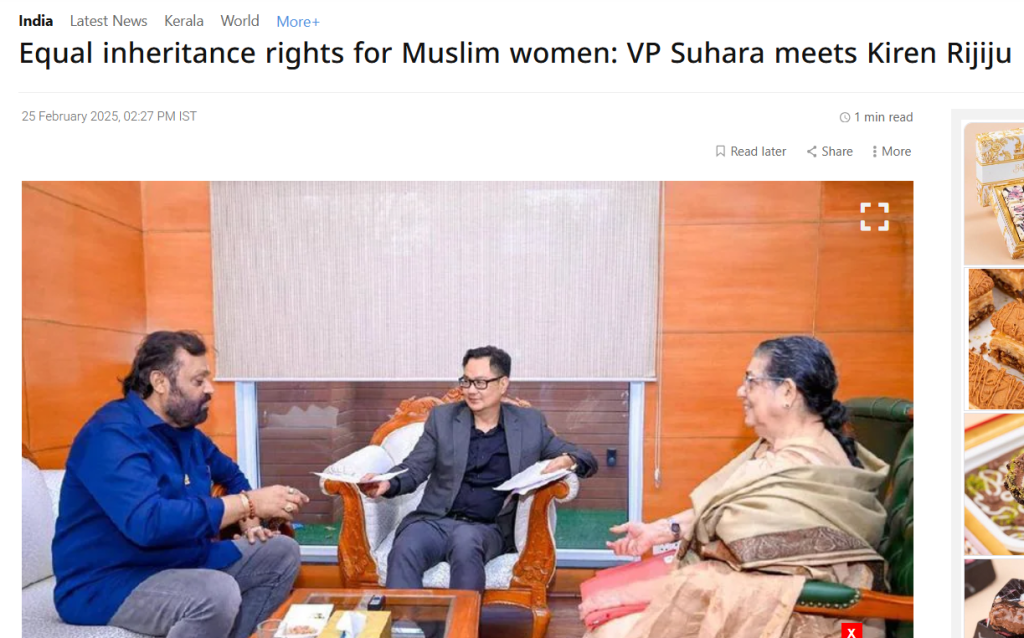
Social activist and NISA founder V.P. Suhara met Indian Minister Kiren Rijiju to demand equal inheritance rights for Muslim women in India, similar to those of Muslim men. Actor and BJP leader Suresh Gopi was also present at the meeting.
V.P. Suhara had earlier launched an indefinite hunger strike at Delhi’s Jantar Mantar, advocating for equal inheritance rights for Muslim women. However, the protest was forcibly stopped by the police. Before returning to Kerala, she announced plans to discuss the issue with key leaders in Delhi.
Did you see anyone in Kerala supporting her? Likely not. Instead, you’ll hear women with internalized misogyny saying, “We don’t want such reforms.” But these reforms aren’t for them. They are for women who seek more. Women who wish to follow traditional rules can continue to do so. Reforms do not prevent anyone from adhering to their beliefs, just as Triple Talaq is still practiced in India despite being banned. However, these reforms give Muslim women the legal option to seek justice if they are forced into following restrictive rules against their will.
When Muslim progressives like Suhara fight for women’s rights, you would expect so-called secular voices in India to stand with them. But these voices only seem to speak up when it comes to reforming Hinduism—whether it’s elephants in festivals, casteism, regressive practices, or allowing women in Brahmachari temples—because, let’s be honest, it’s far safer to push for changes in Hinduism. You see people from all communities, whether Hindu, Christian, or Muslim, openly advocate for these changes with confidence, knowing they face no serious repercussions. However, if you question some of the regressive practices in other communities, suddenly, you’re a bigot. The moment you point out that some proselytization techniques are predatory, you’re immediately accused of supporting the “restriction of religious freedom.” If you take a moment to observe people, you’ll notice countless little things that suddenly jolt you out of your slumber. You won’t need any political party to point this out to you. The double standards are there for the world to see.
When asked why the Muslim community largely does not openly advocate support for such reforms, progressive Muslims argue that it is dangerous to challenge established rules, unlike in other communities. They believe real change requires both internal and external pressure. While I acknowledge that speaking out within the Muslim community comes with risks, how long should we wait? Another century? Would it ever happen in our lifetime? Until then, are we expected to remain silent and unquestioning?
If the Indian government applies the “external pressure” suggested, it would inevitably lead to accusations of Islamophobia, further damaging the global perception of Indian Hindus and India’s image as a whole. Any attempt at reform would be spun as targeting a particular community, making meaningful change even harder to achieve.
Now, another group conveniently refuses to support this cause simply because the BJP—“the communal party”—is handling it. But name one other party that has ever stood up for Muslim women’s rights. The Opposition has always catered to Muslim men, not women, and will continue to dance to their tunes. This isn’t new; it has been the pattern for decades, ever since the Shah Bano case. If the BJP doesn’t take up the issue raised by Suhara, I can say with 100% certainty that no other party in India will.
***
Pic Source: Mathrubhumi.com (auto-translated from Malayalam)
Did you know that around 3.6% of the world’s population lives outside their country of origin? The Pew Research Center has come up with some interesting insights on the religious composition of the world’s migrants in their latest survey. Who migrates more? What are the top three origin and destination countries for each community? Which country hosts the most number of immigrants? The survey answers all these pertinent questions and more with detailed insights.
Why do people migrate? The survey reveals several reasons, such as the need to find jobs, to live with other family members, or for better education. However, religion also plays a part in migration. Migrants have often moved to escape persecution. There is also the need to live with people with similar religious beliefs.
To quote the survey, “Many migrants have moved to escape religious persecution or to live among people who hold similar religious beliefs. Often people move and take their religion with them, contributing to gradual changes in their new country’s religious makeup.“
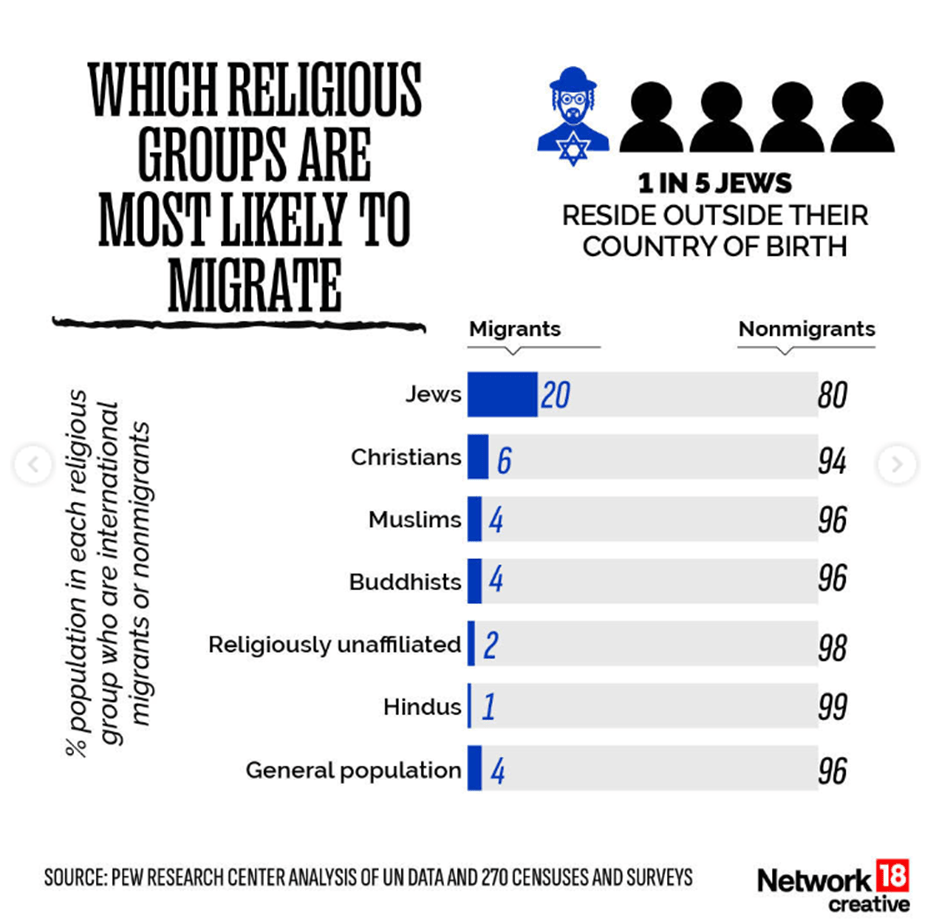
Religious groups most and least likely to migrate
Hindus tend to migrate less as compared to other religious groups and Christians are most likely to migrate from their place of origin.
As per the survey, “Christians are the largest migrant group, but Jews are most likely to have migrated.”
The top source and destination country for Christian migrants
To quote the survey, “Christians make up a much larger share of migrants (47%) than they do of the world’s population (30%). Mexico is the most common origin country for Christian migrants, and the United States is their most common destination.“
The top source and destination country for Muslim migrants
In relation to Muslim migrants, the survey says, “Muslims account for a slightly larger share of migrants (29%) than of the world’s population (25%). Syria is the most common origin country for Muslim migrants, and Muslims often move to places in the Middle East-North Africa region, like Saudi Arabia.” Interestingly, Muslims tend to prefer migrating to “richer” regions that follow their religion. The top destinations for the community are Muslim-majority nations, such as Turkey, Saudi Arabia, and UAE.
The top source and destination country for Hindu migrants
As per the survey, “Hindus are starkly underrepresented among international migrants (5%) compared with their share of the global population (15%). India is both the most common country of origin and the top destination for Hindu migrants.” Hindu migrants to India are most likely to originate from neighboring regions like Afghanistan, Pakistan, and Bangladesh, where minorities face severe persecution. This is evident from statistics indicating a drastic decrease in minority numbers within these regions over the years.
The Pew Survey offers a lot more detailed insights, so I would highly recommend going through it.








 The Monkey Dilemma
You must be logged in to post a comment.